Cybersecurity Policy Templates

4.7from 280+ reviews Trusted by 20M+ businesses

Establish clear security rules for your team, systems, and data — before an incident forces you to.

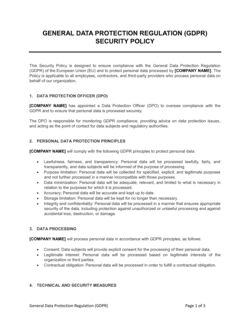
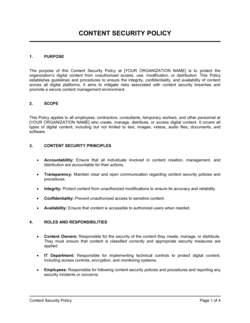
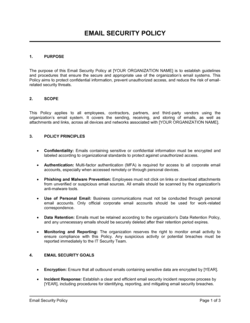
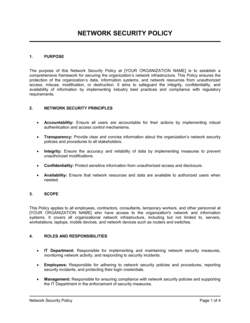
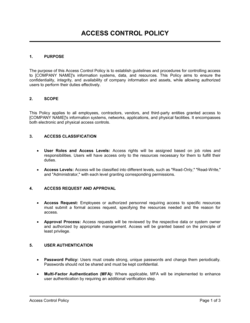
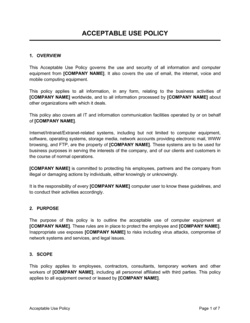
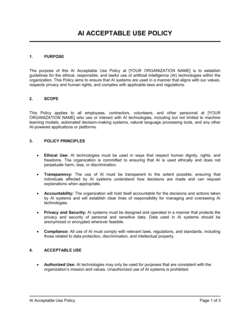
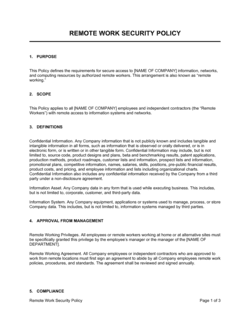
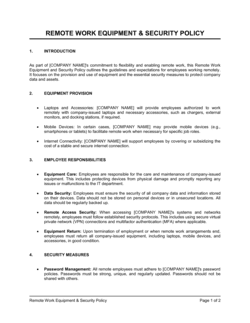
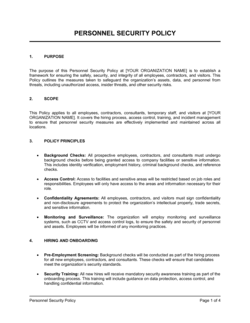
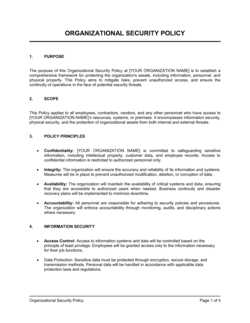
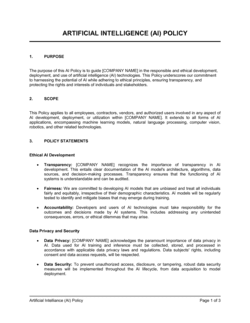
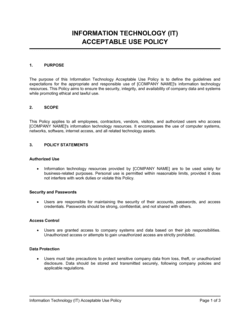
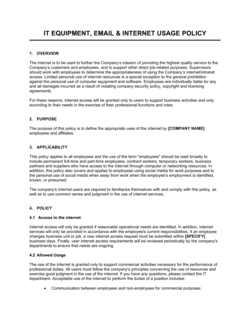
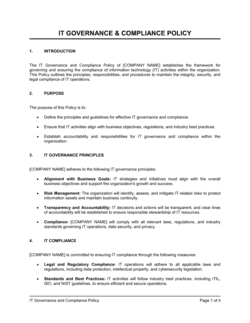
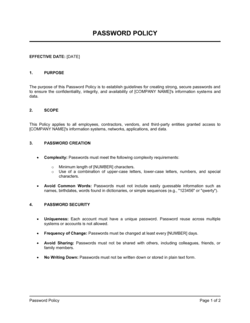
WordEditable onlinePDF36+ cybersecurity policy templates

Other Software & Technology categories

250K+Clients
20M+Free users
20+Years
190+Countries
10,000+Law firms
50M+Downloads

Trusted across review platforms

  • Capterra★★★★☆4.649 reviews
  • G2★★★★☆4.713 reviews
  • GetApp★★★★☆4.649 reviews
  • Google Play★★★★☆4.6179 ratings
  • Google Reviews★★★★☆4.567 reviews

Related categories

Frequently asked questions

What should a cybersecurity policy include?
A cybersecurity policy should define its scope (who and what it covers), assign clear roles and responsibilities, specify acceptable and prohibited use of systems and data, set access-control and authentication requirements, establish data-classification rules, and describe how incidents are reported and handled. Most frameworks also require a stated review cycle and explicit consequences for non-compliance.
Is a cybersecurity policy legally required?
Whether a cybersecurity policy is legally mandatory depends on your industry and jurisdiction. GDPR requires organizations to implement "appropriate technical and organizational measures" to protect personal data — a written security policy is the standard way to demonstrate compliance. PCI-DSS, HIPAA, and ISO 27001 have similar requirements. Even where no specific law applies, a documented policy is strong evidence of due diligence if a breach occurs and litigation follows.
How often should a cybersecurity policy be reviewed?
Industry guidance generally recommends reviewing cybersecurity policies at least once a year. Additionally, a review should be triggered by any significant change to the business — a new product, a merger, a shift to remote work — or after a security incident. Policies that are never updated become a liability rather than a protection.
What is the difference between a cybersecurity policy and a cybersecurity procedure?
A policy states what the organization requires — the rules and standards everyone must meet. A procedure describes how those requirements are carried out in practice — the step-by-step operational instructions. Policies are high-level and approved by leadership; procedures are technical documents used by the teams implementing the controls. Both are needed for a complete security program.
Can small businesses use the same cybersecurity policies as large enterprises?
Yes, with appropriate tailoring. The core clauses — acceptable use, access control, incident response, data handling — apply to businesses of any size. Small businesses should simplify where possible: fewer approval layers, shorter documents, and controls scaled to their actual threat landscape. A 10-person company does not need a 60-page security manual, but it does need clearly documented rules and staff who understand them.
What happens if an employee violates the cybersecurity policy?
The policy itself should specify the consequences, which typically range from a formal warning and remedial training for accidental violations to suspension or termination for deliberate or repeated breaches. In cases involving unauthorized access to personal data, legal exposure for the employee may also arise. Documenting the violation and the organization's response is important for both disciplinary and regulatory purposes.
Do remote workers need a separate cybersecurity policy?
They can be covered under the main cybersecurity policy, but a dedicated remote work security policy is best practice. Remote environments introduce specific risks — unsecured home networks, personal devices, shared living spaces — that a general policy may not address in enough detail. A standalone remote work security policy lets you set precise requirements for VPN use, device configuration, and physical workspace security without bloating the master policy.
How do cybersecurity policies help with GDPR compliance?
GDPR Article 32 requires data controllers and processors to implement appropriate technical and organizational security measures. A written GDPR security policy documents those measures — encryption standards, access controls, breach-notification procedures — and demonstrates to supervisory authorities that the organization took its obligations seriously. Without documented policies, a breach investigation may conclude that no adequate safeguards were in place, increasing the risk of significant fines.

Cybersecurity Policy vs. related documents

Cybersecurity policy vs. IT security policy

A cybersecurity policy covers the full landscape of digital threats — including people, processes, and technology — at a strategic level. An IT security policy is narrower, focusing on the technical controls that IT teams configure and maintain: firewalls, patch cycles, endpoint protection, and system monitoring. Most organizations need both: the cybersecurity policy sets the direction; the IT security policy defines the operational detail.

Cybersecurity policy vs. information security policy

"Information security" is a broader discipline that covers both digital and physical records — paper files, printed reports, and physical media as well as data on systems. A cybersecurity policy focuses specifically on digital assets and systems. In practice the two documents heavily overlap; some organizations combine them while others maintain separate policies to satisfy different compliance frameworks (ISO 27001 uses "information security"; NIST uses "cybersecurity").

Cybersecurity policy vs. acceptable use policy

A cybersecurity policy is an organizational governance document that sets out the company's overall security posture and obligations. An acceptable use policy (AUP) is a rule document directed at end users that tells employees exactly what they may and may not do with company systems, devices, and data. The cybersecurity policy establishes the "why"; the AUP operationalizes the "what" at the individual level.

Cybersecurity policy vs. incident response plan

A cybersecurity policy defines ongoing security rules and standards that govern day-to-day behavior. An incident response plan — or security response plan policy — describes the specific steps the organization takes after a breach or attack has occurred. The policy is preventative; the incident response plan is reactive. Both are required for a defensible security program.

Key clauses every Cybersecurity Policy contains

Regardless of which cybersecurity policy variant you use, most documents in this category share the same core clauses.

  • Scope and applicability. Identifies who and what the policy covers — employees, contractors, systems, locations, and data types.
  • Roles and responsibilities. Names the parties accountable for security — typically a CISO, IT manager, department heads, and individual employees.
  • Acceptable and prohibited activities. Lists what users may and may not do with company systems, devices, software, and data.
  • Access control and authentication. Defines how access to systems and data is granted, reviewed, and revoked, including password and MFA requirements.
  • Data classification and handling. Establishes categories of data sensitivity (e.g., public, internal, confidential, restricted) and the handling rules for each.
  • Incident reporting and response. Requires employees to report suspected breaches and describes the initial response steps and escalation path.
  • Device and endpoint security. Specifies requirements for encryption, screen lock, patching, and anti-malware on company and personal devices.
  • Policy review and enforcement. States how often the policy will be reviewed, who approves changes, and the consequences of non-compliance.

How to write a cybersecurity policy

A cybersecurity policy is only useful if employees understand it and management can enforce it — here is how to build one that meets both tests.

  1. 1

    Define the scope

    Identify every system, device, network, data type, and person the policy will govern before writing a single rule.

  2. 2

    Assign ownership

    Name the individual or role responsible for maintaining the policy — typically a CISO, IT manager, or senior leader.

  3. 3

    Inventory your assets and risks

    List the data and systems you need to protect, then identify the threats most likely to affect them.

  4. 4

    Set clear, specific rules

    Write each control as a concrete requirement — 'all devices must use full-disk encryption' rather than 'devices should be secured'.

  5. 5

    Align with applicable regulations

    Check whether GDPR, HIPAA, PCI-DSS, ISO 27001, or another framework applies and incorporate the relevant obligations.

  6. 6

    Define incident reporting procedures

    Give employees a clear, easy path to report a suspected breach and name who receives and acts on those reports.

  7. 7

    Train staff and obtain sign-off

    Distribute the policy, run a brief training session, and have employees acknowledge receipt in writing.

  8. 8

    Schedule periodic reviews

    Set a review cadence — at minimum annually and after any significant incident or system change.

At a glance

What it is
A cybersecurity policy is a formal document that defines how an organization protects its digital assets, data, and systems from unauthorized access, misuse, or attack. It sets out the rules employees, contractors, and IT teams must follow to reduce the organization's exposure to cyber risk.
When you need one
Any time your business handles sensitive data, operates IT infrastructure, employs remote workers, or is subject to data-protection regulations such as GDPR, you need documented cybersecurity policies in place.

Which Cybersecurity Policy do I need?

The right cybersecurity policy depends on what you are trying to protect and who the policy governs. Match your situation to the template below.

Your situation
Recommended template

Setting an organization-wide cyber security baseline for all staff

Covers the full scope of corporate cyber risk in a single master policy.

Protecting customer and employee data and meeting privacy regulations

Combines data-protection obligations with technical security controls.

Defining rules for how employees use company IT systems and devices

Governs permitted and prohibited use of hardware, software, and networks.

Securing a distributed or hybrid team using personal or company devices

Addresses device security, VPN use, and home-office data handling.

Complying with GDPR data-security requirements as a data controller

Maps technical and organizational measures directly to GDPR Article 32.

Restricting and auditing who can access sensitive systems or facilities

Defines authorization levels, credential rules, and access-review cycles.

Securing the organization's internal network and connected infrastructure

Governs firewall rules, segmentation, monitoring, and patch management.

Planning a structured response when a security incident occurs

Provides a step-by-step incident-response framework to limit breach damage.

Glossary

Acceptable use policy (AUP)
A rule document telling employees what they may and may not do with company IT systems, devices, and data.
Access control
The process of granting or restricting user permissions to systems, applications, and data based on defined authorization rules.
Data classification
A scheme that groups data into sensitivity tiers (e.g., public, internal, confidential, restricted) to determine how each tier must be handled and protected.
Endpoint security
Controls applied to individual devices — laptops, phones, servers — to prevent them from being used as entry points for attacks.
Incident response
The structured process an organization follows to detect, contain, investigate, and recover from a security breach or cyberattack.
Information security
The broader discipline of protecting data in all forms — digital and physical — from unauthorized access, disclosure, or destruction.
Multi-factor authentication (MFA)
A login method that requires two or more independent verification steps, such as a password plus a one-time code, to reduce unauthorized access.
Network segmentation
Dividing a computer network into separate zones so that a breach in one zone cannot automatically spread to others.
Patch management
The process of regularly applying software updates to fix known security vulnerabilities in operating systems and applications.
Security posture
An organization's overall readiness to detect, prevent, and respond to cyber threats, based on its policies, controls, and practices.
Threat landscape
The range of cyber threats an organization faces, including phishing, ransomware, insider threats, and supply-chain attacks.
Zero trust
A security model that requires every user and device to be verified before accessing any resource, regardless of whether they are inside or outside the corporate network.

What is a cybersecurity policy?

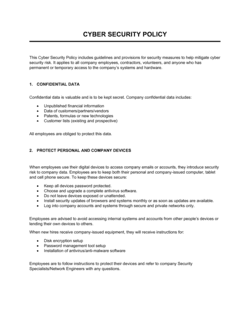
A cybersecurity policy is a formal organizational document that establishes the rules, responsibilities, and controls governing how a company protects its digital systems, networks, and data from unauthorized access, theft, or disruption. It translates a company's security obligations — whether driven by regulation, contractual requirement, or risk management — into clear, enforceable standards that employees, contractors, and IT teams must follow. Unlike a one-off technical control, a cybersecurity policy creates an ongoing governance framework: it sets the expectation, names who is accountable, and describes what happens when the rules are not met.

Cybersecurity policies exist at multiple levels. A master cyber security policy sets the organization-wide direction and is approved at the executive or board level. Supporting policies address specific domains — data security, network security, acceptable use, remote work, access control, and incident response — and are typically maintained by IT, compliance, or HR functions. Together, they form a layered security program that can be demonstrated to regulators, auditors, customers, and insurers.

When you need a cybersecurity policy

Any organization that operates IT systems, stores customer or employee data, or is subject to data-protection regulation needs documented cybersecurity policies. The common trigger is not a breach — it is the recognition that without written rules, there is nothing to enforce and no evidence of due care if something goes wrong.

Common triggers:

  • A regulator or auditor requests evidence of your data-security controls
  • You are onboarding employees who will access sensitive systems or customer data
  • Your team is shifting to remote or hybrid work and using personal devices
  • A customer or enterprise prospect asks for your information security policy as part of vendor due diligence
  • You are preparing for ISO 27001 certification or SOC 2 compliance
  • A cyber insurance underwriter requires documented security controls before issuing a policy
  • You have experienced a phishing attempt, data leak, or unauthorized access incident
  • You are launching a product that processes personal data under GDPR or a similar privacy law

The cost of operating without cybersecurity policies is not just regulatory. Without documented rules, employees cannot be held accountable for security failures, insurers can deny claims on grounds of inadequate controls, and a breach investigation can expose the organization to significantly greater liability. A clear, well-maintained set of cybersecurity policies is the baseline from which every other security investment derives its value.

Award-winning platform

  • Great Place to Work 2025
  • BIG Award — Product of the Year 2025
  • Smartest Companies 2025
  • Global 100 Excellence 2026
  • Best of the Best 2025

Create your document in 3 simple steps.

From template to signed document — all inside one Business Operating System.
1
Download or open template

Access over 3,000+ business and legal templates for any business task, project or initiative.

2
Edit and fill in the blanks with AI

Customize your ready-made business document template and save it in the cloud.

3
Save, Share, Send, Sign

Share your files and folders with your team. Create a space of seamless collaboration.

Save time, save money, and create top-quality documents.

★★★★★

"Fantastic value! I'm not sure how I'd do without it. It's worth its weight in gold and paid back for itself many times."

Managing Director · Mall Farm
Robert Whalley
Managing Director, Mall Farm Proprietary Limited
★★★★★

"I have been using Business in a Box for years. It has been the most useful source of templates I have encountered. I recommend it to anyone."

Business Owner · 4+ years
Dr Michael John Freestone
Business Owner
★★★★★

"It has been a life saver so many times I have lost count. Business in a Box has saved me so much time and as you know, time is money."

Owner · Upstate Web
David G. Moore Jr.
Owner, Upstate Web

Run your business with a system — not scattered tools

Stop downloading documents. Start operating with clarity. Business in a Box gives you the Business Operating System used by over 250,000 companies worldwide to structure, run, and grow their business.

Free Forever Plan · No credit card required