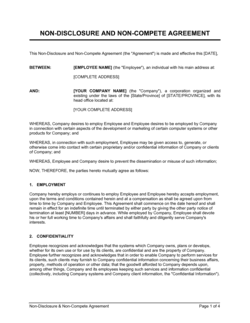
Confidentiality & NDA Templates
★★★★★4.7from 280+ reviews· Trusted by 20M+ businesses
Protect trade secrets, client data, and proprietary information with a ready-to-sign agreement for every situation.
WordEditable onlinePDF26+ confidentiality and NDA templates
Other Legal Agreements categories
Confidentiality agreements
Disclosure notices and policies
More confidentiality & nda templates
250K+Clients
20M+Free users
20+Years
190+Countries
10,000+Law firms
50M+Downloads
Trusted across review platforms
- Capterra★★★★☆4.649 reviews
- G2★★★★☆4.713 reviews
- GetApp★★★★☆4.649 reviews
- Google Play★★★★☆4.6179 ratings
- Google Reviews★★★★☆4.567 reviews
Frequently asked questions
What is the difference between a confidentiality agreement and an NDA?
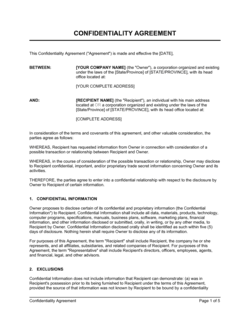
There is no meaningful legal difference. Both terms describe a contract that restricts the disclosure of specified private information. "NDA" is the more common shorthand in US business and technology circles; "confidentiality agreement" is more common in legal drafting and international contexts. Use whichever term your counterpart is comfortable with.
Is an NDA or confidentiality agreement enforceable?
Yes, in most jurisdictions these agreements are generally enforceable when properly drafted and signed by authorized representatives. Enforceability depends on a clear definition of what is confidential, reasonable scope and duration, and compliance with local law. Courts typically will not enforce an NDA that is so broad it covers public information or prevents legally required disclosures. Consider consulting a lawyer for high-stakes situations.
How long should a confidentiality agreement last?
Two to five years from the date of signing or the last disclosure is the most common range for general business information. Trade secrets are often protected indefinitely — for as long as they remain secret. Match the duration to the commercial lifespan of the information: rapidly changing technology may warrant a shorter term, while manufacturing processes or customer formulas may justify a longer one.
Do I need a lawyer to draft an NDA?
For standard situations — onboarding an employee, engaging a contractor, or entering a partnership discussion — a high-quality professionally drafted template is typically sufficient. Engage a lawyer when the agreement involves cross-border parties, heavily regulated industries, material intellectual property, or unusually long protection terms. A template review by counsel usually takes one to two hours.
Can an NDA prevent someone from reporting illegal activity?
No. In most jurisdictions an NDA cannot be used to prevent an employee or contractor from reporting illegal activity to a regulator or law enforcement agency, cooperating with a government investigation, or testifying under subpoena. Clauses that attempt to prohibit whistleblowing are generally void as against public policy.
What is a mutual NDA and when should I use one?
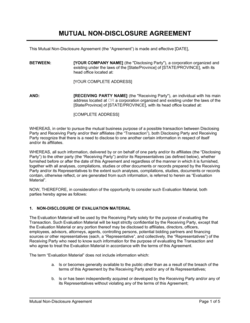
A mutual NDA (also called a bilateral NDA) creates confidentiality obligations for both parties. Use it whenever both sides will be sharing sensitive information — for example, during merger discussions, joint venture negotiations, or co-development projects. If only one party is disclosing, a one-way NDA is simpler and more common.
Can I use the same NDA template for employees and contractors?
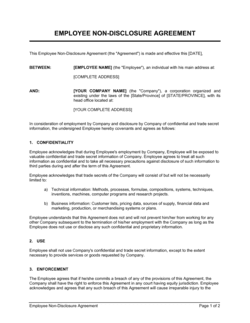
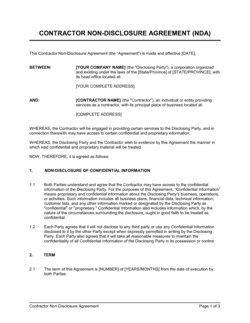
It is better practice to use separate templates. Employee NDAs typically include IP assignment language, reference the employment relationship, and integrate with other employment policies. Contractor NDAs are scoped to the project or engagement and do not include employment-specific provisions. Using the wrong template can create ambiguity about the nature of the working relationship.
Does a confidentiality agreement need to be notarized?
Notarization is not required in most jurisdictions for a confidentiality agreement to be valid. A signature from each party's authorized representative is sufficient. Cross-border transactions or formal corporate filings may occasionally require notarization or apostille certification — verify with local counsel if the agreement crosses international borders.
What information cannot be protected by an NDA?
Information that is already public, that the receiving party knew before signing, that the receiving party independently developed without using your disclosures, or that must be disclosed by law or court order is typically excluded from NDA protection. Clearly listing these exclusions in the agreement itself reduces the risk of disputes later.
Confidentiality & NDA vs. related documents
"Confidentiality agreement" and "NDA" refer to the same legal instrument and are interchangeable in most business contexts. "NDA" is more common in US tech and startup circles; "confidentiality agreement" is preferred in legal, medical, and international settings. Choose the label your counterpart uses — both carry the same enforceability.
An NDA prevents sharing confidential information; a non-compete prevents working for competitors or starting a competing business. They address different risks and are often signed together as a combined document. Non-competes face significant legal restrictions in many jurisdictions, including an FTC rule in the US, while NDAs remain broadly enforceable when properly scoped.
A non-solicitation agreement prevents a departing employee or contractor from poaching a company's customers or staff. An NDA prevents disclosing confidential information. The two documents are distinct but are often bundled together when a high-access employee leaves a company.
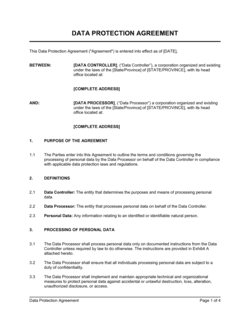
A data protection agreement (DPA) governs how a third-party processor handles personal data under privacy regulations such as GDPR or CCPA. An NDA is broader and covers all categories of confidential information. Companies that share personal data with vendors typically need both: a DPA for regulatory compliance and an NDA for proprietary business information not covered by data protection law.
Key clauses every Confidentiality & NDA contains
Every confidentiality and NDA document in this folder is built on the same core clauses — the wording adapts to the relationship, but the structure stays consistent.
- Definition of confidential information. Specifies exactly what is protected — vague definitions like 'all business information' are often challenged in court.
- Permitted use. Restricts how the receiving party may use the information, typically to evaluating or performing a specific transaction.
- Exclusions from confidentiality. Carves out information that is public, already known, independently developed, or required to be disclosed by law.
- Obligations of the receiving party. Sets the standard of care — typically 'the same degree of care as the receiving party uses for its own confidential information, but not less than reasonable care.'
- Term and survival. Defines how long the obligation lasts, usually two to five years, with trade-secret protection often extending indefinitely.
- Return or destruction of materials. Requires the receiving party to return or securely destroy confidential materials when the engagement ends.
- Remedies for breach. States that monetary damages may be insufficient and that the disclosing party may seek injunctive relief without posting a bond.
- Governing law and jurisdiction. Names the state or country whose laws govern the agreement and where disputes will be resolved.
How to write a confidentiality or NDA document
All confidentiality agreements share the same building blocks — the differences lie in who is bound, what information is covered, and how long the obligation lasts.
1
Choose the right document type
Decide whether you need a one-way NDA (one party discloses), a mutual NDA (both parties disclose), or a specialized variant such as a customer, contractor, or data-processing confidentiality agreement.
2
Identify the parties precisely
Use the full registered legal names of all parties — not trade names, brand names, or abbreviations — to avoid enforcement ambiguity.
3
Define what is confidential
List the specific categories of information being protected: trade secrets, financial projections, source code, customer data, product roadmaps, or other proprietary material.
4
State the permitted purpose
Describe exactly why the information is being shared — evaluating a partnership, performing contracted services, or considering an investment — and limit use to that purpose.
5
Set the duration
Specify how long the confidentiality obligation lasts after signing or after the last disclosure; two to five years is typical for most business information.
6
List the exclusions
Clarify what is not covered: information that becomes public, that the receiving party already knew, that they developed independently, or that a court orders them to disclose.
7
Add remedies and governing law
Include a clause confirming the right to seek injunctive relief and name the governing jurisdiction so both parties know where disputes will be resolved.
8
Execute and store the signed copy
Have authorized signatories sign the document, date it, and store the executed copy in a secure, retrievable location.
At a glance
- What it is
- A confidentiality agreement or non-disclosure agreement (NDA) is a legally binding contract that restricts one or both parties from sharing specified private information with anyone outside the agreement. These documents protect trade secrets, financial data, customer lists, proprietary processes, and any other sensitive material that gives a business a competitive edge.
- When you need one
- Any time you share sensitive business information with an employee, contractor, partner, or prospect, you need a confidentiality or NDA document in place before the disclosure happens. Without one, enforcing a secrecy obligation is difficult and costly.
Which Confidentiality & NDA do I need?
The right document depends on who you are sharing information with and whether the disclosure flows one way or both. Use this table to find the template that matches your situation.
Your situation
Recommended template
Two companies exploring a partnership, merger, or joint venture
Both sides exchange sensitive information, so mutual obligations protect each party equally.Onboarding a new employee with access to sensitive data or IP
Built for ongoing employment relationships and covers trade secrets, IP, and business data.Engaging a freelancer, agency, or independent contractor
Tailored for project-based engagements with clear scope, deliverables, and confidentiality scope.Sharing confidential information with a customer or client
Protects sensitive disclosures made during sales, implementation, or account management.Sharing personal data with a third-party data processor
Addresses data handling, retention, and processing obligations specific to data service providers.Inviting external testers to evaluate an unreleased product
Prevents leaks of product features and feedback before a public launch.Hiring a consultant or contractor on a short-term basis
Covers both consultants and contractors with scope-specific confidentiality language.Two companies or individuals sharing proprietary information equally
Symmetric obligations ensure neither party can disclose what the other shares.Glossary
- Disclosing party
- The party that shares confidential information and whose interests the agreement primarily protects.
- Receiving party
- The party that receives confidential information and is bound by the obligation to keep it secret.
- Confidential information
- The specific categories of data, materials, or knowledge covered by the agreement, as defined in the contract itself.
- Mutual NDA
- An agreement where both parties share confidential information and both are bound by confidentiality obligations; also called a bilateral NDA.
- Unilateral NDA
- An agreement where only one party shares confidential information and only the receiving party is bound; also called a one-way NDA.
- Trade secret
- Proprietary business information that has commercial value precisely because it is not publicly known and is subject to reasonable secrecy measures.
- Permitted purpose
- The specific, narrowly defined reason for which the receiving party is allowed to use the confidential information.
- Tail period
- The length of time confidentiality obligations remain in force after the agreement terminates or after the last disclosure.
- Injunctive relief
- A court order requiring a party to stop a specific action — such as continuing to disclose secrets — used when monetary damages alone cannot undo the harm.
- Exclusion clause
- A provision listing the categories of information that are explicitly not covered by the confidentiality obligation, such as publicly available information.
- IP assignment
- A clause in some NDAs, particularly employee agreements, that transfers ownership of any work product or inventions created during the engagement to the employer or client.
- Non-circumvention
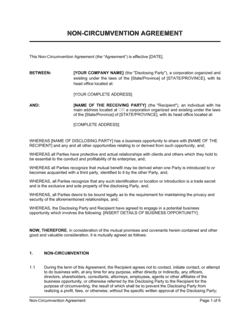
- A provision that prevents a party from bypassing the other to deal directly with contacts or opportunities introduced under the agreement.
What is a confidentiality and NDA document?
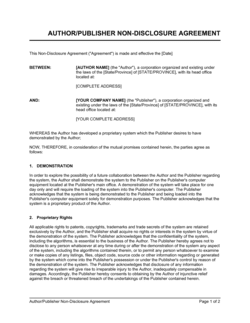
A confidentiality agreement — also called a non-disclosure agreement or NDA — is a legally binding contract that prevents one or both parties from sharing specified private information with anyone outside the agreement. These documents protect trade secrets, financial projections, customer lists, source code, proprietary processes, product roadmaps, and any other sensitive material that gives a business a competitive advantage. The agreement works by converting an implied moral obligation into an explicit legal one: if the receiving party discloses, the disclosing party has clear grounds to seek damages or a court order.
Confidentiality and NDA documents come in two fundamental forms. A unilateral (one-way) NDA protects information flowing in one direction — common when a company shares product plans with a vendor, or when a candidate is briefed on a role before any offer is made. A mutual NDA protects information flowing both ways — standard in partnership talks, joint ventures, and M&A discussions where each side reveals sensitive material to the other. Beyond these two forms, the category includes specialized variants tailored to employees, contractors, customers, data processors, beta testers, and creative collaborations.
When you need a confidentiality or NDA document
Any time your business shares information that, if made public or passed to a competitor, would cause financial or strategic harm, you need a signed confidentiality or NDA document before the disclosure takes place. The moment you start a business conversation that goes beyond publicly available facts, the clock is ticking.
Common triggers:
- Hiring an employee who will have access to pricing, customer data, or product roadmaps
- Engaging a freelancer, agency, or contractor who will work on proprietary systems or content
- Entering partnership, licensing, or acquisition discussions with another company
- Sharing a product demo or technical architecture with a potential investor or buyer
- Allowing a third-party vendor to process personal or financial data on your behalf
- Briefing a job candidate on confidential role details before extending an offer
- Inviting outside testers or reviewers to evaluate an unreleased product or manuscript
- Granting site visitors or tour participants access to a facility with sensitive operations
Operating without a signed agreement does not mean your information is unprotected in every jurisdiction — trade secret law provides a baseline — but it makes enforcement dramatically harder and more expensive. A well-drafted confidentiality or NDA document establishes precisely what was shared, when, and under what conditions, giving you a clear legal basis to act if something goes wrong.
Award-winning platform
- Great Place to Work 2025
- BIG Award — Product of the Year 2025
- Smartest Companies 2025
- Global 100 Excellence 2026
- Best of the Best 2025