Letter to New Employer of Former Employee_Non-Disclosure Template

Free Word download β€’ Edit online β€’ Save & share with Drive β€’ Export to PDF

2 pagesβ€’15–25 min to fillβ€’Difficulty: Standard
Learn more ↓
FreeLetter to New Employer of Former Employee_Non-Disclosure Template

At a glance

What it is
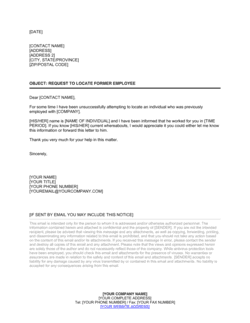
A Letter to New Employer of Former Employee Non Disclosure is a formal business letter sent by a previous employer to a former employee's new workplace, notifying them that the individual is bound by a confidentiality or non-disclosure agreement. This free Word download gives you a ready-to-edit template you can customize and export as PDF in minutes.
When you need it
Use it when a former employee joins a competitor or a company that handles similar proprietary information, and you need to put the new employer on notice of the confidentiality obligations that remain in effect. It is also appropriate when you have credible reason to believe confidential information may be at risk of disclosure.
What's inside
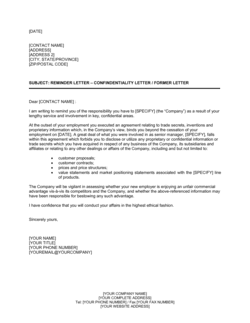
A professional opening identifying both the sender and recipient, a clear statement of the former employee's continuing NDA obligations, a summary of the categories of protected information, a request for the new employer's acknowledgment and cooperation, and a professional closing with contact details for follow-up.

What is a Letter to New Employer of Former Employee Non Disclosure?

A Letter to New Employer of Former Employee Non Disclosure is a formal business letter sent by a previous employer to notify a former employee's new workplace that the individual remains bound by a non-disclosure or confidentiality agreement signed during their prior employment. It identifies the relevant agreement, summarizes the categories of protected information, and requests the new employer's cooperation in ensuring no confidential data is used or disclosed in the course of the new role. Unlike a cease-and-desist letter, it is a proactive and professional notice β€” sent to deter a potential breach before it occurs, not in response to one.

Why You Need This Document

When a key employee leaves for a competitor, the confidentiality obligations in their NDA do not disappear β€” but their practical enforceability depends on whether the new employer knows those obligations exist. Without a formal notice letter, a new employer can later claim they had no knowledge of any restriction, complicating any tortious interference claim you might pursue. Sending this letter early creates a documented paper trail that the new employer received notice, removes any claim of ignorance, and frequently prompts voluntary compliance without the need for legal escalation. For roles involving trade secrets, client relationships, or proprietary technology, the 15 minutes it takes to send this letter is one of the lowest-cost risk-management steps an employer can take at the moment of departure.

Which variant fits your situation?

If your situation is…Use this template
Notifying a new employer of both NDA and non-compete obligationsLetter to New Employer of Former Employee Non-Compete
Reminding the former employee directly of their NDA before they start a new roleNDA Reminder Letter to Former Employee
Sending a formal cease and desist for an active confidentiality breachCease and Desist Letter β€” Trade Secret Disclosure
Documenting the original confidentiality obligation at time of hireNon-Disclosure Agreement (Employee)
Notifying a new employer of non-solicitation obligations alongside NDALetter to New Employer β€” Non-Solicitation Notice
Following up with a demand for confirmation that no confidential data was takenData Return and Destruction Demand Letter

Common mistakes to avoid

❌ Sending the letter without enclosing the NDA

Why it matters: The new employer cannot acknowledge or act on an obligation they have not seen. The notice loses most of its practical and legal force without the supporting document.

Fix: Always attach a copy of the signed NDA. Highlight the confidentiality and post-employment obligation sections so the recipient can review them quickly.
❌ Addressing the letter to a department rather than a named individual

Why it matters: Letters addressed to 'Human Resources' or 'Legal Department' frequently go unread or are deprioritized. Your documented notice trail depends on the letter reaching a decision-maker.

Fix: Research the correct recipient β€” General Counsel, VP of HR, or CEO β€” before sending. Call ahead if the contact is not publicly available.

❌ Disclosing specific confidential content when describing protected categories

Why it matters: Describing what is protected in too much detail can itself constitute a disclosure of confidential information, undermining the very protection you are asserting.

Fix: Use general category labels β€” 'client lists,' 'pricing data,' 'proprietary formulas' β€” drawn directly from the NDA's own definitions.

❌ Using threatening or adversarial language throughout the letter

Why it matters: An aggressive tone increases the likelihood the new employer routes the letter straight to litigation counsel rather than cooperating voluntarily.

Fix: Frame the letter as a professional courtesy notice and request for cooperation. Reserve firm legal language for the liability section only, and close with a collegial tone.

The 8 key clauses, explained

Sender and recipient identification

In plain language: Opens the letter by identifying the sending company's legal name and contact, and addressing the new employer's authorized representative by name and title.

Sample language
[SENDER COMPANY NAME] | [ADDRESS] | [DATE] | Attn: [RECIPIENT NAME], [TITLE] | [NEW EMPLOYER COMPANY NAME] | [ADDRESS]

Common mistake: Addressing the letter to a generic department (e.g., 'Human Resources') rather than a named individual β€” reducing the likelihood it reaches a decision-maker and weakening its evidentiary value.

Subject line and purpose statement

In plain language: A clear subject line and opening sentence that immediately state this is a notice regarding a former employee's continuing confidentiality obligations.

Sample language
Re: Confidentiality Obligations of [FORMER EMPLOYEE NAME], Former [JOB TITLE] of [SENDER COMPANY NAME]

Common mistake: Writing a vague subject line like 'Important Notice' β€” recipients may deprioritize the letter, and the paper trail loses precision.

Employment relationship background

In plain language: Briefly describes the former employee's role and dates of employment at the sending company to establish context.

Sample language
[FORMER EMPLOYEE NAME] was employed by [SENDER COMPANY NAME] as [JOB TITLE] from [START DATE] to [END DATE].

Common mistake: Including unnecessary performance details about the former employee. This letter is a legal notice, not a reference β€” irrelevant commentary can create defamation exposure.

Reference to the NDA

In plain language: Identifies the specific non-disclosure agreement by name and date, and confirms it remains in full force and effect.

Sample language
As a condition of employment, [FORMER EMPLOYEE NAME] executed a Non-Disclosure Agreement dated [NDA DATE] ('Agreement'), a copy of which is enclosed. The Agreement remains in full force and effect.

Common mistake: Citing the NDA without enclosing a copy. The new employer cannot act on β€” or acknowledge β€” an obligation they have not seen.

Summary of protected information categories

In plain language: Lists the general categories of confidential information the former employee agreed not to disclose, without revealing the specific confidential content itself.

Sample language
The Agreement covers, among other things: (a) client and customer lists; (b) pricing structures and financial data; (c) product formulas, designs, and roadmaps; and (d) proprietary processes and technical know-how.

Common mistake: Disclosing specific confidential details when describing what is protected β€” inadvertently leaking the very information the letter is meant to protect.

Statement of the new employer's potential liability

In plain language: Puts the new employer on notice that knowingly facilitating a breach of the NDA may expose them to legal liability, including tortious interference claims.

Sample language
We respectfully advise that any inducement or facilitation of a breach of the Agreement by [NEW EMPLOYER COMPANY NAME] may expose your organization to legal liability, including claims for tortious interference with contract.

Common mistake: Omitting this clause entirely. Without it, the letter establishes notice but misses the opportunity to deter the new employer from encouraging disclosure.

Request for cooperation and acknowledgment

In plain language: Asks the new employer to take reasonable steps to ensure the former employee does not disclose protected information in their new role, and requests written acknowledgment of receipt.

Sample language
We respectfully request that [NEW EMPLOYER COMPANY NAME] take appropriate measures to ensure [FORMER EMPLOYEE NAME] does not use or disclose [SENDER COMPANY NAME]'s confidential information in the course of their new employment. Please confirm receipt of this letter in writing by [DATE].

Common mistake: Setting no deadline for acknowledgment. An open-ended request produces no response and creates no follow-up trigger.

Contact information and closing

In plain language: Provides a named contact at the sending company for questions or correspondence, and closes the letter professionally.

Sample language
Please direct any questions or correspondence regarding this matter to [CONTACT NAME], [TITLE], at [EMAIL] or [PHONE]. We trust this matter can be resolved cooperatively and look forward to your prompt acknowledgment. Sincerely, [AUTHORIZED SIGNATORY NAME] | [TITLE] | [SENDER COMPANY NAME]

Common mistake: Closing with a threatening tone rather than a cooperative one. Aggressive language reduces the chance of voluntary compliance and can escalate a manageable situation unnecessarily.

How to fill it out

  1. 1

    Enter the sender's company details

    Fill in your company's legal name, full mailing address, and the date of the letter in the header block. Use your registered corporate name, not a brand or trade name.

    πŸ’‘ Send the letter on official company letterhead β€” it signals legitimacy and is more likely to be taken seriously by the recipient's legal team.

  2. 2

    Identify the correct recipient at the new employer

    Address the letter to a named individual β€” ideally General Counsel, the VP of HR, or the CEO for smaller companies. Call ahead if needed to confirm the right person and their correct title.

    πŸ’‘ A letter addressed to a named executive is far less likely to be filed away unanswered than one sent to a department.

  3. 3

    Complete the former employee's background details

    Enter the former employee's full name, their job title at your company, and their exact start and end dates of employment. Keep this section factual and brief.

    πŸ’‘ Stick to dates and title β€” do not include reasons for separation, performance notes, or any characterization of the departure.

  4. 4

    Reference and attach the NDA

    Enter the exact name and date of the non-disclosure agreement in the reference clause, then attach a clean copy of the signed agreement as an enclosure.

    πŸ’‘ Highlight the relevant confidentiality and post-employment clauses in the attached NDA so the recipient can locate them immediately.

  5. 5

    List the categories of protected information

    Fill in the general categories of confidential information covered by the NDA β€” client lists, pricing, IP, trade secrets β€” without disclosing any specific confidential content.

    πŸ’‘ Use the language from the NDA's own definition of 'Confidential Information' to ensure consistency and avoid underselling or overstating the scope.

  6. 6

    Set an acknowledgment deadline and add your contact details

    Insert a specific date by which you request written acknowledgment β€” 10 to 15 business days from the letter date is standard. Add the name, email, and phone number of the point of contact for follow-up.

    πŸ’‘ Calendar a follow-up reminder for the day after the acknowledgment deadline so you can send a follow-up promptly if no response arrives.

Frequently asked questions

What is a letter to new employer of former employee non disclosure?

It is a formal business letter sent by a former employer to notify a departing employee's new workplace that the individual remains bound by a non-disclosure agreement. Its purpose is to put the new employer on constructive notice of existing confidentiality obligations so they cannot later claim ignorance, and to request cooperation in preventing any inadvertent or deliberate breach.

Why would a company send this letter?

Companies send this letter when a former employee moves to a competitor or a company that handles similar sensitive information, and there is a reasonable concern that proprietary data β€” client lists, trade secrets, product plans, or pricing β€” could be disclosed. It creates a paper trail that strengthens the sender's position in any subsequent enforcement action and often deters the new employer from encouraging disclosure.

Should the former employee receive a copy of this letter?

It is good practice to send the former employee a concurrent reminder of their continuing NDA obligations, either as a separate letter or by cc'ing them on this one. Doing so closes the loop on notice to both parties and reinforces that the former employer is actively monitoring compliance. Whether to cc or send separately depends on the sensitivity of the relationship and your legal counsel's guidance.

What should I not include in this letter?

Do not include specific confidential details when describing what is protected β€” general category labels are sufficient. Avoid including performance evaluations, reasons for termination, or any characterization of the former employee's conduct that could form the basis of a defamation claim. Keep the letter factual, professional, and limited to the purpose of establishing notice of the NDA.

How long after the employee leaves should I send this letter?

Send it as soon as you become aware of the new employment β€” ideally within the first two weeks of the former employee's start date at the new company. Early notice maximizes the deterrent effect and ensures the new employer has not yet encouraged or received any confidential disclosure. Delays reduce both the practical and legal value of the notice.

What happens if the new employer ignores the letter?

If no acknowledgment is received by the deadline you set, send a follow-up letter and document the attempt. If you have evidence of an actual or imminent breach, consult legal counsel about escalating to a formal cease-and-desist letter or seeking injunctive relief. The paper trail from this letter and any follow-up will support that escalation.

How this compares to alternatives

vs Non-Disclosure Agreement (Employee)

An employee NDA is the original binding contract signed at the start of employment that creates the confidentiality obligation. This letter is a downstream enforcement notice sent to a third party after the employment ends. The NDA creates the obligation; this letter puts a new employer on notice that it exists and remains active.

vs Cease and Desist Letter

A cease and desist letter is used when a breach has already occurred or is actively underway β€” it demands the recipient stop the infringing conduct immediately or face legal action. This non-disclosure notice is a proactive, cooperative communication sent before any known breach to prevent one. Use this letter first; escalate to a cease and desist if the warning is ignored or a breach occurs.

vs Non-Compete Notice Letter

A non-compete notice addresses restrictions on where and for whom the former employee may work, not what information they may share. This letter focuses exclusively on confidentiality and non-disclosure obligations. The two letters can be sent together when both types of post-employment restriction apply, but each covers a distinct legal obligation.

vs Employment Termination Letter

A termination letter ends the employment relationship and may reference surviving obligations, but it is addressed to the employee, not to their future employer. This non-disclosure notice is addressed to the new employer and serves a different purpose: establishing third-party notice of contractual obligations that survive termination. Both documents together create a complete enforcement paper trail.

Industry-specific considerations

Technology / SaaS

Protecting source code, product roadmaps, and customer data when engineers or product managers are hired away by direct competitors.

Professional Services

Safeguarding client relationship details and billing structures when consultants, accountants, or advisors move to rival firms.

Financial Services

Preventing disclosure of trading strategies, proprietary models, and client portfolios when analysts or advisors change firms.

Manufacturing

Protecting proprietary formulas, production processes, and supplier pricing when operations or engineering staff are recruited by competitors.

Template vs pro β€” what fits your needs?

PathBest forCostTime
Use the templateHR managers and business owners sending standard notice letters for departing employees bound by routine NDAsFree15–20 minutes
Template + professional reviewSenior or executive departures, high-value trade secret situations, or cases where a breach is suspected$150–$400 for a legal review of the letter before sending1–2 business days
Custom draftedActive or imminent litigation, cross-border employment situations, or cases requiring coordinated cease-and-desist action$500–$2,000+ depending on complexity and counsel's hourly rate3–7 business days

Glossary

Non-Disclosure Agreement (NDA)
A binding contract in which one party agrees not to share the other's confidential information with third parties, during and typically after an employment relationship.
Confidential Information
Non-public data, knowledge, or materials β€” such as trade secrets, client lists, pricing, or product plans β€” that an employer designates as proprietary.
Trade Secret
A category of confidential business information that derives economic value from not being publicly known and is subject to reasonable steps to keep it secret.
Notice Letter
A formal written communication that puts a party on record as having been informed of a specific fact, right, or obligation β€” creating a documented paper trail.
Constructive Knowledge
Legal doctrine holding that a party who received formal notice of an obligation is treated as knowing about it, even if they claim ignorance later.
Post-Employment Obligation
A contractual duty β€” such as confidentiality or non-solicitation β€” that survives the end of the employment relationship and continues to bind the former employee.
Tortious Interference
A civil claim that arises when a third party β€” such as a new employer β€” knowingly induces a breach of another party's contractual obligations.
Acknowledgment
A written confirmation from the recipient that they have received and understood the notice, often requested to strengthen the sender's evidentiary record.

Part of your Business Operating System

This document is one of 3,000+ business & legal templates included in Business in a Box.

  • Fill-in-the-blanks β€” ready in minutes
  • 100% customizable Word document
  • Compatible with all office suites
  • Export to PDF and share electronically

Create your document in 3 simple steps.

From template to signed document β€” all inside one Business Operating System.
1
Download or open template

Access over 3,000+ business and legal templates for any business task, project or initiative.

2
Edit and fill in the blanks with AI

Customize your ready-made business document template and save it in the cloud.

3
Save, Share, Send, Sign

Share your files and folders with your team. Create a space of seamless collaboration.

Save time, save money, and create top-quality documents.

β˜…β˜…β˜…β˜…β˜…

"Fantastic value! I'm not sure how I'd do without it. It's worth its weight in gold and paid back for itself many times."

Managing Director Β· Mall Farm
Robert Whalley
Managing Director, Mall Farm Proprietary Limited
β˜…β˜…β˜…β˜…β˜…

"I have been using Business in a Box for years. It has been the most useful source of templates I have encountered. I recommend it to anyone."

Business Owner Β· 4+ years
Dr Michael John Freestone
Business Owner
β˜…β˜…β˜…β˜…β˜…

"It has been a life saver so many times I have lost count. Business in a Box has saved me so much time and as you know, time is money."

Owner Β· Upstate Web
David G. Moore Jr.
Owner, Upstate Web

Run your business with a system β€” not scattered tools

Stop downloading documents. Start operating with clarity. Business in a Box gives you the Business Operating System used by over 250,000 companies worldwide to structure, run, and grow their business.

Free Forever PlanΒ Β·Β No credit card required