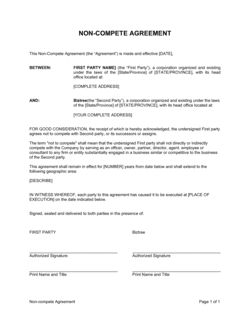
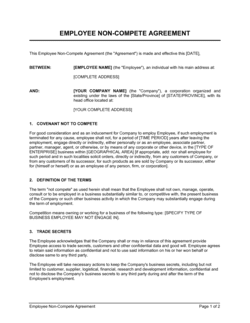
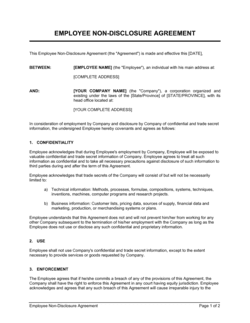
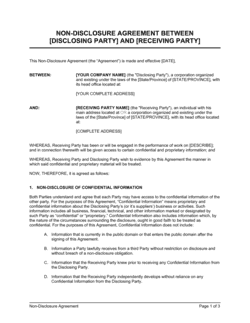
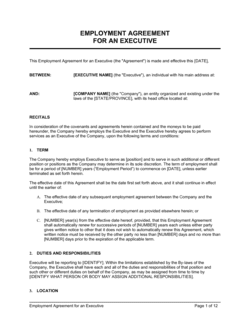
Non-Disclosure and Non-Compete Agreement Template

Free Word download • Edit online • Save & share with Drive • Export to PDF

4 pages25–35 min to fillDifficulty: ComplexSignature requiredLegal review recommended
Learn more ↓
FreeNon-Disclosure and Non-Compete Agreement Template

At a glance

What it is
A Non Disclosure and Non Compete Agreement is a legally binding contract that combines two protective mechanisms in a single document: a confidentiality obligation preventing the receiving party from disclosing sensitive business information, and a restriction preventing that party from competing against or soliciting from the disclosing party for a defined period and geography. This free Word download gives you a professionally structured template you can edit online and export as PDF for use with employees, contractors, business partners, or prospective buyers.
When you need it
Use it before sharing proprietary information with anyone who could later use that knowledge to compete against you — including new hires, departing employees, consultants, co-founders, or parties in M&A discussions. It is particularly critical when the relationship involves access to trade secrets, client lists, pricing models, or product roadmaps.
What's inside
Definitions of confidential information, confidentiality obligations and exclusions, permitted use restrictions, non-compete scope covering industry, geography, and duration, non-solicitation of customers and employees, IP ownership references, remedies and injunctive relief provisions, and governing law and dispute resolution.

What is a Non Disclosure and Non Compete Agreement?

A Non Disclosure and Non Compete Agreement is a legally binding contract that protects a business on two fronts simultaneously: it prevents the receiving party from disclosing or misusing proprietary information, and it restricts that party from directly competing against the business for a defined period and geographic area after the relationship ends. Unlike a standalone NDA, which only governs information flow, or a standalone non-compete, which only governs competitive behavior, the combined agreement addresses both risks in a single executed document — which is typically the real-world situation when onboarding employees, contractors, or business partners who will access sensitive information and could later leverage it competitively.

The agreement works by establishing clear obligations at the outset of the relationship: the receiving party acknowledges what constitutes confidential information, agrees to use it only for the stated purpose, and commits to restrictions on competitive activity that are calibrated to their actual role and access. Courts assess these restrictions against a reasonableness standard — the narrower and more precisely tailored the obligation, the more likely it is to be enforced when tested.

Why You Need This Document

Without a combined non disclosure and non compete agreement, a departing employee or contractor can walk out the door with your client list, pricing model, or product roadmap and immediately begin working for your closest competitor — and there is no enforceable legal mechanism to stop them. The cost is not hypothetical: the loss of a key salesperson to a competitor who now calls your accounts, or a developer who takes your codebase to a rival startup, can represent months or years of competitive damage. Confidentiality obligations in an employment handbook or offer letter are rarely sufficient — they lack the specificity and enforceability of a separately executed, signed agreement. This template gives you a professionally structured starting point that covers the definition of protected information, the boundaries of competitive restriction, remedies including injunctive relief, and jurisdiction-specific governing law — closing the gaps that make ad hoc arrangements legally vulnerable.

Which variant fits your situation?

If your situation is…Use this template
Protecting confidential information only, with no competition restriction neededNon-Disclosure Agreement (NDA)
Restricting a departing employee from competing after terminationNon-Compete Agreement (standalone)
Preventing a former employee from poaching clients or colleaguesNon-Solicitation Agreement
Full employment relationship with confidentiality and non-compete embeddedEmployment Contract
Engaging a contractor who will access proprietary systems or client dataIndependent Contractor Agreement with NDA
Mutual disclosure between two businesses exploring a partnershipMutual Non-Disclosure Agreement
Protecting trade secrets shared during a business sale processConfidentiality Agreement (M&A)

Common mistakes to avoid

❌ Applying the same agreement regardless of role seniority

Why it matters: A broad geographic non-compete and long duration applied to a junior employee with limited competitive knowledge is routinely voided by courts — and in some jurisdictions, an unenforceable clause taints the entire agreement.

Fix: Calibrate the non-compete scope — geography, restricted activities, and duration — to the receiving party's actual access to sensitive information and competitive exposure.

❌ Signing the agreement after the relationship has already started

Why it matters: In common-law jurisdictions including the US, Canada, and the UK, a contract signed after an employee or contractor has already begun work lacks fresh consideration — making the restrictive covenants potentially unenforceable.

Fix: Execute the agreement on or before day one of the relationship, or provide documented additional compensation — a signing bonus, salary increase, or additional PTO — as consideration for a later-executed agreement.

❌ Choosing a governing law state to avoid local restrictions

Why it matters: California, Minnesota, and several other states apply their own employment law to any employee working in their jurisdiction, voiding out-of-state choice-of-law clauses for non-competes.

Fix: Select the governing law based on where the receiving party actually works, and review local enforceability before finalizing the restriction language.

❌ No injunctive relief clause

Why it matters: A breach of confidentiality or non-compete — disclosure of trade secrets to a competitor, or immediate departure to a rival — causes harm that unfolds in real time. A damages-only remedy is often useless because the harm is already done before the lawsuit concludes.

Fix: Include explicit language entitling the disclosing party to seek a temporary restraining order or preliminary injunction without bond, in addition to monetary damages.

❌ Defining the non-solicitation as a blanket ban on all company customers

Why it matters: Courts consistently reject non-solicitation clauses that prevent a departing employee from contacting any customer of the business, including customers they never worked with, as an unreasonable restraint on trade.

Fix: Limit the non-solicitation to customers or prospective customers the receiving party had actual contact with or received confidential information about during the relationship.

❌ Omitting the exclusions from confidentiality

Why it matters: Without standard exclusions for publicly available information, independently developed knowledge, and third-party disclosures, the receiving party cannot freely use information they already knew or that is in the public domain — making the clause commercially unworkable.

Fix: Include the four standard exclusions: publicly available information, previously known information, independently developed information, and third-party disclosures without restriction.

The 10 key clauses, explained

Parties and Recitals

In plain language: Identifies the disclosing party and receiving party by their full legal names and establishes the business context or relationship that necessitates the agreement.

Sample language
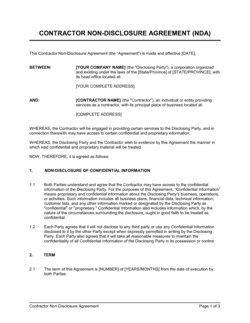
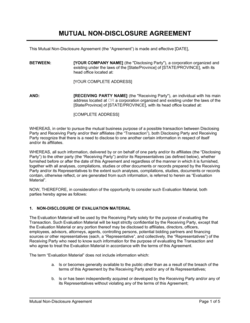
This Non Disclosure and Non Compete Agreement ('Agreement') is entered into as of [DATE] by and between [DISCLOSING PARTY LEGAL NAME] ('Disclosing Party') and [RECEIVING PARTY LEGAL NAME] ('Receiving Party') in connection with [DESCRIPTION OF RELATIONSHIP OR PURPOSE].

Common mistake: Using a trade name or 'doing business as' name instead of the registered legal entity name — if enforcement is needed, the party named must match the legal entity that can be sued.

Definition of Confidential Information

In plain language: Defines precisely what information is protected, including categories such as financial data, technical specifications, client lists, pricing, and business strategies, and specifies how information is designated as confidential.

Sample language
'Confidential Information' means any non-public information disclosed by the Disclosing Party relating to its [business operations / technology / clients / financials], whether disclosed orally, in writing, or by any other means, and whether or not marked 'Confidential.'

Common mistake: Defining confidential information so broadly — 'everything we discuss' — that courts find it unenforceable, or so narrowly that key trade secrets fall outside its scope.

Confidentiality Obligations

In plain language: States that the receiving party must hold the confidential information in strict confidence, use it only for the permitted purpose, and limit disclosure to those with a need to know.

Sample language
Receiving Party shall: (a) hold all Confidential Information in strict confidence; (b) use Confidential Information solely for [PERMITTED PURPOSE]; (c) disclose Confidential Information only to employees or advisors who have a need to know and are bound by equivalent confidentiality obligations.

Common mistake: Failing to require the receiving party to bind their own employees and subcontractors to equivalent obligations — a breach by a third party the receiving party engaged is still the receiving party's liability.

Exclusions from Confidentiality

In plain language: Carves out information that the receiving party has no obligation to protect — typically information already public, independently developed, or received from a third party without restriction.

Sample language
Obligations under this Agreement do not apply to information that: (a) is or becomes publicly available through no fault of the Receiving Party; (b) was already known to the Receiving Party prior to disclosure; (c) is independently developed by the Receiving Party without use of Confidential Information; or (d) is received from a third party without confidentiality restriction.

Common mistake: Omitting the exclusions clause entirely — without it, the agreement may be challenged as unreasonably broad, and the receiving party loses the ability to use legitimately public information freely.

Non-Compete Restriction

In plain language: Prevents the receiving party from engaging in a competing business, working for a named list of competitors, or starting a rival operation within a defined geographic area and time period.

Sample language
For a period of [DURATION] following the termination of this Agreement or the Receiving Party's relationship with the Disclosing Party, Receiving Party shall not, within [GEOGRAPHIC AREA], directly or indirectly engage in, own, manage, or provide services to any business that competes with [DISCLOSING PARTY'S BUSINESS DESCRIPTION].

Common mistake: Using a single non-compete template for all roles regardless of seniority — a broad geographic restriction and 24-month duration applied to an entry-level role is routinely voided by courts.

Non-Solicitation of Customers and Employees

In plain language: Prohibits the receiving party from approaching the disclosing party's customers, clients, or employees for a defined period after the relationship ends.

Sample language
For [DURATION] following termination, Receiving Party shall not: (a) solicit, contact, or do business with any customer or prospective customer of Disclosing Party with whom Receiving Party had contact during the relationship; or (b) recruit, hire, or induce any employee of Disclosing Party to leave their employment.

Common mistake: Drafting the non-solicitation as a blanket ban on any contact with any customer of the company — including customers the receiving party has never interacted with — making it overbroad and unenforceable.

Permitted Use and Return of Materials

In plain language: Limits the receiving party to using confidential information only for the stated purpose, and requires return or destruction of all confidential materials upon termination or request.

Sample language
Upon termination of this Agreement or upon written request, Receiving Party shall promptly return or certifiably destroy all Confidential Information and any copies thereof, and shall provide written certification of such destruction upon request.

Common mistake: No return-or-destroy obligation — without this clause, the receiving party legally retains copies of all shared materials indefinitely after the relationship ends.

Remedies and Injunctive Relief

In plain language: Acknowledges that breach would cause irreparable harm not compensable by money alone, and entitles the disclosing party to seek an injunction without posting bond in addition to other legal remedies.

Sample language
The Receiving Party acknowledges that breach of this Agreement would cause irreparable harm to Disclosing Party for which monetary damages would be inadequate. Disclosing Party shall be entitled to seek injunctive or equitable relief without the requirement to post bond, in addition to all other remedies available at law.

Common mistake: Relying solely on a damages clause without an injunctive relief provision — by the time a lawsuit for damages is resolved, a competitor has already used your trade secrets to capture market share.

Term and Termination

In plain language: Sets the duration of the confidentiality obligation and the non-compete period, specifying which obligations survive termination of the agreement or the underlying relationship.

Sample language
This Agreement shall remain in effect for [TERM]. The confidentiality obligations shall survive termination for a period of [X] years. The non-compete obligations shall apply for [DURATION] following the end of the Receiving Party's relationship with Disclosing Party, regardless of the reason for termination.

Common mistake: Using the same duration for confidentiality and the non-compete — trade secret protection is often perpetual or very long-term, while non-compete periods longer than 12–24 months are frequently challenged.

Governing Law and Dispute Resolution

In plain language: Specifies which jurisdiction's law governs the agreement and the forum or mechanism for resolving disputes — arbitration, mediation, or litigation in a named court.

Sample language
This Agreement shall be governed by the laws of [STATE / PROVINCE / COUNTRY], without regard to conflict-of-laws principles. Any dispute arising under this Agreement shall be resolved by [binding arbitration / litigation] in [CITY / JURISDICTION], and the parties consent to exclusive jurisdiction in that forum.

Common mistake: Choosing a governing law state primarily for its business-friendly reputation without considering that courts in the employee's work location may apply local law anyway — particularly in California, which voids most non-competes regardless of what the contract specifies.

How to fill it out

  1. 1

    Identify both parties with their full legal names

    Enter the registered legal name of the disclosing party (your business) and the receiving party (employee, contractor, or partner). Confirm the entity type — LLC, corporation, sole proprietor, or individual.

    💡 Cross-reference your state or provincial corporate registry to confirm the exact registered name before execution — a name mismatch can void enforcement.

  2. 2

    Define confidential information with specific categories

    List the specific categories of information you are protecting — client lists, pricing models, source code, financial projections, product formulas. Avoid both 'all information' (overbroad) and named documents only (too narrow).

    💡 Include both written and oral disclosures in the definition — deals frequently involve verbal conversations that fall outside agreements limited to written materials.

  3. 3

    Set the non-compete scope: geography, industry, and duration

    Define the geographic area (city, state, country, or radius in miles/km), the specific business activities that are restricted, and the duration following the end of the relationship. Match the scope to the receiving party's actual role and access.

    💡 For a sales representative with a regional territory, a 50-mile radius and 12-month restriction is more defensible than a nationwide, 24-month ban.

  4. 4

    Draft the non-solicitation terms for customers and employees

    Specify which customers are covered — typically those the receiving party had direct contact with — and limit the employee non-solicit to active solicitation rather than a ban on hiring anyone who applies independently.

    💡 A non-solicitation limited to customers the receiving party actually serviced is consistently upheld; a ban on all contact with any company customer is frequently voided.

  5. 5

    State the permitted purpose for confidential information

    Write a single, specific sentence describing the only authorized use for the shared information — for example, 'evaluating a potential employment relationship' or 'performing software development services under Statement of Work #[X].'

    💡 A vague permitted purpose like 'business purposes' defeats the clause — the more specific the use case, the easier a breach is to prove.

  6. 6

    Include the return-or-destroy obligation with a deadline

    Require the receiving party to return all confidential materials — physical and digital — or provide written certification of destruction within a specific number of days of termination or request.

    💡 Specify that electronic copies, backups, and cloud storage are included in the return-or-destroy obligation — most breaches today involve digital files, not paper documents.

  7. 7

    Select the governing law based on the receiving party's location

    Choose the jurisdiction where the receiving party primarily works, not where your business is incorporated. Courts in the receiving party's jurisdiction will typically apply local employment law regardless of the contract's choice-of-law clause.

    💡 If the receiving party works in California, Minnesota, or North Dakota, consult a lawyer before finalizing — these states ban or severely restrict non-competes.

  8. 8

    Execute before the relationship begins and retain a signed copy

    Both parties must sign before the employee starts work, the contractor accesses systems, or the confidential information is shared. Post-commencement signatures require fresh consideration in common-law jurisdictions to be enforceable.

    💡 Use a timestamped eSignature platform so the execution date is documented and cannot later be disputed.

Frequently asked questions

What is a non disclosure and non compete agreement?

A non disclosure and non compete agreement is a single contract that combines confidentiality protections with a restriction on competitive activity. The confidentiality section prevents the receiving party from disclosing or misusing the disclosing party's proprietary information. The non-compete section prevents the receiving party from working for competitors or launching a competing business for a defined period and within a defined geography after the relationship ends. Combining both in one document is common for employment, contractor, and M&A contexts where both risks are present simultaneously.

Is a non disclosure and non compete agreement enforceable?

Enforceability depends on jurisdiction and the reasonableness of the specific restrictions. Confidentiality clauses are generally enforceable in most jurisdictions when the definition of confidential information is specific and the obligation is proportionate. Non-compete clauses face greater scrutiny — California, Minnesota, and North Dakota ban most post-employment non-competes, and courts in most other states will void restrictions that are unreasonable in geographic scope, duration, or breadth of restricted activity. A restriction that is narrowly tailored to the receiving party's actual competitive knowledge is more consistently upheld than a broad, one-size-fits-all clause.

What is the difference between a non-disclosure agreement and a non-compete agreement?

A non-disclosure agreement (NDA) restricts what the receiving party can say or share — it governs the use of information. A non-compete agreement restricts where the receiving party can work or what business they can operate — it governs competitive behavior. Both protect legitimate business interests, but from different angles. An NDA alone does not prevent someone from taking a job at a competitor; a non-compete alone does not prevent them from sharing your trade secrets. Combined, they address both risks.

Can I include both confidentiality and non-compete in a single agreement?

Yes, and it is common practice. A combined agreement is practical when the disclosing party faces both the risk of information leakage and the risk of direct competition from the receiving party — for example, with a senior employee, a key contractor, or a business partner in an exploratory discussion. The two sets of obligations are independent: even if a court narrows or voids the non-compete clause, the confidentiality obligations typically remain enforceable.

How long can a non-compete restriction last?

Most courts that enforce non-competes consider 6 to 12 months reasonable for most roles, and up to 24 months for senior executives or roles with deep access to trade secrets and key client relationships. Restrictions longer than 24 months are frequently voided as unreasonable. Duration should be proportionate to the time it would take the disclosing party to develop a new relationship or protect the competitively sensitive information disclosed.

Does a non-compete apply to independent contractors?

Yes, non-compete and non-disclosure agreements can be used with independent contractors, and often should be — contractors may access the same sensitive information as employees. However, over-restricting a contractor's ability to work in their field can contribute to a worker misclassification argument. Non-solicitation clauses are often more appropriate than broad non-competes for contractors, as they target the specific risk — poaching clients — without restricting the contractor's broader market.

What consideration is required for a non-compete to be enforceable?

In most jurisdictions, the promise of employment or a business relationship is sufficient consideration when the agreement is signed before the relationship begins. Agreements signed after employment has already started typically require fresh consideration — a bonus, salary increase, promotion, or additional benefits — to be enforceable. Some US states and Canadian provinces have specific statutory requirements about what constitutes adequate consideration, so reviewing local law before relying on a mid-employment agreement is advisable.

Can a non-compete be enforced if the employee is terminated without cause?

This varies by jurisdiction. In some US states, courts will decline to enforce a non-compete against an employee who was laid off without cause, viewing it as inequitable. In others, the non-compete survives regardless of the reason for termination. In Canada, courts weigh the circumstances of termination heavily in assessing enforceability. To reduce exposure, consider limiting the non-compete obligation when termination is without cause, or providing garden leave compensation during the restriction period.

What remedies are available if someone breaches a non-compete or NDA?

The disclosing party can seek injunctive relief to stop the breach immediately — a court order preventing the receiving party from continuing to compete or disclose. They can also claim compensatory damages for quantifiable losses caused by the breach, and in cases of willful misuse of trade secrets, potentially punitive damages or attorney's fees under statutes like the federal Defend Trade Secrets Act (DTSA) in the US. The injunctive relief provision in the agreement is critical because it allows the disclosing party to seek an emergency restraining order without first proving the full amount of damages.

Do I need a lawyer to use this non disclosure and non compete agreement template?

For standard employment situations with domestic hires in jurisdictions that permit non-competes, a carefully customized template is often sufficient. Legal review is strongly recommended when the receiving party works in California, Minnesota, or any EU country; when the relationship involves senior executives with access to core intellectual property; when the deal context is M&A or a significant business sale; or when non-compete enforceability is central to protecting significant business value. A one-hour review by an employment attorney typically costs $300–$600 and is worthwhile for high-stakes relationships.

How this compares to alternatives

vs Non-Disclosure Agreement (standalone)

A standalone NDA only restricts disclosure and use of confidential information — it does not prevent the receiving party from working for a competitor or starting a competing business. Use a standalone NDA when you need to share information with a potential partner or vendor who has no realistic path to competing with you directly. When competitive risk is real, the combined agreement is necessary.

vs Non-Compete Agreement (standalone)

A standalone non-compete restricts competitive activity but does not include confidentiality obligations. Use it when the competitive restriction is the primary concern and no significant proprietary information will be shared. The combined agreement is more protective when both risks — disclosure and competition — exist simultaneously, as they do in most employment and contractor relationships.

vs Employment Contract

An employment contract governs the full employment relationship — duties, compensation, benefits, termination, and benefits — and typically includes confidentiality and non-compete clauses within it. A standalone combined NDA and non-compete is appropriate when you need a focused, separately executed document, for contractors who are not employees, or when adding restrictive covenants to an existing employment relationship as a supplemental agreement.

vs Non-Solicitation Agreement

A non-solicitation agreement restricts only the active targeting of customers or employees — it does not prohibit the receiving party from working in the same industry or for a direct competitor. It is appropriate when the primary risk is client poaching rather than broad competition, and in jurisdictions that ban or restrict non-competes. It is a less restrictive and therefore more consistently enforceable alternative.

Industry-specific considerations

Technology / SaaS

Source code, algorithms, product roadmaps, and customer data warrant strong confidentiality; non-competes for engineers are heavily scrutinized and often unenforceable in California, requiring a non-solicitation-focused approach.

Professional Services

Client relationships and billing methodologies are the primary competitive asset; non-solicitation of clients the departing party actually serviced is the most critical and consistently upheld restriction.

Financial Services

Regulatory obligations under FINRA and SEC rules layer onto contractual confidentiality; non-competes for registered representatives interact with FINRA's Protocol for Broker Recruiting and must be drafted accordingly.

Healthcare

Patient data confidentiality governed by HIPAA operates alongside contractual NDA terms; non-competes for physicians face specific statutory restrictions in many states and must reference licensing board obligations.

Manufacturing

Trade secrets in formulas, processes, and supplier pricing models are typically the primary asset to protect; geographic non-compete scope should align with the distribution footprint rather than a national default.

Retail / Franchise

Proprietary operational systems, supplier lists, and pricing structures require confidentiality; franchise non-competes must survive franchise agreement termination and are often subject to FTC Franchise Rule disclosure requirements.

Jurisdictional notes

United States

Non-compete enforceability varies dramatically by state. California, Minnesota, North Dakota, and Oklahoma ban most post-employment non-competes; courts in these states will not enforce a clause regardless of the contract's choice-of-law provision. In states that do enforce them — Texas, Florida, New York — the restriction must be reasonable in duration (typically 6–24 months), geographic scope, and breadth of restricted activity. Federal trade secret protection is available under the Defend Trade Secrets Act (DTSA), which also provides a basis for federal injunctive relief.

Canada

Canadian courts treat non-compete clauses with significant skepticism and will void them if they are not narrowly tailored to protect a legitimate proprietary interest. Non-solicitation clauses are generally preferred and more consistently enforced. Ontario's Working for Workers Act (2021) bans non-compete agreements for most employees, with limited exceptions for executives and business sale contexts. Quebec contracts must comply with the Civil Code and, for provincially regulated employers, must be in French.

United Kingdom

Post-termination restrictive covenants are enforceable in the UK if they go no further than reasonably necessary to protect a legitimate business interest — typically client relationships, trade secrets, or workforce stability. Courts apply a strict reasonableness test and will void overbroad clauses rather than rewrite them. Garden leave provisions are widely used to bridge the employment end date and the start of a formal non-compete. The UK government has proposed limiting non-compete durations to 3 months; check the current legislative position before finalizing.

European Union

Non-compete enforceability and requirements vary by EU member state. Germany, France, and the Netherlands require financial compensation — typically 50–100% of the employee's last salary — to be paid during the non-compete period for the restriction to be enforceable. GDPR obligations apply to any confidential information that includes personal data, requiring appropriate data handling and deletion provisions. The EU Trade Secrets Directive provides a harmonized framework for confidential information protection across member states, but implementation details vary.

Template vs lawyer — what fits your deal?

PathBest forCostTime
Use the templateStandard domestic hires or contractors in jurisdictions that permit non-competes, where the relationship involves moderate access to confidential informationFree20–30 minutes
Template + legal reviewSenior employees, key contractors, cross-state or cross-border relationships, or any situation where non-compete enforceability is material to business value$300–$6001–3 days
Custom draftedM&A transactions, C-suite executives with equity, regulated industries, or situations involving employees in California, Minnesota, or EU member states$1,500–$5,000+1–3 weeks

Glossary

Confidential Information
Any non-public data, knowledge, or material disclosed by one party to another that is designated as confidential or would reasonably be understood to be confidential given its nature.
Non-Compete Clause
A contractual restriction preventing the bound party from working for competitors or starting a competing business within a specified geography and time period.
Non-Solicitation Clause
A restriction preventing a departing party from actively recruiting the other party's employees or approaching their customers for a defined period.
Trade Secret
Proprietary business information — formulas, processes, client lists, pricing models — that has economic value because it is not publicly known and is actively protected.
Receiving Party
The party who receives confidential information under the agreement and is bound by the confidentiality and non-compete obligations.
Disclosing Party
The party who shares proprietary information and seeks protection from unauthorized disclosure or competitive use of that information.
Permitted Purpose
The specific, limited use for which the receiving party is authorized to access and use the confidential information — any use outside this scope is a breach.
Injunctive Relief
A court order compelling or preventing an action — typically sought when monetary damages are insufficient to remedy a breach, such as ongoing disclosure of trade secrets.
Reasonable Restraint
The legal standard courts apply to non-compete clauses — a restriction must be no broader than necessary to protect a legitimate business interest to be enforceable.
Garden Leave
A notice period during which the employee remains employed and paid but is kept away from clients, colleagues, and confidential systems — effectively extending the competitive restriction.
Consideration
Something of value exchanged between parties that makes a contract legally binding — for post-employment agreements, this must be more than the promise of continued employment alone in many jurisdictions.

Part of your Business Operating System

This document is one of 3,000+ business & legal templates included in Business in a Box.

  • Fill-in-the-blanks — ready in minutes
  • 100% customizable Word document
  • Compatible with all office suites
  • Export to PDF and share electronically

Create your document in 3 simple steps.

From template to signed document — all inside one Business Operating System.
1
Download or open template

Access over 3,000+ business and legal templates for any business task, project or initiative.

2
Edit and fill in the blanks with AI

Customize your ready-made business document template and save it in the cloud.

3
Save, Share, Send, Sign

Share your files and folders with your team. Create a space of seamless collaboration.

Save time, save money, and create top-quality documents.

★★★★★

"Fantastic value! I'm not sure how I'd do without it. It's worth its weight in gold and paid back for itself many times."

Managing Director · Mall Farm
Robert Whalley
Managing Director, Mall Farm Proprietary Limited
★★★★★

"I have been using Business in a Box for years. It has been the most useful source of templates I have encountered. I recommend it to anyone."

Business Owner · 4+ years
Dr Michael John Freestone
Business Owner
★★★★★

"It has been a life saver so many times I have lost count. Business in a Box has saved me so much time and as you know, time is money."

Owner · Upstate Web
David G. Moore Jr.
Owner, Upstate Web

Run your business with a system — not scattered tools

Stop downloading documents. Start operating with clarity. Business in a Box gives you the Business Operating System used by over 250,000 companies worldwide to structure, run, and grow their business.

Free Forever Plan · No credit card required