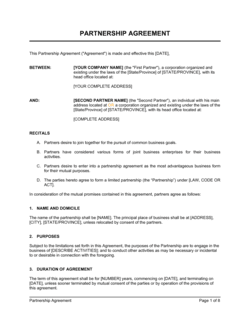
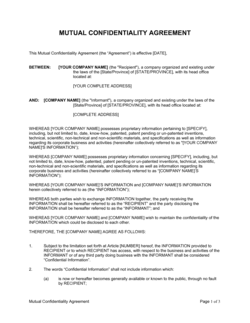
Mutual Non-Disclosure Agreement Template

Free Word download • Edit online • Save & share with Drive • Export to PDF

5 pages25–35 min to fillDifficulty: ComplexSignature requiredLegal review recommended
Learn more ↓
FreeMutual Non-Disclosure Agreement Template

At a glance

What it is
A Mutual Non-Disclosure Agreement (MNDA) is a legally binding contract between two parties who both intend to share confidential information with each other and need equal protection against unauthorized disclosure. This free Word download covers all core provisions — definition of confidential information, obligations, permitted disclosures, exclusions, term, and remedies — in a single ready-to-execute document you can edit online and export as PDF.
When you need it
Use it before any business discussion where both sides will exchange sensitive information — exploratory partnership talks, joint venture negotiations, M&A due diligence, co-development discussions, or vendor evaluations involving proprietary data on both sides.
What's inside
Party identification, a precise definition of confidential information, mutual obligations of non-disclosure and non-use, permitted disclosures to employees and advisors, standard exclusions (public domain, independent development), agreement term and survival period, and injunctive relief and governing law clauses.

What is a Mutual Non-Disclosure Agreement?

A Mutual Non-Disclosure Agreement (MNDA) is a legally binding contract in which two parties simultaneously commit to protecting each other's confidential information from unauthorized disclosure or use. Unlike a one-way NDA — where a single disclosing party shares information and only the recipient bears obligations — a mutual NDA creates equal, reciprocal duties on both sides: each party is at once a disclosing party sharing its own sensitive data and a receiving party bound to protect what it learns. The agreement defines what qualifies as confidential, restricts use to a stated purpose, identifies who may access the information within each organization, and sets the time period during which obligations remain in force. It is the standard instrument for any business relationship where sensitive information will flow in both directions.

Why You Need This Document

Without a mutual NDA in place, information shared during exploratory discussions — pricing models, unreleased product plans, customer data, financial projections — is exchanged on trust alone, with no enforceable obligation on either side. If talks break down, a counterparty who received your proprietary data faces no legal consequences for using it to compete with you or sharing it with others. The practical cost of that exposure is concrete: a competitor who learns your cost structure or product roadmap during failed partnership talks can use that advantage for years. A signed mutual NDA creates a documented, enforceable obligation before the first sensitive document is shared, gives both parties the standing to seek emergency injunctive relief if a breach occurs, and signals to sophisticated counterparties that your organization handles confidential information with appropriate care. This template gives you a professionally structured starting point you can execute in under 30 minutes — protecting both sides from the moment meaningful discussions begin.

Which variant fits your situation?

If your situation is…Use this template
Only one party is sharing confidential informationNon-Disclosure Agreement (One-Way)
Protecting confidential information shared with a new employeeEmployee Confidentiality Agreement
Covering confidential disclosures to an independent contractorIndependent Contractor NDA
M&A due diligence where the seller is the primary disclosing partyConfidentiality Agreement (M&A)
Ongoing vendor relationship requiring continuous confidentiality obligationsVendor Confidentiality Agreement
Technology co-development with shared IP creationJoint Development Agreement
Protecting trade secrets in a long-term strategic allianceStrategic Alliance Agreement

Common mistakes to avoid

❌ Sharing confidential information before signing

Why it matters: Any information disclosed before execution is not covered by the NDA. A party who receives sensitive data before signing has no contractual obligation to protect it, and trade-secret status may be weakened by the voluntary disclosure.

Fix: Execute the agreement — with confirmed signatures on both sides — before any documents are shared, any presentation is given, or any detailed discussions occur. Use a digital signature tool to eliminate the execution-timing gap.

❌ Omitting a non-use clause

Why it matters: An agreement limited to non-disclosure allows a receiving party to exploit confidential information internally — using your pricing strategy, formulas, or roadmap to outcompete you — without ever sharing it with a third party.

Fix: Always include an explicit non-use clause restricting use of confidential information solely to the stated purpose of the agreement.

❌ Using an indefinite or missing term

Why it matters: Without a defined term and survival period, courts in some jurisdictions treat the NDA as perpetual and may refuse to enforce it as unreasonable restraint. In others, ambiguity about when obligations end creates disputes at the worst possible moment.

Fix: State a specific agreement term (1–3 years for most commercial situations) and a separate survival period (2–5 years) that clearly extends obligations beyond the active term.

❌ No compelled disclosure notice requirement

Why it matters: Without a clause requiring the receiving party to notify before complying with a subpoena or regulatory request, the disclosing party loses its opportunity to seek a protective order — and confidential information can be handed to a regulator or court without any chance to object.

Fix: Include a compelled-disclosure clause requiring prompt written notice and cooperation in seeking a protective order before any legally mandated disclosure occurs.

❌ Forgetting electronic and backup copies in the return-or-destroy clause

Why it matters: A clause requiring return of 'documents and materials' may not cover emails, shared drives, cloud backups, and cached files — which is where most confidential information actually resides after a modern business exchange.

Fix: Explicitly include electronic copies, backup files, and data stored in cloud or third-party systems in the return-or-destroy obligation, and require written certification of completion.

❌ Using a one-way NDA when the exchange is mutual

Why it matters: A one-way NDA protects only the disclosing party named in the agreement. If the other party also shares sensitive information, they have no contractual protection — creating an imbalance that frequently surfaces as a dispute when the relationship sours.

Fix: Use a mutual NDA whenever both parties will exchange confidential information, even if the volume or sensitivity is asymmetric. The marginal cost of mutual protection is zero.

The 10 key clauses, explained

Parties and purpose

In plain language: Identifies both parties by their full legal names and states the specific business purpose for which confidential information will be shared.

Sample language
This Mutual Non-Disclosure Agreement is entered into as of [DATE] between [PARTY A LEGAL NAME], a [STATE] [ENTITY TYPE] ('Party A'), and [PARTY B LEGAL NAME], a [STATE] [ENTITY TYPE] ('Party B'), in connection with [DESCRIPTION OF PURPOSE].

Common mistake: Using trade names or abbreviations instead of full registered entity names. If the names do not match the parties' corporate registrations, enforcing the agreement against the correct legal entity becomes unnecessarily complicated.

Definition of confidential information

In plain language: Specifies what qualifies as confidential — including written, oral, and electronic disclosures — and sets any marking or follow-up confirmation requirement for oral disclosures.

Sample language
'Confidential Information' means any non-public information disclosed by one party to the other, in any form, that is designated as 'Confidential' at the time of disclosure or, if disclosed orally, confirmed in writing within [30] days of disclosure.

Common mistake: Defining confidential information so broadly that it covers 'all information exchanged.' Courts may void or narrow an overbroad definition, leaving genuinely sensitive disclosures unprotected.

Mutual obligations of non-disclosure and non-use

In plain language: Each party agrees to hold the other's confidential information in strict confidence, use it only for the stated purpose, and not disclose it to any third party without prior written consent.

Sample language
Each party agrees to (a) hold the other party's Confidential Information in strict confidence using at least the same degree of care it uses for its own confidential information, but no less than reasonable care; (b) use Confidential Information solely for the Purpose; and (c) not disclose Confidential Information to any third party without the prior written consent of the Disclosing Party.

Common mistake: Omitting the non-use obligation and focusing only on non-disclosure. A party can cause serious damage by using confidential information internally without ever sharing it externally.

Permitted disclosures

In plain language: Allows each party to share the other's confidential information with its own employees, contractors, and advisors who need it for the stated purpose, provided those recipients are bound by equivalent confidentiality obligations.

Sample language
Each party may disclose Confidential Information to its employees, officers, directors, legal counsel, and financial advisors ('Representatives') who have a need to know for the Purpose, provided that such Representatives are bound by confidentiality obligations at least as protective as those in this Agreement.

Common mistake: Not requiring that third-party advisors (lawyers, accountants, investors) be bound by equivalent obligations before receiving access. This creates a gap through which confidential information can flow without protection.

Exclusions from confidentiality

In plain language: Lists the four standard carve-outs: information already public, information the receiving party knew before disclosure, information independently developed, and information lawfully received from a third party.

Sample language
Confidentiality obligations do not apply to information that: (a) is or becomes publicly available through no fault of the Receiving Party; (b) was already known to the Receiving Party before disclosure; (c) is independently developed by the Receiving Party without use of Confidential Information; or (d) is lawfully received from a third party without restriction.

Common mistake: Removing the independent development exclusion. Without it, a party could be held liable for developing similar technology or strategies through its own separate efforts, which courts consistently find unreasonable.

Compelled disclosure

In plain language: Addresses what happens if a receiving party is legally required to disclose confidential information — e.g., by court order or regulatory subpoena — requiring prompt notice so the disclosing party can seek a protective order.

Sample language
If the Receiving Party is required by law or court order to disclose Confidential Information, it shall (a) provide prompt written notice to the Disclosing Party before disclosure to the extent permitted by law; (b) cooperate with the Disclosing Party's efforts to obtain a protective order; and (c) disclose only that portion of Confidential Information legally required.

Common mistake: No compelled disclosure clause at all. Without it, a receiving party that receives a subpoena may legally hand over confidential documents with no obligation to give the disclosing party a chance to challenge it.

Term and survival

In plain language: Sets the active period of the agreement during which new disclosures can be made, and the separate survival period during which confidentiality obligations continue after the agreement ends.

Sample language
This Agreement shall remain in effect for [2] years from the Effective Date ('Term'). The confidentiality obligations set forth herein shall survive expiration or termination of this Agreement for a period of [3] years following the end of the Term with respect to Confidential Information disclosed during the Term.

Common mistake: Conflating the agreement term with the survival period. If the NDA expires after 1 year with no survival clause, all obligations end — meaning information disclosed in month 11 is unprotected less than 30 days after it was shared.

Return or destruction of confidential information

In plain language: Requires each party to return or certifiably destroy the other's confidential information — including copies — upon request or upon termination of the agreement.

Sample language
Upon written request by the Disclosing Party or upon termination of this Agreement, the Receiving Party shall promptly return or destroy all Confidential Information and any copies thereof, and upon request certify in writing that destruction has been completed.

Common mistake: Forgetting to address electronic copies, backups, and cached data. A return-or-destroy clause limited to physical documents leaves digital copies in place, which is where most confidential information actually lives.

Remedies and injunctive relief

In plain language: States that a breach would cause irreparable harm for which monetary damages are inadequate and that the non-breaching party is entitled to seek injunctive relief without posting a bond.

Sample language
Each party acknowledges that breach of this Agreement would cause irreparable harm to the other party for which monetary damages would be an inadequate remedy. Accordingly, the non-breaching party shall be entitled to seek injunctive or other equitable relief without the requirement of posting a bond or other security.

Common mistake: Omitting the 'no bond required' language. Without it, a party seeking an emergency injunction may be required to post a substantial cash bond before a court will act, creating a practical barrier to emergency relief.

Governing law and dispute resolution

In plain language: Specifies which jurisdiction's law governs the agreement and the forum — court or arbitration — for resolving disputes.

Sample language
This Agreement shall be governed by and construed in accordance with the laws of [STATE / JURISDICTION], without regard to conflict-of-law principles. Any dispute arising under this Agreement shall be resolved by [binding arbitration administered by [AAA] in [CITY] / litigation in the state or federal courts of [COUNTY/STATE]].

Common mistake: Choosing governing law from a jurisdiction that has no connection to either party's operations. Courts may refuse to apply it, and the mismatch signals a template was used without customization — undermining the agreement's perceived care and enforceability.

How to fill it out

  1. 1

    Identify both parties with full legal names

    Enter each party's complete registered legal entity name, entity type (LLC, Inc., Ltd.), and state or country of formation. Add a primary contact name and address for each party.

    💡 Cross-check the entity name against the relevant corporate registry — a single-word discrepancy can complicate enforcement.

  2. 2

    State the specific purpose of the agreement

    Write a precise one-to-two sentence description of the business context — for example, 'evaluation of a potential co-development arrangement for [PRODUCT CATEGORY].' Avoid vague language like 'general business discussions.'

    💡 A narrow purpose clause protects both parties — it limits how the other side can use your information and prevents scope creep.

  3. 3

    Define confidential information precisely

    Decide whether oral disclosures are covered and, if so, how long after the discussion the disclosing party has to confirm them in writing. Consider whether specific categories — source code, customer lists, financial projections — should be explicitly named.

    💡 If your most sensitive information is technical or belongs to a specific category, naming it explicitly creates stronger protection than a generic catch-all.

  4. 4

    Set the agreement term and survival period

    Enter the active term — typically 1 to 3 years — and the separate survival period for confidentiality obligations after the term ends. Common practice is a 3- to 5-year survival period for most commercial agreements.

    💡 For discussions involving long-lived assets like patents or formulas, consider a survival period that matches the expected commercial life of the information.

  5. 5

    Confirm the permitted-disclosures scope

    Review the list of permitted recipients (employees, contractors, advisors) and confirm each category is appropriate. Add or remove categories based on your actual team structure and whether external advisors like investment bankers or technical consultants will need access.

    💡 If you will share the information with outside investors during a funding round, add 'potential financing sources bound by equivalent confidentiality obligations' to the permitted list.

  6. 6

    Choose governing law and dispute resolution

    Select the jurisdiction whose law governs the agreement — typically the state or country where the primary operating entity is located. Decide between arbitration (faster, private, final) and court litigation (public record, appellate rights).

    💡 If the parties are in different states, choose governing law in the state with the stronger trade-secret protection statutes — most US states have adopted the Uniform Trade Secrets Act, but enforcement quality varies.

  7. 7

    Execute before any confidential information is shared

    Both authorized signatories must sign — and date — the agreement before any confidential information changes hands. Use Business in a Box eSign to timestamp execution and store the fully executed copy in BIB Drive.

    💡 Information shared before the NDA is signed is not covered by it. If an inadvertent disclosure has already occurred, address it explicitly in the agreement or with a separate side letter.

Frequently asked questions

What is a mutual non-disclosure agreement?

A mutual non-disclosure agreement (MNDA) is a legally binding contract in which two parties agree to protect each other's confidential information from unauthorized disclosure and use. Unlike a one-way NDA — where only one party discloses — a mutual NDA creates equal, reciprocal obligations on both sides. It is the standard form for partnership negotiations, M&A due diligence, joint development discussions, and any situation where sensitive information will flow in both directions.

What is the difference between a mutual NDA and a one-way NDA?

In a one-way (unilateral) NDA, only one party — the disclosing party — shares confidential information, and only the receiving party takes on confidentiality obligations. In a mutual NDA, both parties are simultaneously disclosing and receiving parties, and both are bound by identical obligations. Use a mutual NDA whenever both parties will share sensitive data; use a one-way NDA when only one party is disclosing, such as when showing a product to a potential customer.

Is a mutual NDA legally enforceable?

A mutual NDA is generally enforceable when it meets the basic requirements of a contract — offer, acceptance, and consideration — and the obligations are reasonable in scope and duration. Mutual consideration (each party's promise to protect the other's information) satisfies the consideration requirement without any exchange of money. Overly broad definitions of confidential information or unreasonably long survival periods can result in a court narrowing or declining to enforce specific provisions. Consider having a lawyer review the agreement for high-value disclosures.

How long should a mutual NDA last?

Most commercial mutual NDAs have an active term of 1 to 3 years, during which new disclosures can be made. The confidentiality obligations themselves — the survival period — typically continue for 2 to 5 years after the term ends. For highly sensitive technical or trade-secret information, a longer survival period is appropriate. The term and survival period are separate provisions; conflating them is one of the most common drafting errors and can leave late-term disclosures unprotected.

Does a mutual NDA need to be notarized?

No. Notarization is not required for a mutual NDA to be legally binding in any major common-law or civil-law jurisdiction. A signed, dated agreement between two competent parties with matching consideration is sufficient. Notarization may be useful as additional evidence of execution date in a dispute, but it is not a legal requirement for this type of agreement.

What information is not protected by a mutual NDA?

Standard exclusions include: information that is already publicly available through no fault of the receiving party; information the receiving party already knew before disclosure; information independently developed by the receiving party without use of the disclosed information; and information lawfully received from a third party without restriction. These exclusions are standard across jurisdictions and courts will typically imply them even if the agreement omits them — making explicit inclusion clearer for both parties.

Can a mutual NDA prevent someone from using information they already knew?

No — and attempting to do so makes the clause unenforceable. The independent-development and prior-knowledge exclusions exist precisely because a receiving party cannot unlearn what it already knew. Courts will not enforce an NDA that tries to restrict a party's use of knowledge it possesses independently of the disclosure. The agreement protects genuinely new disclosures, not pre-existing knowledge.

What remedies are available if a mutual NDA is breached?

The primary remedies are injunctive relief (a court order to stop the breach immediately) and monetary damages for provable losses. Because quantifying the financial harm from a confidentiality breach is often difficult, most NDAs include language acknowledging irreparable harm and waiving the bond requirement for emergency injunctions. In jurisdictions where the disclosed information qualifies as a trade secret, additional statutory remedies — including exemplary damages and attorney's fees — may be available under laws like the US Defend Trade Secrets Act.

Do I need a lawyer to draft a mutual NDA?

For standard commercial discussions between established businesses, a high-quality template is typically sufficient. Engage a lawyer when the disclosure involves highly valuable or regulated information (clinical data, source code for a core product, regulated financial data), when the counterparty is in a different country, when significant IP rights may be implicated, or when the potential consequences of a breach are material to the business. A 30-to-60-minute template review typically costs $150–$400 and is worthwhile for any disclosure with genuine commercial significance.

How this compares to alternatives

vs One-Way Non-Disclosure Agreement

A one-way NDA creates obligations on only one party — the receiver — while only one party discloses confidential information. A mutual NDA creates equal, reciprocal obligations on both sides. Use a mutual NDA whenever both parties will share sensitive information, even if the exchange is asymmetric in volume. Using a one-way NDA in a genuinely bilateral disclosure leaves one party unprotected.

vs Confidentiality Clause in a Master Agreement

A confidentiality clause embedded in a master services or partnership agreement covers only disclosures made in connection with that specific arrangement. A standalone mutual NDA can be executed before the main agreement is negotiated, protecting the preliminary discussions themselves, and can survive the termination of the main agreement independently. Use both: the NDA for pre-contract discussions, the embedded clause for the ongoing relationship.

vs Employee Confidentiality Agreement

An employee confidentiality agreement runs between employer and employee, typically in one direction, and is usually embedded in or attached to an employment contract. A mutual NDA is a standalone commercial agreement between two independent parties with equal obligations. Using an employee confidentiality agreement for a B2B partnership would create mismatched obligations and is unlikely to be accepted by a corporate counterparty.

vs Non-Compete Agreement

A non-compete restricts a party from competing in a defined market for a defined period — it is about competitive behavior, not information protection. A mutual NDA restricts disclosure and use of specific confidential information but does not restrict competitive activity. The two agreements address different risks and are frequently executed together; the NDA alone does not prevent a counterparty from building a competing product using its own independent knowledge.

Industry-specific considerations

Technology / SaaS

Source code, algorithms, product roadmaps, and API architectures shared during integration or co-development discussions require explicit coverage of electronic copies and technical documentation alongside the standard confidentiality obligations.

Healthcare / Life Sciences

Clinical trial data, formulations, and patient-adjacent information may be subject to HIPAA or GDPR in addition to contractual confidentiality, and the NDA should reference applicable regulatory obligations and include enhanced destruction protocols.

Financial Services

Deal terms, client lists, and proprietary trading strategies shared during M&A or partnership negotiations are highly sensitive; the NDA should specify tight need-to-know lists and include explicit restrictions on using information for trading or competitive intelligence purposes.

Manufacturing

Product formulations, manufacturing processes, and supplier pricing shared with potential co-manufacturers or joint-venture partners benefit from a longer survival period — often 5 years — because manufacturing IP has a longer commercial life than most digital information.

Professional Services

Client lists, pricing models, and proprietary methodologies shared between firms exploring a merger or referral arrangement require careful scoping of the permitted-disclosures list to exclude each firm's existing client relationships from the mutual obligations.

Retail / Consumer Goods

Product designs, supplier terms, and promotional strategies shared during licensing or distribution negotiations are often time-sensitive; the agreement term and return-or-destroy obligations should be calibrated to the product launch calendar.

Jurisdictional notes

United States

Most US states have adopted the Uniform Trade Secrets Act, and the federal Defend Trade Secrets Act (2016) provides additional remedies including exemplary damages and attorney's fees for willful misappropriation. California courts scrutinize overly broad NDAs and may narrow or void provisions that effectively function as post-employment non-competes. State courts vary significantly in how they treat the independent-development exclusion and residuals clauses.

Canada

Canada does not have a unified federal trade-secret statute comparable to the US DTSA; protection relies primarily on common law and provincial statutes. Quebec's civil law system interprets confidentiality obligations somewhat differently from common-law provinces, and contracts should ideally be available in French for parties operating in Quebec. Courts across provinces apply a reasonableness standard to the scope and duration of confidentiality obligations.

United Kingdom

The UK implemented the EU Trade Secrets Directive into domestic law via the Trade Secrets (Enforcement, etc.) Regulations 2018, which survived Brexit and remains in force. Courts apply an equitable duty of confidence that can exist even without a written NDA, but a written agreement significantly strengthens the position of the disclosing party. Post-Brexit, UK courts apply UK law independently of EU interpretations, though the substantive standards remain closely aligned.

European Union

The EU Trade Secrets Directive (2016/943) harmonized trade-secret protection across member states, requiring reasonable steps to maintain secrecy as a condition of protection — a written NDA is the clearest evidence of such steps. Where confidential information includes personal data, GDPR obligations apply in parallel and the NDA should reference data processing restrictions. Member state implementation varies, particularly in remedies and injunctive relief procedures.

Template vs lawyer — what fits your deal?

PathBest forCostTime
Use the templateStandard commercial discussions between established businesses sharing moderately sensitive operational or strategic informationFree15–30 minutes
Template + legal reviewDisclosures involving proprietary technology, regulated data, or cross-border parties in different legal jurisdictions$150–$400 for a 30-to-60 minute lawyer review1–2 business days
Custom draftedHigh-value M&A due diligence, clinical or regulated data sharing, or situations where breach would cause material financial or competitive damage$800–$3,000+3–7 business days

Glossary

Confidential Information
Any non-public data, materials, or knowledge one party discloses to the other under the agreement, typically requiring a marking or written confirmation within a defined window to qualify.
Disclosing Party
The party sharing confidential information in a given exchange; in a mutual NDA, each party acts as both disclosing party and receiving party at different points.
Receiving Party
The party receiving confidential information and taking on the obligation to protect and not misuse it.
Non-Use Obligation
A restriction preventing the receiving party from using the disclosing party's confidential information for any purpose other than the stated purpose of the agreement.
Exclusions from Confidentiality
Categories of information that are not protected, including information already in the public domain, independently developed by the receiving party, or received from a third party without restriction.
Term
The period during which the agreement is active and new confidential disclosures can be made, separate from the survival period that governs obligations after expiry.
Survival Period
The length of time confidentiality obligations continue after the agreement expires or is terminated — commonly 2 to 5 years depending on the sensitivity of the information.
Injunctive Relief
A court order requiring a party to stop a specific action immediately, available as a remedy for NDA breaches because monetary damages are often difficult to calculate for confidentiality violations.
Residuals
A clause in some technology NDAs allowing the receiving party to use information retained in unaided human memory even after the agreement ends — a significant carve-out that narrows protection.
Need-to-Know Basis
A standard limiting disclosure of confidential information within the receiving party's organization to only those employees or advisors who genuinely require it to fulfill the agreement's purpose.
Trade Secret
Confidential business information that provides a competitive advantage and is protected under statute (e.g., the US Defend Trade Secrets Act) independently of any NDA.

Part of your Business Operating System

This document is one of 3,000+ business & legal templates included in Business in a Box.

  • Fill-in-the-blanks — ready in minutes
  • 100% customizable Word document
  • Compatible with all office suites
  • Export to PDF and share electronically

Create your document in 3 simple steps.

From template to signed document — all inside one Business Operating System.
1
Download or open template

Access over 3,000+ business and legal templates for any business task, project or initiative.

2
Edit and fill in the blanks with AI

Customize your ready-made business document template and save it in the cloud.

3
Save, Share, Send, Sign

Share your files and folders with your team. Create a space of seamless collaboration.

Save time, save money, and create top-quality documents.

★★★★★

"Fantastic value! I'm not sure how I'd do without it. It's worth its weight in gold and paid back for itself many times."

Managing Director · Mall Farm
Robert Whalley
Managing Director, Mall Farm Proprietary Limited
★★★★★

"I have been using Business in a Box for years. It has been the most useful source of templates I have encountered. I recommend it to anyone."

Business Owner · 4+ years
Dr Michael John Freestone
Business Owner
★★★★★

"It has been a life saver so many times I have lost count. Business in a Box has saved me so much time and as you know, time is money."

Owner · Upstate Web
David G. Moore Jr.
Owner, Upstate Web

Run your business with a system — not scattered tools

Stop downloading documents. Start operating with clarity. Business in a Box gives you the Business Operating System used by over 250,000 companies worldwide to structure, run, and grow their business.

Start free · No credit card required