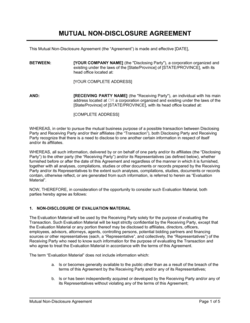
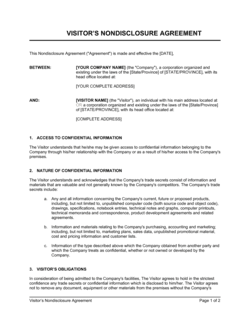
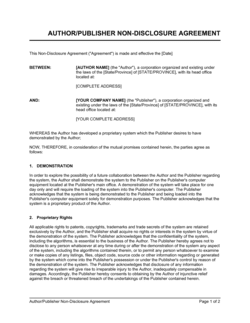
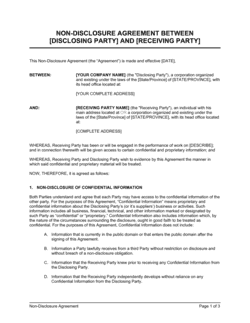
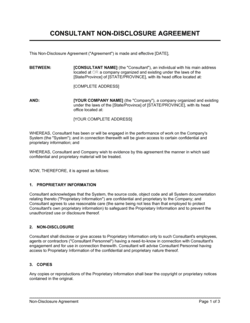
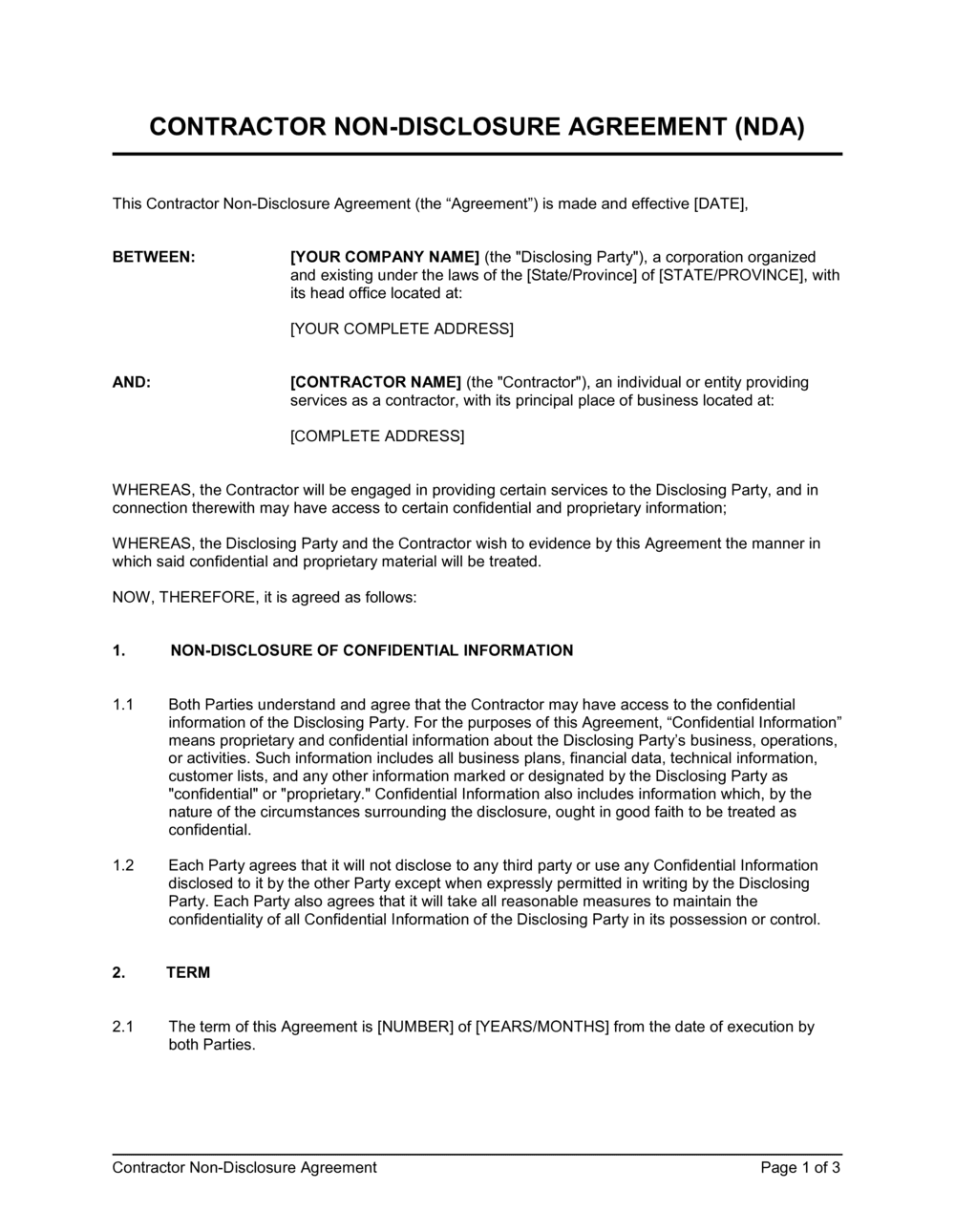
Contractor Non-Disclosure Agreement (NDA) Template

Free Word download • Edit online • Save & share with Drive • Export to PDF

3 pages25–30 min to fillDifficulty: StandardSignature requiredLegal review recommended
Learn more ↓
FreeContractor Non-Disclosure Agreement (NDA) Template

At a glance

What it is
A Contractor Non-Disclosure Agreement (NDA) is a legally binding contract between a business and an independent contractor that restricts the contractor from disclosing, using, or exploiting confidential information accessed during the engagement. This free Word download is editable online and exportable as PDF — covering definition of confidential information, permitted use, exclusions, duration, and remedies in a single enforceable document.
When you need it
Use it before sharing proprietary information — source code, client data, product roadmaps, pricing, or trade secrets — with any freelancer, consultant, or independent contractor who is not a full-time employee. It should be signed before the engagement begins and before any sensitive materials are shared.
What's inside
Definition of confidential information, permitted use restrictions, standard exclusions (publicly known information, independent development), contractor obligations and security requirements, term and post-engagement duration, return or destruction of materials, injunctive relief clause, and governing law.

What is a Contractor Non-Disclosure Agreement (NDA)?

A Contractor Non-Disclosure Agreement (NDA) is a legally binding contract between a business and an independent contractor that restricts the contractor from disclosing, reproducing, or misusing confidential information accessed during the engagement. Unlike an employee confidentiality clause — which sits within a broader employment relationship — a contractor NDA must stand entirely on its own contractual terms, because no employment duty of fidelity exists between the parties. It defines exactly what counts as confidential information, limits how the contractor may use it, sets the duration of the obligation after the engagement ends, and specifies the remedies available if the contractor breaches — including injunctive relief to stop ongoing disclosure before financial harm compounds.

Contractor NDAs are unilateral agreements: the business discloses; the contractor is bound. They are distinct from mutual NDAs, where both parties share sensitive information, and from non-compete agreements, which restrict the contractor from working with competitors — not merely from disclosing what they learned.

Why You Need This Document

Every time you hand source code, client data, a pricing model, or an unreleased product roadmap to a freelancer or consultant, that information leaves your direct control — potentially flowing to other clients they serve, to subcontractors they engage, or to a future employer. Without a signed contractor NDA in place before disclosure, you have no contractual basis to demand return of materials, seek injunctive relief, or claim trade-secret misappropriation. A verbal confidentiality understanding is unenforceable in virtually every jurisdiction. The cost of enforcement without a written agreement — lost IP, exposed client data, damaged competitive position — almost always exceeds the 15 minutes it takes to execute this template. This contractor NDA gives you a specific, enforceable document that defines the information, the permitted use, the duration, and the remedies — executed before a single sensitive file changes hands.

Which variant fits your situation?

If your situation is…Use this template
Sharing confidential information with a full-time employeeEmployee Non-Disclosure Agreement
Both parties will share confidential information with each otherMutual Non-Disclosure Agreement
Disclosing confidential information to a potential business partner before a dealBusiness NDA
Engaging a contractor who will also create deliverables and assign IPIndependent Contractor Agreement with IP Assignment
Protecting trade secrets in a long-term vendor or supplier relationshipVendor Non-Disclosure Agreement
Sharing confidential details before a potential acquisition or mergerM&A Confidentiality Agreement
Onboarding a short-term freelancer for a single defined projectFreelance Contract with NDA Clause

Common mistakes to avoid

❌ Signing after sharing confidential information

Why it matters: Any disclosure made before execution is not covered by the NDA. A contractor who already received your source code or client list before signing has no contractual obligation to protect that specific information.

Fix: Execute the NDA before the kickoff meeting, onboarding call, or any file transfer. Use e-signature to get a countersigned copy within hours, not days.

❌ Using a mutual NDA for a one-way disclosure

Why it matters: A mutual NDA gives the contractor the same confidentiality protections you have — meaning they can claim your attempt to use information they shared with you violates the agreement, complicating enforcement.

Fix: Use a one-way (unilateral) contractor NDA when only your business is disclosing sensitive information. Reserve mutual NDAs for partnerships where both parties share proprietary data.

❌ Setting an indefinite term for all confidential information

Why it matters: Perpetual confidentiality obligations for general business information are routinely limited or struck down by courts in the US, Canada, the UK, and the EU. An unenforceable clause gives you no protection at all.

Fix: Set a specific post-engagement duration of 2–5 years for general confidential information and explicitly state that trade secrets are protected indefinitely as a separate carve-out.

❌ No restriction on subcontractor disclosure

Why it matters: Independent contractors frequently engage their own subcontractors. Without explicit language binding those downstream parties, your confidential information can flow to parties you have never vetted or contracted with.

Fix: Add a clause requiring the contractor to bind any subcontractors to confidentiality obligations no less restrictive than those in the NDA, and to remain liable for any breach by a subcontractor they engage.

❌ Omitting the return-or-destruction clause

Why it matters: When the engagement ends, a contractor who retains copies of your source code, client data, or pricing models poses ongoing risk — even if they make no active use of it.

Fix: Include an explicit return-or-destruction provision covering physical documents, digital files, cloud storage, backups, and any derivative works such as notes or summaries.

❌ No injunctive relief clause

Why it matters: In a standard breach-of-contract action, you must prove and quantify monetary damages — a high bar when the harm is reputational, competitive, or involves disclosed trade secrets. Without an injunctive relief clause, courts may not act quickly enough to prevent ongoing disclosure.

Fix: Include language acknowledging that breach would cause irreparable harm and that the disclosing party is entitled to seek injunctive relief without posting bond or proving actual damages.

The 10 key clauses, explained

Parties and recitals

In plain language: Identifies the disclosing party (the hiring business) and the receiving party (the contractor) as legal entities and states the purpose of the disclosure.

Sample language
This Contractor Non-Disclosure Agreement ('Agreement') is entered into as of [DATE] between [COMPANY LEGAL NAME], a [STATE/PROVINCE] [ENTITY TYPE] ('Company'), and [CONTRACTOR FULL NAME / ENTITY NAME] ('Contractor'), in connection with Contractor's engagement to perform [DESCRIPTION OF SERVICES].

Common mistake: Using a trade name rather than the registered legal entity name. If the disclosing party's name doesn't match its corporate registration, enforcing the agreement against the correct entity in litigation becomes complicated.

Definition of confidential information

In plain language: Specifies exactly what information is protected — broadly enough to capture all sensitive materials, but with enough specificity to be enforceable.

Sample language
'Confidential Information' means any non-public information disclosed by Company to Contractor, whether oral, written, or electronic, including but not limited to source code, business strategies, financial data, client lists, pricing, product roadmaps, and proprietary processes.

Common mistake: Relying on 'all information shared is confidential' without a definition. Courts require reasonable specificity; an overbroad blanket clause can render the entire definition unenforceable.

Permitted use and purpose limitation

In plain language: Restricts the contractor to using confidential information only for the specific purpose of performing the contracted work — nothing else.

Sample language
Contractor shall use Confidential Information solely for the purpose of performing services for Company under [AGREEMENT / PROJECT NAME] and for no other purpose without Company's prior written consent.

Common mistake: Omitting the purpose limitation entirely. Without it, a contractor who uses your client data or IP to build a competing product may argue there was no express restriction on use beyond non-disclosure.

Exclusions from confidentiality

In plain language: Carves out information that the contractor is not bound to protect — typically information already public, independently developed, or received from a third party without restriction.

Sample language
The obligations of this Agreement do not apply to information that: (a) is or becomes publicly known through no breach by Contractor; (b) was rightfully known by Contractor before disclosure; (c) is received from a third party without restriction; or (d) is independently developed by Contractor without use of Confidential Information.

Common mistake: Omitting the exclusions clause entirely. Without it, the NDA may be challenged as unreasonably broad — particularly in jurisdictions where courts scrutinize overreaching confidentiality obligations.

Contractor obligations and security measures

In plain language: Requires the contractor to take reasonable steps to protect the confidential information and limits onward disclosure to employees or subcontractors who need it to perform the work.

Sample language
Contractor shall protect Confidential Information using at least the same degree of care used to protect its own confidential information, but no less than reasonable care. Contractor shall not disclose Confidential Information to any third party without Company's prior written consent, except to employees or subcontractors who are bound by obligations no less restrictive than this Agreement.

Common mistake: No restriction on disclosure to subcontractors. Contractors who engage their own subcontractors can inadvertently expose your information to parties entirely outside your contractual chain.

Term and post-engagement duration

In plain language: States when the confidentiality obligation begins, how long it lasts during the engagement, and how long it continues after the contract ends.

Sample language
This Agreement is effective as of [DATE] and the confidentiality obligations shall survive termination of the engagement and remain in effect for [TWO (2) / THREE (3)] years following the conclusion of Contractor's services, or indefinitely with respect to trade secrets.

Common mistake: Setting no post-engagement duration or using 'indefinitely' for all information types. Courts in many jurisdictions will not enforce perpetual NDAs for general confidential information — but will for trade secrets. Distinguish the two.

Return or destruction of materials

In plain language: Requires the contractor to return all confidential documents and materials — physical and digital — or certify their destruction when the engagement ends.

Sample language
Upon termination of the engagement or written request by Company, Contractor shall promptly return or, at Company's election, destroy all Confidential Information and any copies, notes, or derivatives thereof, and certify in writing that such return or destruction has been completed.

Common mistake: Forgetting to include digital copies and derivative works. A contractor who deletes the original file but retains notes, summaries, or copies in cloud storage has technically complied with a narrow clause while keeping the substance of your information.

Injunctive relief and remedies

In plain language: Acknowledges that a breach would cause irreparable harm and grants the disclosing party the right to seek immediate injunctive relief without proving monetary damages first.

Sample language
Contractor acknowledges that any breach of this Agreement would cause irreparable harm to Company for which monetary damages would be inadequate, and Company shall be entitled to seek injunctive or other equitable relief without the requirement of posting a bond or proving actual damages.

Common mistake: Relying solely on damages as a remedy. By the time you calculate and prove financial loss from an NDA breach, confidential information has already spread. Injunctive relief stops the bleeding immediately.

Independent contractor status

In plain language: Clarifies that this NDA does not create an employment relationship and that the contractor remains an independent business.

Sample language
Nothing in this Agreement shall be construed to create a partnership, joint venture, employment relationship, or agency between the parties. Contractor is an independent contractor solely responsible for all taxes, insurance, and statutory obligations related to Contractor's business.

Common mistake: Omitting this clause and relying on the main contractor agreement for status clarification. NDA breaches are litigated independently — a court must understand the relationship without reference to a separate document.

Governing law and dispute resolution

In plain language: Specifies which jurisdiction's law governs the agreement and how disputes are resolved — arbitration, mediation, or litigation.

Sample language
This Agreement shall be governed by the laws of [STATE / PROVINCE / COUNTRY], without regard to conflict-of-law principles. Any dispute arising hereunder shall be resolved by [binding arbitration in [CITY] / litigation in the courts of [JURISDICTION]], and each party consents to such jurisdiction.

Common mistake: Choosing a governing law with no connection to where the contractor works or where the information is used. Courts in the contractor's jurisdiction may apply local law regardless of what the contract says.

How to fill it out

  1. 1

    Enter the parties' legal names and engagement description

    Use the full registered legal name of your business — not a brand name — and the contractor's legal name or entity name. Include a brief description of the services to be performed so the agreement's purpose is clear.

    💡 If the contractor operates through a personal corporation or LLC, list that entity as the receiving party and have the individual principal sign personally as a guarantor.

  2. 2

    Define confidential information with specificity

    Tailor the definition to the actual information you will share — source code, client data, financial models, product designs — rather than relying on a generic catch-all. The more specific, the more enforceable.

    💡 Consider adding a 'marking' provision for particularly sensitive materials: 'documents marked CONFIDENTIAL shall be deemed Confidential Information without further designation.'

  3. 3

    Set the permitted use and purpose limitation

    State the exact project or engagement for which the information is being shared. This prevents the contractor from using your information for any other client, internal project, or competing venture.

    💡 Reference the main contractor agreement or statement of work by name so the NDA is clearly tied to a defined scope.

  4. 4

    Confirm the exclusions are appropriate

    Review each standard exclusion — public domain, prior knowledge, third-party disclosure, and independent development — and confirm none of them inadvertently carve out information you actually need to protect.

    💡 Add a 'specific information is not excluded merely because it is similar to publicly known information' carve-back if your industry involves closely held process improvements.

  5. 5

    Set the confidentiality term and post-engagement duration

    Enter the duration of ongoing obligations after the engagement ends — typically 2–3 years for general confidential information and indefinitely for trade secrets. Make this distinction explicit in the agreement.

    💡 Courts in California and several EU member states are skeptical of perpetual NDAs for general business information. A 3–5 year post-term period is more consistently enforced than 'forever.'

  6. 6

    Specify the governing law and dispute resolution method

    Choose the jurisdiction whose law will govern and decide whether disputes go to arbitration or court. For contractors working across state or provincial lines, select the jurisdiction where your business is headquartered.

    💡 If the contract value is under $50,000, arbitration through a low-cost provider (AAA or JAMS streamlined rules) is faster and cheaper than litigation.

  7. 7

    Sign before sharing any confidential materials

    Both parties must sign and date the agreement before any confidential information changes hands. Send the document via a tracked e-signature tool so you have a timestamped, tamper-proof execution record.

    💡 Never send confidential materials in the same email as the unsigned NDA — wait for the countersigned copy before attaching anything sensitive.

  8. 8

    Store the executed agreement and set a review reminder

    Save the fully executed NDA in your contract management system linked to the contractor's engagement file. Set a calendar reminder for the post-engagement expiry date so you can follow up on any outstanding return-of-materials obligations.

    💡 Create a short checklist of all materials shared during the engagement so you can verify complete return or destruction when the contract ends.

Frequently asked questions

What is a contractor NDA?

A contractor NDA is a legally binding agreement between a business and an independent contractor that prohibits the contractor from disclosing, misusing, or exploiting confidential information accessed during the engagement. Unlike an employee NDA, it applies to a self-employed individual or entity rather than a staff member, and must account for the fact that the contractor likely works with multiple clients simultaneously. It is typically signed before the engagement begins and before any sensitive materials are shared.

Do I need a separate NDA if I already have a contractor agreement?

Many independent contractor agreements include a basic confidentiality clause, but it is rarely as detailed or enforceable as a standalone NDA. A separate contractor NDA allows you to define confidential information precisely, set post-engagement duration, specify return-of-materials obligations, and include injunctive relief language — protections that a one-paragraph confidentiality clause in a services agreement typically does not cover. For engagements involving IP, client data, or trade secrets, a standalone NDA is strongly advisable.

How long should a contractor NDA last?

The confidentiality obligation typically runs for the duration of the engagement plus 2–5 years after it ends. Trade secrets should be protected indefinitely, as their value does not diminish with time. Courts in most US states, Canada, the UK, and the EU will enforce a 2–3 year post-engagement term for general confidential information; perpetual obligations for non-trade-secret information are more likely to be challenged or limited by a court.

Can a contractor NDA include a non-compete clause?

A contractor NDA can reference a non-compete restriction, but enforceability varies sharply by jurisdiction. California, Minnesota, and several EU countries ban or severely restrict post-engagement non-competes for independent contractors. Where permitted, restrictions must be reasonable in scope, geography, and duration. It is generally safer to keep the NDA focused on confidentiality and address non-compete obligations in the main contractor agreement or a separate restrictive covenant document reviewed by a lawyer in the relevant jurisdiction.

Is a contractor NDA enforceable?

A contractor NDA is generally enforceable when it is properly executed before disclosure, defines confidential information with reasonable specificity, includes standard exclusions, and sets a proportionate post-engagement duration. Agreements that are overbroad — covering all information regardless of sensitivity, lasting indefinitely for all categories, or imposing unreasonable restrictions — are more likely to be challenged. Courts in the US, Canada, the UK, and the EU apply a reasonableness standard; a well-drafted, targeted NDA is far more likely to hold up than a generic catch-all form.

What is the difference between a mutual NDA and a contractor NDA?

A mutual NDA imposes confidentiality obligations on both parties — used when each side will share sensitive information with the other. A contractor NDA is typically unilateral: only the contractor is bound to protect the disclosing party's information, because the business is sharing proprietary data to enable the contractor to perform work. Using a mutual NDA when disclosure flows only one way unnecessarily constrains your own use of information the contractor shares with you.

What happens if a contractor violates the NDA?

If a contractor breaches the NDA, the disclosing party can seek injunctive relief to stop further disclosure immediately, pursue monetary damages for financial harm caused, and potentially claim misappropriation of trade secrets under applicable law — such as the US Defend Trade Secrets Act or the EU Trade Secrets Directive. The strength of the claim depends on how well the NDA is drafted, whether the information was genuinely kept confidential internally, and whether the breach can be documented. A clear return-of-materials record and execution timestamps significantly strengthen enforcement.

Should a contractor NDA be signed before or after the engagement starts?

Always before — specifically before any confidential information is shared. Disclosures made prior to execution are not covered by the NDA, regardless of when the contractor eventually signs. This means the NDA should be executed before the kickoff call, onboarding session, or any file transfer. E-signature tools provide timestamped records that prove the sequence of signing and disclosure in any subsequent dispute.

Does a contractor NDA need to be notarized?

In most jurisdictions, a contractor NDA does not require notarization to be legally binding. A signed agreement between two competent parties with clear terms and consideration (the disclosure of information in exchange for the engagement) is generally sufficient. Some industries — notably government contracting or certain regulated sectors — may require additional formalities, but for standard commercial engagements, notarization is not necessary.

Can I use one contractor NDA for multiple engagements with the same contractor?

Yes, if the NDA is drafted broadly enough to cover ongoing or multiple projects. Include language such as 'any Confidential Information disclosed in connection with any current or future engagement between the parties' rather than tying it to a single named project. However, if the scope of work changes significantly — particularly if new categories of sensitive information will be shared — it is advisable to execute an updated or supplementary NDA to ensure the new materials are explicitly covered.

How this compares to alternatives

vs Employee Non-Disclosure Agreement

An employee NDA governs a staff member whose confidentiality obligations arise partly from the employment relationship itself — courts imply a duty of fidelity. A contractor NDA must stand entirely on its own contractual terms because no employment relationship exists. Contractor NDAs require more explicit definitions, security obligations, and return-of-materials provisions than most employee versions.

vs Mutual Non-Disclosure Agreement

A mutual NDA obligates both parties to protect each other's confidential information — appropriate when two businesses are exploring a partnership or integration where each side shares sensitive data. A contractor NDA is typically unilateral: the business discloses and the contractor is bound. Using a mutual NDA for a one-way contractor engagement gives the contractor confidentiality rights they do not need and can complicate enforcement.

vs Independent Contractor Agreement

An independent contractor agreement governs the full commercial relationship — scope, deliverables, payment, IP ownership, and termination. It may include a short confidentiality clause but rarely covers confidentiality in sufficient depth. A standalone contractor NDA is executed separately to provide detailed, enforceable confidentiality protection — particularly when the engagement involves material IP, client data, or trade secrets.

vs Non-Compete Agreement

A non-compete restricts the contractor from working for competitors or starting a competing business after the engagement ends. A contractor NDA restricts only the disclosure and use of confidential information — it does not prevent the contractor from competing in the market using their general knowledge and skills. The two documents address different risks and are often executed together for senior or high-access engagements.

Industry-specific considerations

Technology / SaaS

Source code, algorithms, unreleased product features, and proprietary API architecture are the primary protected assets, often disclosed to contract developers and QA testers before launch.

Marketing and Creative Agencies

Client campaign strategies, brand positioning, unreleased creative assets, and client lists are routinely shared with freelance designers, copywriters, and media buyers who work across competing accounts.

Healthcare and Life Sciences

Patient data, clinical trial protocols, and proprietary diagnostic processes require contractor NDAs that explicitly incorporate HIPAA obligations and data security standards beyond standard confidentiality language.

Financial Services

Trading strategies, client portfolios, regulatory filings, and proprietary financial models disclosed to contract analysts or developers must be protected with heightened security obligations and short post-engagement windows.

Manufacturing and Product Development

Product formulas, engineering drawings, supplier pricing, and pre-patent invention disclosures shared with outside contractors or prototype manufacturers require broad trade-secret protection with indefinite post-term duration.

Professional Services

Client matter details, fee structures, internal methodologies, and competitive intelligence shared with contract researchers or subcontractors are typically subject to both contractual NDA obligations and professional ethics rules.

Jurisdictional notes

United States

Trade secret protection is governed federally by the Defend Trade Secrets Act (DTSA) of 2016 and at the state level by versions of the Uniform Trade Secrets Act. California limits NDA enforceability significantly — courts scrutinize overbroad definitions and may void clauses that function as de facto non-competes. Some states require specific language to protect employee whistleblower rights, even in contractor agreements.

Canada

Trade secret protection in Canada relies primarily on common law rather than a unified federal statute. Courts apply a reasonableness standard — NDAs must be proportionate to the legitimate business interest being protected. Quebec contractors require French-language contracts for provincially regulated work, and PIPEDA or provincial privacy legislation may impose additional obligations when personal data is involved.

United Kingdom

The UK protects confidential information through common law equitable duties as well as contract. Post-Brexit, the EU Trade Secrets Directive no longer applies directly, but UK courts still apply similar reasonableness principles. NDAs that prevent a contractor from reporting wrongdoing or speaking to regulators are unenforceable, and recent government guidance discourages the use of NDAs to silence whistleblowers.

European Union

The EU Trade Secrets Directive (2016/943) harmonizes trade secret protection across member states and is the key legislative backdrop for contractor NDAs involving proprietary information. GDPR adds a layer of obligations when confidential information includes personal data — contractor NDAs should explicitly reference GDPR compliance and data processing obligations. Member state courts apply a proportionality test to post-engagement duration and scope.

Template vs lawyer — what fits your deal?

PathBest forCostTime
Use the templateStandard domestic contractor engagements involving confidential business information, client data, or non-patented IPFree15–20 minutes
Template + legal reviewEngagements involving trade secrets, source code, cross-border contractors, or regulated data such as HIPAA or financial records$200–$500 for a 1-hour lawyer review1–3 business days
Custom draftedHigh-value IP disclosures, multi-jurisdiction contractors, regulated industries, or where the contractor will have access to patentable inventions or clinical data$800–$2,500+1–2 weeks

Glossary

Confidential Information
Any non-public data, materials, or knowledge — including trade secrets, financials, source code, and client lists — that one party shares with another under an obligation of secrecy.
Disclosing Party
The business or individual sharing confidential information with the contractor — typically the company that hired the contractor.
Receiving Party
The contractor or individual who receives confidential information and is bound by the restrictions in the NDA.
Trade Secret
Proprietary business information — such as formulas, processes, or customer data — that derives economic value from not being publicly known and is subject to reasonable secrecy measures.
Permitted Use
The specific, limited purpose for which the receiving party is allowed to use confidential information — typically restricted to performing the contracted work.
Exclusions
Categories of information that are not protected by the NDA, such as information already in the public domain, independently developed by the contractor, or lawfully received from a third party.
Term (NDA Duration)
The period during which the confidentiality obligations remain in force — typically covering the engagement plus 2–5 years after termination.
Injunctive Relief
A court order requiring a party to stop a specific action — such as continuing to disclose confidential information — used when monetary damages alone are insufficient to remedy a breach.
Return or Destruction Clause
A provision requiring the contractor to return all confidential materials or certify their destruction upon termination of the engagement.
Non-Solicitation
An optional restriction preventing the contractor from soliciting the disclosing party's employees or clients for a defined period after the engagement ends.
Independent Development Defense
An exclusion allowing the contractor to use information they developed independently, without reference to the disclosing party's confidential materials, even if it resembles protected information.

Part of your Business Operating System

This document is one of 3,000+ business & legal templates included in Business in a Box.

  • Fill-in-the-blanks — ready in minutes
  • 100% customizable Word document
  • Compatible with all office suites
  • Export to PDF and share electronically

Create your document in 3 simple steps.

From template to signed document — all inside one Business Operating System.
1
Download or open template

Access over 3,000+ business and legal templates for any business task, project or initiative.

2
Edit and fill in the blanks with AI

Customize your ready-made business document template and save it in the cloud.

3
Save, Share, Send, Sign

Share your files and folders with your team. Create a space of seamless collaboration.

Save time, save money, and create top-quality documents.

★★★★★

"Fantastic value! I'm not sure how I'd do without it. It's worth its weight in gold and paid back for itself many times."

Managing Director · Mall Farm
Robert Whalley
Managing Director, Mall Farm Proprietary Limited
★★★★★

"I have been using Business in a Box for years. It has been the most useful source of templates I have encountered. I recommend it to anyone."

Business Owner · 4+ years
Dr Michael John Freestone
Business Owner
★★★★★

"It has been a life saver so many times I have lost count. Business in a Box has saved me so much time and as you know, time is money."

Owner · Upstate Web
David G. Moore Jr.
Owner, Upstate Web

Run your business with a system — not scattered tools

Stop downloading documents. Start operating with clarity. Business in a Box gives you the Business Operating System used by over 250,000 companies worldwide to structure, run, and grow their business.

Start free · No credit card required