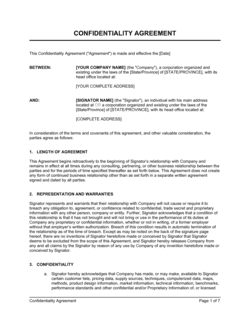
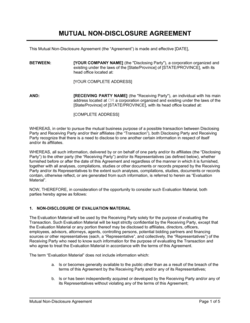
Confidentiality Agreement (Data Processing Services)

Free Word download • Edit online • Save & share with Drive • Export to PDF

8 pages30–40 min to fillDifficulty: ComplexSignature requiredLegal review recommended
Learn more ↓
FreeConfidentiality Agreement (Data Processing Services) Template

At a glance

What it is
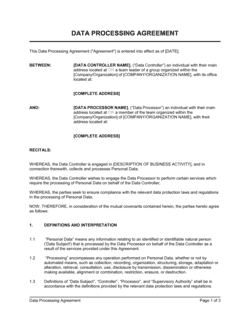
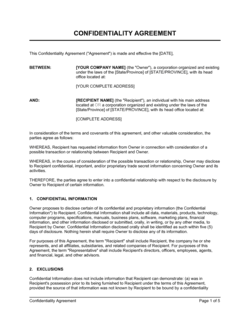
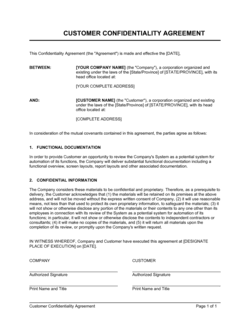
A Confidentiality Agreement for Data Processing Services is a legally binding contract between a data owner (the disclosing party) and a third-party service provider (the data processor) that restricts how confidential data may be accessed, used, stored, and transmitted. This free Word download covers the full scope of data-handling obligations — permitted use, security requirements, breach notification, and return or destruction of data — in a single enforceable document you can edit online and export as PDF.
When you need it
Use it before sharing any sensitive, proprietary, or personally identifiable information with a vendor, contractor, or subprocessor engaged to handle, analyze, store, or otherwise process that data on your behalf. It is especially critical when onboarding payroll processors, cloud storage providers, analytics vendors, or IT service companies.
What's inside
Definitions of confidential information and permitted purpose, data handling and security obligations, restrictions on disclosure and subprocessing, breach notification requirements, data return and destruction obligations, term and termination, and governing law.

What is a Confidentiality Agreement for Data Processing Services?

A Confidentiality Agreement for Data Processing Services is a legally binding contract between a data owner — the controller — and a third-party service provider — the processor — that governs exactly how the processor may access, handle, store, transmit, and ultimately destroy the controller's confidential data. Unlike a general non-disclosure agreement, this document is purpose-built for data processing engagements: it defines the permitted purpose, imposes specific technical and organizational security measures, restricts subprocessing, sets breach notification timelines, and mandates return or certified destruction of data when the engagement ends. It is the contractual instrument that converts a vendor's informal data access into a set of documented, enforceable obligations.

Why You Need This Document

Every time you hand sensitive data — customer records, financial information, employee details, or proprietary business data — to a vendor, that data leaves your control. Without a signed confidentiality agreement tailored to data processing, the vendor faces no contractual obligation to secure the data, restrict who sees it, notify you of a breach, or delete it when the project ends. The consequences are concrete: a breach by an unbound vendor exposes you to regulatory fines under GDPR, CPRA, or HIPAA, because the obligation to protect the data remains with you regardless of who caused the incident. Customers whose data is mishandled do not distinguish between your organization and your vendor. This template gives you a structured, enforceable framework to transfer data with confidence — closing the gap between a handshake vendor relationship and a documented accountability chain before the first file is shared.

Which variant fits your situation?

If your situation is…Use this template
Sharing confidential business information generally, not limited to data processingNon-Disclosure Agreement (Mutual)
Hiring an independent contractor who will handle sensitive dataIndependent Contractor Agreement with Confidentiality
Processing EU or UK personal data subject to GDPR requirementsData Processing Agreement (GDPR)
Sharing confidential information in only one direction from business to vendorOne-Way Non-Disclosure Agreement
Engaging a SaaS or cloud provider with access to customer personal dataData Processing Addendum
Onboarding a full-time employee with access to proprietary data systemsEmployment Contract with Confidentiality
Working with a healthcare vendor handling patient records under HIPAABusiness Associate Agreement (HIPAA)

Common mistakes to avoid

❌ Transferring data before the agreement is signed

Why it matters: Any data shared before execution is unprotected — the processor has no contractual obligation to keep it confidential, and regulators in the EU, UK, and Canada treat this as an unauthorized disclosure.

Fix: Make data transfer contingent on a countersigned agreement. Use a document execution checklist that blocks onboarding until the signed agreement is on file.

❌ Vague security obligation language

Why it matters: Clauses requiring only 'reasonable' or 'industry-standard' security give the processor nearly unlimited discretion and make breach remedies nearly impossible to pursue — what is standard is always disputed after an incident.

Fix: Name specific, measurable controls in the agreement: encryption algorithm, access control model, audit log retention, and any compliance certifications required.

❌ No subprocessor approval or notification requirement

Why it matters: Without a restriction, the processor can legally share your data with any vendor they use — cloud platforms, analytics tools, offshore development teams — none of whom are bound to you.

Fix: Require prior written approval for any subprocessor engagement and mandate that the processor impose equivalent confidentiality terms on all subprocessors in writing.

❌ Omitting a data return or destruction clause

Why it matters: When the engagement ends, the processor may retain copies of your data indefinitely — creating ongoing exposure for breaches, unauthorized use, and regulatory violations long after you stopped working together.

Fix: Include a mandatory return-or-destroy obligation with a specific timeframe (e.g., 30 days post-termination) and a written certification of destruction requirement.

❌ Setting a breach notification window longer than the statutory deadline

Why it matters: A contract that allows 5 business days for notification does not override GDPR's 72-hour supervisory authority reporting deadline — it just means both the processor and controller are non-compliant.

Fix: Set the contractual notification window at or inside the strictest applicable legal deadline — 48 or 72 hours covers most major jurisdictions.

❌ No survival clause for confidentiality obligations

Why it matters: Without explicit survival language, confidentiality obligations terminate with the agreement — the processor is legally free to disclose data the moment the contract ends.

Fix: Specify in the termination section that confidentiality, data return, and security obligations survive termination indefinitely or for a minimum defined period such as 5 years.

The 10 key clauses, explained

Definitions and Scope of Confidential Information

In plain language: Identifies the parties, defines what counts as confidential data in this specific engagement, and sets the outer boundaries of the agreement.

Sample language
For purposes of this Agreement, 'Confidential Information' means all data, files, records, and materials disclosed by [DISCLOSING PARTY NAME] ('Controller') to [PROCESSOR NAME] ('Processor') in connection with [DESCRIPTION OF SERVICES], including but not limited to [PERSONAL DATA / FINANCIAL RECORDS / PROPRIETARY DATA].

Common mistake: Defining confidential information too narrowly by listing only named data categories and omitting a catch-all provision — gaps in the definition allow processors to argue certain data is unprotected.

Permitted Purpose and Use Restrictions

In plain language: Limits the processor to using the data solely for the contracted service and prohibits any secondary use, profiling, sale, or analysis beyond the stated scope.

Sample language
Processor shall access and use Confidential Information solely to perform [SPECIFIC SERVICES] as described in Schedule A. Processor shall not use, analyze, copy, or retain Confidential Information for any other purpose without prior written consent from Controller.

Common mistake: Using vague permitted-purpose language like 'providing services' — courts and regulators interpret this broadly, allowing processors to justify secondary uses that the controller never intended.

Data Handling and Security Obligations

In plain language: Specifies the technical and organizational security measures the processor must maintain — encryption standards, access controls, audit logs, and physical security.

Sample language
Processor shall implement and maintain technical and organizational measures including, at minimum: [AES-256 encryption at rest and in transit], role-based access controls, annual security audits, and documented incident response procedures.

Common mistake: Referencing security obligations in vague terms like 'industry-standard security' without specifying measurable controls — this makes the clause nearly unenforceable when a breach occurs.

Restrictions on Disclosure and Subprocessing

In plain language: Prohibits the processor from sharing confidential data with third parties or engaging subprocessors without the controller's prior written approval, and imposes equivalent obligations on any approved subprocessors.

Sample language
Processor shall not disclose Confidential Information to any third party without prior written approval from Controller. Any approved subprocessor must execute a written agreement imposing obligations no less protective than those in this Agreement.

Common mistake: Allowing blanket subprocessing approval — a clause that permits 'subcontractors as needed' gives the processor free rein to share data with unvetted third parties the controller knows nothing about.

Personnel Obligations and Access Controls

In plain language: Requires the processor to limit data access to employees and contractors who need it to perform the services, and to bind those individuals to confidentiality.

Sample language
Processor shall restrict access to Confidential Information to those personnel who require such access to perform the Services ('Authorized Personnel'). Processor shall ensure all Authorized Personnel are bound by written confidentiality obligations no less restrictive than this Agreement.

Common mistake: No personnel obligation clause at all — without it, the processor's employees face no individual contractual restriction, making internal leaks harder to address.

Security Incident and Breach Notification

In plain language: Sets the timeframe and method for notifying the controller of any suspected or confirmed security incident involving the confidential data.

Sample language
Processor shall notify Controller in writing within [48 / 72] hours of becoming aware of any actual or suspected Security Incident involving Confidential Information. Notice shall include: nature of the incident, data affected, remediation steps taken, and contact details for the Processor's security lead.

Common mistake: Setting a notification window that is longer than the statutory deadline in the governing jurisdiction — under GDPR, 72 hours to supervisory authorities is mandatory, so a contract allowing 5 business days creates a compliance gap.

Data Minimization and Retention Limits

In plain language: Requires the processor to collect only the data necessary for the services and to delete or return data that exceeds defined retention periods.

Sample language
Processor shall collect, access, and retain only the minimum Confidential Information necessary to perform the Services. Processor shall not retain Confidential Information beyond [RETENTION PERIOD] from the date of collection, unless otherwise required by applicable law.

Common mistake: No retention limit at all — processors who retain data indefinitely after a project ends create ongoing breach and regulatory exposure for the controller long after the engagement closes.

Return and Destruction of Data

In plain language: Requires the processor to return or certifiably destroy all confidential data and copies upon termination or expiration of the agreement.

Sample language
Upon termination or expiration of this Agreement, or upon Controller's written request, Processor shall within [30] days return all Confidential Information or certify in writing that all copies have been permanently destroyed using [DoD 5220.22-M standard / equivalent].

Common mistake: No destruction certification requirement — without written confirmation, the controller has no evidence that data was actually deleted, leaving them exposed in a future regulatory audit.

Term, Termination, and Survival

In plain language: Defines how long the agreement lasts, the grounds for early termination, and which obligations — particularly confidentiality — survive after the agreement ends.

Sample language
This Agreement commences on [START DATE] and continues for [TERM] unless terminated earlier. Either party may terminate with [30] days' written notice. Sections [3, 4, 5, 6, 7, and 8] shall survive termination indefinitely.

Common mistake: Failing to include a survival clause — confidentiality obligations that terminate with the agreement offer no protection for data disclosed during the engagement.

Governing Law, Jurisdiction, and Remedies

In plain language: States which jurisdiction's law governs disputes and acknowledges that breach may cause irreparable harm warranting injunctive relief in addition to damages.

Sample language
This Agreement is governed by the laws of [STATE / PROVINCE / COUNTRY]. The parties submit to the exclusive jurisdiction of the courts of [JURISDICTION]. The parties acknowledge that a breach of this Agreement may cause irreparable harm for which monetary damages are an inadequate remedy, and that injunctive relief may be sought without bond.

Common mistake: Selecting a governing jurisdiction that has no meaningful connection to either party's operations — courts may decline jurisdiction, leaving the controller with no practical enforcement mechanism.

How to fill it out

  1. 1

    Identify the parties and their roles

    Enter the full legal names of the data controller and the data processor. Confirm which party owns the data and which is performing the processing services — these roles determine each party's obligations under the agreement and under applicable privacy laws.

    💡 Use registered legal entity names, not trade names or brand names — the entity that appears in your corporate registry is the one that can enforce or be bound by the contract.

  2. 2

    Define confidential information precisely

    List the specific categories of data covered — personal data, financial records, trade secrets, proprietary algorithms, or customer databases. Include a broad catch-all: 'and any other non-public information disclosed in connection with the Services.'

    💡 If you are sharing data that includes personal information of EU or UK residents, note that explicitly — it triggers GDPR obligations that go beyond standard confidentiality.

  3. 3

    Set the permitted purpose in specific terms

    Describe the exact service the processor is performing — not 'IT services' but 'hosting and processing [COMPANY NAME]'s customer transaction records for the purpose of generating monthly analytics reports.' The narrower the permitted purpose, the stronger your protection.

    💡 Attach a Schedule A describing the services in detail so the main agreement body stays clean and the permitted purpose can be updated without amending the core contract.

  4. 4

    Specify security measures and standards

    Replace generic references to 'industry-standard security' with named controls: encryption standard (e.g., AES-256), access control model (role-based or least-privilege), audit log retention period, and any compliance frameworks the processor must maintain (SOC 2 Type II, ISO 27001).

    💡 Ask the processor for their current security documentation before finalizing this clause — you can only enforce controls you have confirmed they actually operate.

  5. 5

    Address subprocessing and third-party disclosure

    Decide whether to prohibit subprocessing entirely or allow it with prior written approval. If approval is allowed, specify that approved subprocessors must sign a written agreement with equivalent protections and that the processor remains liable for their acts.

    💡 Request a current list of the processor's existing subprocessors before signing — if they are already sharing data with third parties you have not reviewed, you need to know before the agreement is executed.

  6. 6

    Set the breach notification window

    Enter a notification deadline consistent with the strictest applicable legal requirement — 72 hours covers GDPR. Include the required notice content: nature of the incident, categories and volume of data affected, likely consequences, and remediation steps taken or planned.

    💡 Pair the notification window with a clear point of contact on each side — a named security or compliance lead, not just a general email address.

  7. 7

    Define retention limits and destruction obligations

    Set the maximum period the processor may retain data after the services conclude and specify the destruction standard they must use. Require written certification of destruction within a defined number of days after termination.

    💡 Check whether the processor is subject to their own legal retention obligations (e.g., financial records laws) — where those obligations apply, the contract should carve out only what is legally required, not a blanket exception.

  8. 8

    Execute before data transfer begins

    Both parties must sign this agreement before any confidential data is shared. Post-transfer signatures create a gap period during which data was unprotected — and, in regulated industries, this alone can constitute a compliance violation.

    💡 Use a timestamped electronic signature to document the exact moment of execution, and retain the fully executed copy in a secure contract management system.

Frequently asked questions

What is a confidentiality agreement for data processing services?

A confidentiality agreement for data processing services is a binding contract between a data owner and a third-party processor that restricts how the processor may access, use, store, and share the owner's confidential data. It goes beyond a general NDA by addressing data-specific obligations: permitted purpose, security measures, subprocessor controls, breach notification, and data return or destruction. It is used whenever a business shares sensitive data — customer records, financial data, or proprietary information — with an outside vendor.

How is this different from a standard NDA?

A standard NDA restricts disclosure of confidential information generally. A confidentiality agreement for data processing services adds obligations that are specific to data handling: security standards, data minimization, breach notification timelines, subprocessor restrictions, and data destruction requirements. For any engagement where a vendor processes personal data or sensitive records on your behalf, the general NDA is typically insufficient on its own.

Is this the same as a Data Processing Agreement under GDPR?

They overlap but are not identical. A GDPR Data Processing Agreement (DPA) is a mandatory contract required under Article 28 of the GDPR whenever a controller engages a processor to handle EU personal data — it must include specific statutory terms. A confidentiality agreement for data processing services is a broader contractual instrument that addresses confidentiality obligations beyond GDPR scope. Businesses subject to GDPR should use a dedicated DPA and may supplement it with this agreement to cover non-personal confidential data.

When do I need a confidentiality agreement for data processing services?

Use it before sharing any sensitive or proprietary data with a vendor engaged to handle, store, analyze, or process that data on your behalf. Common triggers include onboarding a payroll processor, engaging a cloud storage or analytics provider, hiring a data entry contractor, or contracting with an IT service company that will access your internal systems. The agreement should be signed before any data is transferred.

Does this agreement satisfy HIPAA Business Associate Agreement requirements?

No. HIPAA requires a specific Business Associate Agreement (BAA) with defined statutory provisions for any vendor handling protected health information (PHI). This confidentiality agreement for data processing services can complement a BAA but does not replace it. Healthcare operators must use a HIPAA-compliant BAA for any PHI processing arrangement — consult a healthcare attorney to confirm both documents are in place.

What security standards should the agreement require?

The appropriate standard depends on the sensitivity of the data and the regulatory environment. At a minimum, specify encryption at rest and in transit (AES-256 is widely accepted), role-based access controls, audit logging, and an annual security review. For vendors handling financial or health data, consider requiring SOC 2 Type II certification or ISO 27001 compliance. Name these controls explicitly in the agreement rather than relying on vague 'industry standard' language.

Can a confidentiality agreement for data processing services be one-sided?

Yes, and in most data processing engagements it should be. The data controller discloses sensitive data to the processor; the processor typically discloses nothing proprietary in return. A one-directional (unilateral) agreement that binds only the processor to confidentiality is the appropriate structure for most vendor data-handling arrangements. A mutual NDA is more appropriate when both parties exchange confidential information.

How long should the confidentiality obligations last?

The agreement itself typically runs for the duration of the services engagement plus a defined post-termination period. Crucially, the confidentiality obligations themselves should survive termination — either indefinitely for trade secrets and personal data, or for a minimum of 3–5 years for other confidential information. Check applicable statutes: some jurisdictions limit post-employment confidentiality periods, and trade secret law may impose its own durational standards.

Do I need a lawyer to prepare this agreement?

For straightforward domestic vendor engagements with no personal data subject to specific privacy laws, a high-quality template is typically sufficient. Engage a lawyer when the engagement involves EU or UK personal data (GDPR), US health data (HIPAA), financial records (PCI-DSS or GLBA), cross-border data transfers, or large volumes of sensitive customer data. A 1–2 hour attorney review costs $300–$600 and is worth it for any vendor with broad access to your systems.

How this compares to alternatives

vs Mutual Non-Disclosure Agreement

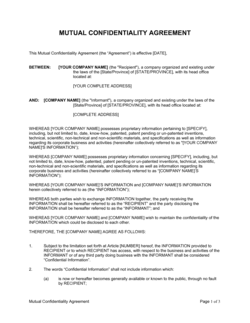
A mutual NDA restricts both parties from disclosing each other's confidential information and is appropriate when both sides are sharing proprietary materials — such as during a business partnership negotiation. A confidentiality agreement for data processing services is typically unilateral and adds data-specific obligations (security standards, breach notification, subprocessor controls, destruction requirements) that a general NDA does not address.

vs Data Processing Agreement (GDPR)

A GDPR Data Processing Agreement is a mandatory contract under Article 28 covering EU personal data specifically, with statutory required terms including data subject rights and transfer mechanisms. This confidentiality agreement is a broader instrument covering all confidential data — personal and non-personal — and may sit alongside a DPA for engagements that involve both personal data and other proprietary information.

vs Independent Contractor Agreement

An independent contractor agreement governs the overall services relationship — deliverables, payment, IP ownership, and liability. It typically contains a confidentiality clause, but that clause is general and not tailored to structured data processing obligations. When a contractor will handle significant volumes of sensitive data, a standalone confidentiality agreement for data processing services should be executed alongside the contractor agreement.

vs Business Associate Agreement (HIPAA)

A HIPAA Business Associate Agreement is a US federal law requirement for any vendor handling protected health information — it specifies mandatory terms under 45 CFR Part 164 that cannot be altered. This data processing confidentiality agreement covers broader categories of confidential data outside the healthcare-specific HIPAA framework. Healthcare operators need both: a BAA for PHI and this agreement for other sensitive data the vendor accesses.

Industry-specific considerations

Healthcare and life sciences

Patient record confidentiality, HIPAA BAA interaction, clinical trial data handling obligations, and PHI breach notification timelines running in parallel with this agreement.

Financial services and fintech

Customer financial data subject to GLBA, PCI-DSS scope for payment card processors, and strict data residency requirements limiting where transaction data may be stored or processed.

SaaS and technology

Subprocessor chains covering cloud infrastructure, analytics platforms, and customer support tools, requiring tiered confidentiality obligations flowing through the entire processing stack.

Professional services

Client data confidentiality when engaging subcontractors for accounting, payroll, or legal document processing — typically paired with an independent contractor agreement.

Retail and e-commerce

Customer purchase history and payment data shared with fulfillment, analytics, and loyalty platform vendors, with state-level privacy law compliance requirements varying by US market.

Human resources and staffing

Payroll processor, benefits administrator, and background-check vendor engagements involving sensitive employee personal data including social security numbers, health information, and compensation records.

Jurisdictional notes

United States

No single federal data processing confidentiality law governs all sectors — HIPAA covers health data, GLBA covers financial data, and FERPA covers education records. State laws add another layer: California's CPRA requires written contracts with service providers handling consumer personal information, and several other states (Virginia, Colorado, Texas, Florida) have passed similar statutes. Breach notification laws in all 50 states impose varying notification timelines, typically 30–60 days, though contractual windows should be set tighter to allow internal response time.

Canada

PIPEDA (federally) and provincial privacy laws in Quebec, Alberta, and British Columbia require organizations to use contractual measures to ensure third-party processors provide comparable privacy protection. Quebec's Law 25 (effective 2023) imposes some of the strictest requirements in North America, including mandatory privacy impact assessments before transferring personal information outside Quebec and 72-hour breach notification to the Commission d'accès à l'information. Contracts should identify whether data will cross provincial or international borders.

United Kingdom

The UK GDPR (retained post-Brexit) and the Data Protection Act 2018 require a written data processing contract meeting the requirements of Article 28 UK GDPR whenever a controller engages a processor handling UK personal data. The ICO expects contracts to specify processing instructions, security measures, and breach notification — aligning closely with the obligations in this template. Data transfers to processors outside the UK require an International Data Transfer Agreement (IDTA) or equivalent transfer mechanism.

European Union

GDPR Article 28 mandates a written contract between controller and processor for all EU personal data processing, with specific required terms that cannot be waived. Supervisory authorities must be notified of personal data breaches within 72 hours under Article 33. Data transfers outside the EEA require a lawful transfer mechanism — Standard Contractual Clauses (SCCs), adequacy decision, or Binding Corporate Rules. Non-compliance with GDPR processor obligations can result in fines of up to 2% of global annual turnover or EUR 10 million, whichever is higher.

Template vs lawyer — what fits your deal?

PathBest forCostTime
Use the templateDomestic vendor engagements involving proprietary business data with no personal data subject to specific privacy regulationsFree20–30 minutes
Template + legal reviewEngagements involving customer personal data, cross-state US data transfers, or vendors with broad system access$300–$6002–4 days
Custom draftedGDPR-regulated EU personal data transfers, HIPAA-covered health data, financial services subject to GLBA or PCI-DSS, or multi-jurisdiction data processing chains$1,500–$5,000+1–3 weeks

Glossary

Data Controller
The party that determines the purposes and means of processing personal data — typically the business engaging the service provider.
Data Processor
The party that processes personal data on behalf of the data controller, following the controller's documented instructions.
Confidential Information
Any non-public data, records, or materials disclosed by one party to the other in connection with the processing services, as defined in the agreement.
Permitted Purpose
The specific, limited reason for which the processor is authorized to access or use the confidential data — anything outside this scope is prohibited.
Subprocessor
A third party engaged by the processor to perform part of the data processing on the processor's behalf, subject to the same confidentiality obligations.
Personal Data
Any information relating to an identified or identifiable natural person — including names, email addresses, financial records, and health data.
Security Incident
Any unauthorized access, use, disclosure, alteration, or destruction of confidential data — whether accidental or intentional.
Breach Notification
The contractual and, in many jurisdictions, legal obligation to inform the data controller and relevant authorities of a security incident within a defined timeframe.
Data Minimization
The principle that a processor should access and retain only the minimum amount of data necessary to perform the contracted services.
Return or Destruction Obligation
The requirement that the processor return all confidential data to the controller or certifiably destroy it upon termination of the agreement.
Technical and Organizational Measures (TOMs)
Specific security controls — encryption, access restrictions, audit logging — that the processor commits to maintaining to protect the data.

Part of your Business Operating System

This document is one of 3,000+ business & legal templates included in Business in a Box.

  • Fill-in-the-blanks — ready in minutes
  • 100% customizable Word document
  • Compatible with all office suites
  • Export to PDF and share electronically

Create your document in 3 simple steps.

From template to signed document — all inside one Business Operating System.
1
Download or open template

Access over 3,000+ business and legal templates for any business task, project or initiative.

2
Edit and fill in the blanks with AI

Customize your ready-made business document template and save it in the cloud.

3
Save, Share, Send, Sign

Share your files and folders with your team. Create a space of seamless collaboration.

Save time, save money, and create top-quality documents.

★★★★★

"Fantastic value! I'm not sure how I'd do without it. It's worth its weight in gold and paid back for itself many times."

Managing Director · Mall Farm
Robert Whalley
Managing Director, Mall Farm Proprietary Limited
★★★★★

"I have been using Business in a Box for years. It has been the most useful source of templates I have encountered. I recommend it to anyone."

Business Owner · 4+ years
Dr Michael John Freestone
Business Owner
★★★★★

"It has been a life saver so many times I have lost count. Business in a Box has saved me so much time and as you know, time is money."

Owner · Upstate Web
David G. Moore Jr.
Owner, Upstate Web

Run your business with a system — not scattered tools

Stop downloading documents. Start operating with clarity. Business in a Box gives you the Business Operating System used by over 250,000 companies worldwide to structure, run, and grow their business.

Start free · No credit card required