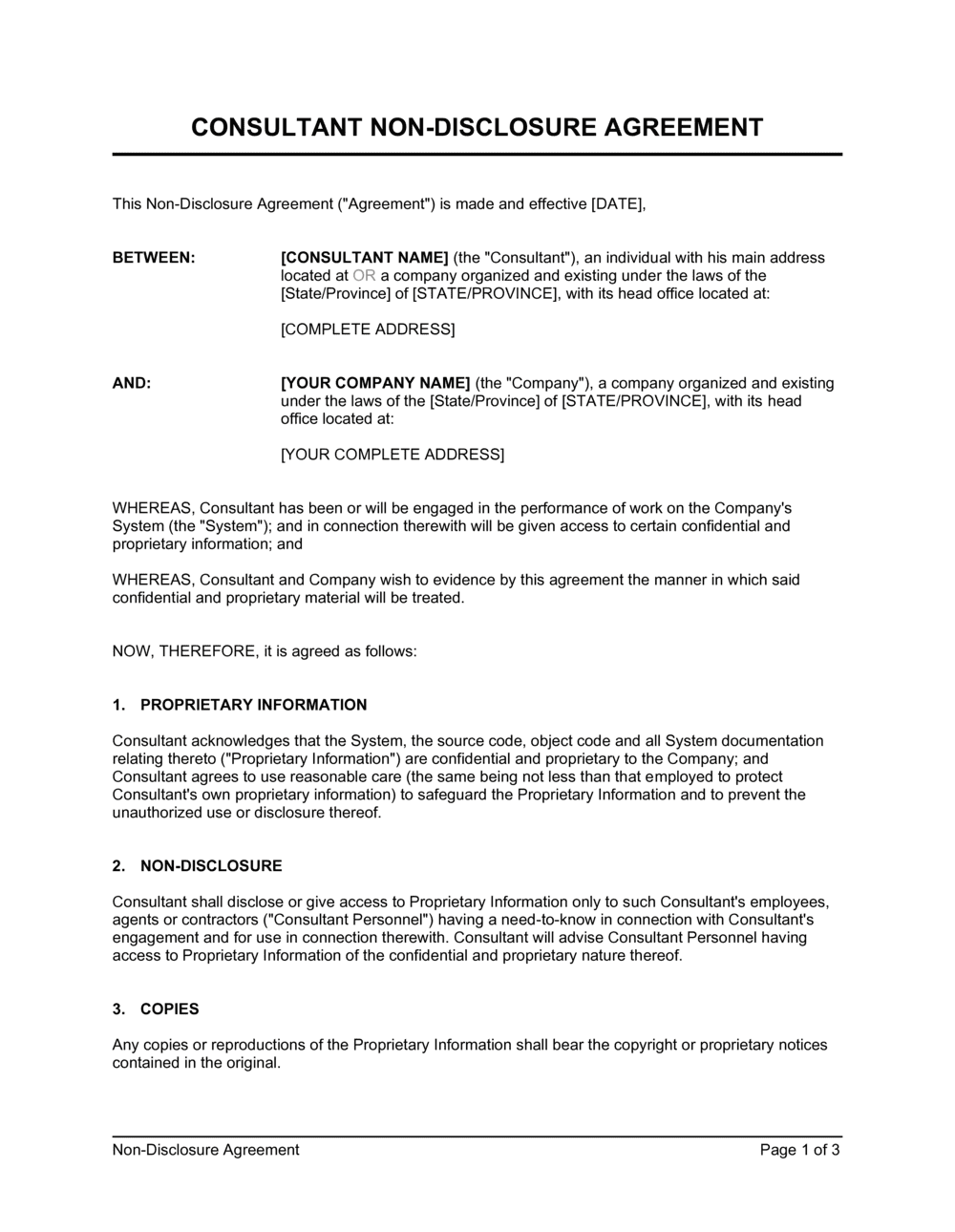
Consultant Non-Disclosure Agreement Template

Free Word download • Edit online • Save & share with Drive • Export to PDF

3 pages25–30 min to fillDifficulty: ComplexSignature requiredLegal review recommended
Learn more ↓
FreeConsultant Non-Disclosure Agreement Template

At a glance

What it is
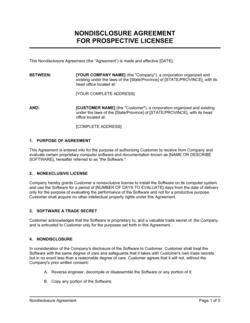
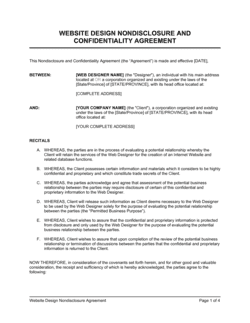
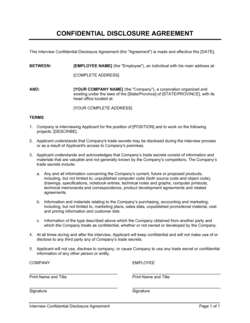
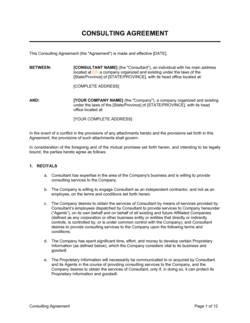
A Consultant Non Disclosure Agreement is a legally binding contract between a company and an outside consultant that prohibits the consultant from disclosing or misusing confidential information shared during the engagement. This free Word download covers the full scope of protected information, permitted uses, duration of obligations, and remedies — ready to edit online and export as PDF before any consulting work begins.
When you need it
Use it before sharing proprietary data, trade secrets, financial figures, client lists, product roadmaps, or strategic plans with any outside consultant, advisor, or freelance specialist. It should be signed before the first briefing call or document handover.
What's inside
Definition of confidential information, permitted use restrictions, exclusions from confidentiality, consultant obligations and standard of care, term and survival clauses, return or destruction of materials, injunctive relief, and governing law.

What is a Consultant Non Disclosure Agreement?

A Consultant Non Disclosure Agreement (Consultant NDA) is a legally binding contract between a company and an outside consultant that obligates the consultant to keep confidential any proprietary information shared during the engagement and to use that information only for the stated consulting purpose. It defines exactly what counts as protected information, which disclosures are permitted, what standard of care the consultant must apply, and what remedies the company can pursue if the obligation is breached. Unlike a general NDA, a consultant-specific agreement addresses the unique dynamics of an external advisory relationship — including the consultant's use of subcontractors, post-engagement return of materials, and survival of obligations after the project closes.

Why You Need This Document

Every time you brief an outside consultant, you hand them a window into the parts of your business that competitors would pay to see — pricing models, product roadmaps, client lists, and strategic plans. Without a signed NDA in place before the first conversation, you have no enforceable basis to stop a consultant from reusing your proprietary methods with competing clients, referencing your financial data in their own marketing, or simply being careless with materials that took years to build. The commercial consequences of a leak — lost competitive advantage, damaged client relationships, regulatory exposure if personal data is involved — almost always exceed the 15 minutes it takes to execute this agreement. A properly drafted Consultant NDA also preserves your right to seek an emergency court injunction the moment a breach is discovered, giving you a legal tool that speed-matches the threat.

Which variant fits your situation?

If your situation is…Use this template
Mutual information sharing between company and consultantMutual Non Disclosure Agreement
One-way NDA from employee joining the companyEmployee Non Disclosure Agreement
Protecting information shared in a potential acquisition or mergerM&A Non Disclosure Agreement
Covering confidentiality within a broader consulting engagement contractConsulting Agreement
Short-form one-page NDA for low-risk or brief engagementsSimple Non Disclosure Agreement
Protecting software source code shared with a technology consultantSoftware Development NDA
Covering confidentiality for a vendor or supplier relationshipVendor Non Disclosure Agreement

Common mistakes to avoid

❌ Sharing information before the NDA is signed

Why it matters: Any information disclosed before execution is not covered by the agreement. Courts have declined to extend NDA protection retroactively to pre-signature disclosures, leaving the disclosing party without a remedy.

Fix: Implement a firm policy: no briefing call, document handover, or system access until the fully signed NDA is in your files. Use eSign to close the gap to minutes, not days.

❌ Using an overly broad confidential information definition

Why it matters: Defining everything as confidential — including publicly available information — can cause courts to find the definition unconscionable or unenforceable, which may void the clause entirely.

Fix: Define confidential information by specific categories relevant to the engagement. Include a carveout for exclusions and avoid catch-all language that sweeps in public or pre-known information.

❌ Setting a survival period shorter than the information's sensitivity window

Why it matters: A 1-year survival clause for a proprietary pricing model or client list gives the consultant a green light to use your data competitively just 12 months after the engagement ends.

Fix: Match the survival period to the real-world shelf life of the information. Trade secrets and financial models warrant 3–5 years; project-specific operational data may only need 1–2 years.

❌ No liability pass-through for the consultant's subcontractors

Why it matters: If the consultant delegates work to a subcontractor who breaches confidentiality, and the agreement doesn't hold the consultant responsible for their Representatives, you may have no contractual remedy against anyone.

Fix: Include explicit language making the consultant liable for breaches by any person they share information with, and require them to bind those individuals to equivalent confidentiality obligations in writing.

❌ Omitting the return or destruction certification requirement

Why it matters: Without a written certification obligation, you cannot prove the consultant fulfilled their post-engagement duties — a gap that becomes critical evidence in any subsequent breach claim.

Fix: Require written certification of return or destruction within a set timeframe (10 business days is standard) and retain that certification with the executed NDA.

❌ Choosing a governing jurisdiction with no connection to the consultant's location

Why it matters: A governing-law clause selecting a distant US state or foreign jurisdiction for a locally based consultant may be unenforceable, requiring you to litigate in the consultant's home forum anyway.

Fix: Select the jurisdiction where the disclosing party is headquartered or where the work will primarily be performed. For cross-border engagements, take legal advice on enforceability before finalizing the clause.

The 10 key clauses, explained

Parties and recitals

In plain language: Identifies the disclosing company and the consultant as named legal parties, states the date of execution, and describes the general purpose of the engagement.

Sample language
This Non Disclosure Agreement ('Agreement') is entered into as of [DATE] between [COMPANY LEGAL NAME], a [STATE] [ENTITY TYPE] ('Disclosing Party'), and [CONSULTANT FULL NAME / ENTITY NAME] ('Consultant').

Common mistake: Using a trade name or brand name instead of the registered legal entity. If the entity name doesn't match the party that owns the confidential information, enforcement becomes legally complicated.

Definition of confidential information

In plain language: Sets the scope of what is protected — typically all non-public information shared in connection with the engagement, regardless of format, plus any information the consultant generates using that data.

Sample language
'Confidential Information' means any non-public information disclosed by Disclosing Party to Consultant in connection with [ENGAGEMENT DESCRIPTION], whether oral, written, electronic, or in any other form, including but not limited to [EXAMPLES: customer lists, financial projections, product specifications, pricing data].

Common mistake: Limiting the definition to written or marked materials only. Verbal disclosures in briefing calls and meetings can contain highly sensitive information — the definition should cover all formats.

Exclusions from confidentiality

In plain language: Carves out information the consultant is not obligated to protect — typically information that is already public, was already known to the consultant, was independently developed, or was lawfully received from a third party.

Sample language
Confidential Information does not include information that: (a) is or becomes publicly known through no fault of Consultant; (b) was known to Consultant prior to disclosure, as documented in writing; (c) is independently developed by Consultant without use of Confidential Information; or (d) is disclosed pursuant to a valid court order, provided Consultant gives prompt written notice.

Common mistake: Omitting the court-order carveout. Without it, the consultant faces conflicting legal obligations if subpoenaed — and the disclosing party may be unable to challenge the order in time.

Permitted use and non-use obligation

In plain language: Restricts the consultant to using confidential information solely for the stated engagement and prohibits any other use — including internal reuse, cross-selling, or application to other clients.

Sample language
Consultant shall use Confidential Information solely for the purpose of [ENGAGEMENT DESCRIPTION] ('Permitted Purpose') and shall not use Confidential Information for any other purpose without the prior written consent of Disclosing Party.

Common mistake: Defining the permitted purpose so broadly that the consultant can effectively apply your proprietary methods to competing engagements. A narrow, specific purpose clause prevents this.

Standard of care and non-disclosure obligation

In plain language: Requires the consultant to protect the information using at least the same precautions they use for their own confidential materials — and in no case less than reasonable care — and prohibits disclosure to any third party.

Sample language
Consultant shall protect Confidential Information using no less than the same degree of care it uses to protect its own confidential information, and in no event less than reasonable care. Consultant shall not disclose Confidential Information to any third party without the prior written consent of Disclosing Party.

Common mistake: No explicit minimum standard of care. Courts will imply a reasonableness standard, but specifying it removes ambiguity and strengthens enforcement.

Permitted disclosures to employees and subcontractors

In plain language: Allows the consultant to share information with their own staff or subcontractors who need it to carry out the engagement, provided those individuals are bound by equivalent confidentiality obligations.

Sample language
Consultant may disclose Confidential Information to its employees, contractors, or agents ('Representatives') who have a need to know for the Permitted Purpose, provided each Representative is bound by confidentiality obligations at least as protective as those in this Agreement. Consultant remains liable for any breach by its Representatives.

Common mistake: Allowing disclosure to Representatives without making the consultant liable for breaches by those individuals. A subcontractor who leaks your data exposes you — the liability pass-through is essential.

Term and survival

In plain language: States how long the NDA is in force and confirms that confidentiality obligations survive termination of the agreement for a defined additional period.

Sample language
This Agreement shall remain in effect for [TERM] from the Effective Date. Notwithstanding termination or expiration, Consultant's confidentiality obligations with respect to Confidential Information shall survive for [X] years following the date of disclosure.

Common mistake: Setting a short survival period — such as 1 year — for information that remains competitively sensitive for much longer. Trade secrets and proprietary financial models warrant 3–5 year survival periods or indefinite protection.

Return or destruction of materials

In plain language: Requires the consultant to promptly return all confidential materials or certify in writing that they have been destroyed when the engagement ends or on the disclosing party's request.

Sample language
Upon termination of this Agreement or upon written request by Disclosing Party, Consultant shall promptly return or destroy all Confidential Information and any copies or derivatives thereof, and shall provide written certification of such return or destruction within [10] business days.

Common mistake: No certification requirement. Without a written confirmation of destruction, the disclosing party has no evidence the obligation was fulfilled — this becomes critical if a breach surfaces later.

Injunctive relief and remedies

In plain language: Acknowledges that monetary damages alone are inadequate to remedy a breach and explicitly preserves the disclosing party's right to seek an emergency court injunction without posting a bond.

Sample language
Consultant acknowledges that a breach of this Agreement would cause irreparable harm to Disclosing Party for which monetary damages would be an inadequate remedy. Disclosing Party shall be entitled to seek injunctive relief and other equitable remedies in any court of competent jurisdiction without the requirement to post a bond.

Common mistake: Omitting the no-bond clause. Courts often require a security deposit before issuing an emergency injunction — waiving it contractually removes a barrier when speed is critical.

Governing law and dispute resolution

In plain language: Specifies which jurisdiction's law governs the agreement and how disputes will be resolved — litigation, arbitration, or mediation — and where proceedings will take place.

Sample language
This Agreement shall be governed by the laws of [STATE / PROVINCE / COUNTRY], without regard to conflict-of-law principles. Any dispute arising hereunder shall be resolved by [binding arbitration / litigation] in [CITY, STATE], and each party consents to the exclusive jurisdiction of the courts located therein.

Common mistake: Choosing a governing jurisdiction with no connection to where the consultant operates. Courts in the consultant's home jurisdiction may refuse to enforce a foreign-law clause for a domestic-resident defendant.

How to fill it out

  1. 1

    Identify and name the parties correctly

    Enter the company's full registered legal entity name and the consultant's full legal name or business entity. If the consultant operates through a corporation or LLC, use that entity — not their personal name.

    💡 Ask for the consultant's W-9 or business registration before the agreement is signed — the name on the NDA should match their tax filing exactly.

  2. 2

    Define the engagement purpose

    Write a specific, narrow description of the consulting engagement that will govern what counts as a permitted use of confidential information. Generic phrases like 'business advisory services' leave the door open for misuse.

    💡 One precise sentence — e.g., 'evaluating supply chain cost reduction options for the [PRODUCT LINE] division' — is more enforceable than three vague ones.

  3. 3

    Scope the confidential information definition

    Customize the definition to reflect the actual categories of information you will share: financial models, customer data, technical specifications, pricing structures, or strategic plans. List them explicitly rather than relying solely on catch-all language.

    💡 If you will be sharing personal data covered by GDPR, CCPA, or PIPEDA, add a data protection clause or attach a data processing addendum — this NDA alone does not satisfy those obligations.

  4. 4

    Set the term and survival period

    Choose the agreement term — typically coterminous with the engagement plus a defined tail — and set the survival period for confidentiality obligations. Use 3–5 years for sensitive trade secrets and proprietary financial data.

    💡 If the engagement has no fixed end date, tie the term to 'the earlier of completion of the engagement or [DATE]' to avoid an open-ended obligation on both sides.

  5. 5

    Confirm the return or destruction clause

    Specify whether you prefer return or destruction of materials, set a deadline (10 business days is standard), and require written certification. Add a clause allowing you to retain copies in legal hold if litigation is reasonably anticipated.

    💡 For digital materials, destruction means permanent deletion from all devices and cloud storage — add explicit language covering backup systems.

  6. 6

    Select governing law and dispute forum

    Choose the jurisdiction whose law will govern — typically your company's home state or province — and decide between court litigation and binding arbitration. Arbitration is faster and private; litigation preserves appeal rights.

    💡 For cross-border engagements, confirm that your chosen governing law is enforceable in the consultant's jurisdiction before finalizing — some countries restrict foreign governing-law clauses.

  7. 7

    Execute before any information is shared

    Both parties must sign the agreement before the first briefing, document handover, or access to any system. Send via eSign and retain a timestamped, fully executed copy in your records.

    💡 Information shared before execution is not covered by the NDA — even if you sign the next day. When in doubt, delay the briefing, not the signature.

  8. 8

    Retain the executed agreement and log disclosures

    Store the signed NDA in a secure contract management system and log each significant disclosure with a date and description. This log is your first line of evidence if a breach occurs.

    💡 A simple spreadsheet tracking disclosure date, material type, and recipient is sufficient for most small businesses and dramatically strengthens any enforcement action.

Frequently asked questions

What is a Consultant Non Disclosure Agreement?

A Consultant Non Disclosure Agreement is a legally binding contract between a company and an outside consultant that restricts the consultant from disclosing or misusing confidential business information shared during the engagement. It defines what information is protected, how the consultant may use it, for how long obligations last, and what remedies the company has if the agreement is breached. It is typically one-way — protecting the company's information only — though mutual versions exist when both parties share sensitive data.

Why do I need an NDA before engaging a consultant?

Consultants routinely receive access to trade secrets, financial models, client lists, product roadmaps, and strategic plans that would cause real commercial harm if disclosed to competitors or misused in other engagements. Without a signed NDA, you have no enforceable confidentiality obligation and no legal basis to seek an injunction or damages if the consultant shares your information. A signed NDA also signals to the consultant that you take IP protection seriously, which deters casual breaches before they happen.

What is the difference between a Consultant NDA and a standard NDA?

A Consultant NDA is tailored to the specific dynamics of an external advisory relationship — it addresses permitted use tied to a defined engagement scope, liability for the consultant's subcontractors and employees, return or destruction of deliverables at engagement end, and survival of obligations beyond the engagement term. A general NDA covers basic non-disclosure between any two parties but may lack these consultant-specific provisions, leaving gaps around subcontractor access and post-engagement use of your information.

Should the NDA be one-way or mutual?

A one-way (unilateral) NDA is appropriate when only the company is sharing sensitive information with the consultant — which is the most common scenario. A mutual NDA is needed when the consultant will also be sharing proprietary methodologies, tools, or information that they consider confidential. If you are unsure, a mutual agreement covers both scenarios without disadvantage — the symmetry often makes it easier to negotiate as well.

How long should a Consultant NDA last?

The agreement itself typically runs for the duration of the engagement plus a tail period. The confidentiality obligations should survive termination for 2–5 years, depending on the sensitivity of the information shared. Trade secrets, proprietary financial models, and customer data warrant longer survival periods. Some agreements provide indefinite protection for materials that qualify as statutory trade secrets — which is enforceable in most jurisdictions as long as the information retains its secret character.

Does a Consultant NDA replace a Consulting Agreement?

No. A Consultant NDA covers confidentiality only. A Consulting Agreement covers the full scope of the engagement — deliverables, fees, timelines, IP ownership, liability limitations, and termination. For any substantive engagement, you need both documents. The NDA should be signed first, as it protects the conversations and materials shared while the Consulting Agreement is being negotiated.

Is a Consultant NDA enforceable if the consultant is in another country?

Cross-border enforceability depends on the governing-law clause and the consultant's home jurisdiction. Courts in most common-law countries (US, UK, Canada, Australia) will generally enforce a foreign NDA if the governing-law clause is reasonable and the obligations are not contrary to local public policy. However, some EU member states and other civil-law countries apply mandatory local rules that override contractual choice-of-law. For international engagements, consider legal review to confirm the clause is effective in the consultant's jurisdiction.

What happens if a consultant violates the NDA?

A breach entitles the disclosing party to seek injunctive relief to stop ongoing or threatened disclosure, monetary damages for actual losses caused by the breach, and potentially disgorgement of profits the consultant earned from the misuse. The injunctive relief clause in the agreement is particularly important because courts can issue emergency orders within days when trade secret misappropriation is evident. Without a signed NDA, the company would need to rely on trade secret laws alone, which require additional proof of reasonable protective measures.

Do I need a lawyer to prepare a Consultant NDA?

For standard domestic consulting engagements, a well-drafted template is typically sufficient. Legal review is advisable when the engagement involves particularly sensitive IP such as patentable inventions or source code, when the consultant is located in a jurisdiction with unusual confidentiality laws, when the engagement involves regulated data such as health or financial records, or when the potential commercial harm from a breach would be severe. A 1-hour NDA review typically costs $200–$400 and is worthwhile for high-stakes engagements.

How this compares to alternatives

vs Mutual Non Disclosure Agreement

A Mutual NDA creates confidentiality obligations running in both directions — each party is simultaneously a disclosing and receiving party. A Consultant NDA is typically one-way, protecting only the company's information. Use the mutual version when the consultant will also be sharing proprietary methodologies or tools that both parties want protected.

vs Consulting Agreement

A Consulting Agreement governs the entire engagement — scope, deliverables, fees, IP ownership, and liability. A Consultant NDA addresses only confidentiality. Both documents are needed for any substantive engagement; the NDA should be executed first so that pre-contract discussions are protected, then the Consulting Agreement is finalized.

vs Employee Non Disclosure Agreement

An Employee NDA is designed for internal staff who encounter confidential information through regular employment. It typically piggybacks on the employer-employee relationship and includes broader IP assignment language. A Consultant NDA is tailored to an independent contractor relationship, carries no IP assignment by default, and must address subcontractor access separately.

vs Independent Contractor Agreement

An Independent Contractor Agreement defines the work relationship, deliverables, payment, and often includes a basic confidentiality clause. That embedded clause is rarely as detailed or protective as a standalone Consultant NDA. For engagements involving sensitive information, use both documents — the Contractor Agreement to define the work, and this NDA to enforce robust confidentiality obligations.

Industry-specific considerations

Technology / SaaS

Protecting source code, system architecture, and product roadmaps shared with technology consultants or security auditors who require deep system access.

Financial Services

Covering proprietary trading strategies, client portfolio data, and regulatory filings shared with compliance or M&A consultants under strict data-handling obligations.

Healthcare

Protecting patient data handling protocols and clinical trial data shared with management or IT consultants, with HIPAA compliance obligations layered onto the base NDA.

Professional Services

Securing client lists, billing rate structures, and proprietary methodologies shared with operational efficiency or talent consultants engaged across the firm.

Manufacturing

Guarding production formulas, supplier pricing, and process engineering data shared with supply chain or lean manufacturing consultants.

Retail / E-commerce

Protecting customer segmentation models, pricing algorithms, and vendor contracts shared with digital transformation or category management consultants.

Jurisdictional notes

United States

The Defend Trade Secrets Act (DTSA) provides federal civil remedies for trade secret misappropriation, supplementing state-level Uniform Trade Secrets Act (UTSA) protections adopted by most states. California requires consideration beyond the consulting relationship for certain post-engagement restrictions. NDAs that are unreasonably broad in scope may be deemed void as against public policy in California and a small number of other states.

Canada

Trade secret protection in Canada derives primarily from common law in most provinces, with Quebec following civil-law principles under the Civil Code. NDAs are generally enforceable if the scope, duration, and definition of confidential information are reasonable. PIPEDA and provincial privacy laws (including Quebec's Law 25) may impose additional obligations when the consultant receives personal data, requiring a separate data processing agreement.

United Kingdom

English law recognizes a common-law duty of confidence independent of any written agreement, but a signed NDA is still best practice to define scope and remedies clearly. The Trade Secrets (Enforcement, etc.) Regulations 2018 align UK protections broadly with EU standards post-Brexit. Courts will enforce NDA clauses if they are reasonable in scope; injunctions are available from the High Court for urgent breaches.

European Union

EU Trade Secrets Directive (2016/943) harmonizes protection across member states, requiring reasonable secrecy measures and providing civil remedies for misappropriation. GDPR applies if the consultant processes any personal data — the NDA must be supplemented by a Data Processing Agreement under Article 28. Some member states (notably Germany and France) impose mandatory provisions that override contractual terms, so local legal review is advisable for cross-border engagements.

Template vs lawyer — what fits your deal?

PathBest forCostTime
Use the templateStandard domestic consulting engagements where the company shares business data, financials, or strategy with a single consultant or small firmFree15–20 minutes
Template + legal reviewEngagements involving patentable IP, regulated data (HIPAA, GDPR, CCPA), or consultants based outside your home jurisdiction$200–$5001–3 days
Custom draftedHigh-value engagements with material trade secret exposure, multi-party consulting arrangements, or cross-border projects with complex governing-law issues$800–$2,500+3–7 days

Glossary

Confidential Information
Any non-public data, documents, or knowledge — including trade secrets, financials, and customer lists — that the disclosing party designates as confidential or that a reasonable person would understand to be confidential.
Disclosing Party
The company or individual sharing confidential information with the consultant under the agreement.
Receiving Party
The consultant or advisor who receives and is obligated to protect the disclosing party's confidential information.
Trade Secret
Commercially valuable information that derives its value from being kept secret and that the owner takes reasonable steps to protect — such as formulas, algorithms, or client pricing models.
Standard of Care
The minimum level of precaution the receiving party must apply to protect confidential information — typically 'at least the same care the receiving party uses to protect its own confidential information, but no less than reasonable care.'
Permitted Use
The specific, limited purpose for which the consultant may access and use confidential information — typically defined as carrying out the stated consulting engagement only.
Residuals Clause
A provision allowing a receiving party to use information retained in unaided human memory after the engagement — considered consultant-friendly and often negotiated out by disclosing parties.
Survival Clause
A provision stating that confidentiality obligations continue in force for a defined period after the agreement or engagement terminates.
Injunctive Relief
A court order requiring a party to stop a specific action — such as disclosing confidential information — used because monetary damages alone are often insufficient to remedy a breach.
Return or Destruction
The contractual obligation for the consultant to return all confidential materials or certify their destruction upon termination of the engagement or on the disclosing party's request.

Part of your Business Operating System

This document is one of 3,000+ business & legal templates included in Business in a Box.

  • Fill-in-the-blanks — ready in minutes
  • 100% customizable Word document
  • Compatible with all office suites
  • Export to PDF and share electronically

Create your document in 3 simple steps.

From template to signed document — all inside one Business Operating System.
1
Download or open template

Access over 3,000+ business and legal templates for any business task, project or initiative.

2
Edit and fill in the blanks with AI

Customize your ready-made business document template and save it in the cloud.

3
Save, Share, Send, Sign

Share your files and folders with your team. Create a space of seamless collaboration.

Save time, save money, and create top-quality documents.

★★★★★

"Fantastic value! I'm not sure how I'd do without it. It's worth its weight in gold and paid back for itself many times."

Managing Director · Mall Farm
Robert Whalley
Managing Director, Mall Farm Proprietary Limited
★★★★★

"I have been using Business in a Box for years. It has been the most useful source of templates I have encountered. I recommend it to anyone."

Business Owner · 4+ years
Dr Michael John Freestone
Business Owner
★★★★★

"It has been a life saver so many times I have lost count. Business in a Box has saved me so much time and as you know, time is money."

Owner · Upstate Web
David G. Moore Jr.
Owner, Upstate Web

Run your business with a system — not scattered tools

Stop downloading documents. Start operating with clarity. Business in a Box gives you the Business Operating System used by over 250,000 companies worldwide to structure, run, and grow their business.

Free Forever Plan · No credit card required