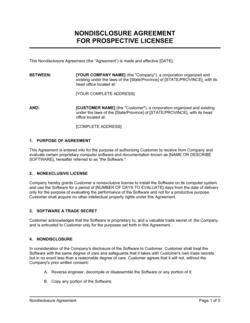
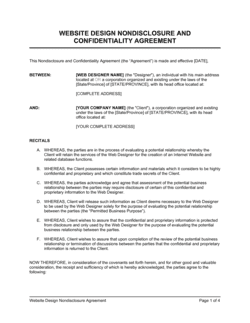
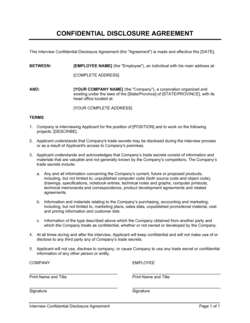
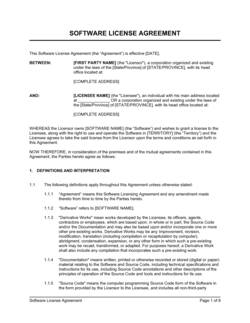
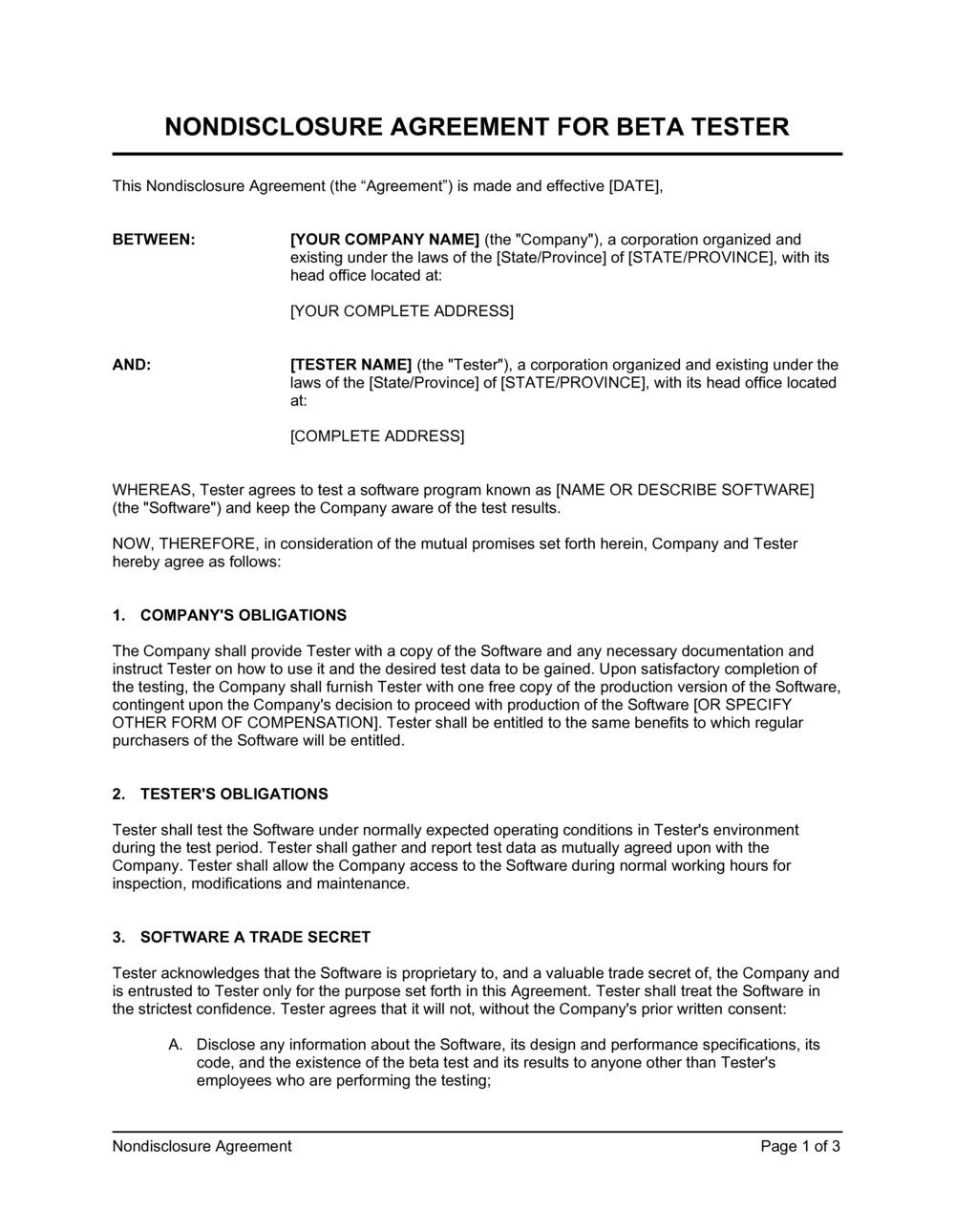
Non-Disclosure Agreement Beta Tester Template

Free Word download • Edit online • Save & share with Drive • Export to PDF

3 pages25–30 min to fillDifficulty: ComplexSignature requiredLegal review recommended
Learn more ↓
FreeNon-Disclosure Agreement Beta Tester Template

At a glance

What it is
A Non Disclosure Agreement Beta Tester is a legally binding contract between a company and an individual invited to test an unreleased product or software build. It prevents the beta tester from disclosing product features, bugs, roadmap details, or any feedback exchanged during the testing period. This free Word download covers all core confidentiality obligations and can be edited online and exported as PDF in minutes.
When you need it
Use it before granting any external individual access to a pre-release product, prototype, or beta build — whether that is a closed software beta, a hardware prototype, or an unreleased mobile app. It should be signed before the tester receives credentials, hardware, or any product documentation.
What's inside
Definition of confidential information, scope of the testing engagement, permitted and prohibited uses of confidential information, feedback and IP ownership, term and termination, return or destruction of materials, and governing law. The agreement also covers the consequences of unauthorized disclosure and the company's right to seek injunctive relief.

What is a Non Disclosure Agreement Beta Tester?

A Non Disclosure Agreement Beta Tester is a legally binding contract between a company and an individual granted access to an unreleased product, software build, or prototype for evaluation purposes. It obligates the tester to keep all product information, features, bugs, and feedback strictly confidential — preventing leaks to competitors, the press, or the public before the company is ready to disclose. Beyond basic confidentiality, the agreement assigns ownership of any feedback or suggestions the tester provides directly to the company, closing the IP gap that a standard NDA leaves open. It is generally enforceable when signed before the tester receives any access credentials or materials.

Why You Need This Document

Distributing a beta build without a signed NDA is one of the most common and costly mistakes early-stage product teams make. A single screenshot posted to a public forum can reveal an unreleased feature to competitors, trigger premature press coverage, and undermine a carefully planned launch. Without a written agreement, you have no legal basis to demand the tester stop publishing, no claim to ownership of feedback that later ships as a core product feature, and no mechanism to recover devices or delete copies of a beta build after the program ends. A properly executed beta tester NDA closes all four gaps — confidentiality, IP ownership, access control, and material return — for the time it takes to fill in a template and send a signing link before issuing the first credential.

Which variant fits your situation?

If your situation is…Use this template
Beta testing with an individual external tester or enthusiastNon Disclosure Agreement Beta Tester
Sharing confidential info with a business partner or vendorMutual Non Disclosure Agreement
Hiring a contractor who will access proprietary source codeIndependent Contractor Agreement with NDA
Onboarding an employee to a product team handling pre-release buildsEmployment Contract with Confidentiality Clause
Sharing a product demo or pitch deck with a potential investorNon Disclosure Agreement (One-Way)
Running a paid beta with multiple business clients under one agreementBeta Software License and NDA
Protecting a physical hardware prototype sent to a testing labConfidentiality Agreement (Hardware Prototype)

Common mistakes to avoid

❌ Issuing beta credentials before the NDA is signed

Why it matters: Once the tester has access to the product, they have seen the confidential information — signing the NDA after the fact creates a consideration problem and signals you were not serious about protecting the IP.

Fix: Automate the onboarding flow so credential delivery is gated behind NDA signature. E-signature tools make this a single workflow step.

❌ No social media or public forum prohibition

Why it matters: The most damaging beta leaks happen on Reddit, Discord, and Twitter within hours of a build going out. A generic non-disclosure clause that doesn't name these channels is ambiguous and harder to enforce.

Fix: Add an explicit non-publication clause listing social media, forums, blogs, podcasts, and any other public channel — and include a clause requiring the tester to notify you within 24 hours if they become aware of a third-party leak.

❌ Omitting an IP ownership clause for feedback

Why it matters: A tester who suggests a feature that ships in version 1.0 can later claim co-authorship or demand royalties if there is no written assignment of feedback ownership.

Fix: Include a clear, broad IP assignment covering all feedback, suggestions, and derivative ideas, with a present-tense assignment ('Tester hereby assigns') rather than a future obligation ('Tester agrees to assign').

❌ Setting no post-termination confidentiality period

Why it matters: An NDA that expires the moment the beta program ends allows the tester to publicly discuss everything they saw immediately after the product launches — potentially before general availability.

Fix: Set a confidentiality tail of at least 2 years after the agreement terminates, regardless of whether the product has launched publicly.

❌ Using only a display name or email handle to identify the tester

Why it matters: An agreement signed by 'xTestPilot42' or a pseudonymous email cannot be enforced against a real person because you cannot prove who signed it.

Fix: Collect full legal name, physical address, and a government ID number or equivalent as part of the beta tester onboarding process before the NDA is executed.

❌ No return or destruction clause for beta builds

Why it matters: Without an obligation to delete the beta software, testers may keep old builds indefinitely and continue using or distributing them after the program ends.

Fix: Require written certification of deletion within 5 business days of the program's end. For hardware, require return of the physical device by a specified date with prepaid shipping.

The 10 key clauses, explained

Parties and Recitals

In plain language: Identifies the company and the beta tester by full legal name, states the purpose of the agreement, and establishes that the tester is receiving access to confidential pre-release materials.

Sample language
This Non Disclosure Agreement ('Agreement') is entered into as of [DATE] between [COMPANY LEGAL NAME], a [STATE/COUNTRY] [ENTITY TYPE] ('Company'), and [TESTER FULL NAME] ('Tester'). Company wishes to provide Tester with access to certain pre-release software and related materials for evaluation purposes.

Common mistake: Using only a username or online handle instead of the tester's legal name. If the tester breaches the NDA, you cannot enforce it against an unidentified party.

Definition of Confidential Information

In plain language: Sets out exactly what information is covered — software builds, source code, feature roadmaps, UI/UX designs, performance data, and any written or oral communications related to the beta product.

Sample language
'Confidential Information' means all non-public information disclosed by Company to Tester in connection with this Agreement, including but not limited to pre-release software builds, feature specifications, product roadmaps, bug and error data, user interface designs, and any feedback exchanged between the parties.

Common mistake: Defining confidential information so broadly that it includes publicly known information. Courts may refuse to enforce an NDA that attempts to cover information already in the public domain.

Scope of Permitted Use

In plain language: Limits the tester to using confidential information solely for the purpose of evaluating and testing the product, and prohibits any other use including competitive analysis or personal projects.

Sample language
Tester shall use Confidential Information solely for the purpose of evaluating and testing the [PRODUCT NAME] beta build as directed by Company. Tester shall not use Confidential Information for any commercial purpose, competitive analysis, or personal project without Company's prior written consent.

Common mistake: Not specifying that feedback cannot be used to develop a competing product. A broad 'evaluation only' clause may not cover this scenario explicitly.

Non-Disclosure Obligations

In plain language: Prohibits the tester from sharing, publishing, or discussing any confidential information with third parties — including on social media, forums, or in press interviews — without prior written permission.

Sample language
Tester shall not disclose, publish, or disseminate any Confidential Information to any third party, including on social media, public forums, blogs, or in any media interview, without Company's express prior written consent. Tester shall protect Confidential Information using at least the same degree of care used to protect their own confidential information, and no less than reasonable care.

Common mistake: Omitting social media and public forums from the list of prohibited disclosure channels. Beta leaks most commonly occur on Reddit, Twitter, and Discord — not in formal press releases.

Feedback and IP Ownership

In plain language: Assigns to the company full ownership of all feedback, bug reports, suggestions, and improvements provided by the tester during the beta period, preventing any future IP ownership claim by the tester.

Sample language
All feedback, suggestions, bug reports, ideas, improvements, and other input provided by Tester to Company in connection with this Agreement ('Feedback') shall be the sole and exclusive property of Company. Tester hereby irrevocably assigns to Company all right, title, and interest in and to such Feedback, including all intellectual property rights therein.

Common mistake: Having no IP assignment clause at all. Without it, a tester who suggests a feature that ships in the final product could claim co-authorship or demand compensation.

Exclusions from Confidentiality

In plain language: Carves out information that is already public, that the tester independently knew before the engagement, or that the tester receives from a third party without restriction — standard exclusions that courts expect to see.

Sample language
The obligations in this Agreement shall not apply to information that: (a) is or becomes publicly known through no breach by Tester; (b) was rightfully known to Tester prior to disclosure by Company; (c) is received by Tester from a third party without restriction; or (d) is independently developed by Tester without use of Confidential Information.

Common mistake: Omitting the standard exclusions entirely in an attempt to make the NDA 'stronger.' This backfires — courts are more likely to void an NDA with no exclusions as unconscionable.

Term and Termination

In plain language: Sets the duration of the testing engagement and the post-termination confidentiality tail — typically 1–3 years after the agreement ends — and describes how either party may terminate early.

Sample language
This Agreement commences on [START DATE] and continues until [END DATE] or until terminated by either party on [X] days' written notice. Tester's confidentiality obligations shall survive termination of this Agreement for a period of [2] years.

Common mistake: Setting no post-termination confidentiality tail. If the NDA expires the moment the beta ends, a tester can immediately publish everything they learned.

Return or Destruction of Materials

In plain language: Requires the tester to return or permanently delete all beta software, documentation, and confidential files upon termination or at the company's request.

Sample language
Upon termination of this Agreement or upon Company's written request, Tester shall promptly return to Company or certify in writing the destruction of all Confidential Information in any form, including all copies, notes, and derivative materials, and shall delete all beta software from any device on which it was installed.

Common mistake: Not requiring a written certification of destruction. A verbal assurance that files have been deleted is not auditable and provides no legal protection.

Remedies and Injunctive Relief

In plain language: States that breach of the NDA would cause irreparable harm and entitles the company to seek immediate injunctive relief in court without having to prove financial damages first.

Sample language
Tester acknowledges that any breach of this Agreement would cause irreparable harm to Company for which monetary damages would be an inadequate remedy. Accordingly, Company shall be entitled to seek equitable relief, including injunctive relief and specific performance, without the requirement of posting a bond or other security.

Common mistake: Relying solely on a damages clause without including injunctive relief language. By the time financial damages are calculated, the confidential information is already public and the harm is done.

Governing Law and Dispute Resolution

In plain language: Specifies the jurisdiction whose law governs the agreement and how disputes will be resolved — typically the company's home state or country, with litigation or arbitration as the mechanism.

Sample language
This Agreement shall be governed by the laws of [STATE / PROVINCE / COUNTRY], without regard to conflict-of-law principles. Any dispute arising under this Agreement shall be resolved exclusively in the courts located in [CITY, STATE / COUNTRY], and each party consents to personal jurisdiction therein.

Common mistake: Choosing a governing law that has no connection to either party's location. Some jurisdictions — including California — apply local trade secret law regardless of what the contract specifies.

How to fill it out

  1. 1

    Identify both parties with full legal names

    Enter the company's registered legal name — not a brand or product name — and the beta tester's full legal name as it appears on government ID. For business entities acting as testers, include the entity type and registration jurisdiction.

    💡 For remote or anonymous testers, collect identity verification before issuing credentials — an NDA signed by 'JohnDoe99' is unenforceable.

  2. 2

    Define the scope of confidential information precisely

    List every category of information the tester will access: pre-release software builds, design mockups, feature specs, pricing data, roadmap slides, and any oral briefings. The more specific the list, the easier it is to prove a breach.

    💡 Add a catch-all phrase after the list — 'and any other non-public information disclosed in connection with the beta program' — to cover items not explicitly enumerated.

  3. 3

    Set the testing period and confidentiality tail

    Enter the start and end date of the beta program. Then set the post-termination confidentiality period — 2 years is standard for software betas; 3 years for hardware or enterprise products with longer competitive cycles.

    💡 Tie the confidentiality tail to a specific date rather than a relative period — 'until December 31, 2028' is clearer than '2 years from termination' and easier to enforce.

  4. 4

    Include the IP assignment and feedback clause

    Confirm the clause assigns all feedback, bug reports, and feature suggestions to the company effective immediately upon creation. Have the tester initial this clause separately if your jurisdiction requires explicit acknowledgment for IP assignments.

    💡 If you are running a paid beta, add a sentence confirming that any compensation paid is in exchange for both testing services and the IP assignment — this prevents a later claim that the assignment lacked consideration.

  5. 5

    Tailor the permitted use restriction

    Specify that the tester may only use the beta build on approved devices, may not reverse-engineer or decompile it, and may not benchmark it against competing products without written consent.

    💡 For mobile betas, add a clause prohibiting screen recording and screenshot sharing, which are the most common leak vectors.

  6. 6

    Add the return or destruction obligation

    Require that the tester delete the beta software, revoke credentials, and return or destroy any physical materials within 5 business days of the program's end. Include a written certification requirement.

    💡 For enterprise or hardware betas, specify a witnessed destruction procedure or require proof of data-wiping software output.

  7. 7

    Confirm governing law matches the enforceability landscape

    Choose the governing law based on where your company is incorporated and where the tester is located. If testers are in California, check that your confidentiality obligations comply with California trade secret law.

    💡 For international beta programs, consider adding a separate exhibit addressing EU GDPR obligations if testers are based in Europe.

  8. 8

    Execute before issuing access credentials

    Both parties must sign the agreement before the tester receives any beta build, login, or documentation. Use e-signature with a timestamp to create an audit trail. Never distribute credentials first and follow up with paperwork later.

    💡 Send the NDA as a signing link via Business in a Box eSign so the timestamp and IP address of execution are captured automatically.

Frequently asked questions

What is a beta tester NDA?

A beta tester NDA is a confidentiality agreement between a company and an individual invited to test an unreleased product. It legally prohibits the tester from disclosing product features, bugs, design details, or any other information encountered during the testing period. It also typically assigns ownership of the tester's feedback to the company. It is generally enforceable when properly executed before the tester receives any access.

Do I need an NDA for beta testers?

Yes, if your beta build contains unreleased features, proprietary technology, or roadmap information that could harm your competitive position if disclosed. Without one, testers have no legal obligation to keep what they see private. Even for informal open betas, a lightweight NDA establishes clear expectations and gives you a legal basis to act if a damaging leak occurs.

Can a beta tester NDA be one-sided?

Yes. A beta tester NDA is typically a one-way (unilateral) agreement where only the tester has confidentiality obligations. The company is disclosing information; the tester is receiving it. A mutual NDA would only be appropriate if the tester is also sharing proprietary information with the company — for example, a corporate pilot customer sharing internal process data as part of the evaluation.

Who owns the feedback a beta tester provides?

By default — without a written agreement — ownership of feedback and ideas is legally ambiguous in many jurisdictions. A beta tester NDA with an IP assignment clause transfers all feedback, bug reports, and feature suggestions to the company immediately upon creation. Without this clause, a tester who suggests a feature that ships in the final product could potentially claim co-authorship or seek compensation.

How long should a beta tester NDA last?

The agreement should cover the active testing period plus a post-termination confidentiality tail. Two years after the program ends is standard for software products. For hardware, enterprise software, or products with longer competitive cycles, three years is more appropriate. The tail should be clearly stated as a fixed end date rather than a relative period to avoid ambiguity.

What happens if a beta tester leaks information?

If the NDA is properly executed, the company can seek damages for any financial harm caused by the leak. More importantly, a well-drafted NDA includes an injunctive relief clause, which allows the company to obtain a court order requiring the tester to stop disclosing information immediately — without waiting to quantify financial damages. Trade secret laws in most jurisdictions may provide additional remedies.

Can I use a standard NDA for beta testers, or do I need a specialized version?

A standard mutual NDA is not ideal for beta testing. Beta-specific NDAs include provisions that generic NDAs omit: IP assignment of feedback, restrictions on benchmarking and reverse engineering, social media non-publication clauses, device-specific access restrictions, and return-or-destruction obligations for beta builds. Using a generic NDA leaves meaningful gaps that are common in beta leak scenarios.

Is a beta tester NDA enforceable against international testers?

Generally yes, but enforcement is more complex across borders. The governing law clause determines which jurisdiction's courts and laws apply. For EU-based testers, the NDA should also address GDPR compliance if the company processes any personal data from the tester. For testers in multiple countries, consider a jurisdiction-specific addendum or consult a lawyer familiar with cross-border IP enforcement.

Does clicking 'I agree' on a beta sign-up form create an enforceable NDA?

A click-through agreement can be enforceable in many jurisdictions if the terms are clearly presented before acceptance and the user takes an affirmative action to agree. However, enforceability is stronger with a separately signed document — especially for high-value IP. For consumer betas with large tester pools, a click-through may be practical; for enterprise or hardware betas, a signed NDA is strongly preferred.

How this compares to alternatives

vs Standard Non Disclosure Agreement

A standard NDA covers general confidential information exchanges between two parties — business plans, financial data, or partnership details. A beta tester NDA adds provisions specific to product testing: IP assignment of feedback, reverse-engineering restrictions, device-specific access controls, and return-or-destruction obligations for beta builds. Use the standard NDA for business discussions; use the beta-specific version for any product access.

vs Mutual Non Disclosure Agreement

A mutual NDA imposes confidentiality obligations on both parties — appropriate when both sides are sharing sensitive information. A beta tester NDA is one-way: only the tester has confidentiality obligations because only the company is disclosing information. Using a mutual NDA for beta testing gives the tester unnecessary rights and may create implied reciprocal obligations for the company.

vs Independent Contractor Agreement

An independent contractor agreement governs a paid working relationship with defined deliverables and often includes a confidentiality section. A beta tester NDA is narrower — it covers only the confidential information shared during the testing engagement and does not establish an employment or contractor relationship. Use a contractor agreement when paying testers as vendors; use the beta NDA for unpaid or lightly compensated community testers.

vs Software License Agreement

A software license agreement grants defined rights to use a software product and sets terms around intellectual property, warranties, and liability. A beta tester NDA focuses solely on confidentiality and information handling — it does not grant a license. For enterprise pilot customers receiving a pre-release build, both documents are typically used together: the license governs use rights, the NDA governs information security.

Industry-specific considerations

SaaS / Technology

Pre-release feature protection, API documentation confidentiality, and restriction on benchmarking the beta build against competing platforms.

Gaming

Story spoilers, unreleased maps or characters, and embargo clauses tied to specific media blackout dates before a game launch.

Healthcare / MedTech

Clinical software betas may involve patient data simulations requiring HIPAA-aligned confidentiality language in addition to standard NDA terms.

Consumer Electronics / Hardware

Physical prototype return obligations, photography and video restrictions, and supply chain detail protection alongside standard software confidentiality.

Jurisdictional notes

United States

Federal trade secret protection is provided by the Defend Trade Secrets Act (DTSA) of 2016, which allows companies to file in federal court for misappropriation. State law also applies — California, for example, follows the Uniform Trade Secrets Act but voids non-compete clauses that some NDAs improperly include. Injunctive relief is available in most states without requiring proof of financial harm. Include a DTSA immunity notice if the NDA may be provided to employees or contractors.

Canada

Canada does not have a federal trade secrets statute; protection relies on common law breach of confidence and provincial privacy legislation. Courts have enforced beta tester NDAs but scrutinize clauses that are overly broad in scope or duration. In Quebec, the agreement must comply with civil law principles rather than common law, and French-language requirements apply for contracts with Quebec residents under the Charter of the French Language.

United Kingdom

The UK Trade Secrets (Enforcement, etc.) Regulations 2018 provide statutory protection for trade secrets, aligned with EU standards before Brexit. NDAs are enforceable when the confidential information has commercial value and reasonable steps have been taken to keep it secret. Post-termination confidentiality periods of 2–3 years are generally upheld. Courts may decline to enforce clauses that are disproportionately wide relative to the company's legitimate interests.

European Union

The EU Trade Secrets Directive (2016/943) harmonizes trade secret protection across member states, requiring that information be secret, have commercial value, and be subject to reasonable confidentiality measures. GDPR applies if the beta testing process involves collecting or processing personal data from EU-based testers — the NDA should reference a separate data processing notice. Post-termination confidentiality obligations are enforceable but must be proportionate; unreasonably long terms may be reduced by national courts.

Template vs lawyer — what fits your deal?

PathBest forCostTime
Use the templateSoftware startups running consumer or community betas with individual testers and standard IPFree15–20 minutes
Template + legal reviewHardware prototypes, enterprise pilot customers, or testers in multiple jurisdictions$200–$5001–2 days
Custom draftedHigh-value IP, clinical or regulated software betas, or betas involving co-development partners$800–$2,500+1–2 weeks

Glossary

Confidential Information
Any non-public data, materials, or knowledge disclosed to the beta tester in connection with the testing engagement, including software builds, feature specifications, and bug reports.
Beta Build
A pre-release version of a software product or application distributed to testers for evaluation, typically before a public general availability launch.
Feedback
Bug reports, feature suggestions, usability observations, or other input provided by the tester to the company during the beta period.
Disclosing Party
The company or individual sharing confidential information — in a beta tester NDA, this is always the product owner or developer.
Receiving Party
The beta tester who receives access to the confidential product and agrees to keep its details private.
IP Assignment
A clause that transfers ownership of any feedback, ideas, or improvements contributed by the tester to the company, preventing future ownership disputes.
Term
The duration of the NDA, including both the active testing period and the post-termination confidentiality tail — often 1–3 years after the agreement ends.
Injunctive Relief
A court order requiring a party to stop a specific action — such as continued disclosure of trade secrets — without requiring proof of financial harm first.
Need-to-Know Basis
A restriction limiting disclosure of confidential information to only those individuals within the receiving party's organization who require it to perform the agreed task.
Residuals
Information retained in the unaided memory of the receiving party after the agreement ends — some NDAs carve out residuals from ongoing confidentiality obligations, which can be a significant loophole for software companies.

Part of your Business Operating System

This document is one of 3,000+ business & legal templates included in Business in a Box.

  • Fill-in-the-blanks — ready in minutes
  • 100% customizable Word document
  • Compatible with all office suites
  • Export to PDF and share electronically

Create your document in 3 simple steps.

From template to signed document — all inside one Business Operating System.
1
Download or open template

Access over 3,000+ business and legal templates for any business task, project or initiative.

2
Edit and fill in the blanks with AI

Customize your ready-made business document template and save it in the cloud.

3
Save, Share, Send, Sign

Share your files and folders with your team. Create a space of seamless collaboration.

Save time, save money, and create top-quality documents.

★★★★★

"Fantastic value! I'm not sure how I'd do without it. It's worth its weight in gold and paid back for itself many times."

Managing Director · Mall Farm
Robert Whalley
Managing Director, Mall Farm Proprietary Limited
★★★★★

"I have been using Business in a Box for years. It has been the most useful source of templates I have encountered. I recommend it to anyone."

Business Owner · 4+ years
Dr Michael John Freestone
Business Owner
★★★★★

"It has been a life saver so many times I have lost count. Business in a Box has saved me so much time and as you know, time is money."

Owner · Upstate Web
David G. Moore Jr.
Owner, Upstate Web

Run your business with a system — not scattered tools

Stop downloading documents. Start operating with clarity. Business in a Box gives you the Business Operating System used by over 250,000 companies worldwide to structure, run, and grow their business.

Free Forever Plan · No credit card required