Reminder Letter_Confidentialty Letter or Former Letter Template

Free Word download • Edit online • Save & share with Drive • Export to PDF

1 page15–25 min to fillDifficulty: Standard
Learn more ↓
FreeReminder Letter_Confidentialty Letter or Former Letter Template

At a glance

What it is
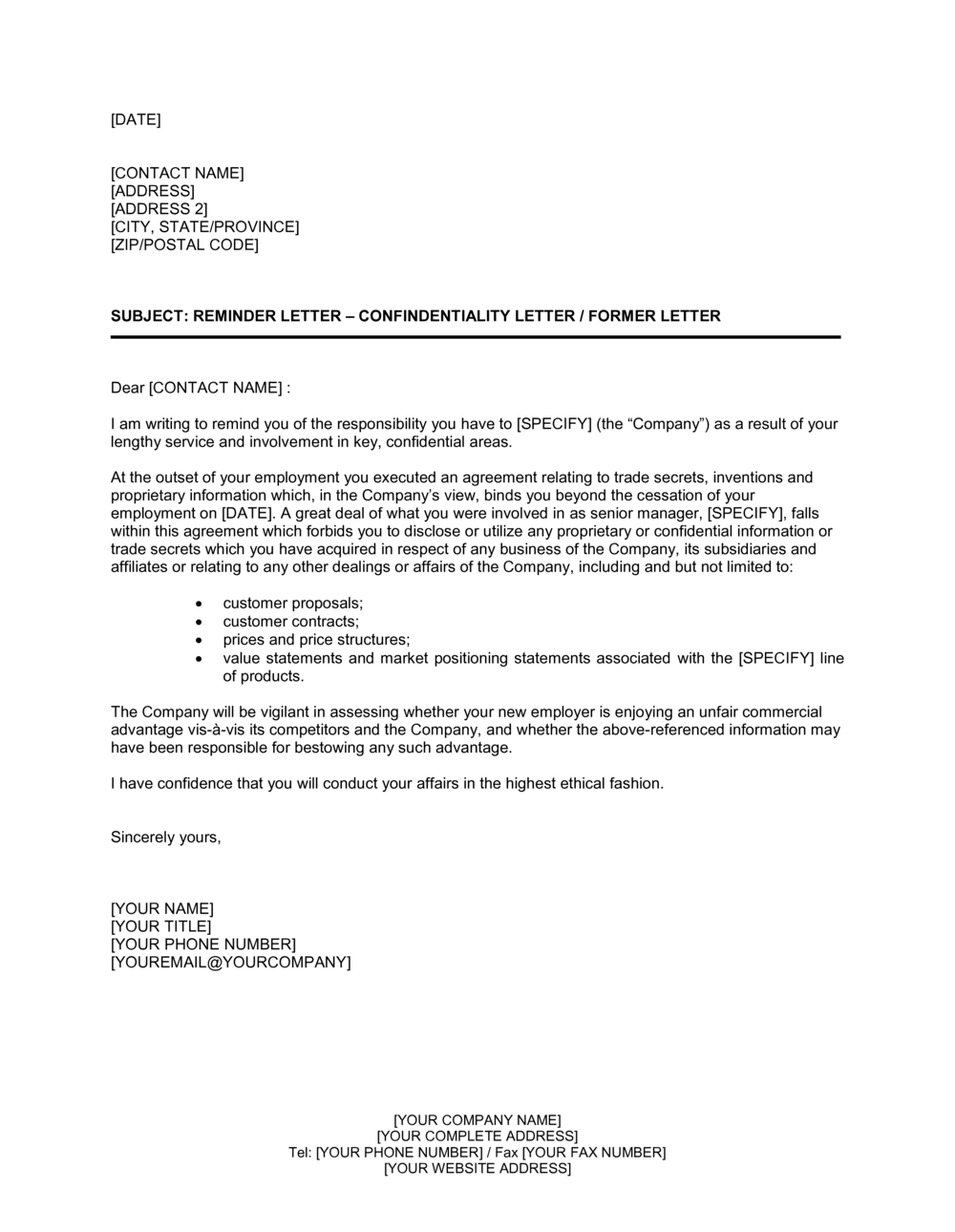
A Reminder Letter — Confidentiality / Former Employee is a formal business letter sent to a departing or recently departed employee to remind them of the confidentiality, non-disclosure, and related obligations they agreed to during employment. This free Word download lets you customize names, dates, and obligation details, then export as PDF and send in minutes.
When you need it
Send it at or shortly after an employee's last day, when you learn a former employee has joined a competitor, or when a potential confidentiality breach has come to your attention and you want to put the individual on formal notice before escalating.
What's inside
A professional salutation and opening, a reference to the original confidentiality agreement or employment contract, a plain-English summary of the obligations that survive termination, a specific warning about prohibited conduct, and a closing call to action requesting written acknowledgment.

What is a Reminder Letter — Confidentiality / Former Employee?

A Reminder Letter — Confidentiality / Former Employee is a formal written notice sent by an employer to a departing or recently departed employee to remind them that the confidentiality, non-disclosure, and related obligations they agreed to during employment continue to apply after the employment relationship ends. It references the original contract or NDA by name and date, summarizes the surviving obligations in plain language, and puts the individual on documented written notice — without creating new legal duties or making adversarial demands. The letter functions as both a deterrent and an evidentiary record that the employer took reasonable steps to protect its confidential information.

Why You Need This Document

Relying solely on a signed NDA without following up at departure is a common and costly oversight. Former employees who receive no reminder often assume their obligations lapsed when employment ended — and courts look closely at whether the employer actively enforced its confidentiality policies. Without a written notice on file, pursuing a breach claim becomes significantly harder: you cannot prove the individual was reminded of specific obligations, and the paper trail stops at the original agreement. This template lets you close that gap in under 15 minutes, establish a documented record for every departure, and signal clearly — to the former employee, to their new employer, and to any future court or arbitrator — that your business treats its confidential information as the competitive asset it is.

Which variant fits your situation?

If your situation is…Use this template
Reminding a departing employee of NDA obligations on their last dayReminder Letter — Confidentiality / Former Employee
Formally warning a former employee after a suspected breach has occurredCease and Desist Letter — Confidential Information
Requesting the return of company property at terminationCompany Property Return Letter
Notifying a former employee of non-compete obligationsNon-Compete Reminder Letter
Initial confidentiality agreement signed at the start of employmentEmployee Non-Disclosure Agreement
Documenting the full offboarding conversation and acknowledgmentsEmployee Exit Interview Form

Common mistakes to avoid

❌ Sending the letter weeks after departure

Why it matters: A long delay signals that the company is not actively monitoring its confidential information and weakens the urgency of the notice. It may also allow a breach to deepen before the individual is put on formal notice.

Fix: Send the reminder letter on or within five business days of the employee's last day, or immediately upon learning of a potential risk.

❌ Using vague obligation language

Why it matters: Phrases like 'do not share company information' give the former employee room to argue they did not know specific information was covered, undermining the letter's effectiveness.

Fix: List the exact categories of information and reference the clause numbers from the original agreement so the scope is unambiguous.

❌ Sending from a personal email rather than a company address

Why it matters: A letter sent from a personal Gmail or similar account appears informal, may be dismissed as non-official, and lacks the organizational authority needed to support legal follow-up.

Fix: Always send from an official company email address — ideally from HR, Legal, or a named senior manager — and use company letterhead on the PDF version.

❌ Omitting an acknowledgment request

Why it matters: Without a request for a signed acknowledgment, you have no proof the former employee received and understood the notice, which weakens your position if you need to pursue a breach claim.

Fix: Include a clear acknowledgment form or reply instruction with a specific deadline, and follow up once if no response is received within the stated period.

The 9 key clauses, explained

Header and date

In plain language: Sender's name and address, the date of the letter, and the recipient's full name and last known address.

Sample language
[COMPANY NAME] | [COMPANY ADDRESS] | [DATE] | [FORMER EMPLOYEE FULL NAME] | [FORMER EMPLOYEE ADDRESS]

Common mistake: Using a personal email address or informal header instead of official company letterhead — this undermines the letter's weight as a formal notice.

Salutation and subject line

In plain language: A formal greeting and a bolded subject line that clearly identifies the letter's purpose.

Sample language
Dear [FORMER EMPLOYEE FULL NAME], | Subject: Reminder of Confidentiality Obligations — [EMPLOYMENT PERIOD]

Common mistake: Using a generic 'To Whom It May Concern' when you know the individual's name — this signals the letter was not written with care and weakens its credibility.

Opening — reference to prior agreement

In plain language: Reminds the recipient of the specific agreement or contract clause that established their confidentiality obligations.

Sample language
We write to remind you that during your employment with [COMPANY NAME] from [START DATE] to [END DATE], you entered into a Confidentiality and Non-Disclosure Agreement dated [AGREEMENT DATE] ('the Agreement').

Common mistake: Referencing 'the agreement' without citing the document name and date — if the matter escalates, the letter must identify the exact instrument being enforced.

Summary of surviving obligations

In plain language: Lists in plain language the specific obligations that continue to bind the former employee after the end of employment.

Sample language
Pursuant to [SECTION X] of the Agreement, you remain obligated to: (a) keep all Confidential Information strictly private; (b) not use or reproduce any Proprietary Information for personal gain or the benefit of any third party; and (c) return or destroy all Company materials in your possession.

Common mistake: Summarizing obligations so vaguely ('keep everything confidential') that the former employee cannot determine what is actually prohibited — specificity is what makes a reminder enforceable.

Definition of confidential information

In plain language: Clarifies what information is covered — trade secrets, client lists, financial data, product plans, etc. — so there is no ambiguity about scope.

Sample language
'Confidential Information' includes, without limitation, client and prospect lists, pricing models, product roadmaps, software source code, financial statements, and any other non-public business information you accessed during your employment.

Common mistake: Omitting a definition and assuming the former employee remembers the original contract's definition — courts and arbitrators require evidence of specificity.

Notice of prohibited conduct

In plain language: Explicitly states the actions the former employee must not take — disclosing to a new employer, using for personal benefit, sharing with third parties.

Sample language
You are expressly prohibited from disclosing, transferring, or using any Confidential Information in your new role at [NEW EMPLOYER NAME] or any other organization, and from soliciting or approaching any client or business contact of [COMPANY NAME] whose identity you learned during your employment.

Common mistake: Failing to mention the new employer by name when it is known — a named reference signals that the company is actively monitoring and increases deterrence.

Acknowledgment request

In plain language: Asks the former employee to confirm in writing that they have received, read, and understood the letter.

Sample language
Please sign and return the enclosed acknowledgment form within [10] business days of receipt to confirm that you have read and understood your ongoing obligations. Failure to respond does not relieve you of these obligations.

Common mistake: Not including a deadline for acknowledgment — without one, the request is ignored indefinitely and the paper trail stalls.

Consequences and escalation warning

In plain language: States the potential legal consequences of a breach — injunctive relief, damages, or further legal action — without making specific threats.

Sample language
[COMPANY NAME] takes the protection of its Confidential Information seriously. Any breach of the obligations outlined above may result in legal action, including claims for injunctive relief and damages, as permitted by applicable law.

Common mistake: Using inflammatory language or specific monetary threats in this paragraph — aggressive language often escalates disputes unnecessarily and can undermine the company's legal position.

Closing and contact details

In plain language: A professional closing inviting the former employee to contact the company with questions, followed by the sender's name, title, and signature block.

Sample language
If you have any questions regarding your obligations or this letter, please contact [CONTACT NAME] at [EMAIL] or [PHONE NUMBER]. Yours sincerely, [AUTHORIZED SIGNATORY NAME] | [TITLE] | [COMPANY NAME]

Common mistake: Signing the letter without including a direct contact — former employees who have questions and no one to call tend not to respond at all.

How to fill it out

  1. 1

    Enter company and former employee details

    Fill in your company's full legal name and address in the header, then add the former employee's full name and last known mailing address. Confirm the employment start and end dates.

    💡 Use the same legal entity name that appears on the original employment contract or NDA — mismatched names create ambiguity about which party is enforcing the obligation.

  2. 2

    Reference the original agreement by name and date

    Identify the specific document that created the obligation — the employment contract, a standalone NDA, or both — and include the date it was signed.

    💡 Attach a copy of the relevant agreement or reference its file location so you can produce it immediately if the matter escalates.

  3. 3

    List the specific surviving obligations

    Copy the exact clause numbers from the original agreement into the summary of surviving obligations section. If the agreement used defined terms, repeat them here exactly.

    💡 Avoid paraphrasing legal definitions — use the original contract's language to eliminate arguments about scope.

  4. 4

    Define confidential information in plain terms

    List the categories of information most relevant to the specific employee's role — client lists, source code, pricing data, product roadmaps. Tailor this to what they actually had access to.

    💡 A role-specific list is far more credible than a boilerplate list — it shows you have thought carefully about what was actually at risk.

  5. 5

    Identify prohibited conduct clearly

    State explicitly what the former employee must not do: disclose to a new employer, use for personal gain, or contact your clients. If you know their new employer, name it.

    💡 Keep this section factual and specific — avoid adjectives like 'strictly' or 'absolutely' that can read as emotional rather than legal.

  6. 6

    Set a deadline for acknowledgment and send by tracked delivery

    Give the former employee 10 business days to sign and return the acknowledgment. Send the letter by email with read receipt and by tracked post to the last known address.

    💡 Sending by both email and tracked mail creates two independent delivery records — essential if the matter proceeds to litigation or arbitration.

Frequently asked questions

What is a confidentiality reminder letter for former employees?

A confidentiality reminder letter is a formal business letter sent to a departing or recently departed employee to remind them of the non-disclosure and confidentiality obligations that survive the end of their employment. It references the original agreement, summarizes the surviving obligations in plain language, and puts the former employee on written notice — creating a documented record before any breach occurs or escalates.

When should I send a confidentiality reminder letter?

Send it on or within five business days of the employee's last day as a routine part of offboarding. Also send one immediately if you learn a former employee has joined a direct competitor, if a client contacts you about being approached by a former employee, or if you detect signs of a potential data or trade secret breach. Early notice is always better than reactive notice.

Does the former employee have to sign and return the acknowledgment?

Legally, no — the underlying obligations exist regardless of whether the acknowledgment is returned. However, a signed acknowledgment strengthens your position significantly in any dispute. If the individual refuses to sign or does not respond, document your delivery attempts and keep the letter on file; non-response does not extinguish the obligation.

Can I send this letter if I do not have a signed NDA on file?

Yes, though its enforceability depends on whether confidentiality obligations were established through another mechanism — such as an employment contract clause, an employee handbook policy, or statutory trade-secret protections like the Defend Trade Secrets Act in the US. Reference whichever instrument applies. If no written obligation exists, consult legal counsel before sending to avoid making claims you cannot support.

Should this letter mention the former employee's new employer?

If you know the new employer and have reason to believe the role creates a risk of disclosure, naming them in the prohibited-conduct paragraph increases the letter's deterrent effect and signals that you are paying attention. Keep the reference factual — state the employer name without implying wrongdoing that has not yet been established.

Is this letter different from a cease and desist letter?

Yes. A reminder letter is a proactive, non-adversarial notice sent before any confirmed breach — its tone is professional and its purpose is prevention. A cease and desist letter is reactive, issued after a breach has occurred or is actively ongoing, and typically demands that specific conduct stop immediately under threat of legal action. A reminder letter is the appropriate first step; a cease and desist follows if the reminder is ignored or a breach is confirmed.

How should I deliver this letter?

Send it by tracked email with read receipt and by certified or tracked post to the last known address simultaneously. This creates two independent delivery records. Keep the email in a dedicated HR or legal file folder. If the matter later proceeds to litigation or arbitration, delivery proof is one of the first things opposing counsel will challenge.

How this compares to alternatives

vs Non-Disclosure Agreement (NDA)

An NDA is the foundational contract that creates confidentiality obligations — typically signed at the start of employment or a business relationship. A reminder letter does not create new obligations; it references and reinforces the existing NDA after the relationship ends. You need the NDA first; the reminder letter comes later.

vs Cease and Desist Letter

A cease and desist letter is a reactive, adversarial notice issued after a breach has been confirmed or is actively ongoing. A confidentiality reminder letter is proactive and preventive — sent before any confirmed breach to put the individual on formal notice. Start with a reminder letter; escalate to cease and desist only if the reminder is ignored or a breach occurs.

vs Employee Termination Letter

A termination letter ends the employment relationship and documents the reason for separation. A confidentiality reminder letter is a separate document sent alongside or after the termination letter to address post-employment obligations specifically. The two documents serve different purposes and should not be merged into one.

vs Employment Contract

The employment contract is where confidentiality obligations are originally established. A reminder letter does not replace or amend the contract — it summarizes and highlights the surviving provisions in a standalone notice. Both documents should be kept in the employee's file.

Industry-specific considerations

Technology / SaaS

Source code, product roadmaps, and customer data make tech companies particularly exposed to IP leakage when engineers or sales staff move to competitors.

Professional Services

Client relationships and billing rate structures are core trade secrets; firms routinely send confidentiality reminders when senior consultants or partners depart.

Financial Services

Regulatory obligations under FINRA, SEC, and data privacy laws amplify the importance of documented post-employment confidentiality notices for brokers and analysts.

Healthcare

HIPAA-covered entities must ensure departing staff understand that patient data obligations survive termination — the reminder letter supports compliance documentation.

Template vs pro — what fits your needs?

PathBest forCostTime
Use the templateStandard offboarding reminders for non-executive employees in most industriesFree10–15 minutes per letter
Template + professional reviewSenior hires, roles with access to high-value IP, or situations where a breach is suspected$150–$400 for a brief legal review1–2 business days
Custom draftedExecutives, confirmed or imminent breach situations, or highly regulated industries requiring specific statutory language$500–$1,500+2–5 business days

Glossary

Confidentiality Obligation
A duty, created by contract or law, to keep specified information private and not disclose it to unauthorized parties.
Non-Disclosure Agreement (NDA)
A contract in which one or both parties agree not to share defined confidential information with third parties.
Surviving Clause
A contract provision that remains in force after the agreement or employment relationship has ended.
Trade Secret
Commercially valuable information — a formula, process, customer list, or pricing model — that gives a business a competitive advantage and is kept confidential.
Post-Employment Restriction
An obligation that continues to bind a former employee after the employment relationship ends, such as confidentiality or non-solicitation.
Notice Letter
A formal written communication that puts a recipient on record as having been informed of a specific obligation, right, or risk.
Acknowledgment
A signed or written confirmation that the recipient has received and understood a communication or obligation.
Offboarding
The formal process of managing an employee's departure, including return of property, access revocation, and documentation of ongoing obligations.
Proprietary Information
Any information owned by a business that is not publicly available, including internal processes, client data, and product roadmaps.

Part of your Business Operating System

This document is one of 3,000+ business & legal templates included in Business in a Box.

  • Fill-in-the-blanks — ready in minutes
  • 100% customizable Word document
  • Compatible with all office suites
  • Export to PDF and share electronically

Create your document in 3 simple steps.

From template to signed document — all inside one Business Operating System.
1
Download or open template

Access over 3,000+ business and legal templates for any business task, project or initiative.

2
Edit and fill in the blanks with AI

Customize your ready-made business document template and save it in the cloud.

3
Save, Share, Send, Sign

Share your files and folders with your team. Create a space of seamless collaboration.

Save time, save money, and create top-quality documents.

★★★★★

"Fantastic value! I'm not sure how I'd do without it. It's worth its weight in gold and paid back for itself many times."

Managing Director · Mall Farm
Robert Whalley
Managing Director, Mall Farm Proprietary Limited
★★★★★

"I have been using Business in a Box for years. It has been the most useful source of templates I have encountered. I recommend it to anyone."

Business Owner · 4+ years
Dr Michael John Freestone
Business Owner
★★★★★

"It has been a life saver so many times I have lost count. Business in a Box has saved me so much time and as you know, time is money."

Owner · Upstate Web
David G. Moore Jr.
Owner, Upstate Web

Run your business with a system — not scattered tools

Stop downloading documents. Start operating with clarity. Business in a Box gives you the Business Operating System used by over 250,000 companies worldwide to structure, run, and grow their business.

Start free · No credit card required