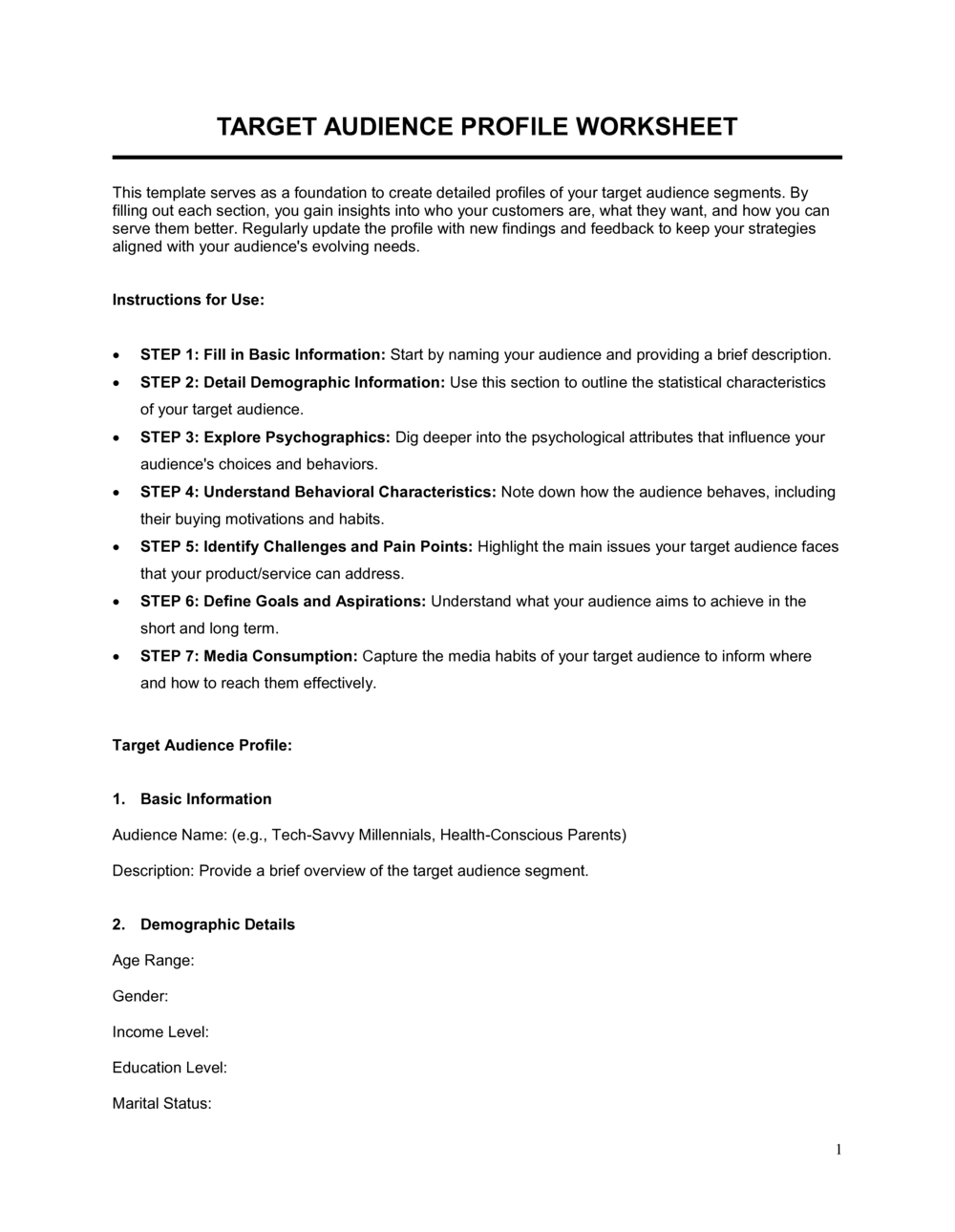
Worksheet Target Audience Profile

Free download β€’ Use as a template β€’ Print or share

2 pagesβ€’20–30 min to useβ€’Difficulty: Standardβ€’Signature requiredβ€’Legal review recommended
Learn more ↓
FreeWorksheet Target Audience Profile Template

At a glance

What it is
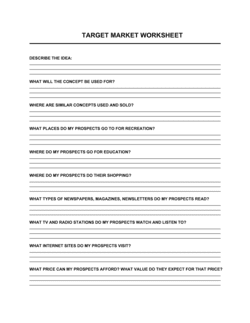
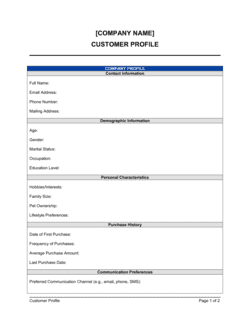
A Target Audience Profile Worksheet is a structured document that captures the demographic, psychographic, behavioral, and geographic characteristics of your ideal customer segment. This free Word download provides a systematic framework you can complete for each distinct customer group, then export as PDF to share with marketing, sales, and product teams.
When you need it
Use it when launching a new product or service, entering a new market, briefing an agency or contractor on campaign targeting, or realigning your marketing strategy around a clearly defined customer base.
What's inside
Demographic identifiers, psychographic values and motivations, behavioral patterns and purchase triggers, pain points and goals, preferred communication channels, competitive alternatives the audience currently uses, and a summary positioning statement tailored to the segment.

What is a Target Audience Profile Worksheet?

A Target Audience Profile Worksheet is a structured planning document that captures the demographic, psychographic, behavioral, and geographic characteristics of a specific customer segment in a single, shareable reference. It moves beyond broad market descriptions by documenting precisely who your ideal buyer is, what motivates them, what problem they are trying to solve, and which channels and messages are most likely to reach them. When completed with validated customer data rather than assumptions, the profile becomes the authoritative brief that aligns marketing, sales, and product teams around a concrete, evidence-based picture of the buyer they are serving.

Why You Need This Document

Without a documented target audience profile, every team involved in acquiring and serving customers operates from a different mental model of who that customer is β€” and those gaps compound quickly into wasted budget, missed messaging, and products built for the wrong person. Marketing teams default to broad targeting that raises cost-per-acquisition; sales teams qualify leads against inconsistent criteria; product teams prioritize features no real customer requested. A completed, data-sourced profile eliminates this drift by creating a single source of truth that every team signs off on. When incorporated into a marketing services agreement or agency brief, it also defines the performance standard the vendor is contractually expected to meet β€” making it both a strategic tool and a legally significant document. This template gives you a repeatable structure to build that document for every segment you serve.

Which variant fits your situation?

If your situation is…Use this template
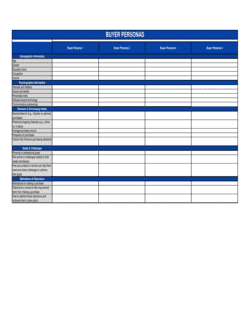
Building a detailed fictional character to guide content and UX decisionsBuyer Persona Template
Profiling B2B accounts by firmographics, budget authority, and purchase processIdeal Customer Profile (B2B)
Mapping the audience's path from awareness to purchase decisionCustomer Journey Map
Evaluating multiple customer segments side by side to pick a primary marketMarket Segmentation Analysis
Briefing an external agency on campaign audience and toneMarketing Creative Brief
Documenting findings from customer discovery interviewsCustomer Discovery Interview Guide
Analyzing competitive positioning relative to audience needsCompetitive Analysis Template

Common mistakes to avoid

❌ Profiling who you want instead of who is actually buying

Why it matters: Aspirational audience profiles lead to campaigns targeting people who will never convert, wasting budget and producing data that reinforces the wrong assumptions.

Fix: Pull demographics and behavioral attributes from your actual buyer data β€” CRM records, transaction history, or post-purchase surveys β€” before writing a single field.

❌ Creating one profile to cover all customers

Why it matters: A single composite profile averages out the differences between segments, producing messaging that is relevant to no one in particular.

Fix: Complete a separate worksheet for each meaningfully distinct segment. Even two or three well-defined profiles outperform one vague composite.

❌ Omitting data sources and validation dates

Why it matters: A profile without a source or date becomes institutional folklore β€” teams treat assumptions as facts, and outdated profiles silently misdirect campaigns for years.

Fix: Record the source (survey, CRM export, interview round) and date for every field. Flag any field built on assumption rather than data.

❌ Listing pain points in feature-gap language

Why it matters: Pain points written as 'lacks integration' or 'needs reporting' describe your product roadmap, not the customer's lived experience β€” and produce messaging that sounds like specs, not empathy.

Fix: Rewrite each pain point as the customer would say it out loud, including the emotional consequence of the problem going unsolved.

❌ Treating the profile as a one-time deliverable

Why it matters: Audience behavior, platform usage, and competitive alternatives shift continuously. A profile written at launch and never revisited sends teams in the wrong direction as the market evolves.

Fix: Schedule a formal profile review every 12 months and after any significant campaign, product launch, or market shift that produces new customer data.

❌ Ranking all communication channels as equally important

Why it matters: When no channel is prioritized, budget gets spread too thin and the team defaults to channels they prefer rather than channels the audience uses.

Fix: Force-rank channels from most to least effective based on actual engagement data, and assign a budget weight to the top two channels in the worksheet.

The 10 key clauses, explained

Segment Identification and Name

In plain language: Names the specific audience segment being profiled and clarifies whether it represents a primary, secondary, or aspirational target group.

Sample language
Segment Name: [SEGMENT LABEL]. Priority Level: [Primary / Secondary / Aspirational]. Prepared by: [NAME], [DATE].

Common mistake: Defining a segment so broadly that it encompasses multiple distinct audiences β€” the resulting profile is too diluted to drive actionable decisions.

Demographic Profile

In plain language: Documents the measurable population attributes of the segment: age range, gender distribution, income bracket, education level, and household or family status.

Sample language
Age Range: [X–Y]. Predominant Gender: [DESCRIPTION]. Household Income: $[X]–$[Y]. Education: [LEVEL]. Location: [CITY / REGION / COUNTRY].

Common mistake: Defaulting to aspirational demographics rather than data-validated ones β€” profiling the customer you wish you had instead of the one who is actually buying.

Psychographic Profile

In plain language: Captures the segment's values, interests, lifestyle choices, and personality characteristics that influence purchase decisions.

Sample language
Core Values: [VALUE 1, VALUE 2]. Primary Interests: [INTEREST 1, INTEREST 2]. Lifestyle: [DESCRIPTION]. Personality Traits: [TRAIT 1, TRAIT 2].

Common mistake: Listing generic traits like 'busy professional' or 'health-conscious' without specificity. Traits need to be granular enough to distinguish this segment from adjacent ones.

Goals and Aspirations

In plain language: Describes what the segment is trying to achieve β€” professionally, personally, or financially β€” and how those goals create relevance for your offering.

Sample language
Primary Goal: [GOAL]. Secondary Goal: [GOAL]. Connection to Offering: [HOW YOUR PRODUCT/SERVICE HELPS ACHIEVE THIS GOAL].

Common mistake: Confusing product features with customer goals. The goal is the outcome the customer wants; the feature is one way to deliver it.

Pain Points and Frustrations

In plain language: Identifies the specific problems, frictions, and unmet needs that drive the segment to seek a solution.

Sample language
Primary Pain Point: [DESCRIPTION]. Consequence of Inaction: [WHAT HAPPENS IF THE PROBLEM PERSISTS]. Emotional Response: [FRUSTRATION / ANXIETY / EMBARRASSMENT].

Common mistake: Describing pain points from the company's perspective rather than the customer's. State them in language the customer would use to describe their own experience.

Buying Behavior and Purchase Triggers

In plain language: Documents how the segment researches, evaluates, and decides to buy β€” including the specific events or circumstances that activate purchasing intent.

Sample language
Decision Timeline: [IMPULSE / DAYS / WEEKS / MONTHS]. Key Trigger: [EVENT OR CIRCUMSTANCE]. Influences: [REVIEWS / PEER REFERRAL / AUTHORITY CONTENT]. Average Spend: $[X].

Common mistake: Skipping the trigger entirely and only documenting channel preferences. Without the trigger, the team cannot time outreach or craft urgency-based messaging.

Preferred Communication Channels

In plain language: Lists the platforms, formats, and media the segment relies on to discover products, consume content, and make purchasing decisions.

Sample language
Primary Channel: [CHANNEL 1]. Secondary Channel: [CHANNEL 2]. Content Format Preference: [VIDEO / LONG-FORM / SHORT-FORM / IN-PERSON]. Peak Engagement Time: [DAY/TIME].

Common mistake: Listing every possible channel without ranking them. A profile that marks all channels as relevant provides no guidance for budget allocation.

Competitive Alternatives Currently Used

In plain language: Identifies what the segment is using today to solve the problem your offering addresses β€” whether a direct competitor, a workaround, or no solution at all.

Sample language
Current Solution: [COMPETITOR / DIY METHOD / NOTHING]. Reason for Current Choice: [PRICE / FAMILIARITY / DEFAULT]. Switching Barrier: [COST / HABIT / CONTRACT].

Common mistake: Omitting this section on the assumption that the audience will automatically prefer your solution. Understanding the incumbent is essential to crafting a displacement message.

Positioning Statement for This Segment

In plain language: Summarizes in one to two sentences how your offering addresses this segment's specific goals and pain points better than alternatives β€” for internal strategic alignment.

Sample language
For [SEGMENT NAME] who [PAIN POINT / GOAL], [PRODUCT/SERVICE] is the [CATEGORY] that [KEY BENEFIT] because [REASON TO BELIEVE].

Common mistake: Writing a positioning statement that could apply to any segment. A valid positioning statement changes meaningfully when the segment name changes.

Data Sources and Validation Notes

In plain language: Records where the profile information came from β€” customer interviews, survey data, CRM analytics, or third-party research β€” and flags assumptions that need validation.

Sample language
Sources: [CRM DATA / SURVEY (N=[X]) / INTERVIEWS (N=[X]) / INDUSTRY REPORT]. Last Validated: [DATE]. Assumptions Requiring Confirmation: [ITEM 1, ITEM 2].

Common mistake: Treating an undated, unvalidated profile as authoritative. Audience profiles built on assumptions rather than data lead to campaigns that miss the actual buyer.

How to fill it out

  1. 1

    Name the segment and set its priority level

    Assign a specific, descriptive label to the segment β€” not 'Customer A' β€” and state whether it is your primary, secondary, or aspirational target. This framing determines how much budget and effort the segment should receive.

    πŸ’‘ Limit each worksheet to one segment. Attempting to profile two groups on a single sheet produces a document that accurately describes neither.

  2. 2

    Complete the demographic fields with validated data

    Pull demographic data from your CRM, customer survey results, or third-party research. Record specific ranges β€” age 28–44, household income $65K–$110K β€” not broad descriptors like 'middle-aged adults.'

    πŸ’‘ If you lack data for a field, mark it as 'assumed' and schedule the research needed to validate it. Acknowledged gaps are less dangerous than unacknowledged ones.

  3. 3

    Document psychographics using the customer's own language

    Use language from actual customer interviews, reviews, or support tickets to populate the values, interests, and lifestyle fields. Paraphrasing or inferring traits without a data source weakens the profile's credibility.

    πŸ’‘ Search your product reviews and NPS verbatims for recurring phrases β€” these are your customers' actual vocabulary and will improve messaging resonance.

  4. 4

    Articulate goals and pain points from the customer's perspective

    Write each goal and pain point as the customer would state it β€” not as a feature gap your product fills. 'I spend three hours every week reconciling spreadsheets' is a pain point. 'Needs automation' is not.

    πŸ’‘ Pair each pain point with the emotional consequence β€” embarrassment, lost revenue, lost time β€” to help the creative team write copy that resonates.

  5. 5

    Map buying behavior and identify the primary trigger

    Document the typical decision timeline, the people who influence the purchase, and the specific event or circumstance that moves this segment from passive interest to active search. Link each trigger to a channel and message in your go-to-market plan.

    πŸ’‘ If you identify more than three triggers, pick the one most common across your existing customer base and treat the others as secondary.

  6. 6

    Rank communication channels by relevance

    List channels in order from most to least effective for this segment based on engagement data, not assumption. Assign a rough percentage of budget weight next to the top two channels.

    πŸ’‘ Channel preferences shift as segments age and platform usage evolves β€” plan to re-validate this section annually against actual campaign performance data.

  7. 7

    Identify the current alternative and the switching barrier

    Name what this segment uses today to solve the problem β€” competitor product, manual workaround, or nothing β€” and document the primary reason they chose it and what it would take to switch.

    πŸ’‘ The switching barrier drives your trial and onboarding strategy. A segment that stays with an incumbent out of habit needs a friction-free free trial; one locked in by contract needs a migration incentive.

  8. 8

    Write the positioning statement and record your data sources

    Draft a one-sentence positioning statement using the [For / Who / Is the / That / Because] framework, then list every data source used and the date each was last validated.

    πŸ’‘ Present the completed profile to two or three real customers from the segment and ask if it describes them accurately. Their corrections will improve the document more than any internal review.

Frequently asked questions

What is a target audience profile worksheet?

A target audience profile worksheet is a structured document that captures the demographic, psychographic, behavioral, and geographic characteristics of a specific customer segment. It translates market research and customer data into a single reference that marketing, sales, and product teams use to align their strategies around a defined buyer. Unlike a general market analysis, it profiles one segment at a time with enough specificity to drive messaging and channel decisions.

What is the difference between a target audience profile and a buyer persona?

A target audience profile documents real, data-validated segment characteristics β€” demographics, behavior patterns, pain points, and channel preferences β€” drawn from actual customer data. A buyer persona is a fictionalized character representation of that segment, given a name and narrative to make the data more memorable for creative teams. The profile is the evidence base; the persona is the storytelling layer built on top of it. Both are useful, but the profile must come first.

How many target audience profiles should a business create?

Most small and mid-sized businesses operate effectively with two to four distinct profiles covering their primary customer segments. Creating more than six is rarely productive β€” it fragments strategy and dilutes budget. Start with one profile for the segment that generates the most revenue, then add profiles for secondary segments once the primary is validated and performing.

What data sources should I use to complete the worksheet?

The most reliable sources are CRM transaction and demographic data, post-purchase surveys, customer discovery interviews (a minimum of 8–12 per segment), NPS verbatim responses, and website or app analytics. Third-party sources such as industry research reports, census data, and platform audience insights (Meta Audience Insights, Google Analytics demographics) are useful for benchmarking and filling gaps, but first-party data should take precedence wherever available.

How often should a target audience profile be updated?

Review and update profiles at least annually, and immediately following any significant campaign, product launch, market entry, or competitive shift that produces new customer data. Demographic and psychographic attributes are relatively stable, but channel preferences, buying triggers, and competitive alternatives can change significantly within 12–18 months β€” particularly in digital-first markets.

Can a target audience profile be used for B2B marketing?

Yes, but B2B profiles require additional firmographic fields β€” industry vertical, company size by revenue and headcount, geographic footprint, and the buying committee structure (economic buyer, technical buyer, champion, and influencer). B2B pain points and buying triggers also operate on longer decision timelines and involve multiple stakeholders, which the worksheet's buying behavior section should reflect explicitly.

What is a positioning statement and why does it belong in a target audience profile?

A positioning statement is a one-to-two sentence internal declaration of how your offering meets a specific segment's needs better than available alternatives. It belongs in the profile because positioning is only meaningful relative to a specific audience β€” the same product can carry different positioning statements for different segments. Having it in the profile keeps messaging decisions anchored to validated customer context rather than internal opinion.

Is a target audience profile a legally binding document?

In its standard form, a target audience profile worksheet is a strategic planning document, not a contract. However, when incorporated by reference into a marketing services agreement, agency contract, or campaign brief, the profile can define the scope of work and performance standards the vendor is expected to meet. In that context, both parties should review and sign the profile as an exhibit to the main agreement.

What happens if we skip building a target audience profile?

Without a defined profile, marketing and sales teams default to targeting the broadest possible audience, which raises cost-per-acquisition, lowers conversion rates, and produces campaign data that is too heterogeneous to generate useful insights. Product teams build features for imaginary users. Sales teams waste time on leads that were never qualified to convert. The profile is the foundation that makes every downstream decision faster and cheaper to execute.

How this compares to alternatives

vs Buyer Persona Template

A buyer persona template builds a named, narrative character from audience data β€” giving teams a memorable archetype to reference in creative decisions. A target audience profile worksheet is the underlying evidence document the persona is built from, containing raw segment data, validated sources, and a positioning statement. Build the profile first; derive the persona from it.

vs Marketing Plan

A marketing plan documents strategy, channels, budget, and campaign calendar across all segments. A target audience profile worksheet defines a single segment in depth and feeds the targeting, messaging, and channel decisions inside the marketing plan. The profile is an input to the plan, not a substitute for it.

vs Competitive Analysis Template

A competitive analysis maps competitor positioning, pricing, and strengths across the market. A target audience profile focuses on the customer β€” their needs, behaviors, and current alternatives. Both inform strategy, but from opposite vantage points. The audience profile asks 'what does the customer want?' while the competitive analysis asks 'what are competitors offering?'

vs Market Segmentation Analysis

A market segmentation analysis divides a broad market into distinct groups and evaluates each for size, growth, and attractiveness β€” it answers which segments to pursue. A target audience profile worksheet goes deep on a single segment already chosen β€” it answers how to reach and convert that segment. Segmentation analysis precedes profile development.

Industry-specific considerations

Retail and E-commerce

Profiles drive product merchandising decisions, paid social targeting parameters, and email segmentation logic β€” small differences in age range or income bracket can shift conversion rates significantly across SKU categories.

SaaS / Technology

B2B SaaS profiles must document the full buying committee β€” economic buyer, technical evaluator, and end-user champion β€” since each role responds to different messaging and requires different content formats.

Healthcare and Wellness

Regulatory constraints on health claims mean psychographic and pain-point language must be reviewed against FDA and FTC guidelines before use in consumer-facing materials drawn from the profile.

Professional Services

Audience profiles for professional services firms must capture the client's decision timeline relative to a triggering event β€” fiscal year-end, a compliance deadline, or an M&A transaction β€” since timing determines channel and message.

Financial Services

Demographic and behavioral data used in audience profiles may be subject to fair lending and equal credit opportunity regulations β€” profiles should not be used to exclude protected classes from offers.

Education and Training

Profiles must distinguish between the buyer (parent, employer, or institution) and the end learner, as their goals, pain points, and channel preferences frequently diverge and require separate messaging strategies.

Jurisdictional notes

United States

When audience profiles inform targeted advertising, the FTC's guidelines on unfair or deceptive practices apply. Financial services and healthcare marketers must ensure profile-based targeting does not constitute discriminatory exclusion under the Equal Credit Opportunity Act or the Fair Housing Act. COPPA restrictions apply to any profile that explicitly targets children under 13.

Canada

PIPEDA and provincial privacy laws (including Quebec's Law 25) require that personal data used to build audience profiles be collected with informed consent and used only for the purpose disclosed at collection. Quebec's Law 25 imposes stricter consent and data residency requirements, and profiles incorporating Quebec customer data should be reviewed against its standards.

United Kingdom

Post-Brexit, the UK operates under the UK GDPR and the Data Protection Act 2018. Audience profiles built using personal data require a lawful basis for processing. The ICO's guidance on profiling and automated decision-making applies when profile data is used to personalize offers or exclude audiences from marketing communications.

European Union

Under EU GDPR, profiling based on personal data requires explicit lawful grounds β€” typically legitimate interest or consent. Article 22 restrictions apply when profiling produces automated decisions with significant effects on individuals. Profiles incorporating sensitive categories (health, ethnicity, financial status) require explicit consent and a data protection impact assessment.

Template vs lawyer β€” what fits your deal?

PathBest forCostTime
Use the templateMarketing teams, founders, and strategists building internal audience alignment documentsFree2–4 hours per segment profile
Template + legal reviewProfiles incorporated as exhibits in agency contracts, licensing agreements, or campaign scopes of work$150–$400 for a contract attorney review1–2 business days
Custom draftedEnterprise brands requiring legally vetted audience definitions in regulated industries such as financial services, healthcare, or children's marketing$800–$2,500+1–2 weeks

Glossary

Target Audience
The specific group of people most likely to buy a product or service, defined by shared characteristics such as demographics, interests, or behaviors.
Demographics
Measurable population characteristics including age, gender, income, education level, occupation, and household size.
Psychographics
Psychological attributes of a customer segment including values, attitudes, lifestyle choices, and personality traits.
Behavioral Segmentation
Grouping customers by how they interact with a product category β€” purchase frequency, brand loyalty, usage occasions, and readiness to buy.
Pain Point
A specific problem, frustration, or unmet need that motivates a customer to seek a solution.
Buying Trigger
The specific event, circumstance, or emotion that moves a prospect from consideration to active purchasing intent.
Customer Lifetime Value (CLV)
The total gross profit expected from a single customer across the entire duration of the relationship.
Ideal Customer Profile (ICP)
A description of the company or individual that gets the most value from your offering and is most likely to buy and retain.
Positioning Statement
A concise internal declaration of how a product or service meets a target audience's needs better than available alternatives.
Segment
A distinct subset of a broader market whose members share enough common characteristics to be addressed with a single, coherent marketing message.
Channel Preference
The communication medium a customer segment habitually uses to discover, research, and purchase products β€” such as email, social media, search, or in-person.
Firmographics
For B2B audiences, the organizational equivalent of demographics: industry, company size, revenue range, and geographic location.

Part of your Business Operating System

This document is one of 3,000+ business & legal templates included in Business in a Box.

  • Fill-in-the-blanks β€” ready in minutes
  • 100% customizable Word document
  • Compatible with all office suites
  • Export to PDF and share electronically

Create your document in 3 simple steps.

From template to signed document β€” all inside one Business Operating System.
1
Download or open template

Access over 3,000+ business and legal templates for any business task, project or initiative.

2
Edit and fill in the blanks with AI

Customize your ready-made business document template and save it in the cloud.

3
Save, Share, Send, Sign

Share your files and folders with your team. Create a space of seamless collaboration.

Save time, save money, and create top-quality documents.

β˜…β˜…β˜…β˜…β˜…

"Fantastic value! I'm not sure how I'd do without it. It's worth its weight in gold and paid back for itself many times."

Managing Director Β· Mall Farm
Robert Whalley
Managing Director, Mall Farm Proprietary Limited
β˜…β˜…β˜…β˜…β˜…

"I have been using Business in a Box for years. It has been the most useful source of templates I have encountered. I recommend it to anyone."

Business Owner Β· 4+ years
Dr Michael John Freestone
Business Owner
β˜…β˜…β˜…β˜…β˜…

"It has been a life saver so many times I have lost count. Business in a Box has saved me so much time and as you know, time is money."

Owner Β· Upstate Web
David G. Moore Jr.
Owner, Upstate Web

Run your business with a system β€” not scattered tools

Stop downloading documents. Start operating with clarity. Business in a Box gives you the Business Operating System used by over 250,000 companies worldwide to structure, run, and grow their business.

Free Forever PlanΒ Β·Β No credit card required