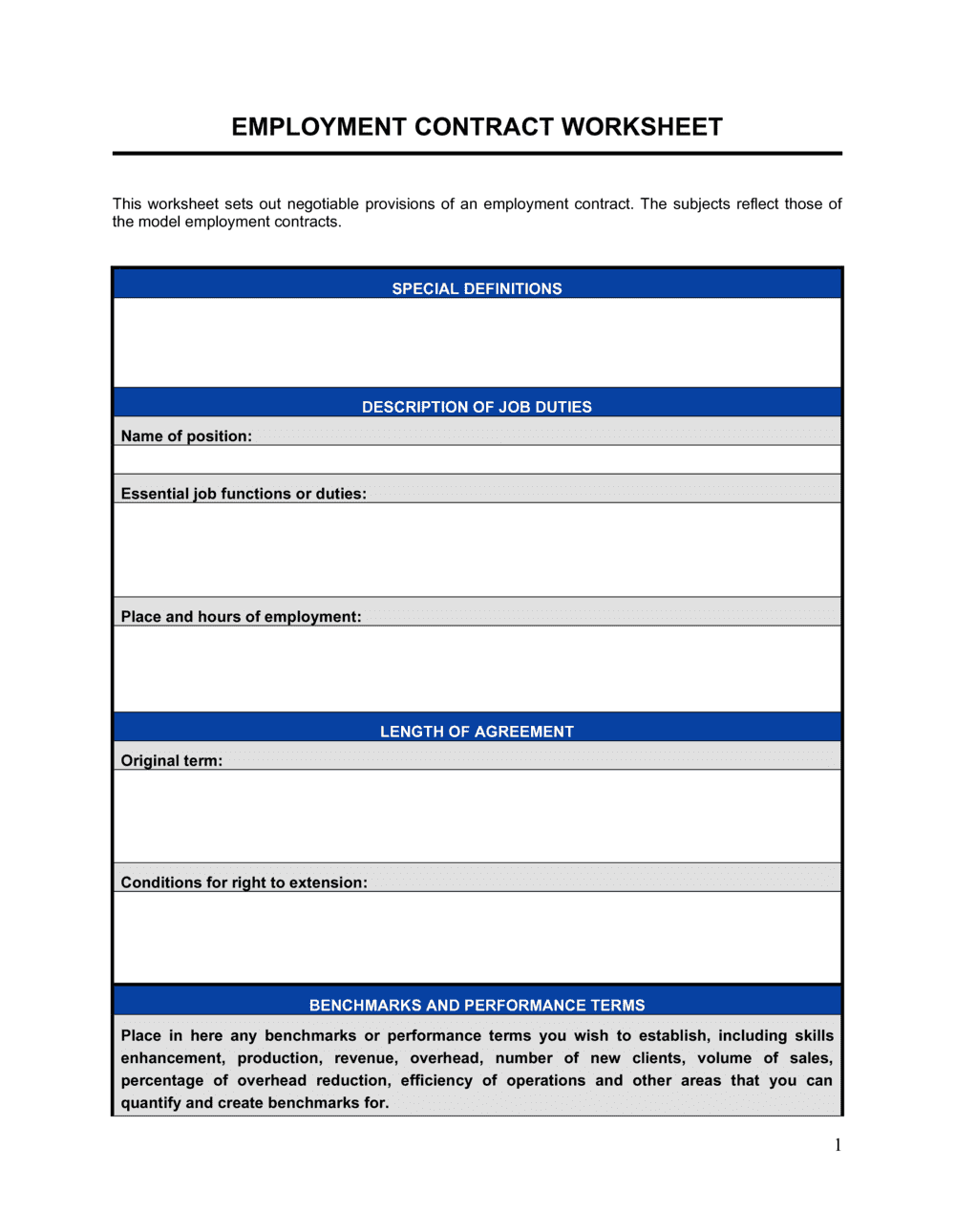
Employment Contract Worksheet

Free download β€’ Use as a template β€’ Print or share

6 pagesβ€’25–35 min to useβ€’Difficulty: Complexβ€’Signature requiredβ€’Legal review recommended
Learn more ↓
FreeEmployment Contract Worksheet Template

At a glance

What it is
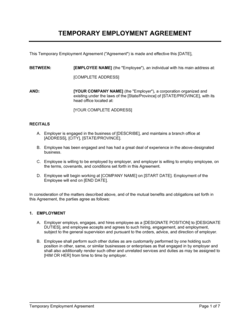
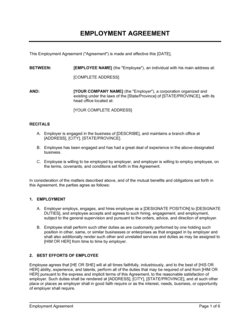
An Employment Contract Worksheet is a structured legal planning document that guides employers through every material term of a new hire's employment relationship β€” from job title and compensation to IP assignment, confidentiality, and termination conditions β€” before those terms are finalized in a binding contract. This free Word download lets you document, compare, and confirm each clause in plain English, then export as PDF for review or handoff to legal counsel.
When you need it
Use it before drafting or issuing a final employment contract β€” especially when onboarding a new full-time or fixed-term employee β€” to ensure every key term has been considered, agreed internally, and recorded in one place before execution.
What's inside
The worksheet covers position details and start date, compensation and bonus structure, benefits and expense policy, working hours and location, IP assignment, confidentiality obligations, non-compete and non-solicitation scope, and termination notice and severance terms β€” each with guided prompts and space for notes.

What is an Employment Contract Worksheet?

An Employment Contract Worksheet is a structured legal planning document that guides employers through every material term of a new hire's employment relationship β€” position, compensation, benefits, working hours, IP assignment, confidentiality, non-compete restrictions, and termination conditions β€” before those terms are formalized in a binding employment contract. It functions as the internal source of truth that aligns HR, legal, and leadership on agreed terms before any document is shared with the candidate, eliminating the ambiguity and mid-process reversals that lead to delayed onboarding, disputed offer letters, and unenforceable contracts.

Why You Need This Document

Without a pre-drafting worksheet, critical employment terms are decided on the fly during offer negotiations, recorded inconsistently across emails and verbal conversations, and sometimes contradicted between the offer letter and the final contract. The consequences are concrete: an IP assignment clause too narrow to cover remote work, a bonus labeled "guaranteed" in an email that creates an unintended contractual obligation, or a non-compete scope never checked against California or Ontario law before it is printed in a binding agreement. Each gap is a potential claim. A completed worksheet routes every term through a deliberate review before it reaches the employee, creates a documented record of what was agreed and when, and ensures the resulting contract is enforceable from day one β€” before any rights are waived or any liability clock starts running.

Which variant fits your situation?

If your situation is…Use this template
Ready to execute a binding full-time employment agreementEmployment Contract (At-Will)
Hiring a senior executive with equity and enhanced severanceExecutive Employment Agreement
Engaging a worker as an independent contractor rather than an employeeIndependent Contractor Agreement
Hiring for a defined project period with a fixed end dateFixed-Term Employment Contract
Onboarding a remote worker in a different state or countryRemote Work Employment Agreement
Sending a formal offer before the full contract is issuedJob Offer Letter
Protecting confidential information independent of the employment contractNon-Disclosure Agreement

Common mistakes to avoid

❌ Using a trade name instead of the registered legal entity

Why it matters: IP assignment, non-compete, and confidentiality clauses become difficult to enforce when the contracting party name does not match the entity that actually employs the worker or owns the assets.

Fix: Verify the employer's full registered name in the corporate registry and use it verbatim on every worksheet and resulting contract.

❌ Applying at-will language to employees outside the US

Why it matters: At-will employment is a US doctrine. In Canada, the UK, and the EU, termination without notice or cause β€” regardless of what the contract says β€” triggers statutory and common-law claims that can exceed 12 months' pay.

Fix: Replace at-will language with a jurisdiction-appropriate notice-period clause that meets or exceeds the statutory minimum in the employee's work location.

❌ Recording specific benefit plan details in the worksheet

Why it matters: Benefits plans change annually. If the final contract locks in specific coverage levels or premiums, every plan change triggers an amendment obligation or creates a breach-of-contract exposure.

Fix: Reference benefits by category only β€” 'standard company health and dental plan as amended from time to time' β€” and direct employees to the current plan summary for specifics.

❌ Setting a blanket non-compete without checking jurisdictional enforceability

Why it matters: Non-competes are void in California, Minnesota, and several EU member states. Recording unenforceable terms in the worksheet means the final contract contains a clause that offers zero protection and may undermine other provisions.

Fix: Check current law in the governing jurisdiction before completing the non-compete section and note any restrictions or bans directly on the worksheet for the reviewing lawyer.

❌ Completing the worksheet after the employee's first day

Why it matters: An employment contract β€” and the restrictive covenants in it β€” signed after the employee has already started work may be unenforceable for lack of fresh consideration in common-law jurisdictions.

Fix: Initiate and complete the worksheet at the offer stage, well before the start date, so the executed contract is in place before day one.

❌ Leaving the severance formula blank or below statutory minimums

Why it matters: A blank severance section gives the employer no contractual ceiling on termination liability. In Canada and the UK, courts award common-law or statutory notice regardless, often far exceeding what the employer anticipated.

Fix: Enter a specific severance formula in the worksheet and confirm it meets the statutory floor in the governing jurisdiction before the contract is drafted.

The 10 key clauses, explained

Parties, position, and start date

In plain language: Records the employer's full legal entity name, the employee's legal name, job title, department, and official first day of employment.

Sample language
This Employment Contract Worksheet is prepared by [EMPLOYER LEGAL NAME], a [STATE/PROVINCE] [ENTITY TYPE], for [EMPLOYEE FULL NAME], engaged as [JOB TITLE] in the [DEPARTMENT] department, with a proposed start date of [START DATE].

Common mistake: Using a trade name or brand name instead of the registered legal entity β€” causing a mismatch between the worksheet, the final contract, and payroll records that complicates enforcement of restrictive covenants.

Employment type and term

In plain language: Specifies whether the role is at-will, indefinite with notice, or fixed-term, and records any probationary period and its conditions.

Sample language
Employment type: [At-Will / Indefinite with Notice / Fixed-Term ending [DATE]]. Probationary period: [X] days, during which termination requires [X days'] notice.

Common mistake: Defaulting to at-will language for employees working in Canada, the UK, or the EU, where the doctrine has no legal effect and statutory notice minimums apply regardless.

Compensation and payment terms

In plain language: Documents the agreed base salary or hourly rate, pay frequency, and any guaranteed versus discretionary bonus structure.

Sample language
Base compensation: $[AMOUNT] per [year / hour], paid [bi-weekly / semi-monthly]. Bonus: up to [X]% of base salary, [discretionary / guaranteed upon meeting [CRITERIA]].

Common mistake: Omitting the word 'discretionary' on bonuses β€” courts in several jurisdictions have found regularly paid bonuses to be contractual entitlements even without explicit written guarantees.

Benefits, PTO, and expense reimbursement

In plain language: References the company benefits plan by category and states the expense reimbursement policy and submission timeline.

Sample language
Employee is eligible for: health ([PLAN TYPE]), dental, vision, [X] days PTO per year, and [401(k) / RRSP] matching up to [X]%. Expenses reimbursed within [30] days of submission with receipts.

Common mistake: Listing specific benefit plan details β€” coverage levels, premium amounts, or carrier names β€” that will change at the next annual renewal and require a contract amendment to update.

Working hours and location

In plain language: States the standard weekly hours, work schedule, primary work location (on-site, remote, or hybrid), and any flexibility or travel expectations.

Sample language
Standard hours: [X] per week, [Monday–Friday / flexible schedule]. Primary location: [OFFICE ADDRESS / Remote β€” [CITY, STATE]]. Expected travel: [none / up to X% of time].

Common mistake: Specifying a single fixed location without a clause allowing reasonable changes β€” making a required office relocation a potential constructive dismissal trigger.

Intellectual property assignment

In plain language: Confirms that all work product, code, designs, and inventions created by the employee in connection with the employer's business are assigned to the employer.

Sample language
Employee agrees that all work product, inventions, and developments created during employment β€” or related to the Company's business β€” are the sole property of [EMPLOYER LEGAL NAME] and are hereby irrevocably assigned to the Company.

Common mistake: Limiting IP assignment to work performed on company premises or devices β€” leaving off-site and remote work product in a grey area, particularly critical for software and product roles.

Confidentiality obligations

In plain language: Defines what counts as confidential information and prohibits the employee from disclosing or misusing it during and after employment.

Sample language
'Confidential Information' includes all non-public information relating to the Company's technology, customers, finances, and strategy. Employee agrees not to disclose or use Confidential Information without prior written consent, during or after employment.

Common mistake: Defining confidential information as 'everything the employee learns at work' without specificity β€” courts apply a reasonableness standard, and overbroad definitions risk making the entire confidentiality clause unenforceable.

Non-compete and non-solicitation terms

In plain language: Records the agreed duration, geographic scope, and activity restrictions on competition and solicitation of customers and staff after the employee's departure.

Sample language
For [X] months after separation, Employee will not: (a) engage in a Competing Business within [GEOGRAPHIC AREA]; (b) solicit any customer or client of the Company; or (c) recruit any Company employee.

Common mistake: Applying a one-size-fits-all restriction regardless of seniority β€” broad non-competes for junior or non-customer-facing roles are routinely struck down, voiding the clause entirely rather than being narrowed.

Termination, notice, and severance

In plain language: States the required notice period for voluntary and employer-initiated termination, the conditions for immediate termination for cause, and the severance formula.

Sample language
Either party may terminate with [X weeks'] written notice. Termination for Cause: immediate, no severance. Termination without Cause: [Y weeks per year of service] severance, payable upon execution of a release.

Common mistake: Setting a severance formula without verifying it meets the statutory minimums in the governing jurisdiction β€” contractual severance below the statutory floor is void, and the higher statutory amount applies automatically.

Governing law and entire agreement

In plain language: Specifies which jurisdiction's law governs the contract and confirms the written document supersedes all prior offers, emails, and verbal representations.

Sample language
This Agreement is governed by the laws of [STATE / PROVINCE / COUNTRY]. This Agreement constitutes the entire agreement between the parties and supersedes all prior representations, offer letters, and understandings.

Common mistake: Choosing a governing law jurisdiction with no meaningful connection to where the employee works β€” California, for example, applies its own employment law regardless of a contrary governing-law clause.

How to fill it out

  1. 1

    Confirm the employer's legal entity name

    Enter the full registered corporate name β€” not a trade name or brand β€” as it appears in your corporate registry. This name must match your payroll system and the final contract to preserve enforceability of restrictive covenants.

    πŸ’‘ Pull the entity name directly from your articles of incorporation or certificate of formation to avoid transcription errors.

  2. 2

    Select the employment type and record any probationary period

    Choose at-will, indefinite with notice, or fixed-term. If using a probationary period, specify its duration and the reduced notice or conditions that apply during it.

    πŸ’‘ For any employee working outside the US, remove at-will language and substitute a notice-period clause before the worksheet reaches legal review.

  3. 3

    Document the full compensation structure

    Enter base salary or hourly rate, pay frequency, and any bonus β€” labeling it discretionary or guaranteed. If equity is involved, note that it will be governed by a separate option agreement rather than embedding vesting details here.

    πŸ’‘ State the currency explicitly for any hire whose work location differs from the employer's home jurisdiction.

  4. 4

    Record benefits, PTO, and expense policy by category only

    List benefit types (health, dental, vision, retirement) and PTO accrual without referencing specific plan names, carrier details, or coverage amounts β€” these belong in the plan summary, not the contract.

    πŸ’‘ Cross-reference the current benefits enrollment guide to confirm PTO accrual rates and any waiting periods before recording them here.

  5. 5

    Define the working hours, location, and travel expectations

    Specify standard weekly hours, the primary work location (on-site, remote, or hybrid), and any regular travel requirement. Include a note that reasonable location changes may be required with appropriate notice.

    πŸ’‘ For remote roles, record the employee's state or country of residence β€” it determines which jurisdiction's employment law applies even if the employer is elsewhere.

  6. 6

    Calibrate non-compete and non-solicitation scope to the role

    Set the geographic area and duration proportionate to the employee's actual access to competitive information and client relationships. Typical ranges are 6–12 months for most roles and up to 24 months for senior sales or executive positions.

    πŸ’‘ Check current enforceability in the governing jurisdiction before recording any non-compete terms β€” California, Minnesota, and several EU member states ban or severely restrict them.

  7. 7

    Confirm the termination and severance formula against statutory minimums

    Enter the notice period and severance formula, then verify the formula meets or exceeds the statutory floor in the applicable jurisdiction before the worksheet proceeds to legal drafting.

    πŸ’‘ In Ontario, common-law notice can reach one month per year of service for long-tenured employees β€” confirm the written formula explicitly displaces common-law entitlements to prevent an open-ended liability.

  8. 8

    Route the completed worksheet to legal review before contract drafting

    Once all sections are completed, share the worksheet with legal counsel or HR leadership for review. Unresolved fields or flagged terms should be resolved at this stage β€” not after the employee has received a draft contract.

    πŸ’‘ Attach the completed worksheet to the final contract file so there is a documented record of what was agreed and when, reducing exposure if terms are disputed later.

Frequently asked questions

What is an employment contract worksheet?

An employment contract worksheet is a structured planning document that captures every material term of a new hire's employment relationship β€” position, compensation, benefits, IP assignment, confidentiality, non-compete scope, and termination conditions β€” before those terms are drafted into a binding contract. It functions as a pre-contract checklist and internal agreement record, ensuring nothing is overlooked and all stakeholders have aligned on terms before legal drafting begins.

Is an employment contract worksheet legally binding?

A worksheet used as an internal planning tool is generally not itself a binding contract β€” it is a preparatory document. However, if the worksheet is signed by both parties and contains all essential terms of employment, a court could treat it as an enforceable agreement. To avoid unintended binding effect, mark the document clearly as a draft or internal planning document and ensure the final executed employment contract is the governing instrument.

When should I complete the employment contract worksheet?

Complete it at the offer stage β€” before extending a written offer letter or employment contract to the candidate. Finalizing terms on paper before the employee's first day ensures the binding contract is executed before work begins, which is critical for enforceability of IP assignment and restrictive covenants in common-law jurisdictions.

What is the difference between an employment contract worksheet and an employment contract?

The worksheet is a pre-drafting planning tool that records, confirms, and aligns all parties on the terms that will appear in the final contract. The employment contract is the binding legal document executed by both parties. The worksheet feeds the contract β€” it is not a replacement for it. Think of the worksheet as the brief your lawyer or HR team works from.

Do I still need a lawyer if I use this worksheet?

For standard domestic hires in a single jurisdiction, a completed worksheet paired with a high-quality employment contract template often suffices. Legal review is recommended for cross-border hires, senior roles involving equity or material non-competes, employees in heavily regulated jurisdictions (California, Ontario, UK, France, Germany), and any situation where the severance or IP terms are commercially significant.

Can I use the same worksheet for every hire?

The worksheet structure applies to most full-time and fixed-term hires, but certain sections β€” non-compete scope, governing law, and severance formula β€” must be customized for each employee's role seniority, work location, and jurisdiction. A worksheet that works for a junior US-based hire will be incorrect for a senior Canadian or UK-based employee without meaningful edits.

What happens if I skip the non-compete section on the worksheet?

If non-compete terms are not agreed and documented before the contract is issued, adding them later requires fresh consideration β€” a documented benefit provided to the employee in exchange for signing. Introducing non-compete restrictions after the employment relationship begins, without consideration, is unenforceable in common-law jurisdictions and may void the entire restrictive covenant package.

How does an employment contract worksheet interact with an offer letter?

The worksheet is an internal document β€” it is not shared with the candidate. The offer letter is the external-facing document sent to the candidate to confirm the role and compensation and secure acceptance. The completed worksheet should drive the content of both the offer letter and the final employment contract, ensuring all three documents are internally consistent.

What employment terms are most commonly missed on worksheets?

The four most frequently overlooked terms are: the severance formula (left blank, triggering unlimited common-law liability), the IP assignment scope (too narrow, missing remote or off-hours work), the governing jurisdiction for non-compete enforceability (not checked against local law), and the entire-agreement clause (absent, allowing prior emails or offer letters to be introduced as binding terms).

How this compares to alternatives

vs Employment Contract (At-Will)

The at-will employment contract is the binding legal instrument that both parties sign and that governs the employment relationship. The worksheet is the pre-drafting planning tool used to confirm every term before that contract is produced. Use the worksheet first to align on terms internally, then populate the employment contract from the completed worksheet.

vs Job Offer Letter

A job offer letter is sent to the candidate to confirm the role and compensation and trigger acceptance β€” it is external and candidate-facing. The worksheet is internal, used before the offer letter is sent to ensure all terms have been reviewed and approved. The two documents should be consistent; the worksheet drives what goes into the offer letter.

vs Executive Employment Agreement

An executive employment agreement is a binding contract covering equity, enhanced severance, change-of-control provisions, and D&O indemnification for C-suite hires. The worksheet can be used as a planning tool for executive hires, but the resulting contract is materially more complex and almost always requires legal drafting rather than a standard template.

vs Independent Contractor Agreement

An independent contractor agreement governs a self-employed worker with no employment entitlements β€” no benefits, no statutory notice, no overtime. The employment contract worksheet is designed for employee relationships, not contractor engagements. Using it for a contractor could inadvertently support a worker's misclassification claim by documenting employment-style terms.

Industry-specific considerations

Technology / SaaS

IP assignment scope is particularly critical β€” the worksheet must capture whether the employee's off-hours software, algorithm, or data work is covered, especially for remote engineers using personal devices.

Financial Services

The worksheet should flag FINRA or FCA registration conditions as employment prerequisites, note any bonus clawback provisions, and document enhanced confidentiality covering trading and client data.

Professional Services

Client non-solicitation scope is a primary focus β€” the worksheet must record which specific client segments the employee will serve and calibrate the post-departure restriction accordingly.

Healthcare

The worksheet should document professional licensing and credentialing as conditions precedent to full duties, and flag HIPAA confidentiality obligations to be incorporated by reference in the final contract.

Manufacturing

Shift schedule and overtime classification must be recorded accurately β€” misclassifying a non-exempt manufacturing employee as exempt triggers back-pay liability under FLSA or provincial employment standards acts.

Retail / Hospitality

High turnover rates make a repeatable, fast-to-complete worksheet especially valuable β€” the template should capture variable scheduling terms, tip and gratuity handling, and at-will or short fixed-term structures as standard fields.

Jurisdictional notes

United States

At-will employment is the default in 49 states and can be documented on the worksheet, but Montana requires cause after a probationary period. The FTC's proposed near-total ban on non-competes was blocked in federal court in 2024 β€” check current status before recording non-compete terms. California, Minnesota, and Oklahoma void most post-employment non-competes regardless of what the contract says. FLSA overtime and minimum wage floors apply to all non-exempt employees and must be reflected in the compensation section.

Canada

At-will employment does not exist in Canada β€” replace it with a notice-period clause that meets or exceeds the Employment Standards Act minimum in the applicable province. Ontario common-law notice can reach one month per year of service for long-tenured employees; the worksheet should confirm the written severance formula explicitly displaces common-law entitlements. Quebec-based employees are subject to French-language contract requirements for provincially regulated employers. Non-competes are enforceable only if reasonable in scope, duration, and geography.

United Kingdom

Employers must provide a written statement of employment particulars on or before the employee's first day β€” the completed worksheet supports compliance with this obligation. Statutory minimum notice is one week per year of service after two years, capped at 12 weeks. Post-termination non-competes are enforceable if reasonable and, in many cases, require the employer to maintain pay during the restriction period (garden leave) to be upheld. IR35 rules must be considered if the worker operates through a personal service company.

European Union

The EU Transparent and Predictable Working Conditions Directive requires written employment terms within seven days of hire. Minimum notice periods and severance entitlements vary significantly by member state β€” France, Germany, and Spain impose particularly stringent protections. Post-employment non-competes typically require financial compensation to the employee (ranging from 25–100% of salary depending on the country) to be enforceable. GDPR implications for handling employee personal data should be noted in the confidentiality section of the worksheet.

Template vs lawyer β€” what fits your deal?

PathBest forCostTime
Use the templateHR teams and founders preparing terms for standard domestic full-time or fixed-term hires in a single jurisdictionFree15–30 minutes per hire
Template + legal reviewCross-border hires, senior roles with equity or material non-competes, or employees in jurisdictions with complex employment law (CA, ON, UK, FR, DE)$300–$600 for a lawyer or HR consultant review1–3 days
Custom draftedC-suite executives, regulated industries (healthcare, financial services), multi-jurisdiction employment, or situations where non-compete enforceability is commercially critical$1,500–$5,000+1–3 weeks

Glossary

At-Will Employment
Employment that either party may end at any time, for any lawful reason, without advance notice β€” recognized in most US states but not in Canada, the UK, or the EU.
Fixed-Term Contract
An employment agreement with a defined start and end date after which employment automatically terminates unless explicitly renewed.
Probationary Period
A defined initial period β€” typically 30 to 90 days β€” during which the employer evaluates performance before confirming permanent employment.
IP Assignment
A contractual clause that transfers ownership of work product, inventions, and other intellectual property created by the employee to the employer.
Non-Compete Clause
A post-employment restriction preventing a departing employee from joining a competitor or launching a competing business within a defined geography and time period.
Non-Solicitation Clause
A restriction preventing a departing employee from poaching the employer's customers or colleagues for a defined period after leaving.
Severance
Compensation paid to an employee upon termination, typically calculated as a set number of weeks' pay per year of service.
Constructive Dismissal
A situation where an employer unilaterally changes employment conditions so significantly that the employee is effectively forced to resign β€” treated legally as termination in most jurisdictions.
Governing Law
The jurisdiction whose employment statutes and case law apply to interpret and enforce the contract.
Entire Agreement Clause
A provision stating that the written contract supersedes all prior representations, offer letters, and verbal promises β€” preventing earlier communications from being introduced as binding terms.
Garden Leave
A notice period during which the employee is paid but required to stay away from the workplace, preventing access to clients or sensitive information before departure.
Fresh Consideration
A documented benefit β€” bonus, raise, or additional PTO β€” provided to an employee in exchange for signing a new or amended contract after their start date, required to make post-start amendments enforceable.

Part of your Business Operating System

This document is one of 3,000+ business & legal templates included in Business in a Box.

  • Fill-in-the-blanks β€” ready in minutes
  • 100% customizable Word document
  • Compatible with all office suites
  • Export to PDF and share electronically

Create your document in 3 simple steps.

From template to signed document β€” all inside one Business Operating System.
1
Download or open template

Access over 3,000+ business and legal templates for any business task, project or initiative.

2
Edit and fill in the blanks with AI

Customize your ready-made business document template and save it in the cloud.

3
Save, Share, Send, Sign

Share your files and folders with your team. Create a space of seamless collaboration.

Save time, save money, and create top-quality documents.

β˜…β˜…β˜…β˜…β˜…

"Fantastic value! I'm not sure how I'd do without it. It's worth its weight in gold and paid back for itself many times."

Managing Director Β· Mall Farm
Robert Whalley
Managing Director, Mall Farm Proprietary Limited
β˜…β˜…β˜…β˜…β˜…

"I have been using Business in a Box for years. It has been the most useful source of templates I have encountered. I recommend it to anyone."

Business Owner Β· 4+ years
Dr Michael John Freestone
Business Owner
β˜…β˜…β˜…β˜…β˜…

"It has been a life saver so many times I have lost count. Business in a Box has saved me so much time and as you know, time is money."

Owner Β· Upstate Web
David G. Moore Jr.
Owner, Upstate Web

Run your business with a system β€” not scattered tools

Stop downloading documents. Start operating with clarity. Business in a Box gives you the Business Operating System used by over 250,000 companies worldwide to structure, run, and grow their business.

Start freeΒ Β·Β No credit card required