Customer Profile Template

Free Word download β€’ Edit online β€’ Save & share with Drive β€’ Export to PDF

2 pagesβ€’20–30 min to fillβ€’Difficulty: Standardβ€’Signature requiredβ€’Legal review recommended
Learn more ↓
FreeCustomer Profile Template

At a glance

What it is
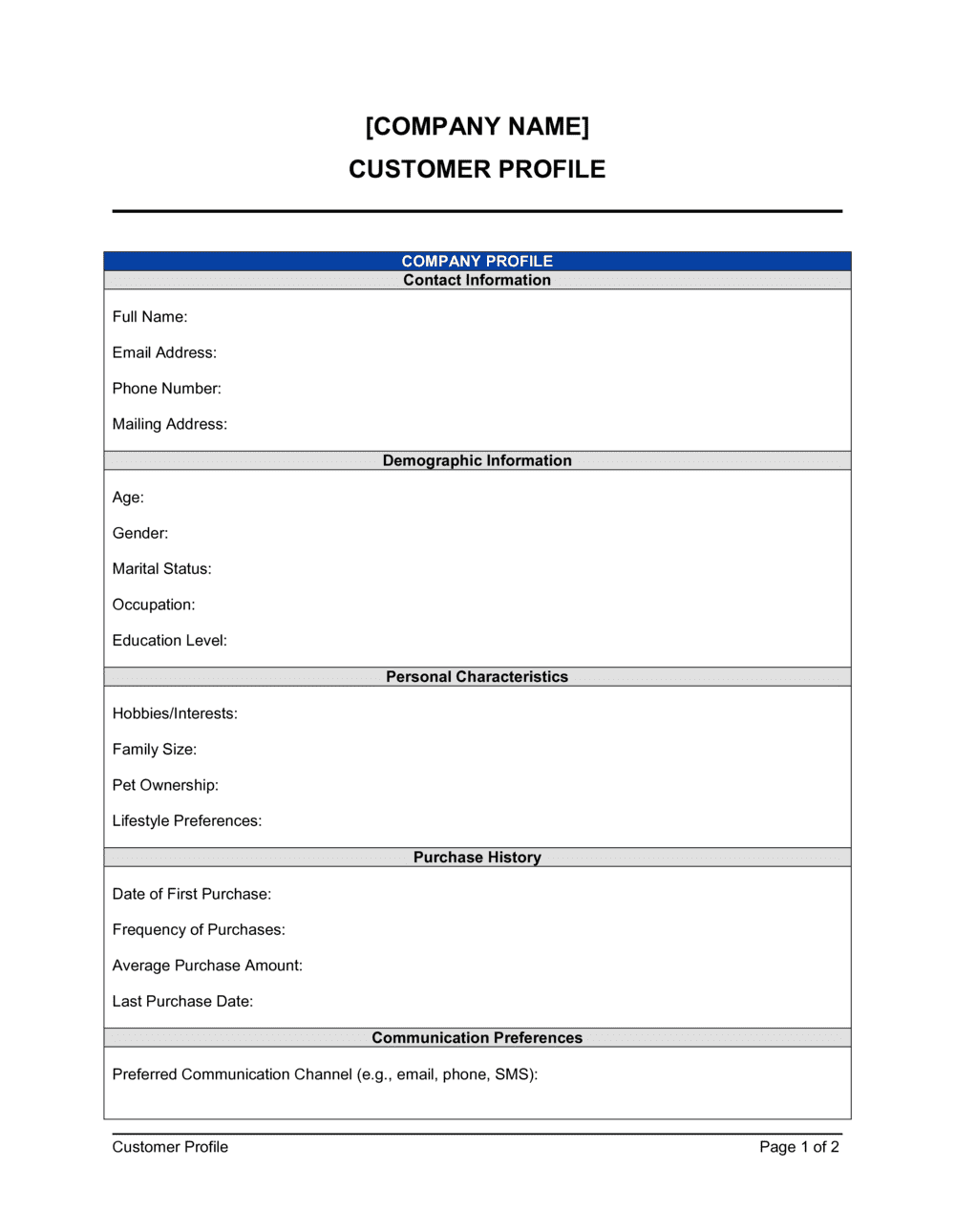
A Customer Profile Template is a structured document used to collect, organize, and store key information about a client or customer β€” including contact details, purchase history, preferences, communication records, and consent to data use. This free Word download gives businesses a consistent, legally sound framework for capturing customer data that can be edited online and exported as PDF for onboarding, CRM entry, or compliance purposes.
When you need it
Use it when onboarding a new client, opening a customer account, or formalizing an ongoing relationship that involves the collection and storage of personal or business data. It is especially important when data privacy regulations require documented consent for how customer information is collected and used.
What's inside
Customer identification details, contact and billing information, business or demographic profile, product and service preferences, purchase and engagement history, communication preferences, data consent and authorization, and an acknowledgment signature block confirming accuracy and consent.

What is a Customer Profile Template?

A Customer Profile Template is a structured document used to collect, record, and formalize key information about a client or customer β€” including their legal identity, contact and billing details, product preferences, purchase history, communication preferences, and explicit consent to the collection and use of their personal data. Unlike an informal CRM entry created by a staff member, a completed and signed customer profile is a legal record: it documents what information the customer provided, when they provided it, and what they consented to, creating a defensible audit trail under applicable data privacy laws.

Why You Need This Document

Without a signed customer profile, your business faces three compounding risks simultaneously. First, you may be storing personal data without documented consent β€” a violation of GDPR, PIPEDA, CASL, and US state privacy laws that carries fines and reputational consequences. Second, account managers and sales teams work from inconsistent or outdated records, leading to billing errors, miscommunications, and churn that could have been prevented. Third, if a customer disputes what information they provided or what they agreed to, you have no written record to fall back on. A standardized customer profile template closes all three gaps: it establishes a consistent onboarding baseline, creates enforceable consent records, and gives every team member a single source of truth about each account. This template is designed to be completed in under 30 minutes per customer, signed at onboarding, and updated annually β€” making data governance a routine operational step rather than a compliance scramble.

Which variant fits your situation?

If your situation is…Use this template
Profiling individual consumers rather than business accountsIndividual Customer Profile
Onboarding a business-to-business client with multiple contactsB2B Client Profile Template
Collecting patient information in a healthcare or clinical settingPatient Intake Form
Recording investor or high-net-worth client details in financial servicesKYC Client Profile Form
Capturing prospects during a sales pipeline qualification processSales Lead Profile Template
Building a loyalty or rewards program membership profileCustomer Loyalty Registration Form
Documenting vendor or supplier details instead of customersVendor Profile Template

Common mistakes to avoid

❌ Collecting data without a documented consent clause

Why it matters: Under GDPR, CASL, and similar laws, storing customer data without explicit, recorded consent exposes the business to fines of up to 4% of annual global turnover. The absence of a consent record makes it impossible to demonstrate compliance during an audit.

Fix: Add a purpose-specific consent clause to every customer profile and obtain a dated signature or verifiable electronic consent before storing any personal data.

❌ Using a single blanket authorization for all data uses

Why it matters: Regulators require that consent be specific to each purpose β€” marketing, analytics, third-party sharing. A single 'I agree to everything' statement is legally insufficient under GDPR and Canada's PIPEDA and may be struck down entirely.

Fix: Break the consent section into separate checkboxes or sub-clauses for each data use category, so the customer can consent selectively and the business has purpose-specific records.

❌ Never updating the profile after onboarding

Why it matters: Outdated contact details lead to failed invoices, missed communications, and service disruptions. An account marked as active with a defunct email or closed billing address creates payment and legal tracing problems.

Fix: Establish a mandatory annual review process and add a 'Last Updated' field to every profile. Flag any profile not reviewed in 18 months for immediate verification.

❌ Omitting the data sharing and third-party disclosure section

Why it matters: Sharing customer data with vendors, payment processors, or analytics platforms without prior disclosure violates privacy law in virtually every major jurisdiction β€” even when the sharing is operationally necessary.

Fix: List every category of third party with whom data may be shared, the purpose of the sharing, and the customer's right to object or opt out of non-essential disclosures.

❌ Collecting excessive demographic or behavioral data

Why it matters: Data minimization is a core principle of GDPR and Canada's PIPEDA. Collecting data you cannot justify a business purpose for increases your breach liability and regulatory exposure without providing operational benefit.

Fix: Audit each data field before finalizing your template. Remove any field where you cannot articulate a specific, current business use for the information collected.

❌ Storing signed profiles without access controls

Why it matters: Customer profiles containing PII and consent records are high-value targets for data breaches. Unrestricted internal access multiplies breach risk and may itself constitute a privacy violation under stricter data governance frameworks.

Fix: Restrict access to completed customer profiles to employees with a documented need β€” account managers, compliance, and legal β€” and log all access events for audit purposes.

The 9 key clauses, explained

Customer Identification

In plain language: Records the customer's full legal name, date of birth or incorporation date, government-issued ID type and number, and unique account identifier assigned by the business.

Sample language
Customer Full Name: [FULL LEGAL NAME] | Account Number: [ACCOUNT ID] | ID Type: [PASSPORT / DRIVER'S LICENSE / BUSINESS REGISTRATION] | ID Number: [ID NUMBER] | Date of Birth / Incorporation: [DATE]

Common mistake: Collecting only a preferred name or nickname rather than the legal name β€” this creates mismatches with payment records, contracts, and identity verification systems.

Contact and Billing Information

In plain language: Captures the customer's primary address, phone number, email address, and billing address if different β€” and designates an alternative or emergency contact where relevant.

Sample language
Primary Address: [STREET, CITY, STATE/PROVINCE, POSTAL CODE, COUNTRY] | Phone: [PHONE NUMBER] | Email: [EMAIL ADDRESS] | Billing Address (if different): [ADDRESS] | Alternate Contact: [NAME, RELATIONSHIP, PHONE]

Common mistake: Storing only one contact method. When that method becomes invalid β€” a changed phone number or abandoned email β€” the business loses the ability to reach the customer entirely.

Business or Demographic Profile

In plain language: For B2B accounts: records the company name, industry, size, and key decision-makers. For consumers: records demographic data relevant to service delivery, such as age range, household size, or occupation.

Sample language
Company Name: [COMPANY LEGAL NAME] | Industry: [INDUSTRY] | Company Size: [NUMBER OF EMPLOYEES] | Primary Contact: [NAME, TITLE] | Secondary Contact: [NAME, TITLE]

Common mistake: Skipping this section for B2B accounts because it seems optional. Without it, sales and account management teams have no shared baseline for personalizing outreach or identifying upsell opportunities.

Product and Service Preferences

In plain language: Documents the customer's stated preferences for product categories, service tiers, delivery methods, and any known constraints such as budget range or exclusions.

Sample language
Preferred Product Categories: [CATEGORIES] | Service Tier: [BASIC / STANDARD / PREMIUM] | Delivery Method: [IN-PERSON / REMOTE / HYBRID] | Budget Range: $[MIN] – $[MAX] per [PERIOD] | Exclusions or Restrictions: [NONE / SPECIFY]

Common mistake: Leaving this section blank during onboarding and assuming preferences will emerge naturally. Undocumented preferences lead to misaligned proposals and repeated customer complaints.

Purchase and Engagement History

In plain language: Provides a running record of past transactions, contract dates, invoice totals, and any service interactions β€” giving account managers a single view of the customer's history with the business.

Sample language
First Purchase Date: [DATE] | Most Recent Purchase: [DATE] | Total Lifetime Value: $[AMOUNT] | Active Contracts: [CONTRACT NAMES / NUMBERS] | Notes on Past Interactions: [SUMMARY]

Common mistake: Treating this as a static snapshot taken at onboarding. A profile not updated after each transaction quickly becomes misleading and is ignored by the teams who need it most.

Communication Preferences

In plain language: Records the customer's chosen contact channels, frequency limits, language preference, and any time-of-contact restrictions β€” establishing a binding basis for compliant outreach.

Sample language
Preferred Contact Channel: [EMAIL / PHONE / SMS / MAIL] | Contact Frequency: [MAXIMUM X TIMES PER MONTH] | Language Preference: [LANGUAGE] | Do Not Contact Before/After: [TIME RANGE] | Opted Into Marketing: [YES / NO]

Common mistake: Failing to record opt-in or opt-out status at the time of data collection. In jurisdictions subject to GDPR, CASL, or CAN-SPAM, the absence of documented consent exposes the business to regulatory fines.

Data Consent and Authorization

In plain language: Obtains the customer's explicit written consent for the collection, storage, processing, and sharing of their personal data β€” specifying the purposes and any third parties involved.

Sample language
I, [CUSTOMER NAME], authorize [COMPANY NAME] to collect, store, and process my personal data for the purposes of [ACCOUNT MANAGEMENT / MARKETING / REGULATORY COMPLIANCE] as described in [COMPANY NAME]'s Privacy Policy dated [DATE]. I understand I may withdraw consent by [METHOD].

Common mistake: Using a blanket consent statement that authorizes all possible uses of data without specifying them. Regulators under GDPR and equivalent laws require purpose-specific consent β€” an undifferentiated clause is insufficient and may be unenforceable.

Data Sharing and Third-Party Disclosure

In plain language: Discloses whether the customer's information will be shared with affiliates, service providers, or regulators β€” and under what conditions β€” so the customer can make an informed decision.

Sample language
Your data may be shared with: [LIST OF THIRD PARTIES OR CATEGORIES] for the purpose of [STATED PURPOSE]. Data will not be sold to unaffiliated third parties without separate consent. Regulatory disclosure may be required by law without notice.

Common mistake: Omitting this section entirely because it feels administrative. Courts and regulators treat undisclosed sharing as a breach of privacy obligations regardless of whether actual harm occurred.

Customer Acknowledgment and Signature

In plain language: Confirms that the customer has reviewed the profile for accuracy, consents to data use as described, and authorizes the business to rely on the information provided.

Sample language
I confirm the information provided is accurate and complete to the best of my knowledge. I consent to its use by [COMPANY NAME] as described above. Signature: _________________________ | Name: [PRINTED NAME] | Date: [DATE]

Common mistake: Collecting the customer's signature electronically without retaining a timestamped record. In the event of a dispute or audit, an unsigned or undated profile has no evidentiary weight.

How to fill it out

  1. 1

    Enter the customer's legal identification details

    Start with the customer's full legal name or registered business name, account number, and a valid government-issued ID reference. For B2B accounts, include the business registration number.

    πŸ’‘ Cross-reference the ID number against the document presented during onboarding β€” a mismatch here creates compliance and payment matching problems downstream.

  2. 2

    Complete all contact and billing fields

    Record the primary address, phone, and email. Note the billing address if it differs from the mailing address. Add an alternative contact for business accounts.

    πŸ’‘ Ask the customer to confirm the correct email format on the spot β€” transcription errors in email addresses are the single most common cause of failed follow-up.

  3. 3

    Build the business or demographic profile section

    For B2B customers, document the company's industry, size, and the decision-makers you'll be working with. For individual consumers, record only the demographic fields relevant to your service delivery.

    πŸ’‘ Collect only data you will actually use. Over-collection of demographic data increases your privacy compliance burden without adding business value.

  4. 4

    Record product and service preferences

    Ask the customer directly about preferred product categories, service tier, budget range, and any constraints. Document their answers verbatim rather than interpreting them.

    πŸ’‘ Frame preference questions around outcomes β€” 'What does success look like for you?' β€” rather than product features. The answers are more actionable.

  5. 5

    Document communication preferences and opt-in status

    Record the customer's preferred channel, frequency, and language. Explicitly ask and record whether they consent to marketing communications β€” and log the date and method of consent.

    πŸ’‘ Store the raw consent record (signed form, checkbox with timestamp) separately from the profile so it is retrievable for audits without searching through customer files.

  6. 6

    Present and explain the data consent clause

    Walk the customer through the consent clause before asking for a signature. Explain what data is collected, why, how long it is retained, and who it may be shared with.

    πŸ’‘ Customers who understand why you collect data are significantly less likely to withdraw consent later. A 30-second plain-English explanation reduces future friction.

  7. 7

    Obtain a dated signature

    Have the customer sign and date the acknowledgment block. For digital completion, use an e-signature tool that timestamps the signing event and records the customer's IP address or email confirmation.

    πŸ’‘ File the signed profile in a location accessible to account managers, compliance, and legal β€” but not marketing teams who have no need for the ID and consent data.

  8. 8

    Schedule a profile review cadence

    Set a reminder to update the profile annually or after any significant change β€” new billing address, revised communication preferences, or a material change in the customer's business.

    πŸ’‘ Add a 'Last Updated' field to the template and populate it at every review. A stale profile with no update date is treated as non-compliant under most data governance frameworks.

Frequently asked questions

What is a customer profile template?

A customer profile template is a structured document that captures all essential information about a client or customer β€” identification, contact details, preferences, purchase history, and data consent β€” in a single organized record. Businesses use it to standardize onboarding, support CRM data entry, and create a legally defensible record of how and why customer data was collected. A well-designed template reduces onboarding time and supports compliance with data privacy regulations.

What information should a customer profile include?

At minimum: full legal name, contact details, billing address, account identifier, communication preferences, product or service preferences, data consent authorization, and a dated signature. For B2B accounts, also include the company name, industry, size, and key contacts. For regulated industries such as financial services or healthcare, include KYC verification details and regulatory disclosure language.

Do customers need to sign a customer profile?

In most jurisdictions, a signature or verifiable electronic consent is required whenever you collect personal data that will be stored, processed, or shared. Without it, the business cannot demonstrate that consent was freely given, specific, informed, and unambiguous β€” the four-part test under GDPR. Even outside the EU, a signed profile protects the business in disputes about what information was provided and when.

How does a customer profile template relate to GDPR compliance?

GDPR requires that businesses have a lawful basis for every type of data processing they conduct. For most customer relationships, consent is that basis. A customer profile template that includes a purpose-specific consent clause, a data retention disclosure, and a third-party sharing notice provides documented evidence of GDPR-compliant data collection. It should be reviewed by a privacy professional for businesses operating in or selling to EU customers.

How often should a customer profile be updated?

Best practice is an annual review for all active accounts, plus an immediate update whenever the customer notifies you of a change to their contact details, billing information, or communication preferences. Under GDPR and PIPEDA, businesses are required to maintain accurate data β€” a profile that is materially incorrect and relied upon for marketing or billing decisions may constitute a data quality breach.

What is the difference between a customer profile and a CRM record?

A CRM record is a digital entry within a software platform β€” it is typically created by staff, updated automatically, and lacks a customer signature. A customer profile template is a formal document that the customer reviews, confirms for accuracy, and signs. The signed profile is the consent and accuracy record; the CRM entry is the operational tool. The two should be synchronized, but the signed profile governs in any dispute about what the customer agreed to.

Can a customer profile template be used for B2B clients?

Yes. For B2B accounts, adapt the identification section to capture the company's registered legal name, business number, and jurisdiction of incorporation alongside the individual contact's details. The consent clause should be signed by an authorized representative of the client company β€” typically someone with signing authority β€” and should reference both the company's and the individual's data as applicable.

How this compares to alternatives

vs Client Intake Form

A client intake form is a one-time data capture instrument completed at the start of an engagement β€” focused on immediate project needs and basic contact details. A customer profile template is a living record that grows over time to include purchase history, preferences, and renewed consent. The intake form feeds the profile; they serve different stages of the customer lifecycle.

vs Vendor Profile Template

A vendor profile documents a supplier's capabilities, pricing, certifications, and contact hierarchy for procurement purposes. A customer profile documents the client's preferences, purchase behavior, and consent for data use. The data structure and consent obligations differ significantly β€” vendor profiles carry fewer privacy law implications than customer profiles containing consumer PII.

vs Service Agreement

A service agreement defines the terms, deliverables, pricing, and remedies for a specific engagement between a business and its client. A customer profile template captures the identity, preferences, and consent data that underpins the relationship. Both documents should reference each other, but the service agreement governs what is delivered while the profile governs how the customer's data is handled.

vs Non-Disclosure Agreement (NDA)

An NDA restricts what either party may disclose about each other's confidential information to third parties. A customer profile template is an affirmative data-collection document that the customer signs to consent to and confirm information. The two documents address different obligations β€” an NDA constrains disclosure; a customer profile authorizes it for defined purposes.

Industry-specific considerations

Financial Services

KYC identity verification, beneficial ownership disclosure, risk tolerance classification, and regulatory reporting fields are standard inclusions for banks, brokers, and advisors.

Healthcare

Patient demographics, insurance details, emergency contacts, and HIPAA authorization language must be integrated into any healthcare customer profile used in the US.

Retail and E-commerce

Purchase history, loyalty tier, preferred payment method, and marketing opt-in status drive personalization and are subject to CCPA and similar state privacy laws in the US.

Professional Services

Engagement history, billing contacts, matter preferences, and conflict-of-interest disclosure fields are essential for law firms, accountants, and consultants managing long-term client relationships.

SaaS / Technology

Product tier, feature usage preferences, renewal dates, and technical contact details support account management and renewal forecasting in subscription-based businesses.

Real Estate

Property preferences, budget range, financing status, and transaction history help agents and brokers manage buyer and tenant relationships across multi-year cycles.

Jurisdictional notes

United States

No single federal privacy law governs commercial customer data collection, but sector-specific laws apply β€” HIPAA for healthcare, GLBA for financial services, and FERPA for education. California's CCPA and CPRA grant consumers the right to know, delete, and opt out of the sale of their personal information. Over 15 states have enacted similar laws as of 2025, making state-by-state compliance a significant consideration for national businesses.

Canada

PIPEDA (and Quebec's Law 25, the most stringent provincial law) requires that customer consent be meaningful, informed, and specific to each purpose for which data is used. CASL imposes strict opt-in requirements for commercial electronic messages. Quebec's Law 25 adds mandatory privacy impact assessments for high-risk data processing and requires a privacy officer designation for businesses of any size. Consent language must be available in both English and French for federally regulated entities.

United Kingdom

Post-Brexit, the UK operates under the UK GDPR and the Data Protection Act 2018, which mirror EU GDPR requirements closely. Customers retain rights to access, rectification, erasure, and data portability. The ICO (Information Commissioner's Office) enforces compliance and can issue fines up to Β£17.5M or 4% of global annual turnover. Customer profiles must include a clear privacy notice and cannot rely on pre-ticked consent boxes.

European Union

GDPR imposes the strictest customer data requirements of any major jurisdiction. Consent must be freely given, specific, informed, and unambiguous β€” and as easy to withdraw as to give. Businesses must document their lawful basis for processing each category of data and retain consent records for the duration of the customer relationship plus any applicable retention period. Profiling and automated decision-making based on customer data carries additional disclosure and opt-out obligations under Article 22.

Template vs lawyer β€” what fits your deal?

PathBest forCostTime
Use the templateSmall businesses and sales teams collecting standard contact, preference, and marketing consent data from customersFree15–30 minutes per profile
Template + legal reviewBusinesses handling sensitive PII, operating across multiple jurisdictions, or subject to sector-specific privacy regulations such as HIPAA or PIPEDA$300–$800 for a privacy counsel review of the template3–5 business days
Custom draftedFinancial institutions, healthcare providers, and enterprises collecting data from EU residents subject to full GDPR compliance requirements$1,500–$5,000+ for a custom privacy-compliant data collection framework2–4 weeks

Glossary

Customer Profile
A structured record of a customer's identifying details, behavioral history, preferences, and consent status used to manage the business relationship.
KYC (Know Your Customer)
A regulatory process requiring businesses β€” particularly in financial services β€” to verify the identity and background of clients before providing services.
Data Subject
The individual whose personal data is being collected, stored, or processed β€” a term used specifically in GDPR and privacy law.
Consent Clause
A section of a document in which the customer expressly authorizes the collection, storage, and use of their personal information for defined purposes.
Data Controller
The business or entity that determines the purposes and means of processing personal data β€” carries primary legal responsibility under GDPR and similar laws.
Personally Identifiable Information (PII)
Any data that can be used on its own or combined with other data to identify a specific individual, such as name, email address, phone number, or national ID.
Communication Preferences
A customer's stated choices for how, when, and through which channels the business may contact them β€” email, phone, SMS, or post.
Customer Segmentation
The practice of grouping customers by shared characteristics β€” demographics, purchase behavior, or geography β€” to enable targeted marketing or service delivery.
Opt-In / Opt-Out
Opt-in requires customers to actively consent to data use or marketing; opt-out places the default as consented unless the customer actively refuses.
Data Retention Policy
A company's documented rules for how long customer data is stored and when it must be deleted or anonymized to comply with privacy regulations.
Account Holder
The named individual or legal entity recognized as the primary owner of a customer account and responsible party for associated transactions.

Part of your Business Operating System

This document is one of 3,000+ business & legal templates included in Business in a Box.

  • Fill-in-the-blanks β€” ready in minutes
  • 100% customizable Word document
  • Compatible with all office suites
  • Export to PDF and share electronically

Create your document in 3 simple steps.

From template to signed document β€” all inside one Business Operating System.
1
Download or open template

Access over 3,000+ business and legal templates for any business task, project or initiative.

2
Edit and fill in the blanks with AI

Customize your ready-made business document template and save it in the cloud.

3
Save, Share, Send, Sign

Share your files and folders with your team. Create a space of seamless collaboration.

Save time, save money, and create top-quality documents.

β˜…β˜…β˜…β˜…β˜…

"Fantastic value! I'm not sure how I'd do without it. It's worth its weight in gold and paid back for itself many times."

Managing Director Β· Mall Farm
Robert Whalley
Managing Director, Mall Farm Proprietary Limited
β˜…β˜…β˜…β˜…β˜…

"I have been using Business in a Box for years. It has been the most useful source of templates I have encountered. I recommend it to anyone."

Business Owner Β· 4+ years
Dr Michael John Freestone
Business Owner
β˜…β˜…β˜…β˜…β˜…

"It has been a life saver so many times I have lost count. Business in a Box has saved me so much time and as you know, time is money."

Owner Β· Upstate Web
David G. Moore Jr.
Owner, Upstate Web

Run your business with a system β€” not scattered tools

Stop downloading documents. Start operating with clarity. Business in a Box gives you the Business Operating System used by over 250,000 companies worldwide to structure, run, and grow their business.

Start freeΒ Β·Β No credit card required