Value Proposition Worksheet

Free download • Use as a template • Print or share

1 page20–30 min to useDifficulty: StandardSignature requiredLegal review recommended
Learn more ↓
FreeValue Proposition Worksheet Template

At a glance

What it is
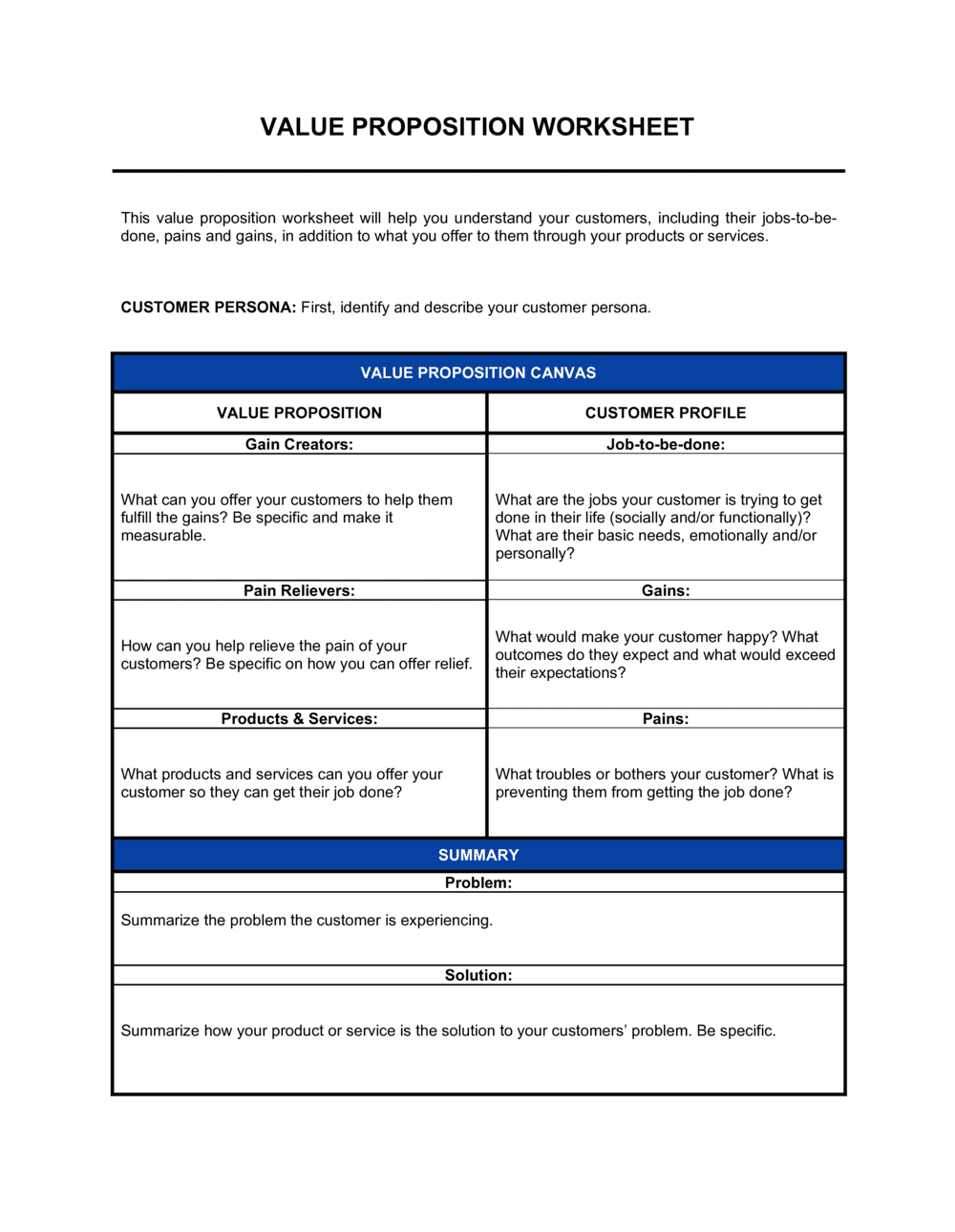
A Value Proposition Worksheet is a structured document that guides a business through systematically defining and articulating the unique value it delivers to a specific customer segment. This free Word download walks you through identifying customer jobs, pain points, gain drivers, and the specific product or service features that address each — producing a clear, testable value proposition statement you can embed in pitch decks, sales materials, and partner agreements.
When you need it
Use it when launching a new product or service, repositioning an existing offering, entering a new market segment, or preparing materials for investor pitches, partnership proposals, or contractual commitments that require a documented statement of differentiated value.
What's inside
Customer segment profile, customer jobs and desired outcomes, pain point inventory, gain drivers, product and service feature map, pain reliever and gain creator analysis, value proposition statement, competitive differentiation summary, and evidence and proof points.

What is a Value Proposition Worksheet?

A Value Proposition Worksheet is a structured analytical document that guides a business team through defining the precise value a product or service delivers to a specific customer segment. Working through the worksheet, teams map customer jobs — the functional, social, and emotional tasks customers are trying to accomplish — against the pain points that block them and the gains they hope to achieve. Those customer insights are then matched to product features, pain relievers, and gain creators, producing a tested value proposition statement backed by quantified proof points. Unlike a tagline or a pitch deck slide, the worksheet is an evidence-based working document that aligns product, marketing, and sales teams around the same customer-grounded understanding of why the product wins.

Why You Need This Document

Without a completed value proposition worksheet, marketing campaigns describe product features rather than customer outcomes, sales teams improvise different value stories for the same product, and investor or partner conversations stall when asked to substantiate a claim. The cost of skipping this analysis is concrete: teams spend budget promoting benefits customers do not value highly, while the pain points that actually drive purchase decisions go unaddressed in messaging. Formally documenting your value proposition also carries legal weight — when claims from this worksheet are reproduced in contracts, partner agreements, or regulated advertising materials, unsubstantiated assertions become potential misrepresentation liability under consumer protection laws in every major jurisdiction. A completed worksheet, reviewed for accuracy before external use, protects the business while giving every customer-facing team a single, coherent, evidence-backed story to tell.

Which variant fits your situation?

If your situation is…Use this template
Mapping value for a SaaS or subscription productSaaS Value Proposition Worksheet
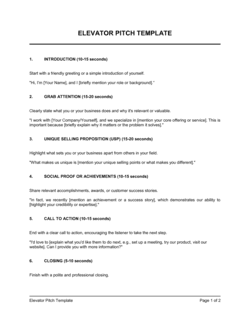
Preparing a value case for an investor pitch deckElevator Pitch Template
Developing positioning for a new market entryMarketing Plan
Aligning value proposition with a distribution or reseller partnerBusiness Partnership Agreement
Documenting customer segment insights from discovery researchCustomer Persona Template
Translating value proposition into a formal business caseBusiness Plan
Validating value proposition assumptions with a go-to-market planGo-to-Market Strategy Plan

Common mistakes to avoid

❌ Targeting multiple customer segments in a single worksheet

Why it matters: Different segments have different jobs, pains, and gain priorities — a worksheet that tries to serve two segments produces a value proposition that is too broad to resonate with either one.

Fix: Complete one worksheet per customer segment. Start with the segment that represents the highest-value or most-validated use case, then create separate worksheets for secondary segments.

❌ Writing the value proposition statement before completing the analysis

Why it matters: Statements written without the underlying pain, gain, and feature mapping default to internal marketing language rather than customer language, and tend to describe features rather than outcomes.

Fix: Treat the value proposition statement as the final output of the worksheet, not the starting point. Only draft it after all preceding sections are complete and cross-referenced.

❌ Using vague or unmeasured gain creators

Why it matters: Claims like 'improves productivity' or 'saves time' without a number are indistinguishable from every competitor's claims and are immediately discounted by buyers, investors, and partners reviewing the document.

Fix: Attach a specific metric to every gain creator — a percentage, a time saving, a cost reduction, or a conversion rate improvement — and cite the source and date of the evidence.

❌ Ignoring the 'do nothing' competitive alternative

Why it matters: The most common competitor in any market is the customer's current behavior, whether that is a manual process, a spreadsheet, or simply tolerating the pain. Omitting it produces a differentiation analysis that misses the real decision most customers face.

Fix: Add 'current approach / status quo' as an explicit row in the competitive differentiation section and document specifically why switching to your solution is worth the cost and effort of change.

❌ Treating the completed worksheet as a final, static document

Why it matters: A value proposition built on assumptions that are never retested against real customer behavior becomes a liability — teams optimize messaging around claims that no longer reflect how customers make decisions.

Fix: Set a review cadence of at least once per quarter for active products, and update the proof point section with new data after each significant customer cohort or market event.

❌ Omitting social and emotional customer jobs

Why it matters: Functional jobs describe what the customer does; social and emotional jobs describe why they care. Ignoring them produces a value proposition that is technically accurate but fails to motivate action.

Fix: In the customer jobs section, explicitly add at least one social job (how the customer wants to be perceived) and one emotional job (how the customer wants to feel) alongside every functional job.

The 10 key clauses, explained

Customer segment definition

In plain language: Identifies the specific customer profile the value proposition targets — including demographics, firmographics, behavioral traits, and the context in which they experience the problem.

Sample language
Target Segment: [SEGMENT NAME] — [DESCRIPTION OF WHO THEY ARE], typically experiencing [CONTEXT / TRIGGER SITUATION], with an annual budget of approximately $[X] for solutions in this category.

Common mistake: Defining the segment too broadly — 'small businesses' or 'enterprise companies' without further qualification. An unfocused segment makes every subsequent section of the worksheet too generic to be actionable.

Customer jobs inventory

In plain language: Lists the functional, social, and emotional jobs the customer is trying to accomplish in the defined context, ranked by importance to the customer.

Sample language
Primary Job: [FUNCTIONAL JOB — e.g., 'Reduce the time spent reconciling monthly invoices']. Secondary Job: [SOCIAL JOB — e.g., 'Demonstrate financial control to the CFO']. Emotional Job: [e.g., 'Feel confident that nothing slips through the cracks.']

Common mistake: Listing only functional jobs and ignoring social and emotional dimensions. Emotional and social jobs frequently drive purchase decisions more than the functional job alone.

Pain point inventory

In plain language: Documents the specific obstacles, frustrations, risks, and negative outcomes the customer faces when trying to complete each job, rated by severity.

Sample language
Pain #1 (Severity: High): [PAIN DESCRIPTION — e.g., 'Manual data entry errors cause invoice disputes that delay payment by an average of 14 days.']. Root Cause: [ROOT CAUSE]. Current Workaround: [WORKAROUND].

Common mistake: Conflating pain points with feature requests. A pain point is what the customer suffers; a feature request is one possible remedy. Documenting the pain — not the assumed solution — keeps the analysis honest.

Gain drivers inventory

In plain language: Identifies the positive outcomes, aspirations, and benefits the customer explicitly wants or would be delighted to receive, beyond just removing pain.

Sample language
Gain #1 (Priority: High): [GAIN DESCRIPTION — e.g., 'Receive payment within 10 business days without manual follow-up.']. Gain #2 (Priority: Medium): [e.g., 'Generate audit-ready reports automatically for year-end.']

Common mistake: Writing gains that mirror pain reliefs rather than capturing aspirational outcomes. Gains should describe what success looks like, not just the absence of a problem.

Products and services feature map

In plain language: Lists the specific features, capabilities, and service components that your offering provides, mapped to the jobs, pains, and gains documented in the previous sections.

Sample language
Feature: [FEATURE NAME]. Job Addressed: [JOB]. Pain Relieved: [PAIN #]. Gain Created: [GAIN #]. Delivery Mechanism: [HOW IT WORKS IN ONE SENTENCE].

Common mistake: Listing every product feature rather than only those that map to a documented customer job, pain, or gain. Unmapped features signal a product-out perspective rather than a customer-in perspective.

Pain relievers analysis

In plain language: Explains precisely how each relevant product feature reduces or eliminates a specific pain point, with a rating for how effectively it addresses the pain.

Sample language
Feature [FEATURE NAME] relieves Pain #[X] by [MECHANISM OF RELIEF]. Effectiveness Rating: [High / Medium / Low]. Evidence: [METRIC OR CUSTOMER QUOTE].

Common mistake: Rating all pain relievers as 'High' effectiveness without supporting evidence. Unsubstantiated ratings undermine credibility in partner negotiations and investor reviews where the worksheet is presented as supporting material.

Gain creators analysis

In plain language: Explains how each feature creates positive value for the customer beyond pain removal, including the magnitude of the gain and supporting proof points.

Sample language
Feature [FEATURE NAME] creates Gain #[X] by [MECHANISM]. Magnitude: [QUANTIFIED OUTCOME — e.g., 'Reduces month-end close from 5 days to 1 day']. Proof Point: [CASE STUDY / METRIC / BENCHMARK].

Common mistake: Describing gain creators in vague language like 'improves efficiency' without a quantified outcome. Buyers and partners test specific claims; vague ones erode trust.

Value proposition statement

In plain language: A single synthesized statement that combines the target segment, the primary job, the dominant pain or gain addressed, and the specific differentiating capability — written in plain language for external use.

Sample language
For [TARGET SEGMENT] who need to [PRIMARY JOB], [PRODUCT / COMPANY NAME] is a [CATEGORY] that [KEY BENEFIT]. Unlike [PRIMARY ALTERNATIVE], we [DIFFERENTIATING CAPABILITY], which means [CUSTOMER OUTCOME].

Common mistake: Writing the value proposition statement first, before completing the pain, gain, and feature map sections. A statement written without the underlying analysis defaults to marketing language rather than customer language.

Competitive differentiation summary

In plain language: Documents the specific dimensions on which the product or service outperforms the named alternatives a customer would realistically consider, with an honest assessment of any gaps.

Sample language
vs. [COMPETITOR A]: We outperform on [DIMENSION] (evidence: [METRIC]). Gap: [DIMENSION WHERE COMPETITOR LEADS]. vs. [COMPETITOR B]: We outperform on [DIMENSION]. Gap: [DIMENSION].

Common mistake: Comparing only against direct product competitors while ignoring the 'do nothing' or 'build in-house' alternative. The status quo is consistently the most common competitive choice and must be addressed explicitly.

Evidence and proof points

In plain language: Compiles the quantified data, case studies, testimonials, and third-party benchmarks that validate each major claim in the value proposition, including the source and date of each data point.

Sample language
Claim: [VALUE CLAIM]. Evidence: [METRIC / CASE STUDY SUMMARY]. Source: [CUSTOMER NAME / STUDY / ANALYST]. Date: [DATE]. Replication: [YES / NO — can this result be achieved for a similar customer?]

Common mistake: Including proof points that are more than two years old without noting their age. Outdated evidence suggests the value proposition has not been recently tested against real customers, which raises credibility concerns in any formal review.

How to fill it out

  1. 1

    Define and bound your target customer segment

    Name one specific customer segment and describe them in three to five attributes — industry, company size or individual profile, role or life stage, and the context in which they experience the problem you solve. Resist the urge to describe multiple segments at once.

    💡 If you genuinely serve more than one segment, complete a separate worksheet for each. A single worksheet covering two segments will produce a value proposition that resonates with neither.

  2. 2

    List all customer jobs in the segment's context

    Brainstorm every functional, social, and emotional job the customer is trying to accomplish in the context you defined. Write each as a verb-noun phrase from the customer's perspective — 'complete monthly payroll on time,' not 'payroll processing.'

    💡 Rank jobs by asking: 'If the customer could only accomplish one of these, which would they choose?' This ranking determines which pain relievers and gain creators matter most.

  3. 3

    Document pain points with severity ratings

    For each high-priority job, list every obstacle, risk, and negative emotion the customer encounters. Rate each pain from 1 (minor inconvenience) to 5 (deal-breaker that triggers active search for an alternative).

    💡 Pull language directly from customer interviews, support tickets, or reviews of competing products. Customers' own words in the pain section dramatically strengthen the final value proposition statement.

  4. 4

    Identify gain drivers beyond pain removal

    List the outcomes, metrics, and aspirations the customer would describe as a genuine win — not just the absence of the pain. For each gain, note whether it is expected (table stakes), desired (meaningful differentiator), or unexpected (potential delight factor).

    💡 Unexpected gains — outcomes the customer hadn't considered but immediately values when shown — are the most defensible basis for premium pricing.

  5. 5

    Map your product features to jobs, pains, and gains

    List each product or service feature and draw explicit links to the jobs, pains, and gains documented above. If a feature maps to nothing in the customer profile, flag it as either a premature feature or evidence of an undocumented customer need.

    💡 Features with no mapping are a product strategy conversation, not a value proposition conversation. Flag them separately rather than forcing them into the worksheet.

  6. 6

    Write pain relievers and gain creators with evidence

    For each mapped feature, write one sentence on how it relieves a specific pain or creates a specific gain, and attach at least one quantified proof point. Effectiveness ratings without evidence should be marked 'unvalidated' until data is available.

    💡 Even a single beta customer metric — 'reduced setup time from 3 hours to 20 minutes in our pilot' — is more persuasive than a claimed percentage without a source.

  7. 7

    Draft the value proposition statement

    Use the structured sentence format in the template: 'For [SEGMENT] who need to [JOB], [PRODUCT] is a [CATEGORY] that [KEY BENEFIT]. Unlike [ALTERNATIVE], we [DIFFERENTIATOR], which means [OUTCOME].' Edit until it reads as a sentence a real customer would find credible.

    💡 Test the statement with three people outside your team who match the target segment. If they do not immediately recognize the pain being addressed, return to the pain point inventory.

  8. 8

    Complete the competitive differentiation and proof point sections

    Name the three to four alternatives your target customer would realistically consider — including doing nothing — and document honestly where you win and where you lag. Attach a proof point to every claim you intend to use externally.

    💡 Investors and partners ask 'why not just use [COMPETITOR]?' during every review. A completed differentiation section gives your team a rehearsed, evidence-based answer.

Frequently asked questions

What is a value proposition worksheet?

A value proposition worksheet is a structured template that guides a team through defining the specific value a product or service delivers to a named customer segment. It maps customer jobs, pain points, and gain drivers against product features, pain relievers, and gain creators, producing a tested, evidence-backed value proposition statement. It is used across product development, marketing, sales, and business development to ensure all teams communicate the same customer-centric value story.

What is the difference between a value proposition and a unique selling proposition?

A unique selling proposition (USP) is a short, outward-facing marketing claim that states the single most compelling reason to choose your product over a competitor. A value proposition is a fuller internal and external framework that maps every dimension of customer value — jobs, pains, gains, features, and evidence — and produces the USP as one of its outputs. The worksheet produces both: a detailed analysis for internal alignment and a polished statement suitable for external communication.

Who should complete a value proposition worksheet?

The most effective value proposition worksheets are completed collaboratively by representatives from product, marketing, and sales — each of whom has direct access to different facets of customer insight. Product teams understand feature capabilities; marketing teams understand how customers describe their problems; sales teams understand the objections customers raise. A worksheet completed by any single function alone tends to be one-sided.

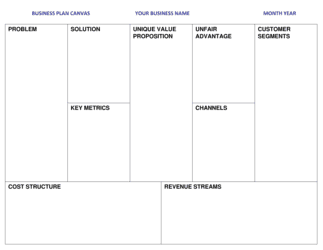
How is this worksheet different from a Business Model Canvas?

The Business Model Canvas maps nine dimensions of an entire business model — customer segments, channels, revenue streams, key activities, and cost structure among them. The value proposition worksheet focuses exclusively on the customer-value fit between a specific segment and a specific product offering. The worksheet typically feeds the Value Proposition block and the Customer Segments block of the Canvas, providing the detail those two blocks require.

Can a value proposition worksheet be used in investor or partner presentations?

Yes. A completed worksheet with quantified proof points is strong supporting material for investor due diligence, partnership proposals, and distribution agreements. It demonstrates that the company has conducted structured customer research and can articulate its differentiated value in a testable format. Many investors and corporate partners request it explicitly during early-stage evaluation as evidence of product-market fit thinking.

How often should a value proposition worksheet be updated?

For active products, review the worksheet at least quarterly and update the evidence section after each new customer cohort, product release, or significant market event. For early-stage companies still validating product-market fit, revisit it after every substantive round of customer interviews — typically every four to six weeks. A worksheet that is more than 12 months old without revision should be treated as an untested hypothesis rather than validated positioning.

Do I need one worksheet per product or per customer segment?

One worksheet per customer segment per product is the recommended approach. If your product serves three distinct customer segments — say, individual freelancers, small teams, and enterprise departments — complete three worksheets. The jobs, pains, and gains differ enough between segments that a single worksheet produces a value proposition too diluted to be compelling for any one of them.

What evidence qualifies as a valid proof point in the worksheet?

Valid proof points include quantified customer outcomes from case studies (e.g., 'Customer X reduced onboarding time from 5 days to 6 hours'), aggregated usage metrics from your own product data, third-party analyst benchmarks, independent research studies, and direct customer testimonials paired with a specific metric. Anecdotal observations without a number or source should be flagged as 'unvalidated' until supporting data is collected.

Is a value proposition worksheet legally binding?

The worksheet itself is not a legally binding contract. However, when incorporated by reference into a partnership agreement, reseller contract, or service-level agreement — or when value claims made in it are reproduced in marketing materials or sales contracts — the documented claims can carry legal weight under consumer protection and advertising standards laws. Claims that are materially misleading in any jurisdiction can expose the company to regulatory or civil liability, which is why legal review is recommended before the worksheet is used in formal commercial agreements.

How this compares to alternatives

vs Business Model Canvas

The Business Model Canvas maps all nine dimensions of a business model, including channels, cost structure, and revenue streams. The value proposition worksheet zooms in exclusively on the customer-value fit between a specific segment and a specific offering, providing the depth that the Canvas's Value Proposition and Customer Segments blocks require but cannot contain. Use the worksheet first, then transfer the outputs into the Canvas.

vs Marketing Plan

A marketing plan defines channels, campaigns, budgets, and timelines for reaching customers. A value proposition worksheet defines what to communicate before the plan determines how and where to communicate it. A marketing plan built without a completed value proposition worksheet often produces consistent distribution of an inconsistent message.

vs Elevator Pitch Template

An elevator pitch is a 30-to-60-second verbal or written summary designed for immediate persuasion in a live conversation. A value proposition worksheet is the analytical foundation that the pitch draws from. The worksheet produces the insight; the elevator pitch distills it into a single compelling statement for a specific audience.

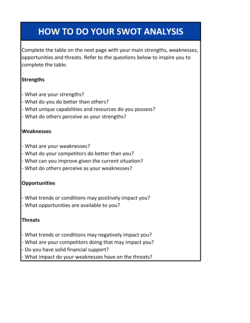
vs SWOT Analysis

A SWOT analysis maps internal strengths and weaknesses against external opportunities and threats at a business level. A value proposition worksheet maps customer jobs, pains, and gains against product capabilities at a segment level. SWOT informs strategic positioning broadly; the worksheet operationalizes that positioning for a specific customer and product combination.

Industry-specific considerations

SaaS / Technology

Value proposition worksheets for SaaS products center on time-to-value, churn reduction, and integration breadth — with proof points drawn from activation rates, NPS scores, and customer retention cohorts.

Professional Services

Service firms use the worksheet to document expertise-based differentiation, outcome metrics from client engagements, and the social and reputational gains clients derive from the relationship.

Healthcare / MedTech

Regulatory constraints require that clinical and outcomes claims in the value proposition are backed by peer-reviewed evidence or clinical trial data, and that gain creator language does not constitute a medical claim without regulatory approval.

Retail / E-commerce

Retail value propositions focus heavily on emotional and social jobs — how the product makes the customer feel or how it signals identity — alongside functional gains like price, convenience, and delivery speed.

Manufacturing

Manufacturing value propositions typically center on cost reduction, lead time compression, defect rate improvement, and supply chain reliability, with proof points drawn from production data and procurement benchmarks.

Financial Services

Financial services value propositions must balance gain creator language with regulatory compliance — claims about returns, risk reduction, or cost savings are subject to FCA, SEC, and FINRA advertising standards and require careful legal review.

Jurisdictional notes

United States

Value claims made in commercial materials are subject to FTC truth-in-advertising standards. Unsubstantiated superlatives or performance claims — particularly in health, finance, and technology — can trigger FTC enforcement. When the worksheet is incorporated into a commercial contract, claims become representations that can give rise to misrepresentation or fraud claims if materially inaccurate. California's consumer protection laws (CLRA and UCL) impose additional scrutiny on performance claims made to consumers.

Canada

The Competition Act prohibits false or misleading representations in commercial activity, including performance claims made in sales and marketing materials. The Competition Bureau has jurisdiction over deceptive marketing practices at the federal level, while provincial consumer protection statutes add a second layer of scrutiny. Quebec's language requirements under the Charter of the French Language apply to any external-facing value materials distributed in the province.

United Kingdom

The Consumer Protection from Unfair Trading Regulations and the Business Protection from Misleading Marketing Regulations govern commercial claims in the UK. The Advertising Standards Authority (ASA) enforces the CAP Code, which requires that marketing claims — including those drawn from a value proposition — are substantiated, accurate, and not misleading. Post-Brexit, Northern Ireland retains some EU consumer protection alignments that differ from the rest of Great Britain.

European Union

The EU's Unfair Commercial Practices Directive prohibits misleading commercial communications across all member states, with national regulators empowered to enforce locally. The 2024 Green Claims Directive adds specific substantiation requirements for environmental or sustainability value claims. GDPR considerations apply where the worksheet incorporates personally identifiable customer data as proof points. Member states vary in how aggressively they enforce advertising claim standards.

Template vs lawyer — what fits your deal?

PathBest forCostTime
Use the templateEarly-stage founders, product and marketing teams building internal alignment before external useFree2–4 hours for a first draft; 1–2 hours per revision cycle
Template + legal reviewTeams incorporating the worksheet's claims into partnership agreements, reseller contracts, or investor materials$300–$800 for a legal and compliance review of external-facing claims2–5 business days
Custom draftedRegulated industries (healthcare, financial services) where value claims carry regulatory risk, or enterprise deals where the worksheet is formally incorporated into a commercial agreement$1,000–$3,500+ depending on regulatory complexity and contract scope1–3 weeks

Glossary

Value Proposition
A clear statement of the specific benefit a product or service delivers to a customer segment, why that benefit matters, and why the provider is the best choice over alternatives.
Customer Segment
A distinct group of customers who share common characteristics, needs, or behaviors that make a specific value proposition relevant to all of them.
Customer Job
The task, problem, or goal a customer is trying to accomplish — whether functional (complete a task), social (look good to others), or emotional (feel a certain way).
Pain Point
An obstacle, risk, or negative outcome a customer experiences or fears when trying to complete a job — the specific friction your solution is designed to remove.
Gain Driver
An outcome or benefit a customer hopes to achieve beyond just solving the core problem — such as saving time, reducing cost, or increasing status.
Pain Reliever
A specific feature or capability of your product or service that directly addresses and reduces a documented customer pain point.
Gain Creator
A specific feature or capability that delivers a benefit the customer desires, beyond merely removing a pain — creating positive value rather than just neutral resolution.
Differentiated Value
The portion of your value proposition that cannot be easily replicated by a direct competitor — rooted in proprietary capability, brand trust, network effects, or unique positioning.
Value Proposition Statement
A single, concise sentence or short paragraph that captures the customer segment, the job being done, the pain or gain addressed, and the product's unique solution — written for external communication.
Proof Point
Quantified evidence — a metric, case study, testimonial, or benchmark — that validates a specific claim made in the value proposition.
Jobs-to-Be-Done (JTBD)
A customer-centric framework that defines what a customer is fundamentally trying to accomplish, used to identify where a product can create the most relevant and defensible value.

Part of your Business Operating System

This document is one of 3,000+ business & legal templates included in Business in a Box.

  • Fill-in-the-blanks — ready in minutes
  • 100% customizable Word document
  • Compatible with all office suites
  • Export to PDF and share electronically

Create your document in 3 simple steps.

From template to signed document — all inside one Business Operating System.
1
Download or open template

Access over 3,000+ business and legal templates for any business task, project or initiative.

2
Edit and fill in the blanks with AI

Customize your ready-made business document template and save it in the cloud.

3
Save, Share, Send, Sign

Share your files and folders with your team. Create a space of seamless collaboration.

Save time, save money, and create top-quality documents.

★★★★★

"Fantastic value! I'm not sure how I'd do without it. It's worth its weight in gold and paid back for itself many times."

Managing Director · Mall Farm
Robert Whalley
Managing Director, Mall Farm Proprietary Limited
★★★★★

"I have been using Business in a Box for years. It has been the most useful source of templates I have encountered. I recommend it to anyone."

Business Owner · 4+ years
Dr Michael John Freestone
Business Owner
★★★★★

"It has been a life saver so many times I have lost count. Business in a Box has saved me so much time and as you know, time is money."

Owner · Upstate Web
David G. Moore Jr.
Owner, Upstate Web

Run your business with a system — not scattered tools

Stop downloading documents. Start operating with clarity. Business in a Box gives you the Business Operating System used by over 250,000 companies worldwide to structure, run, and grow their business.

Start free · No credit card required