Worksheet Extraordinary Habits

Free download β€’ Use as a template β€’ Print or share

1 pageβ€’20–30 min to useβ€’Difficulty: Standardβ€’Signature requiredβ€’Legal review recommended
Learn more ↓
FreeWorksheet Extraordinary Habits Template

At a glance

What it is
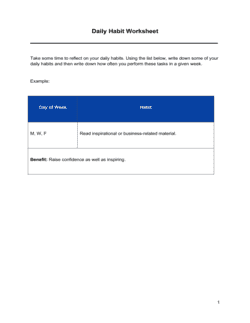
The Worksheet Extraordinary Habits is a structured personal and professional development document that guides individuals and teams through identifying, committing to, and tracking high-impact daily practices. This free Word download lets you define target behaviors, set measurable benchmarks, assign accountability, and record progress β€” all in one signed, dated record you can export as PDF and revisit in regular reviews.
When you need it
Use it when onboarding new employees into a performance culture, launching a personal improvement initiative, or aligning a leadership team around shared behavioral standards. It is also valuable at the start of a new fiscal year, following a performance review, or when an individual has committed to a formal coaching or mentorship program.
What's inside
The worksheet covers the individual's current-state assessment, targeted extraordinary habits with specific descriptions and rationales, measurable success criteria and review cadence, accountability partner or manager sign-off, commitment statement, and a progress log for tracking adherence over time.

What is a Worksheet Extraordinary Habits?

A Worksheet Extraordinary Habits is a structured personal and professional development document that guides an individual through identifying, committing to, and tracking specific high-impact behaviors β€” called extraordinary habits β€” over a defined period of 30, 60, or 90 days. Unlike a general goal-setting form, this worksheet creates a formal, signed behavioral commitment backed by a named accountability partner, measurable success criteria, and a real-time progress log. It functions as both a planning tool and a performance record, making the gap between current behavior and extraordinary performance visible, actionable, and reviewable.

Why You Need This Document

Without a written, signed commitment, behavioral intentions β€” no matter how sincere β€” are routinely displaced by daily urgency within two to three weeks. The absence of defined success criteria makes it impossible to know whether a habit is being practiced well, and the absence of a named accountability partner removes the social enforcement mechanism that research consistently identifies as the single strongest predictor of habit follow-through. In organizational contexts, unsigned and undocumented habit commitments cannot be referenced in coaching sessions, performance reviews, or management check-ins, leaving both manager and employee without a shared baseline. This template closes all of those gaps: it defines the habits, sets measurable thresholds, names the accountability structure, captures the signed commitment, and provides a progress log that turns the worksheet from a one-time exercise into a living record of behavioral change. For coaches, HR teams, and individuals serious about high performance, it is the difference between a good intention and a documented commitment.

Which variant fits your situation?

If your situation is…Use this template
Tracking habits for an individual employee as part of a performance planPerformance Improvement Plan
Establishing behavioral goals at the start of a new quarter or yearPersonal Development Plan
Documenting agreed behaviors between a coach and a clientCoaching Agreement
Building team-wide habits as part of a culture initiativeTeam Charter
Tracking measurable KPIs alongside behavioral habitsEmployee Performance Review
Committing to habits as part of an executive onboarding processExecutive Employment Agreement
Logging daily habit adherence in a recurring structured formatDaily Planner Template

Common mistakes to avoid

❌ Selecting vague or unmeasurable habits

Why it matters: Habits like 'be more focused' or 'improve communication' cannot be tracked, reviewed, or meaningfully evaluated at check-ins β€” making the entire worksheet unactionable.

Fix: Rewrite each habit as a specific behavior: 'Complete one 45-minute deep-work block before checking email each morning' is trackable; 'be more focused' is not.

❌ Skipping the obstacles and mitigation section

Why it matters: Without pre-committed responses to predictable disruptions β€” travel, heavy workload weeks, illness β€” habit adherence collapses at the first obstacle encountered.

Fix: For each habit, write at least one if-then plan before signing. This takes five minutes and more than doubles follow-through rates.

❌ Setting an open-ended commitment with no end date

Why it matters: Without a defined review date, there is no trigger to assess progress, renew the commitment, or adjust habits that are not working β€” and the worksheet is quietly abandoned.

Fix: Always specify a start date, an end date, and the scheduled review meeting in the commitment statement before signing.

❌ Naming an accountability partner without defining their role

Why it matters: A named partner who does not know what is expected of them provides no meaningful accountability β€” the social enforcement mechanism the document depends on never activates.

Fix: Before signing, brief the accountability partner on the check-in format, frequency, and what a useful check-in conversation looks like. Attach the schedule to the signed worksheet.

❌ Committing to more than five habits simultaneously

Why it matters: Behavioral research consistently shows that willpower and attention are finite β€” committing to six or more new habits at once reduces adherence across all of them to near zero within three weeks.

Fix: Limit the first cycle to two or three habits. Add more only after the initial habits are demonstrated as stable over a full 30-day period.

❌ Treating the worksheet as a one-time exercise rather than a living document

Why it matters: Without a formal renewal review, high-performing habits revert to baseline behavior within four to six weeks of the commitment period ending.

Fix: Schedule the renewal review in both parties' calendars at the time of signing. The review should result in either a revised worksheet or a documented decision to close the habit program.

The 10 key clauses, explained

Parties and Identification

In plain language: Names the individual completing the worksheet and, where applicable, the accountability partner, coach, or manager witnessing the commitment.

Sample language
This Worksheet is completed by [FULL NAME] ('Individual'), [TITLE], [DEPARTMENT / ORGANIZATION], and acknowledged by [ACCOUNTABILITY PARTNER NAME], [TITLE], on [DATE].

Common mistake: Omitting the accountability partner's name and role. Without a named witness, the document has no social enforcement mechanism and is treated as a private note rather than a formal commitment.

Current-State Assessment

In plain language: Documents the individual's honest self-evaluation of their present habits, strengths, and specific behavioral gaps they intend to address.

Sample language
Current daily routine: [DESCRIPTION]. Key gap identified: [SPECIFIC BEHAVIOR OR PATTERN]. Impact of gap on performance: [DESCRIPTION OF CONSEQUENCE OR OPPORTUNITY].

Common mistake: Writing aspirational descriptions instead of honest current-state observations. Inflated baselines make progress unmeasurable and undermine the credibility of the entire exercise.

Identified Extraordinary Habits

In plain language: Lists each target habit with a specific description, the rationale for selecting it, and the frequency or context in which it will be practiced.

Sample language
Habit 1: [HABIT NAME] β€” [SPECIFIC DESCRIPTION OF BEHAVIOR]. Rationale: [WHY THIS HABIT SUPPORTS THE INDIVIDUAL'S GOALS]. Frequency: [DAILY / X TIMES PER WEEK / EVERY MORNING BEFORE 9 AM].

Common mistake: Listing vague habits like 'be more proactive' without a concrete behavioral definition. Undefined habits cannot be tracked, measured, or meaningfully reviewed.

Measurable Success Criteria

In plain language: Defines exactly what consistent practice looks like for each habit, expressed in observable and quantifiable terms.

Sample language
Success for Habit [X] is defined as: [SPECIFIC MEASURABLE OUTCOME] achieved at least [X out of Y days / X times per week] over the [REVIEW PERIOD].

Common mistake: Setting success criteria at 100% adherence for new habits. All-or-nothing criteria trigger early abandonment β€” a threshold of 80% is more realistic and produces better long-term adherence.

Accountability Structure

In plain language: Describes who the accountability partner is, what their role entails, and how and when they will check in on the individual's progress.

Sample language
Accountability Partner: [NAME], [TITLE]. Check-in method: [WEEKLY 15-MINUTE MEETING / EMAIL SUMMARY / SHARED PROGRESS LOG]. First review date: [DATE]. Subsequent reviews: [EVERY [X] WEEKS / MONTHS].

Common mistake: Naming an accountability partner without specifying the check-in method and frequency. Undefined accountability structures are abandoned within the first two to three weeks.

Obstacles and Mitigation Plan

In plain language: Asks the individual to anticipate the most likely barriers to habit adherence and document a specific plan for each.

Sample language
Anticipated obstacle: [DESCRIPTION]. Mitigation strategy: [SPECIFIC ACTION THE INDIVIDUAL WILL TAKE IF THIS OBSTACLE ARISES]. Trigger: [IF / WHEN CONDITION].

Common mistake: Skipping this section entirely. Individuals who do not pre-commit to obstacle responses are two to three times more likely to abandon new habits when the first disruption occurs.

Commitment Statement and Duration

In plain language: A formal declaration by the individual committing to practice the listed habits for a defined period β€” typically 30, 60, or 90 days β€” before a structured reassessment.

Sample language
I, [FULL NAME], commit to practicing the habits described in this worksheet consistently from [START DATE] through [END DATE] β€” a period of [X] days β€” and to engaging honestly in all scheduled accountability reviews.

Common mistake: Using open-ended commitment language with no defined end date. Without a time boundary, there is no trigger for review, and the worksheet becomes a document people forget rather than revisit.

Progress Log

In plain language: A dated table or journal section where the individual records daily or weekly adherence, observations, and any adjustments made to the habit practice.

Sample language
Date: [DATE] | Habit [X] adherence: [YES / NO / PARTIAL] | Notes: [WHAT WORKED, WHAT DIDN'T, ADJUSTMENT MADE].

Common mistake: Leaving the progress log blank and relying on memory at review time. Retrospective self-reporting at check-ins is systematically overoptimistic β€” real-time logging produces more accurate and actionable data.

Review and Renewal Clause

In plain language: Specifies that at the end of the commitment period both parties will conduct a formal review, assess outcomes, and decide whether to renew, modify, or close the habit commitment.

Sample language
At the conclusion of the [X]-day commitment period on [END DATE], Individual and Accountability Partner will conduct a structured review to assess adherence, outcomes, and any revisions. A revised worksheet will be completed if the commitment is renewed.

Common mistake: Treating the end of the commitment period as the end of the process. Without a formal renewal step, high-performing habits revert within weeks of the commitment lapsing.

Signatures and Date

In plain language: Captures the dated signatures of the individual and their accountability partner or manager, formalizing the commitment and activating the accountability structure.

Sample language
Individual: [SIGNATURE] | [PRINTED NAME] | [DATE]. Accountability Partner / Manager: [SIGNATURE] | [PRINTED NAME] | [TITLE] | [DATE].

Common mistake: Dating the signatures days or weeks after the stated start date. A signature mismatch undermines the document's credibility and creates ambiguity about when the commitment actually began.

How to fill it out

  1. 1

    Enter the individual's and accountability partner's details

    Fill in full legal names, titles, department or organization, and the date the worksheet is being completed. If used in a coaching context, include the coach's name and the engagement reference.

    πŸ’‘ Use the same name format as appears on the individual's employment records or coaching agreement to ensure the documents can be cross-referenced.

  2. 2

    Complete the current-state assessment honestly

    Describe current daily routines and identify the specific behavioral gaps this worksheet is meant to address. Write in concrete, observable terms β€” not aspirational language.

    πŸ’‘ Ask: 'If someone followed me for a week, what would they see me doing and not doing?' That behavioral lens produces a far more useful baseline than self-reported values.

  3. 3

    Select two to five extraordinary habits

    Choose habits that are specific, behavioral, and directly linked to a measurable performance outcome. For each habit, write a one-sentence description and a one-sentence rationale.

    πŸ’‘ Start with no more than three habits for the first 30-day cycle. Adding more than five at once dramatically reduces adherence rates for all of them.

  4. 4

    Define success criteria for each habit

    Express what consistent practice looks like in observable, countable terms β€” days per week, minutes per session, or a specific output produced. Set a realistic adherence threshold, typically 75–85%.

    πŸ’‘ Avoid binary success definitions. A habit practiced six out of seven days is a success, not a failure β€” and binary framing causes people to quit after missing one day.

  5. 5

    Name the accountability partner and set the check-in schedule

    Write the accountability partner's name and role, the check-in method (meeting, email, or shared log), and the specific dates of the first three check-ins.

    πŸ’‘ Put all three check-in dates in both parties' calendars before signing. Accountability structures that rely on ad-hoc scheduling deteriorate within the first two weeks.

  6. 6

    Document anticipated obstacles and responses

    For each habit, list the most likely obstacle to adherence and write a specific if-then response plan: 'If [obstacle], then I will [specific action].'

    πŸ’‘ Research on implementation intentions shows that pre-committed if-then plans increase follow-through by up to 300% compared to intention-only commitments.

  7. 7

    Sign and date before the start date

    Both the individual and the accountability partner sign and date the worksheet on or before the stated start date. Post-start signatures weaken the commitment's social and psychological force.

    πŸ’‘ Treat the signing as a brief ceremonial moment β€” reading the commitment statement aloud before signing significantly increases perceived obligation.

  8. 8

    Update the progress log in real time

    Record adherence daily or at minimum weekly. Note what worked, what didn't, and any adjustments made. Use the log as the primary input for accountability check-ins rather than relying on recall.

    πŸ’‘ A two-minute end-of-day entry is sufficient. The habit of logging is itself an extraordinary habit worth tracking.

Frequently asked questions

What is a Worksheet Extraordinary Habits?

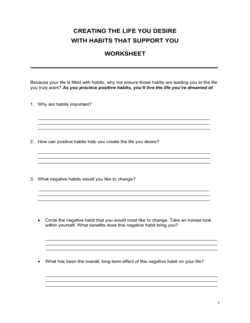
A Worksheet Extraordinary Habits is a structured personal and professional development document that guides an individual through identifying, committing to, and tracking specific high-impact behaviors β€” called extraordinary habits β€” over a defined period. It typically includes a current-state assessment, habit definitions with measurable success criteria, an accountability structure with a named partner, an obstacle-mitigation plan, a signed commitment statement, and a progress log. The signed format transforms a personal goal into a documented commitment with social and professional accountability.

Why does a habits worksheet need to be signed?

A signature converts a private aspiration into a formal commitment with an identifiable witness. Behavioral research consistently shows that written, signed commitments produce significantly higher follow-through rates than verbal or mental intentions. When the worksheet is signed by both the individual and an accountability partner β€” such as a manager, coach, or peer β€” the social cost of non-adherence increases, further strengthening compliance. In coaching and HR contexts, a signed worksheet also creates a documented record that can be referenced in performance reviews or coaching session notes.

How many habits should I include in the worksheet?

For a first 30-day cycle, two to three habits is the most effective range. Adding more than five habits at once dramatically reduces adherence across all of them β€” willpower and behavioral bandwidth are finite resources. Start with the two or three habits that will have the greatest leverage on your performance goals. Once those habits are demonstrated as stable over at least one full 30-day cycle, you can introduce additional habits in the next renewal worksheet.

What is the difference between this worksheet and a performance improvement plan?

A Performance Improvement Plan (PIP) is a formal HR document typically issued when an employee's performance has fallen below acceptable standards β€” it carries disciplinary implications and is often a precursor to termination. A Worksheet Extraordinary Habits is a proactive, aspirational document focused on elevating already-adequate performance to exceptional levels. It is used by choice, not as a corrective measure, and is equally applicable to high-performers, coaches, and business owners outside any employment context.

How long should the commitment period be?

Thirty days is the minimum effective period for a habit commitment worksheet β€” shorter cycles do not provide enough repetitions for a behavior to begin stabilizing. Sixty days is the most common choice for professional development contexts, as it allows one mid-point check-in and a final review within a single quarter. Ninety-day cycles align well with fiscal quarter planning and are appropriate for complex habits requiring sustained effort. Avoid open-ended commitments with no defined end date β€” they are reliably abandoned.

Who should serve as an accountability partner?

The accountability partner should be someone with regular professional contact with the individual β€” a direct manager, a peer in a similar role, or a professional coach. They do not need to share the same habits; their role is to conduct structured check-ins, review the progress log, and provide honest feedback on adherence and outcomes. In a coaching engagement, the coach typically serves as the accountability partner. In a corporate context, a direct manager or HR business partner is most appropriate.

Can this worksheet be used for team-level habit commitments?

Yes. The worksheet can be adapted for a team by having each member complete an individual worksheet and then sharing commitments in a group session. This creates collective accountability and makes team-wide behavioral norms visible. For team use, it is worth identifying one or two shared keystone habits that all members commit to, in addition to individual habits, to build a common behavioral baseline.

How does this worksheet support a coaching engagement?

In a coaching context, the Worksheet Extraordinary Habits serves as the behavioral contract underlying the engagement. It captures the agreed habits at the outset, provides a shared reference point for every coaching session, and creates a documented record of progress over time. Coaches often use the worksheet to open each session β€” reviewing the progress log, discussing adherence, and adjusting habits as the individual develops. At the end of the engagement, the completed worksheets form a tangible record of behavioral change.

What makes a habit 'extraordinary' versus simply a good habit?

An extraordinary habit is not just beneficial β€” it is specifically targeted at a high-leverage gap between the individual's current performance and their potential. A good habit might be drinking enough water; an extraordinary habit might be spending the first 30 minutes of every workday on the single most strategically important task before opening email. The distinction is intentionality and leverage: an extraordinary habit is chosen because its consistent practice is expected to produce a disproportionate improvement in a measurable outcome.

How this compares to alternatives

vs Performance Improvement Plan

A Performance Improvement Plan is a corrective HR document issued when an employee's performance has dropped below acceptable standards, typically with disciplinary implications. A Worksheet Extraordinary Habits is a proactive, aspirational tool used by choice to elevate high-performing individuals further. The PIP addresses a deficit; the habits worksheet pursues excellence.

vs Personal Development Plan

A Personal Development Plan maps longer-term career goals, skill gaps, and learning activities over a 12-month or multi-year horizon. A Worksheet Extraordinary Habits focuses on specific daily or weekly behaviors over a 30–90 day cycle with a signed commitment and accountability structure. The PDP sets direction; the habits worksheet drives execution.

vs Employee Performance Review

An Employee Performance Review is a retrospective assessment of what has already been achieved, scored against predefined KPIs or competency frameworks. A Worksheet Extraordinary Habits is a forward-looking commitment document focused on the specific behaviors that will drive future performance. The review measures outcomes; the worksheet commits to the inputs.

vs Coaching Agreement

A Coaching Agreement defines the terms, scope, fees, and confidentiality of a professional coaching engagement between coach and client. A Worksheet Extraordinary Habits is a working document produced within that engagement, capturing the specific behavioral commitments the client undertakes. The coaching agreement governs the relationship; the habits worksheet governs the work.

Industry-specific considerations

Professional Services

Used by consulting and advisory firms to formalize client-facing behavior standards, proposal response habits, and client relationship practices for consultants and account managers.

Financial Services

Applied by wealth managers, advisors, and brokers to document client outreach habits, market research routines, and compliance-related behavioral commitments in a signed record.

Healthcare

Used in clinical leadership development programs to formalize documentation habits, patient communication standards, and continuing education practices for physicians and care coordinators.

Technology / SaaS

Adopted by engineering and product teams to commit to code review cadence, documentation habits, and technical debt reduction practices as part of agile team culture initiatives.

Education and Coaching

Central to executive education and coaching programs where participants sign individual habit commitments at the close of workshops and track adherence between sessions.

Retail and Hospitality

Used by store and operations managers to formalize team leadership habits β€” daily floor walks, shift briefings, and customer feedback reviews β€” as part of a management development program.

Jurisdictional notes

United States

In the US, a signed Worksheet Extraordinary Habits is generally treated as a non-binding commitment document rather than an enforceable contract, unless it is incorporated by reference into an employment agreement or coaching contract. If used as part of a Performance Improvement Plan process, employers should consult employment counsel to ensure the worksheet does not inadvertently create contractual expectations around continued employment. State-level at-will employment doctrine means the worksheet alone does not create tenure or performance guarantees.

Canada

In Canada, a signed habit commitment worksheet may be referenced in employment disputes as evidence of agreed performance expectations, particularly in Ontario and British Columbia where courts examine the totality of the employment relationship. When the worksheet is used in a performance management context, employers should ensure it does not constitute an implicit amendment to the employment contract without fresh consideration. Quebec employers using the worksheet in French-language workplaces must ensure the document is available in French under the Charter of the French Language.

United Kingdom

Under UK employment law, a signed habits worksheet used in a professional development context does not typically constitute a contractual variation. However, if the worksheet forms part of a documented performance management process, it may be considered as evidence in an unfair dismissal claim before an Employment Tribunal. Employers should retain signed copies and ensure the worksheet's purpose is clearly framed as developmental rather than disciplinary to avoid confusion with formal capability procedures.

European Union

EU member states with strong employee protection frameworks β€” including France, Germany, and the Netherlands β€” may treat documented behavioral commitments as evidence of agreed working conditions. GDPR applies to the personal data contained in the worksheet, including self-assessments and performance observations; employers must ensure that completed worksheets are stored securely, access is limited, and retention periods are defined in the company's data processing policy. In coaching contexts outside employment, GDPR obligations apply to the coach as a data controller.

Template vs lawyer β€” what fits your deal?

PathBest forCostTime
Use the templateIndividuals, coaches, and HR teams creating personal or professional development commitments in a standard employment or coaching contextFree20–40 minutes
Template + legal reviewOrganizations embedding the worksheet into formal performance management frameworks or coaching programs with contractual obligations$150–$400 for an HR consultant or employment lawyer review1–2 days
Custom draftedEnterprises integrating the worksheet into a legally binding performance agreement, executive coaching contract, or regulated professional development program$500–$2,000+3–7 days

Glossary

Extraordinary Habit
A specific, intentional daily or weekly behavior that meaningfully elevates personal or professional performance beyond baseline expectations.
Accountability Partner
A designated individual β€” manager, peer, or coach β€” who reviews progress against committed habits and provides feedback at agreed intervals.
Baseline Assessment
A documented snapshot of current behaviors and performance levels used as the starting point against which habit progress is measured.
Success Criteria
Specific, measurable indicators that define what consistent adherence to a habit looks like β€” for example, completing a task five out of seven days per week.
Review Cadence
The agreed frequency β€” weekly, biweekly, or monthly β€” at which the individual and their accountability partner assess habit adherence and outcomes.
Commitment Statement
A signed declaration by the individual affirming their intent to practice the listed habits consistently over a defined period.
Progress Log
A dated record within the worksheet capturing self-reported adherence, observations, and adjustments made to each habit over time.
Keystone Habit
A single high-leverage behavior whose consistent practice tends to trigger positive change across multiple other areas of performance.
Habit Stacking
A technique for embedding a new habit by attaching it to an existing one β€” for example, reviewing goals immediately after a morning standup meeting.
Behavioral Commitment Device
A formal, often written, mechanism β€” such as a signed worksheet β€” that binds an individual to a course of action and raises the social and professional cost of non-adherence.

Part of your Business Operating System

This document is one of 3,000+ business & legal templates included in Business in a Box.

  • Fill-in-the-blanks β€” ready in minutes
  • 100% customizable Word document
  • Compatible with all office suites
  • Export to PDF and share electronically

Create your document in 3 simple steps.

From template to signed document β€” all inside one Business Operating System.
1
Download or open template

Access over 3,000+ business and legal templates for any business task, project or initiative.

2
Edit and fill in the blanks with AI

Customize your ready-made business document template and save it in the cloud.

3
Save, Share, Send, Sign

Share your files and folders with your team. Create a space of seamless collaboration.

Save time, save money, and create top-quality documents.

β˜…β˜…β˜…β˜…β˜…

"Fantastic value! I'm not sure how I'd do without it. It's worth its weight in gold and paid back for itself many times."

Managing Director Β· Mall Farm
Robert Whalley
Managing Director, Mall Farm Proprietary Limited
β˜…β˜…β˜…β˜…β˜…

"I have been using Business in a Box for years. It has been the most useful source of templates I have encountered. I recommend it to anyone."

Business Owner Β· 4+ years
Dr Michael John Freestone
Business Owner
β˜…β˜…β˜…β˜…β˜…

"It has been a life saver so many times I have lost count. Business in a Box has saved me so much time and as you know, time is money."

Owner Β· Upstate Web
David G. Moore Jr.
Owner, Upstate Web

Run your business with a system β€” not scattered tools

Stop downloading documents. Start operating with clarity. Business in a Box gives you the Business Operating System used by over 250,000 companies worldwide to structure, run, and grow their business.

Start freeΒ Β·Β No credit card required