Marketing Strategy For Growth

Free Word download β€’ Edit online β€’ Save & share with Drive β€’ Export to PDF

9 pagesβ€’20–30 min to fillβ€’Difficulty: Standard
Learn more ↓
FreeMarketing Strategy For Growth Template

At a glance

What it is
A Marketing Strategy For Growth is a structured operational document that defines how a business will acquire new customers, expand existing relationships, and increase revenue over a defined planning horizon β€” typically 12 to 24 months. This free Word download gives you a ready-to-edit framework covering market analysis, customer segmentation, positioning, channel selection, budget allocation, and KPIs, exportable as PDF for executive, board, or investor review.
When you need it
Use it when launching a new product, entering a new market, setting annual marketing priorities, or aligning a cross-functional team around a single revenue-growth plan. It is also required when seeking investor funding or board approval for a significant increase in marketing spend.
What's inside
The template covers situational analysis (market and competitive context), target customer profiles, brand positioning, channel strategy and budget mix, campaign roadmap, content and messaging framework, KPIs and measurement plan, and a quarterly execution timeline.

What is a Marketing Strategy For Growth?

A Marketing Strategy For Growth is a structured operational document that defines how a business will acquire new customers, strengthen its competitive position, and grow revenue over a 12 to 24 month horizon. It combines the upstream strategic decisions β€” target customer segmentation, brand positioning, and channel rationale β€” with a quantified campaign roadmap, budget allocation, and KPI framework that marketing and leadership teams can execute against and measure week over week. Unlike a tactical marketing calendar, it explains the reasoning behind every major decision, creating a single source of truth that survives leadership changes and quarterly pivots.

Why You Need This Document

Without a written growth strategy, marketing budgets get fragmented across whatever channel someone read about last month, and the connection between marketing activity and revenue becomes impossible to trace. The cost shows up as rising customer acquisition costs, inconsistent messaging across channels, and an inability to explain to the board why the marketing budget should increase. A documented strategy forces the segment, positioning, and channel decisions that most businesses defer indefinitely β€” and making those decisions before spending money typically reduces wasted spend within the first 90 days of execution. This template gives you the structure to produce a board-ready, team-aligned growth strategy in days rather than weeks.

Which variant fits your situation?

If your situation is…Use this template
Annual marketing planning for an existing businessMarketing Plan
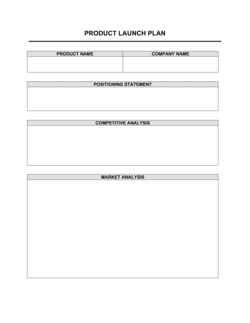
Launching a specific new product to marketProduct Launch Plan
Defining brand identity and messaging before executing campaignsBrand Strategy Template
Planning digital-only acquisition across paid and organic channelsDigital Marketing Plan
Summarizing strategy for a single marketing campaignMarketing Campaign Plan
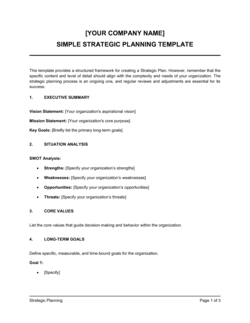
Mapping a high-level company direction including marketingStrategic Plan
Measuring and reporting on marketing results against targetsMarketing Report

Common mistakes to avoid

❌ Tactics masquerading as strategy

Why it matters: A document that lists 'run LinkedIn ads, post on Instagram, and send weekly emails' without explaining why those channels serve the growth objective gives no basis for prioritization or budget decisions.

Fix: Lead with customer segment and positioning decisions before touching channel or tactics. Channels are outputs of a strategy, not the strategy itself.

❌ Growth objectives with no funnel math

Why it matters: A revenue target of $2M that isn't traced back to lead volume, conversion rates, and channel capacity is a wish, not a plan β€” and it will be exposed in the first monthly review.

Fix: Build a simple funnel model from the target backward: revenue β†’ customers needed β†’ opportunities β†’ MQLs β†’ impressions, by channel.

❌ Budget spread too thin across too many channels

Why it matters: Allocating 10% of budget to each of eight channels means none reaches the threshold of spend required to generate statistically meaningful data or consistent results.

Fix: Choose two to four channels, fund them adequately, and measure them for one full quarter before adding or switching channels.

❌ No named owners on the campaign roadmap

Why it matters: When a campaign is owned by 'the marketing team,' it is owned by no one β€” deadlines slip and no one is accountable for the miss.

Fix: Assign a single named owner to every campaign line item on the roadmap. The owner coordinates resources but is personally responsible for the launch date and outcome metric.

❌ KPI lists with more than ten metrics

Why it matters: Teams with ten-plus KPIs spend review meetings explaining data instead of making decisions. Metrics that can't be acted on in the current quarter create noise, not signal.

Fix: Select four to six primary KPIs aligned to the growth objectives and move everything else to a supplementary dashboard reviewed monthly, not weekly.

❌ Positioning copied from competitor messaging

Why it matters: If your positioning statement is functionally identical to a competitor's, your marketing will blend into the category noise and produce higher CAC with lower conversion.

Fix: Test your draft positioning against the three closest competitors' websites. If the language is interchangeable, return to the customer interview data to find a genuinely differentiated angle.

The 8 key sections, explained

Situational Analysis

Target Customer Profile and Segmentation

Brand Positioning and Value Proposition

Growth Objectives and Revenue Targets

Channel Strategy and Budget Allocation

Content and Messaging Framework

Campaign Roadmap and Execution Timeline

KPIs and Measurement Plan

How to fill it out

  1. 1

    Complete the situational analysis before anything else

    Pull recent revenue data, customer win/loss rates, and competitive positioning into the situational analysis section. Use a SWOT or 3C framework (Company, Customer, Competitor) to structure the findings.

    πŸ’‘ Interview two or three recent customers and two or three prospects who chose a competitor β€” these conversations surface positioning gaps faster than any desk research.

  2. 2

    Define no more than three customer segments

    Write a one-paragraph ICP for each segment covering role, company type, core pain point, and decision trigger. Rank them by revenue potential and ease of acquisition.

    πŸ’‘ If you cannot name five real companies that fit a segment today, the segment is too abstract to market to.

  3. 3

    Draft the positioning statement for your primary segment

    Use the format: 'For [TARGET CUSTOMER] who [PAIN], [BRAND] is the [CATEGORY] that [BENEFIT], unlike [ALTERNATIVE] which [WEAKNESS].' Test it by checking whether it could describe a competitor β€” if it can, sharpen it.

    πŸ’‘ Positioning is an internal document first. Agree on it internally before translating it into external copy.

  4. 4

    Set quantified growth objectives tied to funnel math

    Work backward from the revenue target: if the goal is $[X]M new ARR and ACV is $[X]K, you need [X] new customers. At a [X]% close rate, you need [X] qualified opportunities. At a [X]% MQL-to-opportunity rate, you need [X] MQLs.

    πŸ’‘ If the funnel math requires a 3Γ— improvement in conversion rate, flag it as an assumption β€” not a given β€” and plan for it explicitly.

  5. 5

    Allocate budget by channel with explicit rationale

    Choose two to four primary channels based on where your ICP spends time and where you have existing capability or data. Assign a budget percentage and dollar amount to each and write one sentence explaining why each channel was chosen over alternatives.

    πŸ’‘ Reserve 10–15% of the total budget as an unallocated test-and-learn pool for new channels or formats.

  6. 6

    Build the content and messaging matrix

    Create a simple grid: segments on one axis, funnel stages on the other. Fill each cell with the core message and the content type (blog post, case study, demo video, paid ad) that will carry it.

    πŸ’‘ Prioritize content for the decision stage first β€” it has the highest direct revenue impact and is most often underfunded.

  7. 7

    Assign campaign owners and lock the quarterly roadmap

    List every campaign or initiative by quarter with a named owner, launch date, and single success metric. Share the roadmap with channel owners before finalizing to surface capacity constraints.

    πŸ’‘ Keep Q3 and Q4 at 70% capacity on the roadmap β€” unexpected opportunities and reactive campaigns always consume the remainder.

  8. 8

    Define KPIs and set the review cadence

    Pick four to six primary KPIs that directly connect to the revenue targets. Set a weekly channel-level review, a monthly leadership dashboard, and a quarterly board or executive update with variance commentary.

    πŸ’‘ For each KPI, document the baseline, the target, and the acceptable variance threshold before the period begins β€” this removes ambiguity in the review.
Frequently asked questions

What is a marketing strategy for growth?

A marketing strategy for growth is a documented plan that defines how a business will acquire new customers and expand revenue over a specific period β€” typically 12 to 24 months. It covers the target customer profile, brand positioning, channel mix, budget allocation, campaign roadmap, and KPIs. Unlike a tactical marketing calendar, a growth strategy explains why each decision was made and how it connects to a quantified revenue objective.

What is the difference between a marketing plan and a marketing strategy?

A marketing strategy defines the positioning, target segments, and channel choices that will drive growth β€” the 'why' and 'what.' A marketing plan translates that strategy into specific campaigns, timelines, budgets, and owners β€” the 'how' and 'when.' In practice, a Marketing Strategy For Growth document combines both layers into a single working document, making it suitable for both executive alignment and operational execution.

How long should a marketing strategy document be?

For most small to mid-size businesses, 12 to 20 pages is the right range β€” comprehensive enough to cover all strategic decisions, concise enough to be read and acted on. Enterprise teams with multiple product lines or geographic markets may produce 30-plus pages. A one-page summary is useful for executive presentations but is insufficient as an operational guide for a marketing team.

What KPIs should a marketing growth strategy include?

The most actionable KPIs connect directly to revenue: Customer Acquisition Cost (CAC), Marketing Qualified Lead (MQL) volume, pipeline generated by marketing, ROAS by channel, and conversion rate at each funnel stage. Secondary metrics like website traffic, social followers, and email open rates are useful for diagnosing channel performance but should not be primary success measures in a growth strategy.

How do I set a realistic marketing budget for growth?

A common benchmark is 7–12% of revenue for established businesses targeting steady growth, and 15–25% of revenue (or projected revenue) for companies in early growth stages or entering new markets. The more useful framing is to build the budget from the funnel up: calculate the MQL volume required to hit the revenue target, then assign a cost-per-MQL by channel to arrive at the minimum spend needed.

How often should a marketing growth strategy be updated?

Conduct a full strategy review annually, aligned to the fiscal year planning cycle. Run a lighter mid-year checkpoint β€” typically at the end of Q2 β€” to update channel performance data and reallocate budget from underperforming channels to higher-performing ones. Do not revise the core positioning or ICP more than once per year unless customer research reveals a fundamental market shift.

Can a small business use a marketing growth strategy template?

Yes β€” in fact, small businesses benefit most from the discipline a structured template provides. Without a written strategy, small marketing budgets tend to get fragmented across too many channels based on tactical opportunities rather than strategic priorities. A completed template forces segment, positioning, and channel decisions that typically reduce wasted spend within the first quarter of execution.

What is the difference between growth marketing and traditional marketing?

Traditional marketing typically focuses on brand awareness and top-of-funnel reach, measured by impressions and share of voice. Growth marketing focuses on the full funnel β€” acquisition, activation, retention, and referral β€” and uses rapid experimentation to find the lowest-cost path to revenue. A Marketing Strategy For Growth document incorporates both approaches: brand positioning for differentiation and funnel metrics for accountability.

Who should approve a marketing growth strategy?

For a small business, approval by the founder or CEO is typically sufficient. For a growth-stage company, the strategy should be reviewed by the CEO, CFO (to validate budget assumptions), and the sales leader (to align on lead-quality definitions and handoff process). For a funded startup, the board or lead investor may request the document as part of an annual planning review.

How this compares to alternatives

vs Marketing Plan

A marketing plan translates an existing strategy into a tactical calendar of campaigns, budgets, and owners for a specific period. A Marketing Strategy For Growth includes the upstream strategic decisions β€” segment selection, positioning, and channel rationale β€” that a marketing plan assumes are already made. For most businesses, the strategy document is created first and the plan executes it.

vs Digital Marketing Plan

A digital marketing plan is scoped to online channels only β€” SEO, paid search, social, email, and content. A Marketing Strategy For Growth covers the full channel mix including offline, events, partnerships, and sales enablement. Use the digital plan when execution is exclusively online; use the growth strategy when the channel mix is broader or not yet decided.

vs Product Launch Plan

A product launch plan covers the go-to-market activities for a single new product over a defined launch window, typically 90 days. A Marketing Strategy For Growth covers the full portfolio and customer base over a 12–24 month horizon. A launch plan is often a time-bounded execution of one initiative within a broader growth strategy.

vs Strategic Plan

A strategic plan covers the entire business β€” finance, operations, product, people, and marketing β€” at a company level. A Marketing Strategy For Growth is a functional-level document scoped to customer acquisition, positioning, and revenue. The two complement each other: the strategic plan sets company-level objectives; the marketing growth strategy defines how marketing will deliver its share of them.

Industry-specific considerations

SaaS / Technology

Product-led growth motions, free trial conversion funnels, expansion revenue from existing accounts, and CAC-to-LTV ratios by customer segment.

Retail / E-commerce

Seasonal campaign cadence, repeat-purchase rate improvement, paid social and search channel mix, and customer acquisition cost benchmarks by category.

Professional Services

Thought leadership and content as the primary acquisition channel, referral network activation, and account-based marketing for high-value client segments.

Manufacturing and B2B Distribution

Long sales cycles requiring multi-touch nurture programs, distributor and partner channel strategy, and trade show and event pipeline generation.

Template vs pro β€” what fits your needs?

PathBest forCostTime
Use the templateSmall business owners, early-stage founders, and marketing managers building an annual plan without external supportFree1–2 weeks (15–25 hours)
Template + professional reviewGrowth-stage companies preparing a strategy for board review or investor diligence, or teams without a dedicated strategist$500–$2,500 for a marketing consultant or fractional CMO review session2–3 weeks
Custom draftedBusinesses entering a new market, undergoing a rebrand, or requiring a fully validated strategy with primary customer research$5,000–$20,000 for a strategy agency or fractional CMO engagement4–8 weeks

Glossary

Growth Marketing
A data-driven approach to marketing that runs rapid experiments across the full customer funnel to find the most efficient paths to acquisition, retention, and revenue.
Customer Segmentation
Dividing a target market into distinct groups based on shared characteristics β€” such as industry, job title, purchase behavior, or geography β€” so messaging and offers can be tailored to each.
Positioning Statement
A one- or two-sentence internal declaration of how a product or brand occupies a distinct place in the mind of a specific target customer relative to competitors.
Channel Mix
The combination of marketing channels β€” paid search, organic social, email, events, content, partnerships β€” a business uses to reach and convert prospects.
CAC (Customer Acquisition Cost)
Total sales and marketing spend divided by the number of new customers acquired in the same period.
LTV (Customer Lifetime Value)
The total gross profit a business expects to generate from a single customer over the entire duration of the relationship.
Ideal Customer Profile (ICP)
A detailed description of the company or individual most likely to buy, derive maximum value from, and remain a long-term customer of your product or service.
Conversion Rate
The percentage of prospects who complete a desired action β€” a form fill, trial signup, or purchase β€” out of the total who were exposed to the opportunity.
Marketing Qualified Lead (MQL)
A prospect who has engaged with marketing content or channels at a level that meets a defined threshold, indicating readiness to enter the sales funnel.
ROAS (Return on Ad Spend)
Revenue generated divided by the amount spent on advertising in the same period β€” a channel-level efficiency metric distinct from overall marketing ROI.

Part of your Business Operating System

This document is one of 3,000+ business & legal templates included in Business in a Box.

  • Fill-in-the-blanks β€” ready in minutes
  • 100% customizable Word document
  • Compatible with all office suites
  • Export to PDF and share electronically

Create your document in 3 simple steps.

From template to signed document β€” all inside one Business Operating System.
1
Download or open template

Access over 3,000+ business and legal templates for any business task, project or initiative.

2
Edit and fill in the blanks with AI

Customize your ready-made business document template and save it in the cloud.

3
Save, Share, Send, Sign

Share your files and folders with your team. Create a space of seamless collaboration.

Save time, save money, and create top-quality documents.

β˜…β˜…β˜…β˜…β˜…

"Fantastic value! I'm not sure how I'd do without it. It's worth its weight in gold and paid back for itself many times."

Managing Director Β· Mall Farm
Robert Whalley
Managing Director, Mall Farm Proprietary Limited
β˜…β˜…β˜…β˜…β˜…

"I have been using Business in a Box for years. It has been the most useful source of templates I have encountered. I recommend it to anyone."

Business Owner Β· 4+ years
Dr Michael John Freestone
Business Owner
β˜…β˜…β˜…β˜…β˜…

"It has been a life saver so many times I have lost count. Business in a Box has saved me so much time and as you know, time is money."

Owner Β· Upstate Web
David G. Moore Jr.
Owner, Upstate Web

Run your business with a system β€” not scattered tools

Stop downloading documents. Start operating with clarity. Business in a Box gives you the Business Operating System used by over 250,000 companies worldwide to structure, run, and grow their business.

Free Forever PlanΒ Β·Β No credit card required