Worksheet Brand Building

Free download • Use as a template • Print or share

2 pages20–30 min to useDifficulty: StandardSignature requiredLegal review recommended
Learn more ↓
FreeWorksheet Brand Building Template

At a glance

What it is
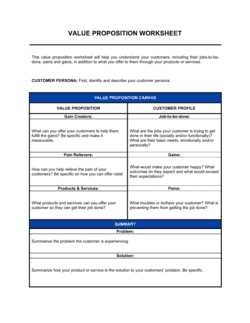
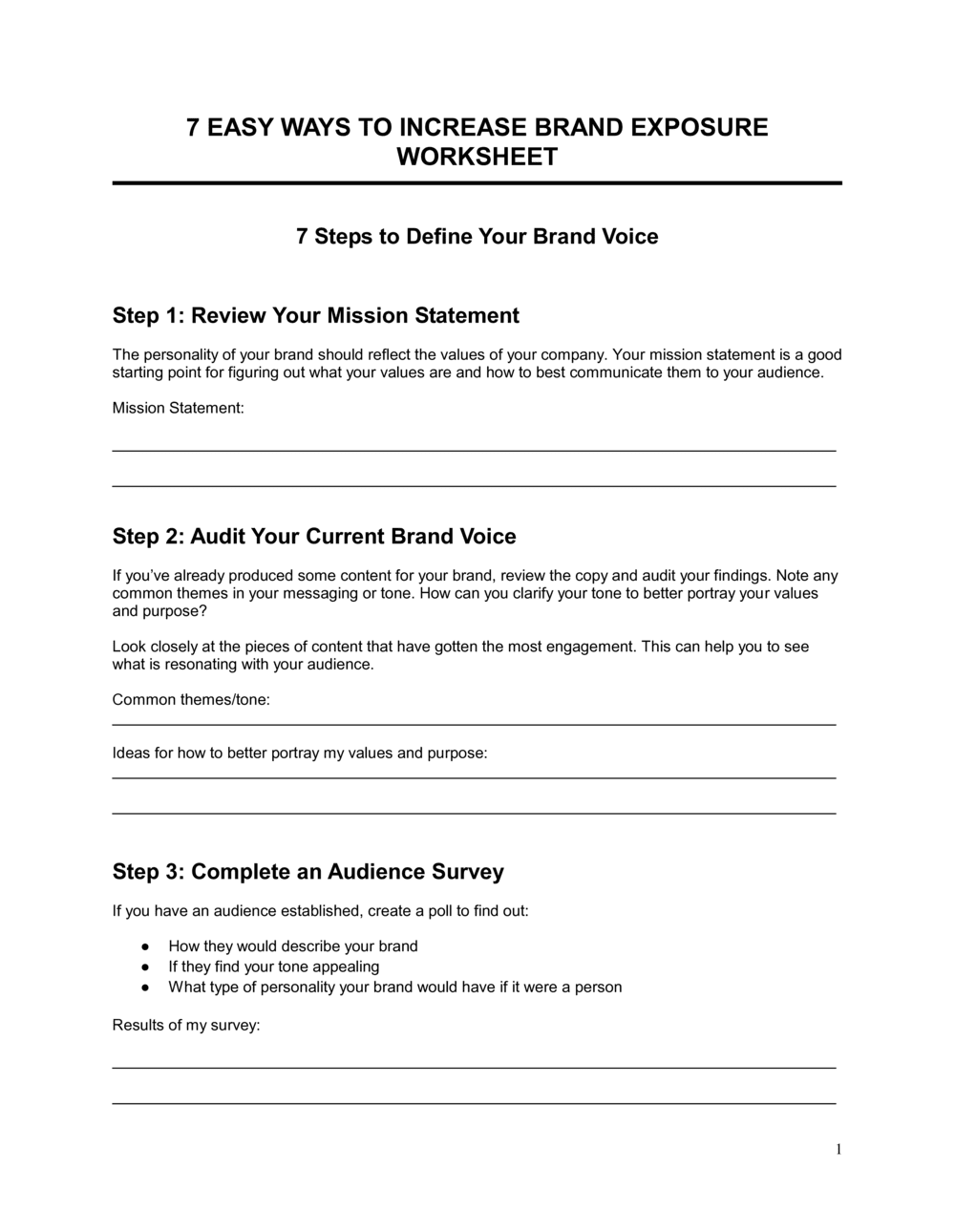
A Brand Building Worksheet is a structured document that guides a business through the process of defining, documenting, and formalizing its brand identity — covering mission, vision, values, target audience, positioning, voice, and visual identity standards. This free Word download gives you a fill-in-the-blank framework you can edit online and export as PDF to align stakeholders, brief designers, and anchor all future brand communications.
When you need it
Use it when launching a new business, rebranding an existing one, onboarding a branding agency, or standardizing brand presentation across a growing team. It is also essential before commissioning a logo, style guide, or brand identity system, ensuring that creative work reflects a documented strategic foundation rather than personal preference.
What's inside
Mission and vision statements, core brand values, target audience profiles, brand positioning statement, unique value proposition, brand personality and voice descriptors, visual identity guidelines, key messaging pillars, and a competitive differentiation summary. Each section includes instructional prompts and fill-in fields to accelerate completion.

What is a Brand Building Worksheet?

A Brand Building Worksheet is a structured strategic document that guides a business through the process of defining, documenting, and aligning its brand identity — capturing mission, vision, core values, target audience, positioning statement, unique value proposition, brand personality and voice, visual identity standards, and key messaging pillars in a single reference document. Unlike a brand style guide, which governs execution, a brand building worksheet establishes the strategic foundation that all brand execution should express. It functions simultaneously as an internal alignment tool, a briefing document for designers and agencies, and a governance record for how the brand may be used by partners and licensees.

Why You Need This Document

Without a completed brand building worksheet, creative and communication decisions default to personal preference, individual interpretation, and whoever is loudest in the room — producing brand inconsistency that is visible to customers and expensive to correct after design assets, campaigns, and agency contracts are already in place. Designers briefed without a documented positioning statement produce logos and color palettes that look polished but communicate nothing distinctive. Copywriters without a documented voice produce content that shifts tone from channel to channel, eroding the sense that there is a coherent brand behind the communications. Agencies hired without a completed worksheet spend the first quarter of the engagement conducting the discovery the worksheet replaces — at your expense. A completed, signed brand building worksheet eliminates that wasted spend, gives every team member and external partner a practical test for on-brand decisions, and creates the documented foundation required before filing a trademark or entering into a brand licensing arrangement.

Which variant fits your situation?

If your situation is…Use this template
Launching a brand-new business with no existing identityBrand Building Worksheet (Startup)
Refreshing an established brand after a merger or pivotBrand Relaunch Strategy Plan
Creating repeatable visual and verbal guidelines for a teamBrand Style Guide Template
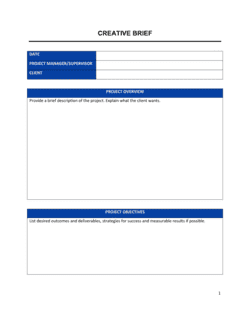
Briefing an external agency on brand strategy and creative directionCreative Brief Template
Defining the marketing strategy that will carry the brand to marketMarketing Plan Template
Protecting the brand name and logo as intellectual propertyTrademark License Agreement
Capturing customer perception data to validate brand positioningCustomer Survey Template

Common mistakes to avoid

❌ Using aspirational values disconnected from actual behavior

Why it matters: Values that do not reflect how the company actually operates create credibility gaps — customers, employees, and partners notice when stated values contradict observable actions, eroding trust faster than having no stated values at all.

Fix: For each value listed, identify one real example from the company's recent history where that value drove a decision. If you cannot find one, replace the value with one that has evidence.

❌ Writing a positioning statement that describes features, not benefits

Why it matters: A positioning statement built on product features tells customers what the brand does but not why they should choose it. It fails to differentiate the brand and gives no guidance to copywriters, designers, or sales teams on the story to tell.

Fix: Rewrite the positioning statement using the 'For [audience] who [need], [brand] is the [category] that [benefit] because [reason to believe]' structure. Test it by asking: does this explain why a customer would pick us over a named competitor?

❌ Defining target audience by demographics alone

Why it matters: A target audience defined only by age range and income level is too abstract to drive messaging decisions. Two customers with identical demographics can have completely different motivations, pain points, and purchase triggers.

Fix: Add a psychographic layer — values, motivations, anxieties — and a behavioral layer — what triggers the purchase, what alternatives they consider — to make the audience profile actionable for campaign and content teams.

❌ Leaving brand governance and approval rules undefined

Why it matters: Without a documented approval process, any employee, vendor, or partner can use the brand's name, logo, or messaging in ways that dilute its meaning, create legal exposure, or contradict the positioning. Unauthorized co-branding and inconsistent logo use are significantly harder to remediate after the fact than to prevent.

Fix: Complete the Brand Governance section before distributing the worksheet. Name a specific role (not a person) as brand approver, list the use cases that require approval, and reference any trademark license agreement that governs third-party usage.

❌ Treating the worksheet as a one-time exercise

Why it matters: A brand building worksheet completed at launch becomes outdated as the company grows, pivots, or enters new markets. Teams continue executing against a positioning that no longer reflects the company's actual offer or audience, creating messaging incoherence that is visible to customers.

Fix: Schedule an annual review of the worksheet and trigger an unscheduled review any time the company changes its core offer, primary audience, or competitive context. Version and date each completed worksheet so teams always reference the current document.

❌ Completing the worksheet without external input

Why it matters: Internal teams have blind spots about how the brand is actually perceived. A positioning statement written entirely by founders and marketing staff frequently reflects internal assumptions that customers do not share — the brand believes it owns an attribute that customers associate with a competitor.

Fix: Before finalizing the worksheet, conduct at least three customer interviews or review existing customer feedback to validate the positioning, value proposition, and audience profile against real perception data.

The 10 key clauses, explained

Brand Mission and Vision

In plain language: Documents the brand's core purpose — why it exists — and the long-term future state it is working toward.

Sample language
Mission: [COMPANY NAME] exists to [CORE PURPOSE] for [TARGET AUDIENCE]. Vision: By [YEAR], [COMPANY NAME] will [LONG-TERM ASPIRATION].

Common mistake: Conflating mission and vision into a single vague statement. Mission answers 'why we exist today'; vision answers 'what we are building toward.' Blending them produces language that answers neither question clearly.

Core Brand Values

In plain language: Lists three to six non-negotiable principles that guide how the brand behaves internally and externally, with a one-sentence explanation of each.

Sample language
1. [VALUE NAME]: [ONE-SENTENCE BEHAVIORAL DESCRIPTION]. 2. [VALUE NAME]: [ONE-SENTENCE BEHAVIORAL DESCRIPTION]. 3. [VALUE NAME]: [ONE-SENTENCE BEHAVIORAL DESCRIPTION].

Common mistake: Listing aspirational values with no behavioral definition — terms like 'integrity' or 'innovation' are meaningless without a sentence explaining what that value looks like in practice at this company.

Target Audience Profile

In plain language: Defines the primary and secondary audiences the brand serves, including demographics, motivations, pain points, and decision-making triggers.

Sample language
Primary Audience: [AGE RANGE], [ROLE/TITLE], located in [GEOGRAPHY]. Key pain point: [PAIN POINT]. Decision trigger: [WHAT PROMPTS THEM TO BUY]. Secondary Audience: [DESCRIPTION].

Common mistake: Defining the target audience so broadly — 'anyone who needs X' — that the brand voice, messaging, and channel choices become impossible to make consistently.

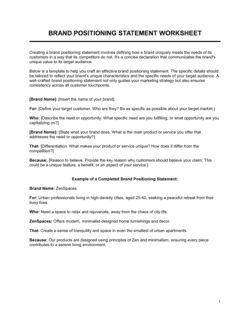
Brand Positioning Statement

In plain language: A single structured statement that articulates who the brand serves, what category it competes in, what it uniquely offers, and the reason to believe.

Sample language
For [TARGET AUDIENCE] who [NEED OR PAIN POINT], [BRAND NAME] is the [CATEGORY] that [KEY BENEFIT] because [REASON TO BELIEVE].

Common mistake: Writing a positioning statement that describes what the brand does rather than why the audience should choose it. A feature description is not a positioning statement.

Unique Value Proposition

In plain language: Summarizes the single most compelling reason a customer should choose this brand over every available alternative, stated in plain language.

Sample language
[COMPANY NAME] is the only [CATEGORY] that [SPECIFIC DIFFERENTIATOR], enabling [TARGET CUSTOMER] to achieve [SPECIFIC OUTCOME] in [TIMEFRAME OR CONDITION].

Common mistake: Writing a UVP that applies equally to three competitors. A UVP must identify a differentiator that is specific, provable, and not easily replicated — otherwise it is just a category description.

Brand Personality and Voice

In plain language: Describes the brand's human personality traits and the tone used across all communications, with examples of what the brand sounds like — and what it never sounds like.

Sample language
Brand personality: [TRAIT 1], [TRAIT 2], [TRAIT 3]. Voice: [DESCRIPTION OF TONE]. We sound like: [EXAMPLE PHRASE]. We never sound like: [EXAMPLE OF OFF-BRAND TONE].

Common mistake: Listing personality traits without 'we never' examples. Without negative examples, every writer interprets 'professional' or 'friendly' differently, resulting in inconsistent brand communication across channels.

Visual Identity Standards

In plain language: Documents the primary logo, color palette (with hex or Pantone codes), typography (with typeface names and hierarchy), and imagery guidelines.

Sample language
Primary logo: [FILE REFERENCE]. Primary color: [HEX CODE]. Secondary palette: [HEX CODES]. Primary typeface: [FONT NAME] for headings. Body: [FONT NAME]. Imagery style: [DESCRIPTION OF APPROVED PHOTOGRAPHY OR ILLUSTRATION STYLE].

Common mistake: Referencing logo files by colloquial name without specifying file format — providing 'the logo' without noting whether it is EPS, SVG, or PNG means designers and vendors frequently use low-resolution versions that degrade print quality.

Key Messaging Pillars

In plain language: Three to five thematic statements the brand consistently emphasizes across all marketing and sales materials, each supported by two or three proof points.

Sample language
Pillar 1: [THEME STATEMENT]. Proof points: (a) [SPECIFIC FACT OR CLAIM], (b) [SPECIFIC FACT OR CLAIM]. Pillar 2: [THEME STATEMENT]. Proof points: (a) [SPECIFIC FACT OR CLAIM], (b) [SPECIFIC FACT OR CLAIM].

Common mistake: Writing messaging pillars as vague brand sentiments rather than defensible claims. Pillars must be specific enough to be supported by proof points — if you cannot write two proof points for a pillar, it is not a pillar, it is a tagline.

Competitive Differentiation Summary

In plain language: Maps two to four key competitors against the brand on three to five dimensions, identifying where the brand leads and where it does not compete.

Sample language
Competitor: [NAME]. Their strength: [ATTRIBUTE]. Our advantage over them: [SPECIFIC DIFFERENTIATOR]. We do not compete on: [DIMENSION WHERE COMPETITOR LEADS].

Common mistake: Claiming superiority on every dimension. A differentiation map that shows the brand winning on all attributes is not credible and prevents teams from making focused positioning decisions.

Brand Governance and Usage Rules

In plain language: States who owns and approves brand decisions, which uses require approval, and how third parties or licensees may and may not use the brand.

Sample language
Brand approvals: all external uses of [BRAND NAME] or logo must be approved by [ROLE/TITLE] prior to publication. Third-party usage: refer to the [TRADEMARK LICENSE AGREEMENT / BRAND GUIDELINES DOCUMENT] dated [DATE].

Common mistake: Leaving brand governance undefined in the worksheet, resulting in inconsistent logo use, unauthorized co-branding, and trademark dilution claims that are expensive to remediate after the fact.

How to fill it out

  1. 1

    Complete the mission and vision fields first

    Write the mission statement as a single sentence answering why the company exists and who it serves. Write the vision statement as a future-state aspiration with a time horizon. Treat these as anchors — every subsequent section should be consistent with them.

    💡 Test your mission by asking whether a competitor could claim the same statement. If they could, it is not specific enough.

  2. 2

    Define three to six core brand values with behavioral descriptions

    Choose values that reflect how the company actually behaves, not how it wants to be perceived. For each value, write one sentence describing what it looks like in a real decision or interaction.

    💡 Involve two or three employees who have been at the company for different lengths of time — values that ring true to a two-year employee as well as a new hire are more likely to be genuine.

  3. 3

    Build your target audience profile from real data

    Pull from existing customer interviews, CRM data, or sales team input to fill in the demographic, psychographic, and behavioral fields. Avoid filling the profile with assumptions alone.

    💡 If you have fewer than 20 customers, write one profile per distinct customer segment rather than averaging across all customers into a single inaccurate profile.

  4. 4

    Draft the positioning statement using the provided formula

    Fill in the 'For [TARGET AUDIENCE] who [NEED], [BRAND] is the [CATEGORY] that [BENEFIT] because [REASON TO BELIEVE]' template directly. Resist the urge to rewrite the formula — the structure forces the strategic discipline the exercise requires.

    💡 The 'reason to believe' is the hardest part. It must be a factual or structural claim — a patent, a proprietary process, a track record — not a promise.

  5. 5

    Document personality traits with positive and negative examples

    List three to five personality traits, then write one on-brand phrase and one off-brand phrase for each. These examples become the practical brief for every copywriter and content creator who works with the brand.

    💡 Read the on-brand and off-brand examples aloud. If you cannot hear a difference, the trait definition is not specific enough.

  6. 6

    Specify visual identity elements with precise values

    Enter hex codes, not color names. Enter typeface names with weights, not generic descriptions. Attach or reference actual logo files by format and resolution. Imprecise visual identity fields produce inconsistent execution.

    💡 For a brand that has not yet worked with a designer, leave visual identity fields blank with a note — do not fill them with guesses that a designer will have to reverse.

  7. 7

    Write messaging pillars with proof points

    Draft three to five thematic statements and immediately write two proof points under each. If a pillar cannot generate two proof points from existing evidence, revise it until it can.

    💡 Proof points should be citable — a statistic, a customer quote, a product specification, or a verifiable claim. 'We care about quality' is not a proof point.

  8. 8

    Review the completed worksheet with at least one external stakeholder

    Share the completed worksheet with a customer, advisor, or colleague outside the founding team. Ask whether the positioning statement and value proposition match their perception of the brand. Gaps between intent and perception are the most valuable output of this exercise.

    💡 If the external reviewer cannot identify the brand's target audience from reading the positioning statement alone, rewrite that section before briefing any designers or agencies.

Frequently asked questions

What is a brand building worksheet?

A brand building worksheet is a structured document that guides a business through the process of defining and documenting its brand identity — covering mission, vision, values, target audience, positioning, voice, visual standards, and key messaging. It functions as both a strategic planning tool and a practical brief for designers, copywriters, and agencies. Completing it before investing in brand execution ensures that visual identity and communications reflect a deliberate strategy rather than guesswork.

Who should complete a brand building worksheet?

Brand building worksheets are used by startup founders establishing an identity before launch, small business owners preparing to brief a designer or agency, marketing directors standardizing brand presentation across a growing team, and brand consultants facilitating discovery workshops with new clients. The document is most valuable when completed by the people who own strategic decisions — typically the founder or CMO — with input from customer-facing team members.

What is the difference between a brand building worksheet and a brand style guide?

A brand building worksheet is the strategic foundation — it captures mission, values, positioning, and personality through a structured discovery process. A brand style guide is the operational output built from those decisions — it specifies logo usage rules, color codes, typography, and layout conventions for daily execution. Complete the worksheet first; commission the style guide from it. Trying to create a style guide without completing a strategy worksheet typically results in visual standards that look polished but communicate nothing distinctive.

Is a brand building worksheet a legally binding document?

The worksheet itself is primarily a strategic planning tool, but it can carry legal weight when signed by multiple stakeholders — such as co-founders, agency partners, or brand licensees — because it documents agreed brand standards and governance rules that downstream agreements may reference. The Brand Governance section in particular can establish the terms under which third parties may use the brand, making legal review advisable before the document is shared with external parties or referenced in contracts.

How long does it take to complete a brand building worksheet?

A solo founder can complete an initial draft in two to four hours. A facilitated workshop with a founding team, agency partner, or brand consultant typically runs four to eight hours across one or two sessions. The financial projections or technical design work — logo, color palette, typography — are not completed in the worksheet itself but informed by it, which may add additional weeks depending on the design process.

How often should a brand building worksheet be updated?

Review the worksheet annually as part of marketing or strategic planning. Trigger an unscheduled review any time the company makes a significant change to its core offer, primary audience segment, or competitive context. A worksheet that is more than 18 months old without review should be treated as a historical reference, not an active brief — brand positioning that was accurate at launch frequently does not reflect the business accurately after a product pivot or market expansion.

What should a brand positioning statement include?

A brand positioning statement should include four elements: the specific target audience (not a broad demographic but a defined segment with a named need), the category the brand competes in, the primary benefit it delivers, and the reason to believe that the benefit claim is credible. The standard formula — 'For [audience] who [need], [brand] is the [category] that [benefit] because [reason to believe]' — is an internal document, not a tagline, and should be written in plain descriptive language rather than marketing copy.

Do I need a lawyer to complete a brand building worksheet?

For most startups and small businesses completing the worksheet as an internal planning tool, legal review is not required. It becomes advisable when the worksheet is being shared with an external agency or partner under a contract that references its contents, when the Brand Governance section establishes trademark usage rules for licensees, or when the brand name and visual identity documented in the worksheet are being registered as trademarks. In those scenarios, having a lawyer review the governance and IP sections before distribution reduces the risk of creating unintended obligations.

What is brand voice and why does it matter in a brand building worksheet?

Brand voice is the consistent personality and tone a brand uses across all written and spoken communications — its defining communication character independent of topic or channel. It matters in the worksheet because it is the single most-used output: every email, social post, ad, proposal, and sales conversation is either on-brand or off-brand based on whether the voice is consistent. Documenting it with on-brand and off-brand examples — not just adjective lists — gives every team member and external partner a practical test they can apply without seeking approval on every piece of content.

How this compares to alternatives

vs Brand Style Guide

A brand style guide specifies how brand elements are applied in execution — logo clear space, hex codes, typeface weights, and layout rules. A brand building worksheet establishes the strategic foundation those rules are built on — mission, positioning, and values. The worksheet comes first; the style guide operationalizes it. A style guide without a strategy worksheet tends to produce visually consistent but strategically undifferentiated work.

vs Marketing Plan

A marketing plan defines the channels, campaigns, and budget allocation for reaching and converting customers over a defined period. A brand building worksheet defines the identity and positioning that all marketing activities should express. The brand worksheet is strategic and relatively stable; the marketing plan is tactical and updated annually. Strong marketing plans are built on — and reference — a completed brand worksheet.

vs Creative Brief

A creative brief is a project-level document that briefs designers, copywriters, or agencies on a specific deliverable — its audience, objective, tone, and constraints. A brand building worksheet is a company-level document that defines the brand standards the brief must reflect. The brief is narrow and time-bound; the worksheet is the standing source of truth it draws from. Agencies that receive a completed brand worksheet produce better creative briefs with significantly fewer alignment rounds.

vs SWOT Analysis

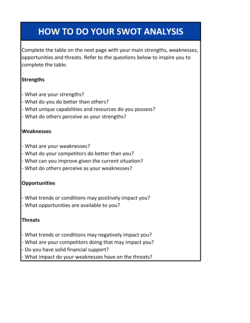
A SWOT analysis maps internal strengths and weaknesses against external opportunities and threats — it is a situational assessment tool used in strategic planning. A brand building worksheet is a brand definition and alignment tool. SWOT analysis is useful input for the competitive differentiation and positioning sections of a brand worksheet but does not capture brand identity, voice, or visual standards. Most brand strategy processes use both: SWOT to understand the competitive context, brand worksheet to define the identity response.

Industry-specific considerations

SaaS / Technology

Positioning in competitive SaaS categories requires documented differentiation beyond features; the worksheet forces articulation of the specific outcome the software delivers and why the team or technology is credible.

Retail / E-commerce

Visual identity and messaging pillar sections are critical for retail brands, where packaging, storefront, and digital presence must be visually and verbally consistent across dozens of touchpoints simultaneously.

Professional Services

For consulting, legal, and accounting firms, brand personality and voice sections are the highest-value outputs — differentiation is almost entirely driven by how the firm communicates, not by product features.

Food & Beverage

Target audience profile and competitive differentiation sections are especially important given high category density; brand values and personality determine shelf presence and social media resonance in markets with dozens of near-identical products.

Healthcare / MedTech

Brand governance and usage rules sections require particular care in regulated healthcare categories, where claims language must comply with FDA or equivalent authority guidelines and off-brand messaging by partners creates compliance risk.

Creative and Marketing Agencies

Agencies use the worksheet as a billable discovery deliverable at the start of brand engagements, giving clients documented brand strategy before creative concepting begins and reducing revision cycles caused by misaligned direction.

Jurisdictional notes

United States

In the US, the brand name and logo documented in the worksheet should be assessed for trademark availability via the USPTO's TESS database before the brand is publicly launched. Common-law trademark rights attach to first use in commerce, but federal registration provides significantly broader protection and the right to use the ® symbol. Brand governance provisions that restrict third-party use of the brand may constitute a trademark license under US law and should be reviewed for compliance with 15 U.S.C. § 1055.

Canada

In Canada, trademark registration is governed by the Trademarks Act and administered by the Canadian Intellectual Property Office (CIPO). Unlike the US, use in Canada is not required to file an application, but registered marks receive stronger protection. Quebec-based businesses must ensure that brand names, slogans, and visual identity elements comply with the Charter of the French Language, which requires that public-facing brand elements be in French or French-equivalent. Brand governance provisions restricting third-party use may require a formal trademark license to be filed with CIPO.

United Kingdom

In the United Kingdom, trademark registration is handled by the Intellectual Property Office (IPO). Post-Brexit, EU trademark registrations no longer extend to the UK — businesses that previously relied on EU-wide marks must register separately with the UK IPO for protection in Great Britain. Brand governance documents shared with UK agency partners should account for the Consumer Protection from Unfair Trading Regulations 2008 when brand claims touch on product performance or customer outcomes.

European Union

EU trademark protection is available through the European Union Intellectual Property Office (EUIPO) via a single EU Trademark (EUTM) application covering all 27 member states. Brand positioning claims and messaging pillar language should be reviewed against the EU Unfair Commercial Practices Directive if they contain comparative or performance claims. GDPR considerations apply to the target audience profiling section if the worksheet documents personal data collected from customers — ensure that profiling is based on consented data and that the retention of audience data is covered by the company's privacy policy.

Template vs lawyer — what fits your deal?

PathBest forCostTime
Use the templateFounders, small businesses, and internal marketing teams completing brand strategy for internal alignment or agency briefingFree2–4 hours
Template + legal reviewBusinesses sharing the worksheet with external agencies under contract, or using it to establish trademark usage rules for partners or licensees$200–$600 for a one-hour IP or contracts review1–3 days
Custom draftedEnterprise rebrands, franchise systems establishing multi-party brand standards, or businesses registering trademarks across multiple jurisdictions$2,000–$8,000 for a full brand strategy engagement with legal review4–8 weeks

Glossary

Brand Identity
The collection of visual, verbal, and emotional elements — name, logo, color palette, tone of voice, and values — that distinguish a company in its market.
Brand Positioning Statement
A one-to-two sentence internal declaration that defines who the brand serves, what it offers, and why it is different from alternatives.
Unique Value Proposition (UVP)
A clear statement of the specific benefit a brand delivers to its customers that competitors do not deliver in the same way.
Brand Voice
The consistent personality and tone a brand uses across all written and spoken communications, independent of the specific channel or format.
Target Audience Profile
A documented description of the ideal customer, typically including demographic, psychographic, behavioral, and pain-point attributes.
Brand Personality
The set of human characteristics attributed to a brand — such as authoritative, playful, empathetic, or innovative — that shape how it communicates.
Visual Identity
The tangible graphic elements of a brand — logo, typography, color palette, imagery style, and layout conventions — that create visual consistency.
Brand Architecture
The structural relationship between a parent brand and its sub-brands or product lines, defining how they are named, positioned, and presented.
Messaging Pillar
A core thematic statement that supports the brand's overall positioning and is expressed consistently across marketing, sales, and communications.
Competitive Differentiation
The specific attributes or capabilities that distinguish a brand from direct competitors and justify a customer's preference for it.
Brand Equity
The commercial value derived from consumer perception of a brand name, which can increase pricing power and customer loyalty independent of product features.

Part of your Business Operating System

This document is one of 3,000+ business & legal templates included in Business in a Box.

  • Fill-in-the-blanks — ready in minutes
  • 100% customizable Word document
  • Compatible with all office suites
  • Export to PDF and share electronically

Create your document in 3 simple steps.

From template to signed document — all inside one Business Operating System.
1
Download or open template

Access over 3,000+ business and legal templates for any business task, project or initiative.

2
Edit and fill in the blanks with AI

Customize your ready-made business document template and save it in the cloud.

3
Save, Share, Send, Sign

Share your files and folders with your team. Create a space of seamless collaboration.

Save time, save money, and create top-quality documents.

★★★★★

"Fantastic value! I'm not sure how I'd do without it. It's worth its weight in gold and paid back for itself many times."

Managing Director · Mall Farm
Robert Whalley
Managing Director, Mall Farm Proprietary Limited
★★★★★

"I have been using Business in a Box for years. It has been the most useful source of templates I have encountered. I recommend it to anyone."

Business Owner · 4+ years
Dr Michael John Freestone
Business Owner
★★★★★

"It has been a life saver so many times I have lost count. Business in a Box has saved me so much time and as you know, time is money."

Owner · Upstate Web
David G. Moore Jr.
Owner, Upstate Web

Run your business with a system — not scattered tools

Stop downloading documents. Start operating with clarity. Business in a Box gives you the Business Operating System used by over 250,000 companies worldwide to structure, run, and grow their business.

Start free · No credit card required