Customer Complaint Resolution Policy Template

Free Word download β€’ Edit online β€’ Save & share with Drive β€’ Export to PDF

3 pagesβ€’20–30 min to fillβ€’Difficulty: Standard
Learn more ↓
FreeCustomer Complaint Resolution Policy Template

At a glance

What it is
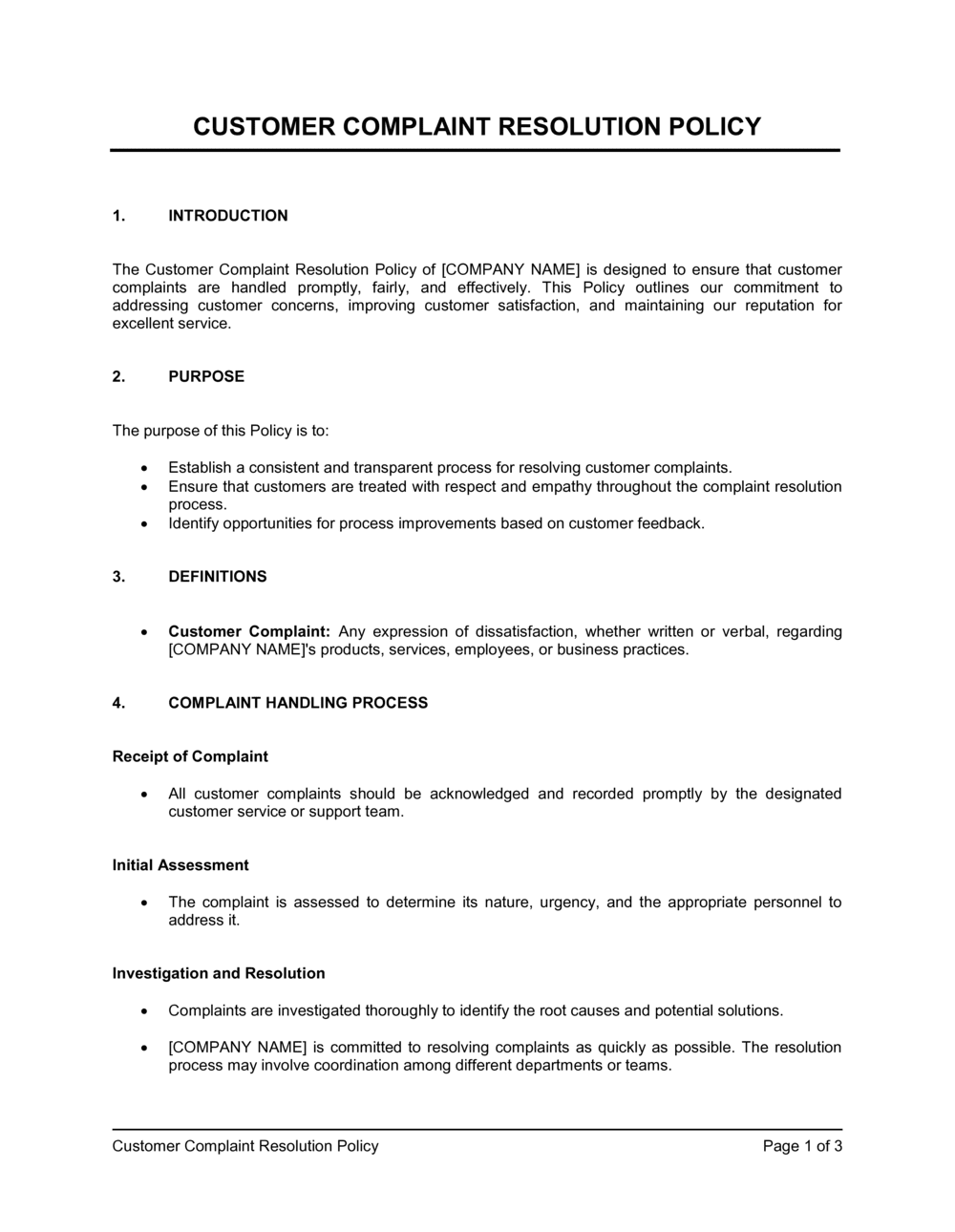
A Customer Complaint Resolution Policy is a formal operational document that defines how a business receives, investigates, escalates, and closes customer complaints. This free Word download gives you a structured, ready-to-customize starting point covering intake channels, response timeframes, escalation tiers, and recordkeeping β€” exportable as PDF for staff training, audits, or regulatory submissions.
When you need it
Use it when formalizing your customer service operations, preparing for a quality audit or certification (ISO 9001, ACAS), or onboarding customer-facing staff who need a clear, documented procedure to follow.
What's inside
Policy scope and objectives, complaint intake and logging procedures, investigation and response timeframes, escalation tiers, resolution options, communication standards, recordkeeping requirements, and a continuous-improvement review cycle.

What is a Customer Complaint Resolution Policy?

A Customer Complaint Resolution Policy is a formal operational document that defines the end-to-end procedure a business follows when a customer expresses dissatisfaction with a product, service, or interaction. It establishes how complaints are received, logged, investigated, escalated, and closed β€” and sets the timeframes, role responsibilities, and authorized remedies that apply at each stage. Rather than leaving complaint handling to individual judgment, the policy creates a repeatable, auditable process that produces consistent outcomes regardless of which team member handles the case.

Why You Need This Document

Without a documented complaint policy, every negative customer interaction becomes a judgment call β€” and judgment calls produce inconsistent outcomes that compound over time into poor reviews, escalated disputes, and regulatory exposure. Staff who don't know what they can approve either over-promise and create liability or under-resolve and drive customers to social media or ombudsman services. The cost of this inconsistency is measurable: unresolved complaints are three to five times more likely to result in customer churn than the original service failure. A written complaint resolution policy closes that gap by giving front-line staff a clear procedure to follow, giving managers a defined escalation path to act on, and giving auditors, certifiers, and regulators the documented evidence they need. This template gives you a complete, customizable starting point β€” covering intake, investigation, escalation, resolution authority, recordkeeping, and continuous improvement β€” so you can have a working policy in hours rather than weeks.

Which variant fits your situation?

If your situation is…Use this template
Defining internal complaint handling for a single customer service teamCustomer Complaint Resolution Policy
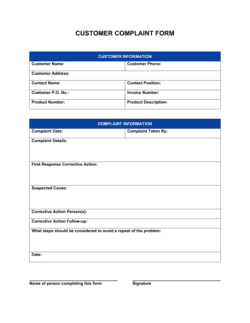
Logging and tracking individual complaint casesCustomer Complaint Form
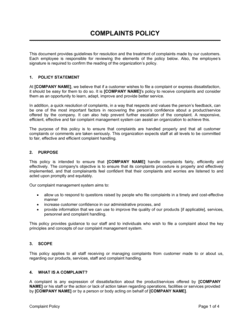
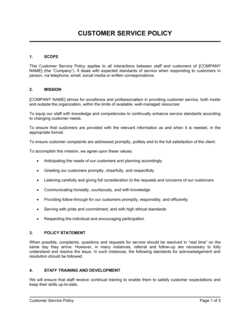
Communicating the complaint process to customers publiclyCustomer Service Policy
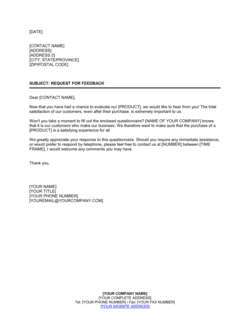
Responding to a specific written complaint from a customerResponse to Customer Complaint Letter
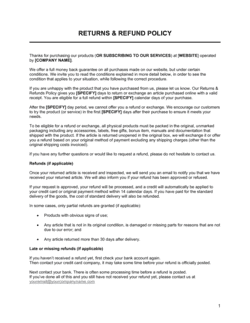
Documenting a full refund or returns process alongside complaintsReturn and Refund Policy
Managing complaints as part of a broader quality management systemQuality Management Plan
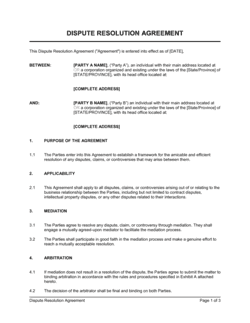
Handling formal escalations or disputes that reach a legal thresholdDispute Resolution Policy

Common mistakes to avoid

❌ No clear complaint definition

Why it matters: Without a definition, staff apply the policy inconsistently β€” some log every negative comment, others log nothing. Complaint volume data becomes unreliable and comparisons over time are meaningless.

Fix: Write a single-sentence definition and test it against real cases before publishing. Include a worked example in the staff training materials.

❌ Setting acknowledgement SLAs with no resolution SLAs

Why it matters: A fast acknowledgement followed by a weeks-long silence frustrates customers more than a slow start β€” it creates the expectation of prompt service and then fails to deliver it.

Fix: Set both an acknowledgement timeframe (e.g., 1 business day) and a target resolution timeframe for each escalation tier, and track both in your complaint log.

❌ Leaving resolution authority undefined

Why it matters: Front-line agents who don't know what they can approve either over-promise remedies that get reversed later or push every complaint to a manager, creating unnecessary escalation volume.

Fix: Publish a clear authority matrix β€” by tier and complaint category β€” specifying exactly what each role can approve without seeking further sign-off.

❌ Storing complaint records in individual inboxes

Why it matters: When the handler leaves or is reassigned, the complaint history becomes inaccessible. Auditors and regulators cannot verify your process, and repeat complainants receive no continuity.

Fix: Require all complaint correspondence and investigation notes to be logged in a central system β€” CRM, shared drive, or ticketing tool β€” at every stage of the process.

❌ Collecting complaint data but skipping the review cycle

Why it matters: Without a scheduled review, complaint trends go unnoticed, root causes recur, and the same issues generate complaints repeatedly β€” eroding customer retention without triggering corrective action.

Fix: Lock a recurring quarterly review into the calendar and assign a named owner. Even a 30-minute review of a one-page summary report is enough to surface the highest-impact improvement opportunities.

❌ Using the same policy language for customers and regulators

Why it matters: A policy written in regulatory or legal language is unusable as a staff training tool. Agents skip sections they can't understand and default to ad hoc behavior.

Fix: Write the policy in plain language for internal use and, if required, produce a separate regulatory submission version. Both should reflect the same procedure, not two different ones.

The 10 key sections, explained

Policy scope and objectives

Definition of a complaint

Complaint intake and logging

Acknowledgement timeframe

Investigation procedure

Escalation tiers

Resolution options and remedies

Communication standards

Recordkeeping and data retention

Continuous improvement review

How to fill it out

  1. 1

    Define the policy scope

    Name the business units, customer types, and product or service categories the policy covers. Explicitly exclude non-customer complaints (e.g., supplier or HR grievances) to avoid scope creep.

    πŸ’‘ If you operate multiple brands or channels, decide upfront whether one policy covers all of them or each requires its own version.

  2. 2

    Write the complaint definition

    Draft a one-sentence definition that distinguishes a complaint from general feedback or a service inquiry. Circulate it to team leaders and agree on the line before publishing.

    πŸ’‘ Test the definition against five real recent cases β€” if two or three fall into a grey area, tighten the language before rolling out.

  3. 3

    Map your intake channels and assign owners

    List every channel through which customers currently contact you (phone, email, chat, social, in-store) and name the role responsible for logging complaints from each one.

    πŸ’‘ Social media complaints are the most commonly missed intake channel β€” assign a named social monitoring owner or the policy will have a visible gap.

  4. 4

    Set acknowledgement and resolution SLAs

    Choose specific timeframes for acknowledgement (typically within 1 business day) and resolution at each escalation tier. Align these with any existing contractual or regulatory commitments.

    πŸ’‘ If your sector has a regulatory timeframe (e.g., 8 weeks in UK financial services), set your internal target at least 1 week shorter to create a buffer.

  5. 5

    Define escalation triggers and tier responsibilities

    For each escalation tier, write the specific condition that triggers a transfer β€” complaint age, compensation amount, repeat contact, or complaint category β€” and name the role that receives it.

    πŸ’‘ Use dollar thresholds for financial remedies rather than judgment calls. Thresholds make escalation decisions faster and more consistent.

  6. 6

    List authorized resolution options

    Document every remedy available at each tier (apology, refund, replacement, credit) and the approval authority for each. Confirm these with your finance or operations lead before finalizing.

    πŸ’‘ Include a 'goodwill gesture' category with a small pre-approved budget at Tier 1 β€” agents who can resolve minor complaints without seeking approval close cases faster and with higher satisfaction.

  7. 7

    Specify recordkeeping requirements

    Name the system where records are stored, who has access, and the minimum retention period. Confirm the retention period meets any sector-specific regulatory minimums.

    πŸ’‘ If you use a CRM, create a dedicated complaint record type rather than logging complaints as general notes β€” it makes reporting and auditing far easier.

  8. 8

    Schedule the continuous improvement review

    Set a recurring calendar date for the quarterly or annual complaint review, name the responsible role, and define the minimum report contents (volume, category breakdown, resolution time, root causes).

    πŸ’‘ Present the complaint summary report to senior leadership at least annually β€” visibility at that level drives the resource decisions needed to act on root-cause findings.

Frequently asked questions

What is a customer complaint resolution policy?

A customer complaint resolution policy is a documented procedure that defines how a business receives, investigates, escalates, and closes customer complaints. It sets response timeframes, names the roles responsible at each stage, lists the resolution options available, and establishes how complaint records are stored and reviewed. It gives staff a consistent process to follow and gives customers a reliable standard to expect.

Why does my business need a complaint resolution policy?

Without a documented policy, complaint handling depends on individual judgment β€” producing inconsistent outcomes, missed escalations, and unresolved cases that become regulatory complaints or negative reviews. A written policy reduces resolution time, improves first-contact resolution rates, and provides the audit trail regulators and quality certifiers require. It also gives management the complaint data needed to identify and fix recurring operational failures.

What should a customer complaint resolution policy include?

At minimum: a definition of what constitutes a complaint, the channels through which complaints are received, acknowledgement and resolution timeframes, escalation tiers with trigger conditions, authorized resolution options and approval authority, communication standards, recordkeeping requirements, and a scheduled continuous improvement review. Missing any of these creates gaps that show up as inconsistent handling or failed audits.

What is a reasonable timeframe for resolving customer complaints?

Industry practice varies, but a common standard is acknowledgement within 1 business day and full resolution within 5–10 business days for standard complaints. Complex complaints requiring investigation may take up to 20–30 business days. Regulated sectors often have statutory deadlines β€” UK financial services firms must resolve most complaints within 8 weeks; healthcare providers in many US states have defined grievance timelines. Your internal target should be shorter than any applicable regulatory deadline.

How many escalation tiers should a complaint policy have?

Three tiers cover most business sizes: Tier 1 (front-line agent), Tier 2 (team leader or supervisor), and Tier 3 (manager or director). Smaller businesses may operate with two tiers. The key is not the number of tiers but the clarity of the trigger conditions β€” a policy that names three tiers without specifying when to escalate produces the same inconsistency as having no tiers at all.

Does a complaint resolution policy need to be shared with customers?

In regulated industries β€” financial services, healthcare, utilities, and telecommunications in many jurisdictions β€” yes, the policy or a customer- facing summary must be publicly available. For other businesses, publishing a summary builds customer trust and reduces the volume of escalations by setting clear expectations upfront. The full internal policy, including escalation authority levels and resolution budgets, is typically for internal use only.

How is a complaint resolution policy different from a customer service policy?

A customer service policy sets the general standards for how a business interacts with customers β€” tone, response times, service commitments. A complaint resolution policy is the specific sub-procedure for the subset of interactions that involve dissatisfaction requiring formal handling. The two documents complement each other; the complaint policy should be referenced within the broader customer service policy.

How often should a complaint resolution policy be reviewed?

At minimum annually, and immediately following any regulatory change, significant complaint spike, audit finding, or major service failure. The continuous improvement review cycle built into the policy itself should generate quarterly complaint data that informs whether the procedure needs adjustment. A policy that has not been reviewed in more than 18 months is likely out of step with current operations or regulatory expectations.

Can a small business use this template without a dedicated complaints team?

Yes. The template is designed to scale β€” a small business can simplify the escalation tiers to just two levels (owner and a nominated deputy) and adapt the timeframes to reflect a smaller operation. The core requirements β€” a complaint log, defined acknowledgement timeframe, authorized resolution options, and a periodic review β€” apply regardless of business size. Having even a simple written procedure is significantly better than relying on ad hoc responses.

How this compares to alternatives

vs Customer Service Policy

A customer service policy sets broad standards for how all customer interactions are conducted β€” tone, response times, and service commitments. A complaint resolution policy is the specific sub-procedure for handling dissatisfied customers formally. The two are complementary: the service policy covers everyday interactions; the complaint policy activates when those standards are not met.

vs Return and Refund Policy

A return and refund policy defines the conditions under which customers may return products and receive refunds β€” a customer-facing commercial commitment. A complaint resolution policy is an internal operational procedure that may trigger a refund as one of several possible remedies. A refund policy tells customers what they are entitled to; a complaint policy tells staff how to handle the process.

vs Dispute Resolution Policy

A dispute resolution policy typically covers formal legal or contractual disputes β€” arbitration, mediation, or legal proceedings. A customer complaint resolution policy covers operational service failures resolved internally before they reach a formal legal threshold. The complaint policy is the first line of response; the dispute resolution policy applies when internal resolution fails.

vs Customer Complaint Form

A customer complaint form is the intake document a customer completes to submit a complaint β€” it captures the facts of the specific case. A complaint resolution policy is the governing procedure that defines what happens after the form is received. The form feeds the process; the policy defines the process.

Industry-specific considerations

Retail and e-commerce

High complaint volumes around delivery failures, product defects, and returns require tiered handling with clear refund authority thresholds at each level.

Financial services

Regulatory deadlines (e.g., 8-week FCA limit in the UK, CFPB oversight in the US) make documented complaint procedures and audit trails a compliance requirement, not just best practice.

Healthcare

Patient complaint processes must align with statutory grievance timelines and often feed into clinical governance reviews β€” complaint records are clinical quality evidence.

Professional services

Complaints often involve disputed fees or work quality, requiring an investigation step that references the original scope of work agreement before any remedy is offered.

Hospitality and food service

Real-time complaint handling at point of service requires front-line staff to have pre-authorized resolution options β€” replacement, discount, or voucher β€” without needing manager approval for every case.

SaaS and technology

Complaints frequently involve service outages or data issues that require cross-functional coordination between support, engineering, and legal before a resolution can be confirmed.

Template vs pro β€” what fits your needs?

PathBest forCostTime
Use the templateSmall to mid-size businesses establishing a formal complaint process for the first timeFree2–4 hours to customize and finalize
Template + professional reviewBusinesses in regulated sectors or those preparing for ISO 9001 or customer service certification$300–$800 for a compliance advisor or quality consultant review3–5 business days
Custom draftedEnterprise operations with multiple business units, complex escalation hierarchies, or statutory complaint-handling obligations$1,500–$5,000 for a specialist consultant or legal team2–4 weeks

Glossary

Complaint
A formal expression of dissatisfaction by a customer regarding a product, service, or interaction that requires a documented response.
Intake Channel
Any method through which a complaint is received β€” phone, email, web form, in-person, or social media.
Acknowledgement
The first response sent to a complainant confirming receipt of their complaint and stating the expected resolution timeframe.
Escalation
The transfer of an unresolved complaint to a higher authority β€” senior staff, a specialist team, or management β€” when the initial handler cannot resolve it.
Resolution
The outcome that closes a complaint, which may include an apology, replacement, refund, service recovery, or policy change.
Root Cause Analysis
A structured investigation method used to identify the underlying process or system failure that caused the complaint, rather than just addressing the symptom.
Complaint Log
A structured record β€” spreadsheet or CRM entry β€” capturing the complaint date, nature, assigned handler, status, and outcome for each case.
Service Level Agreement (SLA)
A defined commitment to respond or resolve within a specific timeframe, such as acknowledging complaints within 24 hours and resolving within 5 business days.
Closed-Loop Process
A complaint handling cycle that includes a final confirmation to the customer that their complaint has been addressed and the case is formally closed.
Continuous Improvement Review
A scheduled process β€” typically quarterly or annual β€” in which complaint data is analyzed to identify trends and drive operational improvements.

Part of your Business Operating System

This document is one of 3,000+ business & legal templates included in Business in a Box.

  • Fill-in-the-blanks β€” ready in minutes
  • 100% customizable Word document
  • Compatible with all office suites
  • Export to PDF and share electronically

Create your document in 3 simple steps.

From template to signed document β€” all inside one Business Operating System.
1
Download or open template

Access over 3,000+ business and legal templates for any business task, project or initiative.

2
Edit and fill in the blanks with AI

Customize your ready-made business document template and save it in the cloud.

3
Save, Share, Send, Sign

Share your files and folders with your team. Create a space of seamless collaboration.

Save time, save money, and create top-quality documents.

β˜…β˜…β˜…β˜…β˜…

"Fantastic value! I'm not sure how I'd do without it. It's worth its weight in gold and paid back for itself many times."

Managing Director Β· Mall Farm
Robert Whalley
Managing Director, Mall Farm Proprietary Limited
β˜…β˜…β˜…β˜…β˜…

"I have been using Business in a Box for years. It has been the most useful source of templates I have encountered. I recommend it to anyone."

Business Owner Β· 4+ years
Dr Michael John Freestone
Business Owner
β˜…β˜…β˜…β˜…β˜…

"It has been a life saver so many times I have lost count. Business in a Box has saved me so much time and as you know, time is money."

Owner Β· Upstate Web
David G. Moore Jr.
Owner, Upstate Web

Run your business with a system β€” not scattered tools

Stop downloading documents. Start operating with clarity. Business in a Box gives you the Business Operating System used by over 250,000 companies worldwide to structure, run, and grow their business.

Free Forever PlanΒ Β·Β No credit card required