Buyer Persona Worksheet

Free Excel download β€’ Use online β€’ Print or share

1 pageβ€’20–30 min to useβ€’Difficulty: Standard
Learn more ↓
FreeXLSBuyer Persona Worksheet Template

At a glance

What it is
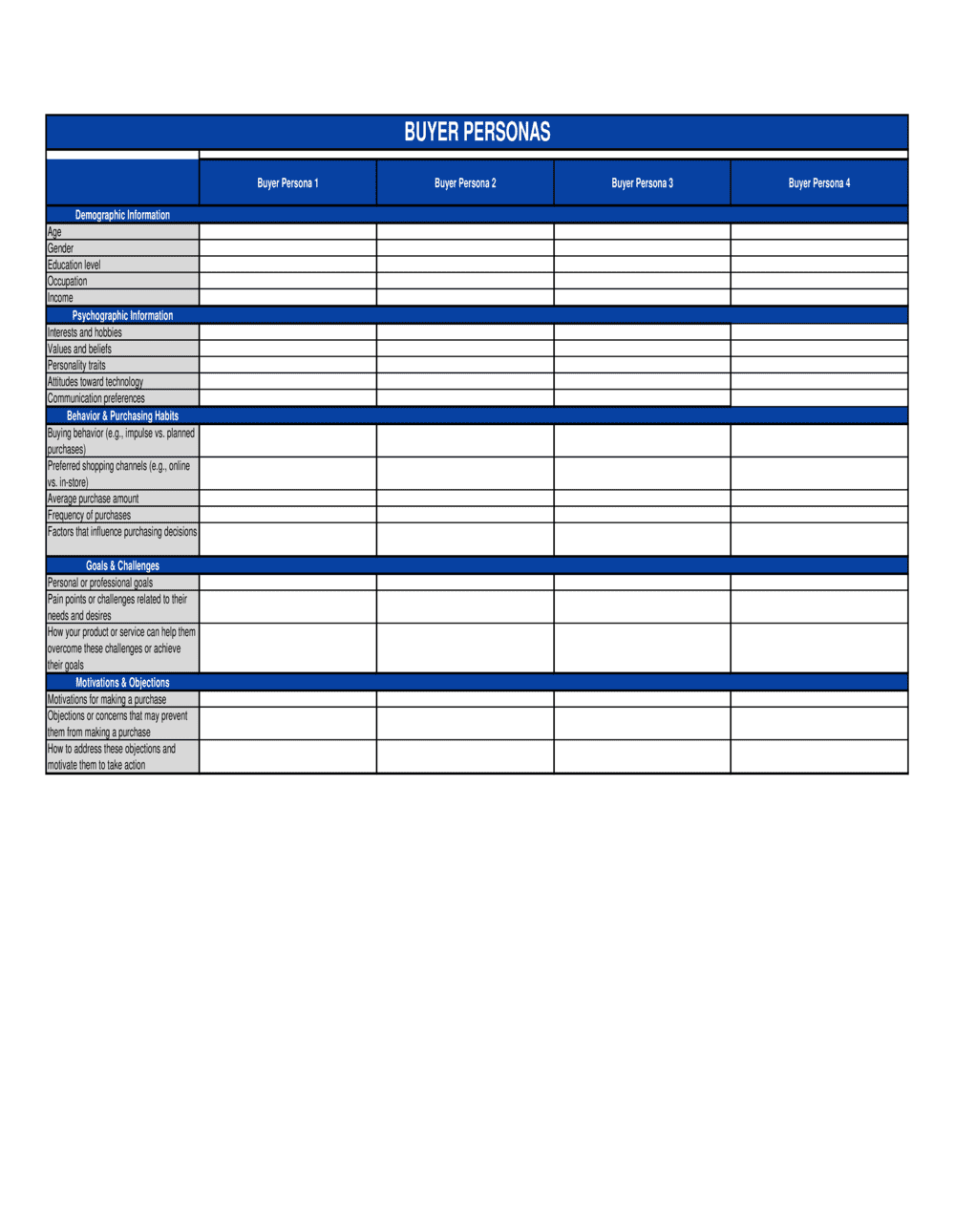
A Buyer Persona Worksheet is a structured research document that captures a detailed, semi-fictional profile of your ideal customer β€” including demographics, job role, goals, pain points, buying behavior, and preferred communication channels. This free Word download gives you a fillable framework to build one or more personas that align your marketing, sales, and product teams around a shared picture of who you are serving and why they buy.
When you need it
Use it when launching a new product or service, entering a new market segment, or realigning your marketing and sales strategy around customer research rather than internal assumptions. It is also essential when onboarding new marketing or sales hires who need a fast orientation to your target audience.
What's inside
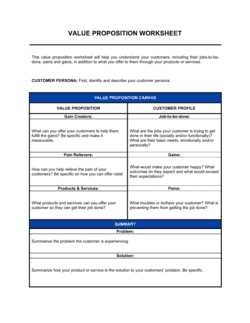
Demographic and firmographic details, job title and responsibilities, primary goals and success metrics, key challenges and pain points, buying process and decision criteria, preferred content and communication channels, common objections, and tailored messaging guidelines.

What is a Buyer Persona Worksheet?

A Buyer Persona Worksheet is a structured research and planning document that captures a detailed, semi-fictional profile of your ideal customer β€” built from real data gathered through customer interviews, CRM analysis, support interactions, and market research. It documents who that customer is, what they are trying to achieve, what frustrates them, how they make purchase decisions, and where they go for information. Unlike a vague audience description, a completed persona worksheet gives every member of your marketing, sales, and product team a shared, specific, and actionable picture of the person they are trying to reach and serve.

Why You Need This Document

Without a documented buyer persona, every campaign brief, sales script, content calendar, and product roadmap rests on untested assumptions about who your customer is and what they care about. The cost shows up in low email open rates, content that generates traffic but no leads, sales conversations that stall on objections nobody prepared for, and product features built for an internal vision of the customer rather than their actual problems. A completed Buyer Persona Worksheet replaces those assumptions with evidence β€” reducing wasted spend, shortening sales cycles, and giving new hires an immediate orientation to the customer that would otherwise take months of firsthand experience to develop. This template gives you the framework to build that foundation in hours, not weeks.

Which variant fits your situation?

If your situation is…Use this template
Defining a B2B buyer with a multi-stakeholder purchase processB2B Buyer Persona Worksheet
Profiling a direct-to-consumer or retail customerB2C Customer Persona Worksheet
Mapping the full customer journey from awareness to purchaseCustomer Journey Map
Summarizing target audience for a campaign brief or agency handoffMarketing Plan
Validating persona assumptions with structured customer interviewsCustomer Interview Guide
Segmenting multiple personas across a product lineMarket Segmentation Analysis
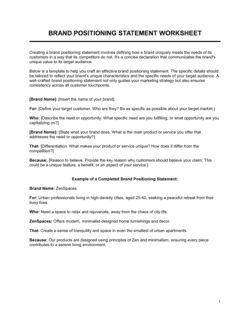
Translating persona research into a positioning statementBrand Positioning Statement Template

Common mistakes to avoid

❌ Building personas from internal assumptions instead of customer data

Why it matters: Personas built from team brainstorms reflect what you believe about your customers, not what is true. Campaigns built on them miss the actual triggers, language, and channels that drive real buyers.

Fix: Conduct at least five customer interviews or pull verbatim data from existing customer interactions before filling in any section of the worksheet.

❌ Creating too many personas and trying to activate all of them

Why it matters: Ten personas means ten sets of messaging, content, and channel strategies β€” which spreads marketing and sales effort so thin that none of the personas receive enough attention to drive results.

Fix: Identify your top two to three personas by revenue contribution or strategic priority and build your go-to-market around those. Archive the rest as secondary references.

❌ Writing pain points at a category level rather than a specific level

Why it matters: Saying your persona 'wants to save time and reduce costs' describes every business buyer in every market. It provides no differentiation signal for your messaging or your product roadmap.

Fix: Describe the specific workflow, tool, process, or interaction that causes frustration β€” with enough detail that someone reading it would recognize the exact situation.

❌ Never updating the persona after its initial creation

Why it matters: A persona frozen at the date of creation drifts from reality as markets evolve, buyer roles shift, and your product moves upmarket or downmarket. Sales reps eventually stop using it because it no longer matches who they talk to.

Fix: Assign a named owner and a fixed review date β€” ideally every six months β€” and update the worksheet based on new customer interviews, churn analysis, and win/loss data.

❌ Omitting the negative persona section

Why it matters: Without explicit disqualification criteria, sales teams spend equal time on poor-fit prospects, driving up CAC, compressing close rates, and filling the customer base with high-churn accounts.

Fix: Use closed-lost deal data and high-churn customer profiles to define at least three disqualifying characteristics and document them in the negative persona section.

❌ Confusing the persona's goals with your product's features

Why it matters: When a persona's 'goal' reads like a feature list ('wants automated reporting and API integrations'), the worksheet trains teams to lead with features rather than outcomes β€” which consistently underperforms outcome-based messaging.

Fix: Frame every goal as the business or personal outcome the buyer is trying to achieve. Features belong in the product section of a pitch, not in a persona's goals block.

The 10 key clauses, explained

Persona name and demographic overview

In plain language: Assigns a memorable name to the persona and captures core demographic data β€” age range, gender distribution, education level, income bracket, and geographic location.

Sample language
Persona Name: [PERSONA NAME] | Age Range: [XX–XX] | Location: [CITY/REGION/COUNTRY] | Education: [LEVEL] | Household Income: $[RANGE]

Common mistake: Making the persona name generic (e.g., 'Marketing Mary') without grounding the demographic details in actual customer data β€” the profile becomes a stereotype rather than a research-backed segment.

Job title, role, and responsibilities

In plain language: Describes what the persona does professionally, who they report to, what they are accountable for, and the size and type of organization they work in.

Sample language
Title: [JOB TITLE] | Reports to: [MANAGER TITLE] | Organization: [INDUSTRY], [EMPLOYEE COUNT] employees | Primary responsibilities: [RESPONSIBILITY 1], [RESPONSIBILITY 2], [RESPONSIBILITY 3]

Common mistake: Listing a single job title when the persona actually spans several titles across different company sizes β€” this produces messaging that resonates with none of them.

Goals and success metrics

In plain language: Captures what the persona is trying to achieve professionally and personally, and how their performance is measured β€” KPIs, quotas, or qualitative outcomes.

Sample language
Primary goal: [GOAL]. Measured by: [KPI OR METRIC]. Secondary goal: [GOAL]. Personal motivation: [MOTIVATION].

Common mistake: Confusing the persona's personal goals with your product's value proposition. Goals belong to the customer; features belong to your solution.

Key challenges and pain points

In plain language: Documents the specific problems, frustrations, and constraints the persona faces that are relevant to the category your product competes in.

Sample language
Top challenge 1: [CHALLENGE β€” describe in the buyer's own words]. Top challenge 2: [CHALLENGE]. Consequence of not solving: [OUTCOME].

Common mistake: Describing pain points at such a high level ('needs to save time') that they apply equally to every business β€” specificity is what makes messaging land.

Buying process and decision timeline

In plain language: Maps the typical steps the persona takes from recognizing a need to completing a purchase, including who else is involved and how long the process takes.

Sample language
Trigger event: [EVENT]. Evaluation stages: [STAGE 1] β†’ [STAGE 2] β†’ [STAGE 3]. Decision timeline: [X days/weeks/months]. Key stakeholders involved: [ROLE 1], [ROLE 2].

Common mistake: Assuming a linear buying process β€” most real buyers cycle between stages, return to evaluation after a trigger, or stall at a specific step for budget or approval reasons.

Decision criteria and objections

In plain language: Lists the factors the persona uses to compare solutions and the most common reasons they hesitate or say no, along with how those objections are best addressed.

Sample language
Top decision criteria: [CRITERION 1 β€” weight: HIGH/MEDIUM/LOW], [CRITERION 2], [CRITERION 3]. Common objection: '[OBJECTION LANGUAGE].' Response: [COUNTER-MESSAGE].

Common mistake: Documenting objections without providing a specific, evidence-based counter-message β€” the worksheet becomes a list of problems with no guidance for the sales or marketing team.

Preferred channels and content formats

In plain language: Identifies where the persona spends time online and offline, which content formats they consume, and which channels are most effective for reaching them at each stage of the funnel.

Sample language
Discovery channels: [CHANNEL 1], [CHANNEL 2]. Preferred content: [FORMAT β€” e.g., short-form video, case studies, webinars]. Primary research sources: [SOURCE 1], [SOURCE 2].

Common mistake: Assigning channels based on where you already publish rather than where the persona actually consumes information β€” this is one of the most common sources of low-engagement content.

Messaging and value proposition

In plain language: Captures the specific language, proof points, and value framing most likely to resonate with this persona β€” translating the persona's goals and pain points into your product's differentiated positioning.

Sample language
Core message: '[MESSAGE STATEMENT β€” written in second person for the buyer].' Supporting proof points: [PROOF POINT 1], [PROOF POINT 2]. Tone: [TONE DESCRIPTOR β€” e.g., authoritative, empathetic, direct].

Common mistake: Writing the messaging statement in the company's voice rather than in language that mirrors how the persona describes their own problem β€” buyers respond to recognition, not product claims.

Quotes and verbatim research

In plain language: Preserves actual language from customer interviews, support tickets, review sites, or surveys so the persona remains anchored in real data rather than internal speculation.

Sample language
'[VERBATIM CUSTOMER QUOTE about the problem or goal].' Source: [INTERVIEW / REVIEW PLATFORM / SURVEY β€” DATE].

Common mistake: Skipping this section entirely because no formal research has been done β€” in its absence, capture verbatim language from sales calls, onboarding conversations, or public reviews before finalizing the persona.

Negative persona flags

In plain language: Documents the characteristics that disqualify a prospect from being a good fit, so sales and marketing can deprioritize or disqualify them early in the funnel.

Sample language
Disqualifying characteristics: [FLAG 1 β€” e.g., company below [X] employees], [FLAG 2 β€” e.g., budget under $[X]/year], [FLAG 3 β€” e.g., buying trigger absent]. Expected outcome if pursued: [LOW CONVERSION / HIGH CHURN / POOR FIT].

Common mistake: Treating all buyers as equal opportunities. Without a negative persona, sales teams spend equal time on low-fit prospects and high-fit ones β€” compressing close rates and inflating CAC.

How to fill it out

  1. 1

    Gather raw data before opening the worksheet

    Pull at least 10 data sources before writing anything: CRM records, customer interview transcripts, support tickets, NPS responses, sales call notes, and public reviews on G2 or Trustpilot.

    πŸ’‘ If you have fewer than five real customers to draw from, supplement with LinkedIn profile research on the job titles you are targeting.

  2. 2

    Identify one distinct segment per worksheet

    Complete a separate worksheet for each meaningfully different buyer segment. A segment is meaningfully different if its goals, pain points, or buying process differ enough to require a different message or channel.

    πŸ’‘ Most businesses need two to four personas, not ten. More than five active personas is a signal that your segmentation is too granular to execute against.

  3. 3

    Fill in demographics and firmographics from data, not assumptions

    Use CRM filters, LinkedIn audience insights, or Google Analytics demographics to populate the demographic block. Flag any field you are estimating rather than measuring.

    πŸ’‘ Label assumed fields with an asterisk and a review date so the team knows which data points need validation in the next customer research cycle.

  4. 4

    Write pain points in the customer's own words

    Pull direct quotes from interviews or reviews for the pain points section. Paraphrase only when a verbatim quote is not available, and note the source.

    πŸ’‘ The most effective pain point descriptions start with 'I struggle with...' or 'It frustrates me when...' β€” language that mirrors the buyer's internal monologue.

  5. 5

    Map the buying process with real deal data

    Review five to ten closed-won and closed-lost deals in your CRM to identify the actual stages, stakeholders, and timelines β€” not the process you wish buyers followed.

    πŸ’‘ Closed-lost deals are more informative than closed-won for understanding where the buying process breaks down.

  6. 6

    Draft the messaging statement last

    Write the core message only after completing every other section. It should directly address the top pain point and connect it to the persona's primary goal using language drawn from the verbatim quotes section.

    πŸ’‘ Read the messaging statement aloud to someone unfamiliar with your product. If they cannot explain it back to you in one sentence, simplify it.

  7. 7

    Validate the persona with three customers before publishing internally

    Share a draft of the persona with three customers who match the profile and ask them to identify anything that feels inaccurate or missing. Update the worksheet before distributing it to your team.

    πŸ’‘ Ask validation interviewees to rate each pain point on a 1–5 scale of relevance. Any pain point averaging below 3 should be removed or reframed.

  8. 8

    Set a review cadence and assign an owner

    Record the completion date and schedule a review in six months. Assign one person as the persona owner responsible for updating it when customer research, market conditions, or product positioning changes.

    πŸ’‘ A persona that is more than 12 months old without a refresh is almost certainly inaccurate β€” markets, buyer roles, and buying behaviors shift faster than most teams update their documentation.

Frequently asked questions

What is a buyer persona worksheet?

A buyer persona worksheet is a structured template used to document a semi-fictional profile of an ideal customer, built from real research and data. It captures demographics, job role, goals, pain points, buying behavior, and preferred channels in a single reference document. Teams use it to align marketing, sales, and product decisions around a shared, evidence-based picture of who they are serving.

How is a buyer persona different from an ideal customer profile (ICP)?

An ideal customer profile describes the type of company most likely to buy β€” defined by firmographic attributes like industry, company size, and revenue range. A buyer persona profiles the individual decision-maker or influencer within that company β€” their role, goals, and behavior. B2B teams typically define the ICP first, then create one or more buyer personas for the key roles within ICP-fit companies.

How many buyer personas does a business need?

Most businesses operate effectively with two to four active personas. The right number depends on how meaningfully different your buyer segments are in terms of goals, pain points, and buying process. If two personas would receive the same message through the same channels, they are likely the same persona. More than five active personas is typically a sign of over-segmentation that is difficult to execute against.

What research do I need before building a buyer persona?

At minimum, draw from customer interviews (five to ten is a reliable floor), CRM data on closed-won and closed-lost deals, NPS or CSAT responses, support ticket themes, and public reviews on platforms like G2 or Capterra. If you lack primary research, LinkedIn audience data, industry reports, and verbatim language from sales call recordings are useful proxies while you build toward formal interviews.

Should I create separate personas for B2B buying committee members?

Yes β€” in B2B sales with multi-stakeholder decisions, each key role typically warrants its own persona. An economic buyer (VP or C-suite approving the budget) has different goals, objections, and decision criteria than a technical evaluator (IT or ops manager) or an end user. Messaging and content that converts one role often fails with another, so separate worksheets prevent your team from treating the committee as a single audience.

How often should buyer personas be updated?

Review and update personas at least every six to twelve months, or immediately following a significant market shift, product repositioning, or a pattern of unexpected churn or lost deals. Assign one owner responsible for the update cycle β€” personas without a named owner tend to go stale indefinitely. A persona more than 18 months old without a refresh should be treated as a hypothesis, not a fact.

Can a buyer persona worksheet be used for content strategy?

Yes β€” the channels and content format section of the worksheet directly informs which topics, formats, and distribution channels to prioritize. The pain points and goals sections tell you what questions buyers are asking at each stage of their journey, which maps directly to search intent for SEO and to editorial topics for thought leadership. Many content teams use the persona as the primary brief for every content piece they produce.

What is a negative persona and why does it matter?

A negative persona documents the profile of a buyer you do not want to target β€” typically characterized by a low budget, a poor fit with your product's core use case, or a buying trigger that rarely appears. It matters because pursuing poor-fit prospects inflates customer acquisition cost, reduces close rates, and populates your customer base with accounts that churn quickly. Explicitly defining who you are not selling to is as strategically important as defining who you are.

How is a buyer persona worksheet different from a customer journey map?

A buyer persona worksheet profiles who the buyer is β€” their background, goals, and decision criteria. A customer journey map traces what they do at each stage of the buying and post-purchase experience β€” touchpoints, emotions, and actions from first awareness through renewal or churn. The persona is an input to the journey map: you need to know who the buyer is before you can accurately map what they experience.

How this compares to alternatives

vs Customer Journey Map

A buyer persona worksheet defines who your buyer is β€” their background, goals, pain points, and decision criteria. A customer journey map traces what that buyer does at each stage from awareness through purchase and retention. The persona is a prerequisite for the journey map: you cannot accurately map the experience without first knowing whose experience you are mapping.

vs Marketing Plan

A marketing plan defines the strategy, channels, budget, and KPIs for reaching your target audience. A buyer persona worksheet provides the audience intelligence that the marketing plan is built around. Without a completed persona, a marketing plan rests on assumptions rather than evidence β€” and channel and message choices lack a research foundation.

vs Market Segmentation Analysis

A market segmentation analysis divides the total available market into groups based on shared characteristics β€” firmographic, demographic, or behavioral. A buyer persona worksheet zooms in on one specific segment and builds a human-level profile of the individual within it. Segmentation tells you who the groups are; the persona tells you how to talk to one of them.

vs Brand Positioning Statement

A brand positioning statement captures how your company wants to be perceived in the market relative to competitors. A buyer persona worksheet captures how your buyer perceives their own problem. The persona is an input to positioning: effective positioning statements are written in response to the specific goals and language documented in the persona.

Industry-specific considerations

SaaS / Technology

Personas typically separate the economic buyer (VP or C-suite), the technical evaluator (IT or engineering), and the end user β€” each requiring distinct messaging and content formats across a 30–90 day sales cycle.

Professional Services

Buyer personas center on the specific business outcome the client is trying to achieve and the trust signals β€” credentials, case studies, referrals β€” that drive selection in high-fee, low-frequency engagements.

Retail / E-commerce

B2C personas emphasize lifestyle identifiers, purchase frequency, price sensitivity, and the emotional triggers (status, convenience, belonging) that move shoppers from browsing to checkout.

Healthcare / MedTech

Personas must distinguish between the clinical user (physician, nurse, therapist), the administrative buyer (hospital procurement, practice manager), and the patient β€” each with fundamentally different goals, objections, and compliance concerns.

Financial Services

Regulatory awareness, risk tolerance, and fiduciary responsibility are primary decision criteria; personas must reflect the specific compliance obligations and approval chains present in banking, insurance, or wealth management contexts.

Manufacturing and Wholesale

Buying committees are large and technical; personas for procurement managers, plant engineers, and C-suite approvers differ significantly in their evaluation criteria, with total cost of ownership and supplier reliability outweighing feature lists.

Jurisdictional notes

United States

In the US, buyer personas inform targeting decisions on platforms like Meta and Google β€” which are subject to FTC guidelines on discriminatory advertising targeting. Personas built around protected characteristics (race, religion, national origin) as proxy targeting signals can expose advertisers to liability under fair housing, credit, and employment ad regulations. Ensure persona-driven targeting parameters are reviewed against platform policies.

Canada

Canada's Anti-Spam Legislation (CASL) affects how persona-based email targeting is executed β€” explicit or implied consent is required before sending commercial messages to contacts identified through persona-driven outreach. Quebec's Law 25 (Bill 64) imposes additional data privacy obligations on companies collecting personal data to inform or validate personas.

United Kingdom

Under UK GDPR, any customer data used to build or validate buyer personas β€” including CRM records, interview notes, and survey responses β€” must be collected and processed lawfully, with appropriate consent or legitimate interest documentation. Persona research involving identifiable individuals requires a data processing basis and appropriate retention limits.

European Union

EU GDPR applies directly to any personal data used in persona research β€” interview recordings, survey responses, or behavioral analytics tied to identifiable individuals. Processing personal data for marketing profiling requires a lawful basis (typically legitimate interest or consent) and must be disclosed in your privacy notice. Member states including Germany and France apply additional national guidance on behavioral profiling and targeted advertising.

Template vs lawyer β€” what fits your deal?

PathBest forCostTime
Use the templateMarketing, sales, and product teams building personas from existing customer data and interviewsFree2–4 hours per persona once research is gathered
Template + legal reviewTeams conducting formal customer research for a product launch or market entry requiring a research debrief$500–$2,000 for a marketing strategist or research consultant review1–2 weeks including research synthesis
Custom draftedEnterprise go-to-market launches, agency-led brand repositioning, or research requiring primary survey fieldwork$3,000–$15,000 for full persona research and development by a market research firm4–8 weeks

Glossary

Buyer Persona
A semi-fictional profile of an ideal customer built from real research, representing a segment of your actual or target audience.
Firmographic Data
Company-level descriptors used in B2B segmentation β€” industry, company size, revenue range, and geographic location.
Pain Points
The specific problems, frustrations, or inefficiencies a buyer experiences that your product or service addresses.
Buying Trigger
The event or circumstance that moves a prospect from passive awareness to active consideration of a purchase.
Decision Criteria
The factors a buyer weighs when evaluating solutions β€” typically price, features, vendor reputation, integration, and support.
Negative Persona
A profile of the customer type you do not want to target β€” used to sharpen segmentation and prevent wasted sales effort.
ICP (Ideal Customer Profile)
A data-driven description of the company or individual most likely to buy, retain, and advocate for your product β€” used primarily in B2B contexts.
Buying Committee
The group of stakeholders involved in a B2B purchase decision β€” typically including an economic buyer, a technical evaluator, and an end user.
Jobs to Be Done
A framework describing the functional, social, and emotional outcomes a buyer is trying to achieve when they hire a product or service.
Messaging Framework
A structured document that maps the value propositions, proof points, and language to use for each buyer persona and stage of the funnel.

Part of your Business Operating System

This document is one of 3,000+ business & legal templates included in Business in a Box.

  • Fill-in-the-blanks β€” ready in minutes
  • 100% customizable Word document
  • Compatible with all office suites
  • Export to PDF and share electronically

Create your document in 3 simple steps.

From template to signed document β€” all inside one Business Operating System.
1
Download or open template

Access over 3,000+ business and legal templates for any business task, project or initiative.

2
Edit and fill in the blanks with AI

Customize your ready-made business document template and save it in the cloud.

3
Save, Share, Send, Sign

Share your files and folders with your team. Create a space of seamless collaboration.

Save time, save money, and create top-quality documents.

β˜…β˜…β˜…β˜…β˜…

"Fantastic value! I'm not sure how I'd do without it. It's worth its weight in gold and paid back for itself many times."

Managing Director Β· Mall Farm
Robert Whalley
Managing Director, Mall Farm Proprietary Limited
β˜…β˜…β˜…β˜…β˜…

"I have been using Business in a Box for years. It has been the most useful source of templates I have encountered. I recommend it to anyone."

Business Owner Β· 4+ years
Dr Michael John Freestone
Business Owner
β˜…β˜…β˜…β˜…β˜…

"It has been a life saver so many times I have lost count. Business in a Box has saved me so much time and as you know, time is money."

Owner Β· Upstate Web
David G. Moore Jr.
Owner, Upstate Web

Run your business with a system β€” not scattered tools

Stop downloading documents. Start operating with clarity. Business in a Box gives you the Business Operating System used by over 250,000 companies worldwide to structure, run, and grow their business.

Start freeΒ Β·Β No credit card required