Request to Contact Credit Manager on Past Due Account Template

Free Word download β€’ Edit online β€’ Save & share with Drive β€’ Export to PDF

1 pageβ€’15–20 min to fillβ€’Difficulty: Standard
Learn more ↓
FreeRequest to Contact Credit Manager on Past Due Account Template

At a glance

What it is
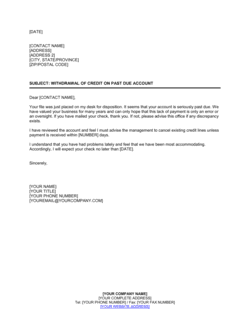
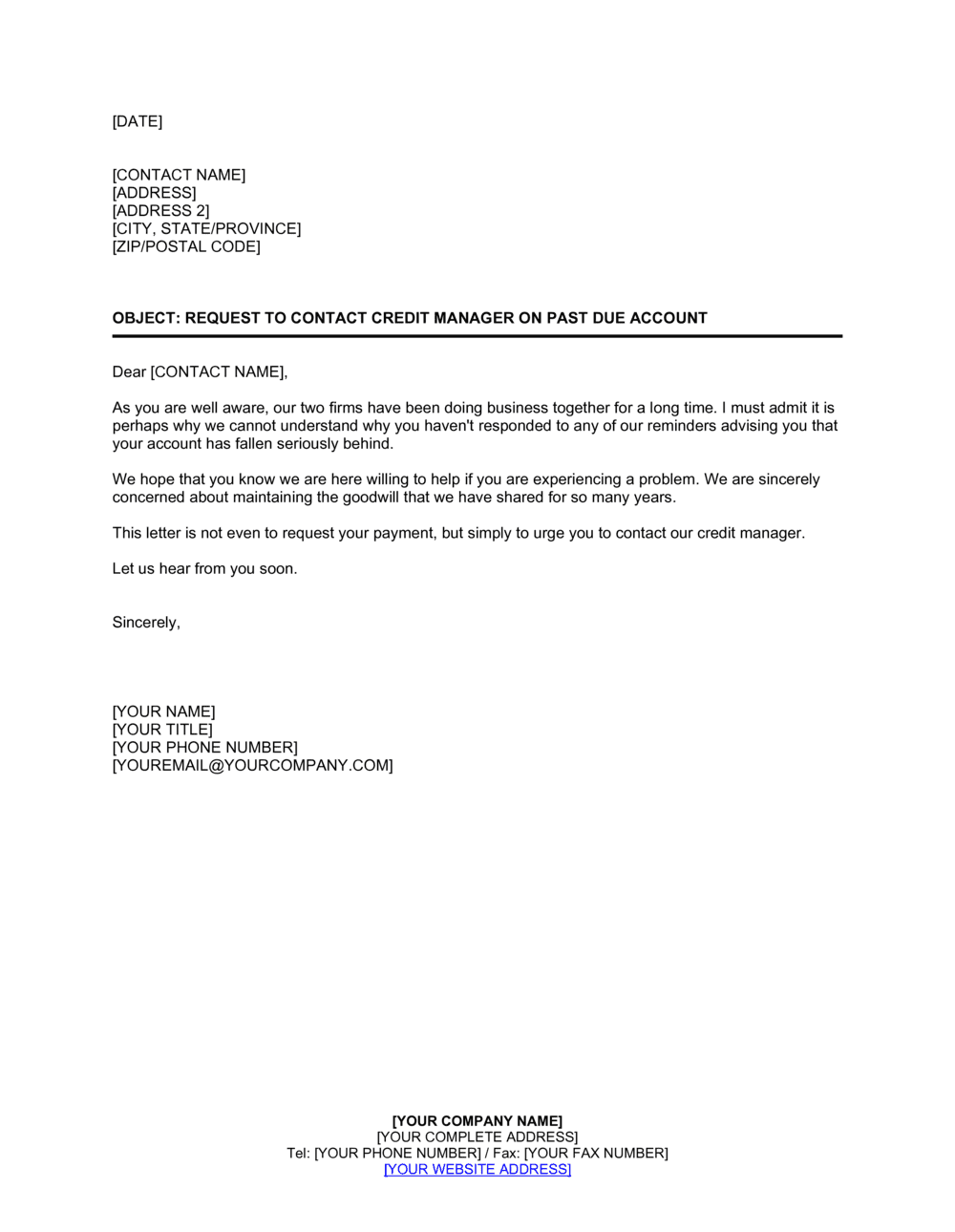
A Request to Contact Credit Manager on Past Due Account is a formal business letter sent to a customer whose account balance is overdue, directing them to get in touch with a named credit manager to resolve the outstanding amount. This free Word download is ready to edit online and send within minutes β€” simply insert the account details, the past due balance, and your credit manager's contact information.
When you need it
Use it when a customer's account is past due and standard invoice reminders have not produced payment or a response. It escalates the matter from routine billing to a direct credit-management conversation before formal collection action becomes necessary.
What's inside
Recipient and sender details, a clear statement of the past due balance and the original due date, a direct request to contact the credit manager by name and phone or email, and a professional closing that leaves the door open for resolution without threatening legal action.

What is a Request to Contact Credit Manager on Past Due Account?

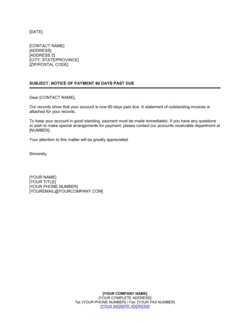
A Request to Contact Credit Manager on Past Due Account is a formal business letter sent to a customer whose invoice or account balance has not been paid by the agreed due date, directing them to contact a named credit manager to resolve the outstanding amount. It occupies a specific position in the accounts-receivable escalation sequence β€” firmer than a routine payment reminder, but less adversarial than a final demand notice or collections referral. The letter identifies the exact balance owed, provides the credit manager's direct contact details, sets a response deadline, and keeps the tone professional enough to preserve the business relationship where possible.

Why You Need This Document

When payment reminders go unanswered, leaving an overdue account in limbo costs you in two ways: cash flow deteriorates and the debt becomes progressively harder to collect. Accounts that reach 60 or 90 days past due without escalation are significantly more likely to require third-party collection, which typically costs 25–40% of the recovered balance. This letter creates a clear escalation step that prompts customer action, generates a documented contact attempt, and opens the door for a credit-manager conversation that can resolve the balance β€” or surface a dispute β€” before it becomes a write-off. Using a consistent, professionally worded template also ensures every overdue account receives the same standard of follow-up regardless of which team member handles it, making your AR process auditable and defensible if the matter ever proceeds to formal collection or litigation.

Which variant fits your situation?

If your situation is…Use this template
First notice β€” account is 1–15 days past duePast Due Payment Reminder Letter
Second notice β€” account is 16–30 days past due with no responseRequest to Contact Credit Manager on Past Due Account
Third notice β€” account is 30–60 days past dueFinal Notice of Past Due Payment Letter
Account is 60+ days past due and being referred to collectionsDebt Collection Letter
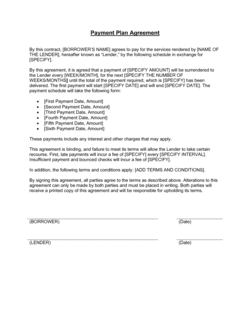
Customer has partial balance and needs a structured repayment planPayment Plan Agreement
Disputing a charge that has caused the account to go unpaidInvoice Dispute Letter
Confirming receipt of a late payment and closing the account issuePayment Receipt Acknowledgment Letter

Common mistakes to avoid

❌ Sending the letter too late in the aging cycle

Why it matters: Waiting until an account is 60 or 90 days past due before escalating to a credit manager significantly reduces the likelihood of voluntary payment and increases collection costs.

Fix: Trigger this letter at 15–30 days past due, after one initial reminder has gone unanswered β€” not as a last resort before collections.

❌ No named credit manager or direct contact details

Why it matters: A letter that routes the customer to a general phone queue or department email adds friction and gives them an easy reason to delay.

Fix: Always include the credit manager's full name, direct dial number, and email so the customer can reach the right person in one step.

❌ Incorrect or unverified balance

Why it matters: If the stated balance doesn't match the customer's records, they will dispute the amount rather than pay β€” turning a collections issue into a billing dispute and adding weeks to resolution.

Fix: Pull the balance directly from your accounting system immediately before sending, and attach or reference the specific invoice numbers that make up the total.

❌ Setting no response deadline

Why it matters: Without a specific date, customers treat the letter as an advisory notice and defer action indefinitely, which extends the delinquency and worsens your cash flow.

Fix: Always state a specific calendar date β€” e.g., 'Please contact us by May 16, 2026' β€” and follow up by phone if no response is received by that date.

The 8 key clauses, explained

Sender and recipient header

In plain language: Identifies the sending company, the date, and the customer's name and mailing address β€” standard business-letter format.

Sample language
[COMPANY NAME] | [ADDRESS] | [CITY, STATE, ZIP] | [DATE] | Attention: [CONTACT NAME] | [CUSTOMER COMPANY NAME] | [CUSTOMER ADDRESS]

Common mistake: Addressing the letter to a generic title like 'Accounts Payable' rather than a named contact. A named recipient reaches the right person faster and is harder to re-route or ignore.

Subject line

In plain language: A one-line reference that identifies the letter as being about a past due account, including the account number or invoice number for easy lookup.

Sample language
Re: Past Due Account β€” Account No. [ACCOUNT NUMBER] β€” Balance of $[AMOUNT] Due Since [DATE]

Common mistake: Omitting the account or invoice number from the subject line. Without it, the recipient's AP team cannot locate the record quickly and the response is delayed.

Opening statement of past due balance

In plain language: States clearly that the account is past due, the exact amount owed, and the original due date β€” no ambiguity about what is being requested.

Sample language
Our records indicate that your account with [COMPANY NAME] has an outstanding balance of $[AMOUNT] that was due on [DUE DATE] and remains unpaid.

Common mistake: Using vague language like 'you may have an outstanding balance.' Uncertainty invites the customer to dispute the existence of the debt rather than addressing it.

Request to contact the credit manager

In plain language: The core request: asks the recipient to contact a specific named credit manager, providing their direct phone number and email address.

Sample language
We kindly request that you contact our Credit Manager, [CREDIT MANAGER NAME], at [PHONE NUMBER] or [EMAIL ADDRESS] at your earliest convenience to discuss this matter.

Common mistake: Providing only a general company phone number or department email. If the customer cannot reach the right person immediately, the follow-through rate drops significantly.

Statement of urgency or deadline

In plain language: Specifies a response deadline β€” typically 5–10 business days β€” to prompt timely action without being threatening.

Sample language
We ask that you respond no later than [RESPONSE DATE], which is [X] business days from the date of this letter.

Common mistake: Setting no deadline at all. Without a specific date, customers treat the letter as a courtesy notice rather than an action item.

Offer to resolve or discuss

In plain language: Keeps the tone professional and solution-oriented by acknowledging that the customer may have questions or require a payment arrangement.

Sample language
If you believe this balance is incorrect, or if you require a payment arrangement, our Credit Manager is available to discuss options that work for both parties.

Common mistake: Skipping this paragraph and jumping straight to consequences. An adversarial tone at this stage can damage the customer relationship unnecessarily and reduce the likelihood of voluntary payment.

Consequences of non-response (optional but recommended)

In plain language: Briefly notes what happens if the account is not resolved β€” credit hold, referral to collections, or suspension of service β€” without making explicit legal threats.

Sample language
Please be advised that failure to contact us by [RESPONSE DATE] may result in a credit hold on your account and referral to our collections department.

Common mistake: Threatening legal action in the same letter as a contact request. Mixing escalation levels in a single letter undercuts the graduated nature of the collections process and can accelerate disputes.

Professional closing

In plain language: Thanks the recipient for their attention, expresses willingness to resolve the matter quickly, and signs off with the sender's name and title.

Sample language
We value our business relationship and are confident we can resolve this matter promptly. Thank you for your attention. Sincerely, [SENDER NAME] | [TITLE] | [COMPANY NAME]

Common mistake: Ending with a cold or curt sign-off. A professional, relationship-preserving close increases the chance the customer responds cooperatively rather than defensively.

How to fill it out

  1. 1

    Enter your company's contact details

    Add your company name, full mailing address, phone number, and email to the sender block at the top of the letter. Use the registered business name, not a trade name.

    πŸ’‘ Save a pre-filled version with your company details as a master file so you only update customer-specific fields for each new letter.

  2. 2

    Identify the correct recipient and their address

    Address the letter to the specific accounts payable contact or decision-maker at the customer's company. Confirm the mailing address matches your current records.

    πŸ’‘ Call the customer's main line before sending to confirm the AP contact name β€” a named letter is significantly harder to ignore than one addressed to a department.

  3. 3

    Fill in the account and invoice details

    Enter the account number or invoice number, the exact outstanding balance in the correct currency, and the original due date in the subject line and opening paragraph.

    πŸ’‘ Cross-reference your aging report before sending to confirm the balance is accurate β€” disputing an incorrect amount is the most common reason customers delay payment.

  4. 4

    Name your credit manager and provide direct contact details

    Insert the credit manager's full name, direct phone number, and email address. Do not use a general department line.

    πŸ’‘ If the credit manager is unavailable during certain hours, note the best time to call to reduce phone-tag and speed up resolution.

  5. 5

    Set a specific response deadline

    Calculate a response date 5–10 business days from the letter date and enter it in the deadline paragraph. Write the full calendar date, not 'within 10 days.'

    πŸ’‘ A Tuesday or Wednesday deadline tends to generate faster responses than a Monday deadline, which often gets pushed to the following week.

  6. 6

    Review tone and send via traceable method

    Read the completed letter aloud to check that it is firm but professional. Send by email with read receipt, certified mail, or both β€” and log the send date in your AR system.

    πŸ’‘ Sending by email and following up with a printed copy via certified mail doubles the contact rate for accounts that are 30+ days past due.

Frequently asked questions

What is a request to contact credit manager on a past due account?

It is a formal business letter sent to a customer with an overdue balance, asking them to contact a named credit manager directly to resolve the outstanding amount. It sits in the middle of the collections escalation sequence β€” after an initial payment reminder but before a formal final notice or collections referral. The goal is to open a direct conversation that leads to payment or an agreed arrangement.

When should I send this letter?

Send it when a customer's account is 15–30 days past due and an initial payment reminder has gone unanswered. Sending it earlier than 15 days past due can feel premature and damage the relationship; waiting beyond 30 days without escalation reduces the chance of voluntary payment. Tie the send date to your AR aging report so it goes out automatically at the right stage.

Should I send this letter by email or by post?

Best practice is to send by both email and traceable physical mail for accounts that are 30 or more days overdue. Email provides speed and a read receipt; certified mail creates a documented delivery record useful if the account later proceeds to collections or litigation. Log both send dates and delivery confirmations in your AR system.

What if the customer disputes the balance?

If the customer contacts the credit manager and disputes the balance, that is still a successful outcome β€” it converts a non-responding account into an active conversation. Have the credit manager pull the original invoices and payment history before the call so they can address the dispute quickly. Resolve confirmed billing errors promptly; confirmed valid balances should be supported with documentation.

Can I use this letter for consumer accounts as well as business accounts?

This template is designed for B2B accounts. Consumer debt collection in many jurisdictions β€” including under the US Fair Debt Collection Practices Act β€” is subject to specific disclosure requirements, contact restrictions, and dispute-response obligations that this letter does not address. For consumer accounts, consult your legal counsel or use a compliant consumer collections notice.

What should I do if there is no response after the deadline?

If the customer has not responded by the stated deadline, follow up by phone the same day. If still no response within 48 hours, issue a final notice letter stating that the account will be referred to your collections department or a third-party agency if payment or contact is not received within a further defined period. Document every contact attempt with dates and outcomes.

How does this letter fit into a broader collections process?

A well-structured collections process typically runs in four stages: a friendly invoice reminder at 1–7 days past due, this credit-manager contact request at 15–30 days, a formal final demand notice at 45–60 days, and a collections or legal referral at 60–90 days. Using all four stages in sequence preserves the customer relationship where possible while creating a clear documented escalation trail.

How this compares to alternatives

vs Past Due Payment Reminder Letter

A payment reminder is an early, low-pressure notice sent a few days after the due date β€” it assumes the non-payment may be an oversight. This credit-manager contact request is a formal escalation for accounts that have already received a reminder and not responded. The reminder precedes this letter in the collections sequence.

vs Final Notice of Past Due Payment Letter

A final notice is a last-step warning sent 45–60 days past due that explicitly states the account will be referred to collections. This letter is softer in tone β€” it requests contact and offers resolution options. Use this letter first; reserve the final notice for accounts that do not respond.

vs Demand Letter

A demand letter is a formal legal document β€” often drafted by or on behalf of counsel β€” that demands payment within a fixed period and signals imminent legal action. This contact-request letter is a business communication, not a legal instrument. Demand letters are appropriate only after internal escalation steps have been exhausted.

vs Debt Collection Letter

A debt collection letter is issued by a collections department or third-party agency once the debt has been referred out of normal AR. This credit-manager request letter is an internal business letter meant to resolve the account before collections involvement. Using this letter effectively can prevent the cost and relationship damage of a collections referral.

Industry-specific considerations

Wholesale and Distribution

High invoice volumes and net-30 to net-60 terms make this letter a standard tool for managing aging AR across large customer bases.

Professional Services

Firms billing for retainers, project milestones, or hourly work use this letter to address clients who delay payment without formally disputing the invoice.

Manufacturing

Long payment cycles and large per-invoice amounts mean a single unresolved account can materially affect cash flow, making early escalation critical.

Construction and Trades

Progress billing and holdbacks create complex AR situations where a credit-manager conversation can clarify disputed amounts before they escalate to lien claims.

Template vs pro β€” what fits your needs?

PathBest forCostTime
Use the templateAny business managing B2B accounts receivable with standard overdue balancesFree5–10 minutes per letter
Template + professional reviewBusinesses adding custom late-fee language, credit-hold policies, or legal notices to the letter$50–$150 (brief review by an accountant or office manager)30–60 minutes
Custom draftedHigh-value disputed accounts, regulated industries, or accounts approaching formal legal collection$200–$500 (legal counsel or specialized collections attorney)1–3 days

Glossary

Past Due Account
A customer account on which payment has not been received by the agreed due date stated on the original invoice or credit terms.
Credit Manager
The employee or officer responsible for approving credit terms, managing receivables, and resolving overdue account balances.
Net 30 / Net 60
Payment terms requiring the full invoice balance to be paid within 30 or 60 days of the invoice date.
Accounts Receivable (AR)
Money owed to a business by its customers for goods or services already delivered but not yet paid for.
Aging Report
An accounts-receivable report that groups outstanding balances by how long they have been unpaid β€” typically 0–30, 31–60, 61–90, and 90+ days.
Escalation
The process of moving an unresolved account issue from routine billing follow-up to a higher level of authority, such as a credit manager or collections team.
Delinquent Account
A customer account that is significantly overdue and has not responded to standard payment reminders.
Payment Terms
The agreed conditions under which a buyer must pay a seller, including the due date, acceptable payment methods, and any late-fee provisions.
Collection Action
Formal steps taken to recover an overdue debt, ranging from internal escalation and demand letters to third-party collection agencies or legal proceedings.
Credit Hold
A temporary suspension of a customer's ability to place new orders or receive further credit until their outstanding balance is resolved.

Part of your Business Operating System

This document is one of 3,000+ business & legal templates included in Business in a Box.

  • Fill-in-the-blanks β€” ready in minutes
  • 100% customizable Word document
  • Compatible with all office suites
  • Export to PDF and share electronically

Create your document in 3 simple steps.

From template to signed document β€” all inside one Business Operating System.
1
Download or open template

Access over 3,000+ business and legal templates for any business task, project or initiative.

2
Edit and fill in the blanks with AI

Customize your ready-made business document template and save it in the cloud.

3
Save, Share, Send, Sign

Share your files and folders with your team. Create a space of seamless collaboration.

Save time, save money, and create top-quality documents.

β˜…β˜…β˜…β˜…β˜…

"Fantastic value! I'm not sure how I'd do without it. It's worth its weight in gold and paid back for itself many times."

Managing Director Β· Mall Farm
Robert Whalley
Managing Director, Mall Farm Proprietary Limited
β˜…β˜…β˜…β˜…β˜…

"I have been using Business in a Box for years. It has been the most useful source of templates I have encountered. I recommend it to anyone."

Business Owner Β· 4+ years
Dr Michael John Freestone
Business Owner
β˜…β˜…β˜…β˜…β˜…

"It has been a life saver so many times I have lost count. Business in a Box has saved me so much time and as you know, time is money."

Owner Β· Upstate Web
David G. Moore Jr.
Owner, Upstate Web

Run your business with a system β€” not scattered tools

Stop downloading documents. Start operating with clarity. Business in a Box gives you the Business Operating System used by over 250,000 companies worldwide to structure, run, and grow their business.

Free Forever PlanΒ Β·Β No credit card required