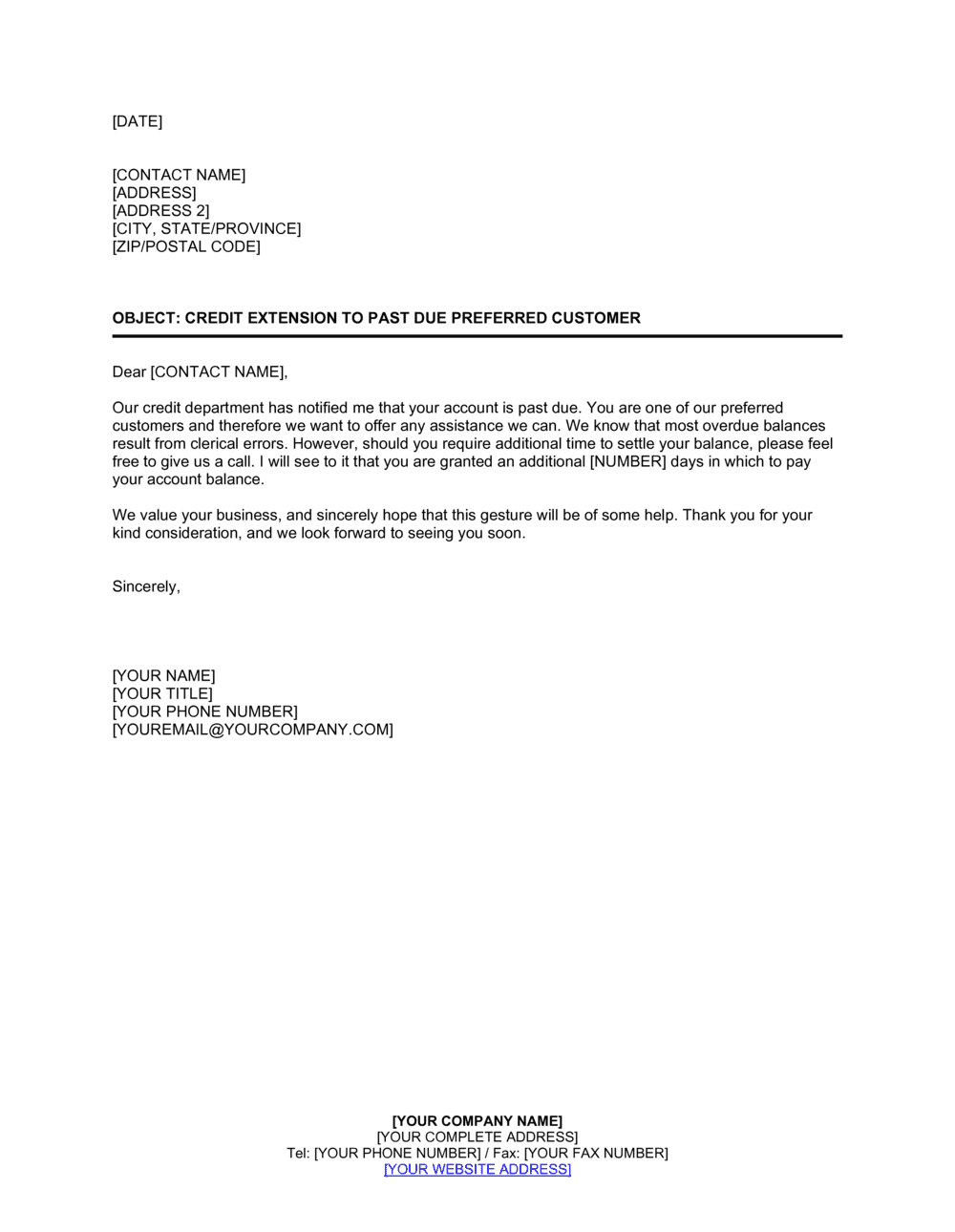
Credit Extension to Past Due Preferred Customer Template

Free Word download • Edit online • Save & share with Drive • Export to PDF

1 page20–30 min to fillDifficulty: StandardSignature requiredLegal review recommended
Learn more ↓
FreeCredit Extension to Past Due Preferred Customer Template

At a glance

What it is
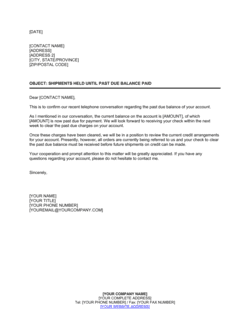
A Credit Extension To Past Due Preferred Customer is a legally binding agreement between a creditor and a valued customer whose account has fallen past due. It formally documents revised payment terms, any waived or reduced penalties, and the conditions under which the creditor agrees to extend rather than pursue collection. This free Word download is editable online and exportable as PDF, giving you a signed record that protects both parties if disputes arise later.
When you need it
Use it when a long-standing or high-value customer has an overdue balance and you want to preserve the relationship by offering structured repayment rather than sending the account to collections. It is also appropriate when a preferred customer requests additional credit time due to temporary cash flow difficulty and you are willing to accommodate under defined conditions.
What's inside
Identification of both parties and the outstanding balance, revised payment schedule with specific due dates, conditions for waiving or reducing late fees and interest, default consequences if the new terms are not met, acknowledgment of the existing debt, and governing law and signature blocks for both parties.

What is a Credit Extension To Past Due Preferred Customer?

A Credit Extension To Past Due Preferred Customer is a legally binding agreement in which a creditor formally grants a valued customer additional time to repay an overdue balance under revised terms, typically in exchange for the customer's signed acknowledgment of the debt and commitment to a structured installment schedule. Unlike a generic demand letter or a referral to collections, this document is designed to preserve a productive commercial relationship while protecting the creditor's legal position — documenting the outstanding amount, any conditional waiver of penalties, and the consequences of failing to meet the new schedule. It functions as both a relationship-management instrument and an enforceable contract that supersedes the original invoice terms.

Why You Need This Document

Operating without a signed credit extension agreement when a preferred customer falls past due leaves you exposed on multiple fronts. Verbal arrangements or email threads are insufficient to reset the statute of limitations, establish a clear default trigger, or document that the customer acknowledged the full balance owed. If the customer later disputes the amount or claims a good-faith payment effort, you have no signed record to rely on. Informally accepting partial payments without revised written terms can constitute an unintended waiver of your right to the original payment conditions, weakening your position in any subsequent collection action. This template gives you a single signed document that acknowledges the debt, replaces ambiguous prior arrangements with specific installment dates, ties any fee waiver to performance, and preserves your full remedies — including acceleration, credit bureau reporting, and legal action — if the customer defaults again.

Which variant fits your situation?

If your situation is…Use this template
Customer is past due and relationship is valued but balance is largeCredit Extension To Past Due Preferred Customer
Customer disputes the amount owed and you want to settleDebt Settlement Agreement
Customer is unresponsive and you are escalating to collectionsDemand Letter for Payment
New customer requesting trade credit before first orderCredit Application Form
Customer has multiple overdue invoices across different accountsPayment Plan Agreement
Granting credit to a new business without established payment historyCredit Agreement
Customer needs a formal acknowledgment of the outstanding debt onlyPromissory Note

Common mistakes to avoid

❌ Accepting a partial payment before the agreement is signed

Why it matters: Accepting payment under the original invoice terms without a signed agreement may be interpreted as an informal modification or waiver of your right to the full balance, undermining your ability to enforce the new schedule.

Fix: Hold all partial payments in a suspense account until both parties have executed the agreement, then apply the first installment as documented.

❌ Using vague installment timing language

Why it matters: Phrases like 'monthly payments' or 'within 30 days' without a specific calendar date allow the customer to argue about when a payment was actually due, delaying your ability to call a default.

Fix: Assign a specific calendar date — e.g., 'June 15, 2026' — to every installment and confirm in the agreement that time is of the essence.

❌ Offering an unconditional waiver of fees and interest

Why it matters: If the waiver is not contingent on full performance, the customer receives the benefit even if they miss installments, removing the primary financial incentive to comply.

Fix: Add explicit language stating that the waiver is void if any installment is more than five calendar days late, and that the full original fee and interest amounts become immediately due upon default.

❌ Omitting the acknowledgment of debt clause

Why it matters: Without a signed acknowledgment, the customer can contest the balance amount in court and may also benefit from a statute of limitations that has already begun running on the original invoices.

Fix: Include a stand-alone acknowledgment clause with the exact balance broken down by principal, interest, and fees, and have the customer initial it separately from the signature block.

❌ No integration clause to supersede prior communications

Why it matters: Without an entire-agreement clause, emails, voicemails, or informal promises made during negotiations can be introduced as contractual terms that contradict the written schedule.

Fix: Include a standard integration clause stating the written agreement is the complete and exclusive statement of the parties' arrangement regarding the overdue balance.

❌ Failing to reduce the customer's credit limit during the repayment period

Why it matters: Allowing the customer to continue purchasing at their original credit limit while repaying a past-due balance doubles the creditor's exposure and signals that the default is not being taken seriously.

Fix: Reduce the available credit line to zero or a nominal amount during the repayment period, with a written process for reinstatement upon successful completion of all installments.

The 10 key clauses, explained

Parties and account identification

In plain language: Identifies the creditor and customer by full legal name and confirms the specific account or invoice numbers covered by the agreement.

Sample language
This Credit Extension Agreement is entered into as of [DATE] between [CREDITOR LEGAL NAME] ('Creditor') and [CUSTOMER LEGAL NAME] ('Customer'), concerning Account No. [ACCOUNT NUMBER] / Invoice(s) [INVOICE NUMBERS].

Common mistake: Using a trade name instead of the registered legal entity name. If the entity name on the agreement differs from the debtor's legal name, enforcing the agreement through the courts becomes significantly harder.

Acknowledgment of outstanding balance

In plain language: The customer explicitly confirms the total amount owed as of the agreement date, removing any later dispute about whether the debt exists or its amount.

Sample language
Customer acknowledges and agrees that, as of [DATE], the outstanding balance due to Creditor is $[AMOUNT], consisting of principal of $[PRINCIPAL] and accrued interest/fees of $[FEES] ('Acknowledged Balance').

Common mistake: Omitting this clause and relying on the original invoice. Without a signed acknowledgment of the balance, the customer can later contest the amount — and in many jurisdictions, a signed acknowledgment resets the statute of limitations clock.

Revised payment schedule

In plain language: Sets out the new repayment plan in specific installment amounts and calendar due dates, replacing the original payment terms.

Sample language
In lieu of immediate payment in full, Customer shall pay the Acknowledged Balance according to the following schedule: [INSTALLMENT 1: $AMOUNT due DATE]; [INSTALLMENT 2: $AMOUNT due DATE]; [FINAL INSTALLMENT: $AMOUNT due DATE].

Common mistake: Writing 'monthly installments' without specifying exact calendar dates. Vague terms like 'on or about the 1st of each month' create disputes about whether a payment is late and undermine the default trigger.

Waiver or reduction of late fees and interest

In plain language: States clearly which penalties the creditor agrees to waive or reduce in exchange for the customer's commitment to the new schedule, and confirms these waivers are conditional on performance.

Sample language
Provided Customer complies fully with this Agreement, Creditor agrees to waive accumulated late fees of $[FEE AMOUNT] and reduce the accrued interest rate from [X]% to [Y]% per annum. This waiver is contingent on timely payment of all installments and is void upon any default.

Common mistake: Offering an unconditional waiver. Waiving fees without tying the benefit to performance removes the customer's financial incentive to comply with the revised schedule.

Conditions for continued credit

In plain language: Defines whether the customer may continue to purchase on credit during the repayment period and, if so, what credit limit and terms apply.

Sample language
During the term of this Agreement, Customer's available credit line shall be reduced to $[REDUCED LIMIT]. New orders exceeding this limit require advance written approval from Creditor's credit department.

Common mistake: Leaving existing credit terms unchanged while the customer is on a repayment plan. Allowing continued open-account purchases increases the creditor's exposure and sends inconsistent signals about the seriousness of the default.

Default and acceleration

In plain language: Defines what constitutes a default under the new terms — typically a missed installment or a dishonored payment — and authorizes the creditor to accelerate the full remaining balance immediately upon default.

Sample language
Customer shall be in default if any installment is not received by Creditor within [5] calendar days of its due date or if any payment is returned for insufficient funds. Upon default, the entire unpaid balance becomes immediately due and payable without further notice.

Common mistake: No grace period definition. If the agreement is silent on how many days constitute a late payment, the customer may argue that a one-day-late payment is not a default — leading to protracted disputes before the creditor can act.

Remedies upon default

In plain language: Lists the actions the creditor is entitled to take if the customer defaults — including filing suit, reporting to credit bureaus, or referring to a collection agency — without waiving any rights.

Sample language
Upon default, Creditor may, at its sole discretion, pursue any or all of the following remedies: (a) file suit for the full Acknowledged Balance plus costs and reasonable attorneys' fees; (b) report the delinquency to credit reporting agencies; (c) refer the account to a third-party collection agency.

Common mistake: Listing only one remedy. Courts in some jurisdictions treat a specific remedy clause as exhaustive — meaning the creditor gave up other remedies by not listing them. Use 'any or all of the following' language to preserve all options.

Waiver of defenses

In plain language: The customer agrees not to raise defenses they could have asserted against the original debt — such as disputes about quality or delivery — now that they have acknowledged the balance and agreed to new terms.

Sample language
Customer waives any and all defenses, setoffs, or counterclaims it may have had against Creditor relating to the original invoices referenced in this Agreement, and agrees that the Acknowledged Balance is valid and enforceable.

Common mistake: Omitting this clause entirely. Without a waiver-of-defenses provision, a customer who signs a repayment agreement can still later claim the underlying goods were defective or the services were not rendered — reopening the dispute.

Governing law and dispute resolution

In plain language: Specifies which jurisdiction's law governs the agreement and how disputes will be resolved — court, arbitration, or mediation.

Sample language
This Agreement is governed by the laws of [STATE / PROVINCE / COUNTRY]. Any dispute arising hereunder shall be resolved in the courts of [COUNTY/JURISDICTION], and Customer irrevocably consents to personal jurisdiction therein.

Common mistake: Choosing a governing jurisdiction with no connection to either party. Courts may decline to enforce forum-selection clauses that are purely one-sided and have no rational tie to the parties' locations or the transaction.

Entire agreement and modification

In plain language: Confirms that this document supersedes all prior discussions or arrangements about the overdue balance and that any changes must be in writing and signed by both parties.

Sample language
This Agreement constitutes the entire agreement between the parties with respect to the Acknowledged Balance and supersedes all prior negotiations, representations, and agreements. No modification shall be effective unless made in writing and signed by both parties.

Common mistake: No integration clause. Without it, the customer can argue that a phone call or email after signing changed the payment terms — potentially excusing a missed installment.

How to fill it out

  1. 1

    Identify both parties and the account

    Enter the creditor's full registered legal name, address, and contact details. Do the same for the customer, using their exact legal entity name and billing address. Reference every invoice or account number covered by the agreement.

    💡 Pull the customer's legal name from their original credit application or incorporation documents — not just the name on their invoices. Mismatches delay enforcement.

  2. 2

    Calculate and confirm the acknowledged balance

    Total all outstanding principal, accrued interest, and late fees as of the agreement date. Break these out as separate line items in the acknowledgment clause so the customer signs off on each component individually.

    💡 Send the customer a detailed statement of account at least three business days before presenting the agreement. Surprises at signing slow execution.

  3. 3

    Set the revised payment schedule with exact dates

    Determine how many installments are realistic given the customer's stated cash flow. Assign a specific calendar date — not a relative date like '30 days from signing' — to each installment. Consider aligning installment dates with the customer's known billing cycles.

    💡 Fewer, larger installments are easier to monitor and default-trigger than many small ones. Aim for no more than six installments unless the balance is very large.

  4. 4

    Define the conditional fee waiver

    Specify the exact dollar amount of fees and interest being waived and the precise condition — full compliance through the final payment — that activates the waiver. State clearly that partial compliance does not trigger a partial waiver.

    💡 A meaningful waiver (at least 15–20% of the overdue balance) increases the customer's motivation to perform. Token waivers are ignored.

  5. 5

    Set the default trigger and grace period

    Define exactly how many calendar days after a due date constitute a default. Five calendar days is standard for commercial credit agreements. Specify that returned or dishonored payments also trigger default immediately.

    💡 Add a notice requirement — e.g., 'Creditor shall provide written notice of default within 3 business days' — to reduce the risk of a good-faith dispute about whether notice was given.

  6. 6

    Review jurisdiction-specific requirements

    Check whether the governing jurisdiction requires specific language for debt acknowledgments, fee waivers, or arbitration clauses. State and provincial consumer-protection laws sometimes apply even to B2B agreements, depending on the customer's entity type.

    💡 If the customer is located in a different state or province than the creditor, have local counsel confirm the forum-selection clause is enforceable before signing.

  7. 7

    Obtain signatures before any forbearance begins

    Both parties must sign the agreement before you suspend any collection activity or accept the first installment payment under the new schedule. Accepting a partial payment without a signed agreement may constitute an informal modification of the original contract.

    💡 Use a timestamped electronic signature platform and store the executed copy in a shared drive immediately upon completion. Date of execution is critical if you later need to prove when the revised terms took effect.

  8. 8

    Set calendar reminders for each installment due date

    Assign a team member to monitor each payment due date and confirm receipt within two business days of the due date. Document every payment received with date, amount, and method for the audit trail.

    💡 Send a courtesy reminder three to five business days before each installment. Customers who miss a payment due to oversight — not inability — can usually be recovered without triggering the default clause.

Frequently asked questions

What is a credit extension to a past due preferred customer?

A credit extension to a past due preferred customer is a formal written agreement in which a creditor grants a valued customer additional time to repay an overdue balance under revised terms — typically including a structured installment schedule and conditional waiver of some penalties. It replaces the original payment obligation with a new binding arrangement that both parties sign, creating an enforceable record of the revised terms.

When should I use a credit extension agreement instead of sending the account to collections?

Use a credit extension agreement when the customer is a long-standing, high-value account with a history of on-time payments, when the overdue balance is the result of a temporary and documented cash flow problem, and when the cost of losing the customer relationship exceeds the short-term cost of extended collection time. If the customer is unresponsive, disputes the balance, or has a pattern of repeated delinquency, escalating to a collection agency or legal action is typically more appropriate.

Does a signed credit extension agreement restart the statute of limitations?

In most US states and Canadian provinces, yes — a signed written acknowledgment of the debt, which is included in this agreement's acknowledgment-of-debt clause, restarts the statute of limitations clock from the date of signing. This is one of the most important legal benefits of the agreement for the creditor. The exact effect varies by jurisdiction, so confirm the rule in the governing state or province before relying on this benefit.

Can I charge interest on the outstanding balance under a credit extension agreement?

Yes, provided the interest rate is disclosed in the agreement and does not exceed the applicable usury limit in the governing jurisdiction. In the US, usury limits vary by state and by the type of creditor — commercial lenders face different limits than trade creditors. In Canada, the criminal interest rate cap under the Criminal Code applies. The agreement should specify the rate per annum and confirm it was previously agreed to in the original credit terms or invoice.

What happens if the customer defaults on the revised payment schedule?

The default and acceleration clause makes the entire remaining unpaid balance immediately due and payable upon default — typically defined as a missed installment or dishonored payment beyond a short grace period. The creditor can then pursue collection through the courts, refer the account to a collection agency, or report the delinquency to credit bureaus, as specified in the remedies clause. Having a signed agreement with a clear default definition makes each of these steps faster and less expensive to execute.

Is this agreement enforceable against a customer who signed under financial pressure?

Generally yes, provided the customer had legal capacity to contract, was not subjected to duress or misrepresentation, and received something of value in exchange — such as a fee waiver or additional repayment time. Courts in most jurisdictions recognize that a creditor offering forbearance constitutes valid consideration. However, if a customer can show the terms were unconscionable or that they were misled about the waiver conditions, a court may modify or void specific provisions.

Should I reduce the customer's credit limit while they are on a repayment plan?

Yes. Allowing continued open-account purchasing at the original credit limit while an overdue balance is being repaid increases the creditor's total exposure and is difficult to explain to auditors or investors. Standard practice is to reduce the available credit line to zero or a nominal amount during the repayment period, with reinstatement tied to successful completion of all installments. This condition should be written explicitly into the agreement.

Does the agreement need to be notarized to be enforceable?

Notarization is not required for a commercial credit extension agreement to be enforceable in most US states, Canadian provinces, or UK jurisdictions. A signed and dated document with the parties' legal names is sufficient. Some creditors choose to have the agreement witnessed or notarized for added evidentiary weight, particularly for larger balances, but it is not a legal requirement in most commercial contexts.

Can I use this agreement for a consumer (individual) customer, not just a business?

This template is designed for B2B commercial credit relationships. Using it for consumer (individual) debtors may trigger additional requirements under the Fair Debt Collection Practices Act (FDCPA) in the US, the Consumer Credit Act in the UK, or provincial consumer protection legislation in Canada. For consumer debt, the language, disclosure requirements, and permissible fee structures are materially different. Consult a consumer credit attorney before adapting this template for individual debtors.

What should I do if the customer refuses to sign the credit extension agreement?

If a customer declines to sign, the original invoice terms remain in force and your remedies are governed by the original credit agreement or applicable law. You can issue a formal demand letter requiring payment in full within a defined period, suspend further shipments or services, report the delinquency to a credit bureau, or refer the account to a collection agency or legal counsel. A refusal to sign a reasonable repayment arrangement is a useful signal about the customer's intent or ability to pay.

How this compares to alternatives

vs Demand letter for payment

A demand letter formally requests immediate payment in full and signals the creditor's intent to pursue legal action if payment is not received. A credit extension agreement, by contrast, offers the customer structured time to repay in exchange for a signed acknowledgment and revised terms. Use a demand letter when the relationship is expendable or when prior accommodation has failed; use a credit extension when preserving the customer is worth the extended timeline.

vs Promissory note

A promissory note is a standalone promise to pay a defined sum on a specific date or schedule, without the conditionality, fee-waiver provisions, or relationship-management context of a credit extension agreement. Promissory notes are more formal instruments often used in lending transactions. A credit extension agreement is more appropriate for a trade creditor managing an overdue commercial account.

vs Payment plan agreement

A payment plan agreement establishes installment terms for a debt but typically does not include acknowledgment-of-debt language, waiver-of-defenses provisions, or conditional fee waivers. The credit extension to a preferred customer specifically incorporates these elements to protect the creditor's legal position while offering goodwill concessions to a valued account.

vs Debt settlement agreement

A debt settlement agreement reduces the total amount owed — the creditor accepts less than the full balance in exchange for immediate or near-term payment. A credit extension agreement keeps the full balance intact but provides additional time and a fee waiver for performance. Use a settlement agreement when collection of the full amount is unlikely; use a credit extension when the customer is solvent but temporarily illiquid.

Industry-specific considerations

Wholesale and distribution

Large per-invoice balances, frequent repeat orders, and thin margins make structured repayment preferable to collections for maintaining supply-chain relationships.

Professional services

Retainer and project-based billing creates variable cash flow for clients; credit extensions formalize a repayment plan while allowing the service engagement to continue under tightened terms.

SaaS and technology

Annual subscription invoices with large upfront amounts are common default triggers; credit extensions allow the vendor to preserve ARR while the customer works through a funding gap.

Construction and contracting

Progress billing tied to project milestones creates payment timing mismatches; credit extensions bridge the gap while documenting the outstanding draw amount and revised completion-linked payment schedule.

Jurisdictional notes

United States

Statute of limitations on written contracts ranges from 3 to 6 years depending on the state; a signed acknowledgment of debt typically restarts the clock. Usury limits on interest vary by state — some states cap commercial interest rates while others exempt B2B agreements. The FDCPA applies only to consumer debts collected by third-party collectors, not to trade creditors collecting their own B2B receivables, but consumer-debt rules apply if the customer is an individual.

Canada

Each province sets its own limitation period for contract claims — Ontario and most common-law provinces apply a 2-year basic limitation period, which a signed acknowledgment of debt resets under the Limitations Act. The federal Criminal Code sets a criminal interest rate cap of 60% per annum on all credit agreements. Quebec civil law requires bilingual or French-language contracts for provincially-regulated commercial dealings and applies distinct rules on novation when replacing original payment terms.

United Kingdom

The Limitation Act 1980 (England and Wales) sets a 6-year limitation period for simple contract debts; a written acknowledgment signed by the debtor restarts this period under s.30. The Late Payment of Commercial Debts (Interest) Act 1998 entitles B2B creditors to statutory interest at 8% above the Bank of England base rate on overdue commercial debts — the credit extension agreement should specify whether this statutory right is waived or preserved. Scotland applies a 5-year prescriptive period under the Prescription and Limitation (Scotland) Act 1973.

European Union

The EU Late Payment Directive (2011/7/EU) sets a maximum 60-day payment period for B2B transactions (30 days involving public authorities) and entitles creditors to statutory interest and recovery costs automatically on late commercial debts. Limitation periods vary by member state — typically 3 years in France and Germany, 5 years in Spain. GDPR considerations apply if the agreement is stored digitally and includes personal data about the customer's representatives. Some member states require specific language for written debt acknowledgments to be effective.

Template vs lawyer — what fits your deal?

PathBest forCostTime
Use the templateTrade creditors and B2B service providers managing overdue balances under $25,000 with a known, responsive customerFree30–60 minutes
Template + legal reviewBalances over $25,000, cross-jurisdictional arrangements, or customers with a history of disputed invoices$300–$750 for a one-hour attorney review1–3 days
Custom draftedComplex creditor–debtor arrangements, regulated industries, balances exceeding $100,000, or customers threatening counterclaims$1,000–$3,500+1–2 weeks

Glossary

Credit Extension
A formal agreement by a creditor to allow a debtor additional time beyond the original due date to repay an outstanding balance.
Past Due Balance
An amount owed by a customer that has not been paid by the original contractual due date.
Preferred Customer
A long-standing, high-value, or strategically important customer to whom a creditor may offer more favorable terms than to the general customer base.
Revised Payment Schedule
A replacement repayment timeline agreed to by both parties, specifying new installment amounts and due dates.
Default Clause
A provision stating what constitutes a breach of the new agreement and what remedies the creditor may pursue if the customer fails to meet the revised terms.
Waiver of Late Fees
A creditor's agreement to forgive accumulated penalty charges as an incentive for the customer to commit to and comply with the new payment terms.
Acknowledgment of Debt
A written admission by the debtor confirming that the outstanding balance is valid and owed, which restarts the statute of limitations in many jurisdictions.
Statute of Limitations
The maximum period a creditor has under applicable law to bring a legal claim to recover an unpaid debt.
Forbearance
A creditor's voluntary decision to refrain from exercising legal remedies — such as collection or litigation — while giving the debtor an opportunity to cure the default.
Acceleration Clause
A provision that makes the entire remaining balance immediately due and payable if the debtor misses a payment under the revised schedule.

Part of your Business Operating System

This document is one of 3,000+ business & legal templates included in Business in a Box.

  • Fill-in-the-blanks — ready in minutes
  • 100% customizable Word document
  • Compatible with all office suites
  • Export to PDF and share electronically

Create your document in 3 simple steps.

From template to signed document — all inside one Business Operating System.
1
Download or open template

Access over 3,000+ business and legal templates for any business task, project or initiative.

2
Edit and fill in the blanks with AI

Customize your ready-made business document template and save it in the cloud.

3
Save, Share, Send, Sign

Share your files and folders with your team. Create a space of seamless collaboration.

Save time, save money, and create top-quality documents.

★★★★★

"Fantastic value! I'm not sure how I'd do without it. It's worth its weight in gold and paid back for itself many times."

Managing Director · Mall Farm
Robert Whalley
Managing Director, Mall Farm Proprietary Limited
★★★★★

"I have been using Business in a Box for years. It has been the most useful source of templates I have encountered. I recommend it to anyone."

Business Owner · 4+ years
Dr Michael John Freestone
Business Owner
★★★★★

"It has been a life saver so many times I have lost count. Business in a Box has saved me so much time and as you know, time is money."

Owner · Upstate Web
David G. Moore Jr.
Owner, Upstate Web

Run your business with a system — not scattered tools

Stop downloading documents. Start operating with clarity. Business in a Box gives you the Business Operating System used by over 250,000 companies worldwide to structure, run, and grow their business.

Start free · No credit card required