Withdrawal of Credit on Past Due Account Template

Free Word download β€’ Edit online β€’ Save & share with Drive β€’ Export to PDF

1 pageβ€’20–30 min to fillβ€’Difficulty: Standardβ€’Signature requiredβ€’Legal review recommended
Learn more ↓
FreeWithdrawal of Credit on Past Due Account Template

At a glance

What it is
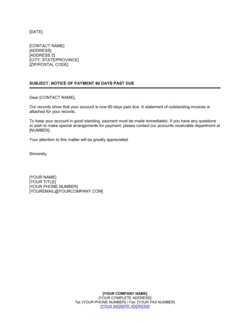
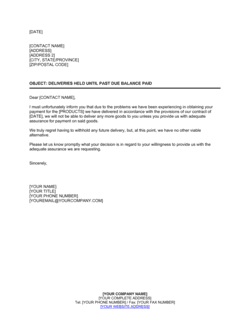
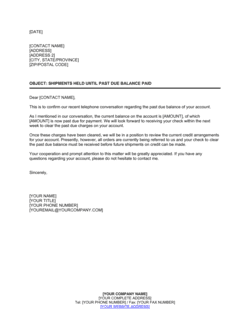
A Withdrawal of Credit on Past Due Account is a formal written notice a creditor sends to a customer or business debtor to officially revoke previously extended credit privileges due to a delinquent or overdue balance. This free Word download lets you document the credit suspension, state the outstanding amount owed, and set clear terms for reinstatement β€” all in a single signed document you can export as PDF and deliver immediately.
When you need it
Use it when a customer's account has fallen past due and standard payment reminders have gone unanswered, and you need to formally end their ability to purchase on credit pending resolution of the outstanding balance. It is also appropriate when internal credit policy requires documented notice before escalating to collections or legal action.
What's inside
Creditor and debtor identification, account reference and outstanding balance details, formal notice of credit withdrawal, demand for payment or repayment arrangement, conditions for credit reinstatement, and governing law and signature blocks.

What is a Withdrawal of Credit on Past Due Account?

A Withdrawal of Credit on Past Due Account is a formal written notice issued by a creditor to a business customer or debtor that officially revokes trade credit privileges because the account has become delinquent. It documents the total outstanding balance with invoice-level detail, sets a hard deadline for payment, suspends further credit-based transactions effective immediately, and preserves the creditor's full range of legal remedies β€” including collections referral, civil litigation, and lien registration. Unlike a payment reminder, which is advisory, a credit withdrawal notice is a binding document that formally changes the terms of the commercial relationship and creates the paper trail required for any subsequent enforcement action.

Why You Need This Document

Allowing a past due account to continue operating without formal written notice of credit withdrawal exposes your business on multiple fronts simultaneously. Without a documented credit suspension, you may continue delivering goods or services on credit β€” deepening an already uncollectable balance β€” while the debtor argues they were never formally notified that credit had been revoked. Courts and collection agencies consistently require evidence that the debtor received proper notice before they will act; an undocumented withdrawal gives a debtor grounds to dispute the process and delay enforcement at every step. A properly executed credit withdrawal notice stops the bleeding by halting further credit exposure, creates the formal demand record needed to pursue collections or a civil judgment, and signals to the debtor that the account has moved from the accounts receivable queue to a legal matter. This template gives you a ready-to-sign document you can complete in under 20 minutes and deliver the same day β€” generating exactly the documentation trail your collections process depends on.

Which variant fits your situation?

If your situation is…Use this template
Sending a first reminder on a mildly overdue accountPast Due Payment Reminder Letter
Formally demanding full payment on a long-overdue balanceDemand for Payment Letter
Revoking credit and threatening legal action if payment is not receivedFinal Notice Before Legal Action
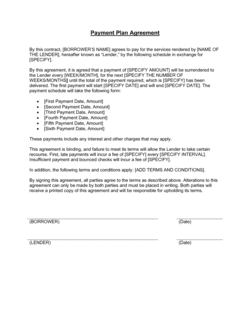
Offering a structured repayment plan to resolve the past due balancePayment Plan Agreement
Turning the account over to a debt collection agencyDebt Collection Assignment Letter
Settling the debt for less than the full amount owedDebt Settlement Agreement
Placing a lien on assets to secure the unpaid balanceUCC Financing Statement / Lien Notice

Common mistakes to avoid

❌ Using a trade name instead of the registered legal entity

Why it matters: A notice issued under a brand name rather than the creditor's legal entity name can be challenged as invalid, delaying collection or complicating litigation.

Fix: Confirm the exact registered corporate name before drafting the notice and use it consistently throughout, including in the signature block.

❌ Stating only a lump-sum balance without invoice-level detail

Why it matters: A debtor who disputes any portion of the balance can stall the entire collection process when individual invoices are not itemized.

Fix: List every past due invoice by number, date, original due date, and individual balance so disputed items can be isolated without blocking payment of the undisputed portion.

❌ Failing to document delivery of the notice

Why it matters: Without proof of delivery, a debtor can claim the notice was never received, which prevents the creditor from enforcing the withdrawal or using the notice as a step in collections escalation.

Fix: Always send via a method that generates proof of receipt β€” certified mail return receipt, courier with signature confirmation, or email with a read receipt and delivery timestamp.

❌ Continuing to extend credit or deliver goods after issuing the notice

Why it matters: Delivering goods or services on credit terms after sending a withdrawal notice may be treated as a waiver of the withdrawal, exposing the creditor to additional non-payment on the new deliveries.

Fix: Halt all credit-based deliveries as of the effective date stated in the notice. If you choose to continue on a cash-in-advance basis, document that separately in writing.

❌ Inserting an interest rate that differs from the original credit agreement

Why it matters: Courts will apply only the contractually agreed rate; a higher rate inserted at the collection stage is unenforceable and can undermine the creditor's credibility in proceedings.

Fix: Copy the exact late-payment interest rate from the original signed credit agreement or terms of sale, and cite that document by date in the clause.

❌ Omitting reinstatement conditions

Why it matters: Without defined reinstatement criteria, a debtor who clears the balance may claim an automatic right to the same credit limit, creating an unintended ongoing credit obligation.

Fix: Include a clause stating reinstatement is at the creditor's sole discretion, conditioned on full payment and a satisfactory credit review, and is not automatic upon payment.

The 10 key clauses, explained

Parties and Account Identification

In plain language: Identifies the creditor (business revoking credit) and the debtor (customer or business whose credit is being withdrawn), along with the specific account number or reference.

Sample language
This notice is issued by [CREDITOR COMPANY NAME], a [STATE/PROVINCE] [ENTITY TYPE] ('Creditor'), to [DEBTOR COMPANY OR INDIVIDUAL NAME] ('Debtor'), in respect of Account No. [ACCOUNT NUMBER] established on [ORIGINAL CREDIT DATE].

Common mistake: Using a trade name instead of the registered legal entity name for the creditor. If the creditor name does not match the entity that issued the original credit agreement, enforceability of the notice and any subsequent legal action is weakened.

Statement of Past Due Balance

In plain language: Sets out the total outstanding amount owed, with a breakdown of invoice numbers, invoice dates, original due dates, and the number of days each invoice is past due.

Sample language
As of [DATE], the following amounts remain outstanding and unpaid: Invoice [INV-001], dated [DATE], due [DATE], balance $[AMOUNT] ([X] days past due). Total outstanding balance: $[TOTAL AMOUNT].

Common mistake: Stating only a lump-sum total without itemizing individual invoices. A debtor who disputes the balance can delay resolution indefinitely; a per-invoice breakdown eliminates that ambiguity and strengthens your position in collections or court.

Formal Notice of Credit Withdrawal

In plain language: The operative clause that explicitly revokes the debtor's credit privileges as of a specific date and suspends the creditor's obligation to extend further goods or services on credit.

Sample language
Effective [DATE], Creditor hereby withdraws all credit privileges previously extended to Debtor. No further goods or services will be provided on credit terms until the outstanding balance is paid in full and credit reinstatement is formally approved by Creditor.

Common mistake: Making the credit withdrawal conditional on a future event without stating a hard effective date. Conditional language like 'if payment is not received' creates ambiguity about when credit actually stops, leaving the creditor exposed to claims of further credit delivery.

Demand for Payment

In plain language: A clear demand that the debtor pay the full outstanding balance β€” or contact the creditor to arrange a payment plan β€” within a defined number of days.

Sample language
Debtor is hereby demanded to remit payment of $[TOTAL AMOUNT] in full no later than [DATE], being [X] days from the date of this notice. Payment must be made by [ACCEPTED PAYMENT METHODS]. Failure to remit payment by this date may result in referral to a collection agency or commencement of legal proceedings.

Common mistake: Not specifying acceptable payment methods or a payee reference. Debtors who want to pay are delayed when instructions are missing, and a missed payment deadline becomes a disputed technicality.

Accrual of Interest and Fees

In plain language: States whether interest is accruing on the overdue balance, the applicable rate, and whether collection costs or legal fees will be passed to the debtor.

Sample language
Interest on the outstanding balance shall continue to accrue at the rate of [X]% per annum ([X]% per month) from the original due date(s) until paid in full, as provided in the original credit agreement dated [DATE]. Debtor shall also be responsible for all reasonable collection costs and legal fees incurred.

Common mistake: Applying an interest rate in the notice that differs from the rate in the original credit agreement. Courts will only enforce the contracted rate; a higher rate inserted at this stage is typically unenforceable and can undermine the creditor's credibility.

Conditions for Credit Reinstatement

In plain language: Sets out what the debtor must do to have credit privileges restored β€” typically full payment of the past due balance, possibly a security deposit or reduced credit limit, and a written reinstatement request.

Sample language
Creditor may, at its sole discretion, consider reinstating credit privileges upon: (a) payment in full of all outstanding amounts including accrued interest; (b) submission of a written reinstatement request; and (c) satisfactory review of Debtor's current credit standing. Reinstatement is not automatic and does not create an obligation on Creditor to restore prior credit limits.

Common mistake: Omitting the 'at sole discretion' language. Without it, a debtor who pays the balance in full could argue they have a contractual right to automatic credit reinstatement at the prior limit β€” creating an unintended obligation.

Effect on Existing Orders and Contracts

In plain language: Clarifies the status of any outstanding purchase orders, open work orders, or ongoing service agreements β€” whether they are suspended, cancelled, or will proceed only on a cash-in-advance basis.

Sample language
All pending orders, purchase orders, and service deliveries under Account No. [ACCOUNT NUMBER] are hereby suspended pending payment of the outstanding balance. Creditor reserves the right to require payment in advance of any future deliveries during the suspension period.

Common mistake: Failing to address outstanding orders at all, then delivering goods on suspended credit. Delivery after issuing a credit withdrawal may be interpreted as a waiver of the withdrawal, exposing the creditor to further non-payment.

Reservation of Rights

In plain language: Preserves all of the creditor's legal and contractual remedies β€” including the right to pursue collections, obtain a judgment, or register a lien β€” without waiving any rights by issuing this notice.

Sample language
This notice does not constitute a waiver of any right or remedy available to Creditor under the original credit agreement, applicable law, or otherwise. Creditor expressly reserves all rights, including the right to pursue collections, commence legal proceedings, or register security interests against Debtor's assets.

Common mistake: Not including a reservation of rights clause. Without it, sending a notice of withdrawal could be read as an election of remedies β€” potentially preventing the creditor from pursuing other concurrent remedies.

Governing Law and Dispute Resolution

In plain language: Specifies which jurisdiction's law governs the notice and any disputes arising from it, and identifies how disputes will be resolved β€” negotiation, mediation, or litigation.

Sample language
This notice and any dispute arising from it shall be governed by the laws of [STATE / PROVINCE / COUNTRY]. Any dispute not resolved by negotiation within [30] days shall be submitted to [arbitration / mediation / the courts of [JURISDICTION]].

Common mistake: Choosing a governing law that differs from the jurisdiction specified in the original credit agreement. Conflicting forum selections create procedural delays and may allow a debtor to challenge which terms control.

Signature and Delivery

In plain language: Provides signature blocks for the authorized creditor representative and documents the method and date of delivery to the debtor β€” certified mail, email with read receipt, or personal delivery.

Sample language
Signed on behalf of [CREDITOR COMPANY NAME] by: [AUTHORIZED SIGNATORY NAME], [TITLE], on [DATE]. Delivered to Debtor by: [DELIVERY METHOD] on [DELIVERY DATE]. Confirmation: [TRACKING NUMBER / EMAIL TIMESTAMP].

Common mistake: Sending the notice without documenting delivery. If the debtor later claims they never received it, an undocumented delivery leaves the creditor unable to prove notice was given β€” undermining any subsequent collection or legal action.

How to fill it out

  1. 1

    Enter creditor and debtor legal entity details

    Fill in the full registered legal name, address, and contact details for both the creditor and the debtor. Include the account number or reference used in your billing system.

    πŸ’‘ Cross-reference the debtor name against the original credit application or agreement β€” matching entity names exactly prevents disputes about who the notice was addressed to.

  2. 2

    Itemize all past due invoices

    List every unpaid invoice by number, invoice date, original due date, and balance. Calculate the total outstanding amount and confirm it matches your accounts receivable aging report.

    πŸ’‘ Run your AR aging report the same day you draft the notice so the balances are current β€” a stale figure gives the debtor grounds to dispute the stated amount.

  3. 3

    Set the effective date of credit withdrawal

    Choose a specific calendar date on which credit privileges are revoked β€” typically the date the notice is sent, or 3–5 business days forward to allow for delivery. State it clearly in the operative clause.

    πŸ’‘ Backdating the effective date to match when invoices first went past due can create unintended consequences β€” stick to the date of notice or a short forward date.

  4. 4

    State the payment deadline and instructions

    Enter the specific date by which full payment must be received β€” typically 10 to 30 days from the notice date. Include all accepted payment methods: check payable to, wire transfer details, ACH information, or an online payment portal link.

    πŸ’‘ 10 to 14 days is the standard demand window for commercial credit notices; shorter deadlines signal urgency without being legally unreasonable in most jurisdictions.

  5. 5

    Confirm the interest rate matches the original credit agreement

    Enter the late-payment interest rate exactly as stated in the original signed credit agreement or terms of sale. Do not insert a higher rate at this stage.

    πŸ’‘ If your original credit terms did not specify an interest rate, reference the applicable statutory rate in your jurisdiction rather than leaving the field blank.

  6. 6

    Address outstanding orders and future deliveries

    Decide whether existing open orders are suspended, cancelled, or will proceed on cash-in-advance terms. State your decision clearly in the relevant clause so there is no ambiguity about whether goods or services will continue.

    πŸ’‘ If you intend to continue serving the account on a cash basis while the balance is resolved, say so explicitly β€” this often accelerates payment while preserving the business relationship.

  7. 7

    Have the notice signed by an authorized representative

    The notice must be signed by someone with authority to bind the creditor β€” a credit manager, CFO, or owner. Print the signatory's name and title below the signature line.

    πŸ’‘ Use the same title that appears on your credit agreement or terms of sale to reinforce authority and consistency.

  8. 8

    Deliver and document receipt

    Send the signed notice by certified mail with return receipt, email with delivery and read confirmation, or courier with proof of delivery. Record the tracking number or email timestamp in your file.

    πŸ’‘ Send via two methods simultaneously β€” certified mail and email β€” so you have proof of delivery regardless of which the debtor claims not to have received.

Frequently asked questions

What is a withdrawal of credit on a past due account?

A withdrawal of credit on a past due account is a formal written notice from a creditor to a customer revoking credit privileges because the customer's account is overdue. It documents the outstanding balance, sets a payment deadline, suspends further credit-based transactions, and preserves the creditor's legal remedies. It differs from a simple payment reminder in that it is a binding document that formally changes the terms of the commercial relationship.

When should I send a credit withdrawal notice rather than another payment reminder?

A credit withdrawal notice is appropriate when an account is 60 or more days past due and standard reminders have gone unanswered, when the balance is large enough to warrant formal documentation, or when your internal credit policy requires a written notice before escalating to collections or legal action. Sending it too early β€” before reminders β€” can damage customer relationships unnecessarily; waiting too long increases the risk of non-collection.

Is a credit withdrawal notice legally binding?

Yes, when properly executed by an authorized representative of the creditor and delivered to the debtor, a credit withdrawal notice is generally enforceable as a formal modification of the parties' credit arrangement. It creates a documented record that the debtor was notified of the outstanding balance and the suspension of credit β€” which is typically required before filing in small claims court, pursuing collections, or registering a lien in most jurisdictions. Consider consulting a lawyer before sending if the balance is substantial or a dispute is anticipated.

What happens if the debtor ignores the credit withdrawal notice?

If the debtor does not pay by the deadline stated in the notice, the creditor's typical next steps are referral to a third-party collection agency, filing in small claims court for balances within local jurisdictional limits, commencing civil litigation for larger amounts, or registering a lien against the debtor's assets where applicable. The notice itself becomes a key exhibit establishing that the debtor received formal demand and failed to respond β€” strengthening the creditor's position in any subsequent proceedings.

Does sending a credit withdrawal notice affect my ability to sue for the debt?

No β€” a properly drafted notice includes a reservation of rights clause that explicitly preserves all legal and contractual remedies. Sending the notice does not waive the creditor's right to sue, pursue collections, or take security. In most jurisdictions, a written demand for payment is actually a prerequisite to filing certain types of collection actions, so issuing the notice strengthens rather than limits your legal options.

Can I charge interest on the past due balance in the notice?

You can include interest only at the rate specified in the original credit agreement or terms of sale. If your credit terms included a late-payment interest clause β€” typically 1–2% per month or 18–24% per annum β€” you may reference and enforce that rate in the withdrawal notice. If your original terms did not specify an interest rate, many jurisdictions provide a statutory rate you may apply. Inserting a new or higher rate at this stage is generally not enforceable.

Should I send the notice by email or certified mail?

Best practice is to send via both methods simultaneously. Certified mail with return receipt provides physical proof of delivery that courts recognize in most jurisdictions. Email with delivery and read confirmation is faster and creates a timestamped digital record. Using both ensures that a debtor cannot claim non-receipt regardless of which channel they later dispute.

What is the difference between a credit withdrawal notice and a demand for payment letter?

A demand for payment letter focuses narrowly on demanding a specific sum by a deadline and is often used as a final step before litigation. A credit withdrawal notice does more: it formally revokes ongoing credit privileges, addresses outstanding orders, sets reinstatement conditions, and preserves broader creditor remedies. In practice, a well-drafted credit withdrawal notice incorporates the demand for payment as one of its clauses, making it the more comprehensive document for accounts with an ongoing credit relationship.

Can credit be reinstated after a withdrawal notice is sent?

Yes, at the creditor's discretion. Most withdrawal notices include a reinstatement clause stating the conditions the debtor must satisfy β€” typically full payment of the past due balance, possibly a security deposit or reduced credit limit, and a formal review of the debtor's current creditworthiness. Reinstatement should always be documented in writing to avoid any ambiguity about what credit terms apply going forward.

How this compares to alternatives

vs Demand for Payment Letter

A demand for payment letter is a focused document demanding a specific sum by a hard deadline, typically used as a final pre-litigation step. A credit withdrawal notice is broader: it formally ends the credit relationship, addresses open orders, sets reinstatement terms, and preserves all remedies. For accounts with an ongoing trading relationship, the withdrawal notice is the more complete document; the demand letter is the appropriate follow-up if the withdrawal is ignored.

vs Past Due Payment Reminder Letter

A payment reminder is an informal or semi-formal nudge used in the early stages of delinquency β€” typically 15 to 30 days past due. It does not revoke credit or create legal obligations on either party. A credit withdrawal notice is appropriate after reminders have failed: it is a formal legal document that changes the terms of the relationship and generates a documented paper trail for collections or litigation.

vs Debt Settlement Agreement

A debt settlement agreement is used when both parties negotiate a reduced payoff amount to resolve the outstanding balance. A credit withdrawal notice precedes settlement β€” it is issued to pressure payment and preserve remedies. If the debtor responds with a settlement offer, the parties then execute a separate debt settlement agreement to document the reduced amount and release of claims.

vs Payment Plan Agreement

A payment plan agreement is a negotiated arrangement allowing the debtor to pay the outstanding balance in installments. It is typically entered into after a credit withdrawal notice has been issued and the debtor has acknowledged the debt but cannot pay in full immediately. The two documents work together: the withdrawal notice establishes the creditor's position; the payment plan documents the resolution.

Industry-specific considerations

Wholesale Distribution

Distributors issue credit withdrawal notices to resellers carrying large open-invoice balances, suspending shipments until accounts are cleared to protect against inventory exposure.

Manufacturing

Manufacturers use credit withdrawal to halt component or finished-goods deliveries to dealers or OEM customers with overdue accounts before production commitments deepen the exposure.

Professional Services

Accounting, legal, and consulting firms suspend ongoing engagements under the credit withdrawal framework when retainer or milestone invoices age beyond 60 days without response.

Construction and Trades

Suppliers and subcontractors withdraw material credit from general contractors or developers with delinquent accounts, often as a prerequisite step before filing a mechanics lien.

Jurisdictional notes

United States

In the US, credit withdrawal notices in commercial transactions are largely governed by state contract and UCC Article 2 principles. Most states do not require a specific form for revoking B2B trade credit, but written notice is strongly advisable before pursuing collections. Some states require a formal demand letter as a prerequisite to small claims or civil court filings. If the original credit agreement included a security interest under UCC Article 9, a credit withdrawal notice should be accompanied by a review of perfection and enforcement rights.

Canada

Canadian commercial credit withdrawals are governed by provincial contract law and the applicable Sale of Goods Act in each province. Written notice is considered best practice before escalating to collections or commencing a civil claim. In Quebec, civil law principles apply under the Civil Code of Quebec, and notices must be drafted accordingly. Interest on overdue commercial accounts is enforceable only at the rate stipulated in the original credit agreement; the Interest Act caps default interest rates in certain circumstances.

United Kingdom

In the UK, creditors revoking trade credit must ensure any credit withdrawal is consistent with the terms of the original credit agreement. The Late Payment of Commercial Debts (Interest) Act 1998 entitles creditors to statutory interest at 8% above the Bank of England base rate on qualifying B2B debts β€” this can be referenced in the notice without requiring a contractual interest clause. For regulated consumer credit, the Consumer Credit Act 1974 imposes additional notice and default requirements that do not apply to standard B2B trade credit.

European Union

EU Directive 2011/7/EU on combating late payment in commercial transactions entitles creditors to statutory interest and compensation for recovery costs when commercial debtors pay late β€” these statutory rights can be referenced in the withdrawal notice without a specific contractual basis. Member state implementations vary: Germany, France, and Spain each have domestic late-payment regimes with specific notice requirements. GDPR considerations apply to how debtor personal data is handled in the notice and in any subsequent collections process involving individual traders or sole proprietors.

Template vs lawyer β€” what fits your deal?

PathBest forCostTime
Use the templateBusinesses revoking credit on straightforward commercial accounts with clearly documented invoice balances below $50,000Free15–20 minutes
Template + legal reviewAccounts with disputed balances, existing contracts with complex credit terms, or balances between $50,000 and $250,000$150–$400 for a lawyer review1–2 business days
Custom draftedLarge commercial accounts above $250,000, cross-border debtors, secured credit arrangements, or situations where litigation is imminent$500–$2,000+3–7 business days

Glossary

Credit Withdrawal
The formal revocation of a buyer's privilege to purchase goods or services on credit, effective immediately upon notice.
Past Due Account
An account on which payment has not been received by the agreed due date, typically expressed in aging buckets of 30, 60, or 90 days overdue.
Trade Credit
An arrangement where a supplier allows a business customer to purchase goods or services now and pay within an agreed period β€” commonly Net 30, Net 60, or Net 90.
Outstanding Balance
The total unpaid amount a debtor owes to a creditor at a specific point in time, including principal, interest, and any applicable fees.
Aging Report
An accounts-receivable report categorizing unpaid invoices by the length of time they have remained outstanding β€” typically 0–30, 31–60, 61–90, and 90-plus days.
Credit Reinstatement
The restoration of a customer's credit privileges after they have cleared the past due balance and met any additional conditions set by the creditor.
Demand for Payment
A formal written request requiring the debtor to pay the outstanding amount in full by a specified date, often a precursor to legal action.
Accounts Receivable
Money owed to a business by its customers for goods or services already delivered but not yet paid for, recorded as a current asset on the balance sheet.
Default
Failure by a debtor to meet the payment obligations set out in a credit agreement or invoice, triggering creditor remedies such as credit suspension or legal action.
Charge-Off
An accounting entry recording an uncollectable receivable as a loss, made after reasonable collection efforts have been exhausted β€” typically at 120–180 days past due.
Net Terms
The agreed payment period stated on an invoice β€” Net 30 means full payment is due 30 days from the invoice date.

Part of your Business Operating System

This document is one of 3,000+ business & legal templates included in Business in a Box.

  • Fill-in-the-blanks β€” ready in minutes
  • 100% customizable Word document
  • Compatible with all office suites
  • Export to PDF and share electronically

Create your document in 3 simple steps.

From template to signed document β€” all inside one Business Operating System.
1
Download or open template

Access over 3,000+ business and legal templates for any business task, project or initiative.

2
Edit and fill in the blanks with AI

Customize your ready-made business document template and save it in the cloud.

3
Save, Share, Send, Sign

Share your files and folders with your team. Create a space of seamless collaboration.

Save time, save money, and create top-quality documents.

β˜…β˜…β˜…β˜…β˜…

"Fantastic value! I'm not sure how I'd do without it. It's worth its weight in gold and paid back for itself many times."

Managing Director Β· Mall Farm
Robert Whalley
Managing Director, Mall Farm Proprietary Limited
β˜…β˜…β˜…β˜…β˜…

"I have been using Business in a Box for years. It has been the most useful source of templates I have encountered. I recommend it to anyone."

Business Owner Β· 4+ years
Dr Michael John Freestone
Business Owner
β˜…β˜…β˜…β˜…β˜…

"It has been a life saver so many times I have lost count. Business in a Box has saved me so much time and as you know, time is money."

Owner Β· Upstate Web
David G. Moore Jr.
Owner, Upstate Web

Run your business with a system β€” not scattered tools

Stop downloading documents. Start operating with clarity. Business in a Box gives you the Business Operating System used by over 250,000 companies worldwide to structure, run, and grow their business.

Start freeΒ Β·Β No credit card required