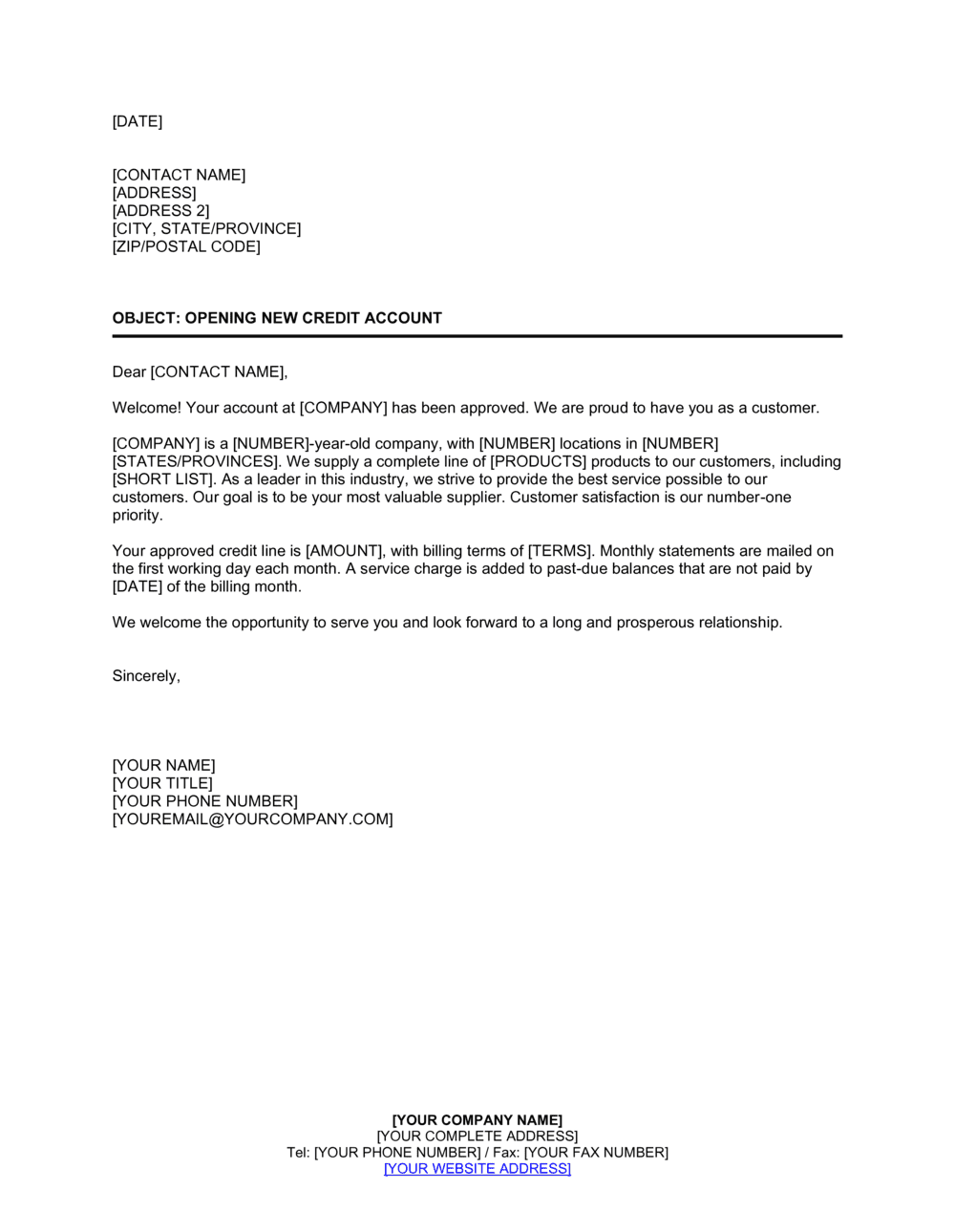
Opening New Credit Account Template

Free Word download β€’ Edit online β€’ Save & share with Drive β€’ Export to PDF

1 pageβ€’20–30 min to fillβ€’Difficulty: Standardβ€’Signature requiredβ€’Legal review recommended
Learn more ↓
FreeOpening New Credit Account Template

At a glance

What it is
An Opening New Credit Account document is a legally binding agreement between a supplier or creditor and a business customer that establishes the terms under which trade credit is extended β€” including the credit limit, payment schedule, interest on overdue balances, and personal guarantee provisions. This free Word download gives you a structured, enforceable starting point you can edit online and export as PDF to issue to new commercial customers before extending any credit.
When you need it
Use it whenever you agree to supply goods or services to a business customer on credit terms rather than requiring immediate payment. It is particularly critical for first-time customers, high-value accounts, or any buyer whose creditworthiness you have not previously verified.
What's inside
Applicant business details, credit limit, payment terms (including due dates and late-payment interest), personal or director guarantee, security interest provisions, default and collection rights, and governing law β€” all in a single signed document that creates enforceable obligations on both parties before the first delivery is made.

What is an Opening New Credit Account?

An Opening New Credit Account document is a legally binding agreement between a supplier or creditor and a business customer that formally establishes the terms under which trade credit is extended. It sets out the approved credit limit, payment due dates, the interest rate charged on overdue balances, personal guarantee obligations, any security interest granted over the customer's assets, and the creditor's rights upon default β€” including acceleration of all outstanding balances and recovery of collection costs. Unlike an informal arrangement confirmed only by email or a verbal understanding, a properly executed credit account agreement creates enforceable obligations on both sides before the first invoice is raised, giving the creditor a clear legal basis to act quickly if the account falls behind.

Why You Need This Document

Extending trade credit without a signed agreement is one of the most common β€” and costly β€” mistakes in commercial operations. Without it, you have no documented credit limit to prevent a customer from running up an unmanageable balance, no contractual interest rate to compensate for late payment, and no personal guarantee to pursue if the business entity has no recoverable assets. When a customer becomes insolvent, unsecured creditors with no signed agreement typically recover cents on the dollar β€” or nothing. A signed credit account agreement with a perfected security interest, by contrast, gives you priority over later creditors and a direct claim against the guarantor's personal assets. This template provides the complete legal framework to protect your receivables from the moment you open a new account, without requiring you to draft from scratch.

Which variant fits your situation?

If your situation is…Use this template
Extending credit to an individual consumer rather than a businessConsumer Credit Agreement
Providing a revolving line of credit with variable draw-downLine of Credit Agreement
Securing a personal director or owner guarantee for business creditPersonal Guarantee Agreement
Lending a fixed sum repayable in instalmentsLoan Agreement
Selling goods on deferred payment terms with retention of titleSales Agreement with Deferred Payment
Recovering an overdue credit balance formallyDemand Letter for Payment
Collecting on a dishonoured cheque or failed paymentReturned Check Notice

Common mistakes to avoid

❌ Extending credit before the agreement is signed

Why it matters: Delivering goods or services before the credit account agreement is executed means any subsequent signature lacks consideration in common-law jurisdictions, potentially voiding restrictive terms like the personal guarantee and security interest.

Fix: Implement a hard system rule: no first delivery until the signed agreement and guarantee are on file. Issue a proforma invoice for the first order while waiting for execution.

❌ Using a trade name instead of the registered legal entity

Why it matters: If the account holder defaults and you sue 'Acme Trading' when the registered entity is 'Acme Trading Solutions LLC,' the judgment is against a non-existent entity and uncollectable.

Fix: Verify the exact registered name through a corporate registry search and match it precisely on the agreement β€” including 'Inc.', 'LLC', or 'Ltd.' as registered.

❌ Failing to file the financing statement after taking a security interest

Why it matters: A security interest that is granted in the agreement but never perfected through a UCC-1 or PPSA filing is subordinate to a bankruptcy trustee and to later-perfected creditors β€” making it worthless in the event of insolvency.

Fix: File the financing statement within five business days of signing. Add a calendar reminder at the filing expiry date (5 years in most US states) to file a continuation statement.

❌ Setting an interest rate above the applicable usury cap

Why it matters: Courts in several US states and Canadian provinces will reduce or void an interest clause that exceeds the statutory maximum β€” and in some jurisdictions the creditor also forfeits all accrued interest.

Fix: Confirm the usury limit for the governing jurisdiction before drafting the agreement. In most US states, commercial rates up to 18–24% per annum are permissible, but check state-specific rules.

❌ Omitting default triggers other than non-payment

Why it matters: An account holder that files for bankruptcy or is sold to a competitor can continue drawing on the credit line if the only default trigger is a missed payment β€” by which point recovery is far more difficult.

Fix: Include insolvency, change of control, dissolution, and material adverse change as default events alongside payment failure, and add an acceleration clause that matures all balances immediately on any default.

❌ No attorney-fees or collection-costs clause

Why it matters: Without this provision, recovering a $3,000 overdue balance through a collection agency or small claims court may cost more in fees than the balance itself β€” making formal enforcement economically irrational.

Fix: Include a clause making the account holder liable for all reasonable collection costs, attorney fees, and court filing fees incurred by the creditor in enforcing the agreement.

The 9 key clauses, explained

Applicant and creditor identification

In plain language: Identifies both parties by their full legal entity names, registered addresses, and principal contacts β€” establishing who is bound by the agreement.

Sample language
This Credit Account Agreement is entered into between [CREDITOR LEGAL NAME], a [STATE/PROVINCE] [ENTITY TYPE] ('Creditor'), and [APPLICANT BUSINESS LEGAL NAME], a [STATE/PROVINCE] [ENTITY TYPE] ('Account Holder'), effective [DATE].

Common mistake: Using a trade name instead of the registered legal entity for the applicant. If the entity name does not match court or collection records, enforcing a judgment becomes significantly harder.

Credit limit and account terms

In plain language: States the maximum credit line approved, the currency, and whether the limit is subject to periodic review by the creditor.

Sample language
Creditor hereby establishes a credit account for Account Holder with an initial credit limit of $[AMOUNT] [CURRENCY]. Creditor reserves the right to review and adjust this limit on [ANNUAL / QUARTERLY] basis or at any time upon [X] days written notice.

Common mistake: Setting a credit limit without a review clause. As customer volume grows, an uncapped review obligation can lock the creditor into a limit that no longer reflects current risk.

Payment terms and due dates

In plain language: Defines when invoices must be paid, the accepted payment methods, and any early-payment discount available to the account holder.

Sample language
All invoices are due and payable [NET 30 / NET 60] days from the invoice date. Payment shall be made by [ACCEPTED METHODS]. Invoices paid within [X] days qualify for an early payment discount of [X]%.

Common mistake: Leaving payment terms as 'due upon receipt' rather than specifying a fixed number of days. Ambiguous terms are interpreted inconsistently by AP departments and are harder to enforce in collection proceedings.

Late payment interest and fees

In plain language: Specifies the interest rate charged on overdue balances and any flat collection or administration fee triggered by late payment.

Sample language
Balances not paid by the due date shall accrue interest at the rate of [X]% per month ([Y]% per annum) from the due date until paid in full. A late payment administration fee of $[AMOUNT] will be applied to any invoice outstanding more than [X] days.

Common mistake: Setting an interest rate that exceeds the applicable usury limit for the governing jurisdiction. Rates above the statutory cap may be reduced by a court, and in some jurisdictions the entire interest clause is voided.

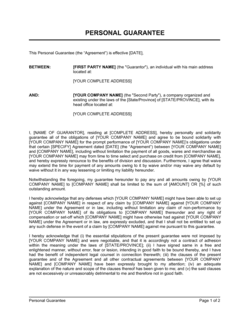
Personal or director guarantee

In plain language: Requires an owner, director, or officer of the applicant business to personally guarantee repayment of all amounts owed under the account.

Sample language
As a condition of account approval, [GUARANTOR FULL NAME], [TITLE], personally and unconditionally guarantees payment of all amounts owing under this Agreement if Account Holder fails to pay. This guarantee is a continuing obligation and shall not be released by any amendment to account terms.

Common mistake: Making the guarantee conditional or limited to a specific invoice. Courts have upheld challenges to guarantees that were not clearly unconditional β€” use 'unconditional and irrevocable' language and have the guarantor sign separately.

Security interest

In plain language: Grants the creditor a security interest in the account holder's assets β€” typically inventory or receivables β€” and authorizes filing a financing statement to perfect that interest.

Sample language
Account Holder hereby grants Creditor a security interest in all present and after-acquired [INVENTORY / RECEIVABLES / ASSETS] as collateral for all amounts owing. Account Holder authorizes Creditor to file a UCC-1 financing statement [or PPSA financing statement] to perfect this interest.

Common mistake: Granting a security interest but failing to file the required financing statement. An unperfected security interest is subordinate to a trustee in bankruptcy and to other creditors who have perfected β€” leaving the creditor effectively unsecured.

Default and acceleration

In plain language: Defines the events that constitute default β€” missed payment, insolvency, change of ownership β€” and confirms that all outstanding balances become immediately due upon default.

Sample language
Account Holder shall be in default upon: (a) failure to pay any invoice within [X] days of the due date; (b) insolvency, assignment for benefit of creditors, or commencement of bankruptcy proceedings; or (c) material change in ownership or control without prior written consent. Upon default, all outstanding balances shall become immediately due and payable.

Common mistake: Listing only missed payment as a default trigger. Insolvency proceedings can freeze collection rights β€” including a cross-default on change of ownership gives the creditor earlier warning and more remedies.

Collection costs and attorney fees

In plain language: Entitles the creditor to recover reasonable collection costs, court filing fees, and attorney fees incurred in enforcing the agreement.

Sample language
In the event Creditor is required to engage a collection agency or legal counsel to enforce this Agreement, Account Holder shall be liable for all reasonable collection costs, court costs, and attorney fees actually incurred.

Common mistake: Omitting an attorney-fees clause entirely. Without it, the creditor bears all enforcement costs even when they prevail β€” materially reducing the economic value of collection action on smaller balances.

Governing law and dispute resolution

In plain language: Specifies which jurisdiction's law governs the agreement and how disputes are resolved β€” typically the creditor's home jurisdiction to control venue and reduce travel costs.

Sample language
This Agreement is governed by the laws of [STATE / PROVINCE / COUNTRY]. Any dispute arising under this Agreement shall be resolved in the courts of [CITY / COUNTY / JURISDICTION], and Account Holder irrevocably submits to the exclusive jurisdiction of those courts.

Common mistake: Choosing a governing jurisdiction with no connection to either party. Courts have declined to enforce forum-selection clauses that bear no reasonable relationship to the transaction β€” particularly against smaller business defendants.

How to fill it out

  1. 1

    Collect and verify the applicant's business details

    Enter the applicant's full registered legal name, business address, entity type, registration or EIN number, and principal contact. Cross-reference a government business registry to confirm the entity name is accurate.

    πŸ’‘ Request a copy of the applicant's certificate of incorporation or articles of organization β€” it confirms legal name spelling and the jurisdiction of registration in one document.

  2. 2

    Set the credit limit and review schedule

    Enter the approved credit limit in the account currency. Specify whether the limit is subject to annual review, or whether you reserve the right to adjust it with written notice.

    πŸ’‘ Start new accounts at 50–60% of the limit the customer requested. Increase it after three to six months of on-time payment history rather than extending maximum credit upfront.

  3. 3

    Define payment terms and due dates

    Select Net 30, Net 45, or Net 60 and confirm the acceptable payment methods β€” bank transfer, cheque, or online portal. Include an early-payment discount if your cash flow supports it.

    πŸ’‘ Aligning your credit terms to your own supplier payment cycle avoids creating a gap between when you pay out and when you collect in.

  4. 4

    Enter the late payment interest rate

    Insert the monthly interest rate on overdue balances and any flat administration fee. Confirm the rate does not exceed the usury cap in the governing jurisdiction before finalizing.

    πŸ’‘ 1.5% per month (18% per annum) is a common market rate in North America β€” high enough to incentivize payment, low enough to withstand legal challenge in most states and provinces.

  5. 5

    Complete the personal guarantee block

    Enter the guarantor's full legal name, title, and address. Have the guarantor sign the guarantee block separately from the main agreement signature line to create a clear, standalone obligation.

    πŸ’‘ Require a copy of the guarantor's government-issued photo ID at signing β€” it prevents later claims of mistaken identity and confirms the person signing has authority.

  6. 6

    Decide whether to take a security interest

    For higher-risk accounts or larger credit limits, check the security interest box and specify the collateral description β€” typically 'all present and after-acquired inventory and receivables.' Plan to file a UCC-1 or PPSA financing statement within 5 business days of signing.

    πŸ’‘ Security interests are particularly valuable in industries with high inventory value β€” construction supply, wholesale food, and equipment distribution β€” where the collateral has immediate resale value.

  7. 7

    Confirm the governing law and venue

    Enter your home state, province, or country as the governing jurisdiction and specify the city or county for any court proceedings. Confirm the choice is legally valid for the customer's location.

    πŸ’‘ If the customer is in a different country, consider whether your jurisdiction's court judgments are enforceable there before relying on a domestic forum-selection clause.

  8. 8

    Execute before the first order is shipped

    Obtain signatures from an authorized representative of the applicant and the guarantor before any goods are delivered or credit is extended. File the financing statement the same day if a security interest is included.

    πŸ’‘ Use a countersignature workflow β€” have the applicant sign first, then your authorized signatory β€” so the execution date is unambiguous and post-dated signatures cannot be claimed.

Frequently asked questions

What is an opening new credit account agreement?

An opening new credit account agreement is a legally binding document between a supplier or creditor and a business customer that establishes the formal terms under which trade credit is extended. It sets the credit limit, payment due dates, interest on overdue balances, personal guarantee requirements, and the creditor's enforcement rights if the account is not paid. It functions as both a credit application and the governing contract for the entire credit relationship.

When should a business require customers to sign a credit account agreement?

Any time you supply goods or services on deferred payment terms rather than collecting immediately, you should have a signed credit account agreement in place before the first delivery. This is especially important for first-time customers, high-value orders, customers in different jurisdictions, and any account where the outstanding balance at any point could materially affect your cash flow or solvency.

Is a personal guarantee legally required for a business credit account?

A personal guarantee is not legally required, but it is strongly advisable for small or new businesses where the entity has limited assets or a short credit history. Without a guarantee, your only recourse on default is against the business entity β€” which may have no recoverable assets. A personal guarantee from the owner or a director gives you a second line of recovery and significantly increases the likelihood of voluntary payment.

What credit limit should I set for a new account?

A common approach is to start at 50–60% of what the customer requests and increase the limit after three to six months of on-time payment history. The limit should also be calibrated against the customer's disclosed revenue and the value of any security interest you hold. Building in an annual review clause allows you to adjust limits without amending the underlying agreement.

What happens if the account holder defaults?

Under a well-drafted credit account agreement, default triggers several remedies simultaneously: all outstanding balances accelerate and become immediately due, late-payment interest begins accruing, and you can enforce any security interest or call on the personal guarantee. You can also engage a collection agency or commence legal action and recover costs from the account holder if you included an attorney-fees clause.

Do I need to file a UCC-1 financing statement for every credit account?

You only need to file a UCC-1 (or PPSA financing statement in Canada) if you have taken a security interest in the account holder's assets. Filing is what makes the security interest 'perfected' β€” meaning it is enforceable against third parties and a bankruptcy trustee. Without filing, the security interest exists between the parties but is effectively worthless if the customer becomes insolvent and other creditors are ahead of you in priority.

What is the difference between a credit account agreement and a loan agreement?

A credit account agreement governs an ongoing commercial trade relationship β€” the customer places orders on account, invoices accumulate, and balances are cleared periodically. A loan agreement involves a discrete disbursement of a fixed sum that is repaid in scheduled instalments with interest. Trade credit is typically short-term and interest-free if paid on time; a loan has a fixed term and accrues interest from day one.

Can I change the credit limit or terms after the agreement is signed?

Yes, provided the original agreement includes a clause reserving your right to adjust the credit limit and terms with written notice β€” typically 14 to 30 days. Without that clause, unilateral changes to the agreed terms may require the account holder's written consent or a formal amendment to avoid claims of breach of contract.

What law governs a credit account agreement?

The agreement should specify the governing jurisdiction β€” typically the creditor's home state, province, or country. In the US, the Uniform Commercial Code (Article 9) governs security interests; in Canada the Personal Property Security Act applies provincially. Consumer credit regulations such as the Truth in Lending Act apply only where the account holder is an individual consumer, not a business entity. Always confirm the chosen governing law is enforceable for the account holder's location before using the agreement.

How this compares to alternatives

vs Loan Agreement

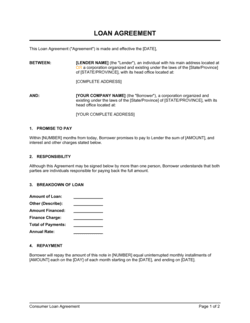
A loan agreement governs a single, fixed disbursement repaid in scheduled instalments with interest from day one. A credit account agreement governs a revolving trade relationship β€” invoices accumulate and are cleared periodically, with no interest if paid on time. Use a loan agreement for capital financing; use a credit account agreement for ongoing supply relationships.

vs Personal Guarantee

A standalone personal guarantee is a separate document where a director or owner personally guarantees another party's obligations. A credit account agreement typically includes a guarantee block within the same document. Use a standalone guarantee when the underlying credit agreement already exists or when the guarantor is not party to the main contract.

vs Sales Agreement

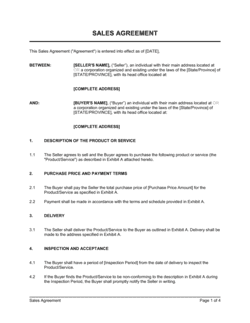
A sales agreement governs the terms of a single or defined series of transactions β€” price, delivery, title, and warranties. A credit account agreement governs the financial relationship across all future transactions on account. You may need both: the sales agreement for transaction-specific terms and the credit account agreement for the payment and enforcement framework.

vs Line of Credit Agreement

A line of credit agreement is a financial instrument allowing the borrower to draw funds up to a limit and repay them β€” typically used by lenders and banks. A credit account agreement is a trade credit instrument between a supplier and a commercial customer for goods and services, not cash. The line of credit is a lending product; the credit account is a supply relationship tool.

Industry-specific considerations

Wholesale and distribution

High transaction volumes and recurring orders make a formal credit account essential for managing aggregate exposure and securing priority over inventory collateral.

Construction and building supply

Contractors frequently require materials on account across multiple projects; credit limits tied to project values and retention of title clauses protect suppliers against contractor insolvency.

Manufacturing

Long production lead times mean credit balances accumulate before delivery; security interests over finished goods or raw materials provide meaningful collateral against default.

Professional services

Firms billing corporate clients on monthly retainer use credit account agreements to formalize payment terms and late-interest rights in lieu of traditional trade credit structures.

Jurisdictional notes

United States

UCC Article 9 governs security interests in personal property β€” a UCC-1 financing statement must be filed with the Secretary of State in the debtor's jurisdiction to perfect a security interest. Usury limits on commercial credit vary by state: most states permit 18–24% per annum, but some (including New York for certain transactions) have stricter caps. Personal guarantees are generally enforceable under state contract law, though some states require specific anti-waiver disclosures.

Canada

Each province has its own Personal Property Security Act (PPSA) governing security interests β€” a financing statement must be registered in the province where the debtor carries on business. Quebec uses a different system under the Civil Code, requiring registration in the Register of Personal and Movable Real Rights (RPMRR). Interest rates on commercial credit are not subject to a specific provincial cap but must not exceed the federal criminal interest rate of 60% per annum under the Criminal Code. French-language requirements apply to consumer contracts in Quebec but generally not to B2B commercial agreements.

United Kingdom

Trade credit between businesses is governed by the Late Payment of Commercial Debts (Interest) Act 1998, which implies an 8% over Bank of England base rate interest right on overdue B2B invoices if no contractual rate is specified β€” making it sensible to set a higher contractual rate. Retention of title (Romalpa) clauses are enforceable if clearly drafted and goods remain identifiable. Personal guarantees from directors are enforceable but must be clearly unconditional; ambiguous language is construed against the creditor.

European Union

The EU Late Payments Directive (Directive 2011/7/EU) requires member states to provide creditors a statutory right to at least 8% above the ECB reference rate on overdue B2B invoices, and mandates a minimum €40 flat recovery fee β€” contractual terms can exceed these minimums but not exclude them. Security interest registration regimes vary by member state: Germany uses the Handelsregister; France uses the Registre du Commerce. GDPR applies to the processing of personal data in credit application forms, particularly where personal guarantors are concerned.

Template vs lawyer β€” what fits your deal?

PathBest forCostTime
Use the templateSmall and mid-sized businesses extending standard trade credit domestically with credit limits below $50,000Free30 minutes per account
Template + legal reviewBusinesses extending credit above $50,000, taking security interests, or onboarding customers in multiple jurisdictions$300–$700 for a solicitor or commercial lawyer review2–5 business days
Custom draftedEnterprise creditors, regulated industries, international accounts, or complex security arrangements requiring PPSA or UCC priority searches$1,500–$4,000+1–3 weeks

Glossary

Trade Credit
An arrangement where a supplier allows a business customer to receive goods or services immediately and pay at a later agreed date β€” effectively a short-term interest-free loan.
Credit Limit
The maximum outstanding balance the creditor is willing to carry for the account at any one time.
Net 30 / Net 60
Payment terms requiring the full invoice balance to be paid within 30 or 60 days of the invoice date.
Personal Guarantee
A commitment by a business owner or director to personally repay the credit account balance if the business entity fails to pay.
Default
Failure by the account holder to meet a payment obligation by the due date, triggering the creditor's enforcement and collection rights.
Security Interest
A legal claim over specific assets of the debtor, giving the creditor priority to those assets if the account is not paid β€” governed by the UCC in the US and PPSA in Canada.
Late Payment Interest
An agreed percentage charge applied to overdue balances, calculated from the payment due date until full settlement.
Credit Application
The section of the agreement where the applicant discloses business details, banking references, and trade references to support the creditor's credit assessment.
Retention of Title
A clause allowing the supplier to retain legal ownership of delivered goods until full payment is received β€” also called a Romalpa clause in the UK.
Acceleration Clause
A provision making the entire outstanding credit balance immediately due and payable upon the occurrence of a specified default event.
Accounts Receivable
Money owed to a business by its customers for goods or services delivered on credit β€” the creditor's side of a trade credit relationship.

Part of your Business Operating System

This document is one of 3,000+ business & legal templates included in Business in a Box.

  • Fill-in-the-blanks β€” ready in minutes
  • 100% customizable Word document
  • Compatible with all office suites
  • Export to PDF and share electronically

Create your document in 3 simple steps.

From template to signed document β€” all inside one Business Operating System.
1
Download or open template

Access over 3,000+ business and legal templates for any business task, project or initiative.

2
Edit and fill in the blanks with AI

Customize your ready-made business document template and save it in the cloud.

3
Save, Share, Send, Sign

Share your files and folders with your team. Create a space of seamless collaboration.

Save time, save money, and create top-quality documents.

β˜…β˜…β˜…β˜…β˜…

"Fantastic value! I'm not sure how I'd do without it. It's worth its weight in gold and paid back for itself many times."

Managing Director Β· Mall Farm
Robert Whalley
Managing Director, Mall Farm Proprietary Limited
β˜…β˜…β˜…β˜…β˜…

"I have been using Business in a Box for years. It has been the most useful source of templates I have encountered. I recommend it to anyone."

Business Owner Β· 4+ years
Dr Michael John Freestone
Business Owner
β˜…β˜…β˜…β˜…β˜…

"It has been a life saver so many times I have lost count. Business in a Box has saved me so much time and as you know, time is money."

Owner Β· Upstate Web
David G. Moore Jr.
Owner, Upstate Web

Run your business with a system β€” not scattered tools

Stop downloading documents. Start operating with clarity. Business in a Box gives you the Business Operating System used by over 250,000 companies worldwide to structure, run, and grow their business.

Start freeΒ Β·Β No credit card required