Company Credit Account Denial Template

Free Word download • Edit online • Save & share with Drive • Export to PDF

1 page20–30 min to fillDifficulty: StandardSignature requiredLegal review recommended
Learn more ↓
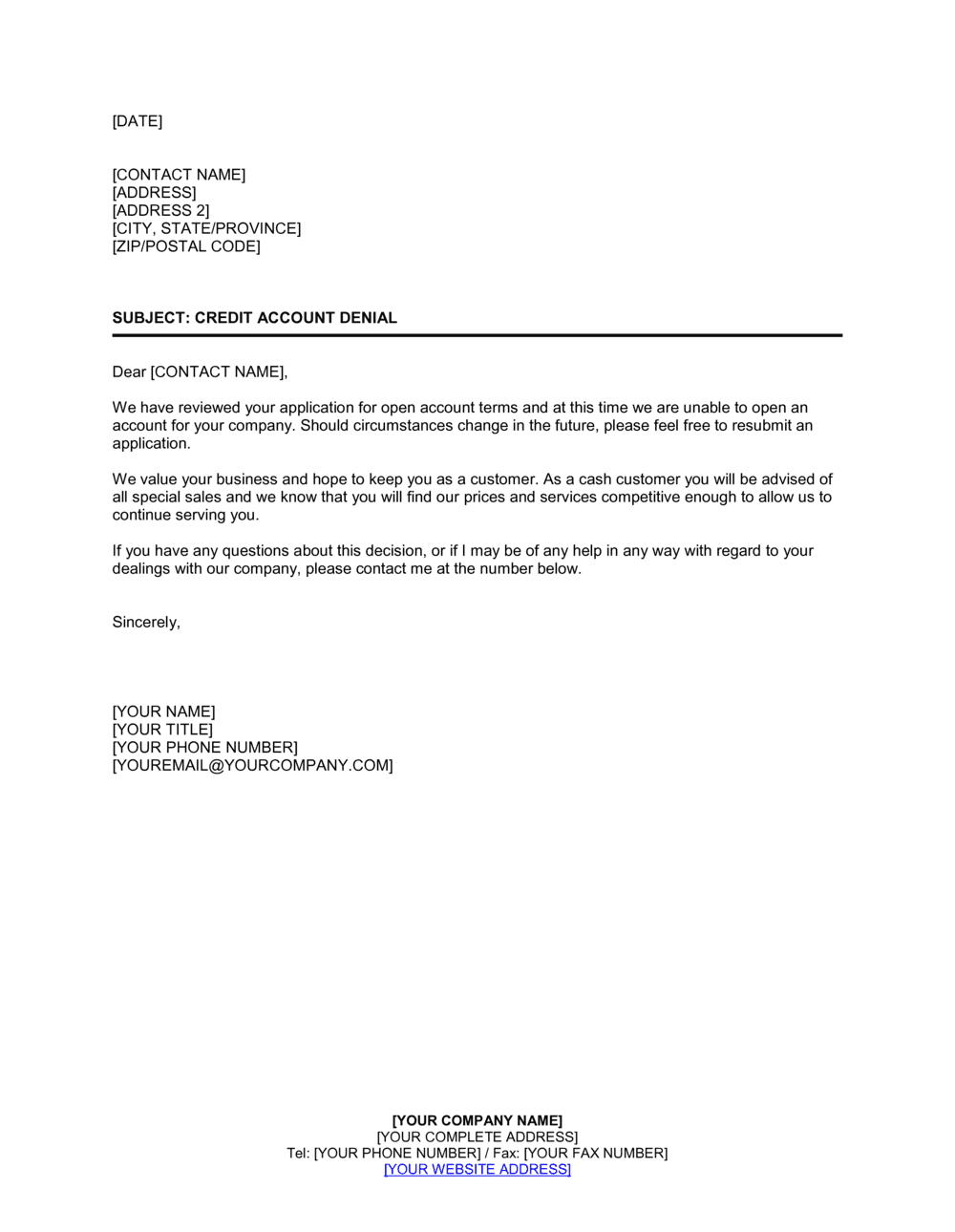
FreeCompany Credit Account Denial Template

At a glance

What it is
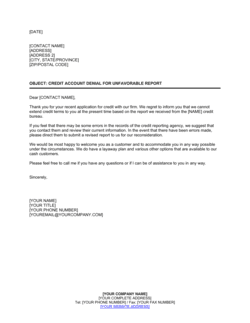
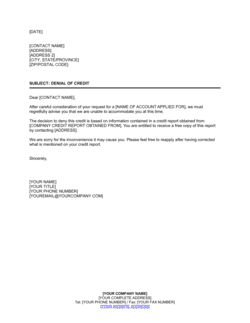
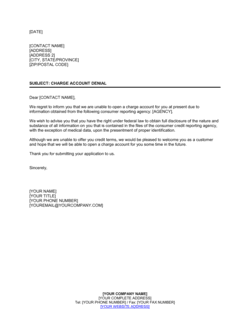
A Company Credit Account Denial is a formal written notice a creditor sends to a business applicant informing them that their application for a commercial credit account has been declined. This free Word download gives you a compliant, professionally structured letter you can edit online and export as PDF — covering the denial decision, specific reasons, applicable regulatory notices, and any right to request additional information.
When you need it
Use it any time you review a commercial credit application and decide not to extend a credit line, net-terms account, or revolving trade account to an applicant. Sending a timely written denial protects your business from regulatory exposure and gives the applicant a fair, documented explanation.
What's inside
Creditor and applicant identification, application reference details, denial decision statement, specific reasons for denial, credit reporting agency disclosures where applicable, applicant rights and recourse information, and authorized signature block.

What is a Company Credit Account Denial?

A Company Credit Account Denial is a formal written notice a creditor issues to a business applicant informing them that their application for a commercial credit account — such as a net-terms trade account, open invoice line, or revolving credit facility — has been declined. The letter documents the specific reasons for the decision, identifies any credit reporting agency whose data influenced the outcome, and informs the applicant of their legal rights, including the right to request additional information and to dispute inaccurate credit data. In the United States and several other jurisdictions, sending a timely, compliant denial notice is a statutory obligation under laws such as the Equal Credit Opportunity Act and the Fair Credit Reporting Act, not simply a professional courtesy.

Why You Need This Document

Failing to issue a properly structured credit account denial exposes your business on two fronts simultaneously. Regulatorily, missing the 30-day adverse action window under ECOA or omitting the required credit reporting agency disclosure under FCRA can result in civil liability, statutory damages, and regulatory complaints — each violation handled independently. Commercially, an undocumented or vague denial creates ambiguity about whether the application was ever formally closed, leaving your credit pipeline cluttered and the applicant uncertain about their standing. A clear, dated, signed denial letter closes the application cleanly, protects your company in any dispute, and gives the applicant the transparent explanation they are legally entitled to receive. This template gives you a compliant, professionally structured starting point that covers every required disclosure element — reducing the time to issue each letter to under 15 minutes while maintaining the documentation standard your credit program requires.

Which variant fits your situation?

If your situation is…Use this template
Declining a new applicant that has never held an accountCompany Credit Account Denial (New Applicant)
Reducing or suspending an existing credit lineCredit Limit Reduction Notice
Declining a consumer credit application (not commercial)Consumer Credit Adverse Action Notice
Notifying an applicant of a counteroffer at lower credit termsCredit Account Approval with Modified Terms
Closing an existing account due to non-payment or defaultCredit Account Termination Letter
Requesting additional information before a final credit decisionCredit Application Incomplete Notice
Denying credit after a periodic review of an existing accountPeriodic Credit Review Denial Letter

Common mistakes to avoid

❌ Using vague denial reasons

Why it matters: Under ECOA and FCRA, US creditors must provide specific, documented reasons. A reason like 'does not meet credit standards' fails this requirement and exposes the creditor to a regulatory complaint or civil action.

Fix: Pull the two to four highest-weighted factors from your credit scoring worksheet and state them explicitly — for example, 'payment history with existing trade creditors shows three delinquencies in the past 12 months.'

❌ Failing to disclose the credit reporting agency

Why it matters: Omitting the required CRA disclosure when a credit report influenced the decision violates FCRA and can result in statutory damages of $100–$1,000 per violation plus attorney fees in a class action.

Fix: Include the CRA name, address, and phone number in every letter where a third-party credit report was a factor, even a minor one, in the decision.

❌ Sending the denial after the statutory deadline

Why it matters: The ECOA requires adverse action notices to be sent within 30 days of a completed credit application. Late notices — even by a few days — constitute a separate statutory violation independent of the denial itself.

Fix: Set a calendar trigger from the date the application is deemed complete. For complex commercial reviews, track the 30-day window from that date, not from the date your credit committee meets.

❌ Omitting the authorized signature

Why it matters: An unsigned or generically signed denial letter is difficult to rely on in a dispute, signals poor internal process to regulators, and in some jurisdictions may not satisfy the written-notice requirement.

Fix: Have a named, authorized credit officer sign every denial letter with their full name, title, and date. Store the signed copy in the applicant's credit file.

❌ Promising a future approval if conditions are met

Why it matters: Language like 'once you reduce your debt by 20% we will approve your account' creates an implied contractual commitment. If the applicant meets the condition and you decline again, you face a breach-of-promise claim.

Fix: Use qualified language: 'We encourage you to reapply after six months, at which time a new application will be considered under the credit policies then in effect.'

❌ Sending the denial to the wrong contact or entity

Why it matters: Addressing the letter to a trade name instead of the registered legal entity, or mailing it to the wrong address, means the statutory notice was never properly delivered — restarting the clock and creating potential liability.

Fix: Confirm the applicant's legal entity name and address against their credit application before issuing the letter. For email delivery, obtain written confirmation of the correct AP contact address.

The 10 key clauses, explained

Creditor and Applicant Identification

In plain language: Names the creditor company and the applicant business entity, including legal names, addresses, and the application or account reference number.

Sample language
[CREDITOR COMPANY NAME] ('Creditor'), located at [CREDITOR ADDRESS], has reviewed the credit account application submitted by [APPLICANT BUSINESS NAME] ('Applicant'), located at [APPLICANT ADDRESS], under Application Reference No. [APPLICATION NUMBER], dated [APPLICATION DATE].

Common mistake: Using a trade name instead of the registered legal entity name for either party. If a dispute arises, the letter may not be binding on the correct legal entity.

Denial Decision Statement

In plain language: Clearly states that the credit application has been denied, the date of the decision, and the type of credit or account that was requested.

Sample language
After careful review of the information provided, [CREDITOR COMPANY NAME] has determined that it is unable to approve the request for a [ACCOUNT TYPE] credit account. This decision was made on [DECISION DATE].

Common mistake: Using ambiguous language such as 'we are unable to proceed at this time' without a definitive denial. Hedged language can imply the application remains open and delays the applicant's ability to seek credit elsewhere.

Principal Reasons for Denial

In plain language: Lists the specific, documented factors that led to the denial — typically two to four reasons drawn directly from the credit review — so the applicant understands the basis of the decision.

Sample language
The principal reason(s) for this decision are as follows: (1) [REASON, e.g., Insufficient credit history with trade references]; (2) [REASON, e.g., Excessive outstanding obligations relative to reported revenue]; (3) [REASON, e.g., Derogatory payment history reported by [CRA NAME]].

Common mistake: Listing only a single vague reason such as 'does not meet our credit standards.' Under ECOA and FCRA, US creditors must provide specific reasons; vague language exposes the creditor to regulatory complaint.

Credit Reporting Agency Disclosure

In plain language: Where the denial was based wholly or partly on information from a consumer or commercial reporting agency, identifies the agency, provides its contact details, and states that the agency did not make the credit decision.

Sample language
Our decision was based in part on information obtained from [CRA NAME], located at [CRA ADDRESS], telephone [CRA PHONE]. [CRA NAME] did not make this decision and cannot explain why it was made. You may request a free copy of your report within 60 days.

Common mistake: Omitting this disclosure when a CRA report was used. Under the FCRA, failure to provide the required CRA notice can expose the creditor to civil liability including statutory damages.

Applicant Rights and Recourse Statement

In plain language: Informs the applicant of their right to request the specific reasons for denial in writing within a defined timeframe, and any right to dispute inaccurate information in a credit report.

Sample language
You have the right to request, within 60 days of receiving this notice, a written statement of the specific reasons for this denial. You also have the right to dispute inaccurate information in any credit report used in this decision directly with [CRA NAME] at the address provided above.

Common mistake: Stating that no further information is available. Even if the creditor's internal scoring model is proprietary, the applicant is legally entitled to the principal factors that drove the decision.

Non-Discrimination Statement

In plain language: Confirms that the denial was made without regard to any protected characteristic under applicable equal credit opportunity laws.

Sample language
This decision was made without regard to race, color, religion, national origin, sex, marital status, age, or any other characteristic protected by applicable law, including the Equal Credit Opportunity Act.

Common mistake: Omitting this clause entirely. While its absence does not automatically prove discrimination, its presence creates a documented record that the correct process was followed.

Invitation to Reapply or Alternative Options

In plain language: Optional but recommended — indicates whether the applicant may reapply in the future, under what conditions, or whether alternative arrangements such as secured terms or prepayment are available.

Sample language
We encourage [APPLICANT BUSINESS NAME] to reapply after [TIME PERIOD, e.g., six months] if the conditions noted above have changed. In the meantime, we would be pleased to discuss [ALTERNATIVE, e.g., a prepaid or secured account arrangement] to facilitate your business needs.

Common mistake: Promising a specific future credit approval if the applicant addresses the stated reasons. Such language creates an implied commitment the creditor may not be able to honor.

Confidentiality of Credit Information

In plain language: Confirms that all financial information provided by the applicant was reviewed in confidence and will not be disclosed to third parties except as required by law.

Sample language
All financial and business information submitted in connection with Application No. [APPLICATION NUMBER] has been reviewed in strict confidence and will be retained in accordance with [CREDITOR COMPANY NAME]'s records retention policy and applicable law.

Common mistake: Not including this clause when the applicant submitted sensitive financial statements or tax returns. Without it, the applicant has no documented assurance of confidentiality and may have legal grounds to object to any future disclosure.

Governing Law

In plain language: Specifies the jurisdiction whose laws govern the credit relationship and the denial notice, and names the venue for any dispute.

Sample language
This notice and any credit relationship between the parties shall be governed by the laws of [STATE / PROVINCE / COUNTRY], without regard to conflict of law principles. Any dispute arising from this notice shall be resolved in the courts of [VENUE].

Common mistake: Selecting a governing law that differs from the applicant's location without understanding whether local mandatory consumer or trade protection statutes override it.

Authorized Signature and Contact Information

In plain language: Identifies the creditor representative who made or approved the credit decision, with their title and direct contact details, and provides a dated signature.

Sample language
Sincerely, [AUTHORIZED REPRESENTATIVE NAME] | [TITLE] | [CREDITOR COMPANY NAME] | [PHONE] | [EMAIL] | Date: [DATE]

Common mistake: Leaving the signature block unsigned or using a generic 'Credit Department' without a named individual. Unsigned denial letters are harder to rely on in disputes and signal a lack of proper process to regulators.

How to fill it out

  1. 1

    Enter creditor and applicant legal entity names

    Insert the full registered legal name of your company and the full legal name of the applicant business. Include mailing addresses and the original application reference number and date.

    💡 Cross-reference the applicant's name against their credit application and any corporate registry search to confirm you are addressing the correct legal entity.

  2. 2

    State the denial decision clearly and date it

    Write a direct denial sentence specifying the account type requested — for example, 'net-60 open trade account' — and the exact date the decision was made. Avoid hedged language.

    💡 The decision date should be the date your credit committee or authorized officer formally concluded the review, not the date the letter is mailed.

  3. 3

    List two to four specific denial reasons

    Identify the principal factors from your credit review — payment history, debt load, time in business, insufficient references — and number each one. Pull these directly from your credit scoring worksheet so the reasons are documentable.

    💡 Limit reasons to those that actually drove the decision. Listing every marginal factor dilutes the notice and makes it harder to defend if challenged.

  4. 4

    Complete the credit reporting agency disclosure if applicable

    If you used a report from Equifax, Experian, Dun & Bradstreet, or any other CRA, enter the agency's name, address, and phone number. Confirm the disclosure states that the CRA did not make the decision.

    💡 Even if the CRA report was only one of several inputs, you are required to disclose it in the US. When in doubt, include the disclosure.

  5. 5

    Add the applicant's rights statement

    Confirm the applicant's right to request the specific reasons for denial in writing within 60 days, and their right to dispute inaccurate CRA data. Customize the timeframe if your jurisdiction requires a different window.

    💡 In Canada and the UK, the applicable disclosure rights differ — review the jurisdictional notes below before finalizing this clause.

  6. 6

    Include the non-discrimination statement

    Insert the standard ECOA non-discrimination language or its equivalent under the governing law. This clause should appear in every denial letter regardless of the applicant's characteristics.

    💡 Keep this clause verbatim and unedited. Paraphrasing it can inadvertently omit a protected class and create regulatory exposure.

  7. 7

    Add reapplication or alternative options if appropriate

    If you are open to the applicant reapplying after a defined period or want to offer a secured account alternative, include that language. If you are not, omit this clause rather than leaving a blank placeholder.

    💡 Only include a reapplication invitation if your credit policy genuinely supports it. An empty invitation followed by a second denial generates complaints.

  8. 8

    Sign, date, and retain a copy

    Have an authorized credit officer sign the letter with their full name and title. Send it via a delivery method that creates a record — certified mail or email with read receipt — and file the signed copy with the application.

    💡 Many regulatory timelines for adverse action notices run from the date of application completion, not the date of mailing. Confirm your jurisdiction's deadline before sending.

Frequently asked questions

What is a company credit account denial letter?

A company credit account denial letter is a formal written notice a creditor sends to a business applicant explaining that their application for a commercial credit account — such as a net-terms trade account or revolving line of credit — has been declined. It documents the specific reasons for the denial, discloses any credit reporting agency used, and informs the applicant of their legal rights. In many jurisdictions, sending this letter within a defined timeframe is a statutory requirement, not merely a courtesy.

Is a credit account denial letter legally required?

In the United States, the Equal Credit Opportunity Act requires creditors to notify applicants of adverse actions within 30 days of a completed application and to provide specific reasons for the denial. The Fair Credit Reporting Act adds a separate obligation to disclose any consumer reporting agency whose report influenced the decision. Similar requirements exist in Canada, the UK, and the EU. Failing to send a timely, compliant denial letter can expose a creditor to regulatory penalties and civil claims.

What reasons can a company give for denying credit?

Legitimate reasons include insufficient credit history or trade references, excessive existing debt relative to reported revenue, derogatory payment history with other creditors, insufficient time in business, inability to verify identity or business registration, and incomplete application information. Under ECOA, creditors may not cite protected characteristics such as race, sex, national origin, or marital status — even indirectly through proxy factors. The stated reasons must reflect the actual factors that drove the decision and must be specific enough for the applicant to understand and, if appropriate, challenge them.

Does the ECOA apply to commercial credit applications?

ECOA applies to all extensions of credit, including commercial credit, but its notification requirements for businesses differ from those for individual consumers. When a business has gross revenues of more than $1 million in its preceding fiscal year, the creditor is exempt from providing a statement of reasons if the applicant is notified of its right to request them. For smaller businesses, full adverse action notice requirements generally apply. Consider consulting a lawyer to confirm the correct obligations for your specific applicant profile.

What is the difference between a credit denial and a counteroffer?

A denial means the creditor is declining to extend credit on the terms applied for. A counteroffer means the creditor is willing to extend credit but under different terms — for example, a lower credit limit, a shorter payment window, or a requirement for a personal guarantee. Under ECOA, a counteroffer that the applicant does not accept is treated as a denial, triggering the same adverse action notice obligations. Use a separate Credit Account Approval with Modified Terms template when making a counteroffer.

How long must a creditor keep denial letters on file?

Under ECOA, creditors must retain records of credit applications and adverse action notices for at least 12 months for business credit, and 25 months for individual credit applications. Some states impose longer retention periods. Best practice is to retain the signed denial letter, the original application, and the credit scoring worksheet together in the applicant's file for at least three years to support any regulatory examination or civil dispute.

Can a denied applicant challenge the credit decision?

Yes. An applicant can request a written statement of specific reasons within 60 days of receiving the denial notice, dispute inaccurate information in any credit report used, and file a complaint with the Consumer Financial Protection Bureau or equivalent regulator if they believe the denial involved discrimination. The denial letter itself does not legally bind the creditor to permanently refuse credit — the applicant may reapply at a later date under new circumstances. However, the creditor is not obligated to reverse the decision absent new information.

Do I need a lawyer to send a credit denial letter?

For routine commercial credit denials where your company has a documented credit policy and scoring criteria, a well-drafted template reviewed by your compliance team is generally sufficient. Engage a lawyer when the applicant is a high-value relationship, when the denial involves a protected characteristic that could be contested, when you operate across multiple jurisdictions with differing requirements, or when you receive a dispute or regulatory inquiry following the denial.

What happens if the denial letter contains an error?

An error in the denial letter — wrong entity name, incorrect reason, missing CRA disclosure — does not automatically void the denial decision, but it does create regulatory and legal exposure. If discovered before sending, correct and reissue. If discovered after sending, issue a corrected notice promptly, document the error and correction in the applicant's file, and consider notifying your legal counsel. Errors that affect a protected class or omit a required FCRA disclosure are the most serious and warrant immediate legal review.

How this compares to alternatives

vs Credit Account Approval Letter

A credit account approval letter grants the requested credit line and states the approved limit, terms, and any conditions. A denial letter declines the application and triggers statutory disclosure obligations. Both should reference the same application number and be issued within the same statutory timeframe. Use the approval template when the applicant meets your creditworthiness criteria; use the denial template when they do not.

vs Credit Account Termination Letter

A termination letter closes an existing account — typically due to non-payment, default, or a material change in the account holder's financial condition. A denial letter declines a new application before any account is opened. The adverse action notice requirements under ECOA also apply to account terminations and credit line reductions, so the two letters share similar disclosure obligations but serve different stages of the credit relationship.

vs Demand for Payment Letter

A demand for payment letter addresses an existing debt owed by a current or former customer — it is a collections tool, not a credit decision notice. A denial letter is issued before any credit relationship begins and contains regulatory disclosures that a demand letter does not. Confusing the two risks missing the adverse action deadline or sending legally required disclosures to a party who already has an account.

vs Credit Limit Reduction Notice

A credit limit reduction notice modifies the terms of an existing approved account and is also classified as an adverse action under ECOA, requiring similar reason-stating and CRA disclosure obligations. A denial letter addresses a first-time application or re-application. Use the reduction notice for existing account holders whose creditworthiness has deteriorated; use the denial letter for new applicants who do not qualify.

Industry-specific considerations

Wholesale Distribution

Wholesalers routinely extend net-terms accounts to retail buyers and need compliant denial letters when applicants fail trade reference checks or Dun & Bradstreet PAYDEX thresholds.

Manufacturing

Manufacturers extending open-account terms to distributors or OEM customers use credit denial letters when new customer revenue projections do not support the credit risk, particularly for high-ticket orders.

Financial Services

Banks, credit unions, and commercial lenders face the strictest regulatory scrutiny on adverse action notices and must satisfy both ECOA and FCRA disclosure requirements with precise, documented reasons.

Professional Services

Law firms, accounting practices, and consulting firms that offer billing accounts to corporate clients use denial letters to manage credit exposure on retainer or milestone-billing arrangements.

Jurisdictional notes

United States

The Equal Credit Opportunity Act (ECOA) and Regulation B require creditors to notify applicants of adverse actions within 30 days of a completed application and to provide specific reasons. The Fair Credit Reporting Act (FCRA) requires a separate disclosure identifying any consumer reporting agency used. Businesses with gross revenues over $1 million may be exempt from automatically providing reasons, but must notify the applicant of their right to request them. State laws — particularly in California and New York — may impose additional obligations.

Canada

Federal and provincial privacy legislation, including PIPEDA and provincial equivalents, governs how applicant credit information is collected and used. While Canada does not have a direct equivalent to ECOA's adverse action notice requirements for commercial credit, creditors must handle personal information in accordance with consent obligations and provide access to information held about the applicant on request. Quebec's Law 25 imposes stricter privacy and transparency requirements for any business collecting personal data from Quebec-based applicants.

United Kingdom

The Consumer Credit Act 1974 applies to consumer credit but not to most business-to-business credit arrangements. For commercial credit, the primary obligations arise under UK GDPR and the Data Protection Act 2018, which require transparency about how credit decisions are made and grant applicants the right to request human review of any automated decision. The Equality Act 2010 prohibits denial on the basis of protected characteristics. Business applicants denied credit have a right under UK GDPR to access the personal data used in the decision.

European Union

GDPR Article 22 grants individuals — and, depending on member state implementation, businesses that are sole traders — the right not to be subject to solely automated credit decisions without human review, and the right to an explanation of the logic involved. The EU's Anti-Discrimination Directives prohibit denial on protected grounds. Member states vary on commercial credit-specific notification requirements: Germany and France have additional transparency obligations under local consumer and commercial codes that may apply to small business applicants.

Template vs lawyer — what fits your deal?

PathBest forCostTime
Use the templateBusinesses with a documented credit policy issuing routine commercial credit denials to small or mid-market applicantsFree10–15 minutes per letter
Template + legal reviewCompanies establishing a credit program for the first time, or those operating across multiple US states or international jurisdictions$200–$500 for a compliance or legal review of your template and credit policy2–5 business days
Custom draftedFinancial institutions, heavily regulated lenders, or situations involving a challenged denial, regulatory inquiry, or potential discrimination claim$500–$2,000+ depending on complexity1–2 weeks

Glossary

Adverse Action
Any denial, revocation, or unfavorable change to a credit application or existing account, triggering mandatory written notice requirements under applicable law.
Adverse Action Notice
A formal written disclosure sent to an applicant explaining the specific reasons credit was denied, as required by statutes such as the US Equal Credit Opportunity Act and Fair Credit Reporting Act.
Commercial Credit Account
A credit arrangement extended by a supplier or financial institution to a business entity, allowing purchases or services to be invoiced and paid on agreed terms rather than upfront.
Net Terms
A payment arrangement — such as Net 30 or Net 60 — where the full invoice balance is due within a specified number of days after the invoice date without a finance charge.
Credit Scoring
A quantitative assessment of a business's creditworthiness based on factors such as payment history, outstanding debt, time in business, and financial ratios.
Consumer Reporting Agency (CRA)
An organization that collects and sells credit data on individuals or businesses; major CRAs include Equifax, Experian, and Dun & Bradstreet for commercial accounts.
Principal Reasons for Denial
The specific, documented factors — such as insufficient payment history, excessive existing debt, or too little time in business — that most influenced the credit decision.
Equal Credit Opportunity Act (ECOA)
A US federal law prohibiting creditors from discriminating against credit applicants on the basis of race, color, religion, national origin, sex, marital status, age, or receipt of public assistance.
Fair Credit Reporting Act (FCRA)
A US federal law requiring creditors who take adverse action based on a consumer report to notify the applicant and identify the reporting agency that provided the information.
Creditworthiness
An assessment of a business's ability and likelihood to repay obligations based on its financial history, current liabilities, revenue, and operational stability.
Trade Credit
Credit extended by one business to another for the purchase of goods or services, typically in the form of an open account with agreed payment terms.

Part of your Business Operating System

This document is one of 3,000+ business & legal templates included in Business in a Box.

  • Fill-in-the-blanks — ready in minutes
  • 100% customizable Word document
  • Compatible with all office suites
  • Export to PDF and share electronically

Create your document in 3 simple steps.

From template to signed document — all inside one Business Operating System.
1
Download or open template

Access over 3,000+ business and legal templates for any business task, project or initiative.

2
Edit and fill in the blanks with AI

Customize your ready-made business document template and save it in the cloud.

3
Save, Share, Send, Sign

Share your files and folders with your team. Create a space of seamless collaboration.

Save time, save money, and create top-quality documents.

★★★★★

"Fantastic value! I'm not sure how I'd do without it. It's worth its weight in gold and paid back for itself many times."

Managing Director · Mall Farm
Robert Whalley
Managing Director, Mall Farm Proprietary Limited
★★★★★

"I have been using Business in a Box for years. It has been the most useful source of templates I have encountered. I recommend it to anyone."

Business Owner · 4+ years
Dr Michael John Freestone
Business Owner
★★★★★

"It has been a life saver so many times I have lost count. Business in a Box has saved me so much time and as you know, time is money."

Owner · Upstate Web
David G. Moore Jr.
Owner, Upstate Web

Run your business with a system — not scattered tools

Stop downloading documents. Start operating with clarity. Business in a Box gives you the Business Operating System used by over 250,000 companies worldwide to structure, run, and grow their business.

Free Forever Plan · No credit card required