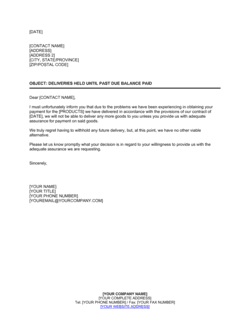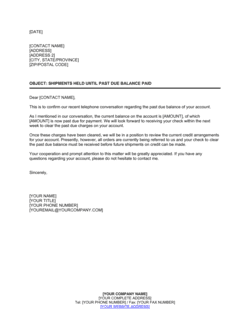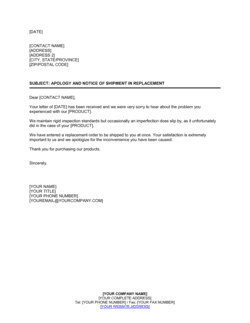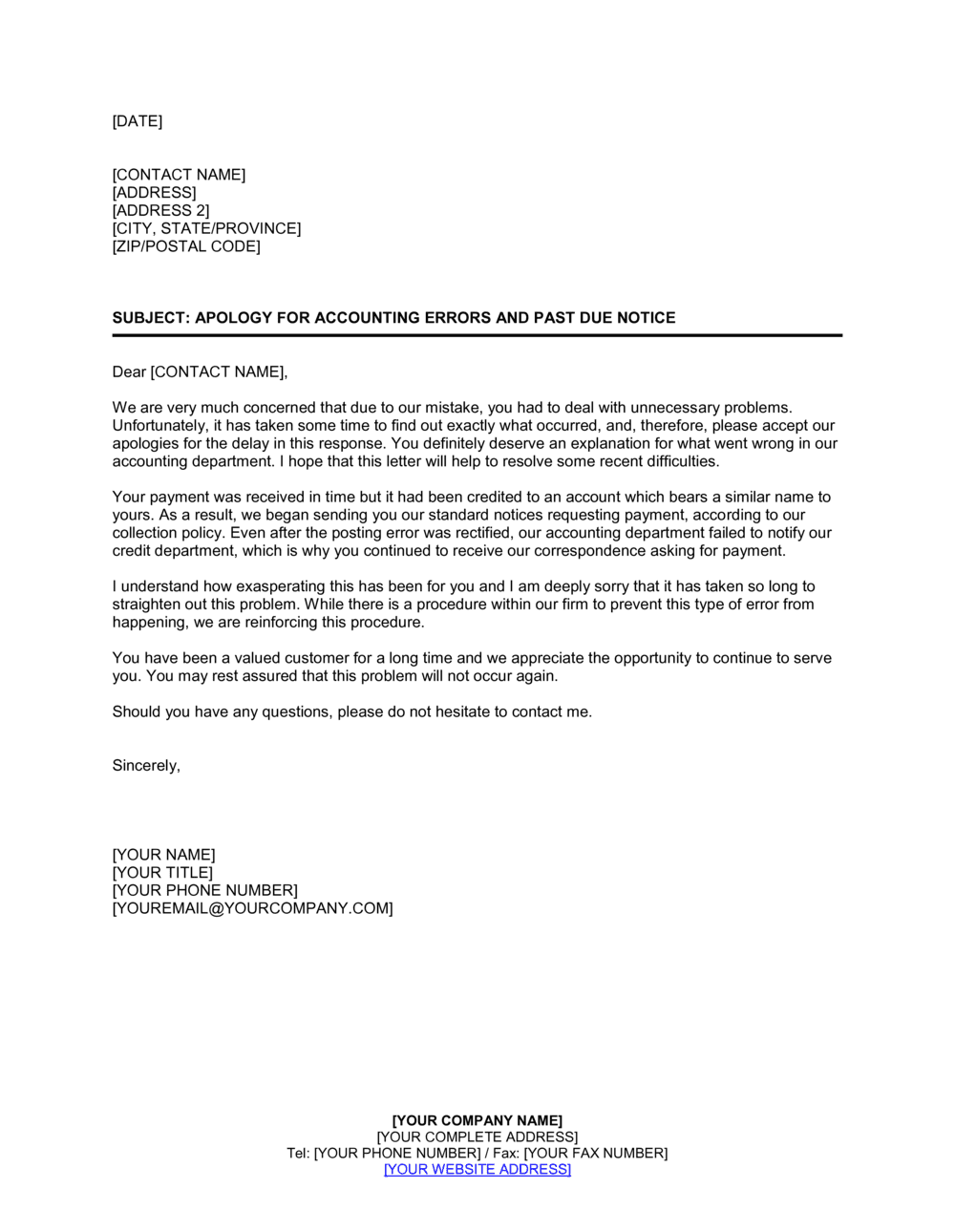
Apology for Accounting Errors and Past Due Notice Template

Free Word download β€’ Edit online β€’ Save & share with Drive β€’ Export to PDF

1 pageβ€’15–25 min to fillβ€’Difficulty: Standard
Learn more ↓
FreeApology for Accounting Errors and Past Due Notice Template

At a glance

What it is
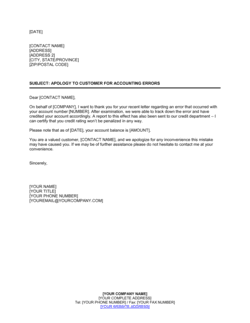
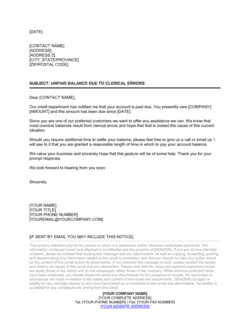
An Apology For Accounting Errors And Past Due Notice is a formal business letter a company sends to a customer or client to acknowledge a billing mistake, retract or correct an erroneous past due notice, and preserve the relationship. This free Word download is ready to edit online and export as PDF in minutes.
When you need it
Use it immediately after discovering that a past due notice was sent in error β€” due to a data entry mistake, payment misapplication, duplicate invoice, or system error β€” before the client escalates the dispute or damages the relationship further.
What's inside
A direct apology opening, a clear description of the specific error, a statement retracting or correcting the past due notice, any corrected balance or payment instructions, and a goodwill closing that reinforces the business relationship.

What is an Apology For Accounting Errors And Past Due Notice?

An Apology For Accounting Errors And Past Due Notice is a formal business letter a company sends to a client or customer to acknowledge that a past due notice was issued incorrectly β€” typically due to a payment posting error, duplicate invoice, or data entry mistake β€” and to formally retract it. The letter identifies the specific error, corrects the account balance on record, and reaffirms the client's good standing. It serves both as an internal accountability document and as a professional communication that protects the business relationship from unnecessary damage.

Why You Need This Document

Sending a past due notice to a client who has already paid is one of the fastest ways to erode trust and trigger a formal dispute. Without a written correction, clients may assume the error is ongoing, escalate to their own finance or legal teams, or β€” in the worst case β€” initiate a chargeback or stop future payments while the confusion is resolved. A prompt, specific apology letter demonstrates that your business identified the problem, corrected it in your system, and takes client relationships seriously enough to communicate clearly. This template gives you the right structure to do that in under 15 minutes, with placeholder language that ensures nothing critical β€” the retraction, the corrected balance, the direct contact β€” is accidentally left out.

Which variant fits your situation?

If your situation is…Use this template
Notifying a client of a duplicate invoice that was sent in errorCredit Note
Correcting the invoice amount after a pricing errorCorrected Invoice
Formally disputing a charge on behalf of your businessLetter of Dispute for Billing Error
Following up after an unanswered legitimate past due invoicePast Due Invoice Notice
Offering a payment arrangement after a billing disputePayment Plan Agreement
Confirming that a previously disputed payment has been receivedPayment Acknowledgment Letter
Closing out a resolved billing dispute in writingSettlement Agreement

Common mistakes to avoid

❌ Leading with the explanation instead of the apology

Why it matters: Clients who feel wrongly accused want acknowledgment first. Opening with a technical explanation before 'we're sorry' reads as defensive and escalates frustration.

Fix: Begin the first sentence with a direct apology. Move the explanation of the error to the second paragraph.
❌ Omitting the explicit retraction of the past due notice

Why it matters: Without a formal retraction, clients may still fear the notice was reported to a credit bureau or sent to collections, even if the balance is corrected.

Fix: Include a dedicated sentence that voids the specific notice by date and amount and confirms it has no effect on the client's credit or account status.

❌ Using a generic salutation instead of a named recipient

Why it matters: A form-letter greeting signals that the apology is automated rather than personal, reducing client trust exactly when you need to rebuild it.

Fix: Address the letter to the client's name and sign it from a named employee with a direct phone number and email.

❌ Leaving the corrected balance ambiguous

Why it matters: If the client cannot clearly identify the corrected amount from the letter, they will call to confirm β€” creating extra work and extending the dispute.

Fix: State the corrected balance as a specific dollar figure on its own line. If the balance is zero, write '$0.00 β€” your account is in good standing.'

The 9 key clauses, explained

Date, addressee, and salutation

In plain language: Identifies when the letter was written, who it is addressed to, and opens with a professional greeting using the recipient's name.

Sample language
[DATE] [CLIENT NAME] [CLIENT ADDRESS] Dear [MR./MS. LAST NAME],

Common mistake: Using 'To Whom It May Concern' instead of a named contact β€” this signals a form letter and undermines the sincerity of the apology.

Opening apology statement

In plain language: Immediately acknowledges the error and apologizes without hedging, setting the tone for the rest of the letter.

Sample language
We sincerely apologize for the accounting error in your account and for the past due notice you received on [DATE]. This notice was sent in error, and we take full responsibility for the inconvenience it caused.

Common mistake: Opening with a defensive explanation before the apology β€” clients read the first sentence and will disengage if it sounds like an excuse.

Description of the specific error

In plain language: Explains clearly what went wrong β€” the nature of the accounting error, when it occurred, and how it resulted in the incorrect past due notice.

Sample language
A data entry error in our billing system resulted in a payment of $[AMOUNT] received on [DATE] being applied to a different account. As a result, your account incorrectly showed an outstanding balance of $[AMOUNT].

Common mistake: Being vague about what the error was β€” phrases like 'an internal issue' without specifics make the client feel the problem is being minimized or hidden.

Retraction of the past due notice

In plain language: Formally states that the past due notice is withdrawn and has no effect on the client's account or credit standing.

Sample language
Please disregard the past due notice dated [DATE] in the amount of $[AMOUNT]. It has been voided in our system and will have no bearing on your account status.

Common mistake: Omitting an explicit retraction and relying only on the correction of the balance β€” without a formal retraction, the client may still worry about credit or collection implications.

Corrected account balance

In plain language: States the accurate current balance on the client's account after the error has been corrected, or confirms that the account is in good standing with a zero balance.

Sample language
Your corrected account balance as of [DATE] is $[CORRECTED AMOUNT / $0.00]. Your account is in good standing, and no payment is currently due.

Common mistake: Leaving out the corrected balance entirely β€” the client needs a clear number to reconcile against their own records.

Explanation of corrective action taken

In plain language: Briefly describes the internal step the company has taken to fix the error and prevent it from recurring.

Sample language
We have corrected the posting in our system and implemented an additional review step for payment applications to prevent this from occurring in the future.

Common mistake: Overpromising systemic fixes that sound unrealistic β€” vague promises like 'this will never happen again' reduce credibility.

Contact information and invitation to follow up

In plain language: Provides a direct contact β€” name, phone, and email β€” and invites the client to reach out with any questions about their account.

Sample language
If you have any questions or would like to review your account in detail, please contact [CONTACT NAME] at [PHONE NUMBER] or [EMAIL ADDRESS]. We are happy to assist.

Common mistake: Directing the client to a general inbox or main phone line instead of a named individual β€” this forces the client to re-explain the issue and signals the company isn't taking personal ownership.

Goodwill closing

In plain language: Closes with a brief expression of appreciation for the client's understanding and reaffirms the value of the relationship.

Sample language
We value your business and appreciate your patience in this matter. Thank you for giving us the opportunity to correct this error and continue serving you.

Common mistake: Ending abruptly after the correction without a closing that acknowledges the relationship β€” a bare sign-off after an error can feel dismissive.

Signature block

In plain language: Includes the sender's name, title, company name, and contact details to formally close the letter.

Sample language
Sincerely, [SENDER NAME] [TITLE] [COMPANY NAME] [PHONE] | [EMAIL]

Common mistake: Signing with only a name and no title or company β€” recipients who receive multiple correspondences may not know who sent the letter or who to contact in response.

How to fill it out

  1. 1

    Identify the exact error and gather supporting records

    Before drafting, pull the original invoice, the payment record, and the erroneous past due notice. Confirm the correct balance, the error date, and the payment amount involved.

    πŸ’‘ Having the exact dollar amounts and dates in hand before you open the template prevents vague language that weakens the apology.

  2. 2

    Address the letter to a named individual

    Enter the client's full name, title, and correct mailing or email address. Use their name in the salutation β€” 'Dear Ms. [LAST NAME]' β€” rather than a generic greeting.

    πŸ’‘ If the client has already called to complain, use the name of whoever they spoke with as the sender β€” continuity signals accountability.

  3. 3

    Write the opening apology before the explanation

    Lead with the apology in the first sentence. State that the past due notice was sent in error and that you take responsibility β€” then explain the cause in the next paragraph.

    πŸ’‘ Keep the opening apology to two sentences. Longer apology paragraphs dilute sincerity.

  4. 4

    Describe the specific error clearly

    Name the type of error β€” misapplied payment, duplicate invoice, data entry mistake β€” and state the specific date and amount involved. Avoid internal jargon or system names the client won't recognize.

    πŸ’‘ Match the language to the client's perspective: describe what they saw (an unexpected past due notice) and why it appeared.

  5. 5

    State the corrected balance and retract the notice

    Enter the accurate current balance and explicitly void the erroneous past due notice by date and amount. If the account is at zero, say so directly.

    πŸ’‘ Put the corrected balance in bold or on its own line so the client can find it at a glance without reading the full letter.

  6. 6

    Add a direct contact for follow-up

    Include the name, phone number, and email of the specific person the client should contact β€” not a general department address.

    πŸ’‘ If the client is likely to call, note your direct-line hours to avoid voicemail loops that prolong the dispute.

Frequently asked questions

What is an apology for accounting errors and past due notice?

It is a formal business letter a company sends to a customer to acknowledge that a past due notice was issued in error due to an accounting mistake β€” such as a misapplied payment, duplicate invoice, or data entry error. The letter retracts the erroneous notice, states the corrected account balance, and preserves the client relationship by taking clear responsibility.

When should I send this letter?

Send it as soon as you confirm the error β€” ideally within 24 to 48 hours of discovery. Delayed apologies allow the client to escalate the dispute, involve their own finance team, or assume bad faith. If the client has already contacted you to complain, the letter should be sent the same business day.

Does this letter need to be signed or notarized?

No. A standard business apology letter for an accounting error does not require a signature or notarization to be effective. It should, however, be signed by a named employee β€” preferably in the accounts receivable or finance department β€” to reinforce personal accountability and give the client a direct contact for follow-up.

Should I send this letter by email, mail, or both?

For most B2B situations, email is faster and sufficient. If the erroneous notice was sent by postal mail, send the correction by mail as well to match the original channel. For high-value client relationships or disputes that have already escalated, send by email for speed and follow with a printed letter for the client's file.

What should I do if the client claims the error damaged their credit?

If your company reported the balance to a credit bureau before discovering the error, contact the bureau immediately to retract the report and request written confirmation of the deletion. Include a copy of the bureau's retraction notice with your apology letter. In this situation, consider consulting a lawyer or credit reporting compliance specialist before communicating with the client about credit impact.

Can this letter be used for a billing dispute where fault is unclear?

This specific template is designed for situations where your company made a clear, verifiable error. If the dispute involves a genuinely contested amount β€” for example, the client disputes the scope of services billed β€” use a billing dispute response letter instead, which can acknowledge the concern without admitting fault before the facts are established.

How do I prevent accounting errors that trigger this kind of letter?

The most common causes are manual payment posting, mismatched invoice references, and batch-processing errors in billing software. Preventive measures include a two-person review on payment applications above a set threshold, automated matching of payment references to invoice numbers, and a reconciliation step before any past due notices are generated or sent.

Should I offer any compensation or goodwill gesture in the letter?

For minor errors with no financial impact on the client, a sincere apology and corrected record are sufficient. For errors that caused the client to take action β€” stopping a payment, contacting their own bank, or spending time disputing the notice β€” a small gesture such as a fee waiver, account credit, or extended payment terms on the next invoice is appropriate and can protect the relationship.

How this compares to alternatives

vs Past Due Invoice Notice

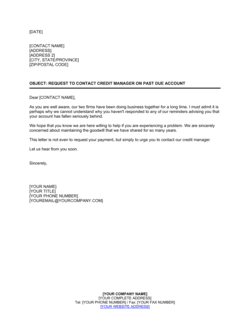
A past due invoice notice is sent when a legitimate, unpaid balance is overdue and payment is being formally requested. The apology letter is its correction β€” used when the past due notice should never have been sent. Using the wrong document in a dispute makes the situation worse.

vs Credit Note

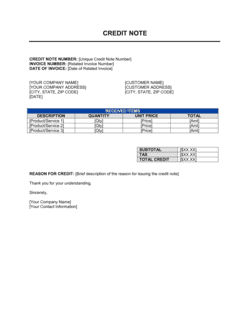
A credit note is an accounting document that formally reduces or cancels a previously issued invoice in your billing system. The apology letter is the client-facing communication explaining why the credit note was issued. Both documents are typically needed together β€” the credit note corrects the ledger; the letter preserves the relationship.

vs Billing Dispute Response Letter

A billing dispute response letter is used when a client challenges a charge and the facts are still under review β€” it acknowledges the dispute without admitting fault. The apology letter is used only after the error is confirmed and admitted. Sending an apology before the facts are verified can constitute an admission that weakens your position if the dispute escalates.

vs Payment Plan Agreement

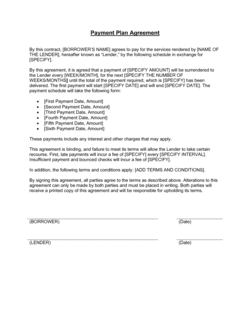
A payment plan agreement is used when a client owes a legitimate outstanding balance and needs a structured schedule to pay it down. The apology letter applies when no balance is owed at all β€” the past due notice was wrong. Sending a payment plan in response to an accounting error signals that the correction was not completed.

Industry-specific considerations

Professional Services

Law firms, consultancies, and agencies with retainer billing are prone to misapplied payments across multiple client matters, making prompt written corrections essential to maintaining trust.

Healthcare

Medical billing errors are common due to insurance coordination complexity; an apology letter accompanied by a corrected explanation of benefits protects patient relationships and reduces formal complaints.

Construction and Trades

Progress billing on multi-phase projects can result in duplicate draw requests or misapplied deposits; a correction letter tied to the specific project phase and contract milestone keeps the relationship professional.

Retail and E-commerce

Subscription billing platforms and bulk invoicing systems frequently produce duplicate charges or incorrect renewal notices that require a swift written correction to prevent chargebacks.

Template vs pro β€” what fits your needs?

PathBest forCostTime
Use the templateAny business that needs to correct an accounting error and retract an erroneous past due notice quicklyFree10–15 minutes
Template + professional reviewHigh-value client relationships or situations where the error may have triggered a credit report or collection action$50–$150 for a brief review by an accountant or office managerSame day
Custom draftedErrors involving disputed credit bureau reporting, potential legal claims, or large enterprise accounts with formal dispute resolution requirements$200–$500 for legal or compliance review1–2 business days

Glossary

Past Due Notice
A formal communication sent to a customer indicating that a payment was not received by the agreed due date.
Accounting Error
A mistake in a financial record β€” such as a data entry error, misapplied payment, or duplicate charge β€” that causes an incorrect amount to be billed or reported.
Credit Note
A document issued to reduce or cancel a previously sent invoice, typically used to correct an overbilling or return.
Payment Misapplication
An accounting error in which a payment received from one customer is posted to the wrong account, making another customer appear overdue.
Accounts Receivable
Money owed to a business by its customers for goods or services already delivered, tracked as a current asset on the balance sheet.
Duplicate Invoice
An invoice issued twice for the same transaction, causing the customer to be billed double the correct amount.
Goodwill Statement
A closing remark in a business letter expressing appreciation for the relationship and commitment to preventing the error from recurring.
Corrected Balance
The accurate outstanding amount owed by a customer after an accounting error has been identified and reversed.
Retraction
A formal statement withdrawing a previously issued notice, claim, or communication that was sent in error.

Part of your Business Operating System

This document is one of 3,000+ business & legal templates included in Business in a Box.

  • Fill-in-the-blanks β€” ready in minutes
  • 100% customizable Word document
  • Compatible with all office suites
  • Export to PDF and share electronically

Create your document in 3 simple steps.

From template to signed document β€” all inside one Business Operating System.
1
Download or open template

Access over 3,000+ business and legal templates for any business task, project or initiative.

2
Edit and fill in the blanks with AI

Customize your ready-made business document template and save it in the cloud.

3
Save, Share, Send, Sign

Share your files and folders with your team. Create a space of seamless collaboration.

Save time, save money, and create top-quality documents.

β˜…β˜…β˜…β˜…β˜…

"Fantastic value! I'm not sure how I'd do without it. It's worth its weight in gold and paid back for itself many times."

Managing Director Β· Mall Farm
Robert Whalley
Managing Director, Mall Farm Proprietary Limited
β˜…β˜…β˜…β˜…β˜…

"I have been using Business in a Box for years. It has been the most useful source of templates I have encountered. I recommend it to anyone."

Business Owner Β· 4+ years
Dr Michael John Freestone
Business Owner
β˜…β˜…β˜…β˜…β˜…

"It has been a life saver so many times I have lost count. Business in a Box has saved me so much time and as you know, time is money."

Owner Β· Upstate Web
David G. Moore Jr.
Owner, Upstate Web

Run your business with a system β€” not scattered tools

Stop downloading documents. Start operating with clarity. Business in a Box gives you the Business Operating System used by over 250,000 companies worldwide to structure, run, and grow their business.

Free Forever PlanΒ Β·Β No credit card required