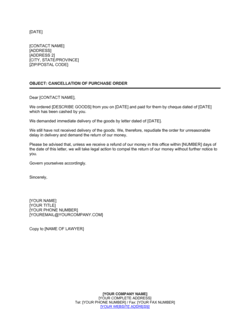
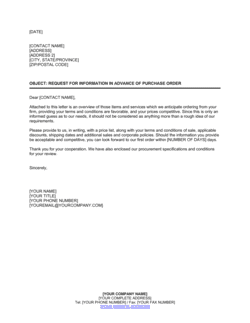
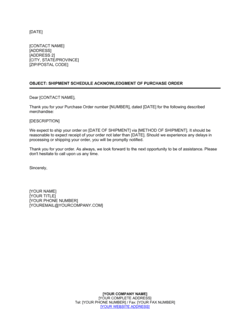
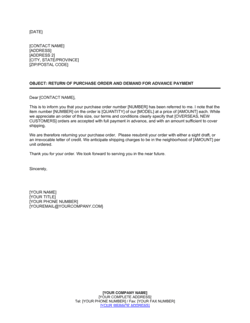
Purchase Order Template

Free Word download • Edit online • Save & share with Drive • Export to PDF

1 page20–30 min to fillDifficulty: StandardSignature requiredLegal review recommended
Learn more ↓
FreePurchase Order Template

At a glance

What it is
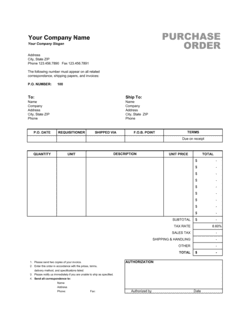
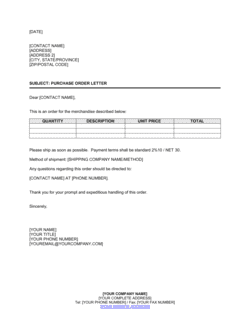
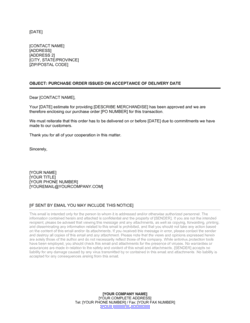
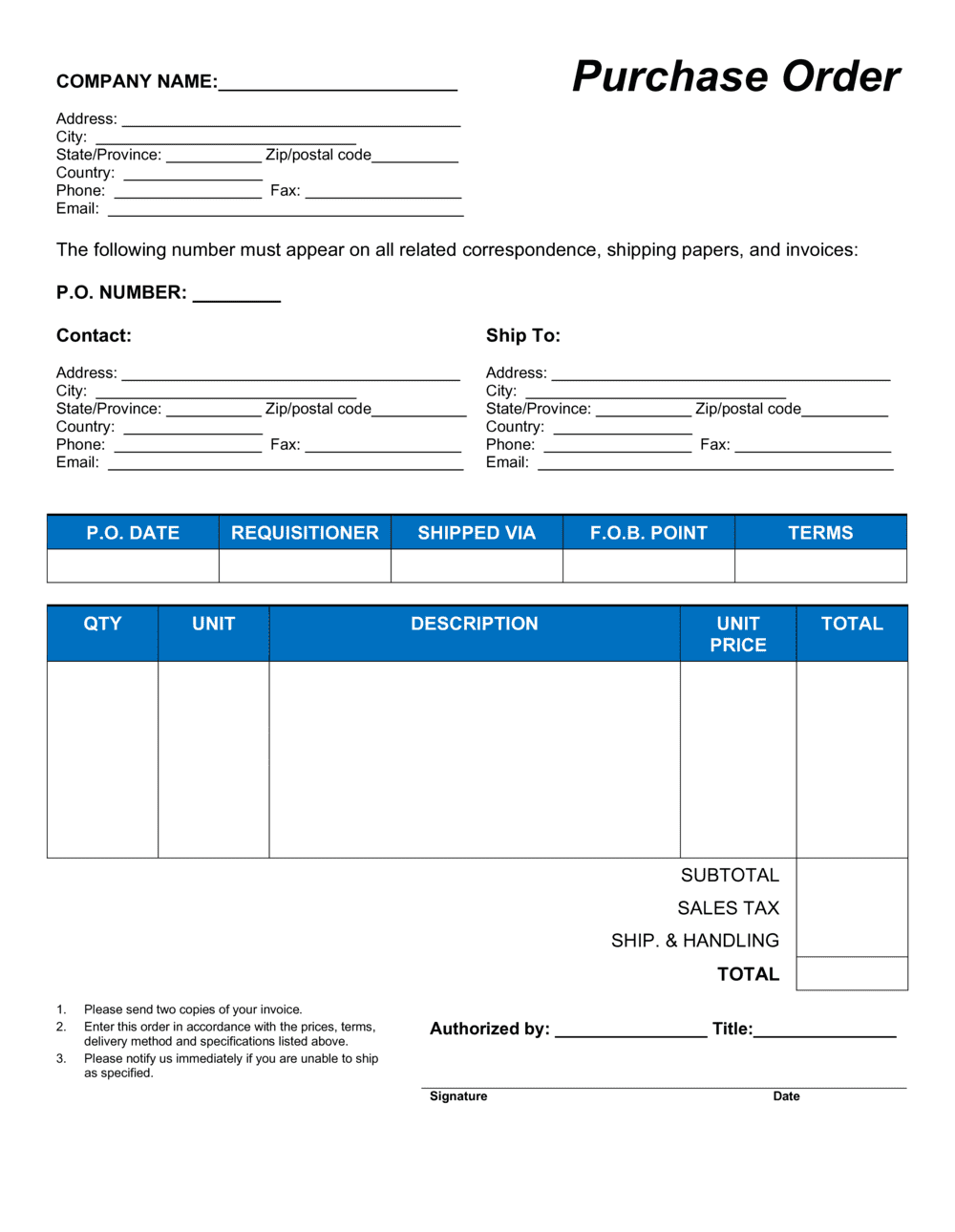
A Purchase Order is a legally binding commercial document issued by a buyer to a supplier authorizing the purchase of specific goods or services at agreed prices, quantities, and delivery terms. This template is a free Word download you can edit online and export as PDF — covering item descriptions, pricing, payment terms, delivery conditions, and acceptance criteria in a single structured document.
When you need it
Issue one whenever you need to formalize a procurement transaction, create an auditable paper trail for accounting or compliance purposes, or protect your business against supplier disputes over price, quantity, or delivery timing.
What's inside
Buyer and supplier identification, a unique PO number and issue date, itemized line items with quantities and unit prices, delivery address and deadline, payment terms, shipping and inspection conditions, and the binding acceptance clause that converts the document into a contract upon supplier acknowledgment.

What is a Purchase Order?

A Purchase Order (PO) is a legally binding commercial document issued by a buyer to a supplier that formally authorizes the purchase of specific goods or services at defined prices, quantities, and delivery terms. It functions simultaneously as a procurement authorization, a contract offer, and an accounting control document — becoming an enforceable agreement the moment the supplier accepts it by signature, written acknowledgment, or by beginning performance. Unlike an informal email or verbal agreement, a properly structured purchase order locks in pricing, delivery obligations, inspection rights, and dispute-resolution terms before any goods change hands or services begin.

Why You Need This Document

Operating without formal purchase orders exposes your business to price disputes, unauthorized spending, and invoice fraud that are difficult and expensive to resolve after the fact. When a supplier delivers the wrong items or invoices at a higher price than verbally agreed, an email chain is a weak legal instrument compared to a signed PO referencing specific part numbers and a fixed price. Accounts-payable teams that process invoices without matching purchase orders have no systemic control against duplicate payments, inflated quantities, or fictitious vendors — a gap that external auditors flag as a material internal-control weakness. In industries subject to regulatory procurement requirements — government contracting, healthcare, and defense — the absence of a PO process can disqualify a business from contracting entirely. This template gives you a complete, enforceable purchase order in under 20 minutes, structured to satisfy three-way matching requirements, protect your inspection rights, and hold suppliers accountable to the exact terms you authorized.

Which variant fits your situation?

If your situation is…Use this template
Ordering physical goods for stock or resaleStandard Purchase Order
Procuring professional or consulting servicesService Purchase Order
Establishing a standing order with a recurring supplierBlanket Purchase Order
Ordering a one-off item with no ongoing relationshipSpot Purchase Order
Buying goods internationally with customs and shipping termsInternational Purchase Order
Issuing a change to an already-accepted purchase orderPurchase Order Amendment
Procuring construction materials and labor for a projectConstruction Purchase Order

Common mistakes to avoid

❌ Vague item descriptions

Why it matters: A description of 'electrical components' or 'office supplies' gives the supplier discretion to substitute equivalent items, leaving the buyer with no contractual recourse when the wrong goods arrive.

Fix: Include part numbers, SKUs, specifications, or technical drawings by reference. The description should be specific enough that a warehouse receiver can confirm a match without calling procurement.

❌ No inspection period or acceptance clause

Why it matters: Without a defined inspection window, goods are legally deemed accepted on delivery in most jurisdictions — eliminating the buyer's right to reject defective or non-conforming items discovered during use.

Fix: Include an explicit inspection period of at least 5–10 business days and a written-rejection process with clear instructions on return or replacement.

❌ Omitting the PO number from invoice requirements

Why it matters: Supplier invoices that do not reference the PO number cannot be matched in a three-way reconciliation, causing payment holds and strained supplier relationships — sometimes resulting in supply disruptions.

Fix: State explicitly on the PO that all invoices must reference the PO number, and provide the supplier's AP contact with a clear reminder at order confirmation.

❌ Using informal emails as purchase authorizations

Why it matters: Email-based orders lack standardized terms for inspection, rejection, governing law, and price locks — creating disputes that are expensive to resolve and may expose the buyer to price increases or substituted goods.

Fix: Issue a formal PO for every procurement transaction above a defined threshold (e.g., $500) and require supplier acknowledgment before production or shipment begins.

❌ No cancellation or change-order clause

Why it matters: Without a cancellation clause, the buyer may be liable for the full order value even if the order is cancelled before production begins, particularly in jurisdictions that enforce anticipatory breach claims.

Fix: Include a pre-acceptance cancellation right and a post-acceptance change-order process with a defined supplier response window of 3–5 business days.

❌ Conflicting terms between the PO and the supplier's quotation

Why it matters: When a supplier's quotation and the buyer's PO contain different payment or delivery terms and there is no order-of-precedence clause, the 'battle of the forms' doctrine in common-law jurisdictions may give the supplier's terms priority.

Fix: Include an entire-agreement clause on the PO and an explicit order-of-precedence provision. Require the supplier to acknowledge the PO rather than just the quotation.

The 10 key clauses, explained

Parties and PO identification

In plain language: Identifies the buyer and supplier as legal entities, assigns a unique PO number, and records the issue date — the foundation for matching invoices and receipts downstream.

Sample language
Purchase Order No. [PO-YYYY-NNNN] | Issue Date: [DATE] | Buyer: [BUYER LEGAL NAME], [ADDRESS] | Supplier: [SUPPLIER LEGAL NAME], [ADDRESS] | Supplier Contact: [NAME / EMAIL]

Common mistake: Using a trade name instead of the registered legal entity name. If the names on the PO, invoice, and contract don't match, three-way reconciliation fails and payment approval stalls.

Itemized line items

In plain language: Lists each product or service ordered with a part number or description, quantity, unit of measure, unit price, and line total — the commercial heart of the document.

Sample language
Item 1: [PART NO. / DESCRIPTION] | Qty: [X] [UNIT] | Unit Price: $[X.XX] | Line Total: $[X.XX] | Item 2: [DESCRIPTION] | Qty: [X] [UNIT] | Unit Price: $[X.XX] | Line Total: $[X.XX]

Common mistake: Using vague descriptions like 'materials' or 'supplies' without a part number or specification. Disputes over substituted goods are nearly impossible to resolve without an itemized, specific description on the PO.

Delivery terms and deadline

In plain language: Specifies where the goods must be delivered, the required delivery date or window, and the Incoterm that allocates freight costs and risk of loss between buyer and supplier.

Sample language
Delivery Address: [FULL ADDRESS] | Required Delivery Date: [DATE] | Shipping Terms: [FOB DESTINATION / FOB ORIGIN / DDP] | Carrier: [SPECIFIED / BUYER'S DISCRETION]

Common mistake: Omitting an Incoterm and relying on a vague 'delivered to our warehouse' instruction. Without a defined Incoterm, liability for goods damaged or lost in transit is ambiguous and costly to litigate.

Payment terms

In plain language: States the payment timeline — typically Net 30 or Net 60 from invoice date — any early-payment discount, and the currency of payment.

Sample language
Payment Terms: Net [30] days from date of invoice. Early payment discount: [2]% if paid within [10] days. Currency: [USD / CAD / GBP / EUR]. Invoices must reference PO No. [PO-YYYY-NNNN].

Common mistake: Omitting the requirement that the supplier's invoice reference the PO number. Without this, AP teams cannot perform the three-way match, and the invoice sits unprocessed — often delaying payment and straining the supplier relationship.

Inspection and acceptance

In plain language: Gives the buyer a defined window after receipt to inspect goods and reject non-conforming items, and specifies what happens to rejected goods — return, replacement, or credit.

Sample language
Buyer shall have [10] business days after delivery to inspect goods. Buyer may reject non-conforming goods within this period by written notice to Supplier. Rejected goods shall be returned at Supplier's expense and replaced within [X] days or credited to Buyer's account.

Common mistake: No inspection window at all — or a window so short (e.g., 2 days) that defects discovered later are deemed accepted. A 10-business-day window is standard and defensible.

Price validity and taxes

In plain language: Locks in the prices stated in the PO and clarifies whether prices are inclusive or exclusive of applicable taxes, duties, and freight.

Sample language
The prices stated in this PO are fixed and not subject to increase. Prices are [inclusive / exclusive] of applicable sales tax, VAT, and import duties. Any additional charges must be pre-approved in writing by Buyer.

Common mistake: Leaving price validity open so the supplier can invoice at a higher rate if costs rise before delivery. Explicitly stating that PO prices are fixed protects the buyer's budget and prevents invoice surprises.

Confidentiality

In plain language: Restricts the supplier from disclosing the buyer's proprietary specifications, pricing, or business information shared in connection with the order.

Sample language
Supplier shall keep confidential all specifications, drawings, pricing, and business information provided by Buyer in connection with this PO and shall not disclose such information to any third party without Buyer's prior written consent.

Common mistake: Omitting confidentiality entirely on POs that include proprietary product specifications or custom formulations. A standalone NDA is preferable for high-sensitivity situations, but baseline confidentiality on the PO itself provides immediate protection.

Cancellation and change order

In plain language: States the buyer's right to cancel or amend the PO before acceptance, and the process for issuing changes after acceptance — including how price and delivery adjustments are negotiated.

Sample language
Buyer may cancel this PO without penalty before Supplier acceptance. After acceptance, changes require a written Change Order signed by both parties. Supplier shall notify Buyer within [5] business days if a change affects price or delivery date.

Common mistake: No cancellation clause — or one that imposes no obligation on the supplier to respond within a defined period. Without a response deadline, buyers lose the ability to re-source quickly when a supplier is slow to confirm or reject a change.

Governing law and dispute resolution

In plain language: Specifies which jurisdiction's commercial law governs the PO and how disputes are resolved — through negotiation, mediation, arbitration, or litigation.

Sample language
This Purchase Order is governed by the laws of [STATE / PROVINCE / COUNTRY]. Any dispute arising from this PO shall first be subject to good-faith negotiation for [30] days, then to binding arbitration in [CITY] under [AAA / ICC] rules, except claims for injunctive relief.

Common mistake: Choosing a governing law jurisdiction with no connection to where either party operates or where delivery occurs. Courts in the supplier's or buyer's home jurisdiction may apply local law regardless, making a mismatched governing-law clause ineffective.

Entire agreement and order of precedence

In plain language: Confirms that the PO supersedes all prior negotiations and informal communications, and establishes which document controls if there is a conflict between the PO, the supplier's quotation, and any master supply agreement.

Sample language
This PO, together with any attachments expressly incorporated by reference, constitutes the entire agreement for the transaction and supersedes all prior representations. In case of conflict, the Master Supply Agreement controls, followed by this PO, then Supplier's quotation.

Common mistake: No order-of-precedence clause when a master supply agreement also exists. When both documents address the same point differently, the absence of a tiebreaker forces expensive legal interpretation of which document governs.

How to fill it out

  1. 1

    Enter buyer and supplier legal entity details

    Use full registered legal names, not trade names or abbreviations. Include billing address, delivery address if different, and a named accounts-payable contact on the buyer side.

    💡 Confirm the supplier's legal name against their most recent invoice or company registration — mismatches create payment-processing delays and audit flags.

  2. 2

    Assign a unique PO number and set the issue date

    Use a sequential format such as PO-YYYY-NNNN. Enter today's date as the issue date. This number becomes the reference point for the supplier's invoice, your goods receipt note, and payment approval.

    💡 Never reuse a PO number even if the original order was cancelled — duplicate numbers break three-way matching and confuse your accounting system.

  3. 3

    Fill in itemized line items with precise descriptions

    List each item on a separate row with part number or detailed description, quantity, unit of measure, and agreed unit price. Calculate each line total and the order subtotal.

    💡 Include the supplier's own part number or SKU alongside your internal description — this is the fastest way to resolve substitution disputes at receiving.

  4. 4

    Set delivery address, deadline, and Incoterm

    Enter the complete delivery address, the required delivery date or window, and the applicable Incoterm. For domestic orders, FOB Destination is the most buyer-protective choice — risk passes when goods arrive at your facility.

    💡 If on-time delivery is critical, add a line stating that time is of the essence — this strengthens your position if you need to claim damages for late delivery.

  5. 5

    Define payment terms and tax treatment

    Specify the payment period (Net 30 is standard), any early-payment discount, the invoicing currency, and whether prices are inclusive or exclusive of sales tax, VAT, or import duties.

    💡 Require that the supplier's invoice reference the PO number in a mandatory field — this single instruction eliminates the majority of three-way match failures.

  6. 6

    Set the inspection window and rejection process

    Enter the number of business days you need to inspect received goods (10 days is standard) and specify whether rejected goods are to be returned, replaced, or credited. Include the written-notice requirement for rejection.

    💡 For custom or made-to-order goods, negotiate a pre-shipment inspection right — once custom items ship, return logistics become significantly more expensive.

  7. 7

    Choose governing law and confirm the order of precedence

    Select the jurisdiction whose commercial law governs the PO — typically where your business is domiciled or where delivery occurs. If a master supply agreement exists with this supplier, confirm the order-of-precedence clause reflects which document controls conflicts.

    💡 For US-based buyers purchasing from Canadian or European suppliers, specify the governing law jurisdiction explicitly — the default rules differ and can favor the supplier's home jurisdiction without a clear clause.

  8. 8

    Obtain supplier acknowledgment before goods are produced or shipped

    Send the PO to the supplier and request a signed or emailed acceptance referencing the PO number. Do not allow production or shipment to begin on an unacknowledged PO.

    💡 A supplier who ships without acknowledging the PO may argue they are operating under their own standard terms — get acceptance in writing before any work begins.

Frequently asked questions

What is a purchase order?

A purchase order is a legally binding commercial document issued by a buyer to a supplier that authorizes the purchase of specific goods or services at defined prices, quantities, and delivery terms. It becomes a contract when the supplier accepts it — either by signature, written acknowledgment, or by beginning performance. It also serves as the primary document in the three-way match process used by accounts-payable teams to approve supplier invoices for payment.

Is a purchase order legally binding?

Yes, a purchase order is generally enforceable as a binding contract in most jurisdictions once the supplier formally accepts it. Acceptance can occur through a signed acknowledgment, a written confirmation email referencing the PO number, or by beginning to produce or ship the goods. Before acceptance, the buyer can typically cancel without penalty. After acceptance, both parties are bound to the stated terms.

What is the difference between a purchase order and an invoice?

A purchase order is issued by the buyer before delivery to authorize and document a procurement transaction. An invoice is issued by the supplier after delivery to request payment. They are two sides of the same transaction — in a properly controlled accounts-payable process, the invoice references the PO number so both documents can be matched against the goods receipt note before payment is approved.

What is the difference between a purchase order and a purchase agreement?

A purchase order is typically a transactional document covering a single order — specific items, quantities, prices, and a delivery date. A purchase agreement (or supply agreement) is a longer-term contract governing the ongoing commercial relationship between buyer and supplier, including warranties, liability caps, IP ownership, and dispute resolution. Individual POs are often issued under a master purchase agreement, which controls if the two documents conflict.

When should a business start using purchase orders?

Most businesses benefit from formal POs once they have more than one person authorized to commit company spending, or once any single supplier order exceeds a meaningful threshold — commonly $500 to $1,000. At that point, informal email orders create audit gaps, budget overruns, and invoice disputes that a simple PO process eliminates. Businesses subject to financial audits or government contracting requirements are typically expected to use POs for all material procurement.

Does a purchase order need to be signed?

The buyer's authorized signatory should approve the PO before it is issued — this is typically an internal approval step. For the PO to become a binding contract, the supplier must also acknowledge acceptance, which can be a countersignature or a written confirmation. Many businesses accept an emailed acknowledgment referencing the PO number as sufficient evidence of supplier acceptance, though a countersigned copy provides stronger legal evidence.

What is a blanket purchase order?

A blanket purchase order pre-authorizes a supplier to make multiple deliveries up to a defined total value or quantity over a set period — typically a fiscal quarter or year — without requiring a new PO for each delivery. It is commonly used for recurring consumable purchases, maintenance supplies, or regular service engagements where the buyer and supplier have an established relationship and consistent pricing.

How do purchase orders work in an international transaction?

International POs include the same core elements as domestic ones but must also specify the applicable Incoterm (e.g., FOB, CIF, DDP), the payment currency, the method of payment (wire transfer, letter of credit), import duties responsibility, and any export control or customs documentation requirements. For high-value international orders, a letter of credit is commonly used to give both parties payment security across jurisdictions.

What happens if a supplier delivers goods that do not match the purchase order?

If the PO includes an inspection and acceptance clause — as it should — the buyer has the right to reject non-conforming goods within the defined inspection window by written notice. The supplier is then typically required to collect the rejected goods at their own expense and either replace them or issue a credit note. Without an inspection clause, the buyer's remedy depends on the jurisdiction's commercial code or sale-of-goods legislation, which may limit the rejection window significantly.

How this compares to alternatives

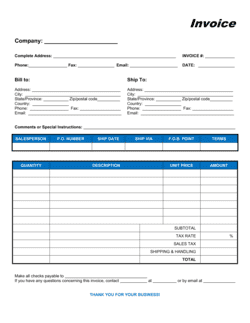
vs Invoice

An invoice is issued by the supplier after delivery to request payment; a purchase order is issued by the buyer before delivery to authorize the transaction. They document the same deal from opposite perspectives and should reference each other by number. A properly functioning accounts-payable process matches both documents against a goods receipt note before releasing payment.

vs Sales Order

A purchase order is a buyer's authorization to procure; a sales order is the supplier's internal document confirming they have accepted and are processing the buyer's purchase order. The two documents mirror each other and are created simultaneously — the buyer issues the PO, and the supplier responds with a sales order or order acknowledgment. They should reference the same PO number.

vs Supply Agreement

A supply agreement is a long-term master contract governing the overall commercial relationship — warranties, liability caps, IP, and dispute resolution. Individual purchase orders are issued under the supply agreement and cover only the transactional details of each order. The supply agreement controls if the two documents conflict. Businesses with ongoing supplier relationships should have both.

vs Request for Quotation (RFQ)

An RFQ is a pre-contractual document a buyer sends to multiple suppliers to solicit competitive pricing before committing to a purchase. A purchase order is issued to the chosen supplier after the RFQ process concludes, incorporating the agreed pricing. The RFQ is not binding; the PO is. The supplier's quotation should be referenced or attached to the PO to lock in the agreed terms.

Industry-specific considerations

Manufacturing

Raw material and component procurement with part-number specificity, lead-time management, and supplier quality inspection requirements built into the PO terms.

Construction

Materials and subcontractor service POs tied to project budgets and phase milestones, with delivery-to-site requirements and lien-waiver coordination.

Retail and E-commerce

Inventory replenishment orders with SKU-level specificity, FOB-origin shipping terms, packaging and labeling standards, and landed-cost tracking across multiple suppliers.

Healthcare

Medical supply and equipment procurement subject to FDA or CE mark compliance requirements, lot-number traceability, and temperature-controlled delivery conditions.

Technology / SaaS

Hardware procurement and third-party software or API service orders with license-count specificity, renewal-term controls, and data-handling confidentiality requirements.

Professional Services

Service POs for consulting, staffing, or outsourced work specifying deliverable scope, rate cards, not-to-exceed totals, and invoicing milestones.

Jurisdictional notes

United States

Purchase orders in the US are governed by Article 2 of the Uniform Commercial Code (UCC) for goods transactions. The UCC's 'battle of the forms' rule under § 2-207 means that if the supplier's acknowledgment includes different terms, those terms may become part of the contract in certain circumstances — making an explicit entire-agreement clause on the PO critical. State-level UCC adoptions are largely uniform, but a few states have minor variations.

Canada

Canadian goods transactions are governed by provincial Sale of Goods Acts modeled on the UK original. Quebec's Civil Code applies different rules from common-law provinces. Federal GST and provincial sales tax (HST, PST, or QST) must be clearly addressed in the PO's price and tax clause. Cross-border US-Canada transactions may involve CUSMA (USMCA) tariff considerations affecting landed cost.

United Kingdom

UK purchase orders are governed by the Sale of Goods Act 1979 and the Supply of Goods and Services Act 1982, which imply statutory conditions of satisfactory quality and fitness for purpose that cannot be excluded in B2C transactions. VAT treatment must be stated clearly, and Making Tax Digital requirements mean PO records must be digitally accessible. Post-Brexit, imports from the EU are subject to customs duty and UK-specific VAT rules.

European Union

EU commercial transactions are subject to the domestic Sale of Goods law of each member state, which implements the EU Sale of Goods Directive (2019/771). Cross-border intra-EU transactions benefit from the Common European Sales Law framework in some member states. VAT on goods must be addressed carefully — intra-EU B2B transactions are typically zero-rated with the buyer accounting for VAT under the reverse-charge mechanism. GDPR applies if personal data is shared in connection with the PO.

Template vs lawyer — what fits your deal?

PathBest forCostTime
Use the templateStandard domestic procurement transactions for goods or services below $50,000 with established suppliersFree10–20 minutes per PO
Template + legal reviewHigh-value orders, custom-manufactured goods, international procurement, or first-time supplier relationships$200–$500 for a lawyer or procurement specialist review1–3 days
Custom draftedEnterprise procurement programs, regulated-industry supply chains (medical devices, aerospace, defense), or cross-border transactions exceeding $250,000$1,000–$5,000+1–3 weeks

Glossary

Purchase Order (PO)
A buyer-issued commercial document that becomes a binding contract when accepted by the supplier, authorizing a specific purchase at defined terms.
PO Number
A unique sequential identifier assigned to each purchase order, used to match the order to delivery receipts, invoices, and payment records.
Three-Way Match
An accounts-payable control that verifies a supplier invoice against the original purchase order and the goods receipt note before approving payment.
Blanket Purchase Order
A long-term agreement with a supplier that pre-authorizes multiple deliveries up to a total value or quantity over a defined period, without issuing a new PO each time.
Incoterms
Internationally standardized trade terms (e.g., FOB, CIF, DDP) published by the ICC that define which party bears shipping costs and risk of loss at each stage of delivery.
Acceptance
The act by which a supplier formally agrees to fulfill a purchase order on the stated terms, converting the PO from an offer into a binding contract.
Lead Time
The elapsed time between issuing a purchase order and receiving the goods or services, used to plan inventory and project schedules.
Back Order
A supplier's acknowledgment that part of an order cannot be fulfilled immediately but will be delivered at a later date.
Goods Receipt Note (GRN)
An internal document confirming that ordered goods have been received, inspected, and accepted — the third document in a three-way match.
Change Order
A formal written amendment to an existing purchase order modifying quantity, price, delivery date, or scope, requiring mutual agreement before it takes effect.
Force Majeure
A clause excusing a party from performance obligations when prevented by events beyond their reasonable control, such as natural disasters, strikes, or government actions.

Part of your Business Operating System

This document is one of 3,000+ business & legal templates included in Business in a Box.

  • Fill-in-the-blanks — ready in minutes
  • 100% customizable Word document
  • Compatible with all office suites
  • Export to PDF and share electronically

Create your document in 3 simple steps.

From template to signed document — all inside one Business Operating System.
1
Download or open template

Access over 3,000+ business and legal templates for any business task, project or initiative.

2
Edit and fill in the blanks with AI

Customize your ready-made business document template and save it in the cloud.

3
Save, Share, Send, Sign

Share your files and folders with your team. Create a space of seamless collaboration.

Save time, save money, and create top-quality documents.

★★★★★

"Fantastic value! I'm not sure how I'd do without it. It's worth its weight in gold and paid back for itself many times."

Managing Director · Mall Farm
Robert Whalley
Managing Director, Mall Farm Proprietary Limited
★★★★★

"I have been using Business in a Box for years. It has been the most useful source of templates I have encountered. I recommend it to anyone."

Business Owner · 4+ years
Dr Michael John Freestone
Business Owner
★★★★★

"It has been a life saver so many times I have lost count. Business in a Box has saved me so much time and as you know, time is money."

Owner · Upstate Web
David G. Moore Jr.
Owner, Upstate Web

Run your business with a system — not scattered tools

Stop downloading documents. Start operating with clarity. Business in a Box gives you the Business Operating System used by over 250,000 companies worldwide to structure, run, and grow their business.

Start free · No credit card required