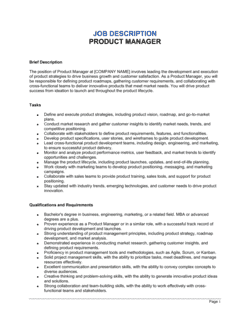
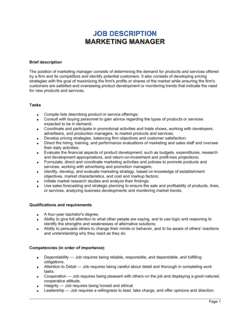
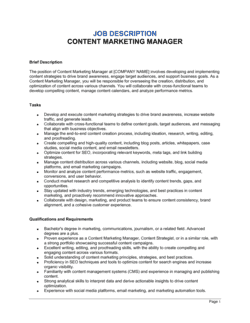
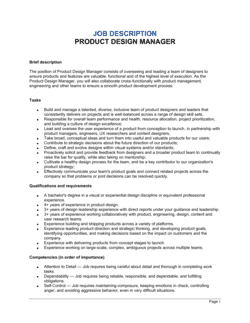
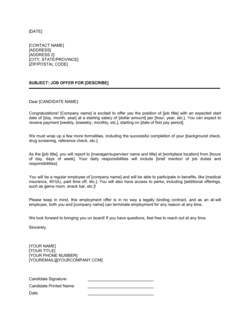
Product Marketing Manager Job Description Template

Free Word download • Edit online • Save & share with Drive • Export to PDF

2 pages20–30 min to fillDifficulty: StandardSignature requiredLegal review recommended
Learn more ↓
FreeProduct Marketing Manager Job Description Template

At a glance

What it is
A Product Marketing Manager Job Description is a formal employment document that defines the scope, responsibilities, qualifications, reporting structure, and compensation terms for a Product Marketing Manager role within an organization. This free Word download gives you a structured, legally grounded starting point you can edit online and export as PDF to post publicly or attach to an offer letter and employment contract.
When you need it
Use it when creating a new PMM role, backfilling an existing position, or standardizing hiring documentation across your marketing organization. It is also the reference document when setting performance expectations and managing the employment relationship throughout the tenure.
What's inside
Role summary, core duties and KPIs, required and preferred qualifications, reporting structure, compensation and benefits overview, IP assignment notice, equal opportunity statement, and acknowledgment signature block.

What is a Product Marketing Manager Job Description?

A Product Marketing Manager Job Description is a formal employment document that defines the scope, responsibilities, qualifications, reporting structure, compensation terms, and performance expectations for a Product Marketing Manager position within an organization. It functions simultaneously as a recruiting tool, a hiring compliance document, and the reference standard for performance management throughout the employment relationship. A well-drafted PMM job description captures not just the tasks the role performs — positioning, launch execution, competitive intelligence, sales enablement — but also the measurable outcomes the hire is accountable for and the IP and EEO terms that govern the engagement.

Why You Need This Document

Hiring a Product Marketing Manager without a precise, documented job description creates compounding legal and operational exposure. Without defined duties, performance improvement plans and terminations for underperformance become legally fragile — employees can credibly argue the standards were never communicated. Without documented qualifications, hiring decisions based on gut-fit judgments are difficult to defend against discrimination claims. Without salary range disclosures, postings that reach candidates in Colorado, California, New York, or Washington trigger regulatory complaints and fines. And without an IP assignment notice, candidates who accept an offer and later encounter a broad IP assignment clause in their employment contract have grounds to contest its scope. This template gives you a single document that closes all four gaps before you post the role — drafted to support recruiting, support performance management, and withstand scrutiny if the employment relationship ever ends in dispute.

Which variant fits your situation?

If your situation is…Use this template
Hiring a senior individual contributor who also manages a teamSenior Product Marketing Manager Job Description
Hiring an entry-level or associate PMM for a large marketing orgAssociate Product Marketing Manager Job Description
Engaging a PMM on a contract or project basisIndependent Contractor Agreement
Defining compensation and benefits formally after the role is acceptedEmployment Contract
Creating a short-term or fixed-term PMM engagementFixed-Term Employment Contract
Formalizing the offer before the full employment contract is executedJob Offer Letter
Documenting performance expectations after the hire is madeEmployee Performance Review Template

Common mistakes to avoid

❌ Omitting salary range where legally required

Why it matters: Colorado, California, New York, and Washington mandate salary range disclosure in job postings accessible to residents of those states. Non-compliance triggers regulatory complaints and fines up to $10,000 per violation in some jurisdictions.

Fix: Confirm pay transparency requirements for every state or country where candidates may apply or work, and include the full salary band in the compensation clause before posting.

❌ Writing responsibilities at the outcome level only

Why it matters: Duties listed as 'drive growth' or 'collaborate cross-functionally' cannot be used to evaluate performance, resolve scope disputes, or justify termination for cause — leaving the employer exposed in wrongful termination claims.

Fix: Rewrite each responsibility as a specific, observable task with a deliverable and frequency: 'produce and maintain competitive battle cards for five named competitors on a quarterly cycle'.

❌ Using unjustified degree requirements

Why it matters: Requiring a bachelor's degree without documented job-relatedness may constitute disparate-impact discrimination under EEOC guidelines and equivalent regulations in Canada and the UK, exposing the employer to enforcement action.

Fix: Replace hard degree requirements with 'bachelor's degree in Marketing, Business, or equivalent professional experience' and document internally why each requirement is necessary.

❌ No KPIs or success metrics in the description

Why it matters: Without documented success criteria, performance improvement plans and terminations for underperformance become legally fragile — employees can claim the standards were never communicated.

Fix: Add 3–5 measurable KPIs to the description and ensure they are referenced in the employment contract or onboarding documentation signed at hire.

❌ Ambiguous remote-work or hybrid language

Why it matters: Listing 'flexible location' with no definition creates misaligned expectations that lead to early attrition, and may trigger multi-state payroll and tax obligations the employer did not anticipate.

Fix: Specify remote, on-site, or hybrid with a precise number of required in-office days; list the primary work location; and confirm whether the role is open to residents of all jurisdictions or specific states only.

❌ Attaching the job description without an IP assignment notice

Why it matters: If the job description is shared with a candidate and no IP terms are surfaced before acceptance, the employee may later contest the scope of the IP assignment clause in the employment contract, arguing surprise.

Fix: Include a brief IP assignment notice in the job description and reference the full employment contract where terms will be detailed — ensuring candidates see IP expectations before accepting the offer.

The 10 key clauses, explained

Role title, level, and reporting structure

In plain language: States the official job title, seniority level (e.g., IC2 or manager-track), the position it reports to, and any direct reports the PMM will manage.

Sample language
Position: Product Marketing Manager | Level: [IC / Manager] | Reports to: [VP Marketing / CMO / Director of Product Marketing] | Direct Reports: [None / [NUMBER] Marketing Associates]

Common mistake: Omitting the seniority level and whether the role has direct reports — candidates interpret scope differently, leading to misaligned expectations and early attrition.

Role summary and business context

In plain language: A 3–5 sentence narrative explaining why the role exists, what problem it solves for the business, and where it sits in the product-marketing ecosystem.

Sample language
The Product Marketing Manager is responsible for defining and communicating the value of [PRODUCT / PRODUCT LINE] to [TARGET MARKET]. This role bridges product, sales, and marketing to drive pipeline, adoption, and revenue growth. The PMM will own positioning, messaging, launch execution, and competitive intelligence for [PRODUCT NAME].

Common mistake: Using generic role-summary language copied from LinkedIn. Vague summaries attract misaligned applicants and reduce offer acceptance rates from high-fit candidates.

Core duties and responsibilities

In plain language: An itemized list of the primary functions the employee is expected to perform — typically 8–12 bullet points covering strategy, execution, and cross-functional collaboration.

Sample language
Develop and maintain positioning and messaging for [PRODUCT NAME] across all customer segments. Lead [NUMBER] product launches per year including launch plans, enablement materials, and post-launch analysis. Own competitive intelligence program: monitor [NUMBER] named competitors quarterly and deliver battle cards to sales.

Common mistake: Writing responsibilities at such a high level ('drive growth', 'collaborate cross-functionally') that the document cannot be used for performance management or scope disputes.

KPIs and success metrics

In plain language: Defines the quantitative and qualitative measures by which the PMM's performance will be evaluated — tied to pipeline, adoption, win rates, or launch velocity.

Sample language
Success in this role is measured by: (a) [X]% increase in sales win rate within [TIMEFRAME]; (b) [X]% growth in product adoption among [SEGMENT]; (c) delivery of all launch assets [X] days before GA; (d) [X] competitive battle cards maintained with [QUARTERLY / ANNUAL] refresh cycle.

Common mistake: Listing no success metrics at all, or listing metrics the PMM cannot directly influence (total company revenue) rather than metrics within their control.

Required qualifications

In plain language: The minimum education, experience, and skill requirements a candidate must meet to be considered for the role — these are legally material and must be defensible as job-related.

Sample language
[X]+ years of product marketing experience in a [B2B / B2C / SaaS / [INDUSTRY]] environment. Demonstrated experience owning at least [NUMBER] full product launch cycles. Proficiency in [TOOLS: e.g., Salesforce, HubSpot, Figma, Productboard]. [Bachelor's degree in Marketing, Business, or equivalent experience].

Common mistake: Setting degree requirements that are not demonstrably required for job performance. In several jurisdictions and under EEOC guidance, unjustified degree requirements may constitute disparate-impact discrimination.

Preferred qualifications

In plain language: Desirable but non-mandatory skills and experiences that would make a candidate stand out — used to differentiate finalists, not screen applicants.

Sample language
Experience marketing [SPECIFIC PRODUCT CATEGORY] to [BUYER PERSONA]. Familiarity with analyst relations (Gartner, Forrester). Prior experience at a [STAGE: Series B / enterprise / PLG] company. Certifications: [Pragmatic Institute PMC / AIPMM CPM].

Common mistake: Loading the preferred section with requirements that are effectively mandatory. Candidates self-select out of roles they are qualified for, reducing pipeline quality.

Compensation, benefits, and FLSA classification

In plain language: States the base salary range, variable compensation (bonus or equity), benefits eligibility, and confirms the role is classified as FLSA-exempt.

Sample language
Compensation: Base salary [$X,000 – $Y,000] annually, commensurate with experience. Bonus: Eligible for annual discretionary bonus up to [X]% of base. Equity: [Eligible / Not eligible] per standard option plan. FLSA Status: Exempt. Benefits: Eligible for Company's standard benefits program.

Common mistake: Omitting salary range where Pay Transparency Laws require it. Colorado, California, New York, Washington, and other states mandate salary ranges in job postings. Non-compliance carries fines and reputational risk.

Work location and travel requirements

In plain language: Specifies whether the role is on-site, hybrid, or fully remote; the primary work location; and the expected travel frequency for conferences, customer visits, or team offsites.

Sample language
Work Location: [On-site / Hybrid [X] days per week / Fully Remote]. Primary Office: [CITY, STATE]. Travel: Up to [X]% of working time, including [customer visits / industry conferences / company all-hands].

Common mistake: Listing a work location as 'flexible' with no definition. Ambiguity creates disputes about remote-work expectations and may complicate multi-state payroll and tax compliance.

IP assignment and confidentiality notice

In plain language: Notifies the candidate that work product created in connection with the role — positioning frameworks, messaging architectures, campaign assets — belongs to the employer, with full terms governed by the employment contract.

Sample language
All work product, marketing materials, positioning frameworks, and proprietary methodologies developed by the employee in the course of this role are the sole property of [COMPANY NAME]. Detailed terms are set out in the Employment Agreement to be executed prior to the first day of employment.

Common mistake: Omitting IP assignment notice from the job description entirely. While the employment contract governs IP legally, including notice here reduces surprise and ensures candidates understand the scope before accepting.

Equal opportunity and accommodation statement

In plain language: States that the employer is an equal opportunity employer and provides reasonable accommodations for applicants with disabilities — legally required language in many jurisdictions.

Sample language
[COMPANY NAME] is an Equal Opportunity Employer. We do not discriminate based on race, color, religion, sex, national origin, age, disability, or any other characteristic protected by applicable law. Applicants requiring reasonable accommodations during the application process should contact [HR EMAIL / CONTACT].

Common mistake: Using boilerplate EEO language that doesn't match the employer's actual jurisdiction or omits protected classes required by local law — for example, omitting sexual orientation and gender identity where required by state or provincial statute.

How to fill it out

  1. 1

    Define the reporting structure and seniority level

    Enter the title, the manager this role reports to, and whether it includes direct reports. Confirm the FLSA classification (typically exempt for a salaried PMM above $684/week as of 2024).

    💡 Align the seniority level with your internal leveling framework before posting — changing the level after candidate outreach creates confusion and extends time-to-fill.

  2. 2

    Write the role summary with product and market context

    Replace the generic summary placeholder with 3–5 sentences specific to your product, target market, and the business problem this hire solves. Reference your product name and the buyer persona the PMM will own.

    💡 Candidates evaluate company clarity from the summary. Specific language ('own positioning for our AI-based procurement platform targeting mid-market CFOs') attracts better-fit applicants than 'join a fast-growing team'.

  3. 3

    List core duties at the task level, not the outcome level

    Write 8–12 bullets describing specific tasks: 'develop quarterly competitive battle cards', not 'drive competitive strategy'. Include launch cadence, cross-functional partners, and any tools the PMM will own.

    💡 Duties you list here become the basis for performance reviews and scope disputes. Overly vague language costs you more in management effort than it saves you in writing time.

  4. 4

    Set measurable KPIs

    Add 3–5 quantitative success metrics tied to pipeline, win rate, launch delivery, or adoption. Include the baseline or target where known (e.g., 'increase win rate from 22% to 30% within 12 months').

    💡 KPIs without baselines are aspirational, not accountable. Pull current benchmarks from your CRM or product analytics before finalizing this section.

  5. 5

    Define required qualifications carefully

    List only qualifications you can demonstrate are necessary for the role. Avoid degree requirements unless the role genuinely cannot be performed without them. Include years of experience, domain expertise, and tool proficiency.

    💡 Check that your required qualifications do not inadvertently screen out protected classes — for example, a 10-year experience minimum may create age-discrimination exposure in some jurisdictions.

  6. 6

    Complete the compensation block with salary range

    Enter the salary band, bonus eligibility, and equity if applicable. Confirm whether your state, province, or country requires salary range disclosure in job postings before publishing.

    💡 In Colorado, California, New York City, and Washington, omitting the salary range in postings that are accessible to residents in those jurisdictions is a compliance violation — even for fully remote roles.

  7. 7

    Specify work location and travel requirements precisely

    Choose on-site, hybrid, or remote, and define hybrid as a specific number of days per week. State the primary office city. Enter a travel percentage rather than a vague descriptor like 'some travel required'.

    💡 For remote roles, note whether the position is open to candidates in all US states or specific states only — multi-state payroll compliance varies significantly.

  8. 8

    Add the EEO statement and get sign-off

    Insert the EEO statement with all protected classes required in your jurisdiction. Have HR or legal review the completed description before it is posted or attached to any offer documentation.

    💡 Store the signed, dated version in your HRIS alongside the offer letter and employment contract — job description version control becomes critical during employment disputes.

Frequently asked questions

What does a Product Marketing Manager do?

A Product Marketing Manager is responsible for positioning and messaging a product to its target market, executing product launches, building sales enablement materials, and maintaining competitive intelligence. They sit at the intersection of product, sales, and marketing — translating product capabilities into customer value and commercial outcomes. In most organizations a PMM owns the go-to-market strategy for one or more products and is measured on win rates, pipeline influence, and adoption metrics.

What qualifications should I require for a Product Marketing Manager?

Typical required qualifications include 3–5 years of product marketing experience in a relevant industry (B2B SaaS, enterprise software, or consumer tech), demonstrated experience owning full product launch cycles, proficiency in tools like Salesforce, HubSpot, or Productboard, and strong written communication skills. Avoid mandatory degree requirements unless genuinely job-related — courts and regulators in the US, Canada, and UK scrutinize unjustified credentials filters. Focus on demonstrated skills and outcomes over pedigree.

Do I need to include a salary range in a PMM job posting?

It depends on where candidates are located or will work. Colorado, California, New York, Washington, and several other US states require salary range disclosure in job postings accessible to residents of those states — including remote roles posted nationally. Canada's provinces are moving in the same direction, with British Columbia enacting pay transparency requirements in 2023. Including the salary range proactively reduces compliance risk and typically increases applicant conversion rates.

What is the difference between a job description and an employment contract?

A job description defines the scope, duties, qualifications, and general terms of a role — it is used in recruiting, performance management, and as a reference document. An employment contract is the binding legal agreement that governs the full employment relationship, including IP assignment, confidentiality, non-compete, termination, and severance. The job description is typically attached to or referenced in the employment contract, but it does not replace it. Both documents are needed before the employee's first day.

Is a job description legally binding?

A job description can carry legal weight in employment disputes, particularly in performance management, wrongful termination, and reasonable accommodation cases. Courts and employment tribunals have used job descriptions as evidence of what duties were within scope and what qualifications were genuinely required. It is not a substitute for a signed employment contract, but inaccurate or vague job descriptions create legal risk — both in defending terminations and in qualifying for FLSA exemptions.

What KPIs should I set for a Product Marketing Manager?

Common PMM KPIs include sales win rate improvement (e.g., increase from 22% to 30% within 12 months), product adoption rate among target segments, on-time launch delivery measured against a pre-set launch calendar, sales enablement asset completion rate, and pipeline influenced by PMM-created content. Choose metrics the PMM can directly influence through their own work — tying PMM performance to total company revenue creates accountability gaps and makes performance conversations unproductive.

How does a PMM job description interact with an IP assignment clause?

The job description should include a brief IP assignment notice indicating that positioning frameworks, marketing assets, and work product created in the role belong to the employer. The full IP assignment terms are governed by the employment contract, which must be signed before the first day of employment. Surfacing IP expectations in the job description reduces candidate surprise and strengthens enforceability of the full IP assignment clause by establishing notice prior to acceptance.

What work location language should I use for a remote PMM role?

Specify whether the role is fully remote, hybrid, or on-site. For remote roles, note whether applicants must be located in specific states or countries — multi-state payroll, tax withholding, and employment law compliance vary significantly. For hybrid roles, define the required number of in-office days per week and the primary office location. Avoid terms like 'flexible' or 'some remote work available' without specifics, as these create misaligned expectations and, in some jurisdictions, disputes about whether a unilateral change to remote policy constitutes constructive dismissal.

Should I use the same job description for internal and external posting?

The external job posting and the internal job description can differ in detail level, but must be consistent on scope, qualifications, and compensation. The internal description — the version attached to the employment contract and used for performance management — should be more detailed, including specific KPIs, tool requirements, and the IP and EEO clauses. The external posting is typically a condensed version. Store the signed, internal version in your HRIS; use the external version for your ATS and job boards.

How this compares to alternatives

vs Employment Contract

A job description defines the scope and qualifications of a role and is used in recruiting, performance management, and compensation benchmarking. An employment contract is the binding legal document governing the full employment relationship — covering IP assignment, confidentiality, non-compete, and termination terms. Both are needed: the job description is typically attached to or referenced in the employment contract. A job description alone does not create enforceable employment obligations.

vs Job Offer Letter

An offer letter confirms the role, compensation, and start date to secure a candidate's acceptance — it is a short transactional document. A job description is the reference document for the role's scope, duties, and qualifications. The offer letter typically references or attaches the job description. Neither the offer letter nor the job description substitutes for a full employment contract, which should be executed before the first day.

vs Independent Contractor Agreement

A job description is used when hiring an employee — a person subject to behavioral and financial control by the employer. An independent contractor agreement is used to engage a self-employed individual for project-based work with no employment entitlements. Misclassifying a PMM engaged under a contractor agreement as an independent contractor when the engagement resembles employment triggers back taxes, penalties, and benefit liability in most jurisdictions.

vs Employee Performance Review Template

A job description documents expected duties and qualifications at the time of hiring. A performance review template is used throughout the employment relationship to evaluate whether the employee is meeting those documented expectations. The job description's KPI clause directly feeds the performance review criteria — misalignment between the two documents is a common source of performance management disputes.

Industry-specific considerations

SaaS / Technology

PMM scope typically covers product positioning for a specific tier or persona, competitive battlecard ownership, PLG adoption messaging, and launch coordination with product and engineering.

Healthcare / MedTech

PMM descriptions in healthcare must reflect regulatory constraints on claims language, FDA clearance status, and distinct buyer personas (clinicians vs. procurement vs. payers).

Financial Services

Fintech PMM roles often require familiarity with compliance review processes for marketing copy, SEC or FCA disclosure requirements, and separate messaging tracks for retail versus institutional buyers.

Professional Services

PMM roles in consulting or agency environments focus on thought leadership positioning, practice-area differentiation, and proposal content — distinct from product-led organizations with discrete SKUs.

Retail / E-commerce

Consumer-facing PMM roles emphasize campaign-level messaging, seasonal launch calendars, and tight coordination with performance marketing on channel-specific creative.

Manufacturing

Industrial PMM roles require technical product fluency to translate engineering specifications into buyer-facing value propositions, often for long sales cycles and distributor channel enablement.

Jurisdictional notes

United States

Pay transparency laws in Colorado (EPEWA), California (SB 1162), New York, and Washington require salary ranges in job postings accessible to residents of those states — including remote roles. The FLSA requires PMM roles to meet both the salary threshold ($684/week as of 2024) and the administrative duties test to qualify as exempt. EEOC guidance scrutinizes degree requirements and experience minimums that may produce disparate impact on protected classes.

Canada

British Columbia's Pay Transparency Act (2023) requires salary ranges in all job postings. Ontario and other provinces are progressing toward similar requirements. Human rights codes in every province prohibit discriminatory qualification requirements — experience minimums that disproportionately screen out protected groups require documented justification. Quebec employers must provide job postings in French for provincially regulated positions.

United Kingdom

The Equality Act 2010 prohibits qualification requirements that create unjustified indirect discrimination based on age, sex, race, or disability. While salary range disclosure is not yet legally mandated in job postings, the Equality and Human Rights Commission recommends it as a pay equity best practice. IR35 rules apply if the PMM is engaged through a personal service company rather than directly as an employee.

European Union

The EU Pay Transparency Directive (2023/970) requires member states to mandate salary range disclosure in job postings by June 2026. GDPR applies to personal data collected during the application process — job postings must not request information that constitutes special category data (health, religion, ethnicity). Several member states, including Germany and France, have additional works council consultation requirements before new roles are posted externally.

Template vs lawyer — what fits your deal?

PathBest forCostTime
Use the templateStandard PMM hires in a single US state or Canadian province where job description requirements are well understoodFree30–60 minutes
Template + legal reviewMulti-state or cross-border postings, roles with complex IP or non-compete notice requirements, or companies in regulated industries$200–$500 for HR consultant or employment lawyer review1–3 days
Custom draftedExecutive-level PMM roles with equity, companies in highly regulated industries (healthcare, financial services), or organizations with prior EEO enforcement history$800–$2,5001–2 weeks

Glossary

Job Description
A formal document that defines a role's responsibilities, qualifications, and reporting structure — used in hiring, performance management, and employment disputes.
Product Marketing Manager (PMM)
An employee responsible for positioning, messaging, competitive intelligence, launch execution, and sales enablement for one or more products.
Go-to-Market Strategy
The plan a company uses to bring a product to market, covering target audience, positioning, pricing, channels, and launch sequencing.
Positioning Statement
A structured declaration of how a product is differentiated from competitors in the minds of a defined target customer segment.
Sales Enablement
The process of equipping sales teams with the messaging, collateral, battle cards, and training they need to convert qualified prospects.
ICP (Ideal Customer Profile)
A detailed description of the type of company or individual most likely to derive maximum value from the product and become a long-term customer.
Win/Loss Analysis
A systematic review of closed deals — both won and lost — to understand the competitive and messaging factors that drove the outcome.
IP Assignment
A clause assigning ownership of work product, positioning frameworks, and marketing assets created by the employee to the employer during the employment relationship.
At-Will Employment
An employment arrangement in which either party may end the relationship at any time for any lawful reason without advance notice — applicable in most US states.
FLSA Classification
The Fair Labor Standards Act determination of whether a role is exempt from overtime pay requirements, typically based on salary level and duties tests.
OKR (Objectives and Key Results)
A goal-setting framework that pairs a qualitative objective with measurable key results — commonly used to define PMM success metrics.

Part of your Business Operating System

This document is one of 3,000+ business & legal templates included in Business in a Box.

  • Fill-in-the-blanks — ready in minutes
  • 100% customizable Word document
  • Compatible with all office suites
  • Export to PDF and share electronically

Create your document in 3 simple steps.

From template to signed document — all inside one Business Operating System.
1
Download or open template

Access over 3,000+ business and legal templates for any business task, project or initiative.

2
Edit and fill in the blanks with AI

Customize your ready-made business document template and save it in the cloud.

3
Save, Share, Send, Sign

Share your files and folders with your team. Create a space of seamless collaboration.

Save time, save money, and create top-quality documents.

★★★★★

"Fantastic value! I'm not sure how I'd do without it. It's worth its weight in gold and paid back for itself many times."

Managing Director · Mall Farm
Robert Whalley
Managing Director, Mall Farm Proprietary Limited
★★★★★

"I have been using Business in a Box for years. It has been the most useful source of templates I have encountered. I recommend it to anyone."

Business Owner · 4+ years
Dr Michael John Freestone
Business Owner
★★★★★

"It has been a life saver so many times I have lost count. Business in a Box has saved me so much time and as you know, time is money."

Owner · Upstate Web
David G. Moore Jr.
Owner, Upstate Web

Run your business with a system — not scattered tools

Stop downloading documents. Start operating with clarity. Business in a Box gives you the Business Operating System used by over 250,000 companies worldwide to structure, run, and grow their business.

Free Forever Plan · No credit card required