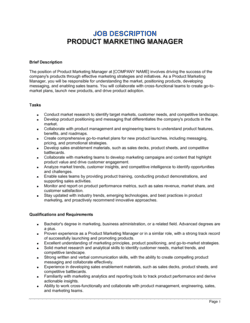
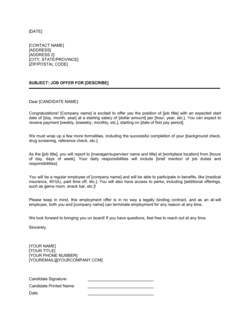
Product Manager Job Description Template

Free Word download • Edit online • Save & share with Drive • Export to PDF

2 pages20–30 min to fillDifficulty: StandardSignature requiredLegal review recommended
Learn more ↓
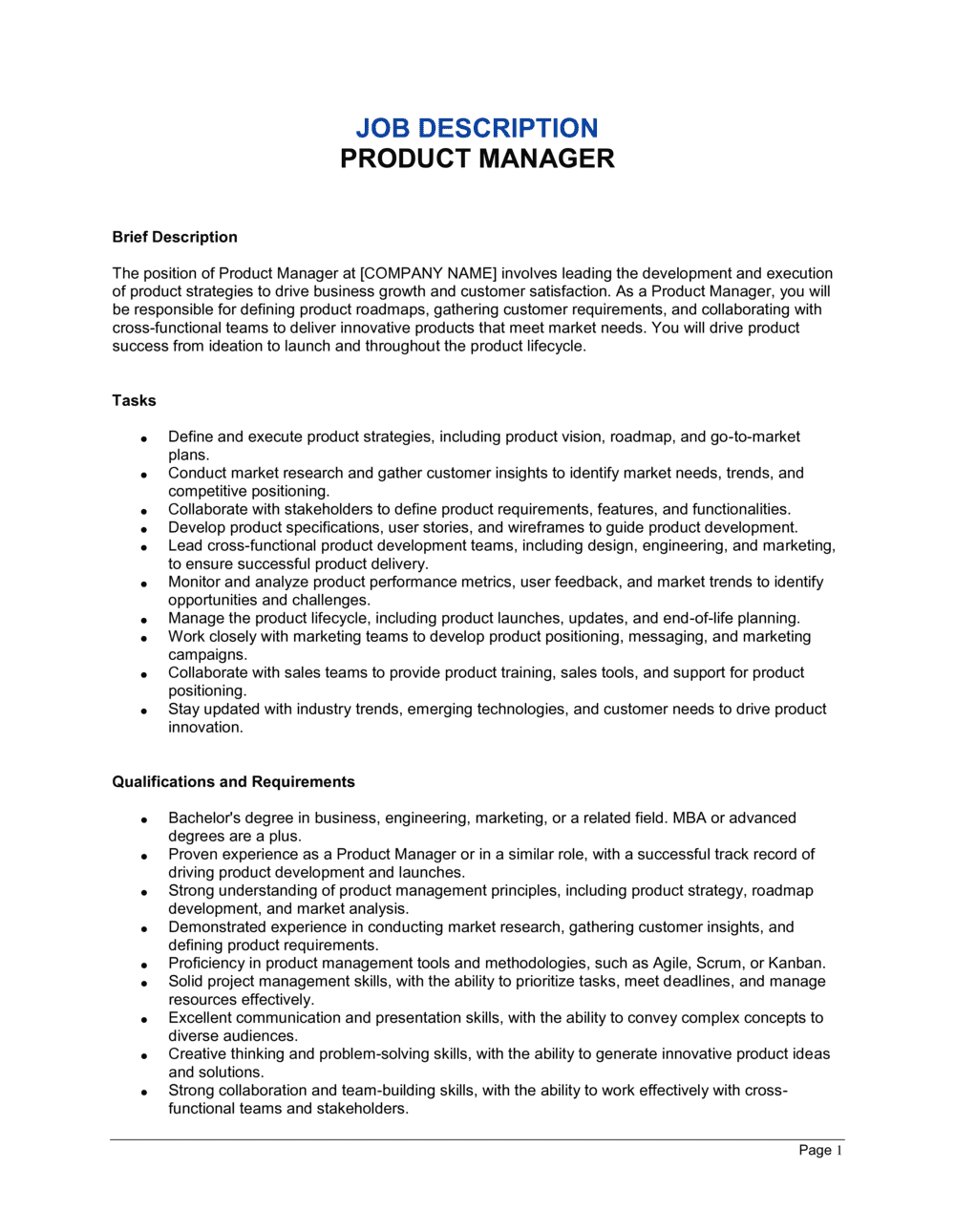
FreeProduct Manager Job Description Template

At a glance

What it is
A Product Manager Job Description is a binding document that formally defines the scope, responsibilities, qualifications, reporting structure, and compensation expectations for a product manager role. This free Word download gives you a structured, legally defensible starting point you can edit online and export as PDF to post on job boards, attach to offer letters, or incorporate directly into an employment contract.
When you need it
Use it when opening a new product manager position, replacing a departing PM, or restructuring an existing role to reflect a changed product strategy or reporting line. A written job description is also required in many jurisdictions as supporting documentation for classification decisions and compensation benchmarking.
What's inside
Role title and level, department and reporting structure, core responsibilities and deliverables, required and preferred qualifications, compensation range and benefits summary, employment type and work location, and equal employment opportunity statement. Each section is drafted to support both external recruiting and internal classification purposes.

What is a Product Manager Job Description?

A Product Manager Job Description is a formal document that defines the title, scope, responsibilities, qualifications, compensation, and reporting structure for a product management role within an organization. It serves a dual purpose: externally, it attracts and screens qualified PM candidates by communicating what the role requires and what success looks like; internally, it creates a documented record of role scope that supports performance management, FLSA classification, pay-equity compliance, and — when attached to an employment contract — forms part of the binding legal relationship with the hire. Unlike an informal role brief or a job posting assembled from a competitor's listing, a properly structured job description is drafted to be defensible: it distinguishes essential functions from marginal tasks, separates required qualifications from preferred ones, and complies with pay transparency statutes in jurisdictions where disclosure is mandated.

Why You Need This Document

Posting a product manager role without a complete, accurate job description creates compounding risks at every stage of the employment lifecycle. At the recruiting stage, vague responsibilities and inflated titles attract mismatched candidates, lengthen time-to-fill, and set up offer-stage fallout when expectations collide with reality. At the classification stage, a description that doesn't clearly document the PM's decision-making authority and professional judgment creates FLSA misclassification exposure — overtime back-pay liability that accrues from the first day of employment. At the performance management stage, a role without documented success metrics cannot be managed fairly, making underperformance conversations legally riskier and more expensive to resolve. And in pay-transparency jurisdictions — California, Colorado, New York, Washington, British Columbia, and an expanding list — omitting the salary range from the posting is a regulatory compliance failure, not a negotiating tactic. This template gives you a structured, legally defensible starting point that closes all four gaps before your first candidate applies.

Which variant fits your situation?

If your situation is…Use this template
Hiring a first PM at an early-stage startup with a generalist scopeProduct Manager Job Description (Generalist)
Defining a senior PM or Group PM role with team leadership responsibilitiesSenior Product Manager Job Description
Hiring a technical PM who owns API, platform, or infrastructure productsTechnical Product Manager Job Description
Defining a growth PM role focused on acquisition, activation, or retentionGrowth Product Manager Job Description
Posting a Principal PM or Director of Product role with cross-functional authorityDirector of Product Management Job Description
Hiring a product owner embedded in an agile development teamProduct Owner Job Description
Defining a CPO or VP of Product role with executive-level accountabilityVP of Product Job Description

Common mistakes to avoid

❌ Inflating the title relative to scope

Why it matters: A candidate who accepts a 'Senior PM' title for an associate-level scope discovers the mismatch within 60 days. Early attrition, reclassification disputes, and pay-equity complaints follow.

Fix: Align the title to a recognized leveling framework before writing the description. If the scope doesn't warrant a senior designation, use PM II or Associate PM and price it accordingly.

❌ Listing degree requirements that aren't genuinely necessary

Why it matters: Degree requirements for PM roles reduce pipeline diversity and increase disparate-impact liability under Title VII in the US and the Equality Act in the UK, without evidence of improved hire quality.

Fix: Replace 'Bachelor's degree required' with 'Bachelor's degree or equivalent professional experience' and audit whether the degree requirement would actually affect your hiring decision.

❌ Omitting the salary range in pay-transparency jurisdictions

Why it matters: California, Colorado, New York, and Washington all mandate salary range disclosure. Non-compliant postings trigger regulatory complaints, and candidates in those states increasingly skip listings without ranges.

Fix: Before publishing, check whether the role's location — or any location from which remote candidates may apply — triggers a disclosure obligation. When in doubt, post the range.

❌ Defining 'hybrid' without specifying in-office frequency

Why it matters: Candidates interpret 'hybrid' as 1–2 days in-office; some employers mean 4. The mismatch surfaces at offer stage or within the first month, causing declined offers or early resignation.

Fix: State the specific minimum in-office days and whether they are fixed days or flexible. 'Hybrid — minimum 2 days per week in [CITY] office, Tuesdays and Thursdays preferred' eliminates ambiguity.

❌ Writing responsibilities as participation rather than ownership

Why it matters: Descriptions like 'supports the roadmap process' or 'assists with customer research' attract candidates who want a supporting role — not a PM who will own outcomes and drive decisions.

Fix: Rewrite each responsibility with an ownership verb: define, own, drive, ship, lead, set, or report. Reserve 'support' and 'assist' for roles that are genuinely subordinate.

❌ Leaving success metrics undefined

Why it matters: A PM hired without defined success criteria cannot be performance-managed fairly. Disputes about underperformance in the first year become credibility contests, making termination legally riskier and more expensive.

Fix: Include at least three measurable outcomes in the description — a 90-day milestone, a 6-month deliverable, and one ongoing KPI — so both parties know what good looks like from day one.

The 9 key clauses, explained

Role title, level, and department

In plain language: States the official job title (e.g., Product Manager II), the team or business unit, and the location — on-site, hybrid, or remote.

Sample language
Position: Product Manager II | Department: Product Management | Location: [CITY, STATE] / Remote eligible | Employment Type: Full-Time, Exempt

Common mistake: Using an inflated title to attract candidates — e.g., 'Senior PM' for a role scoped at an associate level. Mismatched titles create compensation expectation gaps, slow the offer process, and generate pay-equity exposure.

Reporting structure and stakeholder relationships

In plain language: Identifies who the PM reports to and which teams they partner with — engineering, design, data, marketing — without implying direct management authority the role doesn't have.

Sample language
Reports to: [VP OF PRODUCT / HEAD OF PRODUCT]. Works cross-functionally with: [ENGINEERING LEAD], [UX DESIGN LEAD], [DATA ANALYTICS], [MARKETING], and [CUSTOMER SUCCESS].

Common mistake: Omitting stakeholder relationships entirely. A PM who joins without knowing their cross-functional mandate spends their first 60 days negotiating scope that should have been defined before the hire.

Core responsibilities and essential functions

In plain language: The primary duties the PM is accountable for — roadmap ownership, prioritization, discovery, go-to-market coordination, and success metrics — written as measurable outcomes, not vague activities.

Sample language
Own and maintain the product roadmap for [PRODUCT AREA], prioritizing a backlog of [X]+ features quarterly. Define product requirements in collaboration with [ENGINEERING LEAD]. Conduct [X] customer discovery interviews per quarter. Track and report on [KPIs] at [CADENCE].

Common mistake: Writing responsibilities as a laundry list of activities ('attend meetings', 'collaborate with teams') instead of accountabilities. Activity lists attract generalists; accountability lists attract candidates who can actually do the job.

Required qualifications

In plain language: The non-negotiable minimum experience, education, and skills the candidate must bring to be considered — written to reflect what the role genuinely requires, not an aspirational wish list.

Sample language
[X]+ years of product management experience in [B2B SaaS / CONSUMER / PLATFORM]. Demonstrated ability to define and ship product features end-to-end. Proficiency with [JIRA / LINEAR / PRODUCTBOARD]. Experience writing PRDs and user stories.

Common mistake: Requiring a degree when the role does not genuinely need one. In the US, UK, and Canada, over-credentialing in job descriptions increases disparate-impact liability and narrows the candidate pool without improving hire quality.

Preferred qualifications

In plain language: Skills or experiences that differentiate candidates but are not disqualifying if absent — domain expertise, specific methodologies, or tooling familiarity.

Sample language
Experience with [DOMAIN, e.g., payments, healthcare data, marketplace models]. Familiarity with [ANALYTICS TOOL]. Prior experience working in an agile sprint environment. SQL proficiency at a read-level.

Common mistake: Moving genuinely preferred items into the required list to filter aggressively. This signals a 'unicorn' search to experienced candidates, who self-select out — reducing pipeline quality rather than improving it.

Compensation and benefits

In plain language: States the salary range, bonus structure, equity eligibility if applicable, and a summary of benefits — required by law in an increasing number of US states and Canadian provinces.

Sample language
Base Salary: $[MIN]–$[MAX] USD annually, depending on experience. Bonus: Up to [X]% of base, discretionary. Equity: [RSU / ISO options] eligible per company equity plan. Benefits: [HEALTH / DENTAL / VISION / 401K / PTO POLICY].

Common mistake: Omitting the salary range in states where pay transparency is legally required (California, Colorado, New York, Washington). Non-compliant postings generate regulatory complaints and deter candidates who assume the range is below market.

Work location and travel requirements

In plain language: Defines the primary work location (office, hybrid, or fully remote), any required in-office days, and the frequency of travel for customer visits, conferences, or team offsites.

Sample language
Work location: [OFFICE ADDRESS] — hybrid [X] days per week / fully remote. Travel: Up to [X]% annually for customer visits, team offsites, and [CONFERENCE NAME].

Common mistake: Listing 'hybrid' without specifying which days or minimum frequency. Candidates accept hybrid offers and discover post-hire that 'hybrid' means four days in-office — creating early attrition and potential misrepresentation claims.

Performance expectations and success metrics

In plain language: Describes how success will be measured in the role — OKRs, launch cadence, adoption targets, or NPS improvements — giving candidates a concrete picture of what good looks like.

Sample language
In your first [90] days, you will: complete discovery on [PRODUCT AREA], define [X] OKRs for Q[X], and ship [FIRST DELIVERABLE]. Ongoing success metrics: [METRIC 1], [METRIC 2], [METRIC 3].

Common mistake: Leaving success metrics entirely undefined. A PM hired without defined success criteria cannot be managed fairly, and disputes about performance in the first year become credibility contests rather than documented assessments.

Equal employment opportunity statement

In plain language: A legally required (in the US) or strongly recommended (in Canada, UK, EU) statement affirming the employer does not discriminate on protected characteristics.

Sample language
[COMPANY NAME] is an equal opportunity employer. We do not discriminate on the basis of race, color, religion, sex, national origin, age, disability, veteran status, sexual orientation, gender identity, or any other characteristic protected by applicable law.

Common mistake: Using a generic boilerplate EEO statement that doesn't list all protected classes applicable in the posting's jurisdiction. State and provincial laws often protect additional categories — for example, California adds marital status and source of income.

How to fill it out

  1. 1

    Define the role title and level before opening the template

    Align internally on the job title, seniority level, and team placement before filling in a single field. Misalignment between title and scope is the single most common cause of offer stage fallout and early-tenure attrition.

    💡 Map the title to your existing job architecture or a recognized market benchmark (e.g., Radford, Mercer, or Levels.fyi for tech roles) so the leveling is defensible to candidates and to pay-equity auditors.

  2. 2

    Write the reporting structure and cross-functional scope

    Name the direct manager role (not an individual's name) and list every team the PM will partner with regularly. Distinguish between teams the PM coordinates with versus teams they have formal influence over.

    💡 If the PM will have any dotted-line reports or be expected to lead a working group, state it explicitly — vague authority descriptions are a top-five reason experienced PMs decline offers.

  3. 3

    Draft responsibilities as accountabilities, not activities

    Each bullet in the responsibilities section should describe an outcome the PM owns, not a task they participate in. Replace 'work with engineering on features' with 'own the product requirements and acceptance criteria for [PRODUCT AREA] sprint cycles.'

    💡 Aim for 6–8 core accountability bullets. Fewer than 6 signals an under-scoped role; more than 10 signals scope creep or multiple roles collapsed into one.

  4. 4

    Separate required from preferred qualifications honestly

    Required qualifications are conditions under which you would not extend an offer. Preferred qualifications are tiebreakers. Audit each item in the required list — if you would interview a candidate without it, move it to preferred.

    💡 Remove degree requirements unless the role genuinely requires one. Research consistently shows degree requirements for PM roles reduce pipeline diversity without improving performance outcomes.

  5. 5

    Enter the compensation range and verify pay transparency compliance

    Check whether the role's posting location triggers pay transparency laws. California, Colorado, New York, Washington, and several other states require salary range disclosure on all job postings. Enter the approved compensation band, not a range so wide it is meaningless.

    💡 A band wider than 40% of the midpoint (e.g., $80K–$160K) signals an undefined level and generates candidate skepticism. Tighten to ±20% of midpoint for each level.

  6. 6

    Define work location and travel with specific terms

    State the primary work location, any required in-office days and their frequency, and the estimated annual travel percentage. For remote roles, note whether the role is open only in specific states or countries due to entity or tax-nexus constraints.

    💡 If the role is remote-eligible only in certain states because of payroll entity limitations, list those states explicitly. Discovering this post-offer is a top-five candidate drop-out trigger.

  7. 7

    Add the EEO statement and review for compliant language

    Paste the EEO statement from your standard template and verify it covers all protected classes in the jurisdictions where you are posting. Remove any language that could imply age, gender, or physical-ability preferences.

    💡 Phrases like 'digital native,' 'recent graduate,' or 'energetic' carry age-discrimination risk in the US, UK, and Canada. A single legal review pass takes 30 minutes and eliminates the most common compliance flags.

  8. 8

    Attach the job description to the offer letter or employment contract before signing

    Incorporate the finalized job description as a Schedule or Exhibit to the employment contract so both documents reference each other by date. This anchors the role scope and avoids constructive dismissal exposure when duties evolve.

    💡 Have the employee initial the attached job description separately at signing to confirm they reviewed the full scope and expectations.

Frequently asked questions

What is a product manager job description?

A product manager job description is a formal document that defines the title, scope, responsibilities, qualifications, compensation, and reporting structure for a PM role. It functions as both a recruiting tool — used to attract and screen candidates — and a legal document that anchors the employment relationship, supports performance management, and provides the basis for classification and pay-equity decisions.

What should a product manager job description include?

A complete PM job description covers role title and level, department and reporting structure, core responsibilities written as accountabilities, required and preferred qualifications, compensation range, work location and travel requirements, performance success metrics, and an equal employment opportunity statement. Missing any of these creates gaps that complicate hiring, onboarding, and performance management.

Is a product manager job description a legally binding document?

A job description attached to an employment contract as a Schedule or Exhibit is generally enforceable as part of that contract. Standing alone as a job posting, it is not typically binding — but courts and labor authorities in the US, UK, and Canada have used job posting language as evidence of misclassification, pay-equity violations, or misrepresentation claims. Accuracy matters regardless of binding status.

Do I need to include a salary range in a product manager job description?

In California, Colorado, New York, Washington, and several other US states, salary range disclosure is legally required on all job postings. In Canada, British Columbia and Prince Edward Island have enacted pay transparency laws with similar requirements. Even where not mandated, posting a range reduces time-to-fill and candidate drop-out at the offer stage. The trend across North America and the EU is toward mandatory disclosure.

What is the difference between a product manager and a product owner job description?

A product manager job description typically covers market-facing strategy — roadmap ownership, market research, go-to-market coordination, and executive stakeholder communication. A product owner description focuses on execution within an agile sprint team — backlog grooming, user story writing, sprint planning, and acceptance criteria. In many companies the same person holds both responsibilities; where they are separate roles, the PM owns the 'what and why' and the PO owns the 'how and when.'

Can I use the same job description for multiple product manager levels?

Using a single description for PM, Senior PM, and Staff PM roles is a common practice that creates classification and pay-equity exposure. Each level should have a distinct description with calibrated scope, qualifications, and compensation band. A PM II description that is indistinguishable from a Senior PM description gives candidates grounds to challenge their leveling and undermines your compensation architecture.

How often should a product manager job description be updated?

Update the job description whenever the role's scope, reporting structure, or required qualifications change materially — at minimum annually as part of a compensation review cycle. A description that is more than 18 months old often no longer reflects the actual role, creating misalignment between what was recruited and what is being managed. Attach an updated description to any promotion or role-change letter.

What language in a product manager job description creates legal risk?

Phrases implying age preference ('digital native,' 'recent graduate,' 'young and hungry'), physical ability ('must be able to work long hours'), or gender-coded language ('rockstar,' 'ninja,' 'aggressive self-starter') carry discrimination risk under Title VII, the ADEA, the Equality Act, and equivalent laws globally. Degree requirements not tied to genuine job necessity increase disparate-impact exposure. Pay transparency non-compliance in covered jurisdictions triggers regulatory complaints.

Should a product manager job description be attached to the employment contract?

Yes. Incorporating the job description as a Schedule or Exhibit to the employment contract creates a single authoritative record of role scope and prevents disputes about whether duties changed significantly enough to constitute a constructive dismissal. Have the employee initial the attached description at signing and update it formally — with acknowledgment — whenever the scope changes materially.

How this compares to alternatives

vs Software Developer Job Description

A software developer job description defines technical execution responsibilities — coding languages, system architecture, and sprint deliverables. A product manager description defines strategic and coordination responsibilities — roadmap ownership, prioritization, and cross-functional alignment. The two roles are deeply interdependent; publishing misaligned descriptions for both creates friction from the first day of collaboration.

vs Product Owner Job Description

A product owner description focuses on agile ceremony participation, backlog grooming, and sprint-level delivery. A product manager description covers upstream strategy — market research, roadmap sequencing, and executive communication. Where both roles exist in one organization, the descriptions must clearly delineate the boundary to avoid duplication and ownership gaps.

vs Job Offer Letter

An offer letter summarizes compensation, start date, and role title to secure candidate acceptance. A job description defines the full scope of responsibilities and qualifications. The offer letter should reference the attached job description by date; the description does the legal and operational work the offer letter is not designed to carry.

vs Employment Contract

An employment contract governs the legal relationship — IP assignment, non-compete, termination, and governing law. A job description defines the role's scope and expectations. The two documents work together: the contract creates enforceable obligations; the job description anchors the scope of the role those obligations apply to. Relying on one without the other leaves critical gaps.

Industry-specific considerations

SaaS / Technology

Descriptions emphasize roadmap ownership in an agile environment, OKR alignment, data-informed prioritization, and cross-functional coordination with distributed engineering teams.

Financial Services / Fintech

Regulatory awareness (PCI-DSS, PSD2, SOC 2) and experience shipping compliant financial products are standard required qualifications, alongside data-security sensitivity requirements.

Healthcare / HealthTech

HIPAA compliance knowledge, FDA regulatory pathway familiarity, and experience working with clinical stakeholders are common required qualifications that distinguish healthcare PM descriptions from generic ones.

E-commerce / Retail

Descriptions typically require demonstrated experience with conversion optimization, A/B testing at scale, merchandising systems, and cross-border payment or fulfillment product complexity.

Professional Services

Internal-tooling and workflow-automation PM roles at consulting or advisory firms emphasize stakeholder management with senior partners, low-code platform familiarity, and change management experience.

Manufacturing / Industrial

IoT product management, hardware-software integration experience, and familiarity with PLM systems and supply-chain data flows distinguish PM descriptions in manufacturing from pure software environments.

Jurisdictional notes

United States

Pay transparency laws in California (SB 1162), Colorado (EPEWA), New York, and Washington require salary ranges on job postings — non-compliance triggers regulatory complaints. FLSA exempt classification for PM roles requires meeting the executive, administrative, or professional duties test; misclassification generates overtime back-pay liability. The ADA requires that 'essential functions' be clearly distinguished from marginal duties; over-specifying physical or availability requirements creates disparate-impact exposure.

Canada

British Columbia's Pay Transparency Act (effective November 2023) and Prince Edward Island's legislation require salary ranges on public job postings; other provinces are expected to follow. Human rights codes in each province prohibit discriminatory job requirements — degree mandates not tied to genuine necessity have been challenged before provincial human rights tribunals. Quebec employers must ensure all external job postings are available in French under the Charter of the French Language (Bill 96).

United Kingdom

The Equality Act 2010 prohibits job descriptions that directly or indirectly discriminate on the basis of age, sex, disability, or other protected characteristics. Gender pay gap reporting obligations apply to employers with 250+ employees, and job descriptions are audited for gendered language as part of gap analysis. The government's planned pay transparency legislation (expected in force 2025–2026) is likely to mandate salary range disclosure on job postings for covered employers — monitor for updates.

European Union

The EU Pay Transparency Directive (2023/970) requires member states to implement pay range disclosure in job postings by June 2026. GDPR governs any personal data collected through the application process referenced in the job description — a privacy notice or data processing statement should be linked from the posting. Member states including France, Germany, and the Netherlands have existing equal-pay audit obligations that treat job description accuracy as a compliance input.

Template vs lawyer — what fits your deal?

PathBest forCostTime
Use the templateStandard domestic PM hires at small to mid-size companies in a single state or provinceFree30–60 minutes
Template + legal reviewCompanies posting in pay-transparency jurisdictions, hiring remotely across multiple states, or classifying a PM as exempt for the first time$150–$400 for an employment-law or HR attorney review pass1–2 days
Custom draftedEnterprise companies building a multi-level PM job architecture, regulated industries (healthcare, fintech), or cross-border hires with complex classification questions$500–$2,000 for custom drafting and classification review1–2 weeks

Glossary

Job Description
A formal document that defines the title, duties, qualifications, reporting structure, and compensation expectations for a specific role — used for hiring, classification, and performance management.
FLSA Classification
A US determination under the Fair Labor Standards Act of whether a role is exempt from overtime (salaried professional) or non-exempt (entitled to 1.5× pay for hours over 40 per week).
Essential Functions
The core duties a role must perform, as distinguished from marginal tasks — a legally significant distinction under the ADA and equivalent accessibility laws in other jurisdictions.
Bona Fide Occupational Qualification (BFOQ)
A job requirement that would otherwise be discriminatory but is lawfully required because it is genuinely necessary for the role's core function.
Reporting Structure
The chain of authority that identifies who the role reports to directly and, where applicable, which roles report to the position being defined.
Compensation Band
The defined salary range — minimum, midpoint, and maximum — approved for a specific role or job level, used to ensure pay equity and guide offer decisions.
Product Roadmap
A visual or written plan that communicates the prioritized sequence of product initiatives, features, and milestones over a defined time horizon.
OKRs (Objectives and Key Results)
A goal-setting framework that pairs a qualitative objective with 2–5 measurable key results, used to define and track a PM's quarterly or annual performance.
Cross-Functional Collaboration
The requirement for a PM to work across engineering, design, marketing, sales, and customer success teams without direct management authority over any of them.
At-Will Employment
An employment arrangement — common in most US states — in which either party may end the relationship at any time for any lawful reason, independent of the job description's defined scope.
Pay Transparency
The legal or voluntary practice of disclosing a role's compensation range in a job posting, required by statute in California, Colorado, New York, and several other US states.

Part of your Business Operating System

This document is one of 3,000+ business & legal templates included in Business in a Box.

  • Fill-in-the-blanks — ready in minutes
  • 100% customizable Word document
  • Compatible with all office suites
  • Export to PDF and share electronically

Create your document in 3 simple steps.

From template to signed document — all inside one Business Operating System.
1
Download or open template

Access over 3,000+ business and legal templates for any business task, project or initiative.

2
Edit and fill in the blanks with AI

Customize your ready-made business document template and save it in the cloud.

3
Save, Share, Send, Sign

Share your files and folders with your team. Create a space of seamless collaboration.

Save time, save money, and create top-quality documents.

★★★★★

"Fantastic value! I'm not sure how I'd do without it. It's worth its weight in gold and paid back for itself many times."

Managing Director · Mall Farm
Robert Whalley
Managing Director, Mall Farm Proprietary Limited
★★★★★

"I have been using Business in a Box for years. It has been the most useful source of templates I have encountered. I recommend it to anyone."

Business Owner · 4+ years
Dr Michael John Freestone
Business Owner
★★★★★

"It has been a life saver so many times I have lost count. Business in a Box has saved me so much time and as you know, time is money."

Owner · Upstate Web
David G. Moore Jr.
Owner, Upstate Web

Run your business with a system — not scattered tools

Stop downloading documents. Start operating with clarity. Business in a Box gives you the Business Operating System used by over 250,000 companies worldwide to structure, run, and grow their business.

Start free · No credit card required