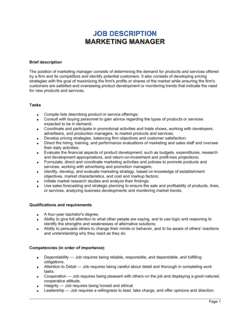
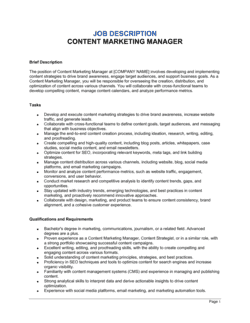
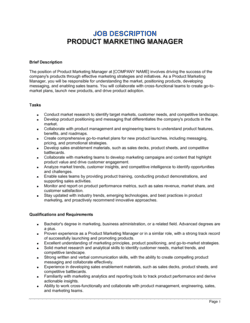
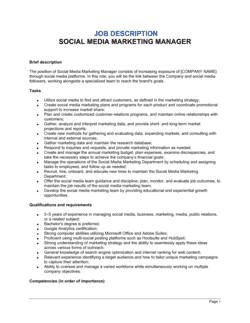
Marketing Director Job Description Template

Free Word download • Edit online • Save & share with Drive • Export to PDF

2 pages25–30 min to fillDifficulty: StandardSignature requiredLegal review recommended
Learn more ↓
FreeMarketing Director Job Description Template

At a glance

What it is
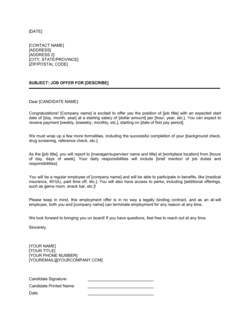
A Marketing Director Job Description is a formal document that defines the scope, responsibilities, qualifications, reporting structure, and compensation parameters for a senior marketing leadership role. This free Word download is fully editable online and can be exported as PDF for use in job postings, offer packages, or as an attachment to an employment contract.
When you need it
Use it when creating a new Marketing Director position, backfilling a departure, or formalizing responsibilities for an existing leader whose role has evolved beyond its original scope. It is also required when posting on job boards or when a candidate requests a written role definition before signing an offer.
What's inside
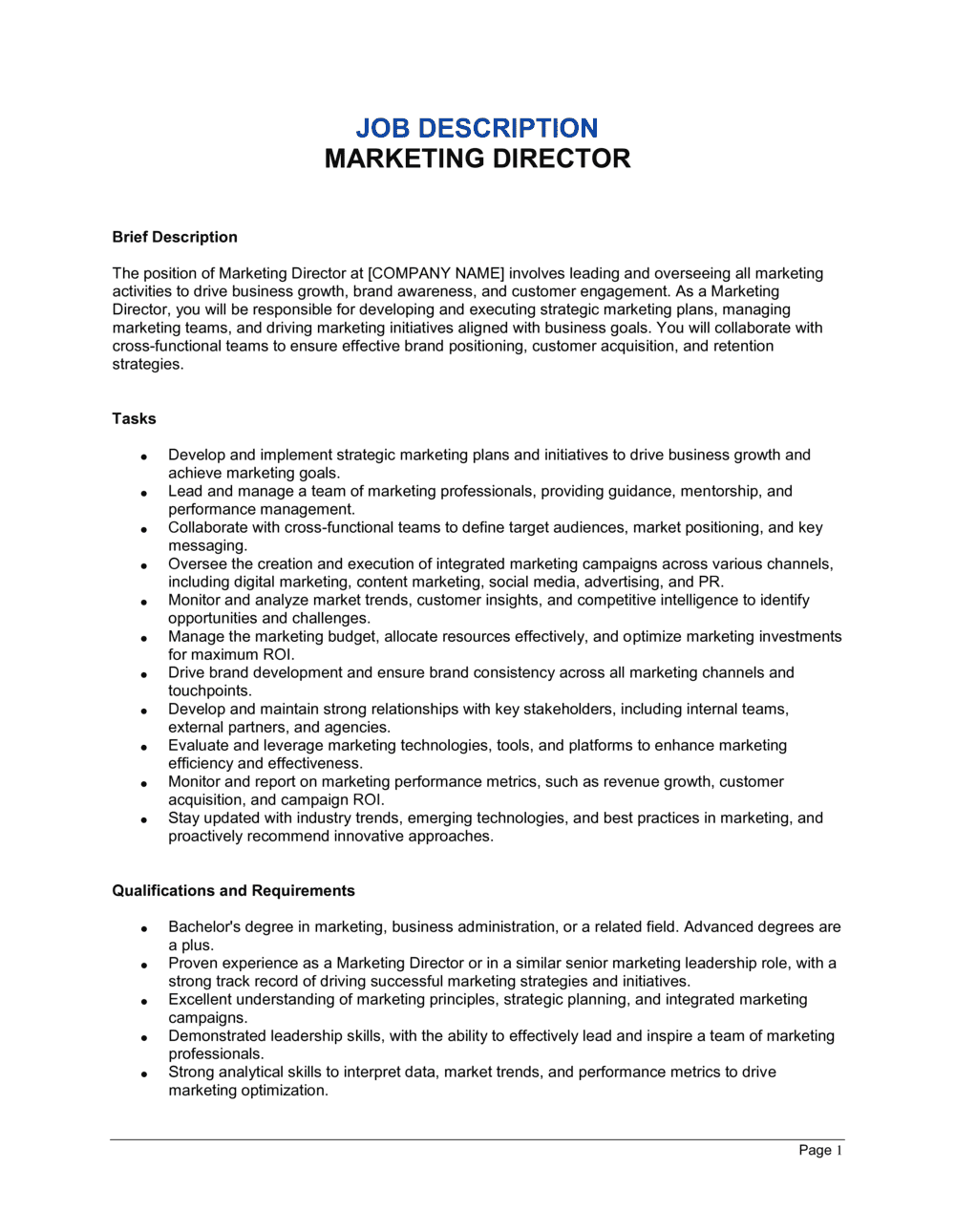
Role summary and reporting line, core duties and KPIs, required and preferred qualifications, team structure and direct reports, compensation range and benefits overview, travel and location requirements, and equal-opportunity and legal compliance language.

What is a Marketing Director Job Description?

A Marketing Director Job Description is a formal document that defines the full scope of a senior marketing leadership role — including core duties, performance metrics, required qualifications, team structure, compensation range, and legal compliance language. It functions simultaneously as a recruiting tool, a performance management baseline, and a legal record of agreed responsibilities. When attached to an employment contract, it creates a documented foundation for onboarding, goal-setting, and — where necessary — performance or termination proceedings.

Why You Need This Document

Hiring a Marketing Director without a clearly defined job description exposes the organization to three distinct risks. First, without measurable KPIs written into the role definition, performance disputes become subjective — making it difficult to document cause for underperformance or justify compensation decisions. Second, in jurisdictions including California, New York, Colorado, and the UK, publishing a job posting without a salary range now carries regulatory fines and reputational consequences. Third, courts in several jurisdictions have treated informal role descriptions as implied contractual terms, limiting an employer's ability to adjust responsibilities as business needs evolve. A properly drafted Marketing Director Job Description — with explicit KPIs, a non-contract disclaimer, an equal opportunity statement, and jurisdiction-appropriate pay transparency language — closes all three gaps. This template gives you a Word download you can tailor in under an hour, with every required section pre-structured and placeholder language ready to replace with your specifics.

Which variant fits your situation?

If your situation is…Use this template
Hiring a VP-level marketing leader with P&L ownership and board exposureVP of Marketing Job Description
Filling a mid-level role managing campaigns and a small teamMarketing Manager Job Description
Hiring a performance or growth marketing specialistDigital Marketing Manager Job Description
Defining a brand-focused leadership role in a consumer businessBrand Manager Job Description
Recruiting a content-led marketing leader for a SaaS or media companyContent Marketing Manager Job Description
Hiring a product-marketing specialist to own positioning and GTMProduct Marketing Manager Job Description
Combining the marketing and communications function under one leaderMarketing and Communications Director Job Description

Common mistakes to avoid

❌ Omitting the salary range in pay-transparency jurisdictions

Why it matters: California, New York, Colorado, Washington, and the UK legally require salary ranges in job postings. Non-compliance triggers regulatory fines and candidate trust erosion.

Fix: Check the pay-transparency laws for every location where the role will be posted or filled, and include the range by default — it improves candidate quality even where not required.

❌ No distinction between required and preferred qualifications

Why it matters: Treating preferred qualifications as required in screening shrinks the talent pool unnecessarily and may create disparate-impact liability if the criteria correlate with protected characteristics.

Fix: Review every qualification item with the hiring manager and label each as required or preferred before publishing. Remove any requirement that cannot be tied directly to job performance.

❌ Listing duties without measurable KPIs

Why it matters: A job description with no performance metrics makes it impossible to objectively evaluate performance, set expectations at hire, or document cause for termination.

Fix: Add a KPIs section with at least three specific, measurable outcomes tied to time periods — pipeline contribution, CAC, or MQL targets are standard for a Marketing Director.

❌ Omitting the non-contract disclaimer

Why it matters: Courts in several jurisdictions have found that detailed duty lists in job descriptions create implied employment terms that limit the employer's ability to change responsibilities or terminate.

Fix: Include a sentence stating that the job description does not constitute a contract of employment and may be modified by the employer at any time.

❌ Copying physical requirements from an unrelated role

Why it matters: Generic physical requirements that do not apply to the actual role create ADA and equivalent-law exposure — an employer must be able to defend each essential function as genuinely necessary.

Fix: Review the physical requirements section for each job description individually and remove any requirement that a Marketing Director will not realistically encounter in normal performance of the role.

❌ Describing an aspirational team structure that does not reflect reality

Why it matters: Candidates who accept a role expecting to lead a team of eight and arrive to find a team of two suffer an immediate trust breach — increasing early attrition and reducing time-to-productivity.

Fix: Describe the current team structure accurately, then separately state approved headcount additions the incoming Marketing Director will be responsible for hiring.

The 10 key clauses, explained

Role title, department, and reporting line

In plain language: States the official job title, the department the role sits in, who the Marketing Director reports to, and whether the role is full-time, part-time, or contract.

Sample language
Title: Marketing Director | Department: Marketing | Reports to: Chief Executive Officer | Employment Type: Full-Time, Exempt

Common mistake: Using an informal working title ('Head of Marketing') that differs from the payroll and HR system title — creating confusion in performance reviews, equity grants, and LinkedIn verification checks.

Role summary

In plain language: A 3–5 sentence overview of the role's purpose, its strategic scope, and the business outcomes it is accountable for.

Sample language
The Marketing Director leads [COMPANY NAME]'s marketing strategy, brand positioning, and demand generation function. This role owns the marketing budget of $[X] and is accountable for pipeline contribution, brand awareness, and customer acquisition targets.

Common mistake: Writing a summary so generic it could describe any marketing role at any company — failing to signal seniority, budget ownership, or the specific business context that attracts qualified candidates.

Core duties and responsibilities

In plain language: A structured list of the role's primary job functions, written as action-verb phrases and grouped by functional area — strategy, execution, team leadership, and cross-functional collaboration.

Sample language
Develop and execute the annual marketing strategy aligned to [COMPANY NAME]'s revenue targets. Manage a team of [X] marketers across brand, content, and demand generation. Own the marketing budget of $[X] and report monthly on ROI by channel.

Common mistake: Listing 20+ bullet points without prioritization, making it impossible for candidates or managers to identify which three to five responsibilities define success in the role.

Key performance indicators (KPIs)

In plain language: The specific, measurable outcomes the Marketing Director will be held accountable for — pipeline contribution, MQL volume, CAC, brand metrics, or revenue from marketing-sourced leads.

Sample language
Success in this role will be measured against: (1) Marketing-sourced pipeline: $[X]M per quarter; (2) Customer Acquisition Cost: at or below $[X]; (3) Monthly website unique visitors: [X]; (4) Net Promoter Score: [X] or above.

Common mistake: Omitting KPIs entirely and relying on vague language like 'drive growth.' Without measurable targets written into the role definition, performance reviews become subjective and termination for poor performance is harder to document.

Required qualifications

In plain language: The non-negotiable education, experience, and skills a candidate must have to be considered — typically a degree, years of experience, and specific domain expertise.

Sample language
Bachelor's degree in Marketing, Business, or a related field required; MBA preferred. Minimum [X] years of progressive marketing leadership experience, including at least [X] years managing a team of [X] or more direct reports.

Common mistake: Setting degree requirements that are not genuinely job-related — courts and regulators in multiple jurisdictions treat unjustified credential requirements as potential proxies for protected-class discrimination.

Preferred qualifications and competencies

In plain language: Additional skills, certifications, or experiences that strengthen a candidate's application but are not eliminatory — typically industry-specific expertise, tools proficiency, or leadership competencies.

Sample language
Experience marketing [PRODUCT TYPE] in a [INDUSTRY] environment preferred. Proficiency with HubSpot, Salesforce, and Google Analytics. Demonstrated ability to manage agency relationships and a $[X]M+ marketing budget.

Common mistake: Treating preferred qualifications as required in screening decisions — exposing the employer to disparate-impact claims if the criteria screen out protected groups at a higher rate than the general applicant pool.

Team structure and direct reports

In plain language: Describes the team the Marketing Director will lead — headcount, functional areas, and any open roles they will be responsible for hiring.

Sample language
This role leads a team of [X] full-time employees across [FUNCTION 1], [FUNCTION 2], and [FUNCTION 3], plus up to [X] agency and contractor relationships. The Marketing Director will be responsible for hiring a [ROLE] in Q[X] [YEAR].

Common mistake: Describing an idealized team structure that does not reflect the actual current state — candidates who discover reality differs significantly from the job description are more likely to exit within 90 days.

Compensation, benefits, and location

In plain language: States the base salary range, variable or bonus target, key benefits, work location (on-site, hybrid, or remote), and travel requirements.

Sample language
Base salary: $[MIN] – $[MAX] per year, commensurate with experience. Annual performance bonus up to [X]% of base. Location: [CITY, STATE] with [X] days per week on-site required. Travel: up to [X]% domestic, [X]% international.

Common mistake: Omitting the salary range in job postings published in jurisdictions — including California, New York, Colorado, and the UK — that legally require pay transparency, exposing the company to regulatory fines.

Equal opportunity and legal compliance statement

In plain language: A mandatory declaration that the employer does not discriminate on the basis of protected characteristics, and that the job description does not constitute a contract of employment.

Sample language
[COMPANY NAME] is an equal opportunity employer. All qualified applicants will receive consideration without regard to race, color, religion, sex, national origin, age, disability, or any other characteristic protected by applicable law. This job description is not a contract of employment.

Common mistake: Omitting the disclaimer that the job description is not a contract. Without it, courts in some jurisdictions have treated detailed duty lists as implied contractual terms, limiting the employer's ability to adjust responsibilities.

Physical requirements and work environment

In plain language: Describes any physical demands of the role and the typical work environment — required under the ADA and equivalent laws to ensure the employer can demonstrate essential functions are genuinely necessary.

Sample language
This role is primarily performed in a professional office or remote environment. The employee must be able to operate a computer for extended periods and occasionally lift items up to [X] lbs. Reasonable accommodations will be made for qualified individuals with disabilities.

Common mistake: Copying generic physical requirements from another job description without verifying they apply to this role — listing requirements like heavy lifting for a desk-based marketing role creates ADA compliance risk.

How to fill it out

  1. 1

    Define the role's strategic scope before writing

    Before opening the template, agree internally on whether this is a strategic leadership role (owning marketing strategy and budget) or a senior execution role (managing programs within a defined strategy). This distinction shapes the title, seniority level, and KPIs.

    💡 If the role reports to a CMO, it is likely execution-focused. If it reports directly to the CEO, it almost certainly needs full strategic ownership.

  2. 2

    Complete the title, department, and reporting line

    Enter the official HR system title, the department name, the title of the person this role reports to, and the employment classification (full-time exempt, in most cases for a director-level role).

    💡 Confirm the FLSA classification with your HR team or employment counsel before publishing — director-level marketing roles are almost always exempt, but compensation thresholds matter.

  3. 3

    Write the role summary in three to five sentences

    Describe the purpose of the role, the business function it leads, the approximate budget or team size it owns, and the outcomes it is accountable for. Be specific enough that a qualified candidate can self-screen.

    💡 Lead with the business outcome, not the activities: 'Owns $2M marketing budget and pipeline contribution of $10M/year' is more compelling than 'Manages the marketing team.'

  4. 4

    List core duties grouped by function

    Organize responsibilities into three to five functional clusters (strategy, team leadership, demand generation, brand, cross-functional collaboration). Limit each cluster to three to five bullet points. Use action verbs: develop, lead, manage, own, drive.

    💡 Keep the total duties list to 12–18 bullets. Longer lists dilute accountability and make the role look unmanageable to strong candidates.

  5. 5

    Define measurable KPIs

    Enter the specific metrics this role will be evaluated against — pipeline contribution targets, CAC thresholds, MQL volume, brand awareness scores, or revenue from marketing-sourced leads. Tie each metric to a time period.

    💡 If you cannot define at least three measurable KPIs at the time of posting, the role's scope is not yet clear enough to hire for effectively.

  6. 6

    Separate required from preferred qualifications

    List only genuinely necessary credentials as required — typically a relevant degree and a specific number of years of leadership experience. Move everything else to preferred. Review both lists to confirm they are job-related and do not inadvertently screen out protected groups.

    💡 Replace 'bachelor's degree required' with 'bachelor's degree or equivalent experience' to widen the candidate pool and reduce credential-discrimination risk.

  7. 7

    Add compensation range, location, and benefits

    Enter the base salary range, bonus target, key benefits, work location model (on-site, hybrid, remote), and travel expectations. Check whether the posting location requires pay range disclosure and include it accordingly.

    💡 Post the actual range you will pay, not an inflated one. Candidates who accept at the bottom of an unrealistic range leave faster when they discover peers are paid significantly more.

  8. 8

    Add the EOE statement and employment-contract disclaimer

    Include the equal opportunity employer statement and a sentence clarifying that the job description does not constitute a contract of employment and may be amended.

    💡 Have your HR lead or employment attorney approve the EOE language before publishing — the specific protected categories listed must meet the legal requirements of every jurisdiction where the role can be filled.

Frequently asked questions

What does a Marketing Director do?

A Marketing Director leads an organization's overall marketing strategy, owns the marketing budget, and is accountable for brand positioning, demand generation, and customer acquisition outcomes. They manage a team of marketing professionals, set KPIs across channels, and report pipeline and revenue contribution to the CEO or CMO. The specific scope varies by company size — in smaller businesses, the role is hands-on; in larger organizations, it is primarily strategic and team-leadership focused.

What qualifications does a Marketing Director need?

Most employers require a bachelor's degree in marketing, business, or a related field, along with seven to twelve years of progressive marketing experience including at least three to five years in a leadership role. An MBA is often preferred for roles with significant budget ownership or board exposure. Practical expertise in demand generation, brand strategy, CRM platforms, and marketing analytics is typically required regardless of formal credentials.

Is a Marketing Director job description a legally binding document?

On its own, a job description is not a contract of employment. However, courts in several jurisdictions have treated detailed duty lists as implied contractual terms when no explicit disclaimer is present. Including an explicit statement that the job description does not constitute a contract and may be amended by the employer protects the organization's flexibility to adjust responsibilities as business needs evolve.

Do I need to include a salary range in the job posting?

It depends on where the role will be filled. California, New York, Colorado, Washington, and the UK require salary range disclosure in job postings. Several other US states and Canadian provinces have passed or are considering similar legislation. Including the range regardless of jurisdiction typically improves application quality and reduces time-to-fill.

What is the difference between a Marketing Director and a VP of Marketing?

A Marketing Director typically manages a specific marketing function or regional scope and reports to a CMO or VP of Marketing. A VP of Marketing generally has broader strategic ownership, reports directly to the CEO or COO, and may carry P&L accountability. In smaller companies the titles are often used interchangeably, but in organizations with both roles, the VP level implies greater organizational authority and compensation.

What KPIs should a Marketing Director be measured on?

The most common KPIs for a Marketing Director include marketing-sourced pipeline contribution (dollar value per quarter), customer acquisition cost, MQL volume and conversion rates, marketing ROI by channel, website traffic and engagement metrics, brand awareness scores, and net promoter score. The right set depends on whether the role is primarily demand-generation or brand focused — define them in the job description before posting.

Can I use the same job description for multiple locations?

The core duties and qualifications can be shared across locations, but the salary range, equal opportunity language, and physical requirements must be reviewed for each jurisdiction. Pay transparency laws, minimum salary thresholds for exempt classification, and protected-characteristic lists differ by country, state, and province. Using a single unadapted description across multiple locations is a common compliance gap.

How often should a Marketing Director job description be updated?

Review it annually alongside the performance review cycle, and update it immediately when the role's scope, reporting structure, budget ownership, or team size changes materially. A job description that no longer reflects the actual role undermines performance management, complicates compensation benchmarking, and creates legal exposure if duties have expanded significantly beyond the agreed scope.

Should the job description be attached to the employment contract?

Attaching the job description as a schedule to the employment contract is common practice and creates a clear record of agreed duties. If you do attach it, include language in the contract confirming that the schedule can be updated with reasonable notice, and that the employer retains the right to assign additional duties consistent with the role's seniority. This avoids the job description becoming a rigid constraint on operational flexibility.

How this compares to alternatives

vs Marketing Manager Job Description

A Marketing Manager job description defines a mid-level role focused on executing campaigns and managing specific channels within a defined strategy. A Marketing Director description defines a senior leadership role with strategic ownership, budget accountability, and team management. Use the Manager template for roles reporting to the Director, and this template for the Director-level hire.

vs Employment Contract

An employment contract is the legally binding agreement governing compensation, IP rights, non-compete restrictions, and termination terms. A job description defines what the employee will do. The job description is typically attached to or referenced in the employment contract but is not a substitute for it — both documents serve distinct legal and operational functions.

vs Executive Employment Agreement

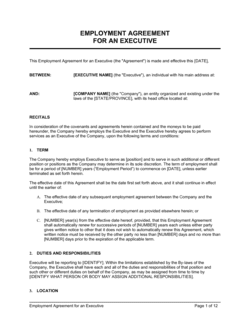
An executive employment agreement governs the full legal relationship — salary, equity, severance, and restrictive covenants — for C-suite or VP-level hires. A job description defines the role's scope and is not a binding agreement on its own. Director-level hires typically receive a standard employment contract with the job description attached, rather than a full executive agreement.

vs Offer Letter

An offer letter confirms the role, start date, and compensation to secure a candidate's acceptance. A job description defines the full scope of duties and qualifications. The offer letter references the job description but does not replace it — candidates should receive both, and the job description should be attached to the employment contract at signing.

Industry-specific considerations

Technology / SaaS

KPIs center on MQL volume, CAC payback period, and marketing-attributed ARR; the role typically owns the full marketing tech stack including HubSpot or Marketo and Salesforce.

Retail and e-commerce

Focus shifts to brand equity, customer retention metrics, seasonal campaign execution, and omnichannel coordination across paid, organic, and in-store channels.

Professional services

The role emphasizes thought leadership content, event marketing, and referral program management, with success measured against RFP conversion rates and client retention.

Healthcare and life sciences

Marketing claims are subject to FDA and FTC regulatory review; the job description must note compliance obligations and experience with regulated communications as a required qualification.

Manufacturing and industrial

Role typically combines trade-show management, distributor enablement, and technical content creation, with emphasis on lead generation for long B2B sales cycles.

Financial services

Marketing materials require compliance and legal review before publication; the job description should list experience with FINRA, FCA, or equivalent regulatory frameworks as a required or preferred qualification.

Jurisdictional notes

United States

Director-level marketing roles are almost always classified as exempt under the FLSA, but the salary threshold for exemption must meet or exceed the current federal minimum (updated periodically — confirm with the Department of Labor). California, New York, Colorado, and Washington require salary range disclosure in postings. California additionally restricts post-employment non-competes; avoid referencing non-compete obligations in the job description itself. The ADA requires that physical requirements reflect genuine essential functions of the specific role.

Canada

Employment standards vary by province; Ontario, British Columbia, and Alberta each set different minimums for overtime exemptions and termination notice. Quebec requires that job postings and employment documents be provided in French for provincially regulated employers. Pay transparency requirements are expanding — British Columbia requires salary ranges in postings as of 2023. The Canadian Human Rights Act and provincial equivalents govern protected characteristics in the qualifications section.

United Kingdom

Employers must provide a written statement of employment particulars on or before day one, and a well-drafted job description attached to that statement satisfies part of this obligation. The Equality Act 2010 requires that qualifications listed be genuinely job-related to avoid indirect discrimination claims. Pay transparency is increasingly scrutinized — while not yet universally mandated, the Equality (Race and Disability) Bill and existing gender pay gap reporting obligations make publishing salary ranges advisable.

European Union

The EU Pay Transparency Directive (effective 2026) will require employers to disclose salary ranges in job postings and provide pay information to candidates on request across all member states. GDPR applies to any personal data collected during the application process, including data referenced in the job description (e.g., LinkedIn profile requests). Non-compete references in job descriptions are scrutinized in Germany, France, and the Netherlands, where post-employment restrictions require financial compensation to be enforceable.

Template vs lawyer — what fits your deal?

PathBest forCostTime
Use the templateHR managers and founders creating a standard domestic Marketing Director role for a single locationFree30–60 minutes
Template + legal reviewRoles posted across multiple US states or internationally, or where the compensation structure includes equity or variable pay$200–$500 (HR consultant or employment attorney review)1–2 days
Custom draftedHighly regulated industries (healthcare, financial services), cross-border roles, or C-suite-adjacent positions with complex performance and termination terms$500–$2,000+3–7 days

Glossary

Job Description
A formal document outlining a role's duties, qualifications, reporting structure, and employment terms — used in hiring, performance management, and compliance.
Essential Functions
The core duties that define the role and that a qualified employee must be able to perform, with or without reasonable accommodation — a legally significant distinction under the ADA and equivalent laws.
KPI (Key Performance Indicator)
A measurable value used to evaluate how effectively a role-holder is achieving defined business objectives.
Reporting Structure
The formal hierarchy specifying who the Marketing Director reports to and who reports to them — critical for authority, accountability, and organizational design.
FLSA Classification
A US-specific designation determining whether a role is exempt or non-exempt from overtime pay requirements under the Fair Labor Standards Act.
Reasonable Accommodation
Modifications to a role's duties or work environment that enable a qualified person with a disability to perform the job's essential functions.
Equal Opportunity Employer (EOE) Statement
A declaration that the employer does not discriminate based on protected characteristics such as race, sex, age, religion, disability, or national origin.
At-Will Employment
An employment arrangement — common in most US states — where either party may end the relationship at any time for any lawful reason without advance notice.
Compensation Range
The minimum and maximum base salary budgeted for a role, which many jurisdictions now require employers to disclose in job postings.
Organizational Chart (Org Chart)
A visual diagram showing the hierarchy and reporting relationships within a company or department, often referenced alongside a job description.
Preferred vs. Required Qualifications
A distinction between credentials and experience that are mandatory for consideration (required) versus attributes that strengthen a candidate's application (preferred).

Part of your Business Operating System

This document is one of 3,000+ business & legal templates included in Business in a Box.

  • Fill-in-the-blanks — ready in minutes
  • 100% customizable Word document
  • Compatible with all office suites
  • Export to PDF and share electronically

Create your document in 3 simple steps.

From template to signed document — all inside one Business Operating System.
1
Download or open template

Access over 3,000+ business and legal templates for any business task, project or initiative.

2
Edit and fill in the blanks with AI

Customize your ready-made business document template and save it in the cloud.

3
Save, Share, Send, Sign

Share your files and folders with your team. Create a space of seamless collaboration.

Save time, save money, and create top-quality documents.

★★★★★

"Fantastic value! I'm not sure how I'd do without it. It's worth its weight in gold and paid back for itself many times."

Managing Director · Mall Farm
Robert Whalley
Managing Director, Mall Farm Proprietary Limited
★★★★★

"I have been using Business in a Box for years. It has been the most useful source of templates I have encountered. I recommend it to anyone."

Business Owner · 4+ years
Dr Michael John Freestone
Business Owner
★★★★★

"It has been a life saver so many times I have lost count. Business in a Box has saved me so much time and as you know, time is money."

Owner · Upstate Web
David G. Moore Jr.
Owner, Upstate Web

Run your business with a system — not scattered tools

Stop downloading documents. Start operating with clarity. Business in a Box gives you the Business Operating System used by over 250,000 companies worldwide to structure, run, and grow their business.

Start free · No credit card required