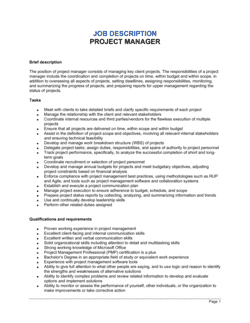
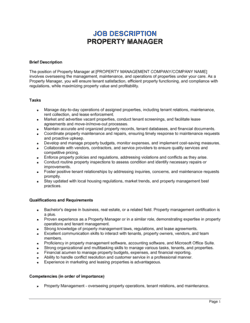
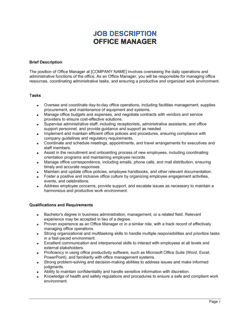
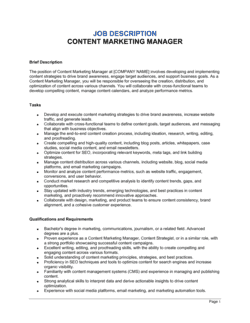
Program Manager Job Description Template

Free Word download • Edit online • Save & share with Drive • Export to PDF

2 pages20–30 min to fillDifficulty: StandardSignature requiredLegal review recommended
Learn more ↓
FreeProgram Manager Job Description Template

At a glance

What it is
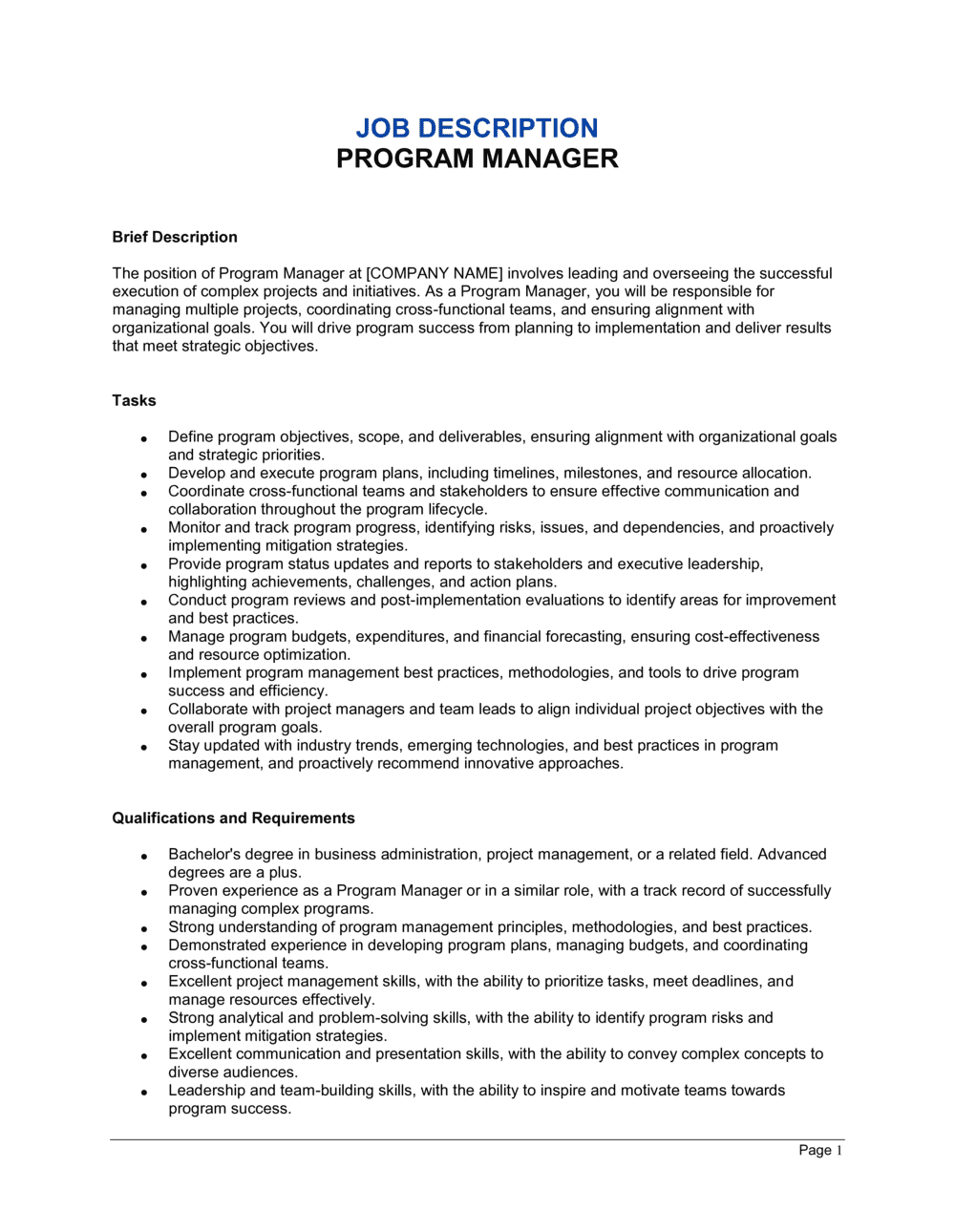
A Program Manager Job Description is a formal employment document that defines the scope, responsibilities, qualifications, reporting structure, and terms of engagement for a program manager role. This free Word download gives you a structured, legally grounded starting point you can edit online and export as PDF to post on job boards, attach to offer letters, or incorporate directly into an employment contract.
When you need it
Use it when opening a new program manager position, backfilling a vacated role, or standardizing inconsistent role definitions across departments or business units. It is also required when the job description must be attached to an employment agreement or used as the basis for a performance management framework.
What's inside
Role title and department, reporting line, position summary, core responsibilities and deliverables, required and preferred qualifications, competency expectations, compensation range, working conditions, and equal opportunity statement. Together these sections create a defensible record of what the employer contracted the employee to perform.

What is a Program Manager Job Description?

A Program Manager Job Description is a formal employment document that defines the scope of responsibilities, required qualifications, reporting relationships, compensation parameters, and employment conditions for a program manager role. Unlike an informal role summary, a properly drafted job description carries legal weight — it establishes the contractual basis for performance management, supports FLSA classification, satisfies pay transparency requirements in covered jurisdictions, and provides the factual record an employer needs in any scope-of-duty, discrimination, or wrongful termination dispute. This template is a free Word download you can edit online and export as PDF to post on job boards, attach to an offer letter, or incorporate as Schedule A in a formal employment contract.

Why You Need This Document

Without a clearly drafted, signed job description, employers face exposure on multiple fronts simultaneously. An undocumented or vague role definition makes performance management nearly impossible to defend — when the employee's duties were never formally agreed upon, disciplinary action and termination decisions become credibility contests rather than contract interpretation. Misclassifying the role as exempt from overtime without a documented duties analysis creates retroactive pay liability under the FLSA of up to three years. Posting a role in California, Colorado, New York, or Washington without a disclosed salary range triggers regulatory fines. And attaching an outdated or unsigned job description to an employment contract leaves IP assignment, non-compete, and cause-for-termination clauses without the factual foundation they require. This template closes all four gaps — giving you a defensible, jurisdiction-aware document that protects the hiring process from first posting through final performance review.

Which variant fits your situation?

If your situation is…Use this template
Hiring a senior-level program manager overseeing multiple portfoliosSenior Program Manager Job Description
Recruiting a technical program manager for an engineering or product orgTechnical Program Manager Job Description
Defining a program manager role within a formal PMO structurePMO Program Manager Job Description
Hiring a program manager on a fixed-term or contract basisContract Program Manager Job Description
Creating a project manager role at a lower seniority levelProject Manager Job Description
Hiring a program coordinator to support an existing program managerProgram Coordinator Job Description
Attaching the job description to a formal employment agreementEmployment Contract

Common mistakes to avoid

❌ Omitting the FLSA classification

Why it matters: Failing to designate the role as exempt or non-exempt exposes the employer to unpaid overtime liability that can accrue retroactively for up to three years under federal law and longer under some state statutes.

Fix: Confirm classification with HR or employment counsel before publishing. Document the duties test analysis used to support the exempt designation and retain it in the hiring file.

❌ Using education requirements without a business-necessity justification

Why it matters: Blanket degree requirements not tied to specific job functions create disparate-impact liability under EEOC Title VII guidelines and have led to regulatory enforcement actions against major employers.

Fix: Audit each required credential against the actual duties performed. Replace degree requirements with equivalent-experience alternatives wherever the job function does not genuinely require a degree.

❌ Skipping pay range disclosure in covered jurisdictions

Why it matters: California, New York, Colorado, Washington, and several municipalities require salary range disclosure in job postings. Non-compliance results in regulatory fines, applicant lawsuits, and reputational damage.

Fix: Maintain a compliance calendar for pay-transparency laws by posting location and update job description templates before each hiring cycle.

❌ Not obtaining a signed acknowledgment from the employee

Why it matters: An unsigned job description has limited evidentiary value in wrongful termination, misclassification, or scope-of-duty disputes — the employer cannot prove the employee was aware of and agreed to the stated responsibilities.

Fix: Add a signature block to every job description and execute it alongside the employment agreement before the first day of work.

❌ Conflating program manager and project manager duties

Why it matters: A job description that blurs the line between program and project management attracts mismatched candidates, creates performance evaluation ambiguity, and can support misclassification claims if compensation structures differ between the two roles.

Fix: Define program management scope explicitly — overseeing multiple related projects toward a strategic objective — and distinguish it from single-project delivery in the position summary and responsibilities sections.

❌ Treating the job description as a static document

Why it matters: A job description that does not reflect the employee's actual duties weakens the employer's position in performance management, accommodation requests, and termination proceedings — courts look at what the employee actually did, not what was written three years prior.

Fix: Review and update job descriptions annually, have employees re-acknowledge material changes, and retain each version with its effective date in the personnel file.

The 10 key clauses, explained

Role title, department, and reporting line

In plain language: States the exact job title, the department or business unit, the position's place in the org chart, and the title of the direct supervisor.

Sample language
Job Title: Program Manager | Department: [DEPARTMENT NAME] | Reports To: [TITLE OF DIRECT SUPERVISOR] | Location: [CITY, STATE / REMOTE]

Common mistake: Using an inflated or inconsistent title that doesn't match payroll or HR systems — creating misalignment in compensation benchmarking and triggering re-grading disputes at offer stage.

Position summary

In plain language: A 3–5 sentence overview of the role's primary purpose, the outcomes it is accountable for, and how it fits into the broader organization.

Sample language
The Program Manager is responsible for overseeing the planning, execution, and delivery of [PROGRAM NAME OR TYPE], coordinating across [NUMBER] project teams to achieve [STRATEGIC OBJECTIVE]. This role partners with [STAKEHOLDER GROUPS] to ensure alignment between program deliverables and organizational priorities.

Common mistake: Writing a summary so broad it could apply to any manager — leaving candidates and evaluators with no clear picture of what makes this role distinct from a project manager or operations manager.

Core responsibilities and deliverables

In plain language: A structured list of the key duties the employee is expected to perform, written as action-verb statements that are specific enough to form the basis of a performance review.

Sample language
- Lead end-to-end program planning for [PROGRAM TYPE], including scope definition, resource allocation, and milestone scheduling. - Track and report program status against [KPI / METRIC] on a [CADENCE] basis to [STAKEHOLDER]. - Identify and resolve cross-project dependencies and escalate risks exceeding [THRESHOLD] to [TITLE].

Common mistake: Listing generic duties like 'manage projects and communicate with stakeholders' without specifying scope, cadence, or decision-making authority — making performance management ambiguous.

Required qualifications

In plain language: The minimum education, certifications, years of experience, and hard skills an applicant must have to be considered for the role.

Sample language
- Bachelor's degree in [FIELD] or equivalent work experience. - [X]+ years of program management experience, including [SPECIFIC CONTEXT]. - [PMP / PgMP / PRINCE2] certification or equivalent. - Demonstrated experience managing budgets of $[AMOUNT]+ and cross-functional teams of [SIZE]+.

Common mistake: Setting education requirements (e.g., 'bachelor's degree required') that are not demonstrably related to job performance — creating disparate-impact liability under EEOC guidelines in the US.

Preferred qualifications

In plain language: Supplementary credentials or experience that differentiate strong candidates but are not eliminatory if absent.

Sample language
- Master's degree in [FIELD] or MBA preferred. - Experience with [SPECIFIC METHODOLOGY, e.g., Agile, SAFe, Waterfall] in a [INDUSTRY] environment. - Familiarity with [TOOLS, e.g., Jira, Smartsheet, MS Project].

Common mistake: Treating preferred qualifications as de facto requirements during screening — effectively excluding qualified candidates and undermining the legal distinction between required and preferred.

Competencies and behavioral expectations

In plain language: The leadership, communication, and problem-solving attributes the employer expects the program manager to demonstrate on the job.

Sample language
- Ability to influence without authority across teams at the [LEVEL] level. - Strong written and verbal communication skills, including executive-level reporting. - Demonstrated ability to manage ambiguity in a [fast-paced / matrixed / regulated] environment.

Common mistake: Including subjective competency language like 'must be a team player' or 'excellent interpersonal skills' without behavioral indicators — language that cannot be assessed objectively during hiring or performance review.

Compensation, classification, and benefits

In plain language: States the compensation range, FLSA classification (exempt or non-exempt), employment type (full-time, part-time, contract), and benefits eligibility.

Sample language
Compensation: $[MINIMUM] – $[MAXIMUM] annually, commensurate with experience. FLSA Status: Exempt. Employment Type: Full-Time. Benefits: Eligible for [COMPANY NAME]'s standard benefits program, including [HEALTH / DENTAL / VISION / 401(k) / PTO].

Common mistake: Omitting the compensation range in jurisdictions where pay transparency is legally required — exposing the employer to regulatory penalties and reputational risk in markets where salary bands are expected.

Working conditions and physical requirements

In plain language: Describes the work environment, travel expectations, remote or on-site requirements, and any physical demands relevant to ADA compliance.

Sample language
This role operates in a standard office environment. Up to [X]% travel may be required. The employee must be able to remain in a stationary position for extended periods and operate standard office equipment. Reasonable accommodations may be made for individuals with disabilities.

Common mistake: Omitting physical requirements entirely or listing demands unrelated to actual job functions — both create ADA compliance exposure and can be challenged during the reasonable-accommodation process.

Equal opportunity and non-discrimination statement

In plain language: A required declaration affirming the employer's commitment to non-discriminatory hiring practices across all protected classes.

Sample language
[COMPANY NAME] is an equal opportunity employer. We do not discriminate on the basis of race, color, religion, sex, national origin, age, disability, veteran status, sexual orientation, gender identity, or any other characteristic protected by applicable law.

Common mistake: Using a boilerplate EEO statement that omits protected classes added by state or local law — for example, failing to include sexual orientation in jurisdictions where it is explicitly protected.

Acknowledgment and signature block

In plain language: Confirms the employee has read, understood, and agreed to the job description as a condition of employment or continued employment.

Sample language
I acknowledge that I have received, read, and understand the job description for the [JOB TITLE] position. I agree that this description accurately reflects the general nature and level of work expected of me. Employee Signature: ____________________ Date: ____________ Hiring Manager Signature: ______________ Date: ____________

Common mistake: Treating the job description as informational rather than having it signed — losing the evidentiary value it provides in wrongful termination, misclassification, or scope-of-duty disputes.

How to fill it out

  1. 1

    Define the role title and org chart position

    Enter the exact job title as it will appear in payroll and HR systems. Identify the direct supervisor's title and, if applicable, the titles of any direct reports. Confirm the department and physical or remote location.

    💡 Align the title to your internal job-leveling framework before posting — misaligned titles cause compensation disputes and complicate future re-grading.

  2. 2

    Write a focused position summary

    Draft 3–5 sentences that explain the role's primary purpose, the program or portfolio it governs, and the strategic outcome it is accountable for. Name the key stakeholder groups the program manager will work with.

    💡 Read the summary aloud — if it could describe a project coordinator or a VP of operations equally well, it is too broad and needs tightening.

  3. 3

    List core responsibilities as measurable action statements

    Write 8–12 bullet points beginning with strong action verbs (Lead, Develop, Report, Coordinate, Escalate). Where possible, include scope indicators such as budget size, team size, cadence, or threshold values.

    💡 Each responsibility should be specific enough to serve as a performance review criterion — vague duties are unenforceable in disciplinary proceedings.

  4. 4

    Separate required from preferred qualifications

    List only genuinely eliminatory criteria under required qualifications — years of experience, certifications, and hard skills the role cannot function without. Move everything else to preferred. Confirm each required credential has a documented business justification.

    💡 In the US, education requirements that lack a demonstrable job-relatedness nexus create disparate-impact liability — document the justification in your hiring file even if you don't publish it.

  5. 5

    Set the compensation range and FLSA classification

    Enter the salary band in full. Confirm the FLSA classification (exempt vs. non-exempt) with HR or legal before publishing — misclassification triggers back-pay liability. Note benefits eligibility and employment type.

    💡 Check whether your posting location requires pay range disclosure — California, New York, Colorado, and Washington all mandate it as of 2025.

  6. 6

    Add working conditions and physical requirements

    Describe the work environment (office, remote, hybrid), expected travel percentage, and any physical demands relevant to job performance. Include the standard ADA reasonable-accommodation language.

    💡 List only physical requirements that are genuine job necessities — overstating them creates reasonable-accommodation disputes and deters qualified applicants.

  7. 7

    Include the EEO statement with jurisdiction-specific protected classes

    Use the standard federal EEO language as a base and add any protected classes required by your state or local law — sexual orientation, gender identity, or military status, for example.

    💡 Keep a current list of protected classes by jurisdiction in your HR policy library and update job descriptions annually as laws change.

  8. 8

    Obtain signatures before the employee's start date

    Route the completed job description to the hiring manager and new employee for signature before day one. File the signed copy alongside the employment agreement in the employee's personnel record.

    💡 A signed job description is your primary evidence in performance management, classification disputes, and wrongful termination claims — treat it with the same care as the employment contract itself.

Frequently asked questions

What is a program manager job description?

A program manager job description is a formal document that defines the responsibilities, qualifications, reporting structure, compensation range, and employment terms for a program manager role. It serves as both a recruiting tool — posted on job boards to attract candidates — and a legal record — attached to the employment agreement to establish the contractual scope of the role. A signed job description is the employer's primary evidence in performance management and scope-of-duty disputes.

What is the difference between a program manager and a project manager?

A project manager oversees a single, defined project with a specific start date, end date, and deliverable. A program manager oversees a group of related projects managed in a coordinated way to achieve a strategic outcome that individual projects cannot deliver alone. Program managers typically operate at a higher organizational level, manage larger budgets and cross-functional teams, and are accountable for long-term benefit realization rather than individual project delivery.

What qualifications should a program manager job description require?

Typical required qualifications include a bachelor's degree in a relevant field (or equivalent experience), 5–8 years of program or project management experience, and a recognized certification such as PMP, PgMP, or PRINCE2. Preferred qualifications often add an MBA, experience with Agile or SAFe methodologies, and familiarity with tools like Jira, Smartsheet, or MS Project. Required credentials should have a documented job-relatedness justification to avoid EEOC disparate-impact exposure.

Does a job description need to be signed?

No federal or provincial law mandates a signed job description, but obtaining a signature is strongly recommended. A signed acknowledgment proves the employee received and understood their role expectations, which is material evidence in performance management proceedings, wrongful termination claims, and reasonable-accommodation disputes. Execute the signature block alongside — or as part of — the employment agreement before the employee's first day.

Is pay range disclosure required in job descriptions?

It depends on the posting location. California, New York, Colorado, and Washington require employers to disclose the pay range for any advertised position. Several additional municipalities have adopted similar rules. Non-disclosure in covered jurisdictions triggers regulatory fines and applicant complaints. Maintain a current compliance calendar for pay-transparency requirements in every location where you post roles.

Can a job description be used in an employment contract?

Yes — and this is one of its primary legal functions. Attaching a signed job description to an employment agreement as Schedule A establishes the contractual scope of duties, supports IP assignment clauses, and provides the factual basis for termination-for-cause provisions. Courts and arbitrators regularly rely on the job description when determining whether an employer's performance expectations were communicated and agreed to.

What should the FLSA classification section include?

The FLSA classification line should state whether the role is Exempt or Non-Exempt, the exemption category relied upon (Executive, Administrative, or Professional), and the basis for the classification. Program managers are typically classified as exempt under the Administrative or Executive exemption, but the classification must be supported by a duties test — not merely by salary level. Misclassification of a non-exempt employee as exempt triggers up to three years of back overtime under federal law.

How often should a program manager job description be updated?

Review job descriptions at minimum annually and whenever the role's responsibilities materially change — for example, when the program manager takes on a new portfolio, gains direct reports, or absorbs duties from an eliminated position. Have the employee re-acknowledge material changes in writing. A job description that is more than 18 months out of date is a liability, not an asset, in any employment dispute.

What is the equal opportunity statement and is it legally required?

An equal opportunity employer statement declares that the company does not discriminate in hiring based on race, color, religion, sex, national origin, age, disability, or other protected characteristics. Federal contractors in the US are legally required to include EEO language in job postings. Non-contractors are not federally mandated to include it, but omission creates reputational risk and may conflict with state or local fair employment laws. Always tailor the statement to include protected classes required by the laws of your specific posting location.

How this compares to alternatives

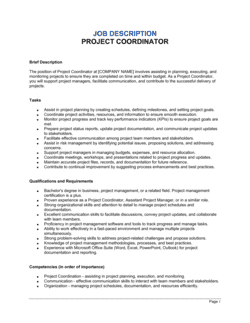
vs Project Manager Job Description

A project manager job description defines accountability for a single, time-bound project with a specific deliverable and budget. A program manager job description defines accountability for a portfolio of related projects aligned to a strategic objective. The program manager role is typically more senior, involves more stakeholder management, and requires broader organizational influence. Use the project manager template for tactical delivery roles and the program manager template for portfolio-level strategic roles.

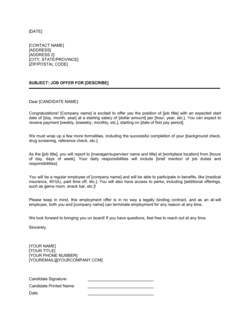
vs Job Offer Letter

A job offer letter confirms compensation, start date, and employment terms to secure candidate acceptance. A job description defines the scope of duties, required qualifications, and performance expectations in binding detail. The two documents serve complementary functions — the offer letter triggers acceptance; the job description governs day-to-day role execution and performance management. Both should be signed before day one.

vs Employment Contract

An employment contract is the master legal agreement governing IP assignment, confidentiality, non-compete, termination, and severance. A job description is typically attached as Schedule A to the employment contract, defining the specific duties and qualifications that give context to the contract's performance and termination clauses. The job description without an employment contract lacks enforceable confidentiality and IP protections.

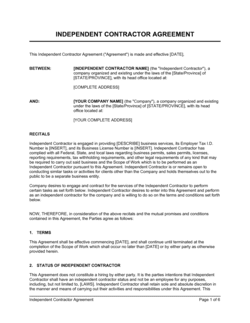
vs Independent Contractor Agreement

An independent contractor agreement engages a self-employed program manager for a defined scope of work without creating an employment relationship — no benefits, payroll taxes, or FLSA protections apply. A job description is an employment document that establishes an employee relationship with all associated legal obligations. Misclassifying an employee program manager as a contractor triggers back-tax liability, benefit obligations, and regulatory penalties.

Industry-specific considerations

Technology / SaaS

Program managers in SaaS organizations typically oversee cross-functional product or platform initiatives, requiring Agile or SAFe methodology experience and familiarity with engineering and product roadmap tooling.

Healthcare / MedTech

Healthcare program managers must coordinate regulatory compliance workstreams, clinical trials, or EHR implementation programs — requiring HIPAA awareness and experience navigating multi-stakeholder clinical environments.

Financial Services

Program managers in financial services oversee compliance transformation, digital banking rollouts, or regulatory remediation programs — often requiring knowledge of SOX, FINRA, or FCA frameworks and familiarity with audit and risk governance.

Government and Public Sector

Public sector program managers operate under procurement rules, federal contracting requirements (FAR), and security clearance mandates — job descriptions often reference specific contract vehicles and agency-specific performance standards.

Construction and Infrastructure

Program managers in construction oversee multi-site capital programs, coordinating general contractors, engineers, and permitting authorities — job descriptions typically specify project value thresholds, safety certification requirements, and scheduling software proficiency.

Professional Services

Consulting and professional services firms use program manager job descriptions to define client-delivery accountability, billable utilization targets, and practice development responsibilities alongside internal program governance.

Jurisdictional notes

United States

Program manager roles are typically classified as exempt under the FLSA Administrative or Executive exemption, but the duties test must be documented — salary level alone is insufficient. California, Colorado, New York, and Washington require salary range disclosure in job postings. California additionally restricts non-compete clauses that may be referenced in accompanying employment agreements. EEOC guidelines require that any minimum education or experience requirements be demonstrably job-related.

Canada

Canadian job descriptions must be consistent with provincial employment standards legislation governing hours of work, overtime, and termination notice. Quebec employers must ensure all employment documents — including job descriptions — are available in French for provincially regulated workplaces under the Charter of the French Language. Pay transparency requirements are emerging in British Columbia and Prince Edward Island as of 2025.

United Kingdom

UK employers must provide a written statement of employment particulars on or before day one, and the job description is typically incorporated by reference. The Equality Act 2010 requires that job requirements be proportionate and non-discriminatory across all nine protected characteristics. Gender pay gap reporting obligations apply to employers with 250 or more employees, making consistent job leveling and compensation documentation important for compliance.

European Union

The EU Pay Transparency Directive (2023/970), which member states must implement by June 2026, requires employers to disclose salary ranges in job postings and prohibits asking candidates about prior salary history. GDPR applies to any personal data collected during the recruitment process, requiring a lawful basis for processing and a privacy notice at the point of collection. Works council consultation may be required before publishing new job descriptions in Germany, France, and the Netherlands.

Template vs lawyer — what fits your deal?

PathBest forCostTime
Use the templateStandard domestic program manager hires at mid-level in a single US state or Canadian provinceFree30–45 minutes
Template + legal reviewRoles with complex FLSA classification, cross-border applicants, or positions requiring pay transparency compliance in multiple jurisdictions$200–$5001–2 days
Custom draftedSenior program managers with equity, federal contractors subject to OFCCP compliance, or regulated industries such as healthcare and financial services$800–$2,500+3–7 days

Glossary

Program Manager
A professional responsible for overseeing a group of related projects managed in a coordinated way to obtain benefits and control not available from managing them individually.
Portfolio Management
The centralized management of one or more portfolios of projects or programs to achieve strategic objectives.
Scope of Work
A section of the job description that defines the boundaries of the role — what the employee is and is not responsible for.
Reporting Structure
The formal hierarchy identifying who the program manager reports to and, where applicable, who reports to them.
KPI (Key Performance Indicator)
A measurable value used to evaluate how effectively the program manager is achieving role objectives.
RACI Matrix
A framework mapping role responsibilities as Responsible, Accountable, Consulted, or Informed — used to clarify the program manager's decision-making authority.
FLSA Classification
The US Fair Labor Standards Act designation determining whether the role is exempt or non-exempt from overtime pay requirements.
Essential Functions
The fundamental job duties the employee must be able to perform, with or without reasonable accommodation — an ADA compliance requirement in the US.
At-Will Employment
A US employment arrangement in which either party may terminate the relationship at any time for any lawful reason — typically referenced or incorporated by the job description via the attached employment agreement.
Equal Opportunity Statement
A required declaration confirming the employer does not discriminate based on protected characteristics such as race, gender, age, disability, or national origin.
Preferred Qualifications
Credentials or experience that are desirable but not mandatory for the role, used to differentiate between equally qualified candidates.

Part of your Business Operating System

This document is one of 3,000+ business & legal templates included in Business in a Box.

  • Fill-in-the-blanks — ready in minutes
  • 100% customizable Word document
  • Compatible with all office suites
  • Export to PDF and share electronically

Create your document in 3 simple steps.

From template to signed document — all inside one Business Operating System.
1
Download or open template

Access over 3,000+ business and legal templates for any business task, project or initiative.

2
Edit and fill in the blanks with AI

Customize your ready-made business document template and save it in the cloud.

3
Save, Share, Send, Sign

Share your files and folders with your team. Create a space of seamless collaboration.

Save time, save money, and create top-quality documents.

★★★★★

"Fantastic value! I'm not sure how I'd do without it. It's worth its weight in gold and paid back for itself many times."

Managing Director · Mall Farm
Robert Whalley
Managing Director, Mall Farm Proprietary Limited
★★★★★

"I have been using Business in a Box for years. It has been the most useful source of templates I have encountered. I recommend it to anyone."

Business Owner · 4+ years
Dr Michael John Freestone
Business Owner
★★★★★

"It has been a life saver so many times I have lost count. Business in a Box has saved me so much time and as you know, time is money."

Owner · Upstate Web
David G. Moore Jr.
Owner, Upstate Web

Run your business with a system — not scattered tools

Stop downloading documents. Start operating with clarity. Business in a Box gives you the Business Operating System used by over 250,000 companies worldwide to structure, run, and grow their business.

Start free · No credit card required