Content Marketing Manager Job Description Template

Free Word download • Edit online • Save & share with Drive • Export to PDF

2 pages25–30 min to fillDifficulty: StandardSignature requiredLegal review recommended
Learn more ↓
FreeContent Marketing Manager Job Description Template

At a glance

What it is
A Content Marketing Manager Job Description is a formal document that defines the scope of the role, core responsibilities, required qualifications, reporting structure, compensation range, and terms of engagement for a Content Marketing Manager. This free Word download can be edited online and exported as PDF for use in job postings, employment contracts, or internal HR records.
When you need it
Use it when hiring a new Content Marketing Manager, promoting an existing employee into the role, or formalizing responsibilities for a team member whose duties have evolved. It is also required when the job description is incorporated by reference into an employment contract.
What's inside
Role title and reporting line, position summary, core duties and responsibilities, required and preferred qualifications, compensation and benefits outline, work location and schedule, performance metrics, IP and confidentiality notice, and equal opportunity statement.

What is a Content Marketing Manager Job Description?

A Content Marketing Manager Job Description is a formal document that defines the scope, responsibilities, qualifications, performance expectations, and employment terms for a Content Marketing Manager role. It specifies what the manager is expected to accomplish — from owning the editorial calendar and driving organic traffic to managing freelance writers and reporting content-attributed pipeline — and establishes the compensation range, work location, reporting structure, and IP ownership terms that govern the engagement. When incorporated by reference into a signed employment contract, the job description becomes a binding Schedule that supports performance management, IP enforcement, and termination decisions.

Why You Need This Document

Hiring a Content Marketing Manager without a structured job description creates four compounding problems. First, without defined KPIs and responsibilities, performance management becomes subjective — making it legally and practically difficult to address underperformance or justify termination for cause. Second, in pay-transparency jurisdictions including California, Colorado, New York, and Washington, publishing a job posting without a salary range exposes the employer to fines of up to $10,000 per violation. Third, absent explicit IP assignment language incorporated into the employment contract, content, strategy documents, and creative assets produced by the employee may not unambiguously belong to the company — a serious risk for businesses whose primary marketing asset is the content itself. Fourth, vague location and schedule language creates the conditions for constructive dismissal claims in Canada and the UK when the employer later enforces a return-to-office requirement. This template addresses all four risks in a single document you can edit in 20 minutes and attach as a Schedule to your standard employment agreement.

Which variant fits your situation?

If your situation is…Use this template
Hiring a content creator focused on writing and editorial output onlyContent Writer Job Description
Hiring a senior leader to own the full marketing strategyMarketing Manager Job Description
Hiring for social media content and community managementSocial Media Manager Job Description
Hiring an SEO-focused content specialistSEO Specialist Job Description
Hiring for a VP or Director of Content role with budget ownershipDirector of Content Job Description
Engaging a freelance content strategist on a project basisIndependent Contractor Agreement
Formalizing the role description within an employment contractEmployment Contract

Common mistakes to avoid

❌ Omitting the salary range in pay-transparency jurisdictions

Why it matters: Colorado, California, New York, Washington, and several municipalities require salary range disclosure in job postings. Violations carry fines of $500–$10,000 per posting, and repeated violations can trigger enforcement investigations.

Fix: Confirm the pay transparency laws in every location where the posting will be published and include the approved salary range in both the public posting and this document.

❌ Using the job description as the sole IP assignment vehicle

Why it matters: Courts generally treat job descriptions as informational rather than binding. Relying on this document alone — without an employment contract that incorporates or mirrors the IP clause — leaves content ownership legally uncertain.

Fix: Incorporate the IP assignment clause by reference into the signed employment contract or duplicate its language there, and have the employee sign before their start date.

❌ Listing 20 or more responsibilities without structure

Why it matters: An unscoped role description makes performance management subjective, contributes to burnout as the employee tries to do everything, and signals to candidates that the company lacks strategic clarity about the function.

Fix: Cap responsibilities at 12 items grouped into 2–3 thematic clusters. Move anything beyond that scope to a separate document or a future role.

❌ Describing location as 'flexible' without a defined standard

Why it matters: Vague location language leads to disputes when the employer later enforces a return-to-office policy. Without a documented expectation at hire, the employer may face constructive dismissal claims in Canada and the UK.

Fix: State the exact arrangement — on-site days per week, required time zone, and any exceptions — in clear, specific terms at the time of hire.

❌ Setting qualification requirements that create disparate-impact risk

Why it matters: Blanket degree requirements or tool-specific prerequisites that disproportionately screen out candidates from protected groups can expose the employer to EEOC complaints, even if unintentional.

Fix: Audit required qualifications against the actual job demands. Where demonstrated skill or a portfolio substitutes for a credential, list it as an alternative path in the qualifications clause.

❌ Failing to incorporate KPIs into the employment contract

Why it matters: KPIs listed only in a job description are aspirational. Without contractual incorporation, a manager can argue the targets were illustrative rather than binding, making performance-based termination legally fragile.

Fix: Cross-reference the KPI clause in the employment contract using language such as 'performance targets as set out in the Job Description dated [DATE] and as updated by the Company from time to time.'

The 10 key clauses, explained

Role title, level, and reporting line

In plain language: States the exact job title, seniority level (e.g., Manager, Senior Manager), and the title of the direct supervisor.

Sample language
Position: Content Marketing Manager | Level: Manager | Reports to: Director of Marketing, [COMPANY NAME] | Department: Marketing

Common mistake: Using a vague title like 'Content Lead' without a defined level. When the job description is incorporated into an employment contract, an ambiguous title creates disputes over compensation benchmarking and promotion eligibility.

Position summary

In plain language: A 3–5 sentence overview of what the role exists to accomplish and how it contributes to the company's commercial objectives.

Sample language
The Content Marketing Manager at [COMPANY NAME] is responsible for developing and executing a content strategy that drives organic traffic, generates qualified leads, and builds brand authority in [TARGET MARKET]. This role owns the editorial calendar, manages content production workflows, and collaborates with Sales, Product, and Design to ensure content output aligns with business priorities.

Common mistake: Writing a position summary that describes tasks rather than outcomes. A task-focused summary attracts candidates who want to complete checklists; an outcome-focused summary attracts candidates who want to own results.

Core duties and responsibilities

In plain language: An itemized list of the primary functions the employee is expected to perform, written with enough specificity to support performance management.

Sample language
Responsibilities include: (a) developing and maintaining a 12-month editorial calendar aligned to [COMPANY NAME]'s pipeline targets; (b) producing or commissioning [X] pieces of long-form content per month; (c) managing relationships with freelance writers and agencies; (d) tracking content performance against defined KPIs and reporting monthly to [TITLE].

Common mistake: Listing more than 12 responsibilities without grouping them by theme. An unstructured list of 20 line items signals the role is poorly scoped and makes performance management subjective.

Required qualifications

In plain language: The minimum education, experience, and skill requirements a candidate must meet to be considered for the role.

Sample language
Required: Bachelor's degree in Marketing, Communications, Journalism, or a related field; [X]+ years of experience in B2B or B2C content marketing; demonstrated ability to grow organic traffic by at least [X]% YoY; proficiency with [CMS PLATFORM], Google Analytics, and a marketing automation tool such as HubSpot or Marketo.

Common mistake: Setting qualification thresholds that screen out qualified candidates — particularly blanket degree requirements for roles where a portfolio demonstrably substitutes. Several US states and major employers have removed degree requirements from marketing roles to widen candidate pools.

Preferred qualifications

In plain language: Additional skills or experience that would make a candidate more competitive but are not required to be considered.

Sample language
Preferred: experience managing a team of 2+ content producers; SEO certification (HubSpot, Semrush Academy, or equivalent); familiarity with [INDUSTRY] regulatory or compliance requirements for published content.

Common mistake: Treating preferred qualifications as de facto requirements during screening. This quietly filters out otherwise strong candidates and can expose the employer to disparate-impact discrimination claims if the preferred criteria correlate with protected characteristics.

Compensation, benefits, and classification

In plain language: States the salary range or hourly rate, FLSA classification (exempt or non-exempt), and the benefits package the role is eligible for.

Sample language
Compensation: $[X,XXX]–$[X,XXX] per year, exempt, paid bi-weekly. Benefits: health, dental, and vision coverage; 401(k) with [X]% employer match; [X] days PTO; professional development stipend of $[X] per year.

Common mistake: Omitting the salary range from public job postings in jurisdictions that now require pay transparency. Colorado, California, New York, and Washington mandate salary range disclosure for most postings — violations carry fines of $500–$10,000 per occurrence.

Work location, schedule, and travel

In plain language: Specifies whether the role is on-site, hybrid, or fully remote; expected core hours; and any travel requirements.

Sample language
This role is [on-site at [CITY, STATE] / hybrid with [X] in-office days per week / fully remote]. Core hours are [TIME ZONE]. Occasional travel to [EVENTS / OFFICES] is expected, approximately [X] times per year.

Common mistake: Describing a role as 'flexible' without defining the actual expectation. Disputes over remote-work arrangements have become one of the most common sources of early-tenure friction — vague location terms leave the employer without a documented standard to enforce.

Performance metrics and review cycle

In plain language: Defines the KPIs against which the employee will be evaluated and the cadence at which formal reviews occur.

Sample language
Performance will be evaluated against the following KPIs: organic sessions (target: [X]% YoY growth), content-attributed leads (target: [X] per month), and content production velocity (target: [X] pieces per month). Reviews are conducted semi-annually in [MONTH] and [MONTH].

Common mistake: Including KPIs in the job description but not the employment contract. Without contractual incorporation, performance targets are aspirational rather than enforceable — making it harder to manage underperformance or justify termination for cause.

IP assignment and confidentiality

In plain language: Assigns ownership of all content, strategy documents, and creative work to the employer and prohibits disclosure of proprietary information.

Sample language
All content, copy, strategy documents, and creative assets produced by the Employee in connection with their duties at [COMPANY NAME] are the sole property of [COMPANY NAME] and are hereby assigned to the Company. Employee agrees not to disclose editorial calendars, campaign data, audience research, or competitive strategies to any third party during or after employment.

Common mistake: Burying IP assignment in a job description without incorporating it by reference into the employment contract. A standalone job description has weaker enforceability than a signed employment agreement — courts treat job descriptions as descriptive, not necessarily binding.

Equal opportunity and accommodation statement

In plain language: A required declaration that the employer provides equal employment opportunity and will accommodate applicants with disabilities.

Sample language
[COMPANY NAME] is an equal opportunity employer. We do not discriminate on the basis of race, color, religion, sex, national origin, age, disability, veteran status, sexual orientation, gender identity, or any other characteristic protected by applicable law. Applicants requiring reasonable accommodation to participate in the hiring process should contact [HR EMAIL / PHONE].

Common mistake: Using a generic EEO statement copied from the internet without verifying it covers all protected classes in the applicable jurisdiction. State and local laws add protected categories beyond the federal minimum — including source of income, caregiver status, and credit history in some municipalities.

How to fill it out

  1. 1

    Enter the company name, role title, and reporting line

    Replace all [COMPANY NAME] placeholders with your registered legal entity name. Confirm the exact job title and the title of the direct supervisor before publishing or incorporating into a contract.

    💡 Use the same job title in this document, the employment contract, and your HRIS system — inconsistencies create classification disputes and complicate payroll.

  2. 2

    Write the position summary focused on outcomes

    Draft a 3–5 sentence overview that describes what business outcome the role exists to achieve, not just what tasks it performs. Reference the specific market, channel, or product line the manager will serve.

    💡 Test your summary by asking: if a candidate read only this paragraph, would they know whether they are the right person for the job? If not, it is too vague.

  3. 3

    Define and group the core responsibilities

    List 8–12 specific responsibilities organized into 2–3 thematic clusters (e.g., strategy, production, analytics). Each item should be specific enough to appear in a performance review.

    💡 Use action verbs tied to measurable outputs — 'develop a 12-month editorial calendar' rather than 'be responsible for content planning.'

  4. 4

    Set qualification thresholds proportionate to the role

    Define minimum years of experience and any tool or platform requirements based on what the role actually demands. Separate genuine requirements from nice-to-haves and list them in the correct clause.

    💡 Check your jurisdiction's pay equity and anti-discrimination guidance before setting degree requirements — several states now restrict blanket degree mandates for roles where demonstrated skill substitutes.

  5. 5

    Enter the compensation range and FLSA classification

    Input the approved salary band, confirm the FLSA exemption status with your HR or legal team, and list the benefits package the role is eligible for.

    💡 If you post this job publicly in Colorado, California, New York, or Washington, you are legally required to include the salary range in the posting itself — not just in internal documents.

  6. 6

    Specify work location and schedule expectations

    Choose on-site, hybrid, or remote and define exactly what that means — number of required office days, core hours, and time zone expectations. Add any travel requirements with estimated frequency.

    💡 Be explicit: 'hybrid, 3 days in-office Tuesday through Thursday, core hours 9am–3pm ET' eliminates ambiguity that causes early-tenure disputes.

  7. 7

    Define KPIs and the review cycle

    Enter 3–5 specific, measurable performance indicators with target values and the frequency of formal performance reviews. Align these with what you will track in your marketing analytics platform.

    💡 Incorporate these KPIs by reference into the employment contract so they carry contractual weight, not just aspirational value.

  8. 8

    Review EEO and IP language for your jurisdiction

    Verify the equal opportunity statement covers all protected classes in your state and municipality. Confirm the IP assignment clause is also reflected in the employment contract the candidate will sign.

    💡 Have your employment counsel review the IP and EEO sections if you operate in California, New York, or any EU member state — local requirements frequently go beyond the federal or national baseline.

Frequently asked questions

What does a Content Marketing Manager job description include?

A complete Content Marketing Manager job description includes the role title and reporting line, a position summary focused on business outcomes, core responsibilities (typically 8–12 items), required and preferred qualifications, compensation range and FLSA classification, work location and schedule expectations, performance KPIs, IP and confidentiality language, and an equal opportunity statement. When incorporated into an employment contract, it also carries binding legal weight for IP ownership and performance obligations.

Is a job description a legally binding document?

A standalone job description is generally not legally binding on its own — courts typically treat it as descriptive rather than contractual. However, when explicitly incorporated by reference into a signed employment contract, the job description's clauses — including IP assignment, KPIs, and location requirements — become enforceable. For full legal protection, ensure the employment contract mirrors or references the key clauses in this document.

What qualifications should a Content Marketing Manager have?

Typical requirements include 3–6 years of content marketing experience, demonstrated ability to grow organic traffic or generate content-attributed pipeline, proficiency with a CMS (WordPress, Contentful, or similar), Google Analytics, and at least one marketing automation platform such as HubSpot or Marketo. A degree in Marketing, Communications, or Journalism is commonly listed but increasingly treated as optional where a strong portfolio substitutes.

What KPIs should be included in a Content Marketing Manager job description?

The three most common performance metrics for this role are organic search traffic growth (typically expressed as a percentage YoY), content-attributed leads or pipeline contribution (a monthly number), and content production velocity (pieces per month or quarter). Additional KPIs may include email open and click-through rates, social engagement, and content conversion rates depending on the channel mix the manager owns.

Do I need to include a salary range in the job description?

In an increasing number of US jurisdictions, yes. Colorado, California, New York, Washington, and several cities require salary range disclosure in any public job posting. If you post this role in those locations — even remotely — you must include the approved pay band. Omitting it risks fines and enforcement action. Check your specific state and municipal requirements before publishing.

What is the difference between a Content Marketing Manager and a Content Manager?

A Content Marketing Manager typically owns the full content strategy, editorial calendar, and content's contribution to business metrics like pipeline and organic traffic. A Content Manager often focuses more narrowly on production workflows, CMS management, and content operations. In practice the titles overlap significantly; the key distinction for job description purposes is whether the role owns strategy and performance or primarily executes production.

Should the job description be signed by the employee?

Yes, when it is incorporated into the employment contract or used as a Schedule. The employee should initial or sign the job description before their start date to confirm they have reviewed the full scope of duties, KPIs, and IP obligations. Post-start-date signatures may raise enforceability issues for IP assignment and non-solicitation clauses in common-law jurisdictions without separate consideration.

Can I use this job description for a freelance content marketing engagement?

No. This template is structured for an employment relationship and includes IP assignment, FLSA classification, and benefits language that does not apply to independent contractors. Using an employment-style job description to govern a freelance engagement can contribute to worker misclassification exposure. Use an Independent Contractor Agreement with a Statement of Work instead.

How often should a job description be updated?

Review and update the job description annually or whenever the role's responsibilities, reporting structure, or KPIs change materially. If the updated description reflects a significant change in duties or compensation, provide the employee with an amended copy and have them acknowledge it in writing — especially if it affects contractual obligations like non-compete scope or performance targets.

How this compares to alternatives

vs Marketing Manager Job Description

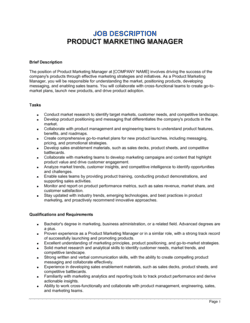
A Marketing Manager job description covers the full marketing function — paid media, events, brand, and sometimes product marketing — while a Content Marketing Manager description scopes specifically to content strategy, editorial production, and organic channel performance. Use the Marketing Manager template when the role owns the entire marketing budget and channel mix; use this one when the role is dedicated to content and SEO.

vs Social Media Manager Job Description

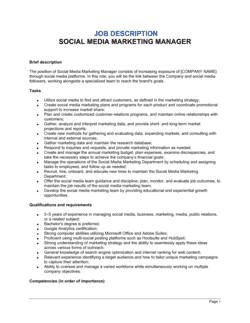
A Social Media Manager description focuses on community management, platform-specific content publishing, and audience engagement metrics. A Content Marketing Manager description covers the broader content strategy that feeds social channels — blog posts, whitepapers, video scripts, and email. The two roles often coexist on the same team, with the Content Marketing Manager setting strategy and the Social Media Manager executing distribution.

vs Employment Contract

A job description defines what the role does and the performance expectations; an employment contract creates the legally binding obligations between employer and employee. The job description is typically attached as a Schedule to the employment contract. Relying on a job description alone — without a signed employment contract — leaves IP assignment, non-solicitation, and termination terms unenforceable.

vs Independent Contractor Agreement

An independent contractor agreement governs a project-based freelance engagement with no employment entitlements. A job description governs an employment relationship with benefits, FLSA classification, and IP obligations. Using a job description to define a contractor relationship contributes to worker misclassification exposure and can trigger back taxes, penalties, and benefit liability.

Industry-specific considerations

SaaS / Technology

Emphasis on product-led growth content, developer documentation ownership, bottom-of-funnel case studies, and integration with product marketing — with KPIs tied directly to trial signups and pipeline.

E-commerce / Retail

Content tied to seasonal campaigns, product category pages, and email nurture sequences — with KPIs focused on organic traffic to product pages and content-attributed revenue.

Financial Services

Regulatory compliance review built into the content production workflow, required disclaimers on all published material, and content approval chains involving legal and compliance teams.

Healthcare / MedTech

HIPAA-compliant content practices, medical accuracy review requirements, restrictions on health claims, and coordination with clinical or regulatory affairs before publication.

Professional Services

Thought leadership and long-form content as primary demand-generation channel, with KPIs around speaking opportunities secured, media placements, and inbound leads from organic search.

Manufacturing

Technical content for engineers and procurement buyers, product documentation ownership, and trade publication contributions — with longer sales cycles requiring content mapped to a 6–18 month nurture funnel.

Jurisdictional notes

United States

Colorado, California, New York, and Washington require salary range disclosure in job postings — including remote roles posted to residents of those states. The FLSA classifies most Content Marketing Manager roles as exempt under the administrative or professional exemption, but confirm the salary threshold ($684/week as of 2024) is met. California additionally restricts post-employment non-solicitation clauses and voids many non-compete provisions entirely.

Canada

Canadian employers must ensure job descriptions comply with provincial human rights codes, which prohibit requirements that constitute barriers for protected groups. Ontario's Pay Transparency Act requires salary range disclosure for publicly advertised positions. Quebec job descriptions must be available in French for provincially regulated employers. Non-solicitation clauses must be reasonable in scope and duration to be enforceable.

United Kingdom

UK employers must provide a written statement of employment particulars — including job title and duties — on or before day one of employment under the Employment Rights Act 1996. Job descriptions used in hiring must comply with the Equality Act 2010, which prohibits requirements that create indirect discrimination. Employers with 250 or more employees must publish gender pay gap data annually, making compensation transparency increasingly expected.

European Union

The EU Pay Transparency Directive (effective 2026 in most member states) requires employers to disclose salary information to job applicants before the first interview. GDPR applies to all personal data collected during the hiring process, including CVs and application records. Job descriptions must comply with member-state equality directives prohibiting discrimination on grounds including age, disability, religion, and sexual orientation.

Template vs lawyer — what fits your deal?

PathBest forCostTime
Use the templateStandard domestic Content Marketing Manager hires at SMBs and startups with straightforward compensation and single-jurisdiction postingFree20–30 minutes
Template + legal reviewRoles posted in pay-transparency jurisdictions, hires with significant IP exposure, or job descriptions being incorporated into employment contracts$200–$500 for an HR consultant or employment attorney review1–3 days
Custom draftedSenior content executives with equity, cross-border hires, regulated industries (financial services, healthcare), or material non-compete requirements$800–$2,500+1–2 weeks

Glossary

Job Description
A formal document that defines a role's responsibilities, qualifications, and terms — used in hiring, performance management, and employment contracts.
Reporting Structure
The organizational hierarchy that identifies who the employee reports to and who, if anyone, reports to them.
Content Strategy
A documented plan governing what content to create, for which audience, through which channels, and toward which business goals.
KPI (Key Performance Indicator)
A measurable metric used to evaluate whether a role or function is achieving its defined objectives — for content roles, often organic traffic, lead volume, or engagement rate.
IP Assignment
A clause transferring ownership of content, creative work, and strategy documents created by the employee to the employer.
At-Will Employment
An employment arrangement in most US states where either party may end the relationship at any time for any lawful reason without advance notice.
FLSA Exemption
A US classification under the Fair Labor Standards Act that determines whether an employee is entitled to overtime pay — most Content Marketing Manager roles qualify as exempt under the administrative or professional exemption.
Non-Solicitation Clause
A post-employment restriction preventing a departing employee from recruiting the employer's staff or soliciting its clients.
Confidentiality Obligation
A requirement that the employee not disclose or misuse proprietary business information, editorial calendars, campaign data, or customer insights.
Equal Opportunity Statement
A required declaration that the employer does not discriminate based on protected characteristics such as race, gender, age, disability, or religion.
Performance Review Cycle
The scheduled cadence — typically annual or semi-annual — at which the employee's output is formally evaluated against the role's defined KPIs.

Part of your Business Operating System

This document is one of 3,000+ business & legal templates included in Business in a Box.

  • Fill-in-the-blanks — ready in minutes
  • 100% customizable Word document
  • Compatible with all office suites
  • Export to PDF and share electronically

Create your document in 3 simple steps.

From template to signed document — all inside one Business Operating System.
1
Download or open template

Access over 3,000+ business and legal templates for any business task, project or initiative.

2
Edit and fill in the blanks with AI

Customize your ready-made business document template and save it in the cloud.

3
Save, Share, Send, Sign

Share your files and folders with your team. Create a space of seamless collaboration.

Save time, save money, and create top-quality documents.

★★★★★

"Fantastic value! I'm not sure how I'd do without it. It's worth its weight in gold and paid back for itself many times."

Managing Director · Mall Farm
Robert Whalley
Managing Director, Mall Farm Proprietary Limited
★★★★★

"I have been using Business in a Box for years. It has been the most useful source of templates I have encountered. I recommend it to anyone."

Business Owner · 4+ years
Dr Michael John Freestone
Business Owner
★★★★★

"It has been a life saver so many times I have lost count. Business in a Box has saved me so much time and as you know, time is money."

Owner · Upstate Web
David G. Moore Jr.
Owner, Upstate Web

Run your business with a system — not scattered tools

Stop downloading documents. Start operating with clarity. Business in a Box gives you the Business Operating System used by over 250,000 companies worldwide to structure, run, and grow their business.

Free Forever Plan · No credit card required