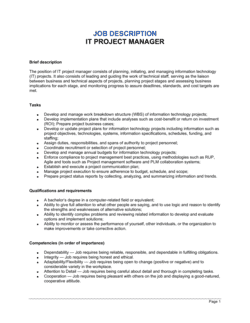
IT Manager Job Description Template

Free Word download • Edit online • Save & share with Drive • Export to PDF

2 pages20–30 min to fillDifficulty: StandardSignature requiredLegal review recommended
Learn more ↓
FreeIT Manager Job Description Template

At a glance

What it is
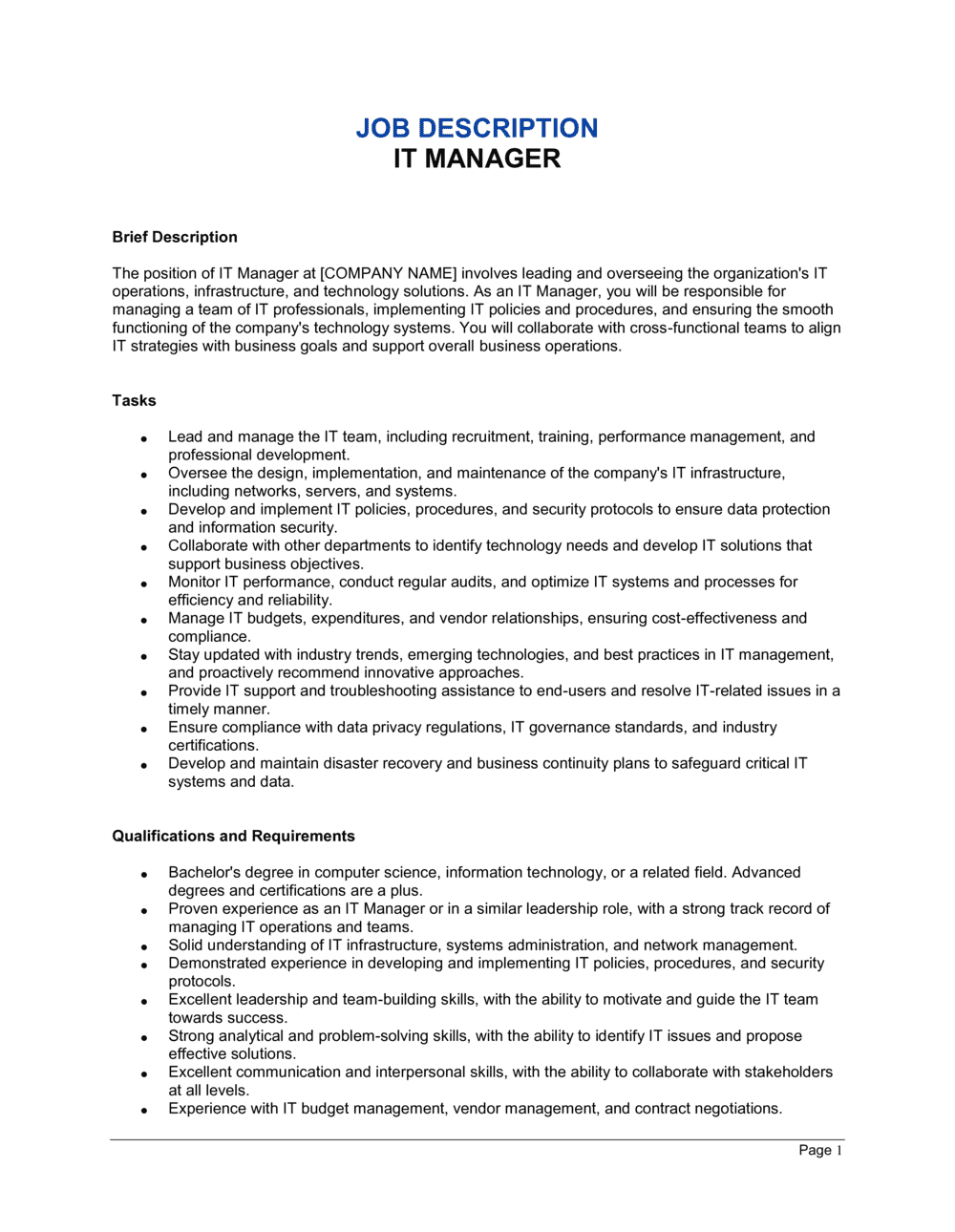
An IT Manager Job Description is a binding employment document that defines the scope, responsibilities, qualifications, reporting relationships, and performance expectations for an Information Technology Manager role. This free Word download gives you a professionally structured template you can edit online and export as PDF — covering everything from infrastructure oversight to team leadership and vendor management in a single document.
When you need it
Use it when hiring a new IT Manager, restructuring an existing technology leadership role, or establishing a documented baseline for performance reviews and employment contracts. It is also essential when posting the role publicly to ensure compliance with equal-employment obligations and to attract qualified candidates.
What's inside
Role summary and objectives, core duties and responsibilities, technical and leadership competency requirements, educational and certification qualifications, reporting structure, employment type and compensation range, performance metrics, and acknowledgment signature block.

What is an IT Manager Job Description?

An IT Manager Job Description is a formal employment document that defines the essential functions, technical and leadership qualifications, reporting relationships, performance metrics, and employment terms for an Information Technology Manager role. It functions both as a recruitment instrument — establishing the criteria by which candidates are evaluated — and as a legally relevant record that anchors performance management, ADA accommodation decisions, and wrongful-termination defenses. Unlike an informal role summary or an internal org-chart note, a properly drafted IT Manager Job Description documents the specific duties the employee is hired to perform, the measurable standards by which success is judged, and the authority limits within which the manager operates.

Why You Need This Document

Operating without a documented IT Manager Job Description creates compounding risk on three fronts simultaneously. First, without defined essential functions, an employer has no objective basis for a performance improvement plan or termination — claims of discrimination or retaliation are far harder to defend when the employee's duties were never put in writing. Second, undocumented qualifications requirements and missing EEO language expose the organization to EEOC charges and state agency complaints that cost an average of $50,000–$125,000 to defend regardless of outcome. Third, in pay-transparency jurisdictions including California, Colorado, and New York, publishing a job posting without a salary range triggers regulatory fines and private litigation. This template gives you a fully structured, jurisdiction-aware starting point that covers every required disclosure — from essential functions and FLSA classification to performance KPIs and acknowledgment signature — so the hire is documented correctly from the first day.

Which variant fits your situation?

If your situation is…Use this template
Hiring a senior IT leader responsible for enterprise-wide strategyIT Director Job Description
Recruiting a hands-on technical administrator rather than a managerSystems Administrator Job Description
Posting a role focused exclusively on cybersecurity oversightInformation Security Manager Job Description
Hiring an IT project lead for a fixed-term implementationIT Project Manager Job Description
Defining responsibilities for a help-desk or technical support leadIT Support Manager Job Description
Engaging an IT consultant on a contract basis rather than as an employeeIndependent Contractor Agreement
Onboarding the selected IT Manager candidate into employmentEmployment Contract

Common mistakes to avoid

❌ Using a generic internet job description verbatim

Why it matters: A copied description does not reflect your actual technology environment, team size, or compliance obligations — resulting in mismatched hires and unenforceable performance expectations.

Fix: Customize the role summary, essential functions, and KPIs to match your specific infrastructure, headcount, and business objectives before posting or signing.

❌ No FLSA exempt/non-exempt classification

Why it matters: Misclassifying an IT Manager as exempt when the role does not meet the FLSA executive or administrative exemption test exposes the employer to unpaid overtime liability, which can run back two to three years.

Fix: Confirm the classification with HR or legal counsel before issuing the job description; the IT Manager role typically qualifies as exempt under the administrative exemption if the salary threshold and duties tests are both met.

❌ Omitting the acknowledgment signature block

Why it matters: Without a signed acknowledgment, the employer cannot prove the employee was formally informed of their responsibilities, making it difficult to sustain a performance-based termination or disciplinary action.

Fix: Add a dated signature line and obtain a signed copy before or on the first day; file it in the employee's permanent HR record.

❌ Listing every technology as a required qualification

Why it matters: Overly broad required qualifications can create disparate-impact exposure and eliminate qualified candidates who have all the skills that actually matter to the role.

Fix: Distinguish Required (day-one must-haves) from Preferred (nice-to-haves), and add an equivalency clause for all educational requirements.

❌ No performance metrics or SLAs in the description

Why it matters: Without documented KPIs, performance improvement plans and terminations for underperformance become subjective and are more vulnerable to discrimination or retaliation claims.

Fix: Include at least three measurable KPIs — uptime target, incident response time, and project delivery rate — that can be tracked objectively from day one.

❌ Skipping salary range disclosure in jurisdictions that require it

Why it matters: California, Colorado, New York, and Washington require employers to disclose pay ranges in job postings; non-compliance triggers state agency fines and private litigation.

Fix: Check pay-transparency laws in every state where the role may be performed or where the posting will be visible, and include the range in the compensation clause before publishing.

The 9 key clauses, explained

Role Summary and Objectives

In plain language: A concise overview of what the IT Manager does, why the role exists, and the primary outcomes the organization expects the person to deliver.

Sample language
[COMPANY NAME] is seeking an experienced IT Manager to lead and oversee the day-to-day operations of the technology infrastructure, ensure systems reliability, and align IT initiatives with [COMPANY NAME]'s strategic business objectives.

Common mistake: Writing a generic summary copied from a public job board without referencing the company's specific technology environment — candidates cannot assess fit, and the document provides no baseline for performance management.

Core Duties and Responsibilities

In plain language: A structured list of the primary tasks the IT Manager is accountable for, written as action-verb statements to satisfy legal 'essential functions' standards under disability law.

Sample language
Manage and maintain all network infrastructure, servers, and end-user systems; oversee the IT helpdesk team of [NUMBER] technicians; develop and enforce IT security policies; manage vendor contracts with [VENDOR TYPES]; and report system performance metrics to [REPORTING TITLE] on a [FREQUENCY] basis.

Common mistake: Omitting the word 'essential' and mixing marginal tasks with core duties. Under the ADA and equivalent statutes, only essential functions can be used to disqualify a candidate with a disability — an undifferentiated list creates legal exposure.

Technical Competency Requirements

In plain language: The specific technologies, platforms, certifications, and technical skills the role requires, separated into required versus preferred to support fair hiring decisions.

Sample language
Required: [X]+ years managing [OS / PLATFORM / NETWORK TYPE] environments; proficiency in [TOOL A, TOOL B]. Preferred: ITIL v4 certification; experience with [CLOUD PLATFORM]; familiarity with [SECURITY FRAMEWORK].

Common mistake: Listing every conceivable technology as 'required' rather than distinguishing required from preferred — this artificially narrows the candidate pool and may screen out protected-class candidates disproportionately, creating disparate-impact liability.

Leadership and Soft-Skill Competencies

In plain language: Behavioral and interpersonal qualifications — team leadership, vendor negotiation, stakeholder communication, budget management — that define how the role is performed, not just what is performed.

Sample language
Demonstrated ability to lead a team of [NUMBER]+ technical staff; strong written and verbal communication skills for cross-functional collaboration with [DEPARTMENT A, DEPARTMENT B]; experience managing IT budgets of $[AMOUNT]+ annually.

Common mistake: Omitting leadership competencies entirely for a management role. A job description that only lists technical skills is incomplete and fails to set behavioral performance expectations enforceable in a PIP or disciplinary process.

Educational and Certification Qualifications

In plain language: The minimum education level and professional certifications required or preferred, with a statement that equivalent experience may substitute — reducing legal exposure around credential requirements.

Sample language
Bachelor's degree in Information Technology, Computer Science, or a related field required, or equivalent combination of education and [X]+ years of progressive IT experience. Preferred certifications: [CERTIFICATION A], [CERTIFICATION B].

Common mistake: Requiring a specific degree without adding an equivalency clause. Courts and regulators scrutinize degree requirements that lack business necessity — omitting the equivalency option increases disparate-impact risk.

Reporting Structure and Authority

In plain language: States who the IT Manager reports to, which positions or teams report to the IT Manager, and the scope of their hiring, firing, and budgetary authority.

Sample language
The IT Manager reports directly to the [CTO / COO / VP of Operations]. Direct reports include [TITLE A], [TITLE B], and [TITLE C]. The IT Manager has authority to approve purchases up to $[AMOUNT] and to initiate disciplinary actions subject to HR review.

Common mistake: Leaving reporting lines vague or omitting budget authority. Without documented authority limits, the IT Manager either escalates every minor decision — creating bottlenecks — or acts beyond their authority, creating unauthorized contract or spending exposure.

Performance Metrics and SLAs

In plain language: Defines measurable outcomes the IT Manager is accountable for — uptime targets, incident response times, project delivery rates, and budget adherence — establishing the objective basis for performance reviews.

Sample language
IT Manager is accountable for maintaining system uptime of [X]% or greater, achieving a mean-time-to-resolve of [X] hours for Priority 1 incidents, delivering [X]% of approved IT projects on schedule and within [X]% of budget.

Common mistake: No metrics clause at all. Without documented KPIs, performance improvement plans and terminations for underperformance become purely subjective and are easier to challenge as discriminatory or retaliatory.

Physical and Environmental Requirements

In plain language: Documents any physical demands of the role — such as lifting server equipment, working in a data center environment, or on-call availability — to satisfy ADA essential-functions disclosure requirements.

Sample language
This role requires the ability to lift and move equipment weighing up to [X] lbs on an occasional basis, work in a server room environment with temperatures as low as [X]°F, and participate in an on-call rotation of [FREQUENCY].

Common mistake: Skipping this clause for an IT Manager role on the assumption that it is a desk job. On-call requirements and data center access are physical and scheduling demands that must be disclosed to support ADA accommodation decisions.

EEO Statement and Acknowledgment

In plain language: A standard equal-employment opportunity statement affirming non-discrimination in hiring, plus a signature block where the selected candidate acknowledges receipt and understanding of the job description.

Sample language
[COMPANY NAME] is an Equal Opportunity Employer. All qualified applicants will receive consideration for employment without regard to race, color, religion, sex, national origin, disability, or veteran status. By signing below, I acknowledge that I have read, understood, and received a copy of this Job Description. Employee Signature: _______________ Date: _______________

Common mistake: Omitting the acknowledgment signature block. Without a signed acknowledgment, the employer cannot prove the employee was informed of their duties — undermining disciplinary actions and wrongful-termination defenses.

How to fill it out

  1. 1

    Define the company context and technology environment

    Fill in the company name, industry, and a brief description of the IT environment — number of users, core systems, cloud vs. on-premises infrastructure, and any compliance frameworks (SOC 2, HIPAA, ISO 27001) the manager must support.

    💡 Specific environment details reduce unqualified applicants by 30–40% and give the hired manager a documented baseline for their first 90-day plan.

  2. 2

    List essential functions using action verbs

    Write each core duty starting with an action verb (Manage, Oversee, Develop, Enforce, Monitor). Separate essential functions from occasional or marginal tasks. Aim for 8–12 essential functions — enough to be comprehensive without being exhaustive.

    💡 Run the list by the hiring manager and the outgoing IT lead (if applicable) to confirm nothing critical is missing before the role is posted.

  3. 3

    Separate required from preferred qualifications

    Label each technical skill and certification as Required or Preferred. Required qualifications must be genuinely necessary for day-one performance; Preferred qualifications are value-adds that tip the decision between otherwise equal candidates.

    💡 Add an equivalency clause — 'or equivalent combination of education and experience' — to every educational requirement to reduce disparate-impact legal exposure.

  4. 4

    Set the reporting structure and authority limits

    Name the specific title the IT Manager reports to, list direct-report titles or team names, and state the dollar threshold for independent purchase approvals. Do not leave authority limits to informal understanding.

    💡 If the company is in a growth phase and reporting lines may change, add a clause stating 'or as otherwise designated by [TITLE]' to avoid amendment obligations on every reorganization.

  5. 5

    Enter measurable performance metrics

    Insert specific KPIs — uptime percentage, mean time to resolve, project on-time delivery rate, and budget variance tolerance. These metrics should match the SLAs in the company's IT service management policy.

    💡 Align the KPIs in the job description with those in the company's ITSM platform so reporting is automated and auditable from day one.

  6. 6

    Add physical requirements and on-call terms

    Document any lifting requirements, data center access, travel expectations, and on-call rotation schedule. These disclosures support ADA accommodation decisions and set scheduling expectations before hire.

    💡 Quantify on-call expectations precisely — 'one week in four on a rotating basis' is enforceable; 'as needed' is not and will generate resentment and retention problems.

  7. 7

    Include the EEO statement and acknowledgment block

    Paste the company's standard EEO statement into the footer. Add a signature line for the selected candidate to sign before or on their first day, acknowledging receipt and understanding of the job description.

    💡 File the signed acknowledgment in the employee's HR record — it is a primary exhibit in wrongful-termination and failure-to-accommodate defenses.

  8. 8

    Review with HR and legal before posting

    Have HR confirm the FLSA exempt/non-exempt classification and verify the qualifications list against current EEO guidance. For roles in California, New York, or Colorado, confirm salary range disclosure requirements before publishing the posting.

    💡 A 30-minute HR review before posting costs nothing; an EEOC charge or state agency complaint costs an average of $50,000–$125,000 to defend, regardless of outcome.

Frequently asked questions

What is an IT Manager Job Description?

An IT Manager Job Description is a formal employment document that defines the responsibilities, qualifications, reporting relationships, performance expectations, and employment terms for an Information Technology Manager role. It serves as a recruitment tool, a baseline for performance management, and a legally relevant record of the role's essential functions for ADA accommodation and wrongful-termination purposes.

What are the typical responsibilities of an IT Manager?

An IT Manager typically oversees network infrastructure, servers, and end-user systems; leads a team of IT technicians or administrators; manages vendor contracts and technology budgets; enforces cybersecurity policies; ensures regulatory and compliance obligations are met; and reports system performance metrics to executive leadership. The exact scope varies by company size — in a small business, the IT Manager may also perform hands-on technical work, while in an enterprise the role is purely supervisory.

Does a job description create a binding employment contract?

A job description alone generally does not create an employment contract in at-will jurisdictions such as most US states, but courts have found that specific language — particularly promises of job security or guaranteed compensation — can create implied contractual obligations. To avoid unintended contracts, include a disclaimer stating the document is not a contract of employment and that employment remains at-will. In the UK, Canada, and EU member states, the job description may be incorporated into or referenced by a formal employment contract.

What qualifications should an IT Manager have?

Most IT Manager roles require a bachelor's degree in Information Technology, Computer Science, or a related field — or equivalent experience — plus five to eight years of progressive IT experience with at least two years in a supervisory capacity. Commonly required certifications include CompTIA Network+, ITIL v4, Microsoft Certified solutions, or Cisco CCNA depending on the environment. Cloud platform experience (AWS, Azure, or GCP) is increasingly listed as a required qualification for roles managing hybrid or cloud-first infrastructure.

Is an IT Manager an exempt or non-exempt employee under the FLSA?

In most cases, an IT Manager qualifies as exempt from FLSA overtime requirements under the executive or administrative exemption, provided the role meets the salary threshold (currently $684 per week as of 2025 — verify for the current year) and the duties test: the employee's primary duty must be managing a department or subdivision, and the employee must regularly direct the work of two or more employees. Misclassifying the role as exempt when these tests are not met exposes the employer to retroactive overtime liability. Consult HR or legal counsel to confirm classification before issuing the job description.

What states require salary ranges in IT Manager job postings?

As of 2025, California, Colorado, New York, Washington, Connecticut, Maryland, Nevada, and Rhode Island require employers to disclose pay ranges in job postings, either proactively or upon request. Several municipalities — including New York City — have their own requirements. Employers posting remote roles that can be filled by residents of these states are generally required to include the range even if the company is headquartered elsewhere. Non-compliance triggers state agency fines and can generate private litigation.

What is the difference between an IT Manager and an IT Director job description?

An IT Manager typically oversees daily operations, manages a team of technicians or administrators, and reports to a Director, CTO, or COO. An IT Director operates at a higher strategic level — setting multi-year technology roadmaps, managing department-level budgets, and reporting to C-suite leadership. The IT Manager role focuses on execution and reliability; the IT Director role focuses on strategy and investment allocation. If the hire will be the most senior technology leader in the company, an IT Director job description is more appropriate.

Should the IT Manager job description reference cybersecurity responsibilities?

Yes — and specifically. IT Managers are typically accountable for enforcing security policies, managing access controls, overseeing patch management, and ensuring compliance with frameworks such as SOC 2, ISO 27001, or HIPAA. Omitting cybersecurity responsibilities from the job description creates ambiguity about accountability and can complicate incident response liability analysis. For organizations in regulated industries, reference the specific compliance frameworks the IT Manager is responsible for maintaining.

Do I need a lawyer to create an IT Manager job description?

For most domestic hires, a well-structured template is sufficient for recruiting and documentation purposes. Engage employment counsel when the role involves access to highly sensitive IP or classified systems, when the company operates in multiple states with differing pay-transparency and employment laws, or when the job description will be incorporated directly into a binding employment contract. A one-hour employment law review typically costs $200–$400 and is worthwhile for senior roles or multistate postings.

How this compares to alternatives

vs Employment Contract

A job description defines the role's scope, duties, and qualifications — it is a functional document used for recruitment and performance management. An employment contract is the binding legal agreement that governs compensation, IP assignment, confidentiality, and termination. The two documents complement each other: the job description is typically attached to or referenced by the employment contract as a schedule defining duties. Neither document alone is complete for a new hire.

vs IT Director Job Description

An IT Director job description defines a strategic leadership role responsible for multi-year technology roadmaps, capital investment decisions, and C-suite reporting. An IT Manager job description defines an operational role focused on day-to-day infrastructure reliability, team supervision, and vendor management. Use the IT Manager template when the hire will report to a CTO or Director; use the IT Director template when the hire will be the most senior technology leader in the organization.

vs Independent Contractor Agreement

An Independent Contractor Agreement engages a self-employed IT professional for project-based or ongoing work without employment entitlements — no benefits, no tax withholding, and no overtime. An IT Manager job description is used to hire an employee with full employment obligations on both sides. Misclassifying an IT Manager as a contractor triggers back payroll taxes, benefit liability, and potential penalties from the IRS and state labor agencies.

vs IT Manager Performance Review Template

A performance review template is used to evaluate an IT Manager's performance against established KPIs after hire. A job description establishes those KPIs and essential functions at the point of hire. The job description must be in place and signed before performance reviews can be conducted fairly — without it, the review has no documented baseline to reference and is more vulnerable to legal challenge.

Industry-specific considerations

Technology / SaaS

Emphasizes cloud infrastructure management (AWS, Azure, GCP), DevOps collaboration, SOC 2 compliance accountability, and uptime SLAs tied to customer contractual commitments.

Healthcare

Requires HIPAA Security Rule compliance as an essential function, EHR system management experience, and documentation of access control procedures to satisfy OCR audit requirements.

Financial Services

Includes PCI DSS compliance oversight, system availability requirements tied to trading or transaction processing SLAs, and enhanced cybersecurity incident response duties aligned with FFIEC guidance.

Manufacturing

Covers OT (operational technology) and SCADA system oversight alongside traditional IT infrastructure, with physical plant access requirements and uptime obligations tied to production schedules.

Jurisdictional notes

United States

At-will employment is the default in 49 states; include a disclaimer in the job description stating it does not constitute a contract of employment. Confirm FLSA exempt status meets both the salary threshold and duties test before classifying the IT Manager as exempt. Pay-transparency laws in California, Colorado, New York, Washington, and several other states require salary range disclosure in job postings — verify the current list before publishing any public posting.

Canada

At-will employment does not exist in Canada; the job description should be paired with an employment contract that includes statutory-minimum notice and severance terms under the applicable provincial Employment Standards Act. In Quebec, job descriptions and postings for provincially regulated employers must be available in French. Human rights legislation in all provinces prohibits requirements that are not bona fide occupational requirements — review qualifications for necessity before posting.

United Kingdom

Employers must provide a written statement of employment particulars on or before day one; a detailed job description supports but does not replace this statutory requirement. The Equality Act 2010 prohibits job descriptions that include requirements which indirectly discriminate against protected characteristics unless objectively justified. IT Manager roles carrying significant data responsibility should reference UK GDPR accountability obligations within the duties clause.

European Union

The EU Transparent and Predictable Working Conditions Directive requires employers to provide written information on the role's duties and terms within seven days of hire. Job postings in several member states — including Germany, France, and the Netherlands — must avoid gendered language and meet national non-discrimination standards. IT Manager roles involving personal data processing should reference GDPR Article 32 responsibilities (technical and organizational security measures) as an essential function.

Template vs lawyer — what fits your deal?

PathBest forCostTime
Use the templateSingle-state domestic hires for standard IT Manager roles in non-regulated industriesFree30–45 minutes
Template + legal reviewMultistate postings, regulated industries (healthcare, finance), or roles with access to sensitive IP or classified systems$200–$400 for a one-hour employment counsel review1–3 days
Custom draftedEnterprise IT Manager roles with complex authority structures, equity components, or integration into a master employment agreement$800–$2,500+1–2 weeks

Glossary

Job Description
A written document that defines the duties, responsibilities, required qualifications, and reporting relationships for a specific position within an organization.
Essential Functions
The core duties that are fundamental to a role — as opposed to marginal tasks — and that must be performed with or without reasonable accommodation under disability law.
Reporting Structure
The formal chain of command identifying who the IT Manager reports to and which staff or teams report to the IT Manager.
FLSA Classification
A US designation under the Fair Labor Standards Act indicating whether a role is exempt or non-exempt from overtime pay requirements; IT Managers typically qualify as exempt under the executive or administrative exemption.
KPIs (Key Performance Indicators)
Measurable targets used to evaluate the IT Manager's effectiveness — such as system uptime percentage, mean time to resolve incidents, or project delivery rate.
SLA (Service Level Agreement)
A documented commitment to a specific level of IT service performance, such as 99.9% uptime or a 4-hour incident response time.
ITIL (Information Technology Infrastructure Library)
A globally recognized framework of best practices for IT service management, commonly listed as a required or preferred qualification for IT Managers.
Vendor Management
The process of overseeing third-party technology suppliers — negotiating contracts, monitoring performance, and managing renewals — a core IT Manager responsibility.
Reasonable Accommodation
A modification to a job, work environment, or the way a task is performed that enables a qualified individual with a disability to perform the essential functions of the role.
At-Will Employment
An employment arrangement in most US states where either party may end the relationship at any time for any lawful reason; a job description does not itself create a contract to the contrary.
Equal Employment Opportunity (EEO)
The legal obligation to consider all applicants regardless of race, color, religion, sex, national origin, age, disability, or genetic information when using a job description to recruit.

Part of your Business Operating System

This document is one of 3,000+ business & legal templates included in Business in a Box.

  • Fill-in-the-blanks — ready in minutes
  • 100% customizable Word document
  • Compatible with all office suites
  • Export to PDF and share electronically

Create your document in 3 simple steps.

From template to signed document — all inside one Business Operating System.
1
Download or open template

Access over 3,000+ business and legal templates for any business task, project or initiative.

2
Edit and fill in the blanks with AI

Customize your ready-made business document template and save it in the cloud.

3
Save, Share, Send, Sign

Share your files and folders with your team. Create a space of seamless collaboration.

Save time, save money, and create top-quality documents.

★★★★★

"Fantastic value! I'm not sure how I'd do without it. It's worth its weight in gold and paid back for itself many times."

Managing Director · Mall Farm
Robert Whalley
Managing Director, Mall Farm Proprietary Limited
★★★★★

"I have been using Business in a Box for years. It has been the most useful source of templates I have encountered. I recommend it to anyone."

Business Owner · 4+ years
Dr Michael John Freestone
Business Owner
★★★★★

"It has been a life saver so many times I have lost count. Business in a Box has saved me so much time and as you know, time is money."

Owner · Upstate Web
David G. Moore Jr.
Owner, Upstate Web

Run your business with a system — not scattered tools

Stop downloading documents. Start operating with clarity. Business in a Box gives you the Business Operating System used by over 250,000 companies worldwide to structure, run, and grow their business.

Start free · No credit card required