Job Offer Letter Long Template

Free Word download β€’ Edit online β€’ Save & share with Drive β€’ Export to PDF

1 pageβ€’20–25 min to fillβ€’Difficulty: Standard
Learn more ↓
FreeJob Offer Letter Long Template

At a glance

What it is
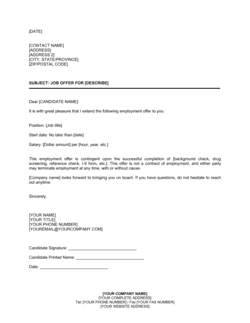
A Job Offer Letter Long is a formal written notice from an employer to a selected candidate confirming an employment offer and summarizing its key terms β€” position, compensation, start date, reporting structure, and conditions. This free Word download is fully editable online and can be exported as PDF and sent to candidates within minutes.
When you need it
Issue it once you have selected a candidate and are ready to extend a formal offer before an employment contract is signed. It bridges the verbal offer and the executed contract, giving the candidate a written record to review and accept.
What's inside
Opening offer statement, position title and department, compensation and bonus details, benefits summary, start date, reporting line, offer conditions (background check, reference verification), acceptance instructions, and a closing with signature block.

What is a Job Offer Letter?

A Job Offer Letter is a formal written notice an employer sends to a selected candidate confirming an offer of employment and summarizing its key terms β€” position title, department, start date, base salary, bonus eligibility, benefits, and any conditions that must be satisfied before employment begins. It bridges the gap between a verbal offer and a fully executed employment contract, giving the candidate a clear written record to review, accept, and retain. Unlike a casual email summary, a properly drafted offer letter uses precise language to define compensation, state any contingencies, and include an at-will clause (where applicable) that protects the employer if the relationship does not work out.

Why You Need This Document

Extending a job offer verbally without a written follow-up creates ambiguity on compensation terms, start dates, and conditions β€” and candidates who resign existing roles based on a verbal offer can pursue legal claims if the terms later change or the offer is withdrawn. A documented offer letter establishes a clear written record of what was agreed, reduces the risk of a candidate claiming a different salary was promised, and ensures conditions such as background checks and right-to-work verification are formally acknowledged before the employee's first day. Without an acceptance deadline, you risk losing other candidates while your preferred hire weighs competing offers β€” and without an at-will clause, informal language in the letter can be cited as evidence of implied job security. This template gives you a complete, professionally structured offer letter you can customize and send in under 15 minutes.

Which variant fits your situation?

If your situation is…Use this template
Hiring a full-time salaried employee with full benefit detailsJob Offer Letter Long
Extending a concise offer with minimal terms for a straightforward roleJob Offer Letter Short
Making a conditional offer pending background or security clearanceConditional Offer Letter
Hiring a part-time or hourly workerPart-Time Offer Letter
Onboarding an executive with equity and enhanced severanceExecutive Employment Agreement
Engaging a freelancer or independent contractor instead of an employeeIndependent Contractor Agreement
Confirming terms for a fixed-term or project-based hireFixed-Term Employment Contract

Common mistakes to avoid

❌ No acceptance deadline

Why it matters: An open-ended offer keeps the role on hold indefinitely. A candidate who accepts two weeks after you have moved on to another candidate creates a competing obligation.

Fix: Always set a deadline of 3–5 business days and state it clearly in the acceptance instructions paragraph.

❌ Omitting the FLSA classification

Why it matters: Not stating whether the role is exempt or non-exempt creates overtime liability if the employee later argues they were owed 1.5Γ— pay for hours over 40 per week.

Fix: Add a single sentence identifying the role as exempt or non-exempt under the Fair Labor Standards Act immediately after the compensation amount.

❌ Guaranteeing a specific bonus amount

Why it matters: A letter that states 'you will receive a $10,000 bonus' rather than 'you are eligible for a discretionary bonus of up to $10,000' creates a contractual obligation to pay it regardless of performance.

Fix: Use the words 'discretionary' and 'up to' in every bonus reference unless the bonus is genuinely guaranteed.

❌ Listing conditions after the acceptance signature line

Why it matters: Candidates often sign at the first blank line they reach. If conditions appear below the signature block, the employer cannot reliably claim the candidate reviewed them.

Fix: Place all conditions of offer in a clearly labeled paragraph before the acceptance and signature section.

The 10 key clauses, explained

Opening offer statement

In plain language: Congratulates the candidate and states clearly that the company is offering them employment in a specific role.

Sample language
We are pleased to offer you the position of [JOB TITLE] at [COMPANY NAME], reporting to [MANAGER TITLE]. This letter outlines the terms of our offer.

Common mistake: Using vague language like 'we would like to invite you to join our team' instead of a clear offer statement β€” ambiguity can blur whether a formal offer has actually been made.

Position title and department

In plain language: States the exact job title, the department the candidate will join, and the work location or remote status.

Sample language
You will serve as [JOB TITLE] within the [DEPARTMENT] department, based at [OFFICE ADDRESS / remote].

Common mistake: Using an informal working title instead of the payroll title β€” mismatches between the offer letter and HR records cause confusion on day one.

Start date

In plain language: Specifies the first day the employee is expected to report to work, giving both parties a firm commitment to plan around.

Sample language
Your anticipated start date is [DATE], subject to the successful completion of pre-employment requirements outlined below.

Common mistake: Omitting the word 'anticipated' when a background check is still pending β€” a firm start date creates an obligation the employer may not be able to honor.

Compensation

In plain language: States the base salary or hourly rate, payment frequency, and FLSA exempt or non-exempt classification.

Sample language
You will receive a base salary of $[AMOUNT] per year ([PAY FREQUENCY] installments), classified as [exempt / non-exempt] under the FLSA.

Common mistake: Omitting the FLSA classification β€” failing to state whether the role is exempt or non-exempt creates overtime liability exposure if the classification is later disputed.

Bonus and incentive eligibility

In plain language: Describes any target bonus percentage, commission plan, or incentive program, and marks it as discretionary unless it is guaranteed.

Sample language
You will be eligible for an annual discretionary performance bonus of up to [X]% of your base salary, based on individual and company performance.

Common mistake: Omitting the word 'discretionary' β€” courts in several jurisdictions have treated routinely paid bonuses as contractual entitlements when the letter doesn't qualify them.

Benefits summary

In plain language: Summarizes the employee benefit programs the candidate will be eligible for β€” health, dental, vision, retirement, and PTO β€” without binding the company to specific plan terms.

Sample language
You will be eligible to participate in [COMPANY NAME]'s standard benefits program, including [HEALTH / DENTAL / VISION / 401(k) / PTO], subject to plan terms as amended from time to time.

Common mistake: Detailing specific coverage levels or plan names in the letter β€” benefit plans change annually, and locking in specifics creates amendment obligations or unmet expectations.

Conditions of offer

In plain language: Lists any requirements the candidate must satisfy before the offer becomes firm β€” background check, reference verification, right-to-work documentation, or drug screening.

Sample language
This offer is contingent upon: (a) satisfactory completion of a background check; (b) verification of your legal right to work in [COUNTRY]; and (c) execution of the Company's standard Employment Agreement.

Common mistake: Listing conditions after the compensation details β€” candidates stop reading carefully after seeing their salary, so bury conditions low and they can be missed, undermining the contingency's enforceability.

At-will statement (where applicable)

In plain language: Confirms that employment is at-will and can be ended by either party at any time, preventing the offer letter from being interpreted as a promise of continued employment.

Sample language
Your employment with [COMPANY NAME] will be at-will, meaning either party may end the employment relationship at any time, with or without cause or notice, subject to applicable law.

Common mistake: Omitting the at-will statement in US offer letters β€” language like 'we look forward to a long and successful relationship' has been used as evidence of implied job security in wrongful termination claims.

Acceptance instructions and deadline

In plain language: Tells the candidate how to accept the offer β€” typically by signing and returning the letter β€” and states the deadline by which they must respond.

Sample language
Please sign and return this letter by [ACCEPTANCE DEADLINE DATE] to confirm your acceptance. If you have questions, contact [HR CONTACT NAME] at [EMAIL / PHONE].

Common mistake: Not setting an acceptance deadline β€” leaving the offer open indefinitely means the employer cannot move on to the next candidate without risk of a late acceptance creating an obligation.

Closing and signature block

In plain language: Closes the letter with a warm statement, provides space for the hiring manager's signature, and includes a candidate acknowledgment line.

Sample language
We are excited to welcome you to the team. Sincerely, [HIRING MANAGER NAME] [TITLE], [COMPANY NAME] Accepted by: _______________ Date: _______________

Common mistake: Including only the hiring manager's signature without a candidate acceptance line β€” without the candidate's countersignature the letter lacks written confirmation of acceptance.

How to fill it out

  1. 1

    Enter company and candidate details

    Add your company's legal name, the candidate's full name and address, and the date. Use the registered company name β€” not a brand or trade name β€” to ensure consistency with payroll records.

    πŸ’‘ Save a master version with your company details pre-filled so each new offer letter only needs candidate-specific changes.

  2. 2

    State the position title and department

    Enter the exact job title as it will appear in your HR system, the department, and the work location or remote arrangement.

    πŸ’‘ Confirm the payroll title with HR before sending β€” mismatches between the offer letter and the HR system cause delays on day one.

  3. 3

    Set the start date

    Enter the agreed first day of work. If a background check is still in progress, prefix it with 'anticipated' to preserve flexibility.

    πŸ’‘ Give candidates at least two weeks from the offer date to the start date β€” standard notice periods at most employers.

  4. 4

    Fill in compensation and FLSA classification

    Enter the annual salary or hourly rate, pay frequency, and state whether the role is FLSA exempt or non-exempt. For non-exempt roles, note that overtime applies.

    πŸ’‘ Double-check the FLSA classification before sending β€” misclassifying a non-exempt employee as exempt is one of the most common and costly payroll errors.

  5. 5

    Add bonus and benefits language

    Include the bonus target percentage marked as discretionary, and reference benefits by category without specifying plan details.

    πŸ’‘ Never promise a specific insurance carrier or coverage level in the letter β€” reference 'the Company's standard benefits program as amended from time to time.'

  6. 6

    List conditions and the at-will statement

    Specify any pre-employment requirements and, for US hires, include a clear at-will clause. Review the conditions list carefully β€” omitting a condition the company intended to impose is hard to add after the letter is sent.

    πŸ’‘ Place the conditions paragraph before the acceptance line so the candidate cannot claim they missed it.

  7. 7

    Set the acceptance deadline and send

    Choose a deadline 3–5 business days from the send date. Send the letter as a PDF attachment with a brief covering email restating the role and deadline.

    πŸ’‘ Follow up by phone on the day you send it β€” candidates are more likely to respond promptly when they hear from a person, not just an inbox.

Frequently asked questions

What is a job offer letter?

A job offer letter is a formal written document an employer sends to a selected candidate confirming an employment offer and summarizing its key terms β€” job title, salary, start date, benefits, and any conditions that must be satisfied before employment begins. It provides a written record for both parties and signals the transition from verbal discussion to a formal offer.

What is the difference between a job offer letter and an employment contract?

A job offer letter summarizes the key terms of an offer to trigger the candidate's acceptance. An employment contract is the comprehensive binding document that governs the full employment relationship β€” covering IP assignment, confidentiality, non-compete, termination, and severance in legal detail. The offer letter gets you to a yes; the employment contract governs everything that follows.

Does a job offer letter need to be signed?

A job offer letter is not a binding contract in the same way an employment agreement is, but having the candidate sign and return it confirms written acceptance and documents the agreed terms. Including a countersignature line is standard practice and prevents later disputes about whether an offer was formally accepted.

What conditions can be included in a job offer letter?

Common conditions include satisfactory completion of a background check, drug screening, reference verification, confirmation of right to work in the country, and execution of a formal employment agreement. Conditions should be listed before the acceptance line so the candidate acknowledges them explicitly.

Should a job offer letter include at-will language?

For US-based hires, yes. Including a clear at-will statement prevents the offer letter from being interpreted as a promise of long-term or permanent employment. Language like 'we look forward to a long relationship' has been cited in wrongful termination claims when no at-will clause was present. Outside the US, at-will has no legal meaning β€” omit it and use notice-period language instead.

How long should a candidate have to accept a job offer?

Three to five business days is the standard window for most roles. For senior or executive positions, a week to ten days is common to allow the candidate to review equity terms or negotiate. Setting and communicating a firm deadline lets you move to the next candidate promptly if the offer is declined and avoids the position sitting vacant while the candidate weighs competing offers.

Can I withdraw a job offer after sending the letter?

In most US at-will states, an employer can withdraw an offer before it is accepted, and in some cases after acceptance, as long as the employee has not yet started and has not relied on the offer to their detriment (such as resigning a current role). However, candidates who resign based on a formal offer and then have it withdrawn may have a promissory estoppel claim. Outside the US, rules vary significantly β€” in many jurisdictions, a signed offer letter creates enforceable obligations.

What should I do if the candidate wants to negotiate after receiving the offer letter?

Treat negotiation requests as normal and respond before the acceptance deadline passes. If you revise terms, issue an updated letter reflecting the agreed changes and reset the acceptance deadline. Never modify a letter verbally without following up in writing β€” undocumented verbal amendments are a frequent source of offer disputes.

Is a job offer letter legally binding?

A signed job offer letter is generally considered a binding commitment to the stated terms in most jurisdictions, even if a formal employment contract has not yet been executed. Courts have held that an accepted offer letter with definite terms creates an enforceable agreement. For this reason, it is important to include contingency language and an at-will clause (where applicable) to preserve flexibility.

How this compares to alternatives

vs Employment Contract

An employment contract is the comprehensive legally binding document governing the full employment relationship β€” covering IP assignment, confidentiality, non-compete, and termination in detail. A job offer letter summarizes key terms to secure the candidate's acceptance before the contract is signed. Both should be used together, not interchangeably.

vs Executive Employment Agreement

An executive agreement covers equity vesting, change-of-control provisions, enhanced severance, and D&O indemnification β€” terms that belong in a binding contract, not an offer letter. Use a standard offer letter to initiate the conversation, then follow up with an executive agreement for C-suite hires.

vs Independent Contractor Agreement

A contractor agreement engages a self-employed individual for project-based work with no employment entitlements. A job offer letter is for employees β€” it carries employment-law obligations including benefits, payroll tax, and overtime. Misclassifying an employee hire as a contractor arrangement triggers significant legal and tax liability.

vs Fixed-Term Employment Contract

A fixed-term contract sets a defined end date and governs the full relationship as a binding document. A job offer letter is used before the contract is signed to confirm the candidate's acceptance of terms. For fixed-term hires, issue the offer letter first, then execute the fixed-term contract before the start date.

Industry-specific considerations

Technology / SaaS

Equity and sign-on bonus terms referenced in the offer letter, with a parallel option agreement issued at onboarding.

Professional Services

Billing target or utilization rate expectations often referenced alongside base salary, with bonus tied to individual billings.

Healthcare

Credentialing and licensure verification listed as conditions precedent to the start date becoming firm.

Retail / Hospitality

Hourly rate, shift schedule, and tip or gratuity handling stated explicitly given high turnover and variable-hour arrangements.

Financial Services

FINRA or FCA registration requirements noted as conditions, with deferred compensation or clawback terms flagged for the formal contract.

Manufacturing

Safety training completion and shift assignment confirmed at offer stage, with collective agreement references noted where applicable.

Template vs pro β€” what fits your needs?

PathBest forCostTime
Use the templateAny employer extending a standard full-time, part-time, or hourly offer domesticallyFree10–15 minutes per letter
Template + professional reviewEmployers adding custom conditions, non-standard bonus structures, or equity references$100–$300 for an HR consultant or employment attorney review1–2 hours
Custom draftedExecutive hires with complex equity, cross-border offers, or heavily regulated industries$500–$1,500+1–3 days

Glossary

Offer Letter
A written document from an employer to a candidate summarizing the terms of an employment offer before a formal contract is signed.
At-Will Employment
Employment that either party may end at any time for any lawful reason, without requiring advance notice or documented cause β€” the default in most US states.
Contingent Offer
An offer of employment that is conditional on the candidate satisfying specific requirements, such as passing a background check or drug screening.
Compensation Package
The full value of what an employer pays an employee, including base salary, bonus, equity, health benefits, retirement contributions, and other perks.
Start Date
The agreed first day on which the new employee is expected to begin work, as confirmed in the offer letter.
Reporting Line
The title or name of the manager or supervisor the new employee will report to directly.
Background Check
A pre-employment verification of a candidate's criminal history, employment history, education credentials, and identity β€” often a condition of offer letters.
Acceptance Deadline
The date by which the candidate must respond to the offer, after which the employer may withdraw it or extend it to another candidate.
FLSA Classification
The designation of a US employee as exempt or non-exempt under the Fair Labor Standards Act, which determines overtime pay eligibility.
Sign-On Bonus
A one-time payment offered to a candidate upon accepting an offer, often used to offset deferred compensation or equity forfeited at a previous employer.

Part of your Business Operating System

This document is one of 3,000+ business & legal templates included in Business in a Box.

  • Fill-in-the-blanks β€” ready in minutes
  • 100% customizable Word document
  • Compatible with all office suites
  • Export to PDF and share electronically

Create your document in 3 simple steps.

From template to signed document β€” all inside one Business Operating System.
1
Download or open template

Access over 3,000+ business and legal templates for any business task, project or initiative.

2
Edit and fill in the blanks with AI

Customize your ready-made business document template and save it in the cloud.

3
Save, Share, Send, Sign

Share your files and folders with your team. Create a space of seamless collaboration.

Save time, save money, and create top-quality documents.

β˜…β˜…β˜…β˜…β˜…

"Fantastic value! I'm not sure how I'd do without it. It's worth its weight in gold and paid back for itself many times."

Managing Director Β· Mall Farm
Robert Whalley
Managing Director, Mall Farm Proprietary Limited
β˜…β˜…β˜…β˜…β˜…

"I have been using Business in a Box for years. It has been the most useful source of templates I have encountered. I recommend it to anyone."

Business Owner Β· 4+ years
Dr Michael John Freestone
Business Owner
β˜…β˜…β˜…β˜…β˜…

"It has been a life saver so many times I have lost count. Business in a Box has saved me so much time and as you know, time is money."

Owner Β· Upstate Web
David G. Moore Jr.
Owner, Upstate Web

Run your business with a system β€” not scattered tools

Stop downloading documents. Start operating with clarity. Business in a Box gives you the Business Operating System used by over 250,000 companies worldwide to structure, run, and grow their business.

Free Forever PlanΒ Β·Β No credit card required