Account Manager Job Description Template

Free Word download β€’ Edit online β€’ Save & share with Drive β€’ Export to PDF

2 pagesβ€’20–30 min to fillβ€’Difficulty: Standardβ€’Signature requiredβ€’Legal review recommended
Learn more ↓
FreeAccount Manager Job Description Template

At a glance

What it is
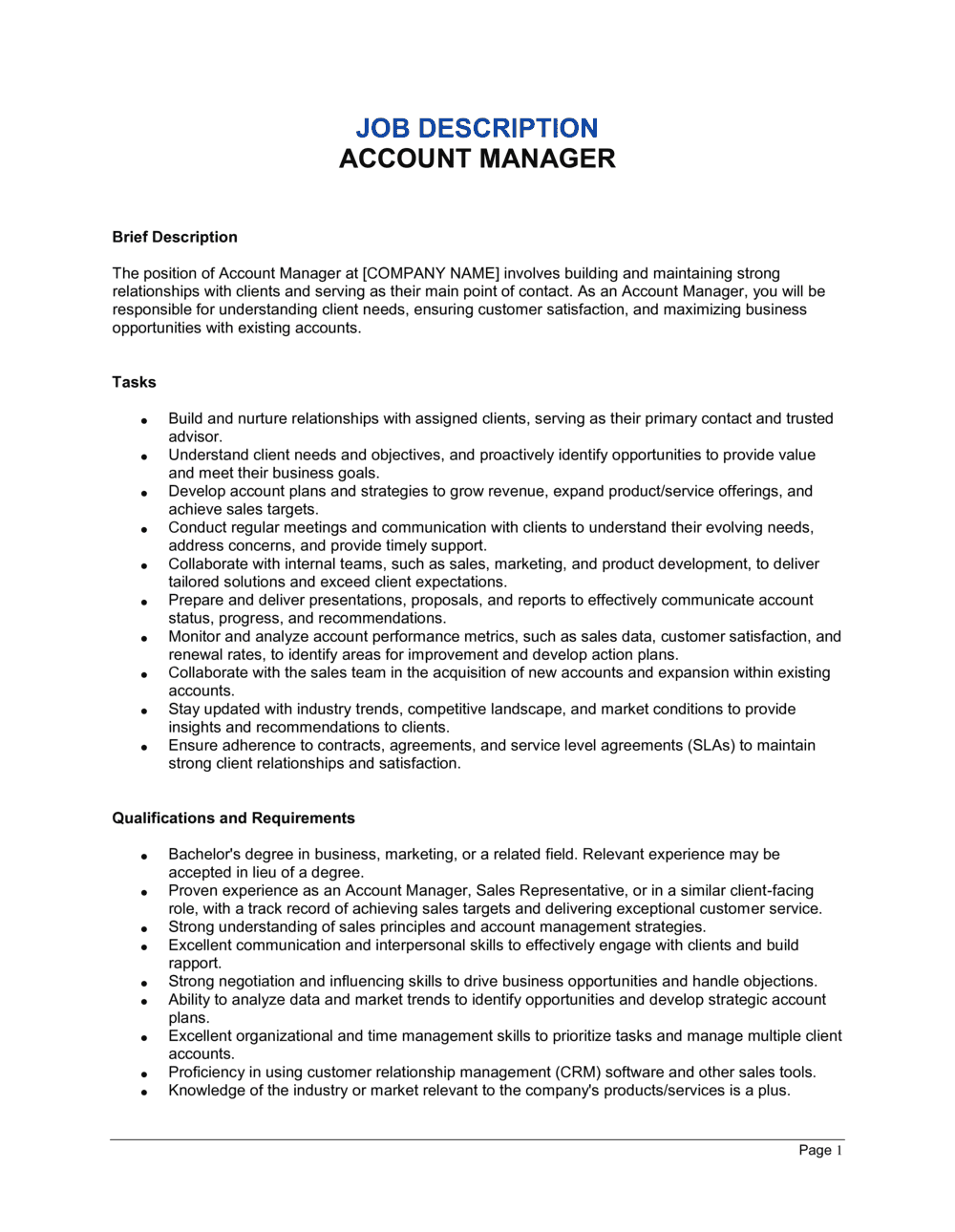
An Account Manager Job Description is a formal document that defines the scope, duties, qualifications, reporting structure, and performance expectations for an account manager role within an organization. This free Word download gives you a structured, legally grounded starting point you can edit online and export as PDF β€” ready to attach to an employment contract, post to job boards, or use in performance reviews.
When you need it
Use it when opening a new account manager position, restructuring an existing role, or standardizing hiring documentation across a sales or client-services team. It is also referenced when managing performance, handling disputes about scope of work, or defending a termination decision.
What's inside
Position title and department, reporting structure, core duties and responsibilities, required and preferred qualifications, compensation range and OTE structure, performance metrics, travel and remote-work requirements, and an acknowledgment clause for the employee to confirm receipt.

What is an Account Manager Job Description?

An Account Manager Job Description is a formal document that defines the scope, responsibilities, required qualifications, performance expectations, compensation structure, and working conditions for an account manager position within an organization. Unlike a casual summary posted to a job board, a properly drafted job description creates a documented, signed record of the role's expectations β€” one that is referenced during onboarding, performance management, and, when disputes arise, by employment tribunals and courts. It typically functions as a schedule attached to the employment contract, giving operational detail to the broader legal terms of the hire.

Why You Need This Document

Without a documented, signed job description, performance management becomes a matter of competing recollections rather than agreed standards. When an account manager misses quota, disputes their duties, or claims their role was changed without consent, the job description is the first document an employment lawyer or tribunal examines. Employers who rely on informal role summaries or unacknowledged job board postings routinely find themselves unable to defend performance improvement plans or terminations β€” not because the employee performed well, but because the expectations were never formally documented. A signed account manager job description closes that gap: it establishes the quota, the KPIs, the working conditions, and the scope of duties in writing before the first day of work, giving both parties a clear, enforceable baseline for the entire employment relationship.

Which variant fits your situation?

If your situation is…Use this template
Hiring a senior account manager to manage enterprise or strategic accountsSenior Account Manager Job Description
Defining a key account manager role focused on top-tier client retentionKey Account Manager Job Description
Describing a technical account manager role in a SaaS or technology companyTechnical Account Manager Job Description
Documenting an entry-level or associate account manager positionJunior Account Manager Job Description
Formalizing the full employment relationship including IP and non-competeEmployment Contract
Posting the role publicly and collecting applicationsJob Posting Template
Onboarding the hired account manager with structured expectationsEmployee Onboarding Checklist

Common mistakes to avoid

❌ Copying a generic job description from a job board

Why it matters: A generic description that doesn't reflect your actual book-of-business size, sales model, or client base attracts unqualified applicants and provides no enforceable performance baseline.

Fix: Customize core duties and performance metrics to match the actual portfolio size, CRM, and revenue targets used internally β€” before posting or attaching to an offer.

❌ Omitting the compensation range

Why it matters: Several US states (Colorado, California, New York), Canadian provinces, and EU jurisdictions now legally require salary ranges in job postings. Non-compliance triggers fines and reputational damage in competitive hiring markets.

Fix: Include a base salary range and OTE figure in every job description posted publicly or shared with candidates, and verify pay transparency requirements for each jurisdiction where the role may be filled.

❌ Skipping the performance metrics clause

Why it matters: Without documented quotas and KPIs in the job description, performance improvement plans and terminations for underperformance become difficult to defend against wrongful dismissal claims.

Fix: Add specific, measurable targets β€” quota amount, retention rate, QBR completion rate β€” to the job description and reference the same metrics in the employment contract and performance review templates.

❌ Using the same job description for exempt and non-exempt account managers

Why it matters: Account managers paid hourly or below the FLSA salary threshold are non-exempt and entitled to overtime. A job description drafted for an exempt role may misrepresent the position's legal classification, creating wage-and-hour liability.

Fix: Confirm FLSA or local classification before finalizing the document, and update the employment type and duties language to accurately reflect the position's exempt or non-exempt status.

❌ Not updating the job description when the role changes materially

Why it matters: An outdated job description that no longer reflects actual duties undermines performance management and can be used against the employer in a constructive dismissal or discrimination claim.

Fix: Review and reissue the job description whenever the portfolio size, reporting structure, compensation model, or primary responsibilities change β€” and obtain a fresh signed acknowledgment from the incumbent.

❌ Leaving out working conditions and travel requirements

Why it matters: Enforcing travel or on-site requirements that were not documented at hire can constitute a unilateral change to employment terms, exposing the employer to constructive dismissal liability in common-law jurisdictions.

Fix: State travel percentage, remote or hybrid status, and any required on-site client visits explicitly in the job description, and include flexibility language if the arrangement is subject to change.

The 9 key clauses, explained

Position Title, Department, and Employment Type

In plain language: States the exact job title, the department the role belongs to, and whether the position is full-time, part-time, or contract.

Sample language
Position: Account Manager | Department: Sales / Client Success | Reports To: [DIRECTOR/VP TITLE] | Employment Type: Full-Time, Exempt

Common mistake: Using an informal working title rather than the official position name. Discrepancies between the job description and payroll records complicate FLSA classification audits and termination disputes.

Role Summary

In plain language: A 3–5 sentence overview of the position's purpose, the team it serves, and the business outcome it drives.

Sample language
The Account Manager is responsible for managing a portfolio of [X] client accounts generating approximately $[X]M in annual recurring revenue. This role serves as the primary point of contact for clients and works cross-functionally with [TEAMS] to ensure contract renewal, client satisfaction, and revenue expansion.

Common mistake: Writing a generic summary copied from a job board that doesn't reflect the company's actual client base or sales model. Vague summaries attract unqualified candidates and provide no baseline for performance management.

Core Duties and Responsibilities

In plain language: An itemized list of the account manager's primary day-to-day tasks, including client management, revenue activities, and internal coordination.

Sample language
Manage a portfolio of [NUMBER] accounts with a combined ARR of $[AMOUNT]; conduct quarterly business reviews with each assigned client; identify and close upsell opportunities with a target of [X]% revenue expansion per account per year; escalate at-risk accounts to [TITLE] within [X] business days of identifying churn signals.

Common mistake: Listing too many responsibilities without prioritizing them. A job description with 20 equal bullet points makes it impossible to evaluate performance or set expectations during onboarding.

Required Qualifications

In plain language: The non-negotiable minimum credentials, experience, and skills the candidate must have to be considered for the role.

Sample language
Minimum [X] years of B2B account management or sales experience; demonstrated track record of meeting or exceeding quota; proficiency in [CRM PLATFORM]; ability to manage a book of business of $[X]M or more.

Common mistake: Inflating required qualifications beyond what the role genuinely demands. Listing a degree requirement for a quota-carrying account manager role may constitute indirect discrimination in jurisdictions with adverse impact protections.

Preferred Qualifications

In plain language: Additional skills or experience that would make a candidate more competitive but are not disqualifying if absent.

Sample language
Experience in [INDUSTRY VERTICAL]; familiarity with [SPECIFIC TOOL]; prior experience managing enterprise accounts above $[X]M ARR; demonstrated ability to navigate multi-stakeholder renewal cycles.

Common mistake: Treating preferred qualifications as effectively required during screening. If your hiring team consistently rejects candidates who lack preferred items, they function as hidden barriers and create legal exposure in jurisdictions with structured hiring laws.

Compensation, OTE, and Benefits

In plain language: States the base salary range, commission or bonus structure expressed as OTE, and applicable benefits β€” framed as the total compensation package.

Sample language
Base Salary: $[MIN]–$[MAX] per year | OTE: $[AMOUNT] at 100% quota attainment | Benefits: [HEALTH/DENTAL/VISION], [401(k)/RRSP] with [X]% employer match, [X] days PTO.

Common mistake: Omitting the compensation range entirely. Several US states, Canadian provinces, and the EU now mandate pay transparency in job postings β€” non-compliance carries fines and reputational risk in competitive hiring markets.

Performance Metrics and Expectations

In plain language: Defines the specific KPIs by which the account manager will be evaluated β€” revenue targets, retention rates, QBR completion, and response time standards.

Sample language
Success in this role is measured by: quota attainment (target [X]% of $[AMOUNT] per [PERIOD]); net revenue retention of [X]% or above; quarterly business review completion rate of [X]%; client satisfaction score (CSAT or NPS) of [X] or above.

Common mistake: Leaving performance metrics out of the job description entirely. Without documented standards, performance management becomes subjective and wrongful termination claims are harder to defend.

Working Conditions, Travel, and Remote Policy

In plain language: Describes the physical or remote working environment, required travel percentage, and any on-site expectations.

Sample language
This role is [REMOTE / HYBRID / ON-SITE]. Travel is required [X]% of the time, including quarterly on-site client visits within [REGION]. When on-site, the employee works from [OFFICE LOCATION].

Common mistake: Omitting remote-work and travel requirements from the job description but enforcing them after hire. Changing material working conditions after signing can constitute constructive dismissal in common-law jurisdictions.

Acknowledgment and Receipt

In plain language: A signature block where the employee confirms they have received and reviewed the job description and understand that duties may be updated with reasonable notice.

Sample language
I, [EMPLOYEE NAME], acknowledge receipt of this job description, understand the duties and expectations outlined above, and agree that [COMPANY NAME] may reasonably update these duties from time to time with notice. Signature: _______________ Date: _______________

Common mistake: Skipping the acknowledgment clause entirely. Without a signed acknowledgment, an employee can claim they were unaware of performance expectations or that unilateral changes were made to their role β€” undermining both performance management and termination defenses.

How to fill it out

  1. 1

    Enter the official position title and classification

    Use the exact job title that will appear on payroll and employment records. Select the FLSA classification (exempt or non-exempt) based on the role's salary level and primary duties. In the US, most quota-carrying account managers qualify as exempt under the administrative or outside sales exemption.

    πŸ’‘ Cross-check the title against your compensation bands and org chart before publishing β€” title inconsistencies create confusion during performance reviews and off-boarding.

  2. 2

    Write the role summary in outcome-focused language

    Draft 3–5 sentences describing what the account manager owns, the client portfolio size they manage, and the business result they are responsible for delivering. Avoid generic descriptions pulled from job boards.

    πŸ’‘ Anchor the summary to a specific book-of-business size or ARR figure. 'Manages $2M in ARR' is far more useful to candidates and hiring managers than 'manages a portfolio of clients.'

  3. 3

    List core duties in priority order

    Write 6–10 duty statements starting with the highest-impact responsibilities. Each statement should begin with an action verb and include a measurable output where possible.

    πŸ’‘ Limit the list to duties that consume at least 5% of the role's time. If a task appears on the list but a manager has never asked about it in a performance review, cut it.

  4. 4

    Define required versus preferred qualifications carefully

    Set required qualifications at the actual minimum needed to do the job on day one. Move stretch criteria to preferred. Review both lists against equal employment opportunity guidelines applicable in your jurisdiction.

    πŸ’‘ In several US states and EU member countries, degree requirements for non-degree-dependent roles carry discrimination risk. Replace 'bachelor's degree required' with 'equivalent experience accepted' where the degree isn't genuinely necessary.

  5. 5

    State the compensation range and OTE clearly

    Enter the base salary band, the OTE at 100% quota, and a description of the commission or bonus structure. Reference the full benefits package by category.

    πŸ’‘ Check pay transparency laws for the posting location before publishing. Colorado, California, New York, and the EU all have active pay disclosure requirements.

  6. 6

    Set specific, measurable performance metrics

    Add the quota figure, retention rate target, QBR cadence, and any CSAT or NPS threshold the account manager will be evaluated against. Tie these directly to the compensation structure.

    πŸ’‘ Align the metrics in the job description with those in your CRM and performance review template so there is no ambiguity about what 'meeting expectations' means.

  7. 7

    Document working conditions and travel requirements

    Specify whether the role is remote, hybrid, or on-site. State the expected travel percentage and any required on-site client visit cadence. Include the primary office location if applicable.

    πŸ’‘ If the remote-work policy may change, add language such as 'remote arrangement subject to periodic review and reasonable notice of changes' to protect against constructive dismissal claims.

  8. 8

    Obtain a signed acknowledgment before or on day one

    Have the employee sign the acknowledgment clause confirming receipt and understanding of the job description before or on their first day. File the signed copy in their personnel record.

    πŸ’‘ Use eSign to timestamp the acknowledgment. A dated digital signature is harder to contest than a paper copy that could be misdated.

Frequently asked questions

What is an account manager job description?

An account manager job description is a formal document that defines the responsibilities, qualifications, performance expectations, compensation structure, and working conditions for an account manager position. It serves as the authoritative reference for hiring, onboarding, performance management, and, when signed by the employee, creates a documented record of agreed role expectations that can be referenced in employment disputes.

What are the main duties of an account manager?

Core duties typically include managing a defined portfolio of client accounts, serving as the primary contact for assigned clients, conducting regular business reviews, identifying and closing upsell and cross-sell opportunities, coordinating internally to resolve client issues, and reporting on account health metrics such as retention rate and net revenue retention. The specific duties vary by industry, account size, and whether the role is primarily retention-focused or growth-focused.

What qualifications should an account manager job description require?

Most account manager job descriptions require 2–5 years of B2B account management or sales experience, a demonstrated track record of quota attainment, proficiency in a CRM platform, and strong communication skills. Degree requirements should be assessed carefully β€” several jurisdictions restrict mandatory degree requirements for roles where equivalent experience is a genuine substitute, to avoid indirect discrimination claims.

Is a job description a legally binding document?

A job description is generally not a standalone binding contract, but when signed and acknowledged by the employee, it creates an enforceable record of agreed duties, performance expectations, and working conditions. Courts and employment tribunals routinely reference job descriptions in performance management disputes, wrongful termination claims, and constructive dismissal cases. A signed acknowledgment clause significantly strengthens the employer's position in those proceedings.

Do I need to include a salary range in an account manager job description?

In a growing number of jurisdictions, yes. Colorado, California, New York, and Washington state in the US, several Canadian provinces, and the EU Directive on pay transparency all require salary ranges to be disclosed in job postings. Even where not legally required, including a base salary range and OTE figure reduces time-to-hire by filtering for candidates with matching salary expectations.

What is OTE and how should it be presented in a job description?

OTE (On-Target Earnings) is the total compensation an account manager earns when achieving 100% of their assigned quota, combining base salary and target commission or bonus. It should be presented as a combined figure alongside the base salary range β€” for example, 'Base: $65,000–$75,000 | OTE: $110,000–$130,000 at 100% quota attainment.' This gives candidates a realistic picture of both floor and upside compensation.

What happens if the account manager's role changes after hiring?

Material changes to duties, reporting structure, quota, or working conditions without employee consent can constitute constructive dismissal in common-law jurisdictions including Canada, the UK, and Australia. Best practice is to reissue an updated job description with the changes clearly noted, obtain a signed acknowledgment from the employee, and β€” where the changes are significant β€” confirm that the employment contract permits reasonable adjustments to duties with notice.

Should a job description be attached to an employment contract?

Attaching the job description as a schedule to the employment contract is strongly recommended for senior or quota-carrying roles. It creates a clear, mutually acknowledged reference for performance management and termination procedures. Many employment contracts include a clause stating that duties may be 'reasonably updated from time to time' β€” the job description operationalizes what 'reasonably updated' means at the time of hire.

How often should an account manager job description be updated?

Review the job description annually as part of the performance review cycle and any time the role changes materially β€” new product lines, revised quota structure, change in reporting line, or shift from on-site to remote. An outdated job description that no longer reflects actual duties creates ambiguity in performance management and can be used against the employer in employment disputes.

How this compares to alternatives

vs Employment Contract

An employment contract is the binding legal agreement governing the full employment relationship β€” compensation, IP, confidentiality, non-compete, and termination terms. A job description defines the scope of the role itself. The job description is typically attached as a schedule to the employment contract rather than replacing it. Both documents are needed for a complete, enforceable hiring package.

vs Offer Letter

An offer letter confirms the role, compensation, and start date to secure the candidate's acceptance before a full contract is issued. It does not define duties in detail or create enforceable performance expectations. A job description provides the operational depth the offer letter lacks and should be signed separately or attached to the contract at onboarding.

vs Performance Review Template

A performance review evaluates how well the employee is meeting the expectations established in the job description. The job description sets the standard; the performance review measures against it. Using a job description that doesn't match the performance review template creates inconsistency that weakens both documents in a performance-management dispute.

vs Sales Representative Job Description

A sales representative job description focuses on new business acquisition β€” prospecting, pipeline development, and closing net-new revenue. An account manager job description focuses on retaining and growing an existing book of business. The two roles are often confused, but they require different KPIs, compensation structures, and qualifications sections in their respective job descriptions.

Industry-specific considerations

SaaS / Technology

Net revenue retention, churn rate, product adoption milestones, and QBR cadence are central KPIs; technical proficiency in CRM and customer success platforms is typically required.

Financial Services

Regulatory licensing requirements, client suitability obligations, and strict confidentiality provisions must be reflected in the duties and qualifications sections.

Professional Services

Billable hours coordination, engagement renewal management, and multi-stakeholder relationship mapping are core responsibilities distinct from product-centric account management roles.

Manufacturing and Distribution

Account managers in this sector focus on order volume targets, contract renewal, and supply-chain coordination β€” with travel requirements typically higher than in SaaS or services roles.

Retail / E-commerce

Vendor or partner account management roles emphasize sell-through rates, co-marketing program management, and inventory planning metrics alongside revenue targets.

Healthcare / MedTech

HIPAA-compliant client communication protocols, credentialing requirements, and compliance training obligations must be documented in the qualifications and working conditions clauses.

Jurisdictional notes

United States

Most quota-carrying account managers qualify as exempt from overtime under the FLSA administrative or outside sales exemption, but the salary threshold ($684/week as of 2025 β€” verify for current year) must be met. Colorado, California, New York, and Washington mandate salary range disclosure in job postings. California and several other states restrict non-compete clauses that are sometimes referenced in job descriptions β€” confirm enforceability before including.

Canada

Job descriptions form part of the employment record and are referenced in Employment Standards Act disputes over constructive dismissal. Ontario, British Columbia, and Alberta each have specific rules on unilateral changes to job duties. Quebec employers must ensure all employment documents β€” including job descriptions β€” are available in French for provincially regulated workplaces. Pay transparency legislation is active in British Columbia and expanding to other provinces.

United Kingdom

Under UK employment law, a job description attached to the written statement of employment particulars becomes part of the contract of employment. Material changes to duties without consent can constitute constructive dismissal. The Equality Act 2010 requires that qualifications listed in job descriptions be genuinely necessary to avoid indirect discrimination claims β€” degree requirements for sales roles are regularly scrutinized.

European Union

The EU Pay Transparency Directive (effective 2026 in most member states) requires employers to disclose salary ranges in job postings and prohibits pay secrecy clauses. The Transparent and Predictable Working Conditions Directive requires written notification of role duties and working conditions on or before day one. GDPR applies to any personal data collected during the hiring process β€” ensure the job description and associated application materials reference a compliant data processing notice.

Template vs lawyer β€” what fits your deal?

PathBest forCostTime
Use the templateSmall businesses and startups hiring a standard domestic account manager without complex compensation structuresFree30–60 minutes
Template + legal reviewEmployers hiring across multiple jurisdictions, roles with complex OTE structures, or companies subject to pay transparency laws$200–$500 (HR consultant or employment lawyer review)1–3 days
Custom draftedEnterprise roles with equity-based compensation, regulated industries (financial services, healthcare), or cross-border account managers operating in multiple legal jurisdictions$800–$2,500+1–2 weeks

Glossary

Job Description
A formal document outlining the duties, responsibilities, qualifications, and conditions of a specific position within an organization.
OTE (On-Target Earnings)
The total compensation an account manager earns when hitting 100% of their quota, combining base salary and target commission or bonus.
Reporting Structure
The defined chain of authority that specifies who the account manager reports to and whether they manage any direct reports.
KPI (Key Performance Indicator)
A measurable metric used to evaluate whether the account manager is meeting the performance expectations of the role.
Account Retention Rate
The percentage of existing clients an account manager retains over a defined period, typically measured annually.
Upsell / Cross-sell
Revenue expansion activities where the account manager sells additional products or services to an existing client beyond the initial contract.
FLSA Classification
A US federal designation β€” exempt or non-exempt β€” that determines whether an employee is entitled to overtime pay under the Fair Labor Standards Act.
Acknowledgment Clause
A signed statement from the employee confirming they have received, read, and understood the job description and its expectations.
At-Will Employment
An employment arrangement, common in most US states, where either party may end the relationship at any time for any lawful reason without advance notice.
Quota
A defined revenue or activity target assigned to an account manager for a specific period, typically a quarter or fiscal year.
Net Revenue Retention (NRR)
A metric measuring revenue from existing customers including expansion, contraction, and churn β€” used to evaluate account manager performance in subscription businesses.

Part of your Business Operating System

This document is one of 3,000+ business & legal templates included in Business in a Box.

  • Fill-in-the-blanks β€” ready in minutes
  • 100% customizable Word document
  • Compatible with all office suites
  • Export to PDF and share electronically

Create your document in 3 simple steps.

From template to signed document β€” all inside one Business Operating System.
1
Download or open template

Access over 3,000+ business and legal templates for any business task, project or initiative.

2
Edit and fill in the blanks with AI

Customize your ready-made business document template and save it in the cloud.

3
Save, Share, Send, Sign

Share your files and folders with your team. Create a space of seamless collaboration.

Save time, save money, and create top-quality documents.

β˜…β˜…β˜…β˜…β˜…

"Fantastic value! I'm not sure how I'd do without it. It's worth its weight in gold and paid back for itself many times."

Managing Director Β· Mall Farm
Robert Whalley
Managing Director, Mall Farm Proprietary Limited
β˜…β˜…β˜…β˜…β˜…

"I have been using Business in a Box for years. It has been the most useful source of templates I have encountered. I recommend it to anyone."

Business Owner Β· 4+ years
Dr Michael John Freestone
Business Owner
β˜…β˜…β˜…β˜…β˜…

"It has been a life saver so many times I have lost count. Business in a Box has saved me so much time and as you know, time is money."

Owner Β· Upstate Web
David G. Moore Jr.
Owner, Upstate Web

Run your business with a system β€” not scattered tools

Stop downloading documents. Start operating with clarity. Business in a Box gives you the Business Operating System used by over 250,000 companies worldwide to structure, run, and grow their business.

Start freeΒ Β·Β No credit card required