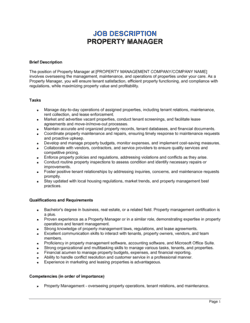
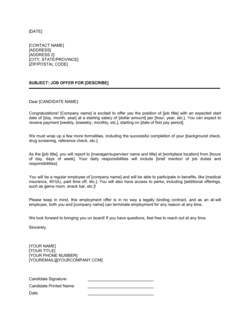
Product Design Manager Job Description Template

Free Word download • Edit online • Save & share with Drive • Export to PDF

2 pages25–30 min to fillDifficulty: StandardSignature requiredLegal review recommended
Learn more ↓
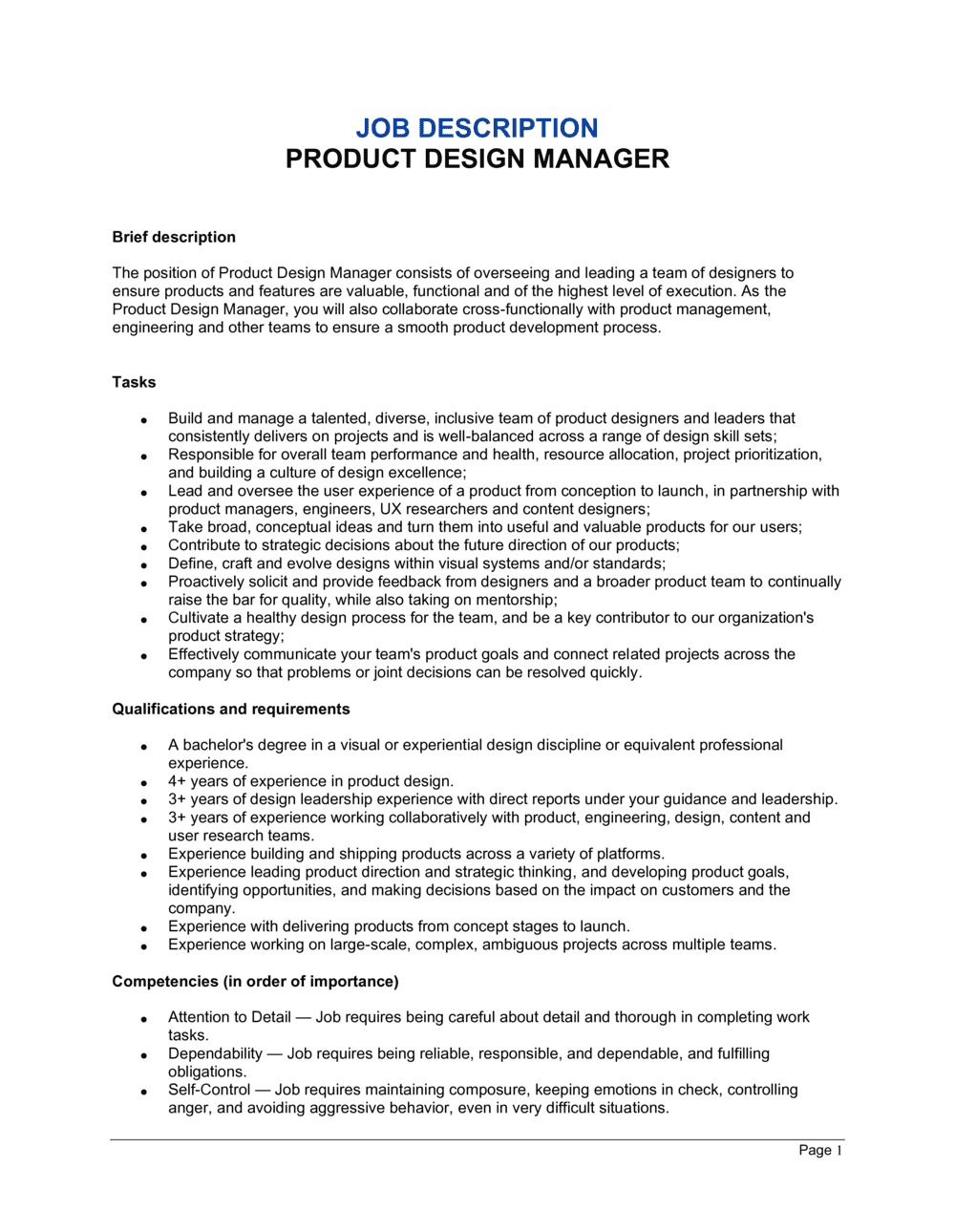
FreeProduct Design Manager Job Description Template

At a glance

What it is
A Product Design Manager Job Description is a formal document that defines the scope, responsibilities, qualifications, compensation band, and reporting structure for a Product Design Manager role within an organization. This free Word download gives you a ready-to-edit template you can tailor to your company, export as PDF, and attach to offer letters or employment contracts.
When you need it
Use it when opening a new Product Design Manager position, backfilling an existing role, or standardizing job documentation across your design organization. It also serves as the authoritative scope-of-work reference when onboarding a new hire or managing performance expectations.
What's inside
Role summary, reporting structure, core responsibilities, design and leadership competencies, required and preferred qualifications, tools and technology expectations, compensation and benefits outline, and equal opportunity statement. Each clause is written to support downstream employment agreements and performance review frameworks.

What is a Product Design Manager Job Description?

A Product Design Manager Job Description is a formal document that defines the scope, responsibilities, qualifications, compensation, and reporting structure for a Product Design Manager role within an organization. It functions simultaneously as a recruiting tool — communicating expectations to candidates — and as an internal governance document that anchors performance management, compensation benchmarking, and headcount planning. When incorporated by reference into an employment agreement, it becomes part of the binding legal relationship between employer and employee, making accuracy and jurisdictional compliance non-negotiable.

Why You Need This Document

Without a clear, documented job description, you face four compounding risks before a single candidate is hired. First, vague or inflated role descriptions attract misaligned candidates, lengthening time-to-fill and increasing early turnover. Second, qualification requirements that cannot be justified — particularly degree mandates — expose you to discrimination claims under EEOC guidance in the US and equivalent statutes in Canada, the UK, and the EU. Third, publishing a role without a salary range violates pay transparency laws in California, New York, Colorado, and a growing number of jurisdictions, carrying fines and reputational harm. Fourth, when the role is eventually filled, a poorly scoped job description makes performance management harder to defend — creating ambiguity in reviews and risk in termination proceedings. This template gives you a structured, legally reviewed starting point that covers every material clause, so you spend your time on the hiring strategy rather than the documentation.

Which variant fits your situation?

If your situation is…Use this template
Hiring a senior individual contributor, not a people managerSenior Product Designer Job Description
Hiring a director-level leader overseeing multiple design managersDirector of Product Design Job Description
Hiring a UX-focused design lead in a research-heavy organizationUX Manager Job Description
Hiring a brand or visual design manager outside the product functionCreative Director Job Description
Formalizing the agreed terms of employment after the hire acceptsEmployment Contract
Engaging a freelance design manager on a project basisIndependent Contractor Agreement
Documenting performance goals for an existing design managerPerformance Review Template

Common mistakes to avoid

❌ Setting degree requirements without a business justification

Why it matters: Requiring a bachelor's degree for a role where degree completion has no meaningful correlation with job performance can constitute disparate impact discrimination under US EEOC guidance and equivalent laws in the UK and EU.

Fix: Replace degree requirements with the actual underlying competencies you need — years of demonstrated experience, a portfolio of shipped work, or specific technical skills — and remove or make optional any degree language that cannot be justified by the role's duties.

❌ Omitting the salary range on public job postings

Why it matters: California (SB 1162), New York, Colorado, Washington, and a growing list of jurisdictions require salary ranges on job postings — non-compliance carries fines up to $250,000 per violation in New York and reputational damage that deters candidates.

Fix: Insert the approved compensation band before publishing. If the range is broad, include a note explaining that placement depends on experience and location.

❌ Publishing the role as remote without geographic restrictions

Why it matters: Hiring remotely in a state or country where the company is not registered as an employer creates immediate payroll tax, unemployment insurance, and benefits obligations — and potential misclassification liability.

Fix: List the specific states or countries where you can legally employ for this role. If the list is long, state 'eligible to work in [COUNTRY]' and confirm the list with your payroll team before posting.

❌ Writing responsibilities identical to a senior IC role

Why it matters: A job description that doesn't distinguish management duties from design craft duties attracts candidates who want to remain individual contributors, leading to role confusion, underperformance, and turnover within the first year.

Fix: Make the people-management responsibilities — hiring, performance management, coaching, team planning — explicit in their own clause, with enough detail that a candidate clearly understands this is a people-management role before applying.

❌ Listing every tool in the company's design stack as required

Why it matters: Over-specifying tools signals to candidates that the company values tool familiarity over design judgment and leadership — and it filters out strong managers who have used equivalent tools but not the exact versions listed.

Fix: Limit required tools to the two or three the candidate will use in the first 30 days. Move everything else to preferred qualifications or a tools note within the onboarding section.

❌ Using a generic EEO statement not reviewed for local law

Why it matters: A standard US federal EEO clause omits protected classes required by California (FEHA), the UK Equality Act 2010, or EU member-state directives — leaving the company exposed to discrimination claims even if the intention was compliant.

Fix: Maintain jurisdiction-specific EEO clauses reviewed by employment counsel for each location where you actively recruit and hire.

The 10 key clauses, explained

Role title and summary

In plain language: States the official job title, the team or function it sits within, and a two-to-four sentence overview of why the role exists and what it is accountable for.

Sample language
[COMPANY NAME] is looking for a Product Design Manager to lead a team of [X] designers within the [PRODUCT AREA] organization. This role owns the end-to-end design process from discovery through delivery and is accountable for the quality and consistency of user experience across [PRODUCT / PLATFORM].

Common mistake: Using an inflated or non-standard title (e.g., 'Design Ninja Lead') that does not match internal leveling or market benchmarks — this creates compensation disputes and confuses candidates comparing offers.

Reporting structure and team size

In plain language: Specifies who the manager reports to and how many direct reports the role carries, establishing organizational authority and budget accountability.

Sample language
This role reports to the [VP of Design / Chief Product Officer] and manages a team of [X] Product Designers and [X] UX Researchers. The role is a member of the [PRODUCT LEADERSHIP TEAM].

Common mistake: Omitting team size or leaving it vague. Candidates use this to evaluate scope and compensation expectations; a mismatch discovered after an offer leads to renegotiation or rejection.

Core responsibilities

In plain language: Lists the primary duties the role is expected to perform day-to-day, written in active voice with measurable outcomes where possible.

Sample language
Lead weekly design critiques and provide actionable feedback to a team of [X] designers. Define and maintain design standards within the product design system. Partner with Product Management and Engineering to scope design work into quarterly planning cycles. Present design strategy to executive stakeholders on a [cadence] basis.

Common mistake: Writing responsibilities so broadly that they could apply to any design role — 'create excellent user experiences' gives neither candidate nor manager a clear performance baseline.

Leadership and management expectations

In plain language: Defines the people-management dimension of the role: hiring, coaching, performance management, and team culture responsibilities.

Sample language
Responsible for recruiting, interviewing, and onboarding Product Designers at the [IC3–IC5] levels. Conducts bi-weekly one-on-ones and quarterly performance reviews. Identifies growth opportunities for each direct report and maintains individual development plans updated at least [twice] per year.

Common mistake: Listing management duties identically to those of a senior IC. If the role is truly a people manager, performance management and hiring accountability must be explicit — otherwise the hire may resist management responsibilities post-onboarding.

Required qualifications

In plain language: States the non-negotiable education, experience, and skill requirements a candidate must meet to be considered for the role.

Sample language
[X]+ years of product design experience, including [X]+ years managing a team of at least [X] designers. Demonstrated portfolio of shipped consumer or enterprise product work. Proficiency in [Figma / Sketch / Adobe XD]. Experience working in an Agile or continuous delivery environment.

Common mistake: Setting degree requirements (e.g., 'Bachelor's degree required') that are not genuinely predictive of job performance — this can constitute unlawful screening under anti-discrimination law in several jurisdictions and narrows the candidate pool unnecessarily.

Preferred qualifications

In plain language: Describes additional skills or experience that differentiate strong candidates from minimally qualified ones, without excluding candidates who lack them.

Sample language
Experience scaling a design team from [X] to [X+] headcount. Background in [INDUSTRY VERTICAL]. Familiarity with design operations or DesignOps frameworks. Experience contributing to or owning a company-wide design system.

Common mistake: Copying preferred qualifications from the required list with minor wording changes — this wastes candidate attention and signals the hiring team hasn't prioritized what actually matters.

Tools and technology

In plain language: Lists the specific software, platforms, and workflows the role is expected to use, distinguishing between required proficiency and exposure.

Sample language
Required: Figma (advanced proficiency), Jira or equivalent project tracking tool, Confluence or equivalent documentation platform. Preferred: Amplitude or Mixpanel for product analytics, UserTesting.com or Maze for usability research, Loom for async design walkthroughs.

Common mistake: Requiring proficiency in every tool the company uses, including legacy or rarely used platforms. Over-specifying tools signals organizational dysfunction and discourages strong generalist candidates.

Compensation and benefits

In plain language: States the salary band, bonus eligibility, equity structure (if applicable), and key benefits — providing enough transparency for candidates to self-qualify.

Sample language
Base salary range: $[MINIMUM]–$[MAXIMUM] USD, depending on experience and location. Eligible for annual performance bonus of up to [X]% of base salary. Equity: [RSU grant / stock options] subject to [X]-year vesting with [X]-year cliff. Benefits include [HEALTH / DENTAL / VISION], [X] days PTO, and [RETIREMENT MATCH DETAILS].

Common mistake: Omitting compensation entirely or stating 'competitive salary.' Pay transparency laws in California, New York, Colorado, and other jurisdictions now require salary ranges on job postings — non-compliance carries fines and reputational risk.

Work location and schedule

In plain language: Specifies whether the role is fully remote, hybrid, or on-site, the expected in-office cadence, and any time-zone requirements.

Sample language
This is a [remote / hybrid / on-site] role. Hybrid employees are expected in the [CITY] office [X] days per week. All candidates must be able to work core hours of [X AM–X PM] in the [TIMEZONE]. Occasional travel to [LOCATION] for team offsites, up to [X] times per year.

Common mistake: Posting a role as 'remote-friendly' without clarifying geographic restrictions. Hiring remotely in a new state or country creates payroll tax, benefits, and employment-law obligations the company may not be set up to meet.

Equal opportunity and accommodation statement

In plain language: Affirms that the company makes hiring decisions without regard to protected characteristics and offers reasonable accommodation to applicants with disabilities.

Sample language
[COMPANY NAME] is an equal opportunity employer. We do not discriminate on the basis of race, color, religion, sex, national origin, age, disability, veteran status, or any other characteristic protected by applicable law. Applicants requiring accommodation during the hiring process should contact [HR EMAIL / CONTACT].

Common mistake: Including a boilerplate EEO statement that does not match the company's actual jurisdiction — an EEO clause drafted for US federal law may omit protected classes required by California, UK Equality Act, or EU member-state statutes.

How to fill it out

  1. 1

    Define the role's level and reporting line

    Confirm the official title, the seniority level within your leveling framework, and exactly who this role reports to. Misalignment between title and level creates compensation disputes at the offer stage.

    💡 Cross-reference your compensation band tool (Radford, Levels.fyi, Mercer) before finalizing the title — market titles shift fast in design roles.

  2. 2

    Draft the role summary in two to four sentences

    Write why the role exists, what problem it solves, and what success looks like in the first 12 months. Avoid generic language — be specific about the product area or team the manager will own.

    💡 A one-sentence mission for the role ('Own the design quality of our checkout flow used by 4M monthly users') is more effective than three sentences of vague mandate.

  3. 3

    List core responsibilities in order of time allocation

    Write six to ten bullet points starting with the activity that takes the most time each week. Use active verbs and quantify scope where possible — team size, cadence, stakeholder level.

    💡 If a responsibility takes less than 5% of the role's time, move it to the preferred qualifications section or cut it entirely.

  4. 4

    Separate required from preferred qualifications strictly

    Required qualifications should represent the minimum bar to succeed — not the ideal candidate profile. Move anything aspirational to the preferred list. Review required qualifications for degree requirements that may not be legally defensible.

    💡 Research shows that candidates from underrepresented groups apply only when they meet 100% of listed requirements; cutting non-essential requirements from the required list meaningfully expands the qualified pool.

  5. 5

    Enter the compensation band and benefits

    Insert the approved salary range, bonus percentage, equity details, and the three to five benefits most relevant to this candidate profile. Check local pay transparency laws before deciding whether to publish the range publicly.

    💡 Roles with a published salary range receive on average 30% more qualified applicants than identical postings without compensation data.

  6. 6

    Specify location, schedule, and time-zone requirements

    State explicitly whether the role is remote, hybrid, or on-site. For remote roles, list any geographic restrictions (states, countries) and the core working hours required. Flag travel expectations.

    💡 Consult with your payroll or legal team before approving a remote hire in a new state or country — employer registration and withholding obligations apply from the first day of work.

  7. 7

    Customize the EEO statement for your jurisdiction

    Replace the placeholder EEO clause with one reviewed for compliance in every location where you are actively recruiting. Verify the list of protected classes matches your jurisdiction — federal US, state, provincial, or EU member-state requirements differ materially.

    💡 If you operate in multiple jurisdictions, maintain separate EEO clauses by region rather than using a single global statement that may be underinclusive in some locations.

  8. 8

    Have HR or legal review before publishing

    Route the final job description through your HR business partner or employment counsel before posting. They will check for unenforceable requirements, pay transparency compliance, and protected-class language gaps.

    💡 A 30-minute HR review before posting prevents a discrimination complaint or pay transparency fine that can cost orders of magnitude more to resolve.

Frequently asked questions

What does a Product Design Manager do?

A Product Design Manager leads a team of product designers and, often, UX researchers — responsible for both the quality of design work and the professional development of the team. They typically own the design process for one or more product areas, partner with product managers and engineers in planning cycles, and represent the design perspective to senior stakeholders. The role splits time between people management (coaching, hiring, performance reviews) and hands-on design leadership (critique, strategy, systems).

What qualifications should a Product Design Manager have?

Most companies require five to eight years of product design experience, including at least two years managing a team of two or more designers. A strong portfolio of shipped consumer or enterprise product work is non-negotiable. Proficiency in Figma or an equivalent design tool, experience working in Agile environments, and demonstrated ability to influence cross-functional stakeholders are standard requirements. Formal education is increasingly treated as optional in this role; portfolio and demonstrated leadership track record carry more weight.

What is the difference between a Product Design Manager and a Design Director?

A Product Design Manager typically owns the design process and team performance for one product area or a defined scope — managing individual contributors directly. A Design Director manages multiple design managers or leads design across the entire product portfolio, and is accountable for design strategy at the organizational level. The distinction is primarily one of scope, headcount, and organizational influence. Some companies use the titles interchangeably at different company sizes.

Is a job description a legally binding document?

A job description is generally not a standalone contract, but it can create legal exposure in several ways. Inaccurate or inflated descriptions can support misrepresentation claims if the actual role differs materially from what was advertised. Required qualifications that have a disparate impact on protected groups can form the basis of a discrimination claim. Pay transparency laws in multiple jurisdictions make salary range disclosure on job postings a legal obligation. For these reasons, HR or employment counsel review before publishing is strongly recommended.

Do I need to include a salary range in a job description?

In a growing number of jurisdictions, yes. California, New York, Colorado, Washington, and several other US states require employers to include a salary range on job postings. In the UK, while not yet mandated, pay transparency is increasingly expected under gender pay gap reporting obligations. In the EU, the Pay Transparency Directive (effective 2026) will require employers to disclose pay ranges before the first interview. Even where not legally required, published salary ranges consistently produce more and better-qualified applicants.

Can I post a Product Design Manager role as fully remote?

You can, but you must include geographic restrictions if your company is not registered to employ in every state or country where candidates may apply. Hiring a remote employee in a new jurisdiction triggers employer registration, payroll tax withholding, unemployment insurance, and benefits compliance obligations from day one of employment. Consult your payroll provider or employment counsel before posting without geographic restrictions.

How does a job description connect to the employment contract?

The job description defines the role's scope and expectations during recruiting. The employment contract formalizes the binding obligations — compensation, IP assignment, confidentiality, non-compete, and termination terms — once a candidate accepts. In most jurisdictions, the employment contract supersedes the job description as the governing document. However, if the contract incorporates the job description by reference, the description's language becomes part of the binding agreement — making accuracy and legal review more important.

What tools and skills should a Product Design Manager be proficient in?

Figma is the current industry standard for product design tooling and is expected at most companies. Beyond tooling, the role requires proficiency in Agile or continuous-delivery workflows, familiarity with product analytics platforms (Amplitude, Mixpanel), and experience facilitating design reviews with executive stakeholders. For managers leading research-integrated teams, experience with usability testing platforms such as UserTesting or Maze is commonly expected at the preferred level.

How specific should the responsibilities section be?

Specific enough that a candidate can estimate how they would spend a typical week, and specific enough that a manager can evaluate performance against documented expectations. Vague language like 'drive design excellence' creates ambiguity in performance reviews and makes it harder to justify a termination or performance improvement plan if the hire underperforms. Six to ten responsibility bullets with active verbs, named stakeholders, and explicit cadence or scope references is the target level of specificity.

How this compares to alternatives

vs Employment Contract

A job description defines the role scope and expectations for recruiting purposes. An employment contract formalizes the binding legal relationship — covering compensation, IP assignment, confidentiality, non-compete, and termination — once the candidate accepts. The two documents work in sequence: the job description attracts and screens; the contract governs. In most jurisdictions the employment contract supersedes the job description unless the description is explicitly incorporated by reference.

vs Offer Letter

An offer letter confirms the specific terms — salary, start date, title, and reporting line — extended to a chosen candidate. A job description is a public-facing document that describes the role to all potential applicants. The offer letter personalizes and commits the terms; the job description communicates requirements. Both are part of the hiring process, but only the offer letter (and subsequent employment contract) creates a binding obligation.

vs Independent Contractor Agreement

An independent contractor agreement engages a self-employed individual for a defined project or deliverable — without employment entitlements, benefits, or tax withholding. A Product Design Manager job description is used to hire an employee with management authority, team accountability, and full employment protections. Using a contractor agreement for someone performing ongoing management duties is a common misclassification risk with significant tax and legal consequences.

vs Performance Review Template

A job description defines role expectations at the point of hiring. A performance review template evaluates how well an employee has met those expectations over a defined period. The job description is the source document for setting performance criteria; an accurate, specific job description makes performance reviews more objective and defensible. Both documents should be reviewed together when updating role expectations or managing underperformance.

Industry-specific considerations

SaaS / Technology

Emphasis on design systems ownership, Agile sprint integration, cross-functional collaboration with engineering squads, and metrics-driven design decisions using product analytics.

Financial Services / Fintech

Regulatory UI compliance (ADA, WCAG 2.1 AA), security-conscious design workflows, and experience designing complex data-heavy interfaces for trading, banking, or insurance products.

Healthcare / MedTech

FDA Human Factors Engineering requirements, HIPAA-compliant design documentation, and experience navigating clinical validation workflows that add lead time to design iterations.

E-commerce / Retail

Conversion-rate optimization fluency, A/B testing at scale, mobile-first design patterns, and tight collaboration with performance marketing teams on landing page and funnel design.

Professional Services

Client-facing design deliverables, experience managing design work across multiple simultaneous accounts or projects, and the ability to translate ambiguous client briefs into scoped design deliverables.

Manufacturing / Industrial

Enterprise software UX, hardware-software interface design, and experience working with complex operational data visualization for logistics, supply chain, or factory floor applications.

Jurisdictional notes

United States

Pay transparency laws in California (SB 1162), New York, Colorado, Washington, and other states require salary ranges on job postings — with fines up to $250,000 per violation in New York. Degree requirements should be removed or justified against EEOC disparate impact guidance. Remote roles require employer registration and payroll tax compliance in each state where the employee works, regardless of where the company is headquartered.

Canada

Federal pay equity requirements under the Pay Equity Act (in force since 2021) apply to federally regulated employers with 10+ employees. Ontario and British Columbia have human rights codes that prohibit discriminatory qualification requirements. Job postings for remote roles must account for provincial employment standards — Ontario ESA, BC ESA, and Quebec Act Respecting Labour Standards each impose minimum requirements that the description must not contradict.

United Kingdom

The Equality Act 2010 prohibits job requirements that indirectly discriminate against protected characteristics including age, disability, race, sex, and religion. While salary range disclosure is not yet legally mandated, the government's gender pay gap reporting framework and anticipated pay transparency legislation make early adoption advisable. Job descriptions incorporated into employment contracts are treated as statements of particulars under the Employment Rights Act 1996.

European Union

The EU Pay Transparency Directive (2023/970), which member states must implement by June 2026, will require employers to disclose salary ranges in job postings and prohibit asking candidates about prior salary history. GDPR applies to any personal data collected during the application process — including portfolio submissions and CV data. Member states including France (Code du Travail), Germany (Allgemeines Gleichbehandlungsgesetz), and the Netherlands each have additional non-discrimination requirements that go beyond the EU directive floor.

Template vs lawyer — what fits your deal?

PathBest forCostTime
Use the templateHR teams and founders hiring for standard Product Design Manager roles in a single domestic jurisdictionFree30–60 minutes
Template + legal reviewCompanies posting in pay-transparency jurisdictions, hiring remotely across multiple states, or incorporating the JD into an employment contract by reference$150–$400 for an HR or employment counsel review1–2 business days
Custom draftedMultinational hiring, roles in regulated industries (healthcare, financial services), or executive-level positions with equity and enhanced confidentiality requirements$500–$1,500+3–7 business days

Glossary

Job Description
A formal document that specifies the duties, qualifications, reporting structure, and compensation expectations for a defined organizational role.
Scope of Work
The set of deliverables, activities, and outcomes a role is accountable for within a given time period or project.
Reporting Structure
The organizational hierarchy defining who the role reports to and, where applicable, who reports to the role.
Design Systems
A shared library of reusable UI components, patterns, and guidelines that ensure visual and functional consistency across a product.
Cross-Functional Collaboration
Working across departments — typically product management, engineering, and research — to align design decisions with business and technical constraints.
IC (Individual Contributor)
An employee who produces work directly without managing other employees, as distinct from a people manager who directs a team.
Leveling Framework
A structured system that defines the skills, scope, and impact expectations at each seniority level within a job family.
Equal Opportunity Employer Statement
A legally required or strongly recommended clause affirming that hiring decisions are made without regard to protected characteristics under applicable employment law.
Compensation Band
The minimum and maximum salary range defined for a role, used to ensure internal pay equity and guide offer negotiations.
OKRs (Objectives and Key Results)
A goal-setting framework that defines measurable outcomes a role or team is expected to achieve within a defined period.
UX Research
Systematic study of users — through interviews, usability tests, or surveys — to inform product and design decisions.

Part of your Business Operating System

This document is one of 3,000+ business & legal templates included in Business in a Box.

  • Fill-in-the-blanks — ready in minutes
  • 100% customizable Word document
  • Compatible with all office suites
  • Export to PDF and share electronically

Create your document in 3 simple steps.

From template to signed document — all inside one Business Operating System.
1
Download or open template

Access over 3,000+ business and legal templates for any business task, project or initiative.

2
Edit and fill in the blanks with AI

Customize your ready-made business document template and save it in the cloud.

3
Save, Share, Send, Sign

Share your files and folders with your team. Create a space of seamless collaboration.

Save time, save money, and create top-quality documents.

★★★★★

"Fantastic value! I'm not sure how I'd do without it. It's worth its weight in gold and paid back for itself many times."

Managing Director · Mall Farm
Robert Whalley
Managing Director, Mall Farm Proprietary Limited
★★★★★

"I have been using Business in a Box for years. It has been the most useful source of templates I have encountered. I recommend it to anyone."

Business Owner · 4+ years
Dr Michael John Freestone
Business Owner
★★★★★

"It has been a life saver so many times I have lost count. Business in a Box has saved me so much time and as you know, time is money."

Owner · Upstate Web
David G. Moore Jr.
Owner, Upstate Web

Run your business with a system — not scattered tools

Stop downloading documents. Start operating with clarity. Business in a Box gives you the Business Operating System used by over 250,000 companies worldwide to structure, run, and grow their business.

Start free · No credit card required