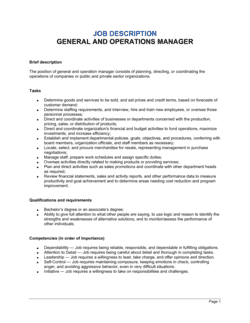
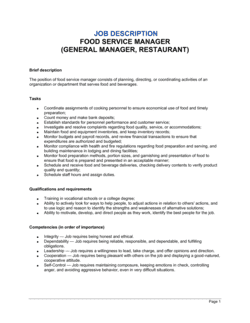
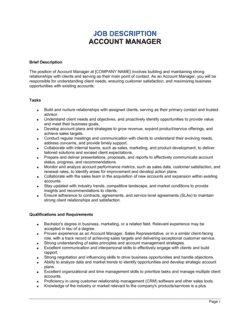
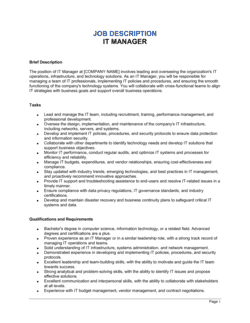
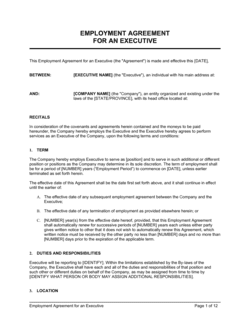
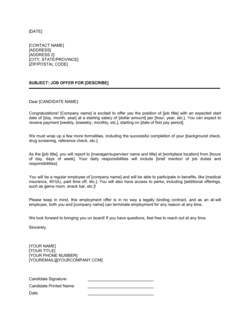
- Job Description
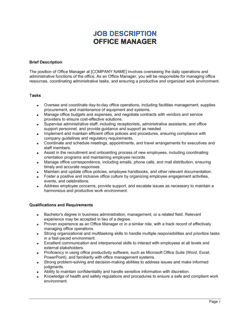
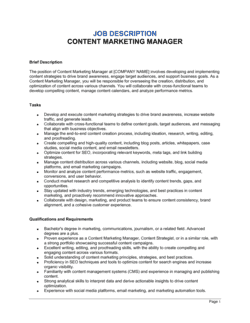
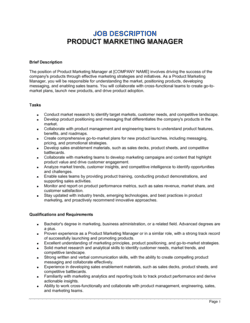
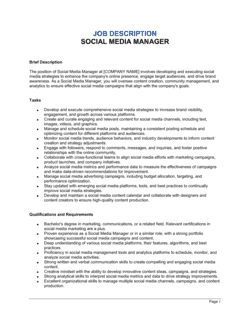
- A formal document outlining the title, duties, qualifications, and reporting structure of a specific position — used for hiring, performance management, and compensation benchmarking.
- Reporting Structure
- The chain of authority defining who the general manager reports to (typically the CEO or owner) and which departments or staff report to the GM.
- Decision-Making Authority
- The defined scope of financial and operational decisions the GM can make independently, including spending limits, hiring approvals, and vendor commitments.
- Key Performance Indicators (KPIs)
- Quantifiable metrics used to evaluate the GM's performance — such as revenue growth percentage, EBITDA margin, employee retention rate, or customer satisfaction score.
- At-Will Employment
- Employment that either party may end at any time for any lawful reason — the document should clarify whether the GM role is at-will or subject to a fixed term.
- Essential Functions
- The core duties that are fundamental to the role and cannot be reassigned without changing the nature of the position — legally relevant under the ADA and equivalent statutes.
- FLSA Exempt Status
- Classification under the US Fair Labor Standards Act indicating that the GM earns a salary above the threshold and meets the executive exemption test, making them ineligible for overtime pay.
- Span of Control
- The number of direct reports or departments the GM is responsible for supervising, which determines organizational complexity and compensation benchmarking.
- Position Summary
- A 3–5 sentence overview of the role's purpose, scope, and primary contribution to the organization — placed at the top of the job description.
- Non-Discrimination Clause
- A statement confirming the employer does not discriminate based on protected characteristics under applicable employment law — typically included as a closing paragraph in the job description.
- Bona Fide Occupational Qualification (BFOQ)
- A characteristic that is genuinely necessary to perform a job — one of the narrow exceptions allowing employers to set requirements that might otherwise appear discriminatory.