How To Become A Top Earner

Free to read β€’ Save or share with one click

FreeHow To Become A Top Earner Template

At a glance

What it is
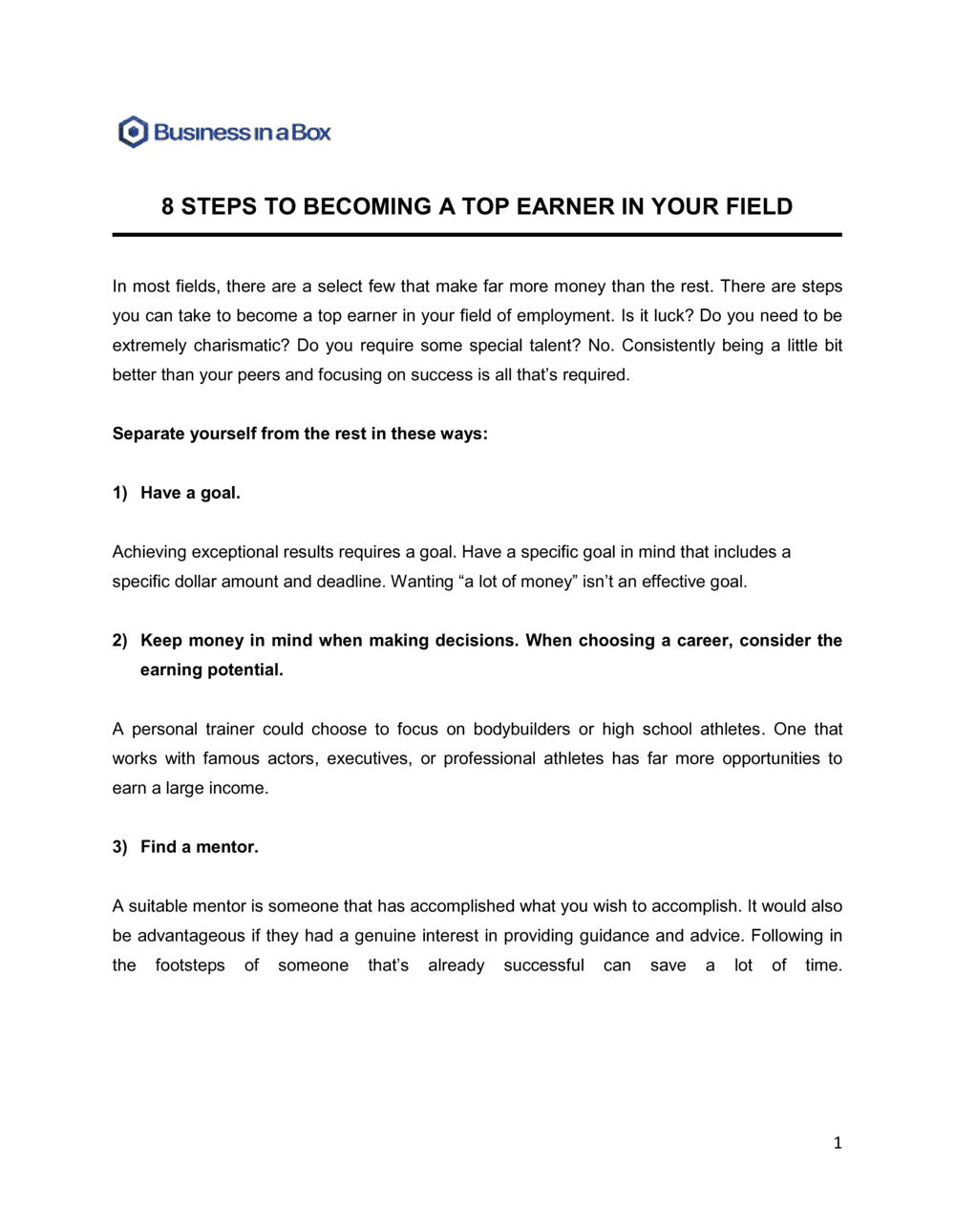
A How To Become A Top Earner guide is an operational document that maps the skills, habits, milestones, and strategies an individual or team needs to reach the highest income tier in their field. This free Word download gives you a structured, editable framework you can customize for your industry, role, or organization and export as PDF to share with employees, mentees, or sales teams.
When you need it
Use it when onboarding high-potential employees, coaching underperformers toward income goals, or building a personal roadmap for career and earnings advancement. It is especially useful in commission-based or performance-driven environments where the path to top-earner status needs to be explicit and measurable.
What's inside
A mindset and goal-setting framework, skill-gap analysis, income milestone targets, daily and weekly habit trackers, networking and relationship-building strategy, and a performance review cadence β€” all structured to give the reader a concrete, step-by-step path from current earnings to top-tier income.

What is a How To Become A Top Earner Guide?

A How To Become A Top Earner guide is an operational document that translates the ambition of high earnings into a structured, measurable action plan. It combines a current-state income assessment, high-income skill development priorities, multi-channel revenue strategy, performance habits, and an accountability framework into a single working document. Unlike generic career advice, it anchors every section to a specific dollar target and a calendar date, giving the reader a concrete basis for tracking progress and adjusting strategy when results fall short. The template is designed for individuals in performance-driven roles β€” sales, consulting, real estate, financial services β€” as well as for managers and coaches who guide others toward top-earner status.

Why You Need This Document

Without a structured plan, income growth defaults to incremental annual raises and occasional windfalls rather than a deliberate trajectory. Professionals who reach the top earning tier in their fields consistently attribute their results to a documented strategy, not talent alone β€” they identified the specific skills the market pays a premium for, built habits that compound over time, and held themselves accountable to milestones on a monthly basis rather than reviewing progress once a year. This template gives you the same framework in a format you can complete in a few hours, share with a coach or manager, and revisit monthly as a live working document. The cost of not having it is not dramatic β€” it is a slower, less intentional climb that leaves significant income on the table over a five- to ten-year career horizon.

Which variant fits your situation?

If your situation is…Use this template
Developing a 90-day onboarding plan for a new sales hireEmployee Development Plan
Setting annual performance targets tied to compensationPerformance Improvement Plan
Coaching an individual through a structured career advancement processCareer Development Plan
Mapping an entire sales team's path to quota and beyondSales Plan
Documenting income goals alongside personal financial targetsPersonal Budget Template
Building a training curriculum for high-earning skillsTraining Plan
Tracking weekly activity metrics for a commission-based teamSales Activity Report

Common mistakes to avoid

❌ Setting an income goal without a deadline

Why it matters: A target without a date is a wish. Without a timeline, there is no basis for calculating the pace of change needed or recognizing when the plan is falling behind.

Fix: Attach a specific calendar date to every income target and milestone. Then work backward to calculate what must happen each month to stay on track.

❌ Skipping the current-state assessment

Why it matters: Building an income growth plan without an honest baseline produces a strategy disconnected from actual starting conditions, making milestones either too easy or structurally unreachable.

Fix: Complete the income assessment before writing any strategy. Use 12 months of actual income data, not estimates or projections, as your baseline.

❌ Developing too many skills simultaneously

Why it matters: Splitting attention across five or six skill gaps produces marginal improvement in each and no mastery in any. Income premiums are paid for deep competence, not broad mediocrity.

Fix: Select one or two high-income skills with the largest gap-to-impact ratio. Commit to them for at least 90 days before adding a new development priority.

❌ Relying on a single income channel

Why it matters: One income source creates complete dependence on one employer, client, or market condition. Top earners are rarely exposed to a single point of failure in their income structure.

Fix: Build a second income channel β€” consulting, freelance, a digital product, or a portfolio asset β€” within the first 12 months of executing the plan.

The 9 key sections, explained

Mindset and Goal-Setting Foundation

Current-State Income Assessment

High-Income Skill Identification and Development Plan

Value Proposition and Personal Brand Statement

Income Growth Strategy and Revenue Channels

Networking and Relationship-Building Plan

Daily and Weekly Performance Habits

Performance Tracking and Milestone Review

Accountability and Support Structure

How to fill it out

  1. 1

    Set a specific, dated income target

    Open the mindset and goal-setting section and write your target income as a specific dollar amount with a calendar date. Break it into annual, quarterly, and monthly milestones.

    πŸ’‘ Set the target at a level that feels challenging but has at least one real-world precedent β€” someone in your field or organization who has reached it. This makes it concrete rather than theoretical.

  2. 2

    Complete the current-state income assessment

    List every current income source with its annual dollar value. Calculate the total and subtract it from your target to get your income gap. Record this number prominently β€” it is your primary planning input.

    πŸ’‘ Be conservative in estimating variable income. Use a trailing 12-month average rather than your best month to avoid building a plan on an outlier.

  3. 3

    Identify your top two high-income skills to develop

    Research what skills command the highest pay in your specific field. Narrow the list to two skills where your current gap is largest relative to the income impact of closing it. Document a learning path for each.

    πŸ’‘ Ask someone already earning at your target level what skill they credit most for their income jump β€” that answer is worth more than any skills list.

  4. 4

    Write your value proposition statement

    Draft a one to two sentence statement that names your target client or employer, the specific outcome you produce, and the quantified result you have achieved. Test it by reading it to someone outside your industry.

    πŸ’‘ If the person you read it to cannot describe what you do back to you accurately, it is not specific enough.

  5. 5

    Map two to three income channels

    Identify the specific paths you will use to close the income gap β€” a raise, new clients, a product, or a consulting stream. For each, enter the target amount, the method, and the timeline.

    πŸ’‘ Prioritize channels where you already have a credible track record over those that require building from zero β€” existing proof of value is your fastest path to higher income.

  6. 6

    Define your daily and weekly performance habits

    Choose four to six daily or weekly actions with the highest direct impact on your income channels. Write each as a specific, timed action β€” not a vague intention.

    πŸ’‘ Schedule habit blocks in your calendar before the week starts. Habits that are not calendared get displaced by reactive work within two weeks.

  7. 7

    Set up your tracking and milestone review cadence

    Enter the three to five KPIs you will track monthly. Set a recurring calendar reminder for your monthly review. Define in advance what threshold triggers a strategy change.

    πŸ’‘ Track leading indicators β€” outreach volume, proposals sent, hours of skill practice β€” not just lagging ones like income. Leading metrics tell you weeks earlier whether you are on track.

  8. 8

    Confirm your accountability partner and first check-in

    Name the person who will hold you accountable, agree on the format and frequency, and schedule the first check-in before you file the completed document.

    πŸ’‘ Choose an accountability partner who is operating at or above your target income level. Peers at the same level tend to normalize current performance rather than challenge it.

Frequently asked questions

What is a How To Become A Top Earner guide?

A How To Become A Top Earner guide is an operational document that maps the strategies, skills, habits, and milestones a person needs to move from their current income level to the top tier in their field or organization. It combines goal-setting, skill development, income channel planning, and accountability structures into a single actionable framework. Managers, coaches, and individuals use it to make the path to high earnings concrete and measurable rather than aspirational.

Who should use this template?

Sales managers coaching high-potential reps, career coaches working with income-growth clients, HR professionals building performance development programs, independent professionals mapping a path to premium rates, and anyone in a commission-based or performance-driven role who wants a structured roadmap rather than general advice. The template is flexible enough to apply across industries as long as earnings are at least partially tied to individual performance.

What is the difference between a top earner guide and a career development plan?

A career development plan focuses broadly on skills, roles, and professional growth over a multi-year horizon. A top earner guide is specifically income-focused β€” it starts with a dollar target, works backward to the skills and actions that drive that income, and measures progress in revenue or compensation terms. The two documents complement each other but are not interchangeable.

How long should it take to execute a top earner plan?

Most meaningful income jumps β€” moving from median to top-quartile earnings in a field β€” take 12 to 36 months of sustained execution. The timeline depends on the size of the income gap, the pace of skill development, and the number of active income channels. Setting 90-day milestones within the larger goal keeps the plan actionable and allows for course correction before a full year is lost to a wrong strategy.

Can this template be used for a team rather than an individual?

Yes. Sales managers and team leaders frequently adapt the framework to create a shared team-level earnings roadmap, where the income targets are collective (total team revenue or average earnings per rep) and the habits and accountability structures are embedded into team meetings and coaching sessions. The individual sections can be assigned to each team member as personal components within a shared plan.

What are the most important habits of top earners?

The habits most consistently linked to top-earner status across industries are daily skill practice, consistent proactive outreach or prospecting, regular review of income metrics against targets, deliberate relationship maintenance with high-value contacts, and a fixed learning block each week. The specific habits matter less than the consistency β€” top earners execute a small number of high-impact actions reliably rather than attempting a comprehensive routine intermittently.

How is this guide different from general self-help advice?

This template is structured around measurable income targets, specific skill gaps, and documented accountability β€” not motivational principles. Every section asks for a number, a date, or a named action. The difference between a guide that produces results and one that does not is specificity: this template forces that specificity at every step.

What KPIs should I track to measure progress?

The most useful leading KPIs depend on the income model, but typically include: number of new client or employer contacts made per week, proposals or applications submitted per month, hours of deliberate skill practice per week, and pipeline value of pending opportunities. The primary lagging KPI is income against monthly milestone target. Tracking both leading and lagging indicators tells you whether a strategy is working before the income number confirms or denies it.

Do I need a coach or mentor to use this guide effectively?

Not necessarily, but an accountability partner significantly increases the likelihood of follow-through. Research on goal achievement consistently shows that people who report progress to another person are more likely to hit their targets than those who self-monitor alone. A formal coach is one option; a peer operating at a higher income level, a manager, or a structured mastermind group can serve the same function at lower cost.

How this compares to alternatives

vs Performance Improvement Plan

A performance improvement plan (PIP) is a corrective document used when an employee is underperforming against a defined standard, typically initiated by a manager. A top earner guide is aspirational and self-directed β€” used to reach the highest income tier, not to correct a deficiency. The PIP is remedial; the top earner guide is developmental. Both use goal-setting and accountability structures, but their starting points and audiences are fundamentally different.

vs Sales Plan

A sales plan defines team-level revenue targets, territory assignments, and go-to-market tactics for a business. A top earner guide focuses on an individual's personal income growth through skill development, habit formation, and multi-channel income strategy. A sales rep might use both simultaneously β€” the sales plan governs their role, while the top earner guide governs their personal development toward the top commission tier.

vs Training Plan

A training plan maps a structured curriculum for developing specific skills, typically for a defined cohort or onboarding program. A top earner guide is broader β€” it incorporates skill development but also covers income channel strategy, networking, habit formation, and performance tracking. Think of the training plan as one component that might be referenced within a top earner guide's skill development section.

vs Strategic Plan

A strategic plan is an organizational document that sets company-wide goals, initiatives, and resource allocation over a 3–5 year horizon. A top earner guide is an individual-level document focused on personal income growth. A business owner might use both β€” the strategic plan for the business and the top earner guide to map their own compensation and skills development alongside it.

Industry-specific considerations

Sales and Business Development

Commission structure milestones, quota attainment benchmarks, and prospecting habit metrics are embedded directly into the income channel and performance tracking sections.

Financial Services

AUM growth targets, client acquisition rates, and fee-based revenue diversification make this guide especially practical for advisors and brokers mapping a path to top-producer status.

Real Estate

Transaction volume targets, listing conversion rates, and geographic farm development are the primary income channels tracked within the plan's revenue strategy section.

Professional Services

Billing rate progression, client retention, and referral network development are the key income levers for consultants, lawyers, and accountants using this guide.

Template vs pro β€” what fits your needs?

PathBest forCostTime
Use the templateIndividuals, sales reps, freelancers, and managers who want a structured, self-directed income growth roadmapFree2–4 hours to complete
Template + professional reviewProfessionals working with a career coach or mentor who will review and stress-test the plan's targets and strategies$150–$500 for a coaching session or plan review1–3 days with coach feedback cycles
Custom draftedOrganizations building a company-wide top-earner development program with custom KPIs, training curricula, and management review processes$1,000–$5,000 for an L&D consultant or HR specialist to design2–4 weeks

Glossary

Income Milestone
A specific, measurable earnings target set at a defined point in time β€” e.g., reaching $100K annual income within 24 months.
Skill Gap
The difference between the skills a person currently has and the skills required to reach the next income level in their field.
High-Income Skill
A capability β€” such as closing complex sales, coding, copywriting, or financial analysis β€” that the market pays a significant premium for.
Top Earner
An individual who consistently ranks in the highest income percentile within their profession, industry, or organization.
Performance Benchmark
A quantified standard β€” revenue generated, clients acquired, deals closed β€” used to measure progress toward top-earner status.
Compounding Habits
Daily or weekly actions that individually appear small but accumulate over time into significant skill, relationship, or income gains.
Leverage
The ability to multiply output β€” income, clients, or results β€” without a proportional increase in time invested, typically through systems, delegation, or assets.
Accountability Structure
A formal or semi-formal system β€” weekly check-ins, peer reviews, coach sessions β€” that keeps an individual on track toward stated income goals.
Value Proposition
The specific, articulated reason a client, employer, or market pays a premium for one professional's services over another's.
Income Diversification
The strategy of building multiple revenue streams β€” salary, consulting, royalties, investments β€” to reduce reliance on a single source of income.

Part of your Business Operating System

This document is one of 3,000+ business & legal templates included in Business in a Box.

  • Fill-in-the-blanks β€” ready in minutes
  • Compatible with all office suites
  • Export to PDF and share electronically

Create your document in 3 simple steps.

From template to signed document β€” all inside one Business Operating System.
1
Download or open template

Access over 3,000+ business and legal templates for any business task, project or initiative.

2
Edit and fill in the blanks with AI

Customize your ready-made business document template and save it in the cloud.

3
Save, Share, Send, Sign

Share your files and folders with your team. Create a space of seamless collaboration.

Save time, save money, and create top-quality documents.

β˜…β˜…β˜…β˜…β˜…

"Fantastic value! I'm not sure how I'd do without it. It's worth its weight in gold and paid back for itself many times."

Managing Director Β· Mall Farm
Robert Whalley
Managing Director, Mall Farm Proprietary Limited
β˜…β˜…β˜…β˜…β˜…

"I have been using Business in a Box for years. It has been the most useful source of templates I have encountered. I recommend it to anyone."

Business Owner Β· 4+ years
Dr Michael John Freestone
Business Owner
β˜…β˜…β˜…β˜…β˜…

"It has been a life saver so many times I have lost count. Business in a Box has saved me so much time and as you know, time is money."

Owner Β· Upstate Web
David G. Moore Jr.
Owner, Upstate Web

Run your business with a system β€” not scattered tools

Stop downloading documents. Start operating with clarity. Business in a Box gives you the Business Operating System used by over 250,000 companies worldwide to structure, run, and grow their business.

Free Forever PlanΒ Β·Β No credit card required