Top 3 Fundamental Ways To Grow Your Business

Free Word download β€’ Edit online β€’ Save & share with Drive β€’ Export to PDF

8 pagesβ€’25–35 min to fillβ€’Difficulty: Complexβ€’Signature requiredβ€’Legal review recommended
Learn more ↓
FreeTop 3 Fundamental Ways To Grow Your Business Template

At a glance

What it is
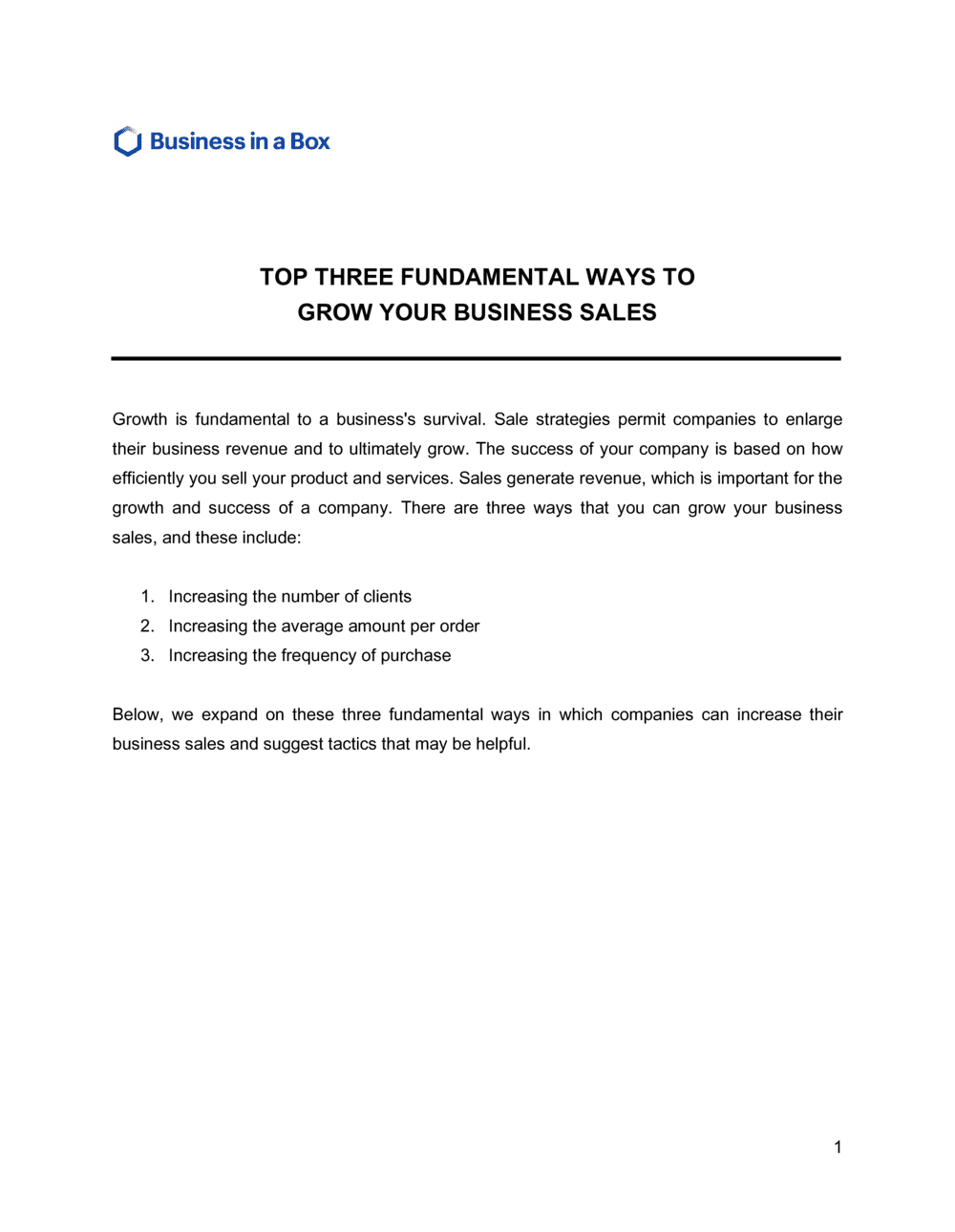
The Top 3 Fundamental Ways To Grow Your Business is a structured strategic framework document that codifies the three core levers every business can pull to increase revenue: acquiring more customers, increasing the average transaction value, and increasing purchase frequency. This free Word download gives owners and executives a binding, actionable framework they can edit online, assign accountability for, and export as PDF to share with leadership teams, advisors, or investors.
When you need it
Use it when revenue has plateaued and you need a disciplined structure to diagnose which growth lever to prioritize. It is equally valuable at company launch, during annual strategic planning, or when preparing a growth narrative for lenders or investors.
What's inside
A structured breakdown of the three fundamental growth levers with supporting tactics, measurable targets, accountability assignments, and implementation timelines. Each lever includes a diagnostic section, specific action items, and KPIs to track progress.

What is the Top 3 Fundamental Ways To Grow Your Business?

The Top 3 Fundamental Ways To Grow Your Business is a structured strategic framework document that identifies and operationalizes the only three levers that can increase revenue in any business: acquiring more customers, increasing the average value of each transaction, and increasing how frequently existing customers buy. First formalized by business strategist Jay Abraham and widely adopted across industries, the framework is powerful because it is mathematically exhaustive β€” every revenue increase in the history of commerce comes from one or a combination of these three mechanisms. This template translates the framework into a binding, accountable document with defined targets, named owners, specific KPIs, and committed budgets that leadership teams can sign and execute against.

Why You Need This Document

Without a documented, signed growth framework, revenue conversations remain aspirational rather than operational. Teams default to the loudest growth idea rather than the highest-return lever, budgets flow to acquisition because it is visible while retention quietly bleeds margin, and no one is formally accountable when targets are missed. A 10% improvement across all three levers simultaneously produces a 33% revenue increase through compounding β€” but capturing that result requires each lever to have an owner, a funded budget, and a review date before the first tactic is launched. This template gives you the structure to move from "we need to grow" to a signed operating commitment with measurable outcomes, whether you are aligning an internal leadership team, reporting to a board, or presenting a growth narrative to an investor.

Which variant fits your situation?

If your situation is…Use this template
Comprehensive multi-year business growth roadmap with financialsBusiness Plan
Focused 12-month revenue growth targets by channelSales Plan
Tracking growth KPIs and metrics on a monthly basisKPI Dashboard
Structuring a customer acquisition campaign with budgetMarketing Plan
Presenting the growth strategy to external investorsInvestor Pitch Deck
Identifying growth opportunities through a structured analysisSWOT Analysis
Operationalizing growth tactics across departmentsStrategic Plan

Common mistakes to avoid

❌ Focusing exclusively on customer acquisition

Why it matters: Acquisition is the most expensive of the three growth levers. Businesses that ignore ATV and frequency improvements spend heavily to replace customers they could have retained, keeping revenue flat despite high marketing spend.

Fix: Model all three levers before allocating budget. In most businesses, improving ATV and frequency by 10% each generates more net revenue than a 20% increase in new customers at the same cost.
❌ Setting targets without a documented baseline

Why it matters: Without a starting point, there is no way to determine whether a target is realistic or to measure whether progress is real or seasonal variation.

Fix: Complete the baseline metrics section before writing a single target. Use a 90-day trailing average for each lever metric to eliminate seasonal distortion.

❌ Assigning growth lever ownership to a team rather than a person

Why it matters: When everyone is accountable, no one is accountable. Group ownership produces no escalation when a lever stalls and no recognition when it succeeds.

Fix: Name one individual β€” not a department β€” as the accountable owner for each lever. Give them the budget authority and reporting access to execute.

❌ Skipping the budget allocation section

Why it matters: Growth initiatives without committed funding stall at the first competing priority. A plan without budget is a list of intentions that leadership can quietly defund without formally canceling.

Fix: Attach a dollar figure to every tactic. If no budget is available, sequence tactics into a future quarter rather than listing them as current-quarter commitments.

❌ Not scheduling a formal review cadence

Why it matters: A growth plan written in January and reviewed in December has been irrelevant for ten of those twelve months. Markets, teams, and assumptions change faster than an annual review cycle.

Fix: Block monthly 30-minute review meetings with all lever owners before the plan is signed. Make reviewing actuals vs. targets a standing agenda item, not an ad hoc event.

❌ Writing tactics instead of outcomes in the KPI section

Why it matters: Tracking whether a tactic was completed β€” 'launched email campaign: yes' β€” tells you nothing about whether the lever is actually moving. Activity metrics mask underperformance.

Fix: Every KPI must be a number that changes based on customer behavior, not team behavior. 'Repeat purchase rate: 28% vs. 22% target' is an outcome KPI. 'Sent 3 emails this month' is an activity log.

The 10 key clauses, explained

Growth Lever 1 β€” Customer Acquisition

In plain language: Defines the strategies, channels, and targets for bringing new customers into the business β€” the most commonly focused growth lever.

Sample language
[COMPANY NAME] will increase new customer acquisition by [X]% over [TIMEFRAME] through the following channels: [CHANNEL 1], [CHANNEL 2], and [CHANNEL 3]. Accountability: [OWNER NAME / ROLE]. Target new customers per month: [NUMBER].

Common mistake: Listing acquisition channels without assigning budget or a single accountable owner β€” resulting in a plan that no one executes and no one can be held responsible for.

Growth Lever 2 β€” Increasing Average Transaction Value

In plain language: Documents specific tactics for raising how much each customer spends per transaction, including upselling, bundling, and premium-tier offerings.

Sample language
[COMPANY NAME] will increase average transaction value from $[CURRENT ATV] to $[TARGET ATV] by [DATE] through: (a) bundling [PRODUCT A] with [PRODUCT B] at $[PRICE], (b) introducing a [PREMIUM TIER NAME] at $[PRICE], and (c) training sales team on upsell scripts by [DATE].

Common mistake: Setting an ATV target without identifying which specific products or offers will drive the increase β€” making the goal aspirational rather than actionable.

Growth Lever 3 β€” Increasing Purchase Frequency

In plain language: Outlines programs, communications, and retention strategies that bring existing customers back to buy more often.

Sample language
[COMPANY NAME] will increase average purchase frequency from [X] times per year to [Y] times per year by [DATE] through: (a) a [loyalty program / subscription model / re-engagement email campaign] launched by [DATE], and (b) quarterly outreach to lapsed customers (last purchase > [X] days).

Common mistake: Focusing exclusively on new customer acquisition while ignoring frequency β€” leaving revenue on the table from customers who already trust the business.

Current Baseline Metrics

In plain language: Records the starting-point data for each of the three growth levers so progress can be measured objectively.

Sample language
As of [DATE]: Monthly new customers: [NUMBER]. Average transaction value: $[AMOUNT]. Average annual purchase frequency: [NUMBER]. Monthly revenue: $[AMOUNT]. These figures serve as the baseline against which all growth targets are measured.

Common mistake: Skipping the baseline section and writing targets without anchoring them to current performance β€” making it impossible to measure actual progress or calculate realistic targets.

Growth Targets and Timeline

In plain language: States specific, time-bound numerical targets for each growth lever and the overall revenue outcome expected from achieving them.

Sample language
Target outcomes by [DATE]: New customers per month: [NUMBER] (from [CURRENT]). ATV: $[TARGET] (from $[CURRENT]). Annual purchase frequency: [TARGET] (from [CURRENT]). Combined projected monthly revenue: $[PROJECTED REVENUE].

Common mistake: Setting targets that are not grounded in the baseline math β€” for example, projecting 3Γ— revenue growth without showing which combination of the three levers produces that result.

Accountability and Ownership

In plain language: Assigns a named individual or role as accountable for each growth lever, with defined review cadence and escalation path.

Sample language
Growth Lever 1 Owner: [NAME / TITLE]. Growth Lever 2 Owner: [NAME / TITLE]. Growth Lever 3 Owner: [NAME / TITLE]. Monthly review: [DATE]. Quarterly review: [DATE]. Escalation to: [CEO / BOARD / ADVISOR].

Common mistake: Assigning ownership to a team or department rather than a specific named individual β€” diffuse accountability produces no accountability.

Key Performance Indicators (KPIs)

In plain language: Lists the specific metrics tracked weekly or monthly to confirm each growth lever is moving in the right direction.

Sample language
Lever 1 KPIs: new leads per week ([TARGET]), lead-to-customer conversion rate ([TARGET]%). Lever 2 KPIs: average order value ([TARGET]$), upsell attachment rate ([TARGET]%). Lever 3 KPIs: repeat purchase rate ([TARGET]%), churn rate ([TARGET]%).

Common mistake: Listing too many KPIs β€” tracking more than three metrics per lever creates reporting overhead that teams stop maintaining after the first month.

Budget and Resource Allocation

In plain language: Documents the investment assigned to each growth lever, including marketing spend, headcount, and technology, to ensure the plan is funded.

Sample language
Growth Lever 1 budget: $[AMOUNT] per month (channels: [BREAKDOWN]). Growth Lever 2 budget: $[AMOUNT] (product development, sales training). Growth Lever 3 budget: $[AMOUNT] (CRM, loyalty program, email automation). Total monthly growth investment: $[TOTAL].

Common mistake: Approving growth targets without approving the corresponding budget β€” leading to initiatives that stall because funding was never formally committed.

Review and Amendment Process

In plain language: Sets out the cadence for reviewing progress against targets and the process for amending the plan when assumptions prove incorrect.

Sample language
This growth plan shall be reviewed monthly on [DAY] by [REVIEW PARTICIPANTS]. Material amendments require written agreement by [AUTHORIZED SIGNATORIES]. The plan shall be fully updated on an annual basis no later than [DATE EACH YEAR].

Common mistake: Treating the plan as a static document with no review cadence β€” growth plans built on month-1 assumptions become irrelevant within 90 days without a formal update process.

Signatures and Effective Date

In plain language: Records the names, titles, and signatures of the parties committing to the plan, along with the effective date.

Sample language
By signing below, the undersigned commit to executing this growth plan in accordance with its terms. [NAME], [TITLE], [COMPANY] β€” Date: [DATE]. [NAME], [TITLE], [COMPANY] β€” Date: [DATE]. Effective Date: [DATE].

Common mistake: Circulating the plan without obtaining signatures β€” unsigned plans carry no formal accountability and are routinely ignored when priorities shift.

How to fill it out

  1. 1

    Record your current baseline metrics

    Before setting any targets, enter your actual current figures for monthly new customers, average transaction value, and annual purchase frequency. Pull these from your accounting system or CRM.

    πŸ’‘ Use a 90-day trailing average rather than a single month's data β€” one unusually strong or weak month will distort your baseline and make targets unreliable.

  2. 2

    Model the revenue impact of each lever

    Use the baseline math to calculate what a 10%, 20%, or 30% improvement in each lever produces in monthly revenue. This shows you which lever has the highest return before you invest in it.

    πŸ’‘ For most businesses, a 10% improvement across all three levers compounds to a 33% revenue increase β€” more than a 30% improvement in any single lever alone.

  3. 3

    Prioritize one lever for immediate focus

    Select the lever with the highest return relative to cost and time to implement. Document your rationale in the plan so stakeholders understand why the other levers are sequenced later.

    πŸ’‘ Increasing purchase frequency is typically the fastest and cheapest lever for service businesses β€” existing customers require no acquisition cost.

  4. 4

    Define specific tactics for each lever

    For each growth lever, list three to five concrete actions β€” not goals. 'Launch a referral program with a $50 reward by June 1' is a tactic; 'grow referrals' is not.

    πŸ’‘ If a tactic cannot be assigned a start date and a named owner in the next 30 seconds, it is not specific enough.

  5. 5

    Assign accountability by name, not by role

    Enter the first and last name of the person accountable for each lever's results. Titles change; names create personal accountability.

    πŸ’‘ Accountability without authority creates frustration β€” confirm each named owner has the budget and decision-making power to execute their lever's tactics.

  6. 6

    Set three KPIs per lever and no more

    Choose the two or three metrics that most directly reflect movement on each lever and enter the current value and the 90-day target for each.

    πŸ’‘ Weekly KPI check-ins under 15 minutes sustain momentum; monthly reviews alone are too infrequent to catch a stalling lever before it costs a quarter.

  7. 7

    Allocate budget to each lever explicitly

    Enter a monthly budget figure for each lever. If the budget is zero, note it β€” zero-budget tactics exist but they must be acknowledged as lower-priority than funded ones.

    πŸ’‘ If total growth investment exceeds 15% of current monthly revenue, phase the plan over two quarters rather than launching all three levers simultaneously.

  8. 8

    Obtain signatures and set the first review date

    Have all accountable parties sign the plan before work begins. Schedule the first monthly review meeting on the calendar the same day the plan is signed.

    πŸ’‘ A growth plan without a signed commitment and a date on the calendar is a wish list, not a plan.

Frequently asked questions

What are the three fundamental ways to grow a business?

The three fundamental growth levers are: acquiring more customers, increasing the average value of each transaction, and increasing how often existing customers buy. Every revenue increase in any business comes from one or a combination of these three levers. The framework, popularized by business educators including Jay Abraham, is valuable precisely because it is exhaustive β€” there is no fourth lever.

Why does focusing on all three levers matter more than just getting new customers?

New customer acquisition is typically the most expensive growth lever β€” it requires marketing spend, sales effort, and time. A 10% improvement across all three levers simultaneously produces a 33% revenue increase (1.1 Γ— 1.1 Γ— 1.1 = 1.331), compounding the effect of each individual improvement. Businesses that focus exclusively on acquisition often find revenue flat because leaking customers and stagnant transaction values offset acquisition gains.

How do I calculate the current baseline for each growth lever?

For new customers, divide total new customers acquired by the number of months in your measurement period. For average transaction value, divide total revenue by total number of transactions. For purchase frequency, divide total transactions by total active customers in the same period. Use a 90-day trailing average for each metric to smooth out seasonal variation and produce a reliable starting point.

What is the fastest growth lever to improve?

Purchase frequency is typically the fastest and cheapest lever for most businesses because it targets customers who have already bought and already trust you. Re-engagement emails, loyalty programs, and subscription offers can produce measurable results within 30–60 days at a fraction of the cost of new customer acquisition. Average transaction value through upselling at point of sale is the second fastest, often implementable through staff training alone.

How is this growth framework different from a full business plan?

A business plan covers market analysis, competitive positioning, team, operations, and 3–5 year financial projections across 20–35 pages. This framework is a focused operational tool that zooms in on the three specific revenue levers, assigns ownership, sets KPIs, and creates accountability for execution in the near term β€” typically 90 days to 12 months. The two documents complement each other: the business plan sets direction; this framework drives day-to-day revenue execution.

Does this document need to be signed to be effective?

Technically, a growth framework can be used without signatures. However, signed commitment from each lever owner and the business's leadership significantly increases execution rates. Signature creates a formal record of agreement on targets, budgets, and accountability β€” reducing the risk that priorities quietly shift when the plan becomes inconvenient. For businesses using this document with advisors, investors, or board members, a signed copy is typically expected.

How often should the growth plan be reviewed and updated?

Monthly reviews against KPI actuals are the minimum cadence for the plan to remain relevant. A full update of targets, tactics, and budget allocation should happen quarterly for fast-moving businesses and semi-annually for more stable ones. Plans that are only reviewed annually become irrelevant within 90 days as market conditions, team composition, and competitive dynamics shift.

Can this framework be used for a nonprofit or service-based business?

Yes. The three levers translate directly: acquiring more donors or clients, increasing the average gift or engagement value, and increasing how often existing donors give or clients return. The terminology changes but the math is identical. Service businesses β€” consulting, healthcare, legal, trades β€” often find the purchase frequency lever the highest-return starting point because repeat business requires no acquisition cost.

What KPIs should I track for each growth lever?

For customer acquisition: new leads per week, lead-to-customer conversion rate, and cost per acquired customer. For average transaction value: average order value, upsell attachment rate, and percentage of customers on a premium tier. For purchase frequency: repeat purchase rate within 90 days, average days between purchases, and annual churn rate. Track no more than three KPIs per lever β€” more than that creates reporting burden that teams stop maintaining.

How this compares to alternatives

vs Business Plan

A business plan is a comprehensive 20–35 page document covering market analysis, team, operations, and multi-year financial projections for external audiences such as investors and lenders. This growth framework is a focused operational document targeting the three revenue levers with near-term tactics and KPIs. Use the business plan to raise capital; use this framework to execute growth after capital is secured or for internal strategic alignment.

vs Marketing Plan

A marketing plan details the campaigns, channels, budget, and messaging strategy for reaching and converting new prospects β€” it primarily addresses the customer acquisition lever. This growth framework spans all three revenue levers and includes sales, retention, and pricing tactics that fall outside the scope of marketing. Use the marketing plan as the detailed execution document for Lever 1, and this framework as the overarching revenue model that contextualizes it.

vs Strategic Plan

A strategic plan sets 3–5 year directional goals across all business functions β€” culture, operations, product, and finance β€” at a high level. This growth framework is narrower in scope and more operationally specific: it focuses exclusively on revenue growth mechanics, assigns individual accountability, and tracks weekly or monthly KPIs. The two documents work together, with the strategic plan setting the direction and this framework driving near-term revenue execution.

vs Sales Plan

A sales plan defines quotas, territories, sales team structure, and pipeline targets β€” it focuses on converting leads into customers and primarily addresses the acquisition and ATV levers from a sales-team perspective. This growth framework takes a broader view, including marketing acquisition channels, pricing and bundling tactics, and customer retention programs that sit outside the sales function. Use the sales plan for sales team management; use this framework for cross-functional revenue growth alignment.

Industry-specific considerations

Retail and E-commerce

ATV improvements through product bundling and minimum-spend free-shipping thresholds deliver measurable results within a single promotional cycle.

Professional Services

Purchase frequency is the dominant lever β€” retainer models, annual service agreements, and proactive client outreach convert one-time engagements into recurring revenue.

Food and Beverage

Loyalty programs and frequency-based offers β€” such as a tenth visit free β€” directly target the purchase frequency lever with low implementation cost.

SaaS and Technology

ATV growth through tiered pricing, seat expansion, and add-on modules operates in parallel with churn reduction as the primary frequency-equivalent lever.

Healthcare and Wellness

Membership or subscription wellness plans increase frequency predictably while referral programs drive acquisition at a lower CAC than paid channels.

Construction and Trades

Maintenance agreements and seasonal service packages convert project-based clients into recurring revenue, directly addressing the purchase frequency gap common in trades businesses.

Jurisdictional notes

United States

Growth commitment documents embedded in shareholder or operating agreements are governed by the law of the state of incorporation. California and Delaware have differing standards for enforcing internal business agreements. Non-compete provisions sometimes referenced in growth plans are subject to state-by-state enforceability rules β€” California bans most post-employment restrictions.

Canada

Canadian corporate law requires growth and strategic commitments that affect shareholder rights to be documented in accordance with provincial corporate statutes. Ontario and British Columbia have specific requirements for unanimous shareholder agreements that may incorporate growth targets. French-language requirements apply to any document used in Quebec business operations under the Charter of the French Language.

United Kingdom

Growth frameworks incorporated into shareholder agreements or investment documents are subject to the Companies Act 2006 and the terms of any applicable shareholder deed. Directors have fiduciary duties under UK company law that make documented growth commitments material to board governance. Growth targets embedded in loan agreements with UK lenders may constitute financial covenants with breach consequences.

European Union

Growth plans shared with EU-based investors or used in cross-border commercial agreements should be reviewed for compliance with applicable member-state contract law. GDPR implications arise if the plan references customer data, acquisition databases, or CRM systems containing personal data of EU residents. German and French commercial law impose good-faith obligations on business agreements that may affect how growth commitments are interpreted in disputes.

Template vs lawyer β€” what fits your deal?

PathBest forCostTime
Use the templateSmall business owners and founders building an internal growth operating model without external capital or legal obligationsFree2–4 hours to complete
Template + legal reviewBusinesses sharing the plan with investors, board members, or advisors where accountability language and KPI commitments need to be precise$200–$500 for a business advisor or consultant review1–3 days
Custom draftedGrowth commitments embedded in shareholder agreements, investor term sheets, or franchise disclosure documents that carry contractual weight$800–$2,500 for legal and advisory drafting1–2 weeks

Glossary

Customer Acquisition
The process of attracting and converting new prospects into paying customers through marketing, sales, and referral activity.
Average Transaction Value (ATV)
Total revenue divided by number of transactions in a given period β€” a key lever for revenue growth without adding new customers.
Purchase Frequency
The average number of times a customer buys from a business within a defined period, such as monthly or annually.
Customer Lifetime Value (CLV)
The total gross profit a business expects to generate from a single customer across the entire relationship.
Upsell
A sales tactic that encourages a customer to purchase a higher-tier product or add-ons at the point of sale or shortly after.
Cross-sell
Offering complementary products or services to a customer who is already purchasing, increasing the transaction value.
Churn Rate
The percentage of customers who stop buying from a business within a defined period β€” the primary obstacle to growing purchase frequency.
Conversion Rate
The percentage of prospects or leads who complete a desired action, such as making a purchase or signing a contract.
Net Promoter Score (NPS)
A customer satisfaction metric that measures how likely customers are to recommend a business on a 0–10 scale, used as a proxy for organic referral growth.
Revenue per Customer
Total revenue divided by total number of active customers β€” a composite metric that reflects both transaction value and frequency improvements.

Part of your Business Operating System

This document is one of 3,000+ business & legal templates included in Business in a Box.

  • Fill-in-the-blanks β€” ready in minutes
  • 100% customizable Word document
  • Compatible with all office suites
  • Export to PDF and share electronically

Create your document in 3 simple steps.

From template to signed document β€” all inside one Business Operating System.
1
Download or open template

Access over 3,000+ business and legal templates for any business task, project or initiative.

2
Edit and fill in the blanks with AI

Customize your ready-made business document template and save it in the cloud.

3
Save, Share, Send, Sign

Share your files and folders with your team. Create a space of seamless collaboration.

Save time, save money, and create top-quality documents.

β˜…β˜…β˜…β˜…β˜…

"Fantastic value! I'm not sure how I'd do without it. It's worth its weight in gold and paid back for itself many times."

Managing Director Β· Mall Farm
Robert Whalley
Managing Director, Mall Farm Proprietary Limited
β˜…β˜…β˜…β˜…β˜…

"I have been using Business in a Box for years. It has been the most useful source of templates I have encountered. I recommend it to anyone."

Business Owner Β· 4+ years
Dr Michael John Freestone
Business Owner
β˜…β˜…β˜…β˜…β˜…

"It has been a life saver so many times I have lost count. Business in a Box has saved me so much time and as you know, time is money."

Owner Β· Upstate Web
David G. Moore Jr.
Owner, Upstate Web

Run your business with a system β€” not scattered tools

Stop downloading documents. Start operating with clarity. Business in a Box gives you the Business Operating System used by over 250,000 companies worldwide to structure, run, and grow their business.

Start freeΒ Β·Β No credit card required