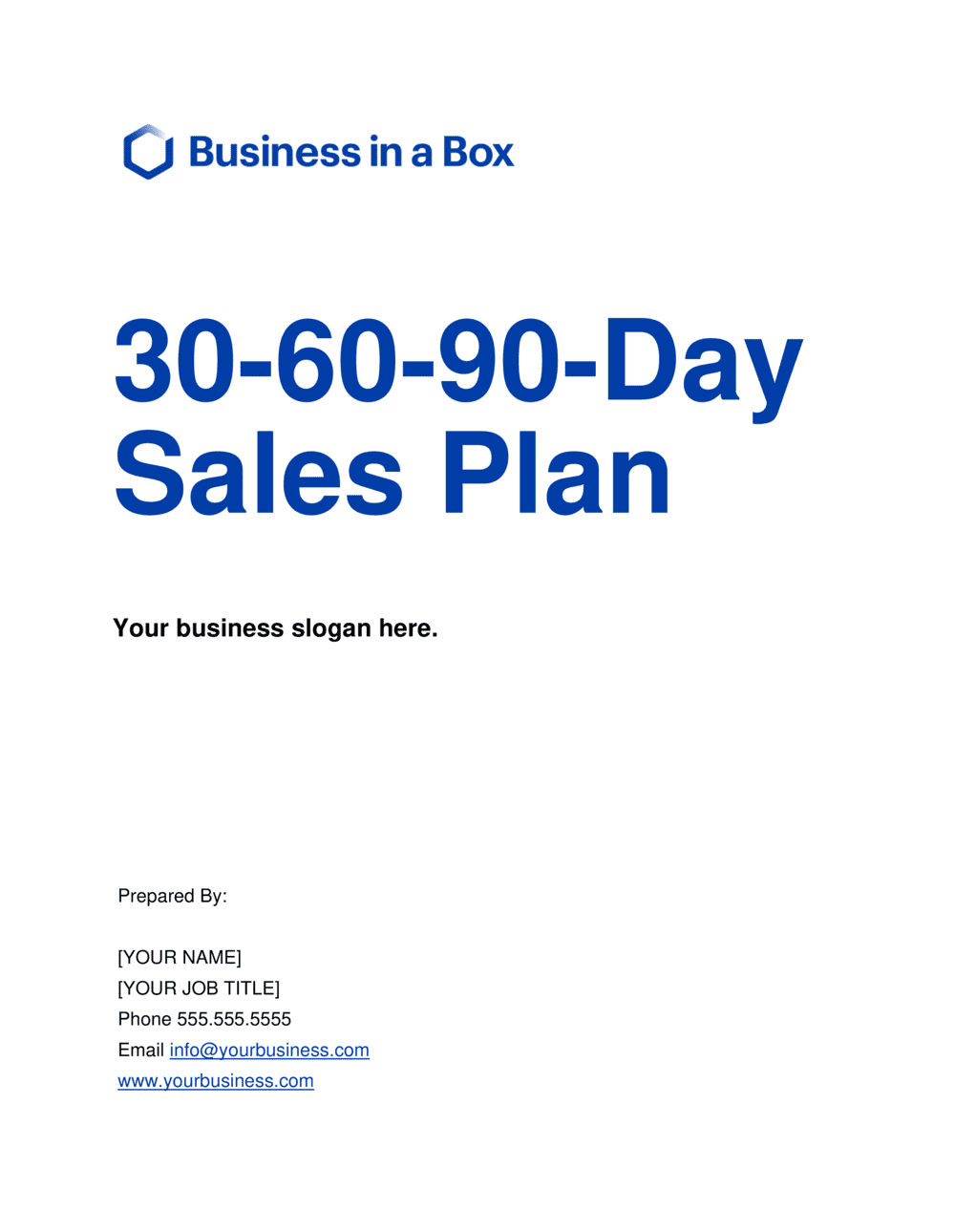
30 60 90 Day Sales Plan Template

Free Word download β€’ Edit online β€’ Save & share with Drive β€’ Export to PDF

8 pagesβ€’1h 5m – 1h 30m to fillβ€’Difficulty: Expert
Learn more ↓
Free30 60 90 Day Sales Plan Template

At a glance

What it is
A 30 60 90 Day Sales Plan is a structured onboarding and performance document that breaks a new sales hire's or sales leader's first three months into three distinct phases β€” learning, applying, and optimizing. This free Word download gives you a pre-built framework you can edit online and share with your manager or hiring team before day one.
When you need it
Use it when starting a new sales role, onboarding a new sales rep, or stepping into a sales management position and needing to demonstrate a clear ramp strategy to leadership.
What's inside
Phase-by-phase objectives, activity targets, learning milestones, pipeline goals, key stakeholder mapping, success metrics for each phase, and a review cadence β€” organized so both the rep and their manager can track progress against concrete benchmarks.

What is a 30 60 90 Day Sales Plan?

A 30 60 90 Day Sales Plan is a structured onboarding document that divides a new sales hire's first three months into three sequential phases β€” learning, pipeline activation, and revenue generation β€” each with specific goals, activity targets, and measurable success criteria. It functions simultaneously as a personal accountability tool for the rep and a management tool for the sales leader, replacing informal onboarding conversations with a written agreement on what success looks like at 30, 60, and 90 days. Candidates use it in final-round interviews to demonstrate strategic preparation; managers use it to set consistent ramp expectations across every new hire.

Why You Need This Document

Sales reps who start without a documented ramp plan take an average of 20–30% longer to reach full quota productivity, because neither the rep nor the manager has a shared definition of what "on track" looks like in the first 90 days. Without phase-specific milestones, learning gaps in Month 1 compound into pipeline shortfalls in Month 2 and missed quota in Month 3 β€” by which point it is too late to course-correct before the first performance review. A written 30 60 90 day sales plan creates the check-in cadence and metric benchmarks needed to catch problems early, align manager and rep on realistic expectations, and give new hires the structured start that converts into durable quota attainment. This template gives you a professionally structured, immediately editable framework so you can walk into your first week β€” or your final interview β€” with a plan that signals you are ready to execute.

Which variant fits your situation?

If your situation is…Use this template
New individual contributor entering a quota-carrying sales role30 60 90 Day Sales Plan (Rep)
Newly hired VP of Sales or Chief Revenue Officer30 60 90 Day Sales Leadership Plan
New sales manager taking over an existing team30 60 90 Day Sales Manager Plan
Candidate presenting a plan during a final-round interviewSales Interview 30 60 90 Day Plan
Full annual territory or revenue planning beyond the ramp periodSales Plan
Tracking rep performance against targets after ramp endsSales Performance Review

Common mistakes to avoid

❌ Setting full quota targets in the first 30 days

Why it matters: Reps who are expected to close business before they understand the product, process, and ICP produce low-quality pipeline and damage early customer relationships.

Fix: Reserve revenue targets for Days 61–90 and use Days 1–30 exclusively for learning milestones and relationship building.

❌ Using vague activity goals without pipeline math

Why it matters: A target of '15 calls per week' is meaningless without connecting it to a pipeline value. Managers cannot evaluate progress and the rep has no way to self-correct.

Fix: Attach each activity metric to a downstream outcome: '15 calls per week Γ— 20% connect rate Γ— 30% discovery conversion = 1 new opportunity per week = $[X] pipeline per month.'

❌ Copying a generic 30 60 90 day plan without company-specific research

Why it matters: Interviewers and managers can immediately spot a plan that doesn't reference the product, the ICP, the competitive landscape, or the actual territory. It signals low effort and low situational awareness.

Fix: Spend two to three hours researching the company's product, recent press, LinkedIn profiles of customers, and Glassdoor reviews before completing the plan. Reference at least three specific facts.

❌ Omitting the review cadence section

Why it matters: Without a documented check-in schedule, there is no mechanism to catch early problems, adjust targets, or surface blockers before they affect quota attainment.

Fix: Commit to a specific weekly 1:1 time and formal end-of-phase reviews on Day 30, Day 60, and Day 90. Put them on the calendar on your first day.

The 9 key sections, explained

Plan Overview and Context

30-Day Phase β€” Learning and Discovery

60-Day Phase β€” Activation and Pipeline Building

90-Day Phase β€” Optimization and Revenue

Key Stakeholder Map

Learning and Enablement Milestones

Success Metrics by Phase

Review and Check-In Cadence

Open Questions and Resource Requests

How to fill it out

  1. 1

    Fill in the plan header with your role context

    Enter your name, job title, start date, manager, and territory. Add one to two sentences on the business context β€” what stage the team is in, what the company needs from this hire.

    πŸ’‘ Reference something specific from your research β€” a product launch, a new vertical, a recent funding round. It signals preparation.

  2. 2

    Set phase-specific learning goals for Day 30

    List the product certifications, call shadows, process walkthroughs, and internal relationships you will build in the first 30 days. Focus entirely on learning β€” do not set revenue targets here.

    πŸ’‘ Ask your manager for the actual onboarding checklist before finalizing this section. Aligning your plan to what they already expect dramatically improves your Day 30 review.

  3. 3

    Define pipeline creation targets for Day 60

    Set a specific dollar value for pipeline you will build by Day 60 and the weekly activity numbers (calls, emails, demos) that will produce it. Connect the activity to the pipeline math explicitly.

    πŸ’‘ Use the company's historical conversion rates if you can get them β€” pipeline target = (closed-won goal Γ· win rate) Γ— pipeline coverage ratio.

  4. 4

    Set realistic revenue goals for Day 90

    Enter your closed-won target for Month 3, expressed both in dollars and as a percentage of full monthly quota. Standard ramp expectations range from 50% to 75% of quota in the first full quota month.

    πŸ’‘ Underpromising slightly and overdelivering in Month 3 builds more credibility than setting an aggressive target you miss by 40%.

  5. 5

    Map key internal and external stakeholders

    List the internal colleagues you need to meet and collaborate with, and the external accounts or contacts you plan to prioritize for outreach. Assign each to the phase where you will engage them.

    πŸ’‘ Include at least two to three target account names in the external stakeholder section, even if they are based on your initial research. This shows you have already started thinking about pipeline.

  6. 6

    Define success metrics for each phase

    Separate activity metrics (calls per week, demos per week) from output metrics (pipeline created, proposals sent, revenue closed) for each of the three phases. Both rows should be populated.

    πŸ’‘ Keep metrics to three to five per phase. A plan with twelve metrics per phase is unmanageable and signals unclear priorities.

  7. 7

    Add the review cadence and open questions

    Confirm your weekly 1:1 schedule, end-of-phase review dates, and the specific questions or resource requests you need answered before the ramp period begins.

    πŸ’‘ Send the completed plan to your manager two to three days before your start date β€” it starts the relationship on a proactive footing and gives them time to adjust expectations.

Frequently asked questions

What is a 30 60 90 day sales plan?

A 30 60 90 day sales plan is a structured document that breaks a new sales hire's first three months into three phases β€” learning, pipeline building, and revenue generation. Each phase has specific goals, activity targets, and success criteria. It is used both as a hiring tool (candidates present it in final interviews) and as an onboarding management tool (managers use it to set and track ramp expectations).

Who should write a 30 60 90 day sales plan?

Both the candidate and the hiring manager have reasons to create one. Candidates write a plan during the final interview stage to demonstrate strategic thinking and preparation. Sales managers write a version to standardize ramp expectations before a new rep starts. For VP-level hires, the plan is typically presented to the CEO or board within the first two weeks.

What is the difference between Day 30, Day 60, and Day 90 goals?

Day 30 goals focus on learning β€” product certification, process understanding, stakeholder relationships, and ICP research. No revenue target is appropriate here. Day 60 goals shift to active prospecting and pipeline creation, with specific dollar targets for qualified opportunities. Day 90 goals focus on closing first deals and establishing the weekly cadence that will carry into full quota attainment.

Should I include revenue targets in a 30 60 90 day sales plan?

Revenue targets belong in the Day 61–90 phase only, and should reflect realistic ramp expectations β€” typically 50–75% of full monthly quota in the first quota period, depending on the average sales cycle length. If the average deal takes 90 days to close, your Day 90 closed-won target may be zero, but your pipeline coverage target should be 3–4Γ— quota.

How do I customize a 30 60 90 day sales plan for a specific company?

Reference the company's actual product, ICP, sales process, and competitive landscape by name. Include two to three target accounts you identified through LinkedIn or the company's public case studies. Use the company's actual CRM, enablement tools, or methodology (e.g., MEDDIC, Challenger Sale) by name. Interviewers score customized plans significantly higher than generic templates.

Can I use a 30 60 90 day plan for a sales management role?

Yes, with different priorities. A sales manager's plan focuses on auditing the existing team's pipeline and skills in Days 1–30, identifying one to two process or coaching improvements to implement in Days 31–60, and driving measurable improvement in team quota attainment by Day 90. Revenue leadership hires β€” VP Sales, CRO β€” additionally address hiring gaps, comp plan adjustments, and go-to-market strategy.

How long should a 30 60 90 day sales plan be?

Four to six pages is the accepted range for a candidate-facing plan. Internal manager templates can run eight to ten pages with more granular activity tracking. A plan shorter than two pages signals low effort; a plan longer than eight pages for an individual contributor role signals poor prioritization. Every section should earn its place by being actionable and measurable.

What metrics should a 30 60 90 day sales plan include?

Include both activity metrics (calls per week, emails per week, demos booked per week) and output metrics (pipeline value created, proposals submitted, closed-won revenue) for each phase. Separate them clearly β€” activity metrics predict performance; output metrics measure it. A strong plan also includes a pipeline coverage target (typically 3–4Γ— quota) and a win rate assumption to validate the revenue projection.

How this compares to alternatives

vs Sales Plan

A sales plan covers full-year revenue strategy, quota allocation, territory design, and go-to-market priorities for an entire team or business unit. A 30 60 90 day sales plan is a personal onboarding document focused on one individual's ramp from hire date to full productivity. Use the 30 60 90 day plan for the first quarter, then feed its learnings into the annual sales plan.

vs Sales Performance Review

A sales performance review evaluates what a rep achieved against quota over a completed period β€” it looks backward. A 30 60 90 day sales plan looks forward, defining what the rep commits to achieving and how. The end-of-phase reviews built into the 30 60 90 plan feed directly into the first formal performance review.

vs Marketing Plan

A marketing plan defines lead generation, campaigns, and brand activities that support the sales team's pipeline goals. A 30 60 90 day sales plan defines how an individual rep will use the pipeline and tools marketing provides. The two documents should reference each other's targets when the rep's territory overlaps with active marketing campaigns.

vs Business Development Plan

A business development plan covers partnership, channel, and strategic alliance activity that creates non-direct revenue streams. A 30 60 90 day sales plan focuses on direct quota attainment through prospecting, discovery, and closing. Both may exist simultaneously but serve distinct motions and audiences.

Industry-specific considerations

SaaS / Technology

Product certification requirements, CRM configuration, and pipeline targets tied to MRR growth make the 90-day structure particularly critical in fast-ramp SaaS environments.

Financial Services

Licensing prerequisites and compliance training must be embedded in the Day 1–30 learning phase before any external prospecting can legally begin.

Professional Services

Long sales cycles mean Day 90 closed-won targets are often zero; plan emphasis shifts to pipeline coverage, relationship mapping, and RFP qualification in the first 90 days.

Manufacturing and Industrial

Territory assignment, distributor relationship mapping, and product line mastery across complex SKU catalogs require a heavily front-loaded Day 1–30 learning phase.

Template vs pro β€” what fits your needs?

PathBest forCostTime
Use the templateIndividual sales contributors and managers creating a personal ramp plan for a new roleFree2–4 hours to complete with company research
Template + professional reviewVP Sales or CRO hires presenting a plan to a CEO or board within the first two weeks$200–$500 for a sales coach or advisor review session1–2 days
Custom draftedEnterprise sales organizations building a standardized, tool-integrated onboarding program across a team of 10 or more reps$1,000–$5,000 for a sales enablement consultant engagement2–4 weeks

Glossary

Ramp Period
The defined time β€” typically 30 to 90 days β€” during which a new sales hire builds the knowledge and pipeline needed to reach full quota productivity.
Sales Quota
A revenue or activity target assigned to a rep for a defined period, used as the primary benchmark for performance evaluation.
Pipeline
The set of active deals at various stages of the sales process, measured by total value and likelihood of closing within a given period.
Activity Metrics
Quantified daily or weekly sales behaviors β€” calls made, emails sent, demos booked, proposals submitted β€” used to predict pipeline generation.
Ideal Customer Profile (ICP)
A description of the company type, size, industry, and pain point that makes the highest-fit, highest-conversion prospect for your solution.
Sales Enablement
The process of providing sales reps with the content, training, and tools they need to engage buyers effectively at each stage of the buying cycle.
Quota Attainment
The percentage of assigned quota a rep closes in a given period, expressed as actual bookings divided by quota target.
Discovery Call
An early-stage sales conversation designed to qualify a prospect's pain, budget, authority, need, and timeline before advancing to a demo or proposal.
Territory
The defined set of accounts, geographies, or verticals assigned exclusively to a sales rep or team for prospecting and coverage.
Win Rate
The percentage of qualified opportunities that result in a closed-won deal, calculated as closed-won deals divided by total opportunities entered.

Part of your Business Operating System

This document is one of 3,000+ business & legal templates included in Business in a Box.

  • Fill-in-the-blanks β€” ready in minutes
  • 100% customizable Word document
  • Compatible with all office suites
  • Export to PDF and share electronically

Create your document in 3 simple steps.

From template to signed document β€” all inside one Business Operating System.
1
Download or open template

Access over 3,000+ business and legal templates for any business task, project or initiative.

2
Edit and fill in the blanks with AI

Customize your ready-made business document template and save it in the cloud.

3
Save, Share, Send, Sign

Share your files and folders with your team. Create a space of seamless collaboration.

Save time, save money, and create top-quality documents.

β˜…β˜…β˜…β˜…β˜…

"Fantastic value! I'm not sure how I'd do without it. It's worth its weight in gold and paid back for itself many times."

Managing Director Β· Mall Farm
Robert Whalley
Managing Director, Mall Farm Proprietary Limited
β˜…β˜…β˜…β˜…β˜…

"I have been using Business in a Box for years. It has been the most useful source of templates I have encountered. I recommend it to anyone."

Business Owner Β· 4+ years
Dr Michael John Freestone
Business Owner
β˜…β˜…β˜…β˜…β˜…

"It has been a life saver so many times I have lost count. Business in a Box has saved me so much time and as you know, time is money."

Owner Β· Upstate Web
David G. Moore Jr.
Owner, Upstate Web

Run your business with a system β€” not scattered tools

Stop downloading documents. Start operating with clarity. Business in a Box gives you the Business Operating System used by over 250,000 companies worldwide to structure, run, and grow their business.

Free Forever PlanΒ Β·Β No credit card required