Top 54 Business Models Template

Free to read β€’ Save or share with one click

FreeTop 54 Business Models Template

At a glance

What it is
The Top 54 Business Models template is a structured reference and planning document that catalogs 54 proven revenue and operating model archetypes β€” from subscription and marketplace to franchise and freemium β€” each with its core logic, revenue mechanism, and strategic fit criteria. Available as a free Word download, it gives founders, strategists, and advisors a single source of truth for evaluating, selecting, and documenting the right business model for any venture or product line.
When you need it
Use it when launching a new venture, repositioning an existing business, advising a client on strategic direction, or completing a business planning exercise that requires a documented rationale for the chosen revenue model. It is also valuable during investor due diligence when you need to articulate how and why your model generates sustainable returns.
What's inside
Fifty-four individually profiled business model archetypes, each with a plain-language definition, revenue logic, key assumptions, and strategic fit indicators. The template also includes a selection framework, a comparison matrix, and guidance on layering multiple models for hybrid strategies.

What is the Top 54 Business Models template?

The Top 54 Business Models template is a structured strategic reference document that catalogs 54 proven revenue and operating model archetypes β€” from subscription, marketplace, and freemium to franchise, razor-and-blade, and asset-light β€” each profiled with its core revenue logic, cost structure, competitive moat characteristics, scalability mechanics, and regulatory considerations. Unlike a one-page canvas or a pitch deck, this template provides a rigorous selection and documentation framework: it helps founders, strategists, and advisors identify which model best fits a given product, customer type, and competitive environment, and then formally document the rationale, assumptions, and jurisdictional constraints before committing to a go-to-market strategy.

Why You Need This Document

Choosing the wrong business model is one of the most common and expensive early-stage mistakes a company can make β€” and it is almost always avoidable with structured analysis. A subscription model applied to a product with a four-month average customer lifetime will never reach contribution-margin positive regardless of how well the product is built. A marketplace model launched without sufficient supply density fails before network effects can take hold. A financial intermediation model launched without the required licenses triggers enforcement action that can shut a business down in its first year. This template forces the selection decision into the open β€” requiring documented assumptions, unit economics, regulatory flags, and a signed leadership sign-off β€” before capital is deployed. For investors and lenders, the completed document provides the model-selection rationale that sits behind every financial projection. For operators, it creates the accountability structure that makes strategic pivots faster and less expensive when market feedback demands them.

Which variant fits your situation?

If your situation is…Use this template
Evaluating a single digital product monetization strategyBusiness Model Canvas
Building a complete investor-ready strategic narrativeBusiness Plan
Mapping a quick one-page strategy for internal alignmentOne-Page Business Plan
Defining go-to-market channels alongside the model selectionMarketing Plan
Presenting the selected model to investors in a pitch formatElevator Pitch Template
Stress-testing the model with strengths, weaknesses, and threatsSWOT Analysis
Projecting financial outcomes once the model is selectedFinancial Projections (12 Months)

Common mistakes to avoid

❌ Choosing a model based on trend rather than unit economics

Why it matters: Subscription models and marketplaces are widely admired, but if your customer lifetime is under 4 months or your transaction volume is too low to support a rake, the model will never reach positive contribution margin regardless of how well it is executed.

Fix: Run the unit economics for your top three model candidates before selecting. The model with the most favorable LTV:CAC ratio at a realistic scale is the right starting point, not the model that raised the most venture capital last year.

❌ Treating regulatory constraints as an afterthought

Why it matters: Launching a lending, insurance, data brokerage, or financial intermediation model without the required licenses in the target jurisdiction can result in enforcement action, forced shutdown, and personal liability for founders.

Fix: Complete the regulatory considerations clause for every model shortlisted before committing to a launch timeline. If a required license takes longer than your runway, that model is not viable in that jurisdiction without additional capital.

❌ Selecting a hybrid model before the primary model has traction

Why it matters: Attempting to operate two unproven revenue models simultaneously splits management attention, complicates messaging, and makes it nearly impossible to diagnose which model is or is not working when growth stalls.

Fix: Pick one primary model, define the specific metric that constitutes traction (e.g., 100 paying customers, $10K MRR, 1,000 daily active users), and defer the second model until that threshold is crossed.

❌ Leaving key assumptions undocumented

Why it matters: Implicit assumptions cannot be tested, challenged, or updated. When a model underperforms, teams without documented assumptions spend weeks debating what they originally believed rather than diagnosing what changed.

Fix: Before finalizing the model selection, fill in every assumption field β€” conversion, churn, CAC, margin, and growth rate β€” with a number and a source. Assumptions sourced from analogous companies are more defensible than estimates drawn from hope.

❌ Ignoring the exit and transition pathway

Why it matters: Some models β€” particularly services-led or lifestyle models β€” structurally cap valuation multiples and make acquisition by a strategic buyer unlikely. Founders who discover this constraint at Series B have fewer options than those who planned for it at incorporation.

Fix: For every model under consideration, identify the most likely exit pathway and the valuation multiple typically assigned to that model type at exit. If the math does not support your return expectations, choose a different model or adjust expectations before raising capital.

❌ Confusing the revenue model with the full business model

Why it matters: A revenue model describes how money is collected; a business model describes the full value-creation-and-capture system. Companies that optimize only the revenue mechanism without addressing cost structure, channel, and competitive moat routinely achieve revenue growth alongside deteriorating margins.

Fix: For the selected model, complete all ten clauses β€” not just the revenue logic and margin profile. The competitive moat, scalability mechanics, and cost structure clauses are equally critical to a defensible strategic position.

The 10 key clauses, explained

Model Definition and Revenue Logic

In plain language: Each of the 54 archetypes is defined in plain language with a precise description of how money flows from customer to business.

Sample language
The [MODEL NAME] generates revenue by [REVENUE MECHANISM]. The core value exchange is: [CUSTOMER] pays [PRICE/FEE STRUCTURE] in return for [OUTCOME/ACCESS/PRODUCT].

Common mistake: Conflating the revenue model with the business model. The revenue model is one component β€” omitting the delivery mechanism, cost structure, and value proposition produces an incomplete picture that misleads planning decisions.

Customer Segment and Value Proposition

In plain language: Identifies the specific target customer for each model and the primary benefit that drives willingness to pay.

Sample language
Target segment: [CUSTOMER PROFILE]. Core value proposition: [COMPANY NAME] enables [CUSTOMER] to [ACHIEVE OUTCOME] without [PAIN POINT], priced at [PRICE POINT].

Common mistake: Defining the customer segment too broadly β€” 'small businesses' or 'consumers' β€” without specifying industry, size, geography, or buying trigger, making the model untestable.

Key Assumptions and Dependencies

In plain language: Documents the critical assumptions the model relies on β€” conversion rates, churn, margin, channel access β€” that must hold for the model to generate positive returns.

Sample language
This model assumes: (a) average conversion rate of [X]%; (b) monthly churn below [Y]%; (c) gross margin above [Z]%; (d) customer acquisition cost below $[AMOUNT] via [CHANNEL].

Common mistake: Leaving assumptions implicit rather than documented. Undocumented assumptions cannot be tested, updated, or communicated to investors and team members, compounding risk as the business scales.

Cost Structure and Margin Profile

In plain language: Outlines the primary cost drivers for the model and the expected gross and operating margin ranges based on industry benchmarks.

Sample language
Primary cost drivers: [COST 1], [COST 2], [COST 3]. Benchmark gross margin for this model type: [X–Y]%. Key margin lever: [SPECIFIC DRIVER].

Common mistake: Using industry-average margins without adjusting for the company's specific scale, geography, or channel mix β€” leading to projections that collapse when confronted with actual operating data.

Competitive Moat and Differentiation Criteria

In plain language: Describes the structural advantage the model creates over time β€” network effects, switching costs, proprietary data, or patents β€” and the conditions under which the moat is defensible.

Sample language
The [MODEL NAME] creates a moat through [MOAT TYPE β€” network effects / switching costs / IP / data]. Moat strengthens when [CONDITION β€” e.g., user count exceeds X / data set reaches Y transactions].

Common mistake: Claiming a moat without specifying the mechanism and threshold. 'We have a strong brand' is not a moat definition β€” it is a hope; the document must identify what specifically prevents a well-funded competitor from replicating the advantage.

Scalability and Growth Mechanics

In plain language: Explains how the model scales β€” whether revenue grows linearly with headcount and cost, or whether there are leveraged growth mechanics like viral loops, platform effects, or licensing.

Sample language
Revenue scales [linearly / non-linearly] with [INPUT β€” headcount / users / transactions]. Growth mechanic: [DESCRIPTION β€” e.g., each new user invites an average of X additional users]. Marginal cost per additional unit: $[AMOUNT].

Common mistake: Projecting non-linear growth without identifying the specific mechanism that creates it. Spreadsheets that accelerate revenue growth without a documented cause produce forecasts that no serious investor will accept.

Regulatory and Jurisdictional Considerations

In plain language: Flags the legal, regulatory, or compliance obligations that vary by jurisdiction and that may limit, modify, or require licensing of the model in certain markets.

Sample language
Operating the [MODEL NAME] in [JURISDICTION] requires compliance with [REGULATION / FRAMEWORK]. Specific obligations include: [LICENSING / DATA / CONSUMER PROTECTION REQUIREMENTS]. Legal review recommended before launch in [JURISDICTION LIST].

Common mistake: Treating the business model as jurisdiction-neutral when regulatory constraints β€” financial services licensing, data localization, consumer protection law β€” materially alter the model's viability or cost structure in key markets.

Exit and Transition Pathways

In plain language: Documents the most common exit strategies or model transitions associated with each archetype β€” acquisition, IPO, pivot to a complementary model, or wind-down.

Sample language
Common exit pathways for the [MODEL NAME]: (a) strategic acquisition by [ACQUIRER TYPE]; (b) transition to [ADJACENT MODEL] once [MILESTONE]; (c) IPO when ARR reaches $[THRESHOLD] and growth rate exceeds [X]%.

Common mistake: Omitting the transition pathway entirely. Founders who select a model without considering exit or evolution constraints often discover mid-stage that the chosen model structurally limits valuation multiples or acquirer interest.

Model Selection Decision Framework

In plain language: A structured decision guide that maps business characteristics β€” product type, customer type, margin target, competitive environment β€” to the most suitable model archetype.

Sample language
If [CHARACTERISTIC β€” e.g., product is digital and replicable at zero marginal cost], then evaluate: [MODEL A], [MODEL B], [MODEL C]. Disqualify if: [CONSTRAINT β€” e.g., customer lifetime under 6 months makes subscription unviable].

Common mistake: Selecting a model based on industry trend or founder preference rather than the company's specific cost structure, customer behavior, and competitive position β€” leading to a structurally mismatched go-to-market strategy.

Hybrid Model Integration Guidelines

In plain language: Provides a framework for layering two or more model archetypes β€” for example, combining subscription with marketplace, or freemium with services β€” and the sequencing logic for introducing each layer.

Sample language
To layer [MODEL A] with [MODEL B]: launch [MODEL A] first to establish [BASE METRIC β€” user base / revenue / data]. Introduce [MODEL B] when [THRESHOLD CONDITION]. Expected impact on blended gross margin: [+/- X percentage points].

Common mistake: Launching multiple models simultaneously without establishing traction in a primary model first. Splitting operational focus across two unproven revenue streams typically produces mediocre results in both rather than compounding returns.

How to fill it out

  1. 1

    Identify your product type and customer profile

    Before selecting a model, document whether your product is digital or physical, recurring or one-time, and whether your buyer is a business or consumer. These four variables eliminate roughly half the 54 archetypes immediately.

    πŸ’‘ Write one sentence: 'We sell [PRODUCT TYPE] to [CUSTOMER TYPE] who pays [ONCE / REPEATEDLY] because [TRIGGER].' If you cannot write this sentence cleanly, the model selection exercise will produce no useful output.

  2. 2

    Review the model definitions and revenue logic for each archetype

    Read each of the 54 model definitions and mark those where the revenue mechanism matches your product's value delivery β€” specifically, the moment the customer receives value and the moment payment occurs.

    πŸ’‘ Payment timing matters more than most founders realize. A model that requires payment before value delivery (SaaS annual prepay) has completely different cash flow and churn dynamics than one that captures payment after delivery (commission marketplace).

  3. 3

    Document key assumptions for your shortlisted models

    For the three to five models that survive initial screening, fill in the assumptions block: conversion rate, churn, CAC, LTV, and gross margin. Use industry benchmarks as a floor and adjust for your specific context.

    πŸ’‘ Use a separate spreadsheet tab to run the unit economics for each shortlisted model side by side. The model with the best LTV:CAC ratio at your target scale is almost always the right primary choice.

  4. 4

    Map regulatory and jurisdictional constraints

    For each shortlisted model, complete the regulatory considerations clause for every jurisdiction in which you plan to operate. Flag any model that requires a license or registration you do not currently hold.

    πŸ’‘ Financial intermediation, data brokerage, insurance, and healthcare models carry the heaviest regulatory burdens. If a model requires a license that takes 6–18 months to obtain, factor that into your launch timeline β€” not as a footnote.

  5. 5

    Select the primary model and document the rationale

    Choose one primary model and write two to three sentences explaining why it fits your product, customer, cost structure, and competitive environment better than the alternatives. This rationale becomes the model section of your business plan.

    πŸ’‘ The selection rationale should be falsifiable β€” it should identify the specific metric that would prove the model wrong. If you cannot state a falsification condition, the rationale is not strategic, it is preference.

  6. 6

    Assess hybrid model layering opportunities

    Using the hybrid integration guidelines, identify whether a second model can be introduced after the primary model achieves traction. Document the threshold condition and sequencing logic.

    πŸ’‘ The most durable businesses typically layer a platform or data model on top of an initial product model. Plan the layer from day one even if you execute it in Year 3.

  7. 7

    Align the selected model with your financial projections

    Transfer the documented assumptions β€” margin, CAC, churn, growth mechanic β€” into your financial model. Every revenue line in the P&L should trace directly back to a named model assumption in this document.

    πŸ’‘ If your financial model and your model selection document contradict each other on margin or growth rate, the financial model will fail investor scrutiny. Reconcile them before any external presentation.

  8. 8

    Review and sign off with leadership and legal counsel

    Have the founding team or executive leadership review and formally sign off on the selected model and documented assumptions. For regulated models or investor-facing use, seek legal review of the regulatory considerations section.

    πŸ’‘ A signed model selection document creates accountability. Teams that have formally committed to a model and its assumptions make faster, more consistent decisions than those operating from informal consensus.

Frequently asked questions

What are the top business models used by successful companies?

The most commonly referenced archetypes include subscription (SaaS, media), marketplace (two-sided platforms), freemium, franchise, razor-and-blade, direct-to-consumer, licensing, advertising, asset-light, and transaction-fee models. This template catalogs 54 distinct archetypes, each with its own revenue logic, margin profile, and strategic fit criteria β€” covering both digital and physical business contexts.

How do I choose the right business model for my startup?

Start with your product type, customer profile, and cost structure. A digital product with zero marginal replication cost typically fits subscription, freemium, or licensing models. A two-sided market fits a marketplace or platform model. Services businesses often combine retainer, project, and productized-service models. The right model is the one with the best LTV:CAC ratio at a realistic scale given your specific operating context β€” not the model that attracted the most venture capital in the last 12 months.

Can a business use more than one model at the same time?

Yes, and most durable businesses eventually layer two or more archetypes. Amazon combines marketplace, subscription (Prime), advertising, and infrastructure-as-a-service (AWS). The key is sequencing: establish traction in a primary model before introducing a second. Launching two unproven models simultaneously typically produces mediocre results in both rather than compounding returns from either.

What is the difference between a business model and a revenue model?

A revenue model is a subset of the business model β€” it describes how and when money is collected. A full business model also covers the value proposition, customer segments, key activities and resources, cost structure, distribution channels, and competitive positioning. Optimizing only the revenue mechanism while ignoring cost structure or channel fit is one of the most common causes of high-revenue, low-margin businesses.

Which business models are best for raising venture capital?

Investors typically assign the highest multiples to models with recurring revenue (subscription, SaaS), network effects (platforms, marketplaces), and asset-light unit economics. Models with high gross margins (above 60% for software, above 40% for marketplaces) and demonstrable scalability without proportional cost growth attract the most interest. Services-led models, however profitable, are generally assigned lower multiples because revenue scales linearly with headcount.

Are business model frameworks like the Business Model Canvas different from this template?

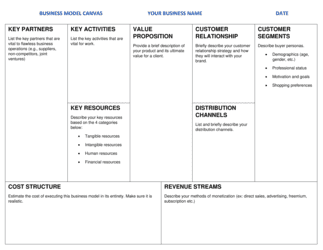
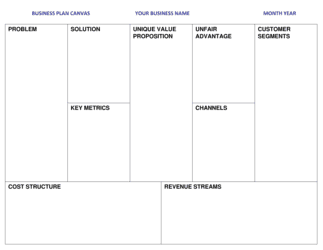
The Business Model Canvas is a one-page visual tool for mapping a single company's model across nine blocks. The Top 54 Business Models template is a reference and selection document that catalogs 54 distinct archetypes, helping you identify which model type to apply before you fill in a Canvas. They are complementary: use the 54 models reference to select your archetype, then use the Canvas to map your specific implementation.

What regulatory issues should I consider when selecting a business model?

Regulatory exposure varies significantly by model type. Financial intermediation, lending, insurance, data brokerage, and healthcare models carry licensing requirements in most jurisdictions. Marketplace models may trigger consumer protection, payment processing, or tax-nexus obligations. Subscription models with auto-renewal provisions face increasing disclosure requirements in the US (FTC Negative Option Rule), the UK, and the EU. The regulatory considerations clause in this template flags jurisdiction-specific obligations for each high-risk archetype.

How often should I revisit my business model selection?

Revisit it whenever a key assumption changes by more than 20% β€” for example, if CAC doubles, churn exceeds projections by more than one percentage point, or a new regulatory requirement materially alters the cost structure. For early-stage companies, a formal model review at the end of each funding stage (pre-seed to seed, seed to Series A) is standard practice. A model that was optimal at 100 customers is often not optimal at 10,000 customers.

Do I need a lawyer to document or implement a business model?

For most standard archetypes, legal review is recommended rather than required. It becomes essential when the model involves financial intermediation, regulated industries, complex IP licensing, franchising, or cross-border operations where local compliance obligations are material. A 1–2 hour review with a business attorney ($300–$600) is typically sufficient for early-stage model documentation; franchise or financial services models require substantially more specialized counsel.

How this compares to alternatives

vs Business Model Canvas

The Business Model Canvas maps a single company's model across nine blocks β€” partners, activities, resources, value proposition, customer relationships, channels, segments, cost structure, and revenue streams. The Top 54 Business Models template is a selection and reference tool that identifies which archetype to apply before the Canvas is filled in. Use the 54 models reference first, then the Canvas to document your specific implementation.

vs Business Plan

A business plan incorporates the selected model into a full investor-ready document covering market analysis, competitive positioning, team, and financial projections. The Top 54 Business Models template is an input to the business plan β€” it documents the model selection rationale that the plan's strategy section requires. Complete the model selection document before drafting the business plan.

vs SWOT Analysis

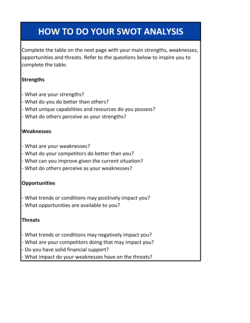
A SWOT analysis evaluates a company's internal strengths and weaknesses alongside external opportunities and threats. It does not define the revenue mechanism or operating model. Use the Top 54 Business Models template to select the model, then run a SWOT analysis to stress-test it against the competitive and macro environment.

vs Financial Projections Template

Financial projections translate model assumptions β€” CAC, churn, margin, growth rate β€” into quantified P&L, cash flow, and balance sheet forecasts. The Top 54 Business Models template documents the assumptions and model logic that drive those projections. The two documents must be consistent: every revenue line in the projections should trace back to a named assumption in the model selection document.

Industry-specific considerations

SaaS / Technology

Subscription, freemium, usage-based, and platform models dominate; the template helps SaaS founders choose between pure subscription, seat-based, and consumption pricing with documented unit economics for each.

Retail / E-commerce

Direct-to-consumer, marketplace, dropship, subscription box, and razor-and-blade models are all applicable; the template maps margin and inventory implications for each retail archetype.

Professional Services

Retainer, project, productized-service, and licensing models are profiled with their respective utilization rate and scalability constraints, helping firms transition from time-for-money to leveraged revenue structures.

Financial Services / Fintech

Interchange, lending, insurance, brokerage, and data models carry the heaviest regulatory burden of any archetype group; the template's regulatory considerations clause is especially critical for this sector.

Healthcare / MedTech

Fee-for-service, value-based care, SaaS-for-health, and medical device subscription models each carry distinct FDA, HIPAA, and reimbursement code considerations documented in the jurisdictional section.

Manufacturing

Equipment-as-a-service, razor-and-blade, licensing, and distribution models are common; the template's cost structure and scalability clauses help manufacturers evaluate the capital intensity trade-offs between each archetype.

Jurisdictional notes

United States

Several model archetypes trigger federal and state-level licensing in the US. Lending models require state money-transmitter or lender licenses in most states. Marketplace models with auto-renewal subscriptions must comply with the FTC's Negative Option Rule (updated 2024), requiring clear disclosure and simple cancellation. Financial intermediation models operating across state lines typically require registration in each state where customers reside.

Canada

Financial services and lending models require registration under the federal Financial Consumer Agency of Canada Act and applicable provincial consumer protection statutes. Franchise models must comply with provincial franchise disclosure legislation in Ontario, Alberta, British Columbia, Manitoba, New Brunswick, and Prince Edward Island β€” disclosure documents must be delivered at least 14 days before signing or payment. Quebec's Act Respecting the Protection of Personal Information in the Private Sector (Law 25) imposes data localization and consent obligations relevant to data-monetization and platform models.

United Kingdom

Financial services business models β€” lending, insurance, investment, and payment processing β€” require FCA authorization under the Financial Services and Markets Act 2000. Marketplace and platform models facilitating consumer transactions must comply with the Consumer Rights Act 2015 and the Digital Markets, Competition and Consumers Act 2024, which strengthens enforcement against subscription traps and auto-renewal practices. Franchise models are not subject to a specific disclosure statute but are governed by the British Franchise Association's voluntary code and general contract law.

European Union

The EU Digital Markets Act (2023) imposes interoperability, data-sharing, and non-discrimination obligations on platform and marketplace models designated as 'gatekeepers.' GDPR is directly relevant to any model that monetizes personal data β€” data brokerage, advertising, and behavioral targeting models require a lawful basis for processing and explicit consent mechanisms. Subscription models with auto-renewal must comply with the Consumer Rights Directive, which requires clear pre-contractual information and a 14-day withdrawal right in most member states.

Template vs lawyer β€” what fits your deal?

PathBest forCostTime
Use the templateFounders, strategists, and students selecting and documenting a business model for planning, pitching, or internal alignmentFree2–4 hours
Template + legal reviewModels involving licensing, franchising, financial intermediation, or cross-border regulatory exposure$300–$800 for a 1–2 hour attorney review of regulatory considerations2–5 days
Custom draftedFranchise systems, regulated financial products, healthcare platforms, or complex multi-jurisdiction licensing arrangements$2,000–$10,000+ depending on jurisdiction count and model complexity2–6 weeks

Glossary

Business Model
The mechanism by which a company creates, delivers, and captures value β€” including what it sells, to whom, through which channels, and at what price.
Revenue Model
The specific method a business uses to generate income, such as subscription fees, transaction commissions, licensing, or advertising.
Value Proposition
The specific outcome or benefit a business promises to deliver to a customer that differentiates it from available alternatives.
Subscription Model
A recurring-payment structure in which customers pay a fixed fee at regular intervals β€” monthly or annually β€” for continued access to a product or service.
Marketplace Model
A platform that connects buyers and sellers and earns revenue through transaction fees, listing fees, or a percentage of each sale.
Freemium
A model in which a basic version is offered free of charge while advanced features, capacity, or support are gated behind a paid tier.
Franchise Model
An arrangement in which the franchisor licenses its brand, systems, and processes to franchisees in exchange for an upfront fee and ongoing royalties.
Unit Economics
Revenue and cost metrics measured at the level of a single customer or transaction, including customer acquisition cost, lifetime value, and gross margin per unit.
Razor-and-Blade Model
A strategy in which a core product is sold at or below cost to lock in recurring revenue from high-margin consumables or accessories.
Platform Business
A business model that creates value by facilitating interactions between two or more interdependent user groups, generating network effects as adoption scales.
Asset-Light Model
A strategy in which a company outsources capital-intensive operations β€” manufacturing, logistics, real estate β€” to focus on higher-margin activities like brand, software, or design.
Network Effect
The phenomenon in which a product or service becomes more valuable to each user as the total number of users increases, creating a compounding competitive moat.

Part of your Business Operating System

This document is one of 3,000+ business & legal templates included in Business in a Box.

  • Fill-in-the-blanks β€” ready in minutes
  • Compatible with all office suites
  • Export to PDF and share electronically

Create your document in 3 simple steps.

From template to signed document β€” all inside one Business Operating System.
1
Download or open template

Access over 3,000+ business and legal templates for any business task, project or initiative.

2
Edit and fill in the blanks with AI

Customize your ready-made business document template and save it in the cloud.

3
Save, Share, Send, Sign

Share your files and folders with your team. Create a space of seamless collaboration.

Save time, save money, and create top-quality documents.

β˜…β˜…β˜…β˜…β˜…

"Fantastic value! I'm not sure how I'd do without it. It's worth its weight in gold and paid back for itself many times."

Managing Director Β· Mall Farm
Robert Whalley
Managing Director, Mall Farm Proprietary Limited
β˜…β˜…β˜…β˜…β˜…

"I have been using Business in a Box for years. It has been the most useful source of templates I have encountered. I recommend it to anyone."

Business Owner Β· 4+ years
Dr Michael John Freestone
Business Owner
β˜…β˜…β˜…β˜…β˜…

"It has been a life saver so many times I have lost count. Business in a Box has saved me so much time and as you know, time is money."

Owner Β· Upstate Web
David G. Moore Jr.
Owner, Upstate Web

Run your business with a system β€” not scattered tools

Stop downloading documents. Start operating with clarity. Business in a Box gives you the Business Operating System used by over 250,000 companies worldwide to structure, run, and grow their business.

Start freeΒ Β·Β No credit card required