How To Become A Sustainable Business

Free to read β€’ Save or share with one click

FreeHow To Become A Sustainable Business Template

At a glance

What it is
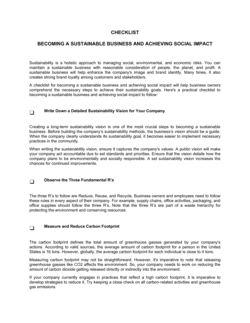
How To Become A Sustainable Business is a structured operational guide that walks an organization through the full sustainability transition β€” from assessing its current environmental and social footprint to setting measurable goals, implementing changes, and reporting progress. This free Word download gives you a ready-to-edit framework you can adapt to your industry, size, and specific sustainability priorities, then export as PDF to share with leadership, investors, or supply-chain partners.
When you need it
Use it when your business is committing to a sustainability strategy for the first time, responding to customer or investor ESG expectations, preparing for a certification such as B Corp or ISO 14001, or restructuring operations to reduce waste and energy costs.
What's inside
A sustainability vision and commitment statement, a baseline audit of current environmental and social impacts, goal-setting frameworks with measurable KPIs, action plans across energy, waste, supply chain, and community, plus a progress-monitoring and reporting structure.

What is a How To Become A Sustainable Business guide?

A How To Become A Sustainable Business guide is a structured operational document that takes a company through every stage of a sustainability transition β€” from auditing its current environmental and social footprint to setting measurable goals, building action plans across energy, waste, procurement, and community impact, and establishing a governance and reporting structure to track progress over time. Unlike a one-page policy statement, this document functions as a working operational plan: it includes a baseline audit, prioritized material issues, SMART goals with named owners, and a defined reporting cycle. It is available as a free Word download you can edit to match your industry, size, and specific sustainability priorities, then export as PDF for internal alignment or external stakeholder communication.

Why You Need This Document

Without a structured sustainability plan, businesses face a growing set of concrete operational and commercial risks. Customers, investors, and procurement teams increasingly require evidence of sustainability commitments before awarding contracts or extending financing β€” a vague mission statement no longer satisfies due diligence. Without a verified baseline and measurable goals, any public claim about environmental improvement is difficult to defend and exposes the business to greenwashing accusations. Internally, sustainability initiatives without named owners, budgets, and review dates rarely progress beyond the announcement stage. This template closes all of those gaps: it forces the discipline of a baseline audit, ties every commitment to a measurable KPI and a responsible owner, and builds in the reporting cycle that transforms a one-time document into a continuously improving operational program.

Which variant fits your situation?

If your situation is…Use this template
Formal ESG disclosure for institutional investors or lendersESG Report
Applying for B Corp certificationB Corp Impact Assessment Preparation Plan
Reducing energy consumption and utility costs specificallyEnergy Management Plan
Setting responsible purchasing and supplier conduct standardsSustainable Procurement Policy
Communicating sustainability progress externally to stakeholdersCorporate Social Responsibility Report
Reducing operational waste and moving toward a circular modelWaste Reduction Plan
Embedding sustainability targets into an annual strategic planStrategic Plan

Common mistakes to avoid

❌ No verified baseline before setting targets

Why it matters: Without a measured starting point, reported 'improvements' cannot be verified, and the plan loses credibility with investors, certifiers, and customers.

Fix: Spend the first 2–4 weeks collecting 12 months of energy, waste, and emissions data before writing a single goal. Document your measurement methodology in the audit section.

❌ Setting goals without named owners

Why it matters: Sustainability targets assigned to 'the company' rather than a specific role consistently go unexecuted because no individual is accountable for delivery.

Fix: Assign every goal and every initiative to a named role, include it in that person's performance objectives, and schedule a quarterly review meeting.

❌ Relying entirely on carbon offsets instead of operational reductions

Why it matters: Offset-only strategies are increasingly scrutinized by regulators, certifiers, and informed customers as a form of greenwashing β€” and offset market quality is highly variable.

Fix: Prioritize measurable operational reductions in energy, waste, and travel first. Use offsets only to address residual emissions that cannot yet be eliminated.

❌ Treating sustainability as a marketing project rather than an operational one

Why it matters: Plans written by communications teams without operational input tend to make commitments that operations cannot deliver, creating a credibility gap when progress is reported.

Fix: Involve the operations, procurement, and finance teams from the audit stage onward so that every goal and budget estimate reflects operational reality.

❌ Publishing a plan with no update or reporting schedule

Why it matters: A sustainability plan with no reporting cycle becomes outdated within months, signals to stakeholders that commitments are not being tracked, and creates legal risk if the document makes material claims.

Fix: Commit to at least an annual progress report against the KPIs in the plan, and publish it on the same schedule as your financial reporting.

❌ Covering every sustainability topic superficially instead of focusing on material issues

Why it matters: A plan that addresses climate, water, biodiversity, human rights, diversity, and governance all at the same shallow depth produces no measurable outcomes in any area.

Fix: Use the materiality assessment to limit the plan to three to five areas where the business has genuine impact and can make credible commitments within its current resource capacity.

The 9 key sections, explained

Sustainability vision and commitment statement

Baseline sustainability audit

Materiality assessment

Sustainability goals and KPIs

Energy and emissions action plan

Waste and circular economy plan

Sustainable supply chain and procurement policy

People, community, and social impact

Governance, reporting, and transparency

How to fill it out

  1. 1

    Conduct the baseline sustainability audit

    Before editing any other section, gather 12 months of data on energy consumption, water use, waste volumes, business travel, and supply chain spend. Use utility bills, expense reports, and waste contractor invoices as primary sources.

    πŸ’‘ Even rough data is more useful than no data β€” document your measurement methodology so you can refine it in Year 2 without losing comparability.

  2. 2

    Run a materiality assessment with key stakeholders

    Interview or survey at least three groups β€” employees, customers, and leadership β€” to identify which sustainability issues matter most to them and to the business's long-term success. Map the results to prioritize your focus areas.

    πŸ’‘ Limit your material topics to five or fewer to keep the plan focused and executable within a 12-month horizon.

  3. 3

    Set SMART goals for each material topic

    For every priority area, write a goal that is Specific, Measurable, Achievable, Relevant, and Time-bound. Attach a baseline figure, a target figure, a target date, and a named owner.

    πŸ’‘ Start with one or two goals per focus area rather than ten β€” a few goals achieved builds more credibility than many goals missed.

  4. 4

    Build action plans with owners and budgets

    For each goal, list the specific initiatives required, estimated cost or investment, the person responsible, and the completion date. Link each initiative directly to its parent goal.

    πŸ’‘ Flag initiatives that require capital expenditure separately so they can be included in the next budget cycle rather than stalling mid-plan.

  5. 5

    Define your supply chain sustainability standards

    Write criteria for supplier assessment covering environmental management, labor standards, and ethical conduct. Decide which spend threshold triggers a formal assessment and how often suppliers are re-evaluated.

    πŸ’‘ Start with your top 10 suppliers by spend β€” together they typically represent 70–80% of procurement impact and are the highest-leverage starting point.

  6. 6

    Assign governance and reporting accountability

    Name the individual or committee responsible for sustainability oversight, set a reporting cadence, and choose the framework you will align to (GRI, SASB, or UN SDGs). Schedule the first progress review before publishing the plan.

    πŸ’‘ Board or senior leadership sign-off on the governance section significantly increases both internal accountability and external credibility.

  7. 7

    Publish the plan internally and externally

    Share the completed plan with all employees first, then publish a summary version on your website or in your next stakeholder report. Internal alignment before external publication prevents employees from being surprised by commitments made in their name.

    πŸ’‘ A one-page summary of goals and timelines β€” pulled directly from the full plan β€” is the most practical format for website publication and investor packs.

Frequently asked questions

What does it mean for a business to be sustainable?

A sustainable business operates in a way that meets current needs without compromising the ability of future generations to meet theirs. In practice, this means actively reducing environmental impacts such as emissions, waste, and resource consumption, treating employees and supply chain workers fairly, and governing the company with transparency and accountability. Sustainability is not a binary state β€” it is a continuous improvement process tracked against measurable goals.

Where should a small business start with sustainability?

Start with a baseline audit of your three largest impact areas β€” typically energy consumption, waste generation, and supply chain spend. From that data, identify one or two material issues where you can set a realistic, measurable goal within 12 months. Small wins with verified results are more valuable than ambitious commitments that go unreported. This template walks through that audit-to-goal process step by step.

What is the difference between a sustainability plan and an ESG report?

A sustainability plan is an internal operational document that sets goals, assigns owners, and maps the actions required to improve environmental and social performance. An ESG report is an external-facing disclosure that communicates actual performance against those goals to investors, lenders, or regulators. You typically need a solid sustainability plan in place before you can produce a credible ESG report.

How long should a sustainability plan be?

A practical sustainability plan for a small or mid-size business runs 10–20 pages, covering a baseline audit, three to five focus areas, specific goals with KPIs, action plans, and a reporting structure. Longer plans are not necessarily better β€” a focused 12-page document with verified data and named owners will outperform a 50-page document with aspirational language and no accountability structure.

Do I need a sustainability consultant to create this plan?

For most small and mid-size businesses, a structured template is sufficient to produce a credible first sustainability plan. Consider engaging a consultant when preparing for formal certification (B Corp, ISO 14001), conducting a detailed Scope 3 emissions inventory, or producing a sustainability report aligned to GRI or SASB standards for institutional investors. A one-day advisory session ($500–$2,000) can validate your baseline methodology and goal-setting without requiring full custom work.

What frameworks should a sustainability plan reference?

The most widely used frameworks for small and mid-size businesses are the UN Sustainable Development Goals (SDGs) for high-level alignment, GRI Standards for detailed reporting, and the Science Based Targets initiative (SBTi) for emissions reduction goals. ISO 14001 is the standard for environmental management systems. You do not need to align to all of them β€” choose the one most recognized by your primary audience (investors, customers, or certifiers).

How do I avoid greenwashing in my sustainability plan?

Greenwashing results from publishing claims that are not backed by verified data, measurable targets, or honest progress reporting. To avoid it: base every claim on a documented baseline, state goals as specific percentages or quantities with a target year, publish annual progress reports against actual performance, and distinguish between achieved results and future aspirations. Having a third party verify your baseline data β€” even informally β€” adds significant credibility.

How often should a sustainability plan be updated?

Review and update the plan annually, aligned with your financial planning cycle. At each review, report actual performance against the prior year's KPIs, recalibrate goals based on what was achieved, and add new initiatives for the coming year. Major business changes β€” new sites, acquisitions, or a significant change in product mix β€” may require an interim update to keep the plan accurate.

Can sustainability improvements also reduce operating costs?

Yes β€” many sustainability initiatives generate direct cost savings. Reducing energy consumption lowers utility bills; cutting packaging waste reduces material and disposal costs; extending equipment life through maintenance programs reduces capital expenditure. Businesses that treat sustainability as a cost-reduction program alongside an environmental commitment typically see faster internal adoption and clearer ROI to present to leadership.

How this compares to alternatives

vs Corporate Social Responsibility Policy

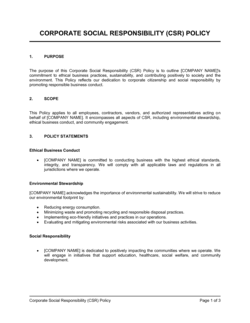
A CSR policy states high-level principles and values around social and environmental responsibility. A sustainability plan goes further β€” it includes a baseline audit, specific measurable goals, action plans with owners, and a reporting structure. Use the CSR policy to establish principles and the sustainability plan to operationalize them.

vs Strategic Plan

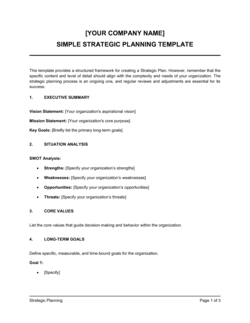
A strategic plan covers the full scope of business direction β€” competitive positioning, financial targets, and organizational priorities. A sustainability plan focuses specifically on environmental and social performance improvement. For most businesses, sustainability goals should be embedded within the broader strategic plan as a dedicated workstream.

vs Environmental Policy

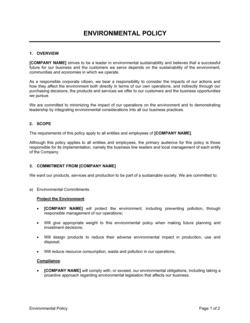
An environmental policy is a brief statement of commitment to environmental principles β€” typically one to two pages. A sustainability plan is a multi-section operational document that backs that commitment with audited data, SMART goals, and action plans. The policy declares intent; the plan delivers it.

vs Business Plan

A business plan addresses the full commercial model β€” market opportunity, competitive positioning, financial projections, and capital requirements. A sustainability plan addresses specifically how the business manages its environmental and social impact. Investors increasingly expect both, with sustainability integrated into the financial projections rather than treated as a separate addendum.

Industry-specific considerations

Retail and e-commerce

Packaging reduction, last-mile delivery emissions, and supplier labor standards dominate the sustainability agenda for retail businesses.

Manufacturing

Energy intensity per unit produced, waste-to-landfill ratios, water use in production, and chemical management are the primary material topics for manufacturers.

Professional services

Business travel emissions, office energy use, and supply chain procurement are the main levers, alongside employee wellbeing and community investment commitments.

Food and beverage

Food waste reduction, sustainable ingredient sourcing, packaging recyclability, and water efficiency are the most material and measurable sustainability focus areas.

Construction

Embodied carbon in materials, construction site waste, subcontractor labor standards, and energy performance of completed buildings are the defining sustainability metrics.

SaaS and technology

Cloud infrastructure energy consumption, hardware end-of-life management, remote-work policy impacts, and diversity in hiring are the primary focus areas for technology businesses.

Template vs pro β€” what fits your needs?

PathBest forCostTime
Use the templateSmall and mid-size businesses building their first sustainability plan or responding to customer and supplier ESG requestsFree2–4 weeks (including baseline audit)
Template + professional reviewBusinesses preparing for B Corp certification, ISO 14001 accreditation, or a first formal ESG disclosure to investors$500–$2,500 for a sustainability advisor review4–6 weeks
Custom draftedPublicly listed companies, regulated industries, or businesses with complex Scope 3 supply chain emissions requiring full GRI or SASB-aligned reporting$5,000–$25,000+2–4 months

Glossary

ESG
Environmental, Social, and Governance β€” a framework used by investors and stakeholders to evaluate a company's non-financial performance and risk profile.
Carbon Footprint
The total greenhouse gas emissions caused directly and indirectly by an organization, measured in tonnes of CO2 equivalent.
Scope 1, 2, and 3 Emissions
A GHG Protocol classification: Scope 1 covers direct emissions, Scope 2 covers purchased energy, and Scope 3 covers all other indirect emissions in the value chain.
Materiality Assessment
A process that identifies which sustainability topics are most significant to a business's operations and most relevant to its stakeholders.
Circular Economy
A model designed to eliminate waste by keeping materials in use through reuse, repair, remanufacturing, and recycling rather than a linear take-make-dispose approach.
B Corp Certification
A third-party certification awarded by B Lab to businesses that meet rigorous standards of social and environmental performance, accountability, and transparency.
ISO 14001
An international standard specifying requirements for an effective environmental management system that helps organizations improve their environmental performance.
Greenwashing
The practice of making misleading or unsubstantiated claims about the environmental benefits of a product, service, or company.
Net Zero
A target state in which a business's total greenhouse gas emissions are balanced by an equivalent amount of carbon removal or offsetting.
Life Cycle Assessment (LCA)
A method for evaluating the total environmental impact of a product or service across every stage of its life, from raw material extraction to end-of-life disposal.

Part of your Business Operating System

This document is one of 3,000+ business & legal templates included in Business in a Box.

  • Fill-in-the-blanks β€” ready in minutes
  • Compatible with all office suites
  • Export to PDF and share electronically

Create your document in 3 simple steps.

From template to signed document β€” all inside one Business Operating System.
1
Download or open template

Access over 3,000+ business and legal templates for any business task, project or initiative.

2
Edit and fill in the blanks with AI

Customize your ready-made business document template and save it in the cloud.

3
Save, Share, Send, Sign

Share your files and folders with your team. Create a space of seamless collaboration.

Save time, save money, and create top-quality documents.

β˜…β˜…β˜…β˜…β˜…

"Fantastic value! I'm not sure how I'd do without it. It's worth its weight in gold and paid back for itself many times."

Managing Director Β· Mall Farm
Robert Whalley
Managing Director, Mall Farm Proprietary Limited
β˜…β˜…β˜…β˜…β˜…

"I have been using Business in a Box for years. It has been the most useful source of templates I have encountered. I recommend it to anyone."

Business Owner Β· 4+ years
Dr Michael John Freestone
Business Owner
β˜…β˜…β˜…β˜…β˜…

"It has been a life saver so many times I have lost count. Business in a Box has saved me so much time and as you know, time is money."

Owner Β· Upstate Web
David G. Moore Jr.
Owner, Upstate Web

Run your business with a system β€” not scattered tools

Stop downloading documents. Start operating with clarity. Business in a Box gives you the Business Operating System used by over 250,000 companies worldwide to structure, run, and grow their business.

Free Forever PlanΒ Β·Β No credit card required