How The Top One Percent Think Template

Free to read • Save or share with one click

FreeHow The Top One Percent Think Template

At a glance

What it is
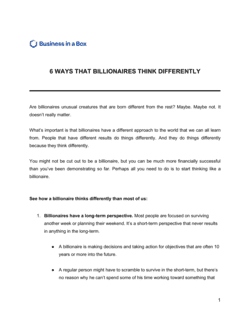
How The Top One Percent Think is a structured guide and framework document that distills the core mental models, decision-making habits, and strategic approaches consistently demonstrated by the highest-performing business leaders, investors, and entrepreneurs. This free Word download gives you a ready-to-edit template you can adapt as a personal development guide, leadership training resource, or coaching framework — and export as PDF for sharing with teams or clients.
When you need it
Use this framework when building a personal development curriculum for executives or high-potential employees, when structuring a coaching or mentorship program, or when you want a concrete reference document to benchmark your own strategic thinking against proven elite-performer principles.
What's inside
The document covers long-term orientation and delayed gratification, asymmetric risk thinking, leverage and systems design, network cultivation, continuous learning habits, outcome ownership, and the role of contrarian conviction in wealth and career building.

What is How The Top One Percent Think?

How The Top One Percent Think is a structured framework document that translates the core mental models, decision-making habits, and strategic orientations of elite business performers, investors, and entrepreneurs into a concrete, operational guide. Unlike motivational or aspirational content, this template is built around specific, measurable personal commitments — from asymmetric risk thresholds and leverage ratios to learning cadences and post-mortem protocols — that encode the thinking patterns responsible for compounding results over time. It functions as both a personal operating standard and a coaching or leadership development tool, giving individuals and organizations a reference document that can be reviewed, updated, and held accountable against measurable outcomes.

Why You Need This Document

Without a structured framework, the principles that drive top-tier performance remain diffuse — known in the abstract, but never translated into decisions that actually change behavior. The result is a persistent gap between understanding what elite performers do and replicating it in practice. High-potential individuals who lack an explicit decision-making framework default to the habits and time horizons of their immediate environment, which rarely produce compounding outcomes. Organizations that invest in leadership development without a foundational mindset document find that training programs produce short-term behavior change followed by regression to baseline. This template closes that gap by giving you a single document where every principle carries a specific commitment, a measurable threshold, and a scheduled review date — converting knowledge into a system that produces results over a 5 to 20-year horizon.

Which variant fits your situation?

If your situation is…Use this template
Building a personal development plan for an individual executivePersonal Development Plan
Structuring a leadership coaching engagement with measurable milestonesCoaching Agreement
Deploying the framework across a management team as a training moduleTraining Plan Template
Documenting strategic thinking principles for a company culture guideEmployee Handbook
Adapting the mindset principles into a mentorship program structureMentorship Agreement
Using the framework as the foundation of a keynote or workshop deckBusiness Presentation Template
Benchmarking leadership behaviors against the framework in performance reviewsEmployee Performance Review

Common mistakes to avoid

❌ Treating the framework as motivational reading rather than an operational document

Why it matters: Without specific numerical commitments and scheduled review dates, the framework produces no behavioral change — it becomes another document filed and forgotten within 30 days.

Fix: Enter at least one specific, measurable commitment in each clause before considering the document complete. Vague principles do not produce compounding results.

❌ Copying thresholds from benchmarks without calibrating to personal circumstances

Why it matters: A reinvestment rate or risk ratio borrowed from a case study may be wildly inappropriate for your capital position, risk capacity, or stage of career — producing either paralysis or recklessness.

Fix: Derive each threshold from your own balance sheet, time constraints, and realistic opportunity set. Use benchmarks as sanity checks, not starting points.

❌ Defining leverage purely in financial terms

Why it matters: Operators who only count financial leverage miss the far higher-return leverage available through systems design, delegation, and audience building — which compound faster and with less capital at early stages.

Fix: Inventory all four leverage types — capital, people, systems, and media — and ensure the framework addresses at least three of them with specific commitments.

❌ Skipping post-mortems after successful outcomes

Why it matters: Success contains as much decision-quality information as failure, and ignoring it means you cannot distinguish skill from luck — making you unable to reliably replicate results.

Fix: Apply the same post-mortem format to outcomes that exceeded expectations as to those that fell short, with the specific question: what decisions within my control caused this result?

❌ Setting a single time horizon for all decisions

Why it matters: Different decisions compound on different timescales — a hiring decision compounds over 3–5 years while a daily habit compounds over 20 — and applying a single horizon to all creates systematic miscalibration.

Fix: Define at least three time horizons in the framework (90 days, 3 years, 10 years) and explicitly assign each major decision category to the appropriate horizon.

❌ Not scheduling the annual framework review at the time of completion

Why it matters: A framework with no review date is effectively a one-time document. Without iteration, it becomes misaligned with reality within 12–18 months and starts producing decisions optimized for a context that no longer exists.

Fix: Before saving and closing the document, enter a specific review date and set a calendar reminder. Treat this with the same scheduling discipline as a board meeting or financial audit.

The 10 key clauses, explained

Long-term orientation clause

In plain language: Establishes the foundational premise that top performers consistently subordinate short-term discomfort to multi-year compounding outcomes in wealth, skill, and reputation.

Sample language
[INDIVIDUAL/ORGANIZATION NAME] commits to evaluating decisions against a [5/10/20]-year horizon, explicitly discounting choices that optimize for immediate recognition, comfort, or liquidity at the expense of long-term compounding.

Common mistake: Stating a long-term orientation without defining a concrete time horizon — leaving the principle aspirational rather than actionable and unmeasurable.

Asymmetric risk assessment clause

In plain language: Documents the principle of seeking opportunities where the maximum loss is defined and bounded while the potential upside is uncapped or significantly larger.

Sample language
Before committing resources to any initiative, [NAME] will document the worst-case loss (capped at $[X] or [X]% of portfolio), the base-case return ([X]%), and the best-case upside ([X]×), and will only proceed when upside exceeds downside by a ratio of at least [X]:1.

Common mistake: Conflating risk tolerance with risk avoidance — the top-performer framework is about calibrating risk, not eliminating it, and failing to make this distinction produces overcautious execution.

Leverage and systems design clause

In plain language: Captures the commitment to designing repeatable systems, delegating execution, and using capital or media to multiply personal output rather than trading time for money linearly.

Sample language
[NAME/ORGANIZATION] will identify [X] activities per quarter where a system, hire, or tool can replace or multiply direct personal effort, targeting a minimum leverage ratio of [X]:1 on time invested.

Common mistake: Treating leverage as purely financial — overlooking that the highest-leverage interventions for most operators are process design and strategic delegation, not capital alone.

Continuous learning and knowledge compounding clause

In plain language: Establishes a structured commitment to regular learning across multiple domains, with the explicit goal of building cross-disciplinary insight that creates decision-making edges.

Sample language
[NAME] commits to [X] hours per week of deliberate learning in [DOMAIN 1], [DOMAIN 2], and [DOMAIN 3], with quarterly reviews to document insights applied to real decisions and measure knowledge compounding.

Common mistake: Focusing learning exclusively within one's primary domain — the cross-domain synthesis that top performers demonstrate requires intentional exposure to adjacent fields such as psychology, history, and systems science.

Network cultivation and reciprocity clause

In plain language: Documents the approach to building and maintaining high-value professional relationships through consistent value delivery, follow-through, and strategic introductions rather than transactional networking.

Sample language
[NAME] will initiate [X] substantive, value-first interactions per month with [TIER 1/TIER 2] network contacts, tracking follow-through commitments in [CRM/SYSTEM] and reviewing relationship health quarterly.

Common mistake: Measuring network activity by connection count rather than relationship depth and reciprocity — a large shallow network generates far less value than a smaller network of high-trust, high-accountability relationships.

Outcome ownership and accountability clause

In plain language: Establishes the behavioral standard of treating all outcomes — including failures caused by external factors — as the individual's responsibility to anticipate, navigate, and learn from.

Sample language
[NAME] agrees that for any material outcome — positive or negative — a written post-mortem will be completed within [X] days identifying decisions within [NAME]'s control that influenced the result and specific adjustments for future decisions.

Common mistake: Completing post-mortems only after failures and skipping them after successes — top performers extract as much learning from wins as from losses, because success contains equally important information about what caused it.

Contrarian conviction and independent thinking clause

In plain language: Articulates the standard for forming and acting on well-researched positions that diverge from prevailing consensus, with explicit criteria for distinguishing informed contrarianism from uninformed contrarianism.

Sample language
Before acting on a position that conflicts with consensus, [NAME] will document: (a) the specific data or reasoning that diverges from consensus, (b) the mechanism by which the market or mainstream is systematically wrong, and (c) the falsifying condition that would cause [NAME] to reverse the position.

Common mistake: Treating contrarianism as an identity rather than a tool — reflexive contrarianism that rejects consensus without a superior evidence base is as destructive as reflexive conformity.

Signal prioritization and noise filtering clause

In plain language: Documents the commitment to defined information filters — specific sources, metrics, and decision criteria — that reduce cognitive load and prevent reactive decision-making driven by irrelevant data.

Sample language
[NAME] will limit primary information inputs to [X] vetted sources per category (news, market data, industry research) and will evaluate all new inputs against the criterion: 'Does this change a decision I am currently making or will make in the next [X] days?'

Common mistake: Building information filters once and never revising them — the highest-value signals shift over time, and static filters that made sense in one environment become noise generators in another.

Wealth compounding and reinvestment clause

In plain language: Establishes the principle and specific commitment to reinvesting a defined percentage of earnings, returns, or profits to accelerate the compounding of financial and human capital.

Sample language
[NAME/ORGANIZATION] commits to reinvesting a minimum of [X]% of net [income/returns/profits] into [ASSET CLASS/SKILL DEVELOPMENT/TEAM CAPACITY] on a [monthly/quarterly/annual] basis, with no withdrawal of compounding gains before [DATE/MILESTONE].

Common mistake: Setting a reinvestment percentage without a defined compounding vehicle — committing to save 20% means nothing if those funds sit in a low-yield account rather than being deployed into appreciating assets or high-return skill development.

Review, iteration, and framework evolution clause

In plain language: Establishes a scheduled review cadence for the entire framework to ensure it adapts to new information, changed circumstances, and evolving personal or organizational goals.

Sample language
[NAME] will conduct a full framework review on [DATE / ANNUALLY], updating commitments and thresholds based on outcomes achieved, assumptions that proved false, and new evidence about what drives performance in [DOMAIN].

Common mistake: Treating the framework as a fixed document rather than a living system — top performers iterate their mental models continuously, and a framework that is not updated becomes a constraint rather than an accelerant.

How to fill it out

  1. 1

    Define your primary context and time horizon

    Enter your name or organization name, the domain this framework applies to (wealth building, career, business operations), and your core time horizon in the long-term orientation clause. Be specific — '10 years' is more actionable than 'long term.'

    💡 Choose a time horizon that is genuinely uncomfortable — if your stated horizon does not require you to make any near-term sacrifices, it is not long enough to produce compounding effects.

  2. 2

    Calibrate your asymmetric risk thresholds

    In the asymmetric risk clause, enter your specific maximum loss tolerance (in dollars or percentage), your required upside-to-downside ratio, and the asset classes or decision types this standard applies to.

    💡 Separate your asymmetric risk threshold by domain — the ratio you require for a career bet is different from a financial investment; conflating them produces paralysis in one area and recklessness in another.

  3. 3

    Map your current leverage and identify gaps

    List your existing leverage mechanisms — systems, team members, tools, and capital — and calculate your current time leverage ratio. Then identify the single highest-leverage addition you could make in the next 90 days.

    💡 The highest-leverage hire or system is almost always the one that frees the most hours of your highest-value attention — not the one that costs the least.

  4. 4

    Set specific learning commitments by domain

    Enter the number of hours per week you commit to deliberate learning and name at least two domains outside your primary expertise. Schedule these as recurring calendar blocks before completing this section.

    💡 Read one book per month outside your primary field — over 5 years, this produces 60 cross-domain reference points that become a genuine information asymmetry advantage.

  5. 5

    Define your network tiers and outreach cadence

    Segment your network into two tiers by relationship value and entry difficulty. For each tier, specify the minimum monthly interactions and the value-first action you will take (introduction, insight, referral, or resource).

    💡 Track follow-through commitments in a CRM or even a simple spreadsheet — the gap between top performers and average performers in networking is almost entirely execution, not intention.

  6. 6

    Establish post-mortem triggers and format

    Set the outcome threshold that triggers a written post-mortem (e.g., any decision involving more than $X, any outcome more than 20% from forecast) and complete the post-mortem template for one recent outcome to validate the format.

    💡 Write post-mortems within 48 hours of the outcome — memory degrades fast, and the instinct to rationalize replaces accurate recollection within a week.

  7. 7

    Schedule your annual framework review

    Enter a specific calendar date — within the next 12 months — for your full framework review and add it to your calendar now. Note the two or three metrics you will use to evaluate whether the framework is producing results.

    💡 Review what you believed 12 months ago that turned out to be wrong — these falsified assumptions are more valuable than confirmed ones for updating your mental models.

Frequently asked questions

What is the How The Top One Percent Think framework?

The How The Top One Percent Think framework is a structured document that distills the core mental models, habits, and decision-making principles consistently demonstrated by elite business performers, investors, and entrepreneurs. It translates abstract success principles into specific, measurable personal commitments covering long-term thinking, leverage, risk calibration, continuous learning, and network cultivation. The template is designed to function as an operational guide, not a motivational resource.

Who should use this framework?

Executive coaches building structured curricula, founders benchmarking their own decision-making, HR professionals designing high-potential leadership programs, and independent consultants packaging advisory frameworks all use this type of document. It is most valuable for individuals who have already achieved a baseline of professional success and want to identify the specific mental habits that differentiate the top tier from the high-performing majority.

How is this different from a standard personal development plan?

A personal development plan typically covers skill gaps, training objectives, and career milestones over 12 months. This framework operates at the level of mental models and decision-making architecture — the underlying thinking patterns that produce performance outcomes rather than the surface-level skills. It is designed to complement, not replace, a standard personal development plan by addressing the cognitive layer those plans rarely touch.

Do I need a lawyer or coach to use this framework?

For personal use or internal team development, the template is designed to be self-administered by a motivated individual or an internal HR team. If you are deploying it as a commercial coaching product, licensing it to clients, or incorporating it into a professional certification program, consider having the document reviewed by a legal professional to ensure the framing meets your professional obligations and any applicable regulatory standards in your jurisdiction.

How often should the framework be reviewed and updated?

An annual review is the minimum standard — timed to coincide with your fiscal year-end or a significant personal milestone. Top performers typically do a lighter quarterly check against the measurable commitments in each clause and a full reset annually where they update thresholds, discard assumptions that proved false, and add new principles they have validated in practice over the prior year.

Can this framework be used for team or organizational development?

Yes. Many of the clauses translate directly into organizational standards — particularly outcome ownership, systems design, and long-term orientation. When deploying as a team document, replace individual name references with team or organizational identifiers, and add a shared accountability mechanism (peer review, manager check-in, or OKR integration) for each commitment. A shared framework adopted by a leadership team is more effective than individual versions applied in isolation.

What is the biggest difference in how the top one percent think compared to average performers?

The most consistently documented difference is time horizon. Top performers make the majority of their significant decisions against a 5–20 year compounding frame rather than a quarterly or annual one. This single shift changes which opportunities look attractive, which relationships are worth investing in, and which short-term costs are worth paying. The second most significant difference is outcome ownership — elite performers treat all results as attributable to their own prior decisions, which produces a very different learning rate from attributing outcomes to external circumstances.

Is this framework applicable outside the business context?

The mental models covered — asymmetric risk, leverage, compounding, systems thinking, and contrarian conviction — are domain-agnostic and apply to career development, personal finance, creative fields, and athletic performance with minimal adaptation. The specific thresholds and metrics in each clause will differ by domain, but the underlying architecture of the framework transfers directly.

What evidence supports these principles?

The principles in this framework are drawn from longitudinal research on high-net-worth individuals (notably the work behind The Millionaire Next Door and studies by Fidelity and UBS on investor behavior), performance science on deliberate practice and expertise development, and the documented decision-making practices of top-tier investors including Buffett, Munger, and Dalio. The framework synthesizes these sources into an actionable structure rather than presenting any single source as definitive.

How this compares to alternatives

vs Personal Development Plan

A personal development plan focuses on skill acquisition, role-specific competency gaps, and 12-month career milestones. The Top One Percent Think framework operates at the level of mental architecture — the decision-making patterns and time horizons that produce the outcomes a development plan targets. Both documents are more effective when used together, with the mindset framework informing how goals in the development plan are selected and prioritized.

vs Strategic Plan

A strategic plan is an organizational document covering 3–5 year goals, initiatives, resource allocation, and KPIs for a business unit or company. The mindset framework is a personal or individual leadership document focused on cognitive habits and decision principles. Strategic plans benefit from leaders who have internalized the thinking patterns in the mindset framework, but the two documents serve entirely different functions and audiences.

vs Employee Performance Review

A performance review is a backward-looking assessment of an individual's output against pre-set objectives for a defined review period. The mindset framework is a forward-looking operating standard for how decisions are made and learning is structured. Performance reviews measure results; the mindset framework governs the thinking quality that produces those results over time.

vs Training Plan

A training plan schedules specific skill-building activities, assigns facilitators, and tracks completion against learning objectives. The mindset framework establishes the principles that determine which skills are worth training in the first place and how training converts to compounding performance advantage. Training plans answer what to learn; the mindset framework answers how to think about learning itself.

Industry-specific considerations

Financial Services and Investment

Asymmetric risk calibration, contrarian conviction, and compounding principles are directly operational in portfolio management, deal sourcing, and client advisory contexts.

Technology and SaaS

Leverage through systems and media, long-term orientation, and continuous learning are structural advantages in a sector where compounding network effects and technical knowledge determine competitive position.

Professional Services

Network density, outcome ownership, and signal prioritization are directly applicable to client retention, business development, and building a practice that commands premium pricing.

Healthcare and Life Sciences

Long-term orientation and systems thinking are particularly relevant for leaders navigating multi-year regulatory timelines, research compounding, and high-stakes resource allocation decisions under uncertainty.

Education and Corporate Training

The framework is most directly deployable in this sector as a curriculum foundation for executive education, high-potential leadership programs, and coaching certification courses.

Real Estate and Development

Compounding, leverage, long-term orientation, and asymmetric risk assessment map directly onto real estate investment analysis, development planning, and portfolio management across market cycles.

Jurisdictional notes

United States

In the US, personal development and mindset frameworks used in a coaching context may intersect with state-level regulations on professional coaching versus licensed therapy or financial advice. Coaches who monetize this framework should ensure their services are positioned clearly outside regulated advice categories. IP ownership of customized framework versions is governed by work-for-hire and assignment principles under federal copyright law.

Canada

Canadian coaches and trainers deploying this framework commercially should note that several provinces have consumer protection rules governing coaching and advisory services, particularly where financial outcomes are implied. Quebec's language requirements apply if the framework is distributed to French-language clients in the province. IP considerations follow federal copyright law, with provincial enforcement variations.

United Kingdom

In the UK, coaching and personal development content that touches on financial decision-making or investment principles must be carefully positioned to avoid falling under FCA-regulated financial advice. The framework's investment-related clauses should include standard disclaimers where deployed commercially. GDPR applies to any personal data collected during framework administration or coaching engagements.

European Union

EU GDPR requirements apply to any data collected in connection with administering this framework to clients, including assessment responses and coaching notes. Member states vary in their regulation of coaching and advisory services — Germany and France have specific consumer protection provisions relevant to paid coaching programs. The framework's financial principles should be accompanied by appropriate disclaimers in any commercial deployment within the EU.

Template vs lawyer — what fits your deal?

PathBest forCostTime
Use the templateIndividuals, internal HR teams, and coaches using the framework for personal or organizational development without commercial licensingFree2–4 hours to complete all clauses with specific commitments
Template + legal reviewCoaches or consultants deploying the framework as a client-facing product or incorporating it into a paid program$300–$800 for a professional review of commercial framing and IP considerations3–5 business days
Custom draftedOrganizations licensing the framework to multiple clients, integrating it into accredited training programs, or operating in regulated professional advice sectors$1,500–$5,000+ depending on scope and jurisdiction2–4 weeks

Glossary

Asymmetric Risk
A situation where potential upside significantly exceeds potential downside — the core logic behind how elite investors and operators allocate capital and effort.
Leverage
Using systems, capital, people, or media to multiply output beyond what personal time and effort alone could produce.
Delayed Gratification
The deliberate choice to forgo immediate reward in favor of a larger, longer-term outcome — a defining behavioral trait of high-net-worth individuals and elite performers.
Mental Model
A simplified framework for understanding how a system works, used to make faster and more accurate decisions under uncertainty.
Contrarian Conviction
The ability to hold a well-researched position that diverges from prevailing consensus, and to act on it before the market or mainstream confirms it.
Systems Thinking
An approach that focuses on how components of a system interrelate and work over time, rather than optimizing individual parts in isolation.
Outcome Ownership
Taking full personal accountability for results regardless of external circumstances — the opposite of an attribution mindset that assigns failure to outside factors.
Long-Term Orientation
Prioritizing decisions that compound favorably over a 5–20 year horizon over those that optimize for the current quarter.
Network Density
The quality and diversity of one's professional relationships — specifically the degree to which those relationships create access to information, capital, and opportunities unavailable through public channels.
Signal vs. Noise
The skill of distinguishing information that is genuinely predictive or actionable from the high volume of irrelevant or misleading data in any environment.
Compounding
The process by which reinvested returns or applied learning generate exponentially growing results over time — applicable to wealth, skills, and reputation equally.

Part of your Business Operating System

This document is one of 3,000+ business & legal templates included in Business in a Box.

  • Fill-in-the-blanks — ready in minutes
  • Compatible with all office suites
  • Export to PDF and share electronically

Create your document in 3 simple steps.

From template to signed document — all inside one Business Operating System.
1
Download or open template

Access over 3,000+ business and legal templates for any business task, project or initiative.

2
Edit and fill in the blanks with AI

Customize your ready-made business document template and save it in the cloud.

3
Save, Share, Send, Sign

Share your files and folders with your team. Create a space of seamless collaboration.

Save time, save money, and create top-quality documents.

★★★★★

"Fantastic value! I'm not sure how I'd do without it. It's worth its weight in gold and paid back for itself many times."

Managing Director · Mall Farm
Robert Whalley
Managing Director, Mall Farm Proprietary Limited
★★★★★

"I have been using Business in a Box for years. It has been the most useful source of templates I have encountered. I recommend it to anyone."

Business Owner · 4+ years
Dr Michael John Freestone
Business Owner
★★★★★

"It has been a life saver so many times I have lost count. Business in a Box has saved me so much time and as you know, time is money."

Owner · Upstate Web
David G. Moore Jr.
Owner, Upstate Web

Run your business with a system — not scattered tools

Stop downloading documents. Start operating with clarity. Business in a Box gives you the Business Operating System used by over 250,000 companies worldwide to structure, run, and grow their business.

Start free · No credit card required