Empower Your Team and Become A Powerful Leader Template

Free Word download β€’ Edit online β€’ Save & share with Drive β€’ Export to PDF

3 pagesβ€’25–30 min to fillβ€’Difficulty: Standardβ€’Signature requiredβ€’Legal review recommended
Learn more ↓
FreeEmpower Your Team and Become A Powerful Leader Template

At a glance

What it is
A Leadership Empowerment Agreement is a binding document that formally delegates decision-making authority, accountability obligations, and performance standards from senior leadership to team leaders and managers. This free Word download lets you define authority boundaries, reporting structures, and measurable outcomes in a single document you can edit online and export as PDF for execution.
When you need it
Use it when promoting a team member into a leadership role, restructuring reporting lines, or formalizing authority delegation during organizational growth or change. It is particularly important when distributed or remote teams need clear, documented boundaries for autonomous decision-making.
What's inside
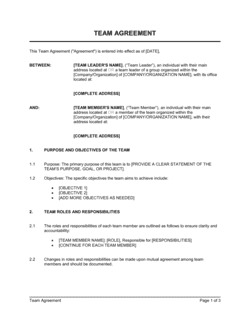
Scope of authority and decision-making limits, team member roles and responsibilities, performance targets and accountability metrics, communication and reporting cadences, resource allocation authority, conflict resolution procedures, and termination or revision conditions.

What is a Leadership Empowerment Agreement?

A Leadership Empowerment Agreement is a binding document that formally transfers defined decision-making authority from senior leadership to a team leader or manager, establishing clear boundaries for autonomous action alongside measurable accountability obligations. It defines exactly what the empowered leader is authorized to decide independently β€” budget thresholds, staffing choices, vendor selection, operational priorities β€” and the performance standards against which their leadership will be evaluated. Unlike a general job description, this document creates enforceable obligations on both sides: the leader commits to specific KPIs and reporting cadences, and the organization commits to providing the resources and indemnification the leader needs to act confidently within the defined scope.

Why You Need This Document

Without a formal empowerment agreement, authority delegation is an informal arrangement that breaks down the moment a dispute arises β€” leaders exceed unstated limits, organizations claim scope was narrower than understood, and both sides lack documented evidence of what was actually authorized. The cost of that ambiguity is concrete: leaders facing personal liability for decisions they believed were sanctioned, organizations exposed to constructive dismissal claims when they revoke authority without a defined process, and teams stalled by leaders who hesitate to act without written cover. A signed empowerment agreement eliminates all three risks by making the scope, the standards, and the consequences explicit before the first delegated decision is made. This template gives you a structured, lawyer-ready starting point that covers every material term β€” authority limits, KPIs, reporting cadence, resource allocation, indemnification, and revocation β€” so you can delegate with confidence and lead with clarity.

Which variant fits your situation?

If your situation is…Use this template
Delegating authority to a newly promoted department headLeadership Empowerment Agreement
Assigning a project manager authority over a defined initiativeProject Management Authority Agreement
Defining board-level governance and executive decision limitsCorporate Governance Policy
Establishing authority for a remote team lead across multiple time zonesRemote Work Employment Agreement
Documenting a formal mentoring relationship with accountability milestonesMentoring Agreement
Setting performance targets for a leader under a formal review cycleEmployee Performance Review
Outlining duties and authority limits for a temporary acting managerFixed-Term Employment Contract

Common mistakes to avoid

❌ Open-ended scope with no decision thresholds

Why it matters: Vague authority language like 'manage the team as needed' creates disputes about what the leader was actually authorized to do β€” and courts will not fill in limits the parties failed to set.

Fix: Define every authority category with a specific limit β€” dollar amounts, headcount levels, or approved vendor lists β€” and put exceptions in writing before execution.

❌ KPIs set to metrics outside the leader's control

Why it matters: Holding a team leader accountable for total company revenue or market share makes performance measurement unfair and legally vulnerable if the leader challenges a PIP or termination.

Fix: Select KPIs that are directly within the leader's sphere of influence β€” team retention, output volume, cycle time, or direct report engagement scores.

❌ No graduated remediation before authority revocation

Why it matters: Immediately revoking a leader's authority for a first KPI miss β€” without a documented PIP process β€” exposes the organization to wrongful demotion or constructive dismissal claims in most jurisdictions.

Fix: Build a two-step remediation: a written warning with a specific improvement window, followed by authority reduction or termination only if the issue persists.

❌ Executing the agreement after the leader starts acting under delegated authority

Why it matters: Decisions made before the agreement is signed are not covered by the indemnification clause, and any authority claimed before execution may be challenged as unauthorized.

Fix: Execute the agreement on or before the leader's first day in the empowered role. Use electronic signature with a timestamp to create a clear execution record.

❌ Relying on a separate NDA for confidentiality instead of incorporating it

Why it matters: When the confidentiality obligation is in a separate document with a different definition of protected information, gaps between the two create exposure on sensitive personnel or financial data accessed through the leadership role.

Fix: Incorporate a confidentiality clause directly in the empowerment agreement, using a definition of Confidential Information that specifically covers the categories the leader will access.

❌ No scheduled review or renewal trigger

Why it matters: A leadership empowerment agreement with no expiry or review date quickly becomes obsolete as the organization grows β€” leaving leaders operating under authority limits that no longer reflect their actual role.

Fix: Set an annual review date in the term clause and calendar it. At each review, confirm the KPIs, budget allocations, and authority thresholds still match the leader's current responsibilities.

The 10 key clauses, explained

Parties and recitals

In plain language: Identifies the organization, the delegating executive, and the empowered leader by full legal name and title, and states the purpose of the agreement.

Sample language
This Leadership Empowerment Agreement ('Agreement') is entered into on [DATE] between [ORGANIZATION LEGAL NAME] ('Organization'), represented by [SENIOR EXECUTIVE NAME], [TITLE], and [LEADER NAME] ('Team Leader'), currently serving as [JOB TITLE].

Common mistake: Using informal names or job nicknames instead of legal names and registered titles β€” this creates ambiguity about who holds authority if the agreement is ever disputed.

Scope of delegated authority

In plain language: Defines exactly what the team leader is authorized to do independently β€” including budget approval limits, staffing decisions, vendor selection, and operational choices.

Sample language
Team Leader is authorized to approve expenditures up to $[AMOUNT] per transaction without additional sign-off, hire and terminate staff at or below [GRADE LEVEL], and select vendors within pre-approved categories listed in Schedule A.

Common mistake: Leaving the scope open-ended with language like 'full operational authority' β€” without defined limits, disputes over what was authorized are nearly impossible to resolve.

Performance standards and KPIs

In plain language: Sets the measurable targets the team leader must meet, the review cycle for those targets, and the baseline against which performance is evaluated.

Sample language
Team Leader agrees to maintain a team retention rate of at least [X]%, achieve a department output of [METRIC] by [DATE], and complete quarterly performance reviews for all direct reports within [X] days of each quarter end.

Common mistake: Setting KPIs that are outcomes the leader cannot control β€” like total company revenue β€” rather than metrics within their direct sphere of influence.

Reporting and communication obligations

In plain language: Specifies how and how often the team leader must report progress, escalate issues, and communicate with senior leadership.

Sample language
Team Leader shall provide a written status report to [SUPERVISOR TITLE] every [FREQUENCY], escalate any decision exceeding the thresholds in Section 2 within [X] business days of identification, and attend scheduled one-on-one meetings on [DAY/TIME].

Common mistake: Specifying reporting formats that are too burdensome β€” requiring daily written reports for a mid-level manager creates friction that undermines autonomous leadership.

Resource allocation authority

In plain language: Defines the team leader's control over budget, headcount, tools, and other organizational resources needed to execute their responsibilities.

Sample language
Team Leader is allocated an operating budget of $[AMOUNT] per [PERIOD] as detailed in Schedule B. Any reallocation between budget line items exceeding [X]% requires written approval from [ROLE]. Headcount changes above the pre-approved plan require [APPROVAL PROCESS].

Common mistake: Granting resource authority without a corresponding accountability mechanism β€” if the leader can spend freely with no approval trail, cost overruns go undetected until year-end.

Confidentiality and information handling

In plain language: Requires the team leader to protect sensitive organizational information accessed through the exercise of their delegated authority.

Sample language
Team Leader agrees to hold all Confidential Information β€” including personnel records, financial data, strategic plans, and client information β€” in strict confidence and to use such information solely for the purposes of fulfilling their responsibilities under this Agreement.

Common mistake: Relying on a separate NDA instead of incorporating confidentiality into the authority document β€” when authority and confidentiality are in separate documents, gaps in scope coverage are common.

Accountability and consequences for non-performance

In plain language: States what happens when the leader fails to meet their KPIs or exceeds their authority β€” including remediation steps, authority reduction, and termination conditions.

Sample language
Failure to meet two or more KPIs in a single review period will result in a written Performance Improvement Plan with a [X]-day remediation window. A second consecutive underperformance period may result in revocation of delegated authority or termination of employment in accordance with [EMPLOYMENT AGREEMENT / POLICY].

Common mistake: Omitting a graduated remediation process and jumping straight to termination consequences β€” courts and employment tribunals expect employers to have given documented opportunities to improve before removing authority.

Indemnification and liability limits

In plain language: Allocates legal and financial liability between the organization and the leader for actions taken within and outside the agreed scope of authority.

Sample language
Organization shall indemnify Team Leader for claims arising directly from decisions made within the scope of authority defined in Section 2, provided such decisions were made in good faith and in accordance with this Agreement. Team Leader assumes personal liability for decisions knowingly made outside the defined scope.

Common mistake: No indemnification clause at all β€” without it, a leader acting in good faith within their authorized scope may face personal liability for organizational decisions.

Revocation, amendment, and term

In plain language: States how long the agreement lasts, what notice is required to revoke or modify the delegated authority, and the conditions under which revocation is immediate.

Sample language
This Agreement is effective as of [DATE] and continues until [END DATE / ONGOING]. Either party may propose amendments in writing with [X] days' notice. Organization may revoke delegated authority immediately upon written notice in the event of gross misconduct, material breach, or insolvency.

Common mistake: Using an indefinite term with no review trigger β€” delegated authority should be formally reassessed at least annually as organizational needs and the leader's role evolve.

Governing law and dispute resolution

In plain language: Specifies the jurisdiction whose employment and contract law governs the agreement, and the process for resolving disagreements β€” mediation, arbitration, or litigation.

Sample language
This Agreement is governed by the laws of [STATE / PROVINCE / COUNTRY]. Disputes shall first be submitted to non-binding mediation within [X] days of written notice. If unresolved, disputes shall be submitted to binding arbitration under [AAA / JAMS / applicable rules] in [CITY].

Common mistake: Choosing a governing jurisdiction with no connection to where the leader actually works β€” some jurisdictions apply local employment law regardless of what the contract specifies.

How to fill it out

  1. 1

    Identify the parties and their titles precisely

    Enter the organization's full legal name, the delegating executive's full name and title, and the team leader's full name and current job title. Confirm that the job title matches HR records.

    πŸ’‘ If the organization operates under a trade name, use the registered legal entity name in the agreement body and reference the trade name in parentheses.

  2. 2

    Define the scope of authority with specific limits

    List every category of decision the leader is authorized to make independently, and for each category, specify the threshold β€” dollar amounts for budget, grade levels for hiring, or category lists for vendor selection.

    πŸ’‘ Attach a Schedule A for detailed authority matrices if the scope is complex β€” keeping limits in a schedule makes future amendments easier without redrafting the entire agreement.

  3. 3

    Set measurable, leader-controlled KPIs

    Choose three to six KPIs that the leader can directly influence through their decisions and actions. Include a baseline value, a target value, and the review period for each.

    πŸ’‘ Avoid company-wide financial metrics as a leader's sole KPI β€” if their team hits every target but the company misses revenue due to external factors, the KPI fails to reflect actual leadership performance.

  4. 4

    Specify the reporting cadence and escalation triggers

    Enter the frequency of written reports, the format expected, and the specific thresholds that require immediate escalation β€” decision value, staffing changes, or external risks.

    πŸ’‘ Keep escalation triggers simple enough to remember without referring to the document β€” a leader who has to check the contract before escalating will often default to handling issues alone.

  5. 5

    Allocate the resource budget with line-item detail

    Attach Schedule B with the full budget breakdown by category. Note the percentage variance allowed before reallocation approval is required.

    πŸ’‘ Build in a contingency line of 5–10% of total budget β€” a leader with no discretionary buffer will constantly need approval for minor unplanned expenses.

  6. 6

    Draft the accountability and remediation process

    State the KPI review cycle, the trigger for a Performance Improvement Plan, the PIP duration, and the graduated consequences for continued underperformance.

    πŸ’‘ Mirror the remediation process to whatever your employment agreement or HR policy specifies β€” inconsistencies between the two documents create legal exposure.

  7. 7

    Complete the indemnification and liability section

    Specify the conditions under which the organization will indemnify the leader, and the conditions under which the leader assumes personal liability. Have legal counsel review this section before execution.

    πŸ’‘ Check whether your directors and officers (D&O) insurance policy covers delegated authority positions β€” if so, reference the policy in this section.

  8. 8

    Sign before the leader begins exercising delegated authority

    Both parties must execute the agreement before the leader makes any decision under delegated authority. Post-execution decisions without a signed agreement are unprotected by the indemnification clause.

    πŸ’‘ Use timestamped electronic signatures to create an unambiguous record of when authority was formally delegated.

Frequently asked questions

What is a leadership empowerment agreement?

A leadership empowerment agreement is a binding document that formally delegates defined decision-making authority from senior leadership to a team leader or manager. It specifies the scope of that authority, the performance standards the leader must meet, reporting obligations, and the consequences of non-performance. It protects both the organization and the leader by creating a clear, enforceable record of what was authorized and expected.

Why do I need a formal document to delegate authority?

Verbal delegation creates disputes β€” leaders act on what they believed they were authorized to do, and organizations later claim the scope was narrower. A written agreement eliminates that ambiguity, protects the leader from personal liability for decisions made in good faith within the defined scope, and gives HR and legal a clear baseline when performance issues or boundary disputes arise.

Is this type of agreement legally binding?

Yes, a properly executed leadership empowerment agreement is generally enforceable as a contract when it identifies the parties, states the obligations of each, includes consideration, and is signed by both parties before the delegated authority is exercised. The employment law of the governing jurisdiction may impose additional requirements β€” particularly around termination consequences and remediation processes.

What is the difference between this agreement and a job description?

A job description defines the general responsibilities of a role. A leadership empowerment agreement defines the specific authority limits, performance targets, and accountability mechanisms for a named individual in that role during a defined period. Job descriptions are not contracts; empowerment agreements are β€” and the obligations in an empowerment agreement supersede the general language of a job description when the two conflict.

Can delegated authority be revoked without notice?

Typically, authority can be revoked immediately only for cause β€” gross misconduct, material breach, or fraud. In most other circumstances, revoking or reducing a leader's authority without notice may constitute constructive dismissal, particularly if the authority is central to their role. The revocation clause should specify notice periods for revocation without cause and immediate revocation triggers for cause-based situations.

What performance metrics work best for a leadership empowerment agreement?

Effective KPIs for a leadership empowerment agreement are metrics the leader can directly influence β€” team retention rate, project delivery against milestones, direct report performance review completion, budget adherence within a defined variance, and employee engagement scores for their team. Avoid company-wide financial metrics as the sole measure; they reflect too many factors outside any single leader's control to be fair accountability standards.

Does this agreement replace an employment contract?

No. A leadership empowerment agreement sits alongside the employment contract β€” it does not replace it. The employment contract governs the employment relationship (compensation, benefits, termination). The empowerment agreement governs the specific scope of authority and accountability for the leadership role. Both should be executed and cross-referenced so that consequences for underperformance are consistent between the two documents.

Do I need a lawyer to finalize this agreement?

For most straightforward domestic leadership roles, a well-structured template is a reliable starting point. Legal review is strongly recommended when the leader will have authority over significant budgets (above $100K), personnel decisions affecting unionized workers, or decisions with regulatory implications. Cross-border arrangements β€” where the leader works in a different jurisdiction from the organization β€” always warrant legal review given the complexity of multi-jurisdiction employment law.

How often should a leadership empowerment agreement be updated?

Review and update the agreement at least annually, or whenever the leader's role changes materially β€” a promotion, a restructuring, or a significant shift in team size or budget. An outdated agreement with stale KPIs and old budget limits creates friction in performance conversations and may not reflect the actual authority the leader has been exercising in practice, which creates enforceability questions.

How this compares to alternatives

vs Employment Contract

An employment contract governs the entire employment relationship β€” compensation, benefits, IP, and termination. A leadership empowerment agreement is a targeted document focused specifically on the scope of delegated authority and accountability within a leadership role. Both documents are needed for an empowered leader; they serve distinct but complementary functions.

vs Job Offer Letter

A job offer letter confirms role, compensation, and start date to secure acceptance from a candidate. It does not define authority limits, performance KPIs, or accountability mechanisms. A leadership empowerment agreement fills those gaps and should be executed alongside or shortly after the offer letter for any management hire.

vs Employee Performance Review

A performance review is a periodic backward-looking evaluation of what a leader achieved against prior expectations. A leadership empowerment agreement is a forward-looking contract that sets those expectations, authority limits, and accountability consequences before the leader begins. The review measures against the standards the empowerment agreement defined.

vs Executive Employment Agreement

An executive employment agreement is a comprehensive contract for C-suite and VP-level hires covering equity, enhanced severance, and change-of-control terms. A leadership empowerment agreement is more focused and appropriate for mid-level managers and team leads who need defined authority but not the full suite of executive-level legal protections and entitlements.

Industry-specific considerations

Technology / SaaS

Engineering team leads and product managers need defined authority over sprint prioritization, vendor tooling decisions, and headcount within approved headcount plans.

Professional Services

Practice group leaders and client service directors require authority frameworks that balance client-facing autonomy with firm-wide billing and staffing controls.

Healthcare

Department heads and clinical leads exercise authority within strict regulatory and credentialing constraints that must be explicitly incorporated into the scope of authority clause.

Retail / Hospitality

Store managers and regional leaders need clear budget, staffing, and vendor limits that align with high-turnover operational realities and multi-location reporting structures.

Manufacturing

Plant managers and shift supervisors require authority defined around safety compliance thresholds, equipment procurement limits, and union agreement interactions.

Nonprofit

Program directors operate within board-approved strategic limits, requiring an authority framework that explicitly references grant compliance obligations and donor reporting duties.

Jurisdictional notes

United States

Delegation of authority agreements are enforceable under general contract law in all US states. The accountability and remediation process should mirror the at-will employment doctrine of the applicable state β€” in California and New York, courts scrutinize authority revocation closely where it resembles a constructive demotion. Non-exempt employees under the FLSA may have additional protections that limit how performance consequences can be applied.

Canada

Canadian employment law in every province treats unilateral reduction of authority as a potential constructive dismissal β€” particularly when authority is central to the leader's role and compensation. Notice periods must mirror the governing employment agreement and provincial Employment Standards Act minimums. Quebec-based agreements must comply with the Civil Code of Quebec and, for provincially regulated employers, must be available in French.

United Kingdom

UK employment law requires that any material change to a manager's role β€” including significant reduction of authority β€” be agreed in writing or risk triggering a constructive unfair dismissal claim under the Employment Rights Act 1996. The agreement should reference the employee's written statement of particulars and be consistent with any existing employment contract. Employees with more than two years of continuous service have full unfair dismissal protection.

European Union

EU member states impose varying levels of employee protection against unilateral authority changes, with France, Germany, and the Netherlands applying the strongest restrictions on unilateral role modifications. The EU Transparent and Predictable Working Conditions Directive requires that authority and responsibility changes be documented in writing within seven days. GDPR considerations apply where the leadership role involves access to employee or customer personal data.

Template vs lawyer β€” what fits your deal?

PathBest forCostTime
Use the templateTeam leads and managers in standard domestic roles with budget authority under $100K and no regulatory complexityFree30–60 minutes
Template + legal reviewLeaders with significant budget authority, union interactions, or roles in regulated industries such as healthcare or financial services$300–$8002–5 days
Custom draftedSenior executives with cross-border authority, complex indemnification needs, or authority over regulated decisions requiring tailored liability language$1,500–$4,000+1–3 weeks

Glossary

Delegation of Authority
The formal transfer of decision-making power from a senior party to a subordinate for a defined scope and duration.
Accountability Framework
A structured set of obligations that define who is responsible for what outcomes, and what consequences follow from non-performance.
Decision-Making Threshold
The maximum value or scope of a decision a delegated leader may make autonomously without seeking approval from a higher authority.
Key Performance Indicator (KPI)
A measurable metric tied to a specific business objective, used to evaluate whether a leader is meeting their defined performance targets.
Reporting Cadence
The agreed frequency and format β€” weekly one-on-ones, monthly reviews, quarterly reports β€” through which a leader communicates progress to their principal.
Scope of Authority
The defined boundaries within which a delegated leader may act independently, including budget limits, staffing decisions, and operational choices.
Fiduciary Duty
An obligation to act in the best interests of another party β€” in this context, the organization β€” when exercising delegated authority.
Performance Improvement Plan (PIP)
A formal document outlining specific deficiencies in a leader's performance and the corrective steps and timeline required to address them.
Indemnification
A contractual commitment by one party to compensate the other for losses or liabilities arising from actions taken within the agreed scope of authority.
Constructive Feedback Obligation
A contractual duty on the delegating party to provide timely, documented, and actionable feedback rather than unilaterally withdrawing delegated authority.
Revocation Clause
A provision allowing the delegating party to withdraw or modify the scope of authority on specified notice, with or without cause.

Part of your Business Operating System

This document is one of 3,000+ business & legal templates included in Business in a Box.

  • Fill-in-the-blanks β€” ready in minutes
  • 100% customizable Word document
  • Compatible with all office suites
  • Export to PDF and share electronically

Create your document in 3 simple steps.

From template to signed document β€” all inside one Business Operating System.
1
Download or open template

Access over 3,000+ business and legal templates for any business task, project or initiative.

2
Edit and fill in the blanks with AI

Customize your ready-made business document template and save it in the cloud.

3
Save, Share, Send, Sign

Share your files and folders with your team. Create a space of seamless collaboration.

Save time, save money, and create top-quality documents.

β˜…β˜…β˜…β˜…β˜…

"Fantastic value! I'm not sure how I'd do without it. It's worth its weight in gold and paid back for itself many times."

Managing Director Β· Mall Farm
Robert Whalley
Managing Director, Mall Farm Proprietary Limited
β˜…β˜…β˜…β˜…β˜…

"I have been using Business in a Box for years. It has been the most useful source of templates I have encountered. I recommend it to anyone."

Business Owner Β· 4+ years
Dr Michael John Freestone
Business Owner
β˜…β˜…β˜…β˜…β˜…

"It has been a life saver so many times I have lost count. Business in a Box has saved me so much time and as you know, time is money."

Owner Β· Upstate Web
David G. Moore Jr.
Owner, Upstate Web

Run your business with a system β€” not scattered tools

Stop downloading documents. Start operating with clarity. Business in a Box gives you the Business Operating System used by over 250,000 companies worldwide to structure, run, and grow their business.

Start freeΒ Β·Β No credit card required