- Business Model
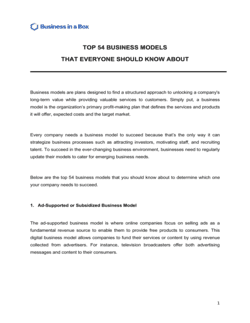
- The mechanism by which a business creates, delivers, and captures value — including what it sells, to whom, through which channels, and how it charges.
- Revenue Model
- The specific method a business uses to generate income — for example, one-time sales, subscriptions, licensing fees, commissions, or advertising.
- Start-Up Cost Tier
- A categorical estimate of the capital required to launch — typically expressed as low (under $5,000), medium ($5,000–$50,000), or high (over $50,000).
- Bootstrapping
- Launching and growing a business using personal savings or operating revenue, without external investment or loans.
- Scalability
- A business's capacity to increase revenue significantly without a proportional increase in costs or headcount.
- Service Business
- A business that sells expertise, labor, or access — such as consulting, cleaning, or tutoring — rather than a physical product.
- Product Business
- A business that manufactures, sources, or resells tangible goods, generating revenue through per-unit sales or wholesale pricing.
- Digital Business
- A business whose primary offering — software, content, courses, or marketplaces — is delivered electronically with near-zero marginal cost per unit.
- Franchise
- A licensed business model where the franchisee pays fees to operate under an established brand, system, and supply chain.
- Side Hustle
- A business operated part-time alongside primary employment, typically with low start-up costs and flexible hours.
- Niche Market
- A narrowly defined customer segment with specific needs that are underserved by mainstream offerings, often enabling premium pricing.
- Recurring Revenue
- Income that is predictably generated on a regular schedule — monthly or annually — through subscriptions, retainers, or service contracts.