Top 10 Sales Closing Techniques Template

Free to read β€’ Save or share with one click

FreeTop 10 Sales Closing Techniques Template

At a glance

What it is
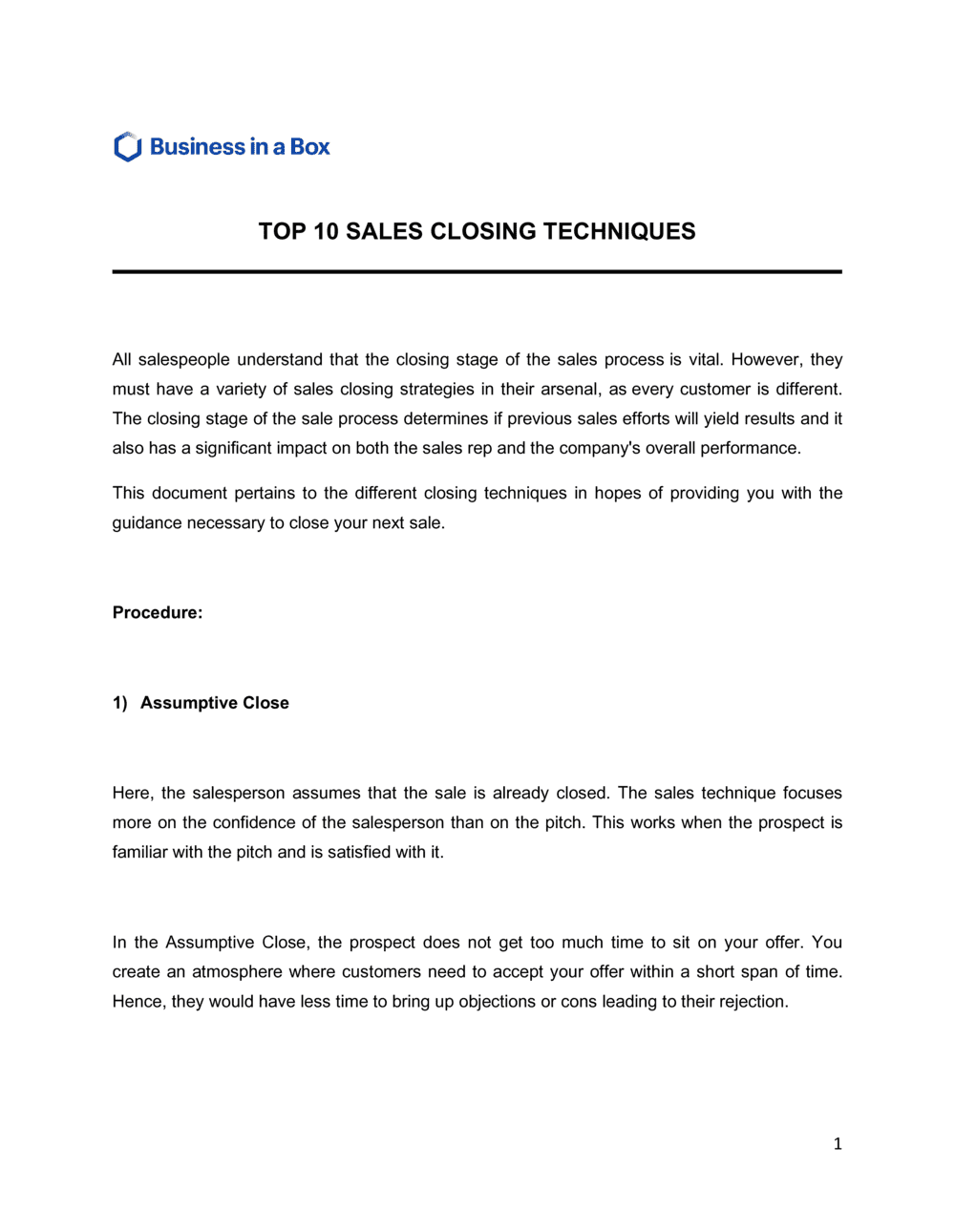
The Top 10 Sales Closing Techniques document is a structured reference and training guide that codifies the ten most effective methods sales professionals use to move a prospect to a signed commitment. This free Word download gives sales managers and reps a ready-to-use, editable framework they can adapt to their product, market, and buyer type, then export as PDF for onboarding or coaching sessions.
When you need it
Use it when onboarding new sales hires, standardizing closing language across a team, or refreshing an existing playbook after a dip in conversion rates. It is equally useful when entering a new market or launching a new product line that requires a tailored closing approach.
What's inside
Ten individually described closing techniques, each with a plain-English explanation, sample dialogue, the buyer situation it suits best, and common mistakes to avoid. The document also includes guidance on reading buyer signals, timing the close, and transitioning from discovery to commitment.

What is a Top 10 Sales Closing Techniques Document?

A Top 10 Sales Closing Techniques document is a structured sales training and reference guide that codifies the ten most effective methods professionals use to convert a qualified prospect into a confirmed buyer. Each technique is described with a plain-English explanation, the specific buyer situation and sales stage it suits best, sample dialogue with placeholders, and the most common mistake that causes the technique to fail. Unlike a generic sales manual, this document focuses exclusively on the closing stage β€” the final 20% of the sales conversation where deals are won or lost.

Why You Need This Document

Without a documented closing methodology, conversion rates vary wildly from rep to rep, and top performers take their techniques with them when they leave. Teams that rely on improvised closing language see higher deal stall rates, longer sales cycles, and inconsistent revenue forecasting. A standardized closing techniques guide levels the floor: it gives every rep access to the language that your best closers have refined through hundreds of real deals. It also creates a compliance baseline β€” ensuring that urgency claims, scarcity representations, and pricing guarantees used in the field are consistent, defensible, and aligned with consumer protection standards in your operating jurisdictions. This template gives you a ready-to-customize framework that takes hours to deploy rather than weeks, without starting from a blank page.

Which variant fits your situation?

If your situation is…Use this template
Training a new inside sales team on transactional closingSales Training Manual
Documenting a full end-to-end sales process including prospecting to closeSales Process Flowchart
Creating a structured script for phone-based closing callsSales Call Script
Standardizing objection handling before the closeObjection Handling Guide
Formalizing the agreed terms after a verbal closeSales Agreement
Tracking close rates and pipeline conversion by techniqueSales Pipeline Tracker
Onboarding a new enterprise account after closeClient Onboarding Checklist

Common mistakes to avoid

❌ Using one technique regardless of buyer type

Why it matters: An assumptive close applied to a risk-averse procurement buyer produces immediate resistance. Mismatching technique to buyer type is the single most common reason strong pitches end without a commitment.

Fix: Train reps to identify buyer type in the discovery phase and match the close to the buyer's decision-making style before entering the closing conversation.
❌ Attempting the close before objections are resolved

Why it matters: An unresolved objection acts as a mental veto. The prospect nods through the close and then surfaces the objection again post-meeting, resetting the entire cycle.

Fix: Use a trial close β€” 'Is there anything else you'd want to understand before making a decision?' β€” to surface and resolve all objections before attempting the final ask.

❌ Fabricating urgency or scarcity

Why it matters: Prospects who discover that a deadline or inventory constraint was invented lose trust permanently. In regulated industries, false urgency can constitute a deceptive trade practice under consumer protection law.

Fix: Only use urgency and scarcity closes when the condition is genuinely real and verifiable. If no real deadline exists, use a value-based close instead.

❌ Treating a soft yes as a signed commitment

Why it matters: Agreement in principle β€” 'yes, this looks good' β€” evaporates between the meeting and the follow-up. Verbal soft yeses have a high reversal rate, especially in committee buying situations.

Fix: Convert every soft yes into a next step with a calendar invite, a named decision-maker, and a defined agenda before ending the conversation.

❌ Ending a trial close without a defined follow-up date

Why it matters: A trial or pilot without a scheduled closing call becomes a free product evaluation. Prospects complete the trial and move on without making a decision.

Fix: Book the evaluation debrief and closing call on the same day the trial begins, not after it ends.

❌ Reading from the script verbatim on live calls

Why it matters: Scripted delivery sounds unnatural and erodes the trust a prospect needs to feel before committing. Buyers detect recitation and associate it with inexperience or inauthenticity.

Fix: Train reps to internalize the intent and structure of each technique so they can deliver it conversationally, adapting phrasing in real time while preserving the closing logic.

The 10 key clauses, explained

The Assumptive Close

In plain language: The salesperson moves forward as though the decision has been made, focusing conversation on logistics rather than the yes/no decision itself.

Sample language
Great β€” let me get the paperwork started. Should we ship to [BILLING ADDRESS] or a different location for [COMPANY NAME]?

Common mistake: Using the assumptive close before the prospect has shown any buying signals. Skipping past an unresolved objection with assumptive language destroys trust and kills the deal.

The Summary Close

In plain language: The salesperson lists every benefit and agreement point reached during the conversation, then asks for the decision while the value is freshest in the prospect's mind.

Sample language
So to recap β€” [COMPANY NAME] gets [BENEFIT 1], [BENEFIT 2], and [BENEFIT 3], all at [PRICE] with [TERMS]. Does that work for you?

Common mistake: Summarizing features rather than outcomes. Recapping specs the prospect already knows adds no momentum β€” summarize the results they told you they need.

The Urgency (Now or Never) Close

In plain language: The salesperson introduces a genuine, time-bound condition that makes acting now more advantageous than waiting.

Sample language
Our current pricing of [PRICE] is locked until [DATE]. After that, [PRODUCT/SERVICE] moves to [HIGHER PRICE]. I'd hate for you to miss the savings β€” can we confirm today?

Common mistake: Fabricating urgency. Invented deadlines that the prospect can verify are false permanently destroy credibility and often terminate the relationship entirely.

The Question Close

In plain language: The salesperson asks a direct question that invites the prospect to voice any remaining barrier, resolves it, and then naturally transitions to the commitment.

Sample language
Is there anything that would prevent you from moving forward with [PRODUCT/SERVICE] today?

Common mistake: Asking the question and then immediately talking over the silence. The prospect's pause after this question is where the deal is won or lost β€” wait for the answer.

The Sharp Angle Close

In plain language: When a prospect makes a conditional request, the salesperson agrees immediately on the condition that the prospect commits to buying right now.

Sample language
If I can get [REQUESTED CONCESSION β€” e.g., expedited delivery / additional seat / extended warranty] approved for you, are you ready to sign today?

Common mistake: Offering the concession before securing the commitment. Once the salesperson agrees without tying it to the close, the prospect pockets the concession and resets their negotiating position.

The Take-Away Close

In plain language: The salesperson implies the product or a specific benefit may not be available or may not be the right fit, triggering the prospect's natural aversion to missing out.

Sample language
Given what you've described about your timeline, I want to make sure [PRODUCT/SERVICE] is actually the right fit. Let me double-check whether [LIMITED INVENTORY / ONBOARDING SLOT] is still available for [COMPANY NAME].

Common mistake: Using the take-away close on a prospect who is already skeptical. It amplifies hesitation in a buyer who isn't yet convinced of value, accelerating their exit.

The Soft Close

In plain language: The salesperson asks a low-pressure question to confirm alignment before formally requesting the commitment, giving an agreeable prospect an easy path to yes.

Sample language
Based on what we've discussed, does [PRODUCT/SERVICE] seem like a solution that would work for [COMPANY NAME]?

Common mistake: Stopping at the soft close when the prospect says yes. A yes to 'does this seem like a good fit?' is not a purchase commitment β€” it must be followed immediately by a direct ask or next-step proposal.

The Ben Franklin Close

In plain language: The salesperson draws a two-column pros-and-cons list with the prospect to make the case for buying visually concrete and mathematically obvious.

Sample language
Let's do a quick pros-and-cons list together for [COMPANY NAME]. On the benefits side: [BENEFIT 1], [BENEFIT 2], [BENEFIT 3]. What concerns are still on the other side for you?

Common mistake: Letting the prospect populate the cons column without guiding the exercise. An unmanaged cons list will surface every objection at once and overwhelm the value narrative.

The Puppy Dog Close

In plain language: The salesperson offers a no-risk trial or pilot so the prospect can experience the product before committing, betting that usage converts to purchase.

Sample language
Why don't you try [PRODUCT/SERVICE] for [TRIAL PERIOD] at no obligation? Once [COMPANY NAME] sees [KEY OUTCOME], you can decide with full confidence.

Common mistake: Offering an open-ended trial with no agreed evaluation criteria and no scheduled follow-up. Without a defined success metric and a closing call date, trials expire without a decision.

The Summary + Next Step Close

In plain language: The salesperson closes the conversation by combining a benefit recap with a specific, concrete next step that moves the deal forward without requiring an immediate final signature.

Sample language
Here's what I'll do β€” I'll send the proposal covering [BENEFIT 1] and [BENEFIT 2] to [CONTACT NAME] by [DATE]. Can we schedule 30 minutes on [DAY] to review and confirm the details?

Common mistake: Proposing a vague next step like 'I'll follow up next week.' A close requires a calendar commitment with a specific date, time, and defined agenda β€” otherwise it is a delay, not a progression.

How to fill it out

  1. 1

    Identify your primary sales context

    Determine whether your team sells transactionally (short cycle, single decision-maker) or consultatively (long cycle, committee buy-in). This determines which of the ten techniques to lead with and which to use as backups.

    πŸ’‘ Document the average number of touchpoints before a deal closes in your current pipeline β€” that number tells you whether you need urgency-based or trust-based closes.

  2. 2

    Map each technique to a buyer type and stage

    Go through each of the ten techniques and annotate it with the specific buyer persona, sales stage, and objection type it addresses best. Not every technique works in every context.

    πŸ’‘ Color-code techniques by sales stage β€” early, mid, and late β€” so reps can reference the right method without reading the full document mid-call.

  3. 3

    Customize the sample language to your product and market

    Replace all [PLACEHOLDERS] with your actual product name, pricing, delivery terms, and value proposition. Generic scripts produce generic results β€” reps close better with language that matches their real conversations.

    πŸ’‘ Record two or three real closed deals and extract the exact language used at the closing moment. Use that as the basis for your customized sample dialogue.

  4. 4

    Add objection-resolution sequences before each close

    For each technique, document the one or two most common objections that arise just before the close and the specific language used to resolve them. A close attempted before objections are cleared almost always fails.

    πŸ’‘ Pair this document with a dedicated objection-handling reference so reps can access both in a single sales playbook.

  5. 5

    Define success metrics for each technique

    Assign a target close rate or pipeline-stage conversion rate to each technique so you can measure which methods perform best with your specific buyer base.

    πŸ’‘ Track technique usage in your CRM by tagging closed deals with the method used β€” 90 days of data will show you which two or three techniques to double down on.

  6. 6

    Conduct role-play sessions before field use

    Run structured role-plays where one rep plays the buyer and another executes the close. Use the sample language in the document verbatim first, then encourage natural adaptation.

    πŸ’‘ Record role-plays and review them as a team β€” reps self-correct significantly faster when they hear their own closing language played back.

  7. 7

    Review and update the document quarterly

    Sales language, buyer psychology, and market conditions shift. Set a quarterly calendar reminder to update sample dialogue, remove underperforming techniques, and add emerging approaches your top performers are using.

    πŸ’‘ Pull your top three closers into a 45-minute review session each quarter β€” they will surface language improvements no manager would find reviewing CRM notes alone.

Frequently asked questions

What are sales closing techniques?

Sales closing techniques are structured verbal and written approaches that salespeople use to guide a prospect from interest to a confirmed purchase commitment. Each technique is designed for a specific buyer type, sales stage, or objection pattern. Used correctly, they reduce deal stall, shorten sales cycles, and increase conversion rates without resorting to pressure tactics that damage the relationship.

Which sales closing technique works best?

No single technique works best across all contexts. The assumptive close performs well with decisive buyers in short-cycle transactional sales. The summary close works for committee buying situations where multiple stakeholders need to re-anchor on agreed value. The soft close suits risk-averse buyers who need a low-pressure path to yes. Top performers typically master three to four techniques and deploy them based on real-time reading of the buyer's decision style.

When is the right time to attempt a close?

The right time to close is after all material objections have been resolved and the prospect has demonstrated at least one clear buying signal β€” asking about implementation timelines, payment terms, or onboarding steps. Attempting a close before these conditions are met typically produces a delay rather than a decision and can damage rapport. A trial close question mid-conversation is a reliable way to test readiness before the final ask.

Is urgency-based closing ethical?

Urgency and scarcity closes are ethical when the condition is genuine and verifiable β€” a real price increase, a limited inventory count, or an expiring promotion. They become deceptive when the deadline or constraint is fabricated. In several jurisdictions, false urgency may constitute a misleading commercial practice under consumer protection or fair trading legislation. Always use time-based closes with a condition you can document and defend.

How do sales closing techniques differ for B2B versus B2C sales?

B2B sales typically involve multiple decision-makers, longer cycles, and formal procurement steps β€” making summary closes, question closes, and next-step closes more effective than high-pressure techniques. B2C sales often involve a single buyer making a faster, more emotionally driven decision, where assumptive, urgency, and puppy-dog closes perform better. The core principle β€” identify readiness, resolve objections, then ask β€” applies in both contexts.

What should a sales closing techniques document include?

A complete document should cover ten to fifteen techniques, each with a plain-English explanation, the buyer situation it suits best, sample dialogue with placeholders for product name and pricing, common mistakes to avoid, and guidance on how to transition from the pitch to the close. It should also include a section on reading buying signals and a brief overview of how to sequence techniques when the first attempt does not produce a commitment.

How often should a sales closing techniques guide be updated?

Quarterly updates are the practical standard for active sales teams. Buyer behavior, competitive messaging, and market conditions shift fast enough that language effective twelve months ago may feel dated today. A lightweight update process β€” pulling your top closers into a 45-minute review each quarter β€” is sufficient for most teams. A full rewrite is warranted when a major product change, new market entry, or significant shift in buyer profile occurs.

Can these techniques be used in written proposals and emails?

Yes. The summary close, soft close, and next-step close translate directly to written proposals and follow-up emails. The urgency close works well in email when the deadline is genuine and stated early in the message. The question close adapts naturally to a proposal sign-off line. Techniques that rely on real-time dialogue β€” the sharp angle close and the take-away close β€” are harder to execute in writing and are better reserved for calls and in-person meetings.

How this compares to alternatives

vs Sales Call Script

A sales call script covers the full arc of a call from introduction through discovery to pitch. A closing techniques document focuses exclusively on the final stage β€” moving a warmed prospect to commitment. Use the call script to structure the conversation and the closing techniques guide to execute the last 20% of it.

vs Sales Agreement

A sales agreement is the binding legal document that memorializes the terms of a closed deal. A closing techniques document is the pre-contract training tool that gets the prospect to agree to those terms in the first place. The closing techniques guide produces the verbal yes; the sales agreement converts that yes into an enforceable written commitment.

vs Sales Training Manual

A sales training manual covers the full sales methodology β€” prospecting, qualifying, discovery, pitching, objection handling, closing, and account management. A closing techniques document is a focused, single-stage reference covering only the close. Teams typically use both: the manual for onboarding and the closing guide as a quick-reference tool in active selling situations.

vs Objection Handling Guide

An objection handling guide addresses the stage immediately before the close β€” identifying, acknowledging, and resolving prospect concerns. A closing techniques document picks up where objection handling ends, providing the specific language to convert resolved objections into a commitment. Both documents belong in the same sales playbook and are most effective when used in sequence.

Industry-specific considerations

SaaS / Technology

Free-trial-based puppy-dog closes, next-step closes tied to technical evaluation milestones, and urgency closes aligned to contract renewal cycles.

Financial Services

Soft and question closes dominate due to regulatory requirements around pressure selling; compliance review of any urgency or scarcity language before field use is standard practice.

Real Estate

Assumptive and urgency closes aligned to listing deadlines and competing-offer timelines, with sharp angle closes used during offer negotiation.

Professional Services

Summary and next-step closes suit the consultative buying process; closing language is built around ROI and risk-reduction outcomes rather than product features.

Retail / E-commerce

Urgency and take-away closes aligned to flash sales and limited-stock events; puppy-dog closes executed via free-return and satisfaction-guarantee messaging.

Manufacturing and Wholesale

Sharp angle and Ben Franklin closes used in high-value capital equipment deals; summary closes deployed in multi-stakeholder purchasing committee presentations.

Jurisdictional notes

United States

The FTC Act prohibits unfair or deceptive acts in commerce, which includes fabricated urgency or false scarcity claims used in sales closing. Several states β€” including California, New York, and Florida β€” have additional consumer protection statutes that regulate high-pressure sales tactics, cooling-off periods for certain contract types, and telemarketing closing scripts. Sales language directed at consumers in these states should be reviewed for compliance with state-specific unfair business practices rules.

Canada

The Competition Act and provincial consumer protection legislation β€” including Ontario's Consumer Protection Act and Quebec's Consumer Protection Act β€” restrict misleading representations and high-pressure selling tactics. Quebec's language requirements mean any sales script distributed to Quebec-based reps or customers must be available in French. Cooling-off periods apply to direct sales and certain remote contracts, affecting how urgency closes can be legally deployed.

United Kingdom

The Consumer Protection from Unfair Trading Regulations 2008 prohibits aggressive and misleading commercial practices, including false urgency and scarcity claims. The FCA regulates sales scripts and closing language in financial services, insurance, and mortgage contexts, requiring scripts to be fair, clear, and not misleading. Sales teams operating in regulated sectors must have closing language reviewed and approved by their compliance function before field use.

European Union

The EU Unfair Commercial Practices Directive prohibits aggressive selling practices and misleading actions, including creating false impressions of limited availability or time pressure. GDPR considerations apply when closing techniques involve personalized data-driven urgency β€” for example, referencing a prospect's browsing or purchase history in a close. Member states including Germany and France have additional national-level regulations that restrict specific closing tactics in consumer-facing sales contexts.

Template vs lawyer β€” what fits your deal?

PathBest forCostTime
Use the templateSales managers and business owners building or refreshing an internal closing playbook without outside helpFree2–4 hours to customize and distribute
Template + legal reviewTeams whose closing language includes pricing guarantees, urgency claims, or scarcity representations communicated directly to customers$200–$500 for a compliance or legal review1–3 days
Custom draftedRegulated industries β€” financial services, insurance, healthcare β€” where sales scripts and closing language require formal compliance sign-off before field use$1,000–$3,000 for compliance counsel review and redline1–2 weeks

Glossary

Closing Technique
A specific verbal or written approach a salesperson uses to move a prospect from consideration to a firm purchase commitment.
Assumptive Close
A technique where the salesperson speaks and acts as if the prospect has already decided to buy, using language like 'When would you like delivery?'
Summary Close
A technique where the salesperson recaps all agreed benefits and value points immediately before asking for the decision, reinforcing why the deal makes sense.
Urgency Close
A technique that uses a genuine time-limited condition β€” a price increase, limited inventory, or expiring promotion β€” to prompt a decision before the deadline.
Trial Close
A low-stakes question used mid-conversation to gauge a prospect's readiness to buy without formally asking for the sale.
Objection
A stated concern or hesitation from the prospect that must be acknowledged and resolved before the close can succeed.
Buying Signal
A verbal or behavioral cue β€” asking about delivery timelines, payment terms, or onboarding steps β€” indicating the prospect is mentally moving toward a decision.
Value Proposition
The specific bundle of outcomes and benefits a product or service delivers to a defined customer, expressed in terms the buyer values.
Sharp Angle Close
A technique where the salesperson immediately agrees to a prospect's condition ('Can you do faster delivery?') on the condition that the prospect commits to buying.
Take-Away Close
A technique where the salesperson implies the product may not be the right fit or may not be available, triggering the prospect's desire not to miss out.
Soft Close
A low-pressure approach that asks for the sale in question form β€” 'Does this solution address what you're looking for?' β€” giving the prospect a comfortable path to yes.

Part of your Business Operating System

This document is one of 3,000+ business & legal templates included in Business in a Box.

  • Fill-in-the-blanks β€” ready in minutes
  • Compatible with all office suites
  • Export to PDF and share electronically

Create your document in 3 simple steps.

From template to signed document β€” all inside one Business Operating System.
1
Download or open template

Access over 3,000+ business and legal templates for any business task, project or initiative.

2
Edit and fill in the blanks with AI

Customize your ready-made business document template and save it in the cloud.

3
Save, Share, Send, Sign

Share your files and folders with your team. Create a space of seamless collaboration.

Save time, save money, and create top-quality documents.

β˜…β˜…β˜…β˜…β˜…

"Fantastic value! I'm not sure how I'd do without it. It's worth its weight in gold and paid back for itself many times."

Managing Director Β· Mall Farm
Robert Whalley
Managing Director, Mall Farm Proprietary Limited
β˜…β˜…β˜…β˜…β˜…

"I have been using Business in a Box for years. It has been the most useful source of templates I have encountered. I recommend it to anyone."

Business Owner Β· 4+ years
Dr Michael John Freestone
Business Owner
β˜…β˜…β˜…β˜…β˜…

"It has been a life saver so many times I have lost count. Business in a Box has saved me so much time and as you know, time is money."

Owner Β· Upstate Web
David G. Moore Jr.
Owner, Upstate Web

Run your business with a system β€” not scattered tools

Stop downloading documents. Start operating with clarity. Business in a Box gives you the Business Operating System used by over 250,000 companies worldwide to structure, run, and grow their business.

Start freeΒ Β·Β No credit card required