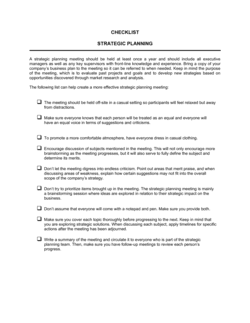
Strategic Planning Template

Free Word download β€’ Edit online β€’ Save & share with Drive β€’ Export to PDF

3 pagesβ€’45 min – 1h 5m to fillβ€’Difficulty: Expert
Learn more ↓
FreeStrategic Planning Template

At a glance

What it is
A Strategic Planning Template is a structured Word document that guides leadership teams through setting a multi-year direction for their organization β€” covering mission, vision, environmental analysis, strategic goals, initiatives, KPIs, and an execution roadmap. This free Word download gives you a complete, board-ready starting point you can edit online and export as PDF to share with executives, investors, or department heads.
When you need it
Use it at the start of a new fiscal year, when entering a new market, after a significant leadership change, or when the organization needs to realign around a shared set of priorities and measurable outcomes.
What's inside
Executive summary, mission and vision statements, core values, SWOT analysis, strategic goals and objectives, key initiatives with owners and timelines, KPIs and success metrics, resource allocation summary, and an implementation roadmap with quarterly milestones.

What is a Strategic Planning Template?

A Strategic Planning Template is a structured document that guides leadership teams through defining an organization's multi-year direction β€” covering mission and vision, environmental analysis, strategic goals, key initiatives, KPIs, resource allocation, and an implementation roadmap. Unlike an annual operating plan focused on near-term execution, a strategic plan typically spans three to five years and establishes the overarching framework that annual budgets, hiring decisions, and functional plans are built to serve. It translates broad organizational ambition into specific, accountable commitments with measurable outcomes.

Why You Need This Document

Without a written strategic plan, leadership teams make decisions in isolation β€” each department optimizes for its own priorities, and the organization drifts rather than advances. The absence of explicit goals and KPIs means no one can tell whether the business is on track until the financial results arrive, by which point it is too late to course-correct. Boards, investors, and funders consistently ask for strategic plans before committing capital or resources; presenting one signals organizational maturity and credible leadership. This template gives you a complete, battle-tested structure that eliminates the blank-page problem, forces the trade-off conversations that most planning processes avoid, and produces a document that can actually be executed β€” not filed and forgotten.

Which variant fits your situation?

If your situation is…Use this template
Setting a high-level 3–5 year organizational directionStrategic Planning Template
Rapid one-page goal alignment for a small team or startupOne-Page Business Plan
Detailed annual financial and operational targetsAnnual Business Plan
Analyzing internal strengths and external threats before strategy-settingSWOT Analysis
Translating strategy into quarterly department-level execution plansOperational Plan
Presenting the strategic narrative to investors or a board of directorsBusiness Plan
Tracking ongoing execution of strategic initiatives against targetsKPI Dashboard / Balanced Scorecard

Common mistakes to avoid

❌ Setting more than five strategic goals

Why it matters: Organizations with six or more strategic goals consistently underdeliver on all of them β€” execution bandwidth is finite, and prioritization collapses when everything is labeled a priority.

Fix: Force-rank all candidate goals, select the top three to five, and move the rest to a formally documented 'future consideration' list reviewed at the annual refresh.

❌ No named owner on each initiative

Why it matters: Initiatives assigned to a team, department, or committee lose accountability at the first cross-functional conflict β€” no individual feels responsible for unblocking the work.

Fix: Assign one named person β€” not a title, not a team β€” as the accountable owner for every initiative listed in the plan.

❌ Skipping the resource allocation section

Why it matters: A strategic plan without committed budget and headcount is a wish list β€” leaders at every level interpret unresourced goals as optional, and the initiatives quietly die.

Fix: Before finalizing the plan, attach a dollar amount and FTE count to every initiative. If the budget doesn't exist, either fund it or remove the initiative from the plan.

❌ Building the roadmap without accounting for organizational capacity

Why it matters: Front-loading initiatives into Q1 creates an immediate execution crunch, erodes confidence in the plan, and often results in the roadmap being abandoned by mid-year.

Fix: Map each initiative against the teams responsible for it and confirm that no team is carrying more than two major initiatives simultaneously in any given quarter.

❌ No defined review and governance cadence

Why it matters: Without scheduled checkpoints, the plan is completed, filed, and ignored β€” conditions change, but no one is responsible for updating the plan to reflect them.

Fix: Define at minimum a monthly KPI dashboard review and a quarterly leadership session before the planning meeting ends, and put both on the calendar immediately.

❌ Generic, unmeasured KPIs

Why it matters: KPIs like 'improve customer satisfaction' or 'grow the business' cannot be tracked, which means no one can tell whether the strategy is working until it is too late to adjust.

Fix: Every KPI must have a numeric baseline, a numeric target, a deadline, and a named owner β€” if any of these four elements are missing, the KPI is not ready to include in the plan.

The 10 key sections, explained

Executive Summary

Mission, Vision, and Core Values

Environmental Analysis (SWOT / PESTLE)

Strategic Goals and Objectives

Key Strategic Initiatives

KPIs and Success Metrics

Resource Allocation Plan

Risk Assessment and Mitigation

Implementation Roadmap

Review and Governance Cadence

How to fill it out

  1. 1

    Gather your leadership team and set the planning horizon

    Decide whether you are planning for 1, 3, or 5 years and confirm who has authority to set and approve strategic direction. Distribute the template in advance so attendees arrive with initial input.

    πŸ’‘ A 3-year horizon is the most practical for most organizations β€” long enough to pursue meaningful change, short enough for assumptions to remain credible.

  2. 2

    Confirm or rewrite the mission, vision, and values

    Review existing statements critically. If the mission no longer reflects what the organization actually does, rewrite it. Each value should have a one-sentence behavioral definition that staff can act on.

    πŸ’‘ Test your mission statement by asking three frontline employees to read it β€” if they can't connect it to their daily work, rewrite it.

  3. 3

    Complete the environmental analysis

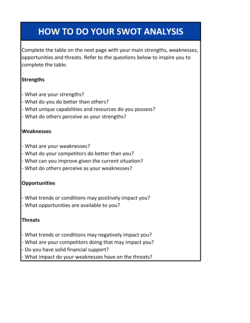
    Run a SWOT session with your leadership team. Populate at least two items per quadrant based on evidence β€” customer data, market research, or financial results β€” not opinion.

    πŸ’‘ Spend as much time on weaknesses and threats as on strengths and opportunities. The threats section is where most organizations under-invest.

  4. 4

    Define three to five strategic goals

    Each goal should be outcome-oriented and span the planning horizon. Write each goal as a complete sentence that names what will change, for whom, and by when.

    πŸ’‘ If you have more than five goals, force-rank them and move the lower ones to a 'watch list.' Trying to pursue six or more simultaneously is the most common reason strategic plans fail.

  5. 5

    Identify initiatives and assign owners

    For each strategic goal, list the two to four initiatives required to achieve it. Assign a single named owner β€” not a team or department β€” to each initiative, along with a budget estimate and end date.

    πŸ’‘ Name a person, not a role. 'The marketing team' cannot be held accountable; 'Sarah Chen, VP Marketing' can.

  6. 6

    Set KPIs with baselines and targets

    For each strategic goal, define one to three KPIs. Record the current baseline value, the target value, and the reporting frequency. Link each KPI to the initiative responsible for moving it.

    πŸ’‘ If you cannot find a baseline value, your first initiative should be to establish the measurement system β€” you cannot manage what you cannot measure.

  7. 7

    Allocate budget and headcount

    Assign a dollar amount and any required headcount to each initiative. Make trade-offs explicit: if two initiatives compete for the same resource, state which takes priority and why.

    πŸ’‘ Reserve 10–15% of the strategy budget as a contingency for opportunities or risks that emerge mid-year.

  8. 8

    Build the quarterly implementation roadmap and governance cadence

    Sequence initiatives across quarters based on dependencies and capacity. Define the monthly KPI review and quarterly leadership check-in cadence before the plan is finalized.

    πŸ’‘ Schedule the first quarterly review before you leave the planning session β€” a date on the calendar is the difference between a living plan and a shelf document.

Frequently asked questions

What is a strategic plan?

A strategic plan is a document that defines an organization's direction over a multi-year horizon β€” typically 1 to 5 years β€” by articulating its mission and vision, assessing its environment, setting specific goals, identifying the initiatives required to achieve them, and establishing the KPIs that will track progress. It functions as both a decision-making framework for leadership and a communication tool for staff, boards, and funders.

What should a strategic plan include?

A complete strategic plan covers ten areas: executive summary, mission and vision statements, core values, environmental analysis (SWOT or PESTLE), strategic goals and objectives, key initiatives with owners and budgets, KPIs and success metrics, resource allocation, risk assessment, and an implementation roadmap with a governance cadence. Plans that omit resource allocation or KPI baselines are rarely executed successfully.

How long should a strategic plan be?

For most organizations, 15 to 30 pages is the right range β€” enough to be substantive without becoming so long it is not read. A financial model, SWOT detail, or initiative backlog can go in an appendix. One-page summaries are useful for communicating direction to all staff, but they are not a substitute for the full plan used by leadership.

How often should a strategic plan be updated?

The full plan should be refreshed annually, typically 60 to 90 days before the new fiscal year begins. Quarterly leadership reviews should update the implementation roadmap and KPI targets based on actual results. If a major market shift, acquisition, or leadership change occurs mid-cycle, an unscheduled refresh is warranted rather than waiting for the annual cycle.

What is the difference between a strategic plan and a business plan?

A business plan is primarily an external document used to raise capital or secure financing β€” it includes market analysis, competitive positioning, and financial projections designed to persuade investors or lenders. A strategic plan is primarily internal, focused on how existing leadership will allocate resources and execute against multi-year goals. Growing companies typically need both: the business plan to attract capital and the strategic plan to deploy it.

How long does it take to write a strategic plan?

Most organizations spend 4 to 8 weeks on a complete strategic planning cycle, including pre-work (data gathering, environmental analysis), a leadership planning session (1 to 2 days), and drafting and review. Using a structured template cuts the drafting time significantly, leaving most of the effort in the facilitation and alignment work that genuinely requires human judgment.

Who should be involved in the strategic planning process?

At minimum, the CEO and direct reports should participate in setting strategic goals. For larger organizations, input from department heads, key customers, and board members strengthens the environmental analysis. The final plan should be approved by the board or governing body and communicated to all staff β€” not just the leadership team.

What makes a strategic plan fail?

The four most common failure modes are: too many goals (more than five), no named initiative owners, no committed budget attached to initiatives, and no scheduled review cadence. Any one of these predictably results in the plan being completed, presented once, and then ignored until the next annual planning cycle.

What is the difference between a strategic goal and a KPI?

A strategic goal is a broad outcome the organization commits to achieving over the planning horizon β€” for example, "expand into two new geographic markets by 2027." A KPI is a specific, measurable indicator that tracks progress toward that goal β€” for example, "number of active customers in new markets, target 200 by Q4 2027." Goals describe direction; KPIs measure movement.

How this compares to alternatives

vs Business Plan

A business plan is an external-facing capital document β€” it includes market sizing, competitive analysis, and financial projections designed to persuade investors or lenders. A strategic plan is internal, focused on how existing leadership allocates resources and executes against multi-year goals. Most growing organizations need both: the business plan attracts capital; the strategic plan deploys it.

vs Annual Business Plan

An annual business plan covers a single fiscal year with detailed operational targets, budgets, and departmental priorities. A strategic plan spans 3 to 5 years and sets the directional framework that annual plans are built to serve. The strategic plan answers 'where are we going?'; the annual plan answers 'what will we do this year to get there?'

vs SWOT Analysis

A SWOT analysis is a single-section diagnostic tool that feeds into a strategic plan β€” it identifies the inputs but does not produce goals, initiatives, or a roadmap. Use the SWOT analysis as a structured input exercise during the planning session, then embed the findings in the environmental analysis section of the full strategic plan.

vs Marketing Plan

A marketing plan translates strategic goals into specific customer acquisition, brand, and campaign tactics for a defined period. It is a functional execution plan that sits one level below the strategic plan. The strategic plan sets the goal (e.g., grow market share in segment X); the marketing plan defines the specific programs and budgets to achieve it.

Industry-specific considerations

Technology / SaaS

Product roadmap integration, ARR growth targets, churn reduction goals, and engineering headcount scaling tied directly to strategic initiatives.

Healthcare and nonprofits

Mission alignment with funding requirements, program outcome metrics for grant reporting, and multi-year workforce development goals.

Professional services

Utilization rate and revenue-per-employee targets, practice area expansion goals, and client concentration risk reduction as a strategic priority.

Retail and e-commerce

Omnichannel expansion roadmaps, customer lifetime value improvement goals, and inventory and supply chain resilience as strategic risk areas.

Manufacturing

Capacity utilization targets, automation and capex investment sequencing, and supplier diversification as a risk mitigation initiative.

Education

Enrollment and retention goals, accreditation milestone planning, and faculty and curriculum development tied to multi-year strategic priorities.

Template vs pro β€” what fits your needs?

PathBest forCostTime
Use the templateSmall businesses, startups, and nonprofits running their first formal planning cycleFree2–4 weeks (including facilitation and drafting)
Template + professional reviewMid-size organizations or leadership teams that want external facilitation for the planning session$1,500–$5,000 for a strategy facilitator or advisor3–6 weeks
Custom draftedLarge enterprises, board-governed organizations, or companies undergoing major transformation (merger, turnaround, market entry)$10,000–$50,000+ for a full strategy consulting engagement6–16 weeks

Glossary

Mission Statement
A concise declaration of what an organization does, for whom, and to what end β€” its present-tense reason for existing.
Vision Statement
A forward-looking description of what the organization aspires to achieve or become within a defined time horizon.
SWOT Analysis
A structured framework assessing internal Strengths and Weaknesses alongside external Opportunities and Threats.
Strategic Goal
A broad, high-priority outcome the organization commits to achieving over the planning horizon, typically 1–5 years.
KPI (Key Performance Indicator)
A measurable value that tracks progress toward a specific strategic goal, with a defined target and reporting cadence.
Strategic Initiative
A specific project or program designed to advance one or more strategic goals, with a named owner, budget, and timeline.
PESTLE Analysis
An external environmental scan covering Political, Economic, Social, Technological, Legal, and Environmental factors affecting the organization.
OKR (Objectives and Key Results)
A goal-setting framework pairing a qualitative objective with two to five quantitative key results that define what success looks like.
Balanced Scorecard
A performance management framework that tracks strategy execution across four perspectives: financial, customer, internal processes, and learning and growth.
Resource Allocation
The deliberate assignment of budget, headcount, and time to specific strategic initiatives based on their priority and expected return.
Implementation Roadmap
A timeline β€” typically quarterly β€” that sequences strategic initiatives, assigns accountability, and sets milestone checkpoints.

Part of your Business Operating System

This document is one of 3,000+ business & legal templates included in Business in a Box.

  • Fill-in-the-blanks β€” ready in minutes
  • 100% customizable Word document
  • Compatible with all office suites
  • Export to PDF and share electronically

Create your document in 3 simple steps.

From template to signed document β€” all inside one Business Operating System.
1
Download or open template

Access over 3,000+ business and legal templates for any business task, project or initiative.

2
Edit and fill in the blanks with AI

Customize your ready-made business document template and save it in the cloud.

3
Save, Share, Send, Sign

Share your files and folders with your team. Create a space of seamless collaboration.

Save time, save money, and create top-quality documents.

β˜…β˜…β˜…β˜…β˜…

"Fantastic value! I'm not sure how I'd do without it. It's worth its weight in gold and paid back for itself many times."

Managing Director Β· Mall Farm
Robert Whalley
Managing Director, Mall Farm Proprietary Limited
β˜…β˜…β˜…β˜…β˜…

"I have been using Business in a Box for years. It has been the most useful source of templates I have encountered. I recommend it to anyone."

Business Owner Β· 4+ years
Dr Michael John Freestone
Business Owner
β˜…β˜…β˜…β˜…β˜…

"It has been a life saver so many times I have lost count. Business in a Box has saved me so much time and as you know, time is money."

Owner Β· Upstate Web
David G. Moore Jr.
Owner, Upstate Web

Run your business with a system β€” not scattered tools

Stop downloading documents. Start operating with clarity. Business in a Box gives you the Business Operating System used by over 250,000 companies worldwide to structure, run, and grow their business.

Free Forever PlanΒ Β·Β No credit card required