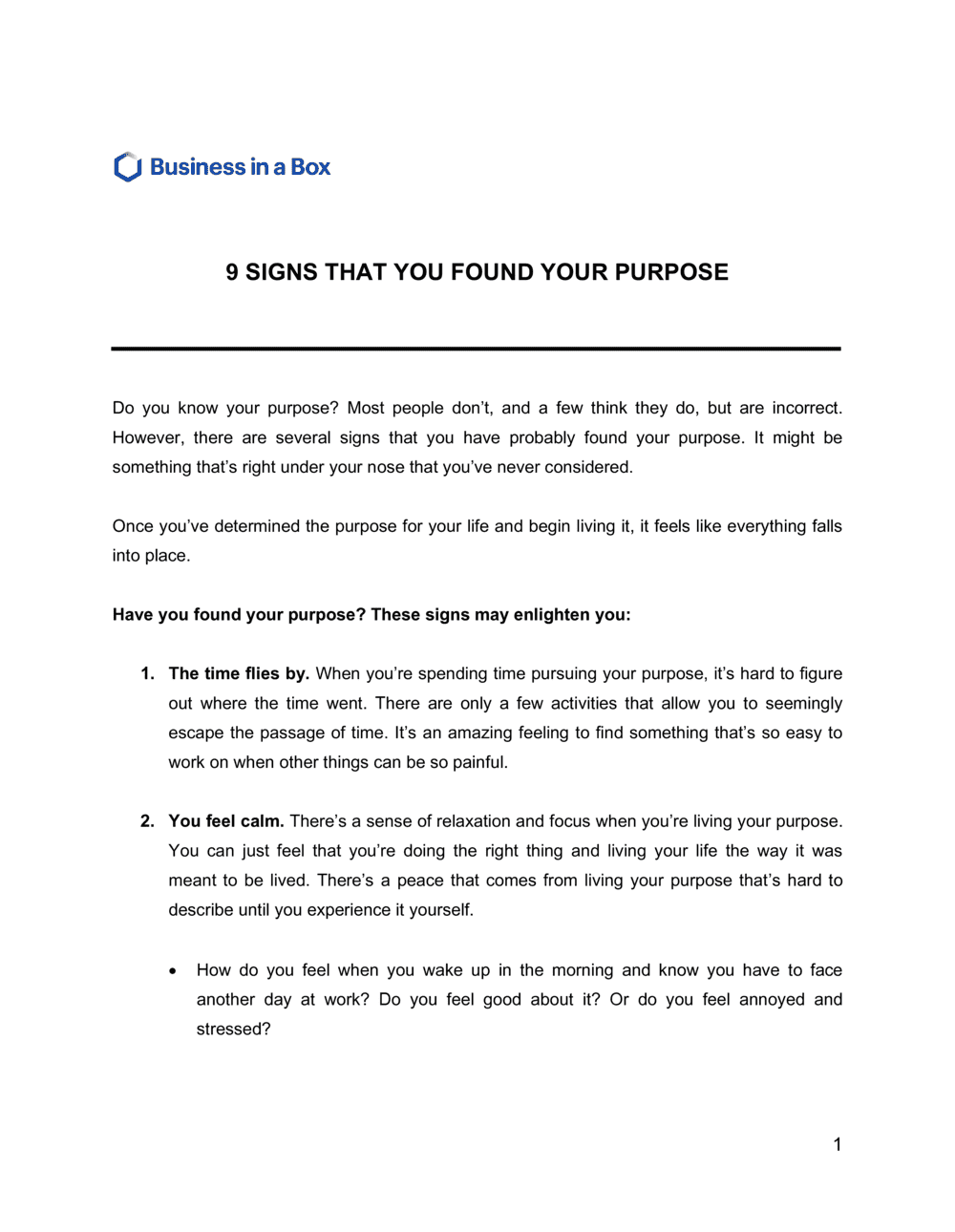
9 Signs That You Found Your Purpose Template

Free download β€’ Use as a template β€’ Print or share

3 pagesβ€’20–30 min to useβ€’Difficulty: Standard
Learn more ↓
Free9 Signs That You Found Your Purpose Template

At a glance

What it is
The 9 Signs That You Found Your Purpose is a structured self-assessment and reflection document that guides professionals, founders, and leaders through nine validated indicators of purpose alignment. This free Word download lets you work through each sign systematically, document your responses, and export a completed record as PDF to share with a coach, mentor, or leadership team.
When you need it
Use it during a career transition, a business pivot, an annual strategic review, or any moment when you need to confirm that your work is genuinely aligned with your deeper motivations β€” or to identify where it is not.
What's inside
Nine evidence-based assessment sections covering energy, flow, impact, values alignment, resilience, authentic voice, contribution, intrinsic motivation, and a consolidated purpose statement β€” each with reflection prompts and a scoring rubric.

What is the 9 Signs That You Found Your Purpose Template?

The 9 Signs That You Found Your Purpose is a structured self-assessment document that guides professionals, founders, and leaders through nine evidence-based indicators of purpose alignment. Rather than offering abstract advice, it asks you to produce written evidence from your recent work experience across nine measurable dimensions β€” flow, energy, impact, values alignment, resilience, authentic voice, intrinsic motivation, contribution, and a synthesized purpose statement. Each section combines a reflection prompt with a 1–5 rating scale, producing a scored summary that reveals where your work is genuinely purposeful and where the gaps are. The document is available as a free Word download you can complete online and export as PDF.

Why You Need This Document

Without a written, evidence-based purpose assessment, purpose conversations stay in the abstract β€” inspiring but not actionable. Professionals who skip this kind of structured reflection often discover the misalignment only after making an expensive career move or a costly strategic pivot. The consequences are concrete: sustained values misalignment is a documented driver of professional burnout, reduced decision quality, and disengagement. Founders who build businesses around unclear purpose tend to abandon them when the work gets hard, because there is no deeper reason to continue. This template converts a fundamentally subjective question β€” "Am I doing work that matters to me?" β€” into a documented, reviewable, and improvable answer. It creates the written record you need for a productive coaching conversation, a career planning session, or a leadership development review, and it identifies your two to three highest-leverage development priorities in a single 90-minute session.

Which variant fits your situation?

If your situation is…Use this template
Assessing purpose alignment as a one-time deep-dive exercise9 Signs That You Found Your Purpose
Writing a formal one-sentence mission or purpose statementPersonal Mission Statement Template
Mapping strengths and values to career optionsSWOT Analysis (Personal)
Setting annual personal and professional goals around your purposePersonal Development Plan
Translating individual purpose into an organizational missionStrategic Planning Template
Aligning a team around shared purpose in a workshop settingTeam Charter Template
Building a purpose-driven business from scratchBusiness Plan Template

Common mistakes to avoid

❌ Completing the assessment in fragments over several weeks

Why it matters: Your frame of reference shifts between sessions β€” a difficult week lowers scores for energy and resilience that a good week inflates. Fragmented completion produces inconsistent data.

Fix: Block 60–90 uninterrupted minutes for a single sitting and complete all nine sections in sequence before reviewing or adjusting any score.

❌ Scoring what you aspire to rather than your current reality

Why it matters: Aspirational scoring produces a high total that misrepresents where you actually are β€” the summary then points to no meaningful development priorities.

Fix: Before scoring each sign, ask yourself: 'Can I show evidence from the past 90 days?' If you cannot, the score should not exceed 3.

❌ Skipping the written evidence fields and only entering scores

Why it matters: Without written evidence, the scoring is purely intuitive and cannot be reviewed, challenged, or improved in a coaching conversation.

Fix: Treat the written response as mandatory. If you cannot write two sentences of evidence for a sign, that is diagnostic information β€” do not skip past it.

❌ Leaving the purpose statement and next-steps section incomplete

Why it matters: Without a drafted purpose statement and committed next action, the assessment is a diagnostic with no prescription β€” reflection without direction.

Fix: Even an imperfect purpose statement is more useful than none. Write a rough draft, mark it 'version 1,' and commit to refining it within 30 days based on feedback.

❌ Using the document in isolation without an external review

Why it matters: Self-assessment is systematically biased β€” people consistently over-score their strengths and under-recognize blind spots without external input.

Fix: Share the completed document with a coach, mentor, or peer who will give honest calibration on your scores and purpose statement β€” not just encouragement.

❌ Conflating busyness and productivity with purpose

Why it matters: A packed calendar and strong output metrics can coexist with deep purpose misalignment β€” productivity is not a sign of purpose.

Fix: In the energy and flow sections specifically, distinguish between being efficient at tasks and finding those tasks genuinely meaningful.

The 10 key sections, explained

Introduction and instructions

Sign 1 β€” You lose track of time

Sign 2 β€” Your work energizes rather than drains you

Sign 3 β€” You feel a sense of impact

Sign 4 β€” Your work reflects your values

Sign 5 β€” Setbacks don't stop you

Sign 6 β€” You speak about your work with genuine enthusiasm

Sign 7 β€” You seek to grow within your domain

Sign 8 β€” You feel you are contributing to something larger than yourself

Purpose summary and next steps

How to fill it out

  1. 1

    Read the introduction and calibrate the rubric

    Before scoring any sign, read the instructions section fully and understand what a 1, 3, and 5 mean on the rating scale. The rubric anchors your scores so they are comparable across all nine sections.

    πŸ’‘ Complete the assessment in a single 60–90 minute session rather than across multiple days β€” context switching shifts your frame of reference and skews consistency.

  2. 2

    Complete each sign with written evidence, not just a score

    For every sign, write at least two to three sentences of supporting evidence before assigning a rating. The written response is the actual data; the number summarizes it.

    πŸ’‘ Set a two-minute timer per sign to prevent over-editing β€” your first unfiltered response is almost always the most accurate.

  3. 3

    Rate yourself on the 1–5 scale for each sign

    After writing your evidence, assign a score from 1 (not present in my work) to 5 (consistently and clearly present). Be specific β€” a 3 means you can demonstrate the sign sometimes but not reliably.

    πŸ’‘ If you are uncertain between two scores, choose the lower one. Over-scoring yourself produces a falsely optimistic summary that leads to weak next steps.

  4. 4

    Complete the impact and values sections with named specifics

    For Sign 3 (impact) and Sign 4 (values), name actual people, decisions, or events from the past 90 days. Abstraction in these two sections is the most common accuracy problem.

    πŸ’‘ Pull your calendar or journal from the past month before completing these sections β€” concrete recent events produce far better responses than memory alone.

  5. 5

    Write the purpose summary and draft your purpose statement

    Add up your eight sign scores, note the total, then draft a one-sentence purpose statement using the 'I [verb] [who] so that [impact]' framework. This is the deliverable the whole document builds toward.

    πŸ’‘ Your purpose statement should feel slightly uncomfortable to write β€” if it comes instantly and easily, you may be defaulting to a polished version rather than an honest one.

  6. 6

    Identify your lowest-scoring signs as priorities

    Highlight the two to three sections with the lowest scores. These are not failure indicators β€” they are the areas where deliberate development will most increase your overall purpose alignment.

    πŸ’‘ Pair each low-scoring sign with one specific, time-bound action β€” 'Schedule a conversation with [PERSON] about [TOPIC] by [DATE]' β€” rather than a vague intention.

  7. 7

    Share the completed document with a coach, mentor, or trusted colleague

    Export the completed assessment as a PDF and share it with at least one person who knows your work well. External perspective on your scores and purpose statement significantly improves accuracy.

    πŸ’‘ Ask your reviewer to challenge any score they find surprising rather than just affirm your self-assessment β€” confirmation is less useful than calibration.

Frequently asked questions

What is the 9 Signs That You Found Your Purpose template?

It is a structured Word document that guides you through nine evidence-based indicators of purpose alignment β€” from flow state and energy levels to values congruence and contribution. Each sign includes reflection prompts and a 1–5 rating scale. The document concludes with a consolidated purpose statement and a prioritized list of development actions based on your lowest scores.

Who should use this template?

Anyone at a professional crossroads will benefit: founders evaluating a new venture, mid-career professionals considering a pivot, coaches facilitating client sessions, HR professionals building leadership development programs, and senior leaders who feel disconnected from the work they are doing. The template is equally useful for individuals and for facilitated group workshops.

How long does it take to complete the assessment?

Most users complete the full document in 60–90 minutes when done in a single sitting. The written evidence sections account for most of that time β€” the scoring itself takes only a few minutes. Rushing the written responses is the most common way to reduce the quality of the output.

What is a purpose statement and how do I write one?

A purpose statement is a single sentence that captures who you serve, what you do for them, and the specific impact you intend to create. A useful framework is "I [verb] [who] so that [impact]" β€” for example, "I help first- generation entrepreneurs build sustainable businesses so that economic opportunity is not limited by starting point." The statement should be specific enough to guide decisions and narrow enough to exclude things that are not your purpose.

Is purpose the same as passion?

No. Passion is an emotional state β€” intense enthusiasm for an activity. Purpose is a directional commitment to a specific impact that persists even when the work is difficult or unglamorous. Passion is unreliable as a career compass because it fluctuates; purpose is more durable because it is grounded in values and contribution rather than enjoyment alone. This template measures purpose, not passion.

Can this template be used in a team or organizational context?

Yes. HR and L&D professionals use it in leadership development cohorts and onboarding programs. The individual assessments can be completed privately and then discussed in a facilitated workshop where participants share selected findings and identify where personal purpose intersects with team or organizational mission. A shared team session typically runs 2–3 hours.

How is this template different from a personal SWOT analysis?

A personal SWOT analysis maps strengths, weaknesses, opportunities, and threats in a general strategic context. This template focuses exclusively on purpose alignment through nine specific behavioral and experiential indicators. A SWOT tells you what you are good at; this tells you whether what you are doing is actually meaningful to you. The two documents are complementary and often used together during career or business planning.

How often should I revisit this document?

An annual review aligned to your personal or business planning cycle is the minimum. Many users revisit it at transition points β€” before a new role, after a significant setback, or when considering a major strategic shift. A year-over- year comparison of scores also reveals whether you are moving toward greater purpose alignment or drifting away from it.

What if my score is low across most signs?

A low total score is not a judgment β€” it is diagnostic information. It means your current work situation does not yet reflect your purpose, which is common and correctable. The lowest-scoring signs point directly to the changes most worth making. Many users find that identifying the specific gaps is more valuable than a high score, because it makes the path forward concrete.

How this compares to alternatives

vs Personal SWOT Analysis

A personal SWOT maps strengths, weaknesses, opportunities, and threats to support strategic decisions. This template focuses specifically on purpose alignment through nine behavioral indicators. The SWOT tells you what you are capable of; this template tells you whether what you are doing is genuinely meaningful. The two documents are most powerful when used together at a career or business transition point.

vs Personal Development Plan

A personal development plan documents learning goals, skill gaps, and action steps for the next 6–12 months. This template is the upstream diagnostic that informs what a development plan should prioritize. Without clarity on purpose, a development plan risks building skills in directions that don't serve long-term alignment. Complete this assessment first, then build the development plan around the gaps it reveals.

vs Strategic Planning Template

A strategic plan defines organizational goals, initiatives, and resource allocation for a business or team. This template operates at the individual level β€” establishing the personal purpose that a leader brings to organizational strategy. Leaders who have completed this assessment tend to write more authentic strategic plans because the organizational mission is grounded in their own clearly articulated purpose.

vs Employee Performance Review

A performance review evaluates outputs against role-defined objectives set by the organization. This template evaluates internal alignment β€” whether the individual's values, energy, and contributions match their own sense of purpose, not just their manager's expectations. The two serve different functions: performance reviews assess what you delivered; this template assesses whether the work itself is meaningful to you.

Industry-specific considerations

Professional Services

Consultants and advisors use this template during annual reviews to confirm client work remains aligned with their professional identity and to prevent burnout from values-misaligned engagements.

Education

Career counselors embed this template in student development programs to help undergraduates and graduate students articulate purpose before entering the job market.

Healthcare

Clinicians and healthcare administrators use it to reconnect with clinical mission after periods of administrative overload β€” a recognized factor in reducing occupational burnout.

Technology / SaaS

Startup founders and product leaders use the template to validate that a new product direction is grounded in the founder's genuine purpose, not just market opportunity.

Template vs pro β€” what fits your needs?

PathBest forCostTime
Use the templateIndividuals completing a self-directed purpose assessment without a coachFree60–90 minutes
Template + professional reviewProfessionals using the output in a coaching engagement or leadership development program$150–$500 for a single coaching session to debrief resultsHalf a day including the session
Custom draftedOrganizations embedding a customized purpose-alignment assessment into a formal L&D or onboarding curriculum$1,000–$5,000 for a facilitation design and custom instrument2–4 weeks

Glossary

Purpose
A clearly articulated reason for doing your work that goes beyond financial reward β€” rooted in values, impact, and identity.
Flow State
A condition of deep concentration and effortless engagement in a task, identified by psychologist Mihaly Csikszentmihalyi, in which time passes unnoticed and performance peaks.
Intrinsic Motivation
Motivation that comes from within β€” curiosity, meaning, mastery, or contribution β€” rather than from external rewards like pay or recognition.
Values Alignment
The degree to which your daily work activities match the personal values you consider non-negotiable β€” integrity, creativity, service, or autonomy, for example.
Ikigai
A Japanese concept meaning 'reason for being' β€” the intersection of what you love, what you are good at, what the world needs, and what you can be paid for.
Purpose Statement
A single, written sentence that captures who you serve, what you do, and the specific impact you intend to create.
Resilience
The capacity to recover from setbacks, sustain effort through difficulty, and maintain motivation in the face of obstacles β€” a reliable indicator of purpose alignment.
Contribution
The specific, observable value you create for other people β€” the tangible difference your work makes in their lives, organizations, or communities.
Authentic Voice
The consistent, unfiltered perspective you bring to your work that reflects your genuine beliefs and experience rather than what you think others want to hear.
Engagement
The level of psychological investment in your work β€” characterized by attention, enthusiasm, and a sense that the work matters.

Part of your Business Operating System

This document is one of 3,000+ business & legal templates included in Business in a Box.

  • Fill-in-the-blanks β€” ready in minutes
  • 100% customizable Word document
  • Compatible with all office suites
  • Export to PDF and share electronically

Create your document in 3 simple steps.

From template to signed document β€” all inside one Business Operating System.
1
Download or open template

Access over 3,000+ business and legal templates for any business task, project or initiative.

2
Edit and fill in the blanks with AI

Customize your ready-made business document template and save it in the cloud.

3
Save, Share, Send, Sign

Share your files and folders with your team. Create a space of seamless collaboration.

Save time, save money, and create top-quality documents.

β˜…β˜…β˜…β˜…β˜…

"Fantastic value! I'm not sure how I'd do without it. It's worth its weight in gold and paid back for itself many times."

Managing Director Β· Mall Farm
Robert Whalley
Managing Director, Mall Farm Proprietary Limited
β˜…β˜…β˜…β˜…β˜…

"I have been using Business in a Box for years. It has been the most useful source of templates I have encountered. I recommend it to anyone."

Business Owner Β· 4+ years
Dr Michael John Freestone
Business Owner
β˜…β˜…β˜…β˜…β˜…

"It has been a life saver so many times I have lost count. Business in a Box has saved me so much time and as you know, time is money."

Owner Β· Upstate Web
David G. Moore Jr.
Owner, Upstate Web

Run your business with a system β€” not scattered tools

Stop downloading documents. Start operating with clarity. Business in a Box gives you the Business Operating System used by over 250,000 companies worldwide to structure, run, and grow their business.

Free Forever PlanΒ Β·Β No credit card required