Thank You for Your Confidence, Service Business Template

Free Word download β€’ Edit online β€’ Save & share with Drive β€’ Export to PDF

1 pageβ€’20–25 min to fillβ€’Difficulty: Standardβ€’Signature requiredβ€’Legal review recommended
Learn more ↓
FreeThank You for Your Confidence, Service Business Template

At a glance

What it is
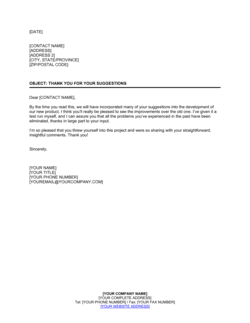
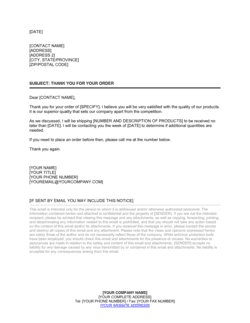
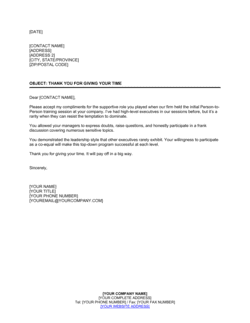
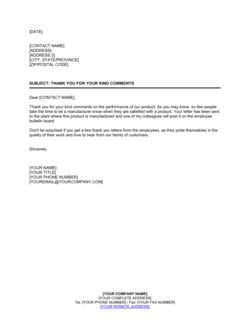
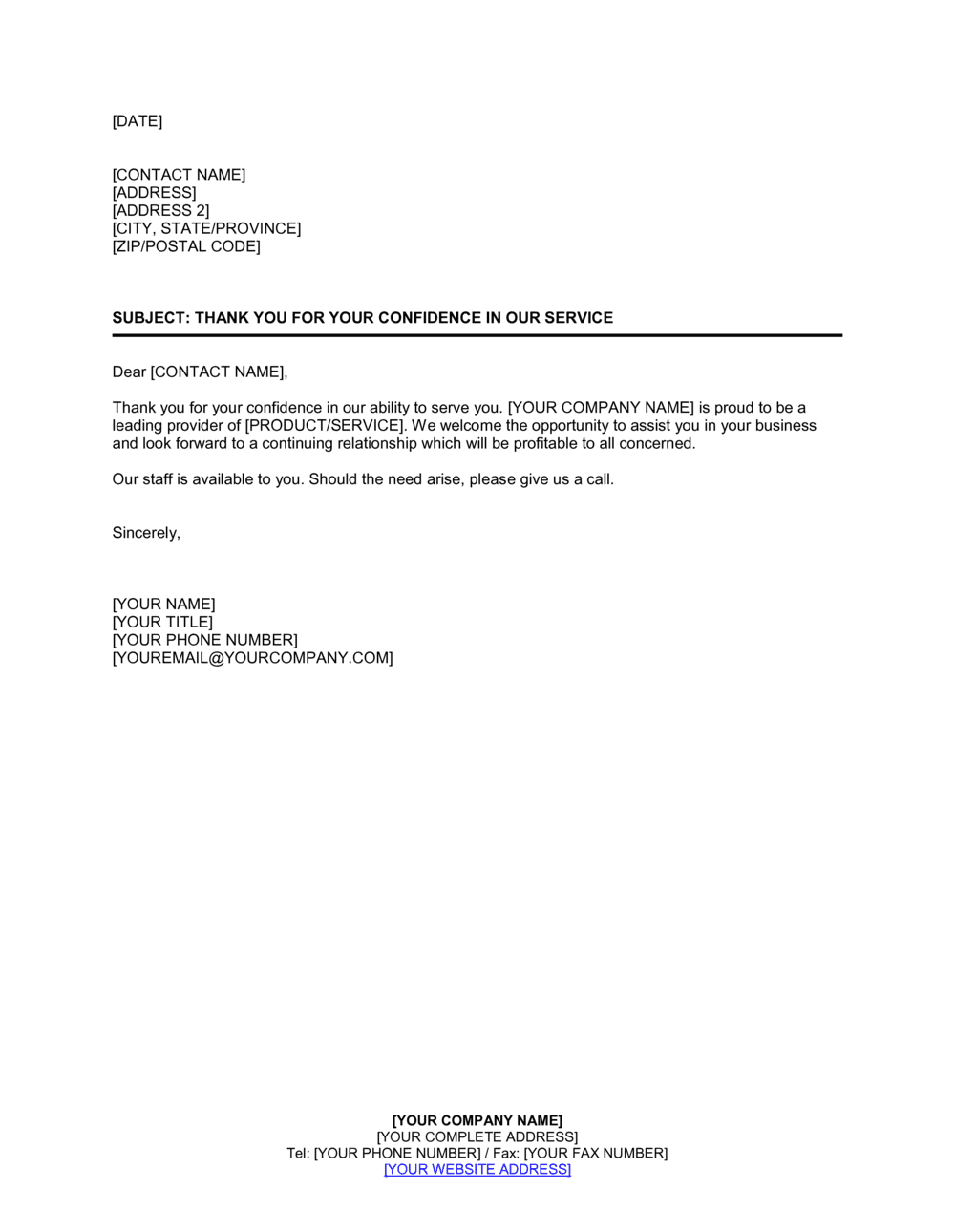
A Thank You For Your Confidence letter is a formal written communication a service business sends to a client after they have selected the firm for an engagement, signed a contract, or renewed a service agreement. This free Word download lets you customize the tone, confirm engagement terms, and create a signed record of the client's commitment β€” all in a single professional document you can edit online and export as PDF.
When you need it
Use it immediately after a client signs a service agreement, awards you a contract, or renews an existing engagement. It is especially valuable when the relationship involves ongoing retainers, high-value projects, or situations where written confirmation of scope and mutual expectations prevents future disputes.
What's inside
A personalized acknowledgment of the client's decision, a restatement of the agreed service scope and key commercial terms, a confirmation of next steps and points of contact, and a signature block that creates a documented record of both parties' acknowledgment of the engagement.

What is a Thank You For Your Confidence Letter for a Service Business?

A Thank You For Your Confidence Letter is a formal, signed business communication a service provider sends to a client immediately after the client has selected the firm, executed a service agreement, or renewed an ongoing engagement. It does more than express appreciation β€” it restates the agreed scope of services, confirms fee and billing terms, identifies the designated contacts at each organization, and outlines the immediate next steps required to begin the engagement. When signed by both parties, it creates a written record of mutual acknowledgment that sits alongside the underlying contract and can be referenced if scope, billing, or expectation disputes arise later in the relationship.

Why You Need This Document

The moment a client signs a service agreement is the moment their expectations are highest and the details are freshest β€” but it is also the moment most service businesses send a congratulatory email and move on. Without a formal signed acknowledgment, the precise scope, billing terms, and points of contact confirmed in that original conversation exist only in the contract itself, which most clients do not re-read until something goes wrong. A thank you for your confidence letter fills that gap: it gives the client a concise, personalized restatement of what they agreed to, who they will be working with, and what happens next β€” and it asks them to sign it, creating a documented moment of shared understanding. Service businesses that use this letter consistently report fewer scope disputes, faster onboarding, and stronger client relationships from day one. This template gives you a professionally structured, legally considered starting point you can customize in minutes and deploy for every new or renewed engagement.

Which variant fits your situation?

If your situation is…Use this template
Client has just signed a new multi-year service retainerThank You For Your Confidence Service Business
Client has renewed an expiring annual service agreementContract Renewal Letter
Client has accepted a formal project proposalProposal Acceptance Confirmation Letter
Client relationship has concluded and you want to preserve goodwillThank You For Your Business Letter
New client requires a formal welcome package with onboarding detailsClient Welcome Letter
You want to thank a client who referred new business to youThank You For Referral Letter
Client has approved a change order or scope expansion mid-engagementChange Order Confirmation Letter

Common mistakes to avoid

❌ Sending the letter unsigned as a courtesy note

Why it matters: An unsigned thank-you letter is a courtesy gesture, not a legal document. Without signatures, it cannot serve as evidence of mutual acknowledgment if a scope or billing dispute arises later.

Fix: Always request a countersignature and date from the client before the engagement begins. Treat this letter as a binding acknowledgment, not a formality.

❌ Restating scope in looser language than the signed contract

Why it matters: If the thank-you letter describes the scope more narrowly or broadly than the underlying agreement, a client can use the letter to argue for a different interpretation of what was contracted.

Fix: Copy the exact scope language from the service agreement into the relevant clause, or reference the agreement directly rather than paraphrasing.

❌ Omitting the governing law reference

Why it matters: Without a governing law clause, the letter floats as an independent document with no stated legal framework β€” which creates ambiguity if it is ever introduced in a dispute.

Fix: Include a one-sentence governing law reference that matches the jurisdiction named in the underlying service agreement.

❌ Using the same generic letter for every client regardless of engagement type

Why it matters: A retainer client and a one-time project client have entirely different expectations β€” a letter that treats them identically signals that the firm has not actually read its own contract.

Fix: Create two or three base variants of the template β€” one for retainers, one for fixed-scope projects, one for renewals β€” and customize the scope and billing clause for each engagement.

The 9 key clauses, explained

Opening acknowledgment of client confidence

In plain language: Formally thanks the client for selecting the firm and acknowledges the trust placed in the service provider.

Sample language
On behalf of [FIRM NAME], I want to sincerely thank you for placing your confidence in us. We are honored by the trust [CLIENT COMPANY NAME] has extended to our team and are committed to delivering the results we have discussed.

Common mistake: Using a generic, impersonal opening that reads as a form letter β€” clients notice this and it undermines the goodwill the letter is meant to create.

Restatement of engagement scope

In plain language: Summarizes the agreed services, deliverables, and timelines so both parties have a written reference point from day one.

Sample language
As confirmed in our [SERVICE AGREEMENT / PROPOSAL] dated [DATE], [FIRM NAME] will provide [DESCRIPTION OF SERVICES] commencing [START DATE] and concluding [END DATE / on an ongoing basis].

Common mistake: Restating scope in vague terms rather than mirroring the language in the signed agreement β€” vague restatements can inadvertently narrow or expand the contracted scope.

Fee and billing confirmation

In plain language: Restates the agreed fees, payment schedule, and invoice cycle to avoid ambiguity about financial obligations.

Sample language
Services will be rendered at the agreed rate of [FEE AMOUNT] per [month / project / hour], invoiced [monthly on the 1st / upon milestone completion], with payment due [NET 30] from the invoice date.

Common mistake: Omitting the billing cycle or payment terms, which forces the client to refer back to the original contract for basic financial information and increases the risk of late payment.

Points of contact and communication protocol

In plain language: Identifies the designated contact person at each party and establishes the preferred method and frequency of communication during the engagement.

Sample language
Your primary point of contact will be [CONTACT NAME], [TITLE], reachable at [EMAIL] and [PHONE]. Please direct all project-related communications to [CONTACT NAME]. We will schedule [weekly / bi-weekly] check-ins starting [DATE].

Common mistake: Failing to name a specific individual β€” leaving only a team email address creates accountability gaps and slows response times when issues arise.

Next steps and onboarding timeline

In plain language: Outlines the immediate actions the service provider and client each need to take to start the engagement smoothly.

Sample language
To commence services, we ask that you complete the following by [DATE]: (1) provide access to [SYSTEM / RESOURCE], (2) complete the attached [INTAKE FORM / BRIEF], and (3) confirm your billing contact for invoice delivery.

Common mistake: Listing next steps without assigning responsibility or deadlines, which leaves the onboarding process open-ended and delays the start of billable work.

Confidentiality acknowledgment

In plain language: Reminds both parties that information shared during the engagement is confidential and subject to any non-disclosure obligations already in place.

Sample language
All information shared by [CLIENT COMPANY NAME] in connection with this engagement will be treated as confidential in accordance with the terms of our [Non-Disclosure Agreement dated [DATE] / standard confidentiality policy].

Common mistake: Referencing a confidentiality obligation without citing the specific NDA or agreement β€” if a dispute arises, the reference is unenforceable without a clear document citation.

Commitment and quality assurance statement

In plain language: Expresses the firm's commitment to delivering quality work and invites the client to raise concerns promptly if expectations are not being met.

Sample language
We are committed to delivering work that meets or exceeds the standards described in our agreement. If at any point you feel our performance does not reflect the quality you expect, please contact [CONTACT NAME] immediately so we can address it.

Common mistake: Making unqualified quality promises in this clause without tying them to the specific deliverables in the contract β€” open-ended quality commitments can be cited in disputes.

Governing law reference

In plain language: States which jurisdiction's laws govern the letter and the engagement, consistent with the underlying service agreement.

Sample language
This letter and the engagement it references are governed by the laws of [STATE / PROVINCE / COUNTRY], consistent with the governing law provision in our [SERVICE AGREEMENT / ENGAGEMENT LETTER] dated [DATE].

Common mistake: Specifying a governing law that conflicts with the jurisdiction named in the underlying service agreement β€” inconsistency between documents creates enforceability ambiguity.

Signature and acknowledgment block

In plain language: Provides a signature line for both parties to confirm receipt and acknowledgment of the letter's contents, creating a dated written record.

Sample language
By signing below, both parties confirm they have read and understood the terms described in this letter. [FIRM REPRESENTATIVE NAME], [TITLE] β€” [FIRM NAME] | [CLIENT REPRESENTATIVE NAME], [TITLE] β€” [CLIENT COMPANY NAME] | Date: [DATE]

Common mistake: Leaving the signature block optional or sending the letter without requesting a countersignature β€” an unsigned acknowledgment letter has limited value as evidence of mutual understanding.

How to fill it out

  1. 1

    Enter both parties' full legal names and contact details

    Use the service provider's registered business name and the client's full legal entity name β€” not trade names. Include the business address and primary contact for each party.

    πŸ’‘ Cross-reference the client's name against the signed service agreement to ensure the entity names match exactly β€” discrepancies between documents create unnecessary ambiguity.

  2. 2

    Reference the underlying service agreement by date

    Cite the specific service agreement, proposal, or engagement letter that this thank-you letter confirms. Include the document title and execution date so there is no doubt about which contract governs the relationship.

    πŸ’‘ If the service agreement has a reference number or document ID, include it here β€” it makes records management significantly easier for both parties.

  3. 3

    Restate the scope of services in plain language

    Summarize the agreed services, key deliverables, and timeline in two to four sentences. Mirror the language in the signed agreement rather than paraphrasing, to avoid unintentional scope changes.

    πŸ’‘ If the engagement has phases or milestones, list them numerically rather than in flowing prose β€” numbered lists reduce misinterpretation.

  4. 4

    Confirm the fee, billing schedule, and payment terms

    State the agreed fee amount, invoice frequency, and the exact payment deadline (e.g., Net 30 from invoice date). Include the billing contact at the client organization if known.

    πŸ’‘ State the currency explicitly if the client is in a different country β€” 'USD' or 'CAD' prevents disputes on international engagements.

  5. 5

    Name the point of contact at each organization

    Identify the specific individual at your firm who will manage the account and request the same from the client. Include email and direct phone for each.

    πŸ’‘ Establishing named contacts in writing reduces the risk of communications falling into a shared inbox and never being acted on.

  6. 6

    List specific next steps with owners and deadlines

    Enumerate the two to five actions needed to start the engagement, assign each to the responsible party (client or provider), and attach a deadline date to each.

    πŸ’‘ Keep next steps to no more than five items β€” a longer list signals poor onboarding design and overwhelms new clients before work has started.

  7. 7

    Have both parties sign and date the letter

    Send the completed letter to the client for countersignature before the engagement start date. Store the fully executed copy in your client records alongside the service agreement.

    πŸ’‘ Use a digital signature tool to timestamp the execution and eliminate courier delays β€” a signed PDF returned the same day is far more useful than a wet-ink copy that arrives weeks later.

Frequently asked questions

What is a thank you for your confidence letter in a service business context?

A thank you for your confidence letter is a formal written communication a service business sends to a client after they have selected the firm, signed a contract, or renewed a service engagement. It acknowledges the client's decision, restates the key terms of the engagement, identifies points of contact, and outlines next steps β€” all in a signed document that creates a written record of mutual understanding at the start of the relationship.

Is a thank you for your confidence letter legally binding?

When signed by both parties and containing specific terms that reference or restate the underlying service agreement, this letter can carry legal weight as evidence of mutual acknowledgment and intent. It is not a substitute for a full service contract, but a properly executed letter can be introduced in a dispute to demonstrate that both parties understood and agreed to the engagement scope and commercial terms at the outset. Consider consulting a lawyer if the engagement involves material fees or complex deliverables.

When should I send a thank you for your confidence letter?

Send it within 24–48 hours of the client signing the service agreement or awarding the contract. Sending it before the engagement start date ensures the letter can be countersigned and filed alongside the contract before any work begins. A letter sent after work has started is less useful as a documentation tool and may feel like an afterthought to the client.

Does the letter need to be signed by both parties?

For the letter to serve as a legal acknowledgment document, yes β€” both parties should sign and date it. A one-sided signature from the service provider alone makes the letter a courtesy note rather than a binding record. Request a countersignature from the client's authorized representative before the engagement begins and store the executed copy alongside the underlying service agreement.

Should I include the full fee schedule in this letter?

You should restate the key fee figures β€” total contract value, monthly retainer amount, or project fee β€” and the payment terms, but you do not need to reproduce a detailed line-item fee schedule. Reference the relevant section of the service agreement for the full schedule. The goal is to confirm mutual understanding of the financial terms, not to duplicate the entire contract.

Can I use this letter instead of an engagement letter?

No. An engagement letter is a comprehensive contract that establishes the scope, fees, liability limitations, and termination conditions of a professional relationship. A thank you for your confidence letter is a supplementary document that acknowledges the client's decision and confirms the key terms of an agreement already in place. You need both β€” the engagement letter governs the relationship; the thank-you letter reinforces it.

What tone should I use in this letter?

The letter should be warm but professional β€” genuinely appreciative without being effusive, and specific enough to demonstrate that the firm has read and understood the client's situation. Avoid generic phrases like 'we value your business.' Instead, reference the specific engagement, the client's stated goals, and the firm's commitment to the outcomes they care about. One sentence of genuine personalization is worth more than three paragraphs of stock language.

How does this letter differ from a simple thank-you email?

A thank-you email is an informal courtesy gesture with no legal standing. A thank you for your confidence letter is a formal signed document that restates engagement terms, identifies responsible parties, and creates a paper trail. Emails can be deleted, disputed, or misattributed. A signed letter stored alongside the service agreement is far more useful if a scope or billing dispute arises six months into the engagement.

Should I send this letter for every client, or only major accounts?

For any engagement involving a signed contract, ongoing retainer, or fees above a threshold meaningful to your business, a signed acknowledgment letter is worth the 15 minutes it takes to complete. For very small or transactional engagements, a well-crafted email confirmation may be sufficient. The threshold to use a formal letter is lower than most service providers assume β€” the cost of a dispute far exceeds the time spent sending the letter.

How this compares to alternatives

vs Engagement Letter

An engagement letter is a comprehensive contract that establishes scope, fees, liability, and termination conditions. A thank you for your confidence letter presupposes an engagement letter is already in place and supplements it by acknowledging the client's decision and confirming key terms. You need both β€” the engagement letter governs; the thank-you letter reinforces.

vs Service Agreement

A service agreement is the primary binding contract covering all terms of the service relationship in full legal detail. A thank you for your confidence letter is a shorter acknowledgment document that references the service agreement and confirms mutual understanding of its key terms. The service agreement is the legal foundation; this letter is a relationship-building companion document.

vs Client Welcome Letter

A client welcome letter focuses on onboarding logistics β€” team introductions, system access, and process overview β€” without restating commercial terms or requesting a signature. A thank you for your confidence letter is a signed legal acknowledgment that confirms scope and fees as well as expressing appreciation. Use a welcome letter for operational onboarding and this letter for formal acknowledgment.

vs Contract Renewal Letter

A contract renewal letter is sent when an existing agreement is expiring and proposes new or continuing terms for the next period. A thank you for your confidence letter is sent after a contract has already been signed β€” new or renewed β€” to acknowledge the decision and confirm the agreed terms. Renewal letters are pre-signature; this letter is post-signature.

Industry-specific considerations

Management Consulting

Confirms project scope and key milestones immediately after contract signing, reducing scope creep disputes on long-duration engagements.

Marketing and Creative Agencies

Restates retainer deliverables, revision limits, and billing cycle at the start of each client relationship to prevent invoice disputes.

Accounting and Tax Services

Acknowledges annual engagement renewals, confirms filing deadlines, and documents the client's authorization for the coming tax year.

IT Managed Services

Confirms service-level commitments, escalation contacts, and onboarding timelines so technical expectations are set in writing before the first incident.

Jurisdictional notes

United States

In the US, acknowledgment letters are generally enforceable as supplementary contract documents when signed by both parties and referencing a valid underlying agreement. State contract law governs interpretation; ensure the governing law clause in the letter matches the state named in the service agreement. Some states β€” particularly California β€” apply specific rules to service contracts in regulated professions.

Canada

Canadian courts treat signed acknowledgment letters as evidence of mutual intent and can use them to resolve ambiguity in underlying service contracts. In Quebec, formal business correspondence with legal effect must comply with the Civil Code of Quebec, and French-language requirements apply to provincially regulated businesses. Ensure the governing law reference is consistent with the province named in the service agreement.

United Kingdom

In the UK, a signed acknowledgment letter that restates contractual terms can be treated as part of the contract record and admitted as evidence in disputes. Professional service firms in regulated sectors β€” solicitors, accountants, financial advisers β€” are typically required to issue client care letters under SRA, ICAEW, or FCA rules; this template complements but does not replace those regulatory obligations.

European Union

Across EU member states, written acknowledgment of service terms supports the transparency requirements under various consumer and B2B service directives. GDPR considerations apply if the letter is stored digitally and contains personal data about the client contact β€” ensure your data retention and processing practices are documented. Member state contract law varies; French, German, and Spanish law each have distinct rules on the evidentiary weight of supplementary letters.

Template vs lawyer β€” what fits your deal?

PathBest forCostTime
Use the templateService businesses sending acknowledgment letters for standard engagements with clear, already-contracted termsFree15–20 minutes per letter
Template + legal reviewHigh-value retainers, multi-year contracts, or engagements involving sensitive confidential information$150–$400 for a lawyer review of the template and underlying agreement1–2 days
Custom draftedComplex professional services engagements in regulated industries, cross-border clients, or situations where the letter must carry significant legal weight$500–$1,500+3–7 days

Glossary

Engagement Letter
A formal document that defines the scope, fees, and terms of a professional service relationship between a provider and a client.
Retainer Agreement
A contract in which a client pays a recurring fee β€” typically monthly β€” to secure ongoing access to a service provider's time or expertise.
Scope of Services
The specific tasks, deliverables, and boundaries of work a service provider agrees to perform under a given engagement.
Point of Contact
The designated individual at each party who is responsible for day-to-day communication and decision-making during an engagement.
Acknowledgment Clause
A statement in a letter or agreement in which a party confirms they have received, read, and understood the terms described.
Consideration
Something of value exchanged between parties that makes a contract legally binding β€” typically payment in exchange for services rendered.
Mutual Understanding
A shared, documented agreement between two parties about the expectations, obligations, and terms of a business relationship.
Onboarding
The structured process by which a service provider integrates a new client into their workflows, systems, and communication protocols.
Governing Law
The jurisdiction whose laws will be used to interpret and enforce a contract or formal letter if a dispute arises.
Integration Clause
A provision stating that the written document represents the complete and final agreement between parties, superseding all prior verbal or written communications.

Part of your Business Operating System

This document is one of 3,000+ business & legal templates included in Business in a Box.

  • Fill-in-the-blanks β€” ready in minutes
  • 100% customizable Word document
  • Compatible with all office suites
  • Export to PDF and share electronically

Create your document in 3 simple steps.

From template to signed document β€” all inside one Business Operating System.
1
Download or open template

Access over 3,000+ business and legal templates for any business task, project or initiative.

2
Edit and fill in the blanks with AI

Customize your ready-made business document template and save it in the cloud.

3
Save, Share, Send, Sign

Share your files and folders with your team. Create a space of seamless collaboration.

Save time, save money, and create top-quality documents.

β˜…β˜…β˜…β˜…β˜…

"Fantastic value! I'm not sure how I'd do without it. It's worth its weight in gold and paid back for itself many times."

Managing Director Β· Mall Farm
Robert Whalley
Managing Director, Mall Farm Proprietary Limited
β˜…β˜…β˜…β˜…β˜…

"I have been using Business in a Box for years. It has been the most useful source of templates I have encountered. I recommend it to anyone."

Business Owner Β· 4+ years
Dr Michael John Freestone
Business Owner
β˜…β˜…β˜…β˜…β˜…

"It has been a life saver so many times I have lost count. Business in a Box has saved me so much time and as you know, time is money."

Owner Β· Upstate Web
David G. Moore Jr.
Owner, Upstate Web

Run your business with a system β€” not scattered tools

Stop downloading documents. Start operating with clarity. Business in a Box gives you the Business Operating System used by over 250,000 companies worldwide to structure, run, and grow their business.

Start freeΒ Β·Β No credit card required