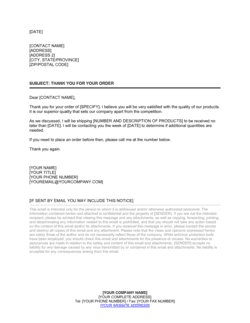
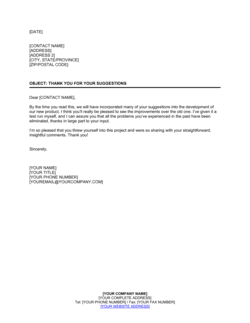
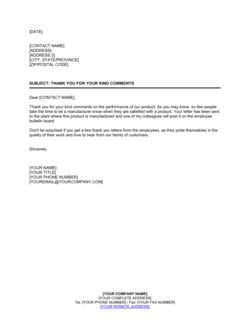
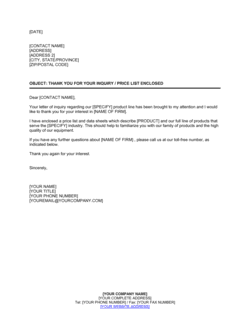
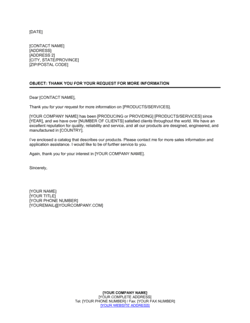
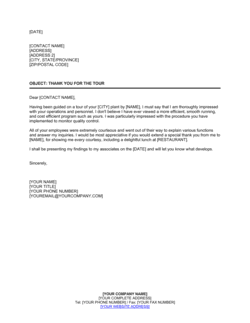
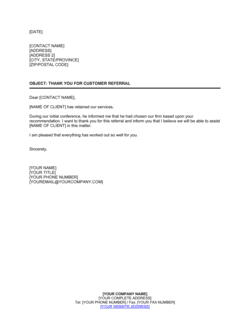
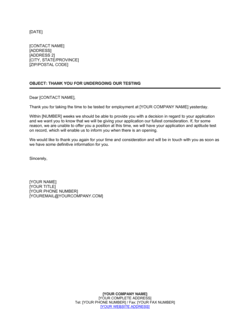
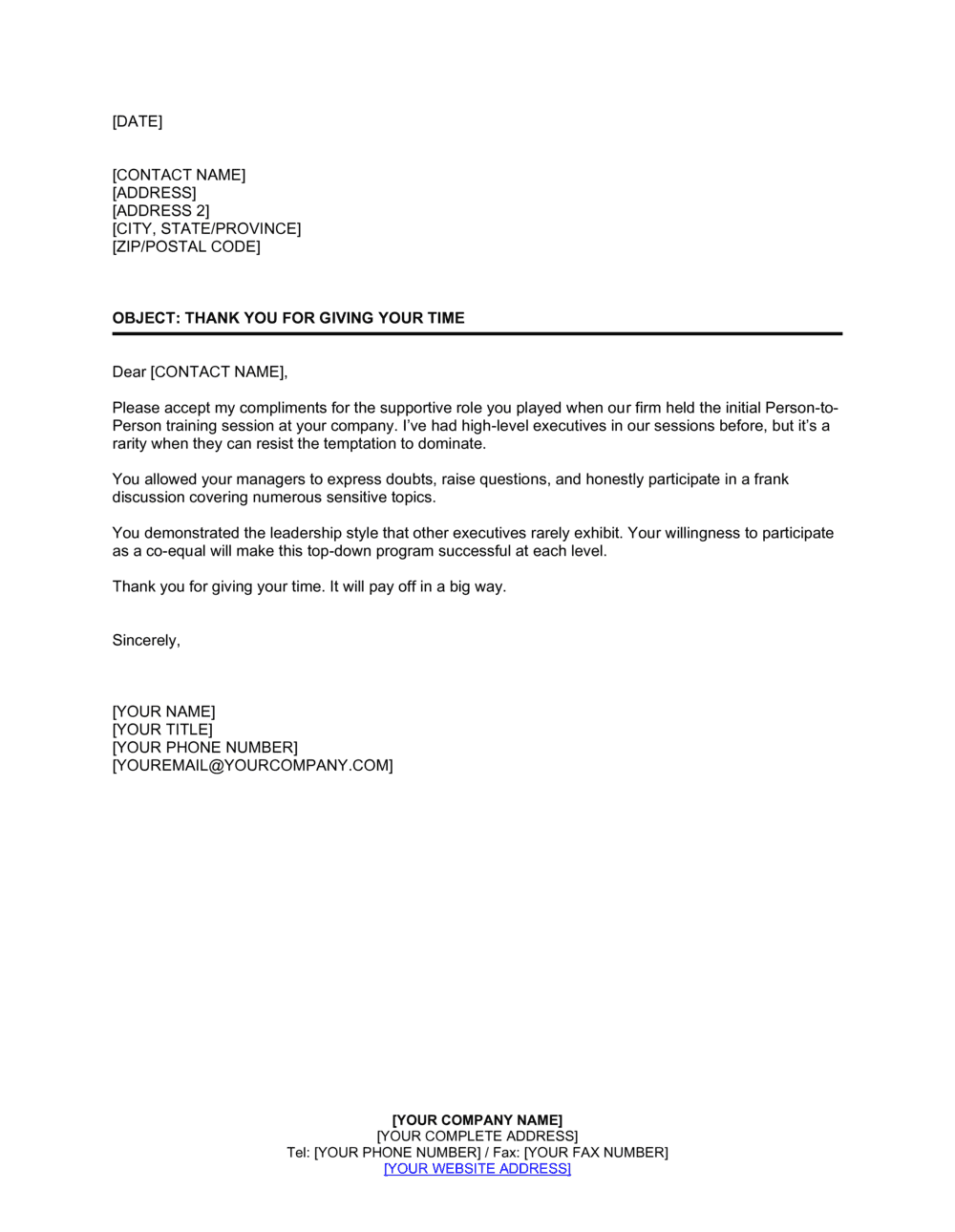
Thank You for Giving Your Time Template

Free Word download • Edit online • Save & share with Drive • Export to PDF

1 page20–30 min to fillDifficulty: StandardSignature requiredLegal review recommended
Learn more ↓
FreeThank You for Giving Your Time Template

At a glance

What it is
A Thank You For Giving Your Time letter is a formal acknowledgment document issued by an organization to a volunteer, advisor, or pro bono contributor to confirm the nature and duration of their unpaid service. Beyond expressing gratitude, this template incorporates binding clauses covering confidentiality, liability release, and intellectual property assignment — making it a legally significant document as well as a goodwill gesture. This free Word download can be edited online and exported as PDF for signature and filing.
When you need it
Use it when wrapping up a volunteer engagement, advisory session, pro bono project, or any situation where an individual gave time without compensation and you need to formally close the relationship, record the contribution, and protect the organization from future claims. It is equally appropriate after a one-day community event and a multi-month advisory commitment.
What's inside
Recipient and organization details, description and dates of the time contributed, formal expression of gratitude, confidentiality obligations, liability and claims release, intellectual property assignment for any work product created, and governing law with signature blocks for both parties.

What is a Thank You For Giving Your Time Letter?

A Thank You For Giving Your Time letter is a formal closing document issued by an organization to a volunteer, advisor, or pro bono contributor at the conclusion of their unpaid engagement. While its surface purpose is to express sincere gratitude for the individual's contribution, its legal function is equally important: when signed by both parties, it operates as a binding agreement incorporating confidentiality obligations, a mutual release of claims, an intellectual property assignment covering any work product created, and an explicit disclaimer of any employment or contractor relationship. This free Word download can be edited online and exported as a signed PDF, giving organizations a professional, legally protective record of every volunteer engagement they close.

Why You Need This Document

Without a formal closing letter, organizations that rely on volunteers, advisors, or pro bono contributors carry ongoing legal exposure long after the engagement ends. A departing volunteer who created reports, designs, or code retains copyright in that work by default — without a written IP assignment, the organization may not legally own the deliverables produced on its behalf. A volunteer who encountered confidential strategic or donor information has no binding obligation to keep it private without a signed confidentiality clause. And without an explicit release, a dissatisfied volunteer may bring claims against the organization for incidents that occurred during the engagement. This template closes all three gaps in a single document that takes 20 minutes to complete — protecting the organization, respecting the volunteer, and creating a clear, dated record that both parties accepted the terms under which the engagement concluded.

Which variant fits your situation?

If your situation is…Use this template
Acknowledging a single-day event volunteerThank You For Giving Your Time (Event Volunteer)
Closing a multi-month advisory or mentoring relationshipThank You For Giving Your Time (Advisor Acknowledgment)
Documenting pro bono professional servicesPro Bono Services Agreement
Onboarding a volunteer before engagement beginsVolunteer Agreement
Recognizing an employee's volunteer contributionEmployee Recognition Letter
Issuing a tax-receipted in-kind donation acknowledgmentDonation Acknowledgment Letter
Formally ending an advisory board relationshipAdvisory Board Member Resignation Acceptance Letter

Common mistakes to avoid

❌ Treating the document as purely ceremonial

Why it matters: Organizations that omit or skim the legal clauses lose the liability release and IP protections that justify issuing a formal letter in the first place. A thank-you email has the same goodwill value without any legal effect.

Fix: Ensure all binding clauses — confidentiality, release, IP assignment, and no-employment disclaimer — are present and signed by both parties before filing.

❌ Omitting the IP assignment for volunteers who produced deliverables

Why it matters: Without an explicit written assignment, the volunteer retains copyright in any reports, designs, code, or other original work they created — regardless of who directed the project or paid for resources.

Fix: Include the IP assignment clause and tailor it to describe the specific types of work product created during the engagement. Have the volunteer sign before the document is filed.

❌ Using a one-sided liability release

Why it matters: A release that runs only in favor of the organization may be challenged for lack of mutual consideration — particularly in jurisdictions that require both parties to give something of value for a contract to be binding.

Fix: Draft the release as mutual: the volunteer releases the organization, and the organization releases the volunteer for good-faith acts within the agreed scope.

❌ Issuing the letter weeks or months after the engagement ended

Why it matters: Late-issued documents face enforceability challenges on the grounds of lack of fresh consideration — the volunteer has already given their time and received nothing new at the time of signing.

Fix: Issue and execute the letter within 5 business days of the engagement's end. If a delay is unavoidable, provide a documented additional benefit — a formal reference letter, a testimonial, or a LinkedIn endorsement — as fresh consideration.

❌ Failing to include a no-employment disclaimer

Why it matters: Regulators in the US, Canada, and the UK have reclassified unpaid volunteers as employees based on the nature and regularity of their work, triggering back-pay, benefit, and tax withholding liability for the organization.

Fix: Include an explicit clause confirming that the volunteer is neither an employee nor a contractor, and ensure the engagement itself was genuinely voluntary and non-displacing of paid staff roles.

❌ Signing only on behalf of the organization without the volunteer's signature

Why it matters: A unilateral document signed only by the issuing organization is not a binding agreement — it is a letter. The release of claims and IP assignment require the volunteer's agreement to be enforceable.

Fix: Always obtain the volunteer's dated signature alongside the organizational representative's signature before treating the document as executed.

The 10 key clauses, explained

Parties and Engagement Description

In plain language: Identifies the organization and the volunteer by full legal name, and describes the nature, scope, and dates of the time contributed.

Sample language
This letter is issued by [ORGANIZATION LEGAL NAME] ('Organization') to [VOLUNTEER FULL NAME] ('Volunteer') in acknowledgment of Volunteer's contribution of time and services in the capacity of [ROLE/DESCRIPTION] from [START DATE] to [END DATE].

Common mistake: Using a department name or trade name instead of the organization's registered legal entity. If the entity name on this document does not match corporate registration records, the release and IP assignment clauses may be unenforceable.

Formal Expression of Gratitude

In plain language: States the organization's sincere appreciation for the volunteer's contribution, referencing specific activities or outcomes where possible.

Sample language
The Organization sincerely thanks Volunteer for [SPECIFIC CONTRIBUTION, e.g., 'facilitating three strategic planning workshops and contributing approximately [X] hours of advisory support'], which directly contributed to [OUTCOME OR PROJECT NAME].

Common mistake: Keeping the gratitude language so generic — 'thank you for your help' — that it provides no evidentiary record of what was actually contributed, undermining the document's value in any future dispute about scope.

Confidentiality Obligations

In plain language: Binds the volunteer to keep confidential any non-public information encountered during the engagement, including strategic plans, financial data, personnel information, and client details.

Sample language
Volunteer agrees not to disclose, publish, or use for any purpose other than the Engagement any Confidential Information of the Organization. 'Confidential Information' means any non-public information relating to the Organization's operations, finances, personnel, donors, clients, or strategic plans, whether disclosed orally or in writing.

Common mistake: Failing to define 'Confidential Information' specifically. Courts apply a reasonableness standard — an overbroad or absent definition can render the entire confidentiality clause unenforceable.

Intellectual Property Assignment

In plain language: Transfers to the organization ownership of all work product, materials, reports, designs, or other deliverables the volunteer created during the engagement.

Sample language
Volunteer hereby irrevocably assigns to the Organization all right, title, and interest in and to any work product, materials, reports, designs, or other deliverables created by Volunteer in connection with the Engagement ('Work Product'), including all intellectual property rights therein.

Common mistake: Omitting the IP assignment entirely on the assumption that unpaid work automatically belongs to the organization. Without an explicit assignment, the creator retains copyright by default in most jurisdictions.

Liability Release

In plain language: The volunteer releases the organization from liability for any claims arising from the engagement, and the organization releases the volunteer from liability for good-faith actions taken within the scope of their role.

Sample language
Volunteer hereby releases and discharges the Organization, its officers, directors, employees, and agents from any and all claims, demands, or causes of action arising out of or relating to the Engagement. The Organization similarly releases Volunteer from claims arising from good-faith actions taken within the agreed scope of the Engagement.

Common mistake: Including only a one-sided release that runs solely in favor of the organization. A mutual release is more likely to be upheld as supported by valid consideration and is fairer to both parties.

No Employment or Contractor Relationship

In plain language: Clarifies that the volunteer is neither an employee nor an independent contractor of the organization, and that no entitlement to wages, benefits, or fees arises from the engagement.

Sample language
Nothing in this letter creates an employment relationship, independent contractor relationship, partnership, or joint venture between Volunteer and the Organization. Volunteer is not entitled to any wages, salary, benefits, or fees in connection with the Engagement.

Common mistake: Omitting this clause when the volunteer performed work that closely resembles paid employment. Labor authorities in several jurisdictions have reclassified unpaid 'volunteers' as employees based on the nature of the work performed, triggering back-pay liability.

Indemnification

In plain language: Each party agrees to indemnify the other against losses resulting from their own acts of negligence, fraud, or willful misconduct in connection with the engagement.

Sample language
Each party agrees to indemnify, defend, and hold harmless the other party from any losses, damages, or costs (including reasonable legal fees) arising from that party's own negligence, fraud, or willful misconduct in connection with the Engagement.

Common mistake: Writing a broad, one-sided indemnity that requires the volunteer to cover all organization losses regardless of fault. Courts in most jurisdictions will not enforce an indemnity that operates as a penalty against a non-compensated volunteer.

Entire Agreement and Amendments

In plain language: States that this letter is the complete agreement between the parties on the subject matter and can only be amended in writing signed by both parties.

Sample language
This letter constitutes the entire agreement between the parties with respect to the Engagement and supersedes all prior oral or written representations, agreements, and understandings. Any amendment must be in writing and signed by both parties.

Common mistake: Not including this clause, leaving the door open for prior emails, verbal promises, or informal communications to be introduced as additional contractual terms in a dispute.

Governing Law and Dispute Resolution

In plain language: Specifies the jurisdiction whose law governs the document and how any disputes will be resolved — mediation, arbitration, or court.

Sample language
This letter is governed by the laws of [STATE / PROVINCE / COUNTRY]. Any dispute arising from or relating to this letter shall be resolved by [binding arbitration / mediation followed by litigation] in [CITY], except that either party may seek injunctive relief in any court of competent jurisdiction.

Common mistake: Choosing a governing law jurisdiction with no meaningful connection to where the volunteer actually performed their work. Some jurisdictions will apply local law regardless of the contractual choice, especially in employment-adjacent situations.

Signature Block

In plain language: Provides signature lines for both the authorized organizational representative and the volunteer, along with printed names, titles, and dates of execution.

Sample language
By signing below, both parties confirm they have read, understood, and agree to the terms of this letter. [ORGANIZATION REPRESENTATIVE NAME], [TITLE], [ORGANIZATION NAME] | Date: [DATE] | [VOLUNTEER FULL NAME] | Date: [DATE]

Common mistake: Having only one party sign. In jurisdictions requiring mutual consideration to enforce a release of claims, a document signed only by the volunteer — with no organizational signature — may be challenged as a unilateral and non-binding instrument.

How to fill it out

  1. 1

    Enter the organization's registered legal name and the volunteer's full name

    Use the exact registered entity name for the organization — not a program name, department name, or doing-business-as brand. Confirm the volunteer's full legal name as it appears on government-issued ID.

    💡 Cross-check the entity name against your corporate registry filing before issuing. Mismatched entity names on release documents create enforceability questions.

  2. 2

    Describe the engagement with specific dates and activities

    Fill in the role, the type of work performed, and the precise start and end dates of the volunteer engagement. The more specific this description, the clearer the scope of the release and IP assignment.

    💡 If the engagement involved multiple distinct activities, list each one briefly — 'facilitated two board workshops, reviewed draft strategic plan, and participated in three advisory calls' is far more useful than 'provided advisory services.'

  3. 3

    Review and customize the confidentiality definition

    Read through the definition of 'Confidential Information' and add any categories specific to your organization — donor databases, patient records, proprietary software, or trade secrets.

    💡 If your organization handles particularly sensitive data (health information, financial account data), consider adding a separate data-handling clause or attaching your standard privacy policy by reference.

  4. 4

    Confirm the IP assignment scope matches the work performed

    If the volunteer created no deliverables — for example, they mentored staff informally — you may narrow or remove the IP assignment clause. If they produced reports, designs, or code, ensure the clause covers all formats and media.

    💡 For software or creative work, add 'including all moral rights to the extent waivable by law' to the IP assignment language to cover jurisdictions that recognize non-waivable moral rights.

  5. 5

    Verify the no-employment clause reflects the actual engagement

    Confirm that the volunteer's role was genuinely voluntary and not structured to avoid paying for work that should be compensated. If there is any ambiguity, consult legal counsel before issuing this document.

    💡 The IRS, CRA, and UK HMRC each have specific tests for distinguishing genuine volunteers from misclassified workers. The key factors are organizational benefit, volunteer discretion, and whether the role displaces paid staff.

  6. 6

    Set the governing law to the jurisdiction where the volunteer worked

    Enter the state, province, or country whose laws will govern the document. For volunteers who worked remotely across multiple jurisdictions, choose the organization's home jurisdiction and note that local statutory rights may also apply.

    💡 In Canada, choose the specific province — not 'Canada' generically — since employment and volunteer protections are provincially legislated.

  7. 7

    Obtain signatures before filing

    Both the authorized organizational representative and the volunteer must sign and date the letter. Use Business in a Box eSign to timestamp execution digitally, or arrange wet signatures and retain original copies for both parties.

    💡 Send the letter while the engagement is still fresh — ideally within 5 business days of the end date. Delays reduce the likelihood of the volunteer signing and weaken the evidentiary record.

Frequently asked questions

What is a Thank You For Giving Your Time letter?

A Thank You For Giving Your Time letter is a formal document issued by an organization to a volunteer, advisor, or pro bono contributor at the conclusion of their unpaid engagement. It acknowledges the contribution with genuine gratitude while incorporating binding legal clauses covering confidentiality, liability release, intellectual property assignment, and a no-employment disclaimer. When properly signed by both parties, it functions as a binding agreement that protects the organization and closes the engagement cleanly.

Does a volunteer thank-you letter need to be signed by both parties?

Yes, if the letter includes legally binding clauses such as a release of claims or an IP assignment. A document signed only by the organization is a unilateral statement, not a binding contract. The volunteer's signature is required for the confidentiality, release, and IP assignment provisions to be enforceable. Always obtain both signatures before filing the document as an executed agreement.

Is an IP assignment clause necessary when thanking a volunteer?

It depends on whether the volunteer created any tangible work product — reports, designs, software, or written materials — during the engagement. If they did, an IP assignment is necessary because copyright vests in the creator by default in most jurisdictions, regardless of who directed or resourced the work. Without an explicit written assignment, the organization may not own the deliverables a volunteer produced on its behalf.

Can this letter serve as documentation for a tax in-kind donation?

In the US, the IRS does not allow deductions for the value of donated time or services — only for out-of-pocket expenses incurred while volunteering. In Canada and the UK, similar rules apply. This letter documents the contribution and expresses organizational gratitude, but it does not function as a formal charitable receipt for tax purposes. For in-kind service deductions in jurisdictions that permit them, consult a tax advisor and issue a separate formal receipt if required.

What makes this document different from a standard thank-you letter?

A standard thank-you letter is a courtesy communication with no legal effect. This template adds binding clauses — confidentiality obligations, a mutual release of claims, IP assignment for any work product created, a no-employment disclaimer, and a governing law provision — that transform it into an enforceable agreement. The formal gratitude language is genuine, but the document's primary legal function is to close the engagement with both parties' rights and obligations clearly documented.

When should I issue this letter — before or after the volunteer engagement?

This letter is issued at the end of the engagement, after the volunteer has completed their contribution. It closes the relationship formally and provides the legal protections described. For longer-term or higher-stakes engagements — such as an advisory relationship involving access to confidential information — a Volunteer Agreement should be signed at the start, with this letter issued as a closing acknowledgment.

Does the no-employment clause fully protect against worker misclassification claims?

A no-employment clause is an important protective measure but is not automatically conclusive. Labor authorities in the US, Canada, and the UK apply substance-over-form tests — meaning they look at how the relationship actually functioned, not just what the document says. Key factors include whether the work displaced paid staff, whether the organization controlled how work was performed, and whether the volunteer received any indirect compensation. The clause reduces risk but does not substitute for structuring the engagement properly from the outset.

Do I need a lawyer to issue a Thank You For Giving Your Time letter?

For routine volunteer engagements — a community event, a one-day workshop, or a short advisory session with no sensitive IP involved — a well-drafted template is generally sufficient. Legal review is worth considering when the volunteer had access to highly sensitive confidential information, created commercially significant IP, or the engagement lasted several months in a capacity closely resembling employment. A 30-minute template review typically costs $150–$300 and is a proportionate precaution for higher-stakes situations.

Can this template be used for corporate employee volunteer programs?

Yes. Corporate social responsibility coordinators use this template when employees volunteer time on behalf of their employer to a partner nonprofit or community organization. In that context, the issuing organization (the nonprofit or recipient) sends the letter to the individual employee volunteer. The no-employment disclaimer should note that the volunteer's primary employment relationship is with their own employer, not with the issuing organization.

How this compares to alternatives

vs Volunteer Agreement

A Volunteer Agreement is signed before the engagement begins and sets out expectations, duties, confidentiality obligations, and IP terms prospectively. This Thank You letter is signed at the end and closes the relationship with a release and formal acknowledgment. For longer or higher-stakes engagements, both documents should be used — the agreement at the start, this letter at the finish.

vs Donation Acknowledgment Letter

A Donation Acknowledgment Letter documents a gift of money or goods and typically serves as a charitable receipt for tax purposes. This template documents a gift of time and service, which is not tax-deductible in most jurisdictions. The Thank You For Giving Your Time letter adds legal clauses — release, IP assignment, confidentiality — that a standard donation receipt does not include.

vs Independent Contractor Agreement

An Independent Contractor Agreement governs a paid engagement where the contributor is compensated for services rendered. This letter governs an unpaid volunteer contribution and explicitly disclaims any employment or contractor relationship. Using an independent contractor agreement for a volunteer engagement would inadvertently create compensation expectations and tax reporting obligations.

vs Employee Recognition Letter

An Employee Recognition Letter acknowledges the achievements of a current employee within an ongoing employment relationship. This letter closes a relationship with an external volunteer who was never employed by the organization. The legal protections in this template — release, IP assignment, no-employment disclaimer — are not present in a standard recognition letter and are not needed for existing employees.

Industry-specific considerations

Nonprofit and Charitable Organizations

High volume of volunteers across programs, events, and governance roles makes a standardized closing letter essential for IP protection, confidentiality, and tax record-keeping.

Professional Services

Law firms, consultancies, and accounting practices issuing this letter to pro bono recipients or departing advisors need the IP assignment and confidentiality clauses to protect client data and proprietary methodologies.

Technology / SaaS

Startups relying on uncompensated advisors and mentors require the IP assignment clause to ensure that code reviews, product feedback, or prototype contributions do not create ambiguous ownership claims.

Healthcare

Volunteers in clinical or administrative settings may encounter protected health information — a tailored confidentiality clause referencing HIPAA or PIPEDA obligations is critical before the engagement closes.

Education

Guest lecturers, mentors, and curriculum advisors who contribute time to educational institutions benefit from a formal acknowledgment that clarifies IP ownership of course materials and releases the institution from liability.

Retail / Hospitality

Event venues and hospitality organizations relying on event-day volunteers need a rapid-issuance closing letter that includes a liability release covering on-site activities and a no-employment disclaimer.

Jurisdictional notes

United States

The IRS does not permit deductions for donated time or services — only for out-of-pocket volunteer expenses. The Fair Labor Standards Act (FLSA) distinguishes genuine volunteers from misclassified workers based on whether the work displaces paid employees and whether the volunteer receives any direct or indirect benefit. Several states, including California, impose additional protections that may apply even to unpaid contributors. The release of claims must be supported by adequate consideration to be enforceable.

Canada

Volunteer protections and worker classification rules are provincially legislated — Ontario, British Columbia, and Quebec each have distinct employment standards that can apply if an unpaid relationship is found to resemble employment. The Canada Revenue Agency does not allow deductions for donated time but does permit deductions for documented out-of-pocket expenses in some circumstances. In Quebec, the document should be available in French for provincially regulated organizations. IP assignment language should reference the Copyright Act (Canada) to be effective.

United Kingdom

The UK distinguishes volunteers from workers and employees under the Employment Rights Act 1996 — a volunteer who receives any payment or benefit beyond genuine out-of-pocket reimbursement may acquire worker rights. HMRC does not allow income tax deductions for donated time. The Equality Act 2010 applies to volunteers in some contexts. The UK Copyright, Designs and Patents Act 1988 vests copyright in the creator, making a written IP assignment essential for any work product produced during the engagement.

European Union

EU member states vary significantly in their treatment of volunteers — France, Germany, and Spain each have national volunteer statutes that define permissible scope and protections. GDPR applies when volunteers handle personal data of EU residents, and a data processing acknowledgment should be included or appended for engagements involving such data. IP assignment effectiveness varies by member state: some (notably Germany and France) recognize non-waivable moral rights that limit the practical scope of an assignment clause.

Template vs lawyer — what fits your deal?

PathBest forCostTime
Use the templateStandard event, program, or advisory volunteers with routine confidentiality and no commercially significant IPFree15–20 minutes per letter
Template + legal reviewVolunteers who created significant IP, had access to sensitive data, or performed work resembling employment over an extended period$150–$400 for a one-hour legal review1–3 business days
Custom draftedHigh-profile advisors with equity-adjacent arrangements, regulated industries (healthcare, finance), or cross-border volunteer engagements$500–$2,0003–7 business days

Glossary

Volunteer Acknowledgment
A formal written confirmation by an organization that an individual contributed time and services without compensation.
Release of Claims
A contractual clause in which one party gives up the right to bring future legal claims against the other arising from the described engagement.
Pro Bono
Services rendered by a professional at no charge, typically as a charitable or community contribution rather than as a gift of physical goods.
IP Assignment
A clause that transfers ownership of any work product, materials, or inventions created during the volunteer engagement to the receiving organization.
Confidentiality Obligation
A binding requirement that the volunteer not disclose non-public information encountered during their engagement to any third party.
In-Kind Contribution
A non-cash donation of goods, services, or time, which may have tax implications for the donor depending on jurisdiction.
Indemnification
A commitment by one party to protect the other from financial loss or legal liability arising from specified acts or omissions.
Consideration
Something of value exchanged between parties to make a contract legally binding — in this context, the formal acknowledgment and reference letter serve as consideration for the volunteer's release.
Entire Agreement Clause
A provision stating that the signed document represents the complete understanding between the parties, superseding any prior verbal or written arrangements.
Governing Law
The jurisdiction whose laws will be used to interpret and enforce the agreement in the event of a dispute.

Part of your Business Operating System

This document is one of 3,000+ business & legal templates included in Business in a Box.

  • Fill-in-the-blanks — ready in minutes
  • 100% customizable Word document
  • Compatible with all office suites
  • Export to PDF and share electronically

Create your document in 3 simple steps.

From template to signed document — all inside one Business Operating System.
1
Download or open template

Access over 3,000+ business and legal templates for any business task, project or initiative.

2
Edit and fill in the blanks with AI

Customize your ready-made business document template and save it in the cloud.

3
Save, Share, Send, Sign

Share your files and folders with your team. Create a space of seamless collaboration.

Save time, save money, and create top-quality documents.

★★★★★

"Fantastic value! I'm not sure how I'd do without it. It's worth its weight in gold and paid back for itself many times."

Managing Director · Mall Farm
Robert Whalley
Managing Director, Mall Farm Proprietary Limited
★★★★★

"I have been using Business in a Box for years. It has been the most useful source of templates I have encountered. I recommend it to anyone."

Business Owner · 4+ years
Dr Michael John Freestone
Business Owner
★★★★★

"It has been a life saver so many times I have lost count. Business in a Box has saved me so much time and as you know, time is money."

Owner · Upstate Web
David G. Moore Jr.
Owner, Upstate Web

Run your business with a system — not scattered tools

Stop downloading documents. Start operating with clarity. Business in a Box gives you the Business Operating System used by over 250,000 companies worldwide to structure, run, and grow their business.

Start free · No credit card required