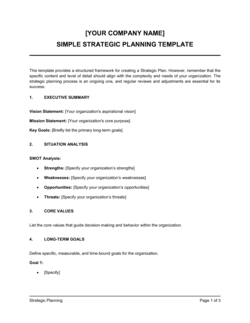
Elevator Pitch Template

Free to read β€’ Save or share with one click

FreeElevator Pitch Template

At a glance

What it is
An Elevator Pitch Template is a structured one-page script that distills your business, product, or personal value proposition into a compelling 60-to-90-second verbal presentation. This free Word download gives you a proven framework covering the problem, solution, market, traction, ask, and call to action β€” ready to edit online and export as PDF for practice or handout use.
When you need it
Use it before investor meetings, networking events, pitch competitions, sales calls, or job interviews where you have under two minutes to make an impression and secure a follow-up. It is equally useful when preparing a team to represent the company consistently across conferences and demos.
What's inside
Hook statement, problem definition, solution summary, target market and size, unique value proposition, traction evidence, team credibility line, funding ask or call to action, and a memorable closing statement. Each section includes guidance text and fill-in placeholders you replace with your own details.

What is an Elevator Pitch?

An Elevator Pitch is a structured, 60-to-90-second verbal presentation that distills your business, product, or personal value proposition into a compelling narrative a listener can understand, remember, and act on. It covers the core elements of any persuasive business case β€” the problem, the solution, who it is for, why it is better than alternatives, what proof exists that it works, and what you want the listener to do next β€” in the time it takes to ride an elevator. Unlike a business plan or pitch deck, it requires no slides, no handouts, and no pre-arranged meeting: it is designed to work in hallways, at conferences, on cold calls, and in introductions.

Why You Need This Document

Without a prepared, structured elevator pitch, high-value encounters β€” a chance meeting with an investor at a conference, a cold introduction at a networking event, or an unexpected opening on a sales call β€” produce vague conversations that trail off without a next step. The cost is concrete: founders who cannot articulate their value proposition in under two minutes are consistently passed over for follow-up meetings in favor of those who can. A written template forces the discipline of identifying the single most important problem, the single strongest proof point, and the single most compelling differentiator β€” before you need them under pressure. This template gives you a proven structure to draft, stress-test, and rehearse your pitch so that every conversation has a clear outcome.

Which variant fits your situation?

If your situation is…Use this template
Pitching to early-stage or seed investors at a demo dayInvestor Elevator Pitch
Opening a B2B sales call or trade-show conversationSales Elevator Pitch
Introducing yourself at a professional networking eventPersonal Elevator Pitch
Presenting a 10-to-15-slide fundraising story to investorsPitch Deck
Applying for a bank loan or SBA financing requiring a written planBusiness Plan
Competing in a 3-to-5 minute structured pitch competitionStartup Pitch Script
Preparing a written one-page company summary for investor outreachOne-Page Business Plan

Common mistakes to avoid

❌ Opening with the company name and founding story

Why it matters: Listeners have no context for why the company exists yet, so the name and history land without meaning. Attention drops in the first ten seconds and is rarely recovered.

Fix: Open with the problem or a hook statistic. Introduce the company name only after the listener understands what pain it solves.

❌ Pitching features instead of outcomes

Why it matters: A list of product capabilities means nothing to a listener who has not yet been convinced the problem is worth solving. Feature-heavy pitches consistently fail to generate follow-up meetings.

Fix: Replace every feature mention with the customer result it produces. 'Automated reconciliation' becomes 'accountants close the month in one day instead of five.'

❌ Using a vague or unmeasured call to action

Why it matters: Ending with 'let me know if you want to chat' puts the entire burden of next steps on the listener. Without a specific ask, most conversations end politely and go nowhere.

Fix: Close with a specific, time-bound request: 'Can I send you our one-pager and schedule 20 minutes this week?' A direct ask doubles follow-through rates.

❌ Citing only vanity metrics as traction

Why it matters: Downloads, page views, and social followers do not signal commercial demand. Experienced investors and buyers discount them immediately, and the pitch loses credibility at the most critical moment.

Fix: Lead with revenue, paying customers, or signed contracts. If you are pre-revenue, cite the number of pilots, the pilot conversion rate, and any quantified willingness-to-pay data from customer interviews.

❌ Trying to cover every audience with one pitch version

Why it matters: An investor cares about market size and returns; a prospective customer cares about their specific pain and your proof it works. A pitch that tries to serve both audiences dilutes the message for each.

Fix: Maintain separate pitch versions for investors, customers, and partners. The core problem and solution remain constant; the framing, traction metrics, and call to action differ for each audience.

❌ Delivering the pitch without practicing the follow-up questions

Why it matters: A polished 90-second delivery followed by a stumbling answer to 'how do you make money?' destroys the credibility built in the pitch. Listeners judge founders on the Q&A as much as the script.

Fix: Prepare and rehearse two-sentence answers to the five most common follow-up questions before every pitch event. Write them on the back of your pitch outline and review them before each use.

The 10 key clauses, explained

Hook / Opening Statement

In plain language: The first sentence β€” delivered in under 10 seconds β€” that earns the listener's attention by framing an urgent problem, citing a striking number, or posing a question they cannot immediately answer.

Sample language
Did you know that [X]% of [TARGET CUSTOMER] lose an average of $[AMOUNT] every year because of [PROBLEM]? We built [COMPANY NAME] to fix that.

Common mistake: Opening with the company name and founding year. Listeners disengage before the problem is established, and the pitch loses its hook entirely.

Problem Statement

In plain language: A two-to-three sentence description of the specific, painful problem your target customer faces, quantified wherever possible.

Sample language
[TARGET CUSTOMER] currently spends [X hours / $X] per [week / month] on [PROBLEM]. Existing solutions like [ALTERNATIVE] fail because [SPECIFIC REASON], leaving a [CONSEQUENCE] that costs the industry $[X]B annually.

Common mistake: Describing a problem too broadly β€” 'businesses waste time on admin' β€” rather than a precise, quantified pain that signals the founder actually understands the customer.

Solution Summary

In plain language: One to two sentences on what your product or service does and how it directly resolves the problem just described β€” no jargon, no feature lists.

Sample language
[COMPANY NAME] is a [CATEGORY] that enables [TARGET CUSTOMER] to [OUTCOME] in [TIMEFRAME], without [PAIN OF ALTERNATIVES].

Common mistake: Describing features instead of outcomes. Saying 'we use AI and machine learning' signals nothing; 'we cut invoice processing time from 3 days to 4 hours' is what listeners remember.

Target Market and Size

In plain language: A credible, evidence-based statement of who the customer is and how large the opportunity is β€” using TAM and a realistic near-term SAM.

Sample language
We target [CUSTOMER SEGMENT] β€” a market worth $[TAM]B globally. Our initial focus is [GEOGRAPHY / VERTICAL], representing approximately $[SAM]M in reachable opportunity.

Common mistake: Claiming 1% of a $10B market as the primary market-size argument. Investors recognize this as a sign the founder has not done bottom-up sizing and it erodes credibility immediately.

Unique Value Proposition

In plain language: The single most important reason a customer should choose you over every alternative β€” stated as a specific, measurable advantage, not a generic claim.

Sample language
Unlike [COMPETITOR / STATUS QUO], [COMPANY NAME] [SPECIFIC DIFFERENTIATOR] β€” resulting in [QUANTIFIED OUTCOME] for our customers.

Common mistake: Saying 'we are faster, cheaper, and better.' Claiming superiority on every dimension signals no real differentiation. Choose the one dimension that matters most to the buyer.

Traction and Validation

In plain language: Quantified proof that real customers want the product β€” revenue figures, customer count, growth rate, pilot results, letters of intent, or key partnerships.

Sample language
Since launching [DATE / X months ago], we have [X paying customers / $X ARR / X% MoM growth]. Notable customers include [NAME] and [NAME]. We have [X] signed LOIs representing $[X] in pipeline.

Common mistake: Listing vanity metrics β€” app downloads, social followers, or website visits β€” without revenue or engagement data. Sophisticated listeners discount these immediately.

Team Credibility

In plain language: One to two sentences establishing why this specific team is uniquely positioned to solve this problem β€” domain expertise, prior exits, or relevant operational experience.

Sample language
[FOUNDER NAME] previously [RELEVANT ACHIEVEMENT] at [COMPANY], where [QUANTIFIED RESULT]. [CO-FOUNDER NAME] built and scaled [RELEVANT EXPERIENCE].

Common mistake: Reciting academic credentials and job titles without linking them to the specific problem being solved. Investors back people who have evidence of executing in the relevant domain.

Funding Ask and Use of Funds

In plain language: The specific capital amount sought, the instrument, and the two or three milestones the funding will achieve β€” keeping it to one or two sentences.

Sample language
We are raising $[AMOUNT] on a [SAFE / convertible note / equity round] to [MILESTONE 1] and [MILESTONE 2] within [TIMEFRAME], putting us on a path to [OUTCOME].

Common mistake: Omitting the ask entirely out of reluctance to 'seem too forward.' Investors who hear a pitch without a clear ask leave without knowing what to do next, and follow-up rates drop sharply.

Call to Action

In plain language: The explicit, single next step you want the listener to take β€” a 30-minute meeting, an introduction to a partner, a pilot agreement, or a follow-up call within a stated timeframe.

Sample language
I would love 30 minutes this week to walk you through our deck and pilot data. Are you available [DAY] or [DAY]?

Common mistake: Ending with 'let me know if you're interested.' Passive closes put the burden on the listener and result in far lower conversion than a specific, time-bound request.

Closing / Memorable Statement

In plain language: A single sentence that reinforces the core value proposition and makes the pitch memorable β€” often echoing the hook or using a vivid analogy.

Sample language
[COMPANY NAME] is turning [PAINFUL PROCESS] into [SIMPLE OUTCOME] β€” and we are just getting started.

Common mistake: Repeating the solution summary verbatim as the close. The closing should create emotional resonance, not restate information already delivered.

How to fill it out

  1. 1

    Define your single target listener before writing a word

    Decide who this version of the pitch is for β€” seed investor, enterprise buyer, or potential partner. A pitch optimized for all audiences serves none of them. Write the listener's role at the top of the template as a constant reminder.

    πŸ’‘ If you need pitches for three different audiences, fill out three separate copies of the template. The problem framing, traction metrics, and call to action will differ significantly for each.

  2. 2

    Write the problem statement with a specific number

    Identify the single most painful, quantifiable consequence of the problem your customer faces. Use a dollar amount, time lost, or error rate β€” not a vague description. Cite your source in the template notes even if you do not say it aloud.

    πŸ’‘ If you cannot find a published statistic, a direct quote from a customer interview citing a specific cost or time loss carries more credibility than an industry report estimate.

  3. 3

    State the solution as an outcome, not a feature

    Fill in the solution field by completing this sentence: '[Customer] can now [do X] in [timeframe], instead of [old way].' If you find yourself listing capabilities or technologies, delete them and rewrite from the customer's perspective.

    πŸ’‘ Read the solution aloud to someone outside your industry. If they cannot explain it back to you in plain language, simplify further.

  4. 4

    Add traction in descending order of credibility

    List your metrics starting with revenue or paying customers, then growth rate, then pipeline, then letters of intent. If you are pre-revenue, lead with the number and quality of pilot participants and any validated willingness-to-pay data.

    πŸ’‘ One strong metric β€” '$120K ARR, 40% MoM growth' β€” is more effective than six weak ones. Ruthlessly cut anything that does not signal real demand.

  5. 5

    Write the funding ask with a milestone, not just an amount

    State the dollar amount, the instrument, and the two or three specific milestones the capital will fund β€” 'reach 200 paying customers,' 'hire VP Sales,' 'close Series A in 18 months.' Milestones tell the investor what they are buying.

    πŸ’‘ Tie the ask amount directly to your burn rate and runway projection. If asked 'how did you arrive at $750K?', you should be able to answer in 20 seconds.

  6. 6

    Rehearse to 75 seconds, not 60

    Time yourself delivering the pitch naturally β€” not rushed β€” and aim for 70-to-80 seconds. Hitting exactly 60 seconds usually signals a memorized recitation. A conversational delivery with a slight buffer feels more natural and holds attention better.

    πŸ’‘ Record yourself on video at least twice. The first recording reveals filler words and pacing issues invisible in live practice.

  7. 7

    Prepare three answers before any pitch event

    Every elevator pitch generates the same three follow-up questions: 'How do you make money?', 'Who else is doing this?', and 'Why now?' Prepare crisp, two-sentence answers for each and practice them until they feel as natural as the pitch itself.

    πŸ’‘ Write the three answers on the back of a printed copy of the template. Reviewing them immediately before a meeting keeps them top of mind.

Frequently asked questions

What is an elevator pitch?

An elevator pitch is a concise, structured verbal presentation β€” typically 60 to 90 seconds β€” that communicates who you are, what problem you solve, who you solve it for, and what you want the listener to do next. The name comes from the idea that you should be able to deliver it in the time it takes to ride an elevator. It is used by founders pitching investors, sales professionals opening conversations, and job seekers networking at events.

What should an elevator pitch include?

A complete elevator pitch covers ten elements in roughly this order: a hook statement, the problem, your solution, the target market and size, your unique differentiator, traction evidence, a one-line team credibility statement, a funding ask or specific value offer, a call to action, and a memorable closing line. Not every pitch needs all ten β€” a sales pitch may skip the funding ask, and a personal pitch may skip market sizing β€” but the problem, solution, differentiator, and call to action are always required.

How long should an elevator pitch be?

The standard target is 60 to 90 seconds for a spoken pitch, which translates to roughly 150 to 225 words at a natural speaking pace of 130 to 150 words per minute. Investor demo day slots are often 90 seconds to two minutes. Sales cold-call openers should aim for 30 to 45 seconds before asking a question to engage the listener. A written elevator pitch for email or a one-pager can run 100 to 150 words.

What is the difference between an elevator pitch and a pitch deck?

An elevator pitch is a spoken 60-to-90-second verbal summary designed to generate interest and secure a follow-up meeting. A pitch deck is a 10-to-15 slide visual presentation used in that follow-up meeting to walk investors through the full business case. The pitch gets you in the room; the deck closes the conversation. Both should be built from the same core narrative, but the pitch must work without slides, printed materials, or visual aids.

How do I start an elevator pitch?

Start with a hook β€” a specific statistic, a provocative question, or a vivid one-sentence problem statement β€” that gives the listener an immediate reason to keep listening. Avoid opening with your company name, your founding story, or your job title. The fastest way to lose an audience in the first ten seconds is to lead with information they have no context to care about yet.

What traction should I mention in an elevator pitch?

Lead with your strongest commercial signal: annual or monthly recurring revenue, number of paying customers, or month-over-month growth rate. If you are pre-revenue, cite pilot participants, signed letters of intent, or validated willingness-to-pay data from customer interviews. One strong, specific metric β€” '$85K ARR, 35% month-over-month growth' β€” outperforms a list of five weaker ones. Avoid downloads, page views, and social followers unless they directly correlate to revenue.

Do I need a different elevator pitch for investors vs. customers?

Yes. An investor pitch emphasizes market size, traction metrics, the funding ask, and the return thesis. A customer pitch emphasizes the specific pain the customer experiences, the concrete outcome your product delivers, and the proof that it works for customers like them. The core problem and solution stay constant across versions; the framing, metrics highlighted, and call to action should be tailored to each audience.

How do I end an elevator pitch?

End with a specific, time-bound call to action: 'Can I send you our one-pager and schedule 20 minutes this week?' or 'I would love to set up a demo β€” are you available Thursday?' Follow with a memorable closing line that echoes your hook or crystallizes the vision. Never end with a passive statement like 'let me know if you're interested' β€” it transfers all responsibility for next steps to the listener and dramatically reduces follow-through.

How many times should I practice an elevator pitch before using it?

Practice until the delivery feels conversational, not recited. Most coaches recommend a minimum of 20 to 30 full run-throughs before using a pitch at a high-stakes event. Record yourself on video at least twice β€” once early in practice to catch filler words and pacing issues, and once when you believe it is ready, to confirm it sounds natural. Practice the five most common follow-up questions with equal rigor.

How this compares to alternatives

vs Business Plan

A business plan is a 20-to-35-page written document providing full market analysis, competitive positioning, operational detail, and three-to-five year financial projections. An elevator pitch is a 90-second spoken summary designed to generate interest in that fuller document. Use the pitch to open the conversation; use the business plan to close the funding round or loan application.

vs One-Page Business Plan

A one-page business plan is a written single-page document covering strategy, value proposition, customer segments, channels, and financials β€” designed for internal alignment or leaving behind after a meeting. An elevator pitch is a spoken performance optimized for live delivery without props. The one-pager is what you hand over after the pitch lands.

vs Executive Summary

An executive summary is the opening section of a business plan or proposal β€” a written one-to-two page overview that covers problem, solution, market, team, and financials for a reader who has requested the full document. An elevator pitch is a verbal tool for cold and warm introductions where no document has been requested yet. The executive summary supports reading; the pitch supports listening.

vs Sales Proposal

A sales proposal is a detailed written document sent to a specific prospect that outlines the scope of work, pricing, timeline, terms, and expected outcomes for a defined engagement. An elevator pitch is the spoken opening that creates enough interest for a prospect to request a proposal. Sending a proposal without a prior pitch conversation typically results in a lower read rate and slower sales cycles.

Industry-specific considerations

Technology / SaaS

MRR, ARR, and net revenue retention are the traction metrics investors expect; the pitch must translate technical architecture into a plain-language customer outcome.

Professional Services

The pitch focuses on the specific business problem solved and the measurable client result β€” billable hour savings, risk reduction, or revenue generated β€” rather than methodology.

Retail / E-commerce

Average order value, repeat purchase rate, and customer acquisition cost are the credibility metrics; the pitch often leads with a consumer insight or behavior shift.

Healthcare / MedTech

Clinical validation data, regulatory pathway status, and payor reimbursement codes must be referenced to establish credibility with investors and hospital procurement teams.

Food & Beverage

Velocity data (units sold per store per week), distribution footprint, and gross margin after COGS are the metrics that resonate with retail buyers and CPG investors.

Nonprofit / Social Enterprise

The pitch centers on the population served, the cost per beneficiary, and the evidence base for the intervention β€” donors and foundation officers evaluate impact efficiency, not revenue.

Jurisdictional notes

United States

In the US, an elevator pitch is not a legal document and creates no binding obligations. However, any forward-looking financial statements made verbally to prospective investors may implicate SEC securities laws and Regulation D disclosure requirements. Founders should avoid making specific return promises or guarantees during investor pitches and should consult counsel before any fundraising activity involving unaccredited investors.

Canada

In Canada, verbal representations made to prospective investors during a pitch can be considered part of the offering and may be subject to provincial securities regulation under the applicable Securities Act. Ontario, British Columbia, and Quebec each have prospectus exemption requirements for private placements. Founders pitching to non-accredited investors should obtain legal advice before proceeding.

United Kingdom

In the UK, communicating a financial promotion to the public β€” including a fundraising pitch β€” is a regulated activity under the Financial Services and Markets Act 2000 unless an exemption applies. Pitches to sophisticated or high-net-worth investors typically qualify for exemptions, but founders should confirm their investor classification with a solicitor before pitching to avoid FCA enforcement risk.

European Union

Across the EU, the Prospectus Regulation and national implementation of MiFID II govern communications to prospective investors. Verbal pitches to professional investors generally fall within exemptions, but public or retail investor pitches may require a prospectus or equivalent disclosure document. GDPR considerations also apply when collecting contact details at pitch events β€” founders should have a lawful basis for processing attendee data.

Template vs lawyer β€” what fits your deal?

PathBest forCostTime
Use the templateFounders, sales professionals, and job seekers preparing standard investor, customer, or networking pitchesFree2–4 hours to draft; 1–2 days to rehearse
Template + legal reviewFounders preparing for a high-stakes demo day, Series A roadshow, or enterprise sales process$300–$1,500 for a pitch coach or startup advisor session3–5 days including coaching and revision cycles
Custom draftedFounders raising over $1M who need a professionally scripted and coached narrative aligned to a full deck and data room$2,000–$8,000 for a pitch consultant or communications firm2–4 weeks

Glossary

Hook Statement
The opening sentence of a pitch designed to immediately capture attention β€” typically a surprising statistic, a provocative question, or a vivid problem statement.
Value Proposition
A clear, specific statement of the concrete benefit your product or service delivers to a defined customer, and why it is better than the alternatives.
Pain Point
A specific, recurring problem a target customer experiences that is costly, frustrating, or time-consuming enough to motivate them to seek a solution.
TAM (Total Addressable Market)
The total revenue opportunity available if your product reached every potential customer in its defined market, used to signal scale to investors.
Traction
Quantified evidence that the market wants your product β€” including revenue, signed customers, pilots, LOIs, downloads, or user growth metrics.
Call to Action (CTA)
The specific next step you ask your listener to take at the end of the pitch β€” a meeting, an introduction, a demo, or a funding conversation.
Unique Differentiator
The one feature, capability, or structural advantage that makes your solution meaningfully better or different from every alternative a prospect could choose.
Social Proof
Third-party validation of your claims β€” customer logos, press mentions, awards, testimonials, or reference-able pilot results β€” included to build credibility quickly.
Funding Ask
The specific dollar amount you are raising, the instrument (equity, convertible note, or SAFE), and the milestone the capital is intended to achieve.
SAFE (Simple Agreement for Future Equity)
A financing instrument common in early-stage fundraising that converts to equity at a future priced round, often referenced when stating a seed-stage funding ask.
Positioning Statement
A structured sentence format that defines your product's category, target customer, key benefit, and primary competitive alternative in a single compound sentence.

Part of your Business Operating System

This document is one of 3,000+ business & legal templates included in Business in a Box.

  • Fill-in-the-blanks β€” ready in minutes
  • Compatible with all office suites
  • Export to PDF and share electronically

Create your document in 3 simple steps.

From template to signed document β€” all inside one Business Operating System.
1
Download or open template

Access over 3,000+ business and legal templates for any business task, project or initiative.

2
Edit and fill in the blanks with AI

Customize your ready-made business document template and save it in the cloud.

3
Save, Share, Send, Sign

Share your files and folders with your team. Create a space of seamless collaboration.

Save time, save money, and create top-quality documents.

β˜…β˜…β˜…β˜…β˜…

"Fantastic value! I'm not sure how I'd do without it. It's worth its weight in gold and paid back for itself many times."

Managing Director Β· Mall Farm
Robert Whalley
Managing Director, Mall Farm Proprietary Limited
β˜…β˜…β˜…β˜…β˜…

"I have been using Business in a Box for years. It has been the most useful source of templates I have encountered. I recommend it to anyone."

Business Owner Β· 4+ years
Dr Michael John Freestone
Business Owner
β˜…β˜…β˜…β˜…β˜…

"It has been a life saver so many times I have lost count. Business in a Box has saved me so much time and as you know, time is money."

Owner Β· Upstate Web
David G. Moore Jr.
Owner, Upstate Web

Run your business with a system β€” not scattered tools

Stop downloading documents. Start operating with clarity. Business in a Box gives you the Business Operating System used by over 250,000 companies worldwide to structure, run, and grow their business.

Free Forever PlanΒ Β·Β No credit card required